Nabucco at the Lyric opera in Chicago

Lyricopera_logoNabucco

Opera by Giuseppe Verdi

In Italian with projected English titles

January 2016
Saturday 01/23/16 7:30 PM
Wednesday 01/27/16 7:30 PM
Sunday 01/31/16 2:00 PM

February 2016
Wednesday02/03/16 2:00 PM
Saturday 02/06/16 7:30 PM
Tuesday 02/09/16 7:30 PM
Friday 02/12/16 7:30 PM

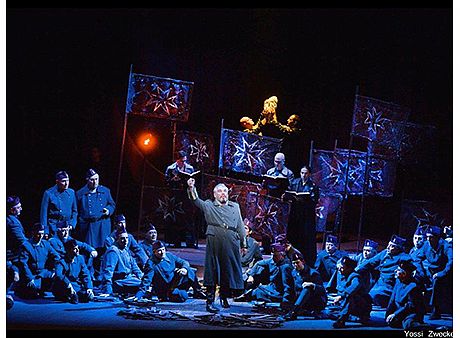
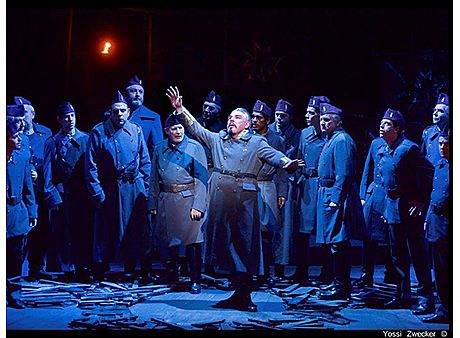
Politics. Religion. A dangerous love triangle. Plus two killer roles and some of the greatest choral music ever written, including the soul-stirring “Va, pensiero” chorus. The ensembles are as thrilling as the arias in the opera that made Verdi a star!

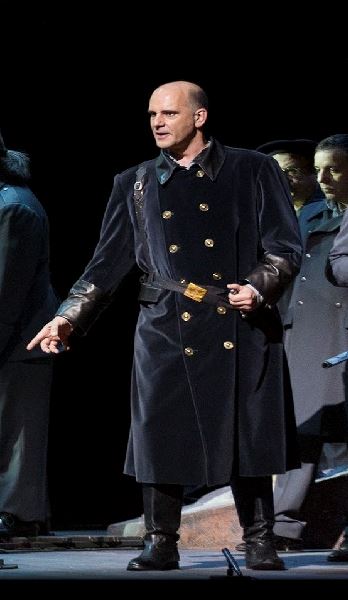
On one side, the fiery Hebrew priest Zaccaria, battling to lead his people from oppression. On the other, Nabucco, the tyrannical Babylonian king and his adopted daughter Abigaille, who will stop at nothing to get her father’s throne and her sister’s lover.

Photo: Cory Weaver (San Diego Opera)

Photo: Cory Weaver (San Diego Opera)

Željko Lučić (Lyric’s riveting Rigoletto in 2013) is Nabucco, a role compared to Shakespeare’s King Lear in its majestic sweep. This is Verdi’s first great role for baritone! Experience Nabucco’s journey from despised despot to self-proclaimed god — and then from paranoid madman to grateful father redeemed by faith.

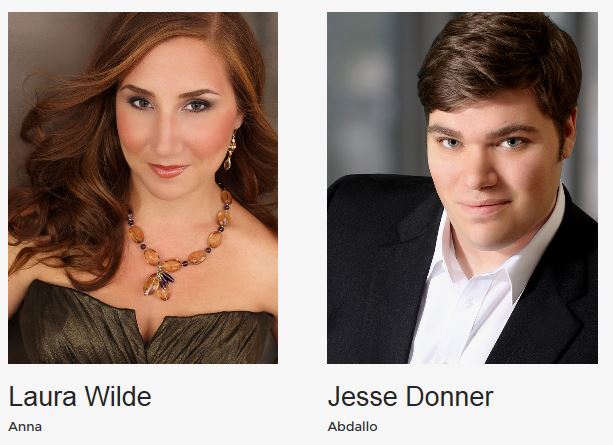
And watch as dramatic-soprano phenom Tatiana Serjan eats up the stage as the warrior princess Abigaille, worthy sister to Lady Macbeth in her lust for power. There’s no leading lady in opera more formidable than Abigaille, who sails up to blockbusting high Cs at the slightest provocation!

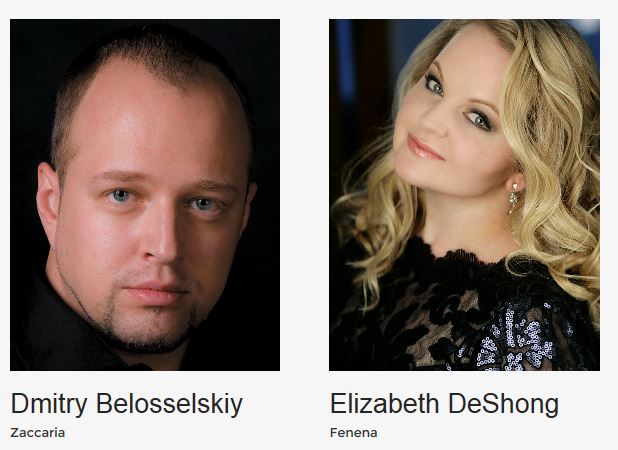
Russian’s mighty Dmitry Belosselskiy is Zaccaria, one of Verdi’s few roles for a truly virtuoso bass. And velvet-voiced Elizabeth DeShong is Nabucco’s gentle daughter Fenena, whose sweet, soulful music is the perfect contrast to the fiery Abigaille!

Performance running time: 2 hours 38 minutes including 1 intermission

Elizabeth Morse Genius Charitable Trust, The Elizabeth Morse Charitable Trust, the Harris Family Foundation, and Katherine A. Abelson and Robert J. Cornell are the generous sponsors of Lyric’s presentation of Verdi’s Nabucco. Lyric Opera production originally made possible by the Gramma Fisher Foundation of Marshalltown, Iowa.

Please note that this production is different from the one originally announced in January 2015.

CAST

nabuccocast1

nabuccocast2nabuccocast3nabuccocast5ARTISTIC TEAM

nabuccocast4nabuccoteam1nabuccoteam2

Posted in OPera | Tagged , , , , | Leave a comment

La Boheme at the Metropolitan Opera

bohememettitle
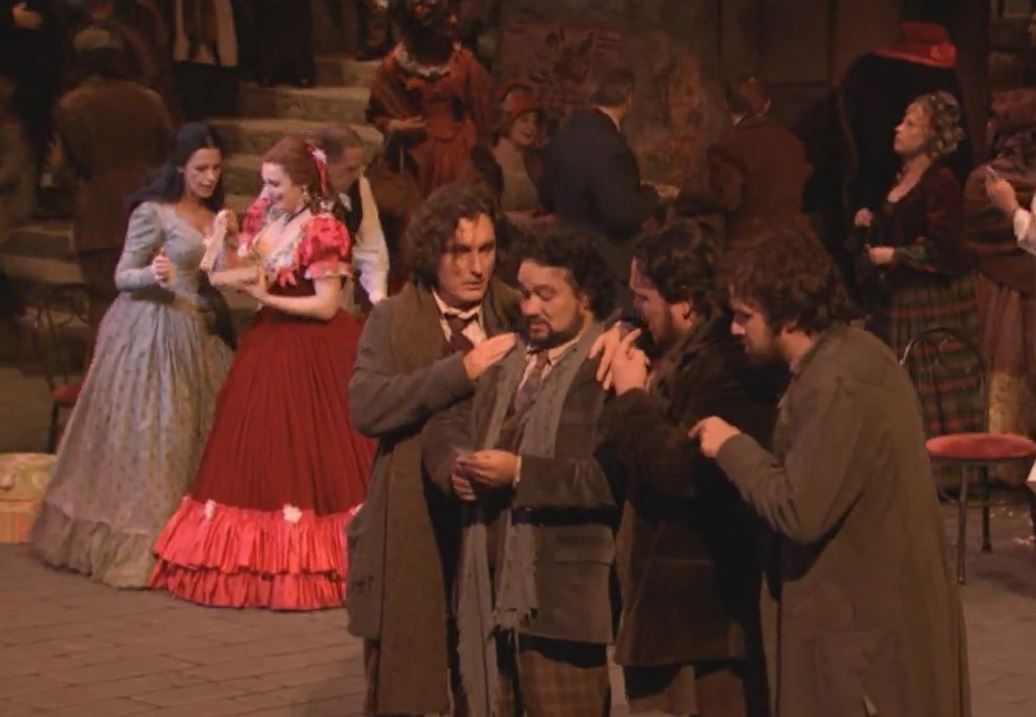
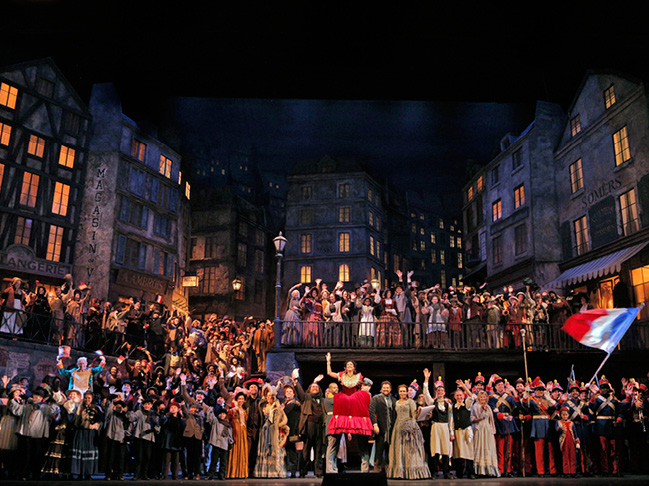
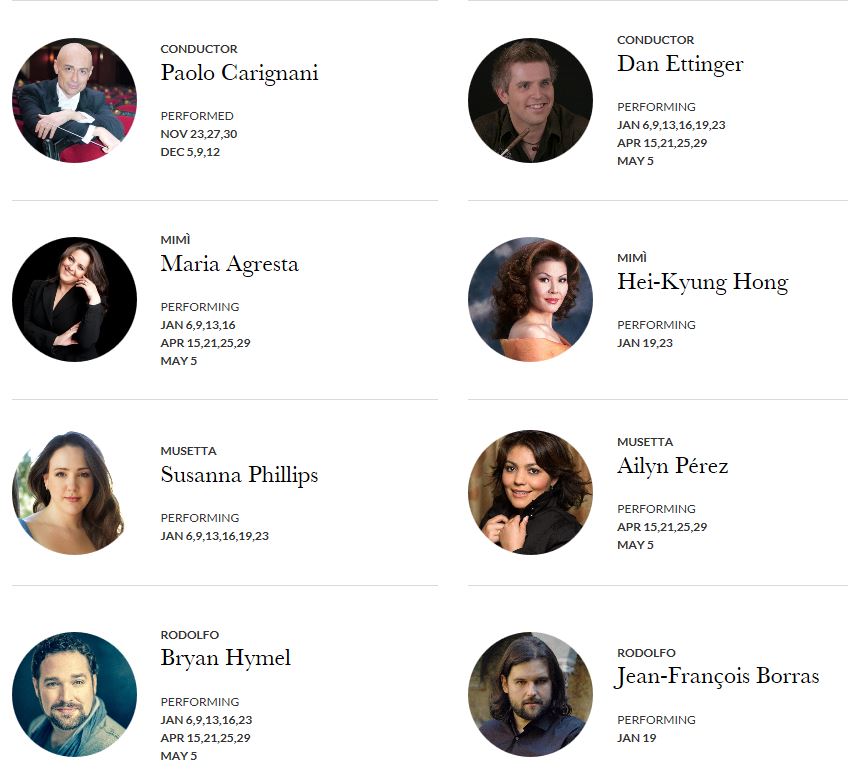
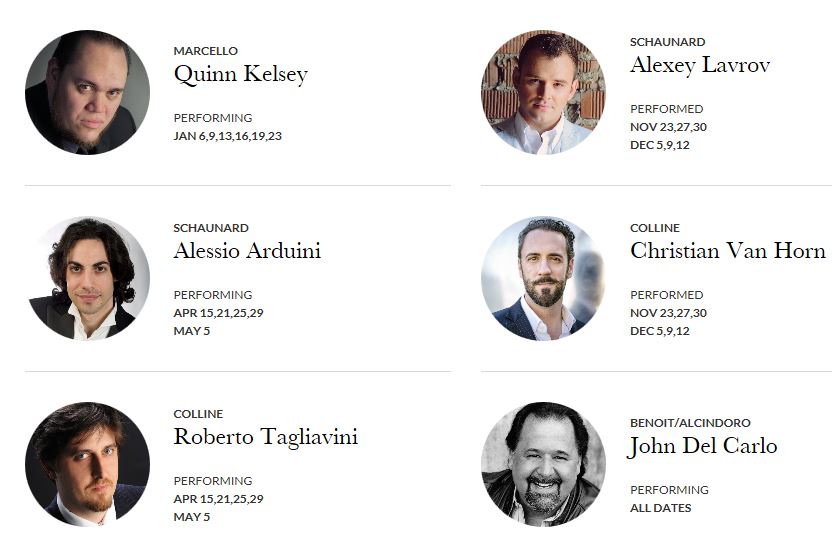
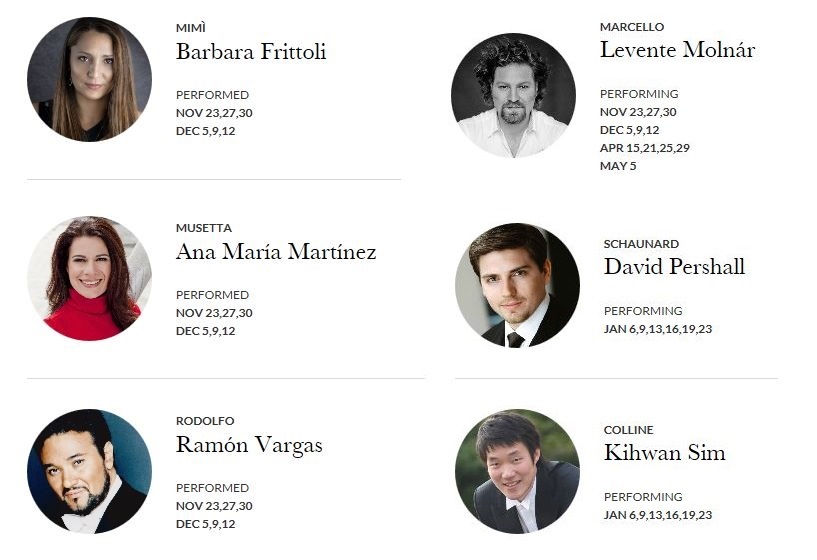
metlogoPuccini’s unforgettable tale of love, youth, and tragic loss returns in Franco Zeffirelli’s classic production, perhaps his most beloved staging of all. Barbara Frittoli, Maria Agresta, Ramón Vargas, and Bryan Hymel are among the artists appearing as the young Parisian lovers in the bohemian setting that brings the Latin Quarter to life on the stage of the Met. Paolo Carignani and Dan Ettinger conduct.

bohememet3

World premiere: Teatro Regio, Turin, 1896. Met company premiere: Los Angeles (on tour), November 9, 1900. La Bohème, the passionate, timeless, and indelible story of love among young artists in Paris, can stake its claim as the world’s most popular opera. It has a marvelous ability to make a powerful first impression and to reveal unsuspected treasures after dozens of hearings. At first glance, La Bohème is the definitive depiction of the joys and sorrows of love and loss; on closer inspection, it reveals the deep emotional significance hidden in the trivial things—a bonnet, an old overcoat, a chance meeting with a neighbor—that make up our everyday lives.

bohememet6

Lyrical and touchingly beautiful, the score of La Bohème exerts an immediate emotional pull. Many of its most memorable melodies are built incrementally, with small intervals between the notes that carry the listener with them on their lyrical path. This is a distinct contrast to the grand leaps and dives that earlier operas often depended on for emotional effect. La Bohème’s melodic structure perfectly captures the “small people” (as Puccini called them) of the drama and the details of everyday life.

 SETTING

bohememet9p

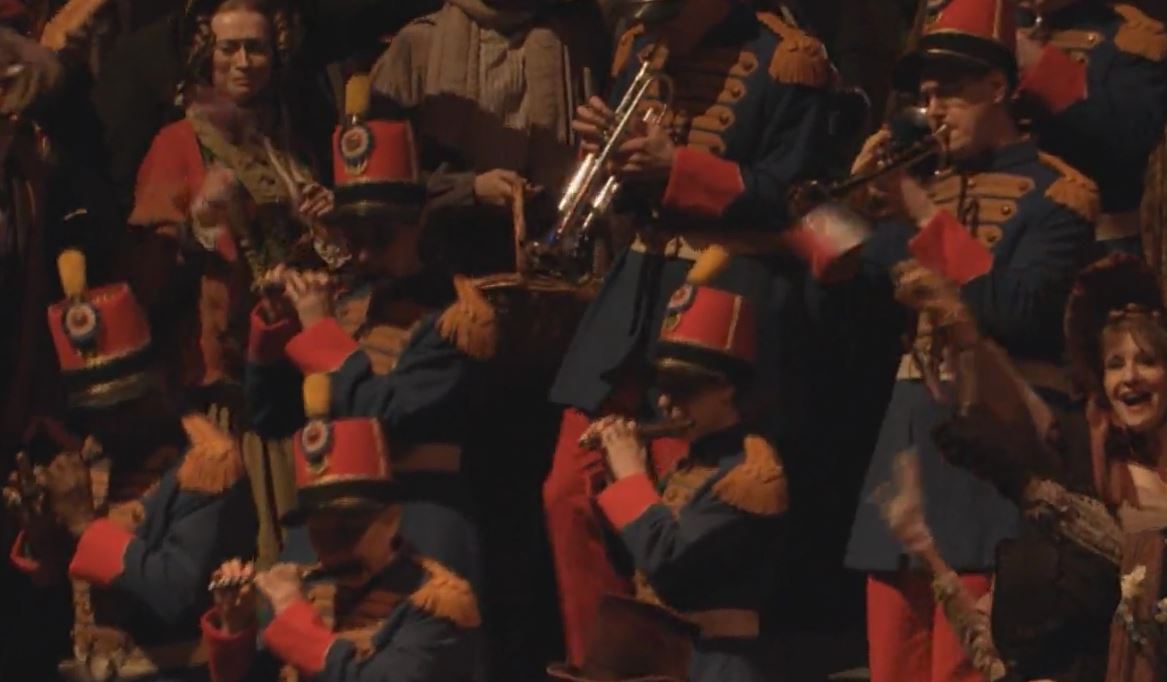
The libretto sets the action in Paris, circa 1830. This is not a random setting, but rather reflects the issues and concerns of a particular time when, following the upheavals of revolution and war, French artists had lost their traditional support base of aristocracy and church. The story centers on self-conscious youth at odds with mainstream society—a Bohemian ambience that is clearly recognizable in any modern urban center. La Bohème captures this ethos in its earliest days.

For a review of the 2014 performance, please click here ****

CASTbohememetcast1 bohememetcast2
bohememetcast3b
GALLERY

Posted in OPera | Leave a comment

Une Éducation Manquée in Washington and New York City!

education_manquee_title

(An Incomplete Education)

OperaLafayette_logoPresented in partnership with the French Institute Alliance Française
Music by Emmanuel Chabrier
Libretto by Eugène Letterier and Albert Vanloo
Opera sung in French with English supertitles

Count Gontran, a young teen, is well-versed in Greek and metaphysics, but he is woefully unprepared for his wedding night. He and his bride turn to relatives and mentors in frantic search of a coup de foudre to spark their romance in this opéra-comique by composer Emmanuel Chabrier.

This charming 19th-century opéra – comique invites the audience back to the carefree days of adolescent love, when life’s greatest challenge was how to ignite a romance. Highlighting the return of Bernard Deletré, director of 2013’s Lalla Roukh (“graceful and witty,” The New York Times), and costumes by Bessie-nominated designer Patricia Forelle, this production features a mesmerizing cast and the addition of rarely performed songs by Chabrier.

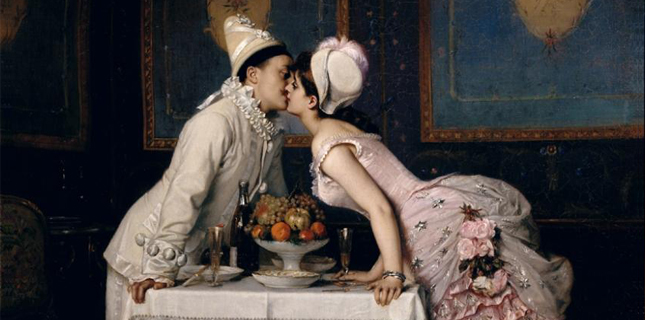
educationmanquee


Music by Emmanuel Chabrier

Libretto by Eugène Letterier and Albert Vanloo
In French with English supertitles

FIAF is delighted to welcome 18th-century French opera specialists Opera Lafayette back to Florence Gould Hall with this charming production featuring period costumes and a superlative cast.


Pre-performance discussion at 6:30pm in Tinker auditorium

CAST
Amel Brahim Djelloul, Gontran
Sophie Junker, Hélène
Dominique Cote, Pausanias
Jeffery Watson, Piano
Bernard Deletré, Director
Patricia Forelle, Costumes

2016-02-05-opera-s

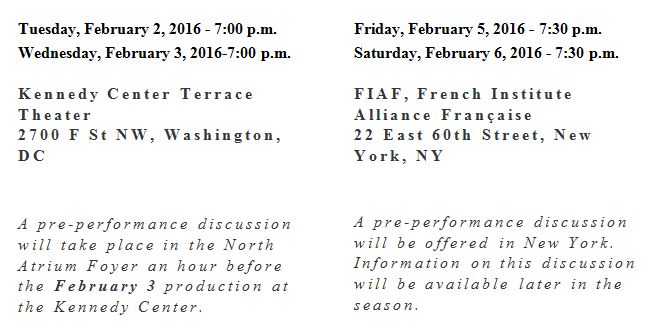
PERFORMANCES IN WASHINGTON AND NEW YORK CITY!!

francaise


Posted in OPera | Leave a comment

Les Pêcheurs de Perles at the Metropolitan opera

peucherstitle

metlogo

peuchers9

January  8, 12, 16, 20, 23, 2016 

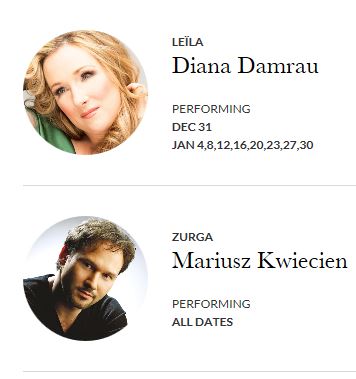
Don’t miss the production the New York Times hails as “the sleeper hit of the Metropolitan Opera season… a dream cast… Sensitive and insightful production… Theatrical magic… Diana Damrau brings brilliant coloratura agility, radiant sound and charisma galore to the role of Leila. Mariusz Kwiecien is an ideal Zurga… Matthew Polenzani sang his haunting aria of remembrance with wonderful lyrical tenderness – if you think it is impossible for a tenor to cap phrases…with melting, pianissimo high notes, report to the Met to hear how this is done superlatively… If only [Bizet] could have seen this production.”

Pearl-Fishers_Interview

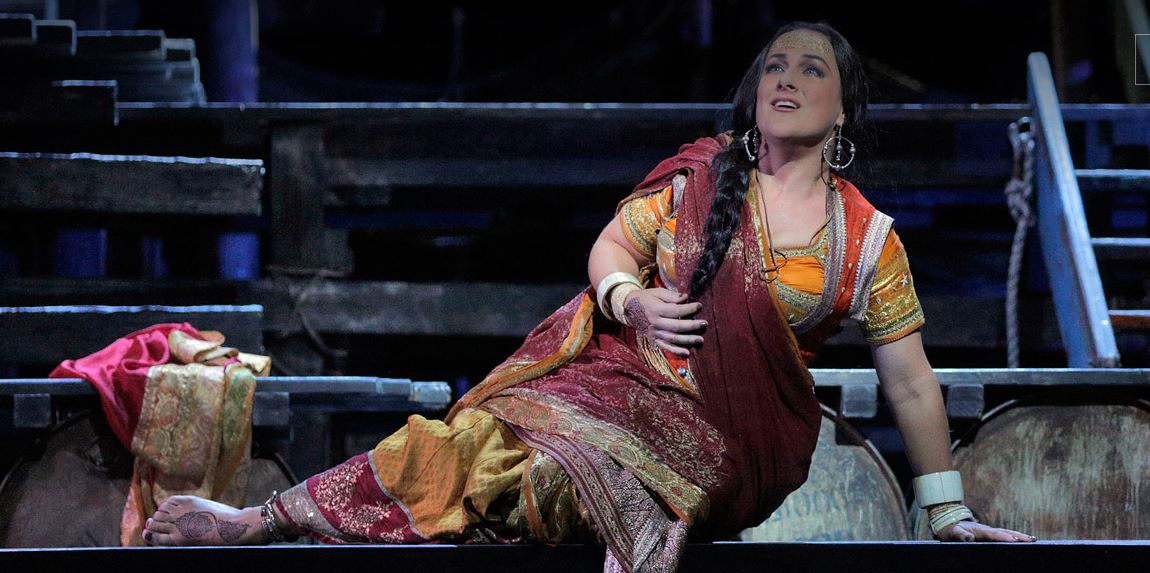
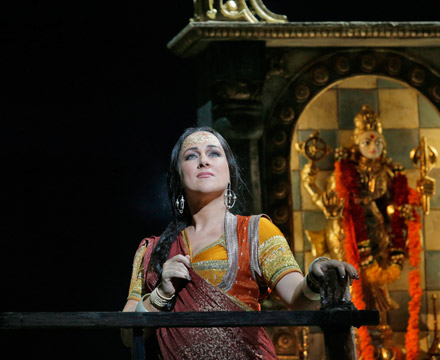
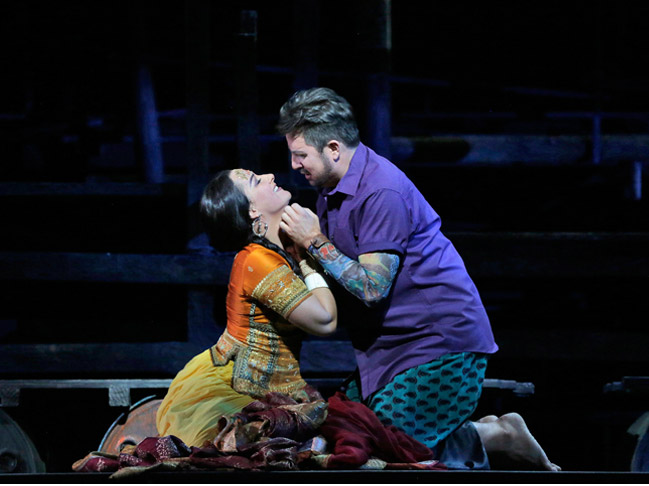
Bizet’s gorgeous opera of lust and longing set in the Far East returns to the Met stage for the first time in 100 years. Soprano Diana Damrau stars as Leïla, the beautiful Hindu priestess pursued by rival pearl divers competing for her hand. Her suitors are tenor Matthew Polenzani and baritone Mariusz Kwiecien, who sing the lilting duet “Au fond du temple saint,” which opera fans know and adore. Director Penny Woolcock explores the timeless themes of pure love, betrayal, and vengeance in a production that vividly creates an undersea world on the stage of the Met. Conductor Gianandrea Noseda brings his romantic flair to the lush score from the composer of Carmen.

Pearl_Fishers_Introduction

Production a gift of the Gramma Fisher Foundation, Marshalltown, Iowa

Additional funding from The Annenberg Foundation; Mr. William R. Miller, in memory of Irene D. Miller; and American Express

Pecheurs_de_Perles_02_10

World premiere: Théâtre Lyrique, Paris, 1863. Few operas can match the sheer lyric beauty of Bizet’s youthful The Pearl Fishers. Critics at the time were not in favor of it but the audience was swept up in the ravishing score tinged with the allure of a mythical South Asian setting. The drama itself remains within the conventional standards of the day, with a love triangle complicated by the true friendship of the two men involved in it. Although not performed frequently, the opera successfully stands on its own when appreciated for its unique atmosphere, rather than compared to the composer’s later masterpiece, Carmen, or held up to modern notions of dramatic plausibility.

CAST

castPeuchers

cast1peuchers

GALLERY

Music

 In addition to its striking lyrical expression, the score is filled with surprising and delightful features throughout. The important role of the chorus is evident from the opening number, with its extraordinarily beautiful middle section for men’s voices. The orchestral writing is equally sophisticated, especially in the subtle touches of instrumentation. But highest honors must go to the remarkable solos and ensembles that have made the opera impossible to forget, chief among them the celebrated duet for the tenor and baritone, “Au fond du temple saint.” Its abundant melody miraculously encompasses a profusion of diverse sentiment, from religious ecstasy to exalted friendship to sadness and loss.

Posted in OPera | Tagged , , | 1 Comment

La Boheme at the Bolshoi in Moscow.

boheme_title

bolshoilogoPremiered on February 20, 1996.

  • 28 January 2016
  • 29 January 2016
  • 30 January 2016
  • 31 January 2016
1boheme_bolshoi

Alexei Dolgov as Rodolfo. Photo by Damir Yusupov.


Sung in Italian with Russian surtitles.
Presented with one interval.
Running time: 2 hours 45 minutes.


Libretto by Giuseppe Giacosa and Luigi Illica
based on Henry Murger’s novel Scenes de la Vie de Boheme

Music Director: Peter Feranec
Stage Director: Federik Mirdita
Designer: Marina Azizyan

CAST

Conductor Pavel Klinichev
Rodolfo, a poet Andrei Dunaev
Marcello, a painter Vasily Ladyuk
Schaunard, a musician Nikolai Kazansky
Colline, a philosopher Pyotr Migunov
Mimi Irina Churilova
Musetta Anna Aglatova
Alcindoro, state councillor Otar Kunchulia
Benoit, a landlord Alexander Naumenko
Parpignol, a toy-seller Marat Gali

2bohemeBolshoi Photos by Damir Yusupov.

SYNOPSIS

Act I
Scene 1
A Garret
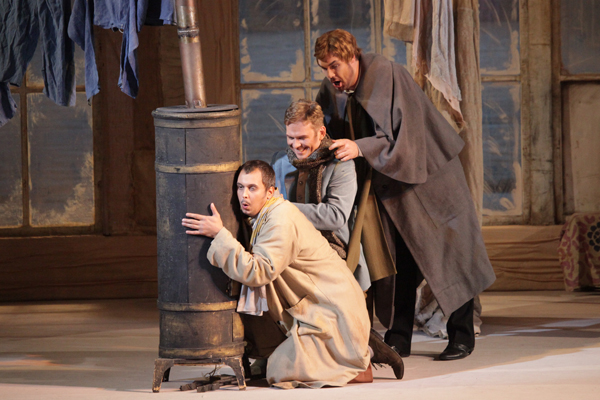
In an unheated garret Marcello, an artist, is working on his canvas “Crossing the Red Sea”. He has difficulty holding his brush because the cold has so cramped his fingers. His friend, the poet Rodolfo, enviously looks at the smoke emerging from the smokestacks of the well-heated Parisian houses. Marcello sadly muses over his flighty and unfaithful girl-friend Musetta. Rodolfo turns down Marcello’s offer to fire the stove with his unfinished “Red Sea” and decides to sacrifice the first act of his drama rather than break up the chair for this purpose.

Another friend, the philosopher Colline, returns with a bundle of books that he wanted to sell, but since this is Christmas eve the stores were closed. His bad mood is dispelled by the warmth of the heated stove.

3bohemebolshoi

The fourth member of the group of friends arrives. The musician Schaunard with the help of errand-boys has brought delicious snacks, wine, cigars, firewood and a bunch of coins. All are so aghast at the sight of such riches that they are not listening to Schaunard’s story about what happened. He became acquainted with a bored Englishman who wanted nothing more of him than that he “play” until death a parrot that was disturbing him. The successful job, which was not completed without a little poison, was generously rewarded. Schaunard hinders the immediate consumption of the food, but allows them to enjoy the wine. Then, in a condescending tone, he invites his friends to partake in Latin Quarter cuisine.

4bohmebolshoi

The joyful mood is disturbed by the arrival of Benoit, the old landlord, who demands the long-overdue rent. They reassure him by showing that they have money and offer him wine. He becomes somewhat tight and boasts of past amorous escapades, whereupon they hit him with his own weapon of Philistine morals: indignantly, they turn the shameful “debauchee” out of the room without paying the rent. Schaunard magnanimously shares his money with his friends and all head for their favorite café. Rodolfo decides to stay for a few minutes to finish an article. The friends will wait for him below.

Mimi, a neighbor, comes to ask that her extinguished candle be lighted. A coughing spell detains her in the room. Rodolfo is captivated by the tender creature. After leaving, Mimi returns in search of her key. The draft extinguishes both candles. Rodolfo and Mimi rummage in the dark in search of the key. Rodolfo finds it and unnoticed hides it. Taking advantage of the situation, he dares to touch Mimi’s hand.

5bohemebolshoi

Rodolfo contemplates: can he build castles in the air when he is merely a hopelessly poor poet? But Mimi’s beautiful eyes immediately give him reason for optimism.

Mimi tells about herself: she is a seamstress. Her simple existence is warmed by the modest happiness of “unrealizable fantasies” and the “poetry” of minutiae. Rodolfo’s friends are still waitingbelow and call to him. He tells them to go on and promises to follow shortly. In the enchanting beams of the moonlight penetrating the attic, Rodolfo and Mimi speak of their love for each other.Then, Mimi remembers their promise, so hand in hand they head for the Latin Quarter.

6bohemebolshoi

Scene 2
In the Latin Quarter

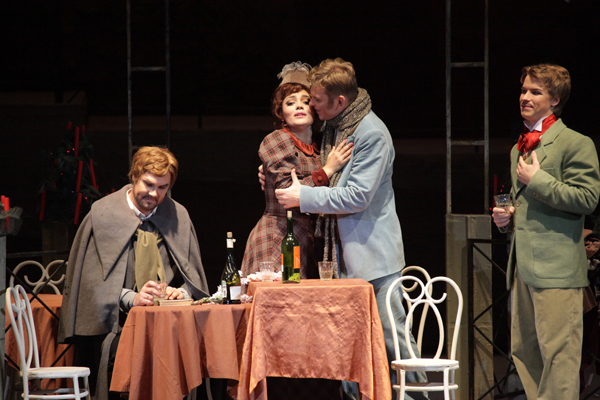
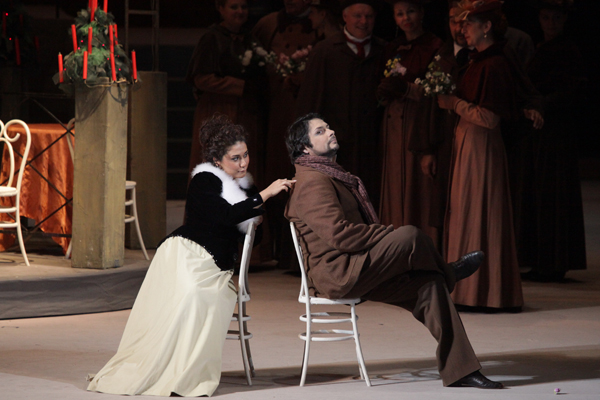
At the Christmas fair in front of the café, traders offer their goods. Each of the friends, having come into means, makes his purchases. Schaunard buys a defective horn, Colline acquires a stack of books and Rodolfo a mob-cap for Mimi. Only Marcello, yearning for Musetta, cannot find consolation in spending money or flirting with other girls. The companions finally meet in the café. Mimi is gladly accepted as one of the group. While in the street children noisily surround Parpignol, the trader of toys. They order exquisite viands. Rodolfo and Mimi’s love makes Marcello utter bitter truths.
7bohemebolshoi

The season for Marcello’s dejected state soon comes to light. The appearance of Musetta, accompanied by a rich and already piqued suitor, calls forth a burst of animation in the café. The darling of the Latin Quarter tries by all means to attract the attention of her former lover. Marcello, despite all efforts, cannot hide that he is not indifferent to her. When Musetta, to Alcindoro’s shame, sings a song directed only to

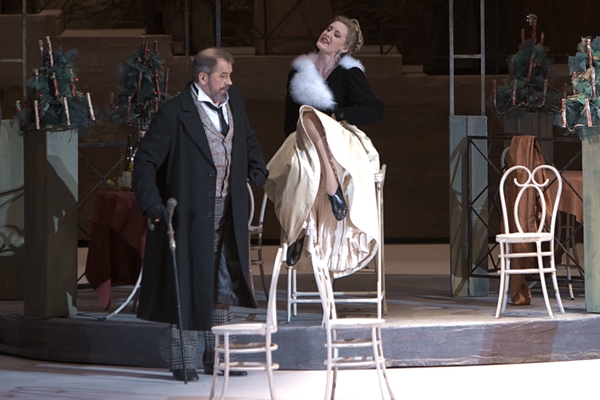
Marcello, the ice breaks. Enfeebled Alcindoro is unable to pacify excited Musetta. Musetta gets rid of her suitor by claiming that her foot hurts and she needs new shoes. As soon as he leaves, Musetta and Marcello fall into each others arms. The check brought by the waiter causes bewilderment, but Musetta puts the bill on Alcindoro’s account. When Alcindoro returns, he finds the cafeempty. He remains alone with the box of shoes and the unpaid bill.

8bohemebolshoi

Act II
At the Gate d’Enfer

Marcello and Musetta have found temporary quarters in a tavern on the outskirts of Paris. Marcello is painting a signboard for the owner. Mimi, plagued by coughing spells, asks the sergeant about the artist Marcello. She calls him from the tavern and tells him about her troubles. She knows that Rodolfo loves her, but nevertheless he has left her.

Marcello confirms that Rodolfo has come here early morning and, exhausted, is now sleeping. Under such circumstances, he is also for separation. He, like Musetta, prefers a light relationship. Rodolfo wants to open his heart to his friend. Marcello does not hide that he thinks Marcello is concealing something. Rodolfo claims that Mimi continuously flirts with other men, so that living with her has become impossible. When Marcello expresses doubts, Rodolfo reveals the real reason for his decision: Mimi’s incurable disease and his poor room with northern exposure is undermining her health further. Marcello is unable to prevent Mimi from learning the bitter truth. A coughing spell reveals her presence. Repenting, Rodolfo embraces Mimi, while jealous Marcello, infuriated by the flirtatious laughter of Musetta, rushes into the tavern.

9bohemebolshoi

Now, Mimi has decided to leave Rodolfo. But recalling their life together does not allow them to separate. While Marcello makes a scene out of jealousy and Musetta leaves him again, Rodolfo and Mimi decide to postpone separation until Spring.

Act III
A Garret

Several months later. Rodolfo and Marcello are again alone in the garret. They cannot forget their past happiness. The friends are submerged in thoughts. Each is looking at his pledge of love: Marcello at Musetta’s portrait and Rodolfo at the mob-cap, his present to Mimi.

Schaunard and Colline enter and bring only stale bread and a wretched herring. With the humor of gallows-birds, they act as though before them is a richly-laden table.


At the height of the merriment, Musetta rushes in with the news that Mimi feels her end is approaching. Rodolfo seats Mimi in an arm-chair. Life returns. Everyone tries to lighten Mimi’s suffering. Marcello is to sell Musetta’s ear-rings and bring medicine. Musetta wants to buy a muff for Mimi’s hands that are always cold.

Colline is taking his old, worn coat to be pawned. Schaunard, who has nothing, contributes his only available contribution: he leaves Mimi and Rodolfo alone.

Happiness returns to Rodolfo and Mimi. They talk about memories of their past. A sudden choking spell makes Mimi silent. Marcello returns with medicine, Musetta with the desired muff. She supports Mimi’s illusion that it is Rodolfo’s gift. Mimi falls asleep happy. Marcello reports that the doctor will come soon. Schaunard is the first to realize that Mimi is dead. Colline returns with moneyfrom the pawnshop. The change in the behavior of Marcello and Schaunard makes Rodolfo realize that Mimi has died.

La Bohème at the Bolshoi

“The Bohemian world — bold and challenging, the Bohemia of carefree poverty, of tender kisses, stolen surreptitiously from the moist, pink lips of some young girl… a company of artist-friends, inspired by great ideals and big appetites or of long-haired poets in badly-fitting coats, always in search of their fortune and of the pretty faces of innocent young girls”, — it was into this world, the world of his youth, that Puccini was plunged when composing his opera. The picture of Paris given in La Bohème, for all the concrete place names and locations mentioned in the scenario, turns out to be in large part a convention: the composer was even reproached for lack of local color, “the air of the Seine, the smell of the gutters and pancakes of the Latin Quarter” were missing. However, showing through the mask of the French capital in the opera, are Milan, and St.-Petersburg, and Moscow — every listener, every interpreter have memories of their own and, thanks to the marvelous atmosphere created, a total visual and oral illu­sion is achieved. It is an atmosphere of youth and high-spirits, permeated by a bewitching sensuality.

La Bohème owes its appearance at the Bolshoi Theatre to its popularity with the public (the opera had had its first per­formance at Zimin’s Theatre in 1897 and had been in the repertory of the Mariinsky Theatre since 1900), and to the per­sonal initiative of Leonid Sobinov, who chose it for his debut as producer at the Theatre in 1911. Sobinov commissioned a new translation of the scenario specially for the production: the excessive naturalism and coarse expressions of the exist­ing version were not to his liking.

The endless joking which helps the artists keep the cold at bay gives way to the avowals of lovers; noisy merrymaking — to angry explanations. It is difficult to think of a better con­structed plot. This life, full of dreams and hopes, is just what the public, who loves to fantasize and cry at the slightest tri­fle, craves for and, at the end of the opera, sobbing is inevitable.

Posted in OPera | Tagged , , | Leave a comment

Il Trittico in Denmark

trittico_title

det_logo1

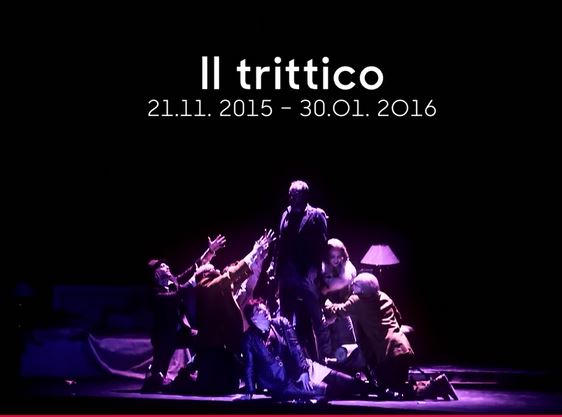
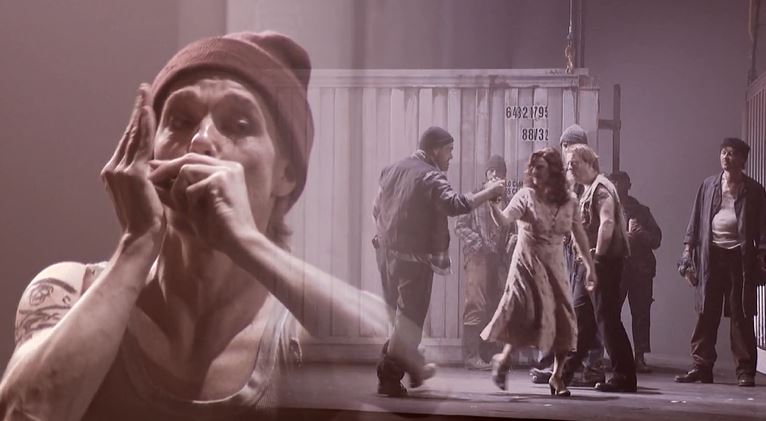
Puccini is the maestro of emotion, and in Il trittico we explore the whole register of the soul. Il trittico begins with red-hot jealousy in Il tabarro in which Michele and Giorgetta lead an unhappy shared life after the loss of their beloved son.

trittico_Title_image

logoDenmarkThe drama continues in Suor Angelica; the story of a group of marginalised young women who have violated society’s laws and norms. Finally, the mood is lifted with Gianni Schicchi, a cheerful comedy that lampoons greedy heirs who cheat their way to inheriting the fortunes of deceased relatives – only to fall victim themselves to the cunning Gianni Schicchi.

Italian director Damiano Michieletto stages the acclaimed production with his flair for both raw-edged comedy and delicate sensitivity. The production premiered in 2013 and earned a Reumert Award in addition to wide critical acclaim.

At the revival, international opera stars Johan Reuter and Marco di Felice will alternate in the roles as Michele in Il tabarro and the title role in Gianni Schicchi. You can also look forward to revisiting British star singer Elizabeth Llewellyn, who in the spring of 2014 appeared at the theatre in the role of Bess in Porgy and Bess.

Il trittico is performed in Italian with Danish supertitles. Il trittico is a coproduction with Theater an der Wien. Nykredit is the exclusive performance sponsor of Il trittico.

Expected duration: 3 hours and 15 minutes including 1 interval]

JANUARY 2016

JANUARY 2016

trittico3

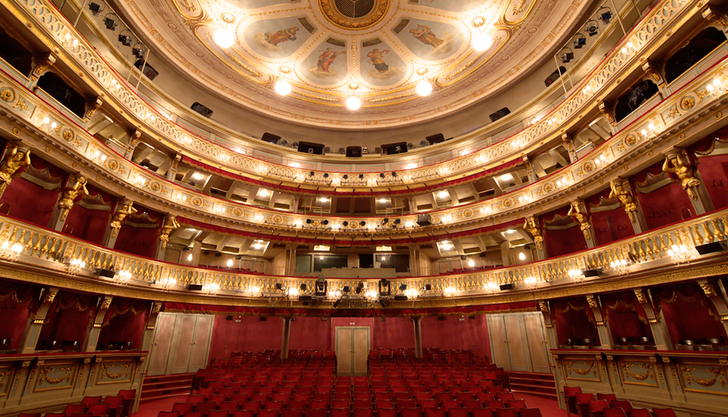
 THE OPERA HOUSE

The Opera House, Main Stage

ARTISTIC TEAM

Director: Damiano Michieletto

Director of revival : Anne Fugl

Conductor: Giuliano Carella

Scenography: Paolo Fantin

Costume design: Carla Teti

Lights: Alessandro Carletti

CAST

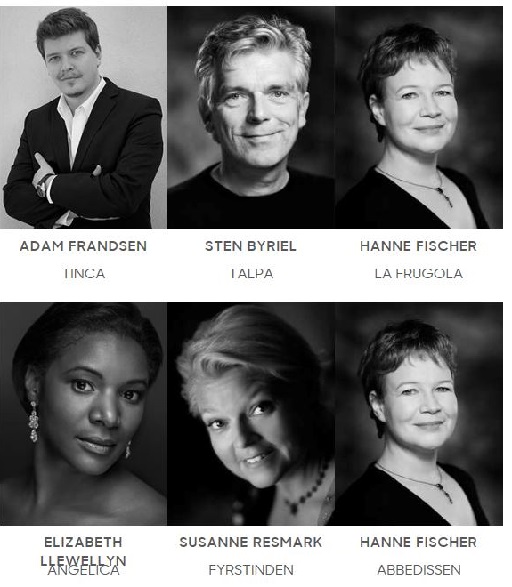
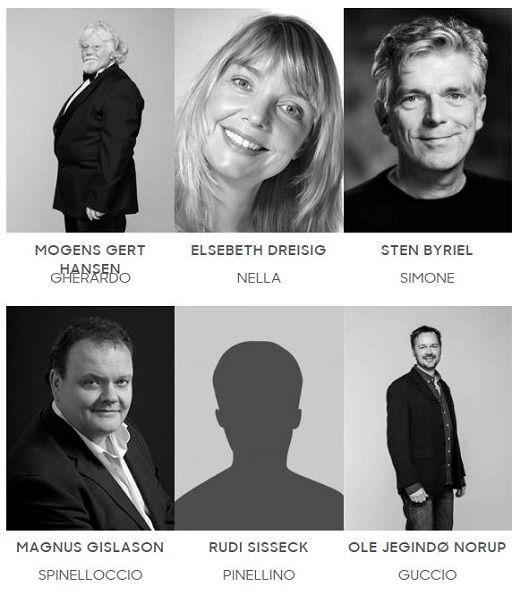
trittico_cast11trittico_cast12trittico_cast21trittico_cast22trittico_cast31trittico_cast32

Posted in OPera | Leave a comment

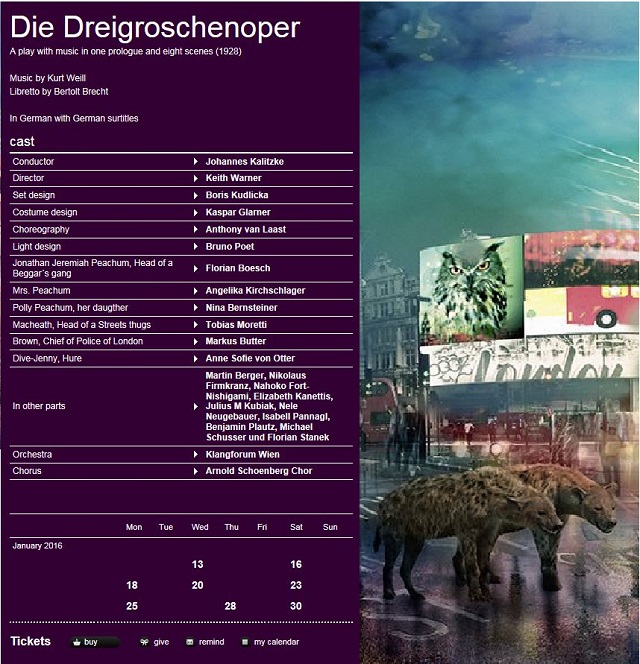
Die Diegroschenopener at the Theater an der Wien in Vienna…

Theater3

dreigroschenoper_weblogoanderwien


dieg11diegTitle

Posted in OPera | Tagged , , , | Leave a comment

Strauss’ Salome in Berlin

deutschelogo

Richard_Strauss-Woche_festival_poster_1910_by_Ludwig_HohlweinSalome

Richard Strauss (1864 – 1949)

A music drama in one act
Music and libretto by Richard Strauss
after the play SALOME by Oscar Wilde
Translation by Hedwig Lachmann
World premiere 9th December 1905 in Dresden
Premiere at the Deutsche Oper Berlin: 24th January 2016

In German language with German and English surtitels

Cast

conductor Alain Altinoglu
Stage Director Claus Guth
Set Design, Costume Design Muriel Gerstner
Lighting Gérard Cleven
Dramaturge Curt A. Roesler
Dramaturge Yvonne Gebauer
Herodes Burkhard Ulrich
Thomas Blondelle (02.04.2016 | 06.04.2016)
Herodias Jeanne-Michèle Charbonnet
Salome Catherine Naglestad
Jochanaan Michael Volle
Narraboth Thomas Blondelle
Attilio Glaser (02.04.2016 | 06.04.2016)
A bellboy Annika Schlicht
1st Jew Paul Kaufmann
James Kryshak (02.04.2016 | 06.04.2016)
2nd Jew Gideon Poppe
3rd Jew Jörg Schörner
Andrew Dickinson (02.04.2016 | 06.04.2016)
4th Jew Clemens Bieber
5th Jew Stephen Bronk
1st Nazarene Noel Bouley
Dong-Hwan Lee (02.04.2016 | 06.04.2016)
2nd Nazarene Thomas Lehman
1st soldier Tobias Kehrer
2nd soldier Alexei Botnarciuc
Andrew Harris (02.04.2016 | 06.04.2016)
A Cappadocier N. N.
Michael Adams (02.04.2016 | 06.04.2016)
A slave Matthew Peña
N. N. (02.04.2016 | 06.04.2016)
Orchestra Orchester der Deutschen Oper Berlin
Catherine Nagelstad Photo Tanja Niemann

Catherine Nagelstad. Photo By Tanja Niemann

Information

Claus Guth Regine Korner

Claus Guth. Photo By Regine Korner

Long after the Paris world premiere in 1896 Oscar Wilde’s tragedy “Salomé” remained a thorn in the flesh of the establishment across Europe. In Wilhelminian Germany and the Danube Monarchy, too, official art adjudicators considered the subject “repulsive” and the text “an insult to morality”. In the minds of the guardians of public morals the New Testament story of Herod’s daughter was as ill-suited to the stage as it was to pictorial representation, which was experiencing a boom at the time. Salomé’s stepfather, Herod, the Roman’s client king of Judea, Galilee and Samaria who is said to have ordered the massacre of the innocents around Bethlehem, persuades her to dance for him. Encouraged by her mother, she demands to be given the head of John the Baptist as a reward.

Alain Altinoglu Photo Fred Toulet

Alain Altinoglu. Photo By Fred Toulet

Official disapproval meant that the performance of Wilde’s play that Richard Strauss saw in 1902 in Max Reinhardt’s “Kleines Theater” in Berlin was a private function. The composer, who was already in possession of the beginnings of an opera libretto in verse form, resolved to use Hedwig Lachmann’s prose text as the basis for his composition. His SALOME was one of the first literaturopern of the 20th century and reflected a number of operatic preferences of the time such as the predilection for one-act works and for exotic, oriental subjects. A literaturoper is an opera whose lyrics are lifted directly, albeit sometimes in shortened and rearranged form, from a pre-existing play.

Michael Volle Photo Suzanne Schwiertz

Michael Volle. Photo By Suzanne Schwiertz

Claus Goth, an internationally feted director since his MARRIAGE OF FIGARO in Salzburg in 2006, is taking on his first production at the Deutsche Oper Berlin. His SALOME focuses on the interior motivations of the characters and explores the power dynamic within the house of Herod. Will Salomé manage to break free from her hellish domestic situation?

Kindly supported by Förderkreis der Deutschen Oper Berlin e. V.
Presented by Wall AG and kulturradio vom rbb

Posted in OPera | Tagged , , , | Leave a comment

Opera de Paris present “Capriccio” at the Palais Garnier

Photo © Enric Montes

Photo © Enric Montes

Logo_OnPOpening night Tuesday 19 January 2016
2h30 no interval
Palais Garnier from 19 January to 14 February 2016

Capriccio

Conversation in music in one act (1942)

Music
Richard Strauss
Libretto
Clemens Krauss
Richard Strauss
Capriccio1

2012 – 2013 © Élisa Haberer/OnP

CAST
Conductor
Ingo Metzmacher
Director
Robert Carsen
Die Gräfin
Emily Magee
Der Graf
Wolfgang Koch
Flamand
Benjamin Bernheim
Olivier
Lauri Vasar
La Roche
Lars Woldt
Die Schauspielerin Clairon
Daniela Sindram
Eine italianische Sängerin
Chiara Skerath
Ein italianischer Tenor
Juan José De León
Monsieur Taupe
Graham Clark
Der Haushofmeister
Jérôme Varnier
Acht Diener
Ook Chung
Julien Joguet
Myoung-Chang Kwon
Chae Wook Lim
Vincent Morell
Christian Rodrigue Moungoungou
Hyun-Jong Roh
Slawomir Szychowiak
Set design
Michael Levine
Costume design
Anthony Powell
Lighting design
Robert Carsen
Peter Van Praet
Choreography
Jean-Guillaume Bart
Dramaturgy
Ian Burton

Paris Opera Orchestra and Chorus
French and English surtitles

capriccio-quote

Photos from the 2012-2013 season

capriccioDvdEven if the world were to fall apart – as indeed it did on October 28th 1942 when Richard Strauss first performed his opera in Munich – Countess Madeleine would still remain, impassively awaiting an answer that would come neither “tomorrow morning at 11 o’clock”, nor for that matter, ever – an answer to the seemingly futile question: “Prima la musica, o prima le parole?” Is this a nostalgic twilight tribute to the world of yesteryear, which in its collapse would swallow up Stefan Zweig, the very artist who, in 1934, planted the idea for Capriccio in the composer’s head; or is it a mere caprice whose theoretical hedonism questions the position of the ageing composer, who entrenched himself in his Garmisch villa as dramatic events took place around him.

Robert Carsen, a master in the art of metatheatre, transforms the perspective of the Palais Garnier’s stage and the Foyer de la Danse into a mirrored jewel box for Adrianne Pieczonka’s opalescent voice. Ingo Metzmacher conducts the great German composer’s’ lyric testament.

Posted in OPera | Tagged , , | 1 Comment

The Magic Flute in Munich.

magic_title

A German Opera in two acts

bayerischeoperalogoComposer Wolfgang Amadeus Mozart · Libretto by Emanuel Schikaneder
In German without surtitles


Saturday, 02. January 2016
06:00 pm – 09:15 pm
Nationaltheater

Duration est. 3 hours 15 minutes · 1 Interval between 1. Akt and 2. Akt (est. 07:15 pm – 07:50 pm )

Papageno wants Papagena – Tamino his Pamina. But the pathway to love is not a simple one! Everyone has to undergo difficult trials. They even have to decide against murder and suicide, and do without food and drink and sometimes even without speech and song. The things that help them survive danger are a flute and a set of magic bells. The most world-renowned opera in a classically beautiful production, the legacy of stage director August Everding. The snake still breathes “real” fire, the Queen of the Night is still really a “star-flaming” monarch. The stage portrait (by Jürgen Rose) is wondrous fair. The magic of this opera really works here.

magic2

Conductor Asher Fisch

Stage Director August Everding

Production assistant Helmut Lehberger

Sets and costumes Jürgen Rose

Lights Michael Bauer

Choreography Beate Vollack

Choir Director Sören Eckhoff


Sarastro
Georg Zeppenfeld
Tamino
Mauro Peter
Sprecher
Markus Eiche
Königin der Nacht
Albina Shagimuratova
Pamina
Hanna-Elisabeth Müller
Erste Dame
Golda Schultz
Zweite Dame
Angela Brower
Dritte Dame
Okka von der Damerau
Drei Knaben
Tölzer Knabenchor
Papageno
Nikolay Borchev
Papagena
Leela Subramaniam
Monostatos
Kevin Conners
Erster Geharnischter
Michael Baba
Zweiter Geharnischter
Christoph Stephinger
Erster Priester
Wolfgang Grabow
Zweiter Priester
Michael Baba
Dritter Priester
Ingmar Thilo
Vierter Priester
Ivan Michal Unger
Drei Sklaven
Markus Baumeister
Drei Sklaven
Walter von Hauff
Drei Sklaven
Johannes Klama
  • Bayerisches Staatsorchester
  • Chorus of the Bayerische Staatsoper

SYNOPSIS

Background

When Pamina’s father died his wife, the Queen of the Night, lost her power, because he had handed the seal of the seven circles of the sun to the initiates. Sarastro is now administering the Sun King’s legacy.
The Queen of the Night is not willing to submit to being directed by the wise men around Sarastro. She endeavours to regain her former power.
In order to foil her plans, Sarastro has kidnapped Pamina, who is actually her father’s heir.

magic3

Act One

The Queen of the Night has chosen Prince Tamino to free her daughter. Pursued by a huge snake from which he is endeavouring to escape, the prince stumbles into the realm of the Queen of the Night and falls unconscious from exhaustion. Three ladies, attendants of the Queen of the Night, save his life.
When Tamino awakes, he discovers the snake lying dead at his feet. He meets Papageno and assumes that the bird-catcher has rescued him from the snake. Papageno does not contradict him and is punished for his boasting by the three ladies. They show Tamino a picture of Pamina and he immediately falls in love with her.
When the Queen of the Night herself appears on the scene, Tamino swears to deliver her daughter from the hands of the “demon” Sarastro. Tamino and Papageno, who is to accompany the prince,  are given magical instruments to protect them from danger: a flute and a set of chimes. Three youths or genii are to accompany them on their journey to Sarastro’s palace.
Tamino has sent Papageno on ahead, and the latter meets Monostatos, who is keeping guard over Pamina and pursuing her with unwelcome attentions. Papageno’s appearance puts Monostatos to flight. Pamina now learns from Papageno that a prince, who is in love with her, is coming to set her free. Papageno persuades Pamina to flee.
In the meantime, Tamino has been led to Sarastro’s temple by the three youths. A priest, a spokesman of the initiates, emerges and informs him about Sarastro’s real character, assuring him that he is a kind, wise man and also telling him of  Sarastro’s plan. Tamino also learns that Pamina is still alive. In his gratitude he plays the flute, the magic of which tames wild animals. Monostatos and his slaves catch up with Papageno and Pamina but they are able to free themselves again with the help of the set of chimes. Their plan to escape is then foiled again by the arrival of Sarastro.
Pamina and Tamino meet for the first time and fall into each other’s arms. Monostatos drags them apart, but, instead of the reward he expects for his services, he is punished by Sarastro.
Tamina and Papageno are led into the Temple of Ordeal.

Act Two

Sarastro informs the initiates of his plan to lead Tamino to a greater destiny and the priests approve his decision. Tamino, however, must first  prove himself worthy of the greater happiness by submitting to the ordeals. Pamina and Tamino must take their leave of each other. Papageno is also to be put to the test. First of all, both he and the prince are enjoined to silence.

Tamino does not allow himself to be tempted by the three ladies of the Queen of the Night who have sneaked into the temple. In the meantime, the Queen of the Night has managed to reach her daughter and orders Pamina to kill Sarastro. Pamina cannot do this. Monostatos, who has overheard the Queen talking to her daughter and is
blackmailing Pamina by threatening to reveal all, is chased away by Sarastro. Sarastro is aware of Pamina’s predicament and is able to reassure her.
While Tamino and Papageno are awaiting further ordeals, an old crone appears and introduces herself as Papageno’s sweetheart. Before she can tell them her name, there is a clap of thunder and a flash of lightning and she disappears. Tamino plays his flute, the sound of which guides Pamina to him. She speaks to him but, not knowing that he has been enjoined to silence, she believes he does not love her any longer when she gets no answer. Life no longer seems worth living to her.
Sarastro considers Tamino to be capable of ruling as a wise prince, once he has surmounted the two last ordeals. Papageno, on the other hand, has failed and is afraid that he will be thrown into a dungeon for the rest of his life if he does not take the old crone as his wife. When he reluctantly agrees to do so, Papagena reveals herself as a young and attractive woman. The two of them are, however, still destined not to be united yet.
In her despair, Pamina is contemplating suicide. The three youths restrain her and lead her to Tamino, who is awaiting the final ordeals at the “Gate of Fear”. Accompanied by the music of the magic flute, the two of them undergo the ordeals by fire and water together and overcome despair and the fear of death.
In the meantime the three youths have brought Papageno and his Papagena together. The Queen of the Night and her ladies make a last bid for revenge by trying, in vain, to storm Sarstro’s palace and are cast into endless night.
Tamino and Pamina are welcomed into the temple by Sarastro and the priests.

© Bavarian State Opera

The Joy of Drawing Has Remained

A Conversation with Jürgen Rose about the Revised Production of Die Zauberflöte

Jürgen Rose

Jürgen Rose

They look like works of art all by themselves: the sketches, stage settings and costume designs Jürgen Rose created in elaborately loving detail for August Everding’s production of Die Zauberflöte back in 1978. In their abundance and elaborateness, they document the development of a production concept and bring back many a memory.

For this revised production of Die Zauberflöte you worked together with the theatre craftspeople to overhaul and freshen up the sets and costumes. What do you feel about an artistic work that meanwhile lies 26 years in the past? Is this also an encounter with yourself?

That’s exactly the point: we recognize ourselves in these works, and yet they are somewhat unfamiliar at the same time, because, of course, we’ve developed further. I was amazed at the nonchalance with which I approached this piece, and the ideas that emerged. I would do many things totally differently today. But we have to be very careful to keep from destroying our original ideas. Ultimately our task today is to give the production a new sheen, and restore some things that have perforce worn out over the years: whether these are damaged stage backdrops or hangers which have fallen away for pragmatic reasons, costumes that are missing or are no longer in their original condition because they had to be altered every time a role was re-cast, and so on. I’ve gotten used to this in the course of all the work I’ve done, especially for the ballet. John Cranko or John Neumeier ballets I designed 20, 30, 40 years ago are still being performed all over the world, and all the ballet companies place great value on keeping them as original as possible.

The sketches, designs and drawings that came about for this Zauberflöte production document different phases of the conceptual work. However, they also reveal that there were originally some ideas that were later not implemented. Does that indicate that the artistic conception had gone through a long maturation process?

Fundamentally, I need a lot of time to develop my ideas. It begins with collecting a great deal of material – photos, pictures, fabric samples, etc., which I can use to give form to my initial thoughts on the piece. In the case of Zauberflöte I had an abundance of images and ideas in my head, and I would have liked to put them all on the stage. Things were similar with August Everding, who was not staging the work in Munich for the first time. I remember, for example, that initially we had thought of a lavish salon for the Queen of the Night, a very feminine world in contrast to Sarastro’s domain, which we saw as architecturally more severe, built into a cliff or something like that. We considered how the Three Ladies might look, if they are perhaps birds, in other words fictional creatures like the serpent, or warrior maidens, and many other things. Then we began sorting out and discussing the various details. During these meetings I kept drawing sketches, so to speak as memoranda to myself. I work the same way with other stage directors. The complicated thing with Everding, however, was the he was so full of zeal for action, and there was never enough time for all the things he planned. Something always intervened: phone calls, appointments, visitors. When we started on the Zauberflöte, which was a very difficult piece for me, I really had to lock him up at my home, without the telephone or any other contact possibilities to the outside world so we could work concentratedly for a few hours on the piece. Those hours were terrific. Everding was absolutely brimming over with ideas, and his thoughts about the context of the drama and the music were absolutely thrilling. He really provoked me to turn those ideas into images. For all of this, when we went into rehearsal a half year later, many things had changed, and he showed up with new ideas he had just come up with. I actually like that sort of thing. But at a specific point in time a stage concept has to be nailed down in its basic structure. With Die Zauberflöte with its frequent scene changes, that is especially urgent. On top of that there was the difficulty of bringing this piece onto the huge stage of the Nationaltheater. I would have preferred doing it in the Prinzegententheater or even in the Cuvilliès-Theater, where the visual factors are more intimate and the technical sequences not quite so elaborate.
Everding stressed that the piece had to be performed seamlessly, in other words without long interruptions and scene changes. How did you manage that?

Naturally we used the stage machinery, but on such a big stage it always takes a few seconds for the side wagons to travel in or out, or for yard-long walls to open and close. There was always the hazard of things getting stalled. That’s why from time to time there were highly pragmatic reasons for changing the concept, in which the stage director would have to invent additional actions to make it possible for a given change in the scenic sequence to become integrated. Fortunately Everding was a real past master at that.
Everding was also determined to stress the human qualities in the characters and thus bring the basic idea of humanity to the fore. This was particularly clear in the characterization of the priests as 18th century human beings.

That was something totally new back then. Until that time the priests were generally decked out in Egyptian accessories, helmets from the time of the pharaohs, ritualistic garments, that sort of thing, For us, as you said, it was important to show them as human beings. Human beings who could have been Mozart’s contemporaries. We wanted our singers – Mr. Adam, Mr. Vogel, Mr. Auer and the others – to look quite natural, without artificially bouffant wigs, with their own hair, with only a pigtail pinned on to indicate the historical period. That was unusual back then, and I can remember that Jean Pierre Ponnelle in the Salzburg Zauberflöte production he did shortly after ours also had the priests come out in 18th century costumes. On the large stage of the Nationaltheater this attempt at individualization however didn’t quite come off. Today we would create different stage areas that focus more on the characters. That principle had not yet established itself back then.

One special “trade mark” of this production is also the wonderful bed-tree at the end and the entrance of the many little Papagenos and Papagenas.

Everding retained that idea with the children in all of his Zauberflöte productions. I’m sure there were also highly personal reasons for this. Everding had married rather late in life and then became the father of four sons. This conclusion attests to this highly personal happiness he felt, and it always goes over very well with the audience. Of course, a theatre man like Everding had calculated that precisely.

For the difficult question of who the Three Boys are and where they come from, you decided on a “floating” solution.

Here it was quite clear to us right from the start that these would definitely have to be three real children. Back then those roles were generally sung by three girl choristers. But we wanted children, three boys, who, in keeping with their enigmatic origin, become transformed in the course of the play, sometimes appearing as little Mozarts, sometimes as children from well-heeled homes, sometimes as little scamps. In any cased we wanted them to look totally terrestrial, even though they come floating in on a cloud.

We can also see this urge for naturalness in the delineation of the costume designs, when we look at your designs for the chorus, or more precisely, the “people”.

The people have only a tangential function in this drama. They come on to welcome Sarastro with jubilation, and they come back at the end, when Tamino and Pamina are taken into the community of the initiated. For this they often put the ladies in priestly robes, which makes absolutely no sense, because the unprecedented event here is that Pamina is the first woman to be taken into the order. I myself made those priestess costumes back in the sixties for a Zauberflöte production in Berlin, but it must always have been a disturbance. That’s why I considered how the people might look. I found the inspiration during a trip to Italy, where I saw Neapolitan crêches with their large spectrum of common people statuettes, whose liveliness fascinated me. The Munich National Museum owns a very large collection of such statuettes, and I myself began collecting them so I could study them down to the last detail. The same thing applies to Monostatos and the slaves. That way we were able to get away from the cliché of the evil Monostatos and give him a more human face.

Many of the costumes had to be reworked for the new revision. Were there problems there?

It was very complicated. The greatest difficulty was finding similar fabrics. You have to realize that most of the companies we originally acquired our materials from no longer exist today. Back then we had the good fortune that the Fuchs Company in Augsburg arranged to have the original fabrics for the costumes of the Queen and the Three Ladies woven for us in India. That may sound terribly upscale, but in those days it was totally affordable. Today we have to look around the textile market, that is to say select our materials from catalogues. Those fabric catalogues, however, are geared in color and material to current fashion trends. The few special firms that still exist today generally want to sell in large quantities. It also happens that a fabric, despite the same production number, looks quite different today. We saw that in the Queen of the Night costume. It’s still the same gown Edita Gruberova wore back in 1978, and all the Queens after her have also worn. Now it is already totally worn out. But the newly supplied cloth isn’t anywhere near as beautiful. So we had to decide in each individual situation whether we could retain the old costume or whether we would have to make a new one, in certain cases by sacrificing some æsthetic qualities. The same applies to the settings. This often has to do with certain skills, such as flat painting, which today’s craftspeople have not mastered on the same level today because there isn’t that much of a demand for it because of the change in stage æsthetics. And so we just had to refer back to what we already had.

You also staged Zauberflöte yourself for the first time in 1999 in Bonn. Were you influenced there by your experience in Munich?

No, because twenty years had passed from one production to the other. I saw it more as an opportunity to implement ideas I hadn’t yet realized. Of course I wanted the sequence to continue seamlessly here as well, but it was important to me to create more intimate spaces and delineate the characters more precisely. For instance, I wanted to make Monostatos into a really loving person and stage his tragedy as something like Othello’s and generally focus more on the relationships of the individual characters.

Are your set and costume designs today just as “picturesque” as your Zauberföte designs?

I work somewhat differently today and prefer to develop costumes on the body. I imagine a fabric or a color and want to try both of them out first on a dummy to see how the cloth falls or what effect the color has. In earlier times I would first paint the design, so to speak as a kind of ideal situation. Of course I still have to draw a lot of sketches, especially for ballet productions. They are the work material for the costume workshops. I like doing that, too, exactly as I still like to build my stage design models. Especially in the case of Zauberflöte, I designed the various spaces in minute detail on my models all the way to putting little figurines in them. That gave me a better spatial orientation than the drawing. To this day, I always begin a new job by initially designing the spaces for myself alone. Not until later, when the set is technically fixed, do I work with assistants on a stage model. I also need this first phase of concentration and the solitude that goes with it to develop costumes. I need to be alone when I face the challenge of sitting in front of an empty sheet of paper, designing, rejecting and starting over. But then I suddenly begin having fun again as I work everything through precisely. Over the past years I have drawn costume designs in the form of little scenes, in groups of figures. This of course has to do with my work as a stage director, which I am doing more and more these days. But the joy of drawing has remained.

Interview conducted by Hella Bartnig
English translation by Donald Arthur

Posted in OPera | Tagged , , , , | Leave a comment