



PERFORMANCE PREMIERE
Tue 10/20/15 7:30pm
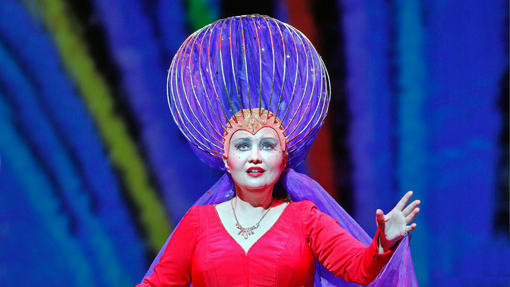


Dramma tragico in 3 acts
Libretto by Salvatore Cammarano
First preformed on 26th September 1835 at Naples
Premiered at the Deutsche Oper Berlin on 15th December 1980
In Italian with German and English surtitles

Fri 16. October 2015 19:30h
Wed 21. October 2015 19:30h
Sun 1. May 2016 18:00h
Wed 4. May 2016 19:30h

Cast
Conductor Daniel Cohen
Director, Stage-design, Costume-design Filippo Sanjust
Choir Conductor Thomas Richter
Enrico Marco Caria
Dalibor Jenis (01.05.2016 | 04.05.2016)
Lucia Pretty Yende
Hulkar Sabirova (01.05.2016 | 04.05.2016)
Edgardo Yosep Kang
Ismael Jordi (01.05.2016 | 04.05.2016)
Arturo Attilio Glaser
Matthew Newlin (01.05.2016 | 04.05.2016)
Raimondo Marko Mimica
Nicolas Testé (01.05.2016 | 04.05.2016)
Alice Irene Roberts
Annika Schlicht (01.05.2016 | 04.05.2016)
Normanno Jörg Schörner
Chorus Chor der Deutschen Oper Berlin
Orchestra Orchester der Deutschen Oper Berlin
Information
 Enrico wishes to marry off his sister Lucia to the mighty Lord Arturo Bucklaw in order to save himself from ruin. Lucia has sworn eternal loyalty to Edgardo Ravenswood, Enrico’s mortal foe, who is citing ancient laws in support of his claim as the rightful owner of Enrico’s lands. Enrico forges a letter in which Edgardo is accused of infidelity and Lucia held responsible for the family ruin. Enrico manages to persuade Lucia to marry Lord Bucklaw. Edgardo appears at the wedding and curses Lucia. She kills her husband. Edgardo challenges Enrico to a duel. Lucia is stricken by a madness that leads to her death. Upon hearing the death knell Edgardo stabs himself.
Based on Sir Walter Scott’s famous novel of 1819 The Bride of Lammermoor, this is perhaps Donizetti’s most popular tragic opera. In his libretto Salvatore Cammarano has chosen a radical path: not only has he relegated the politics of the conflict between the Ashtons and Ravenswoods to the background, and reduced the preceding events to hints in the dialogue; he has also limited the complex entanglement of relationships in the novel to the conflicts between Enrico Ashton, his sister Lucia and her lover Edgardo.
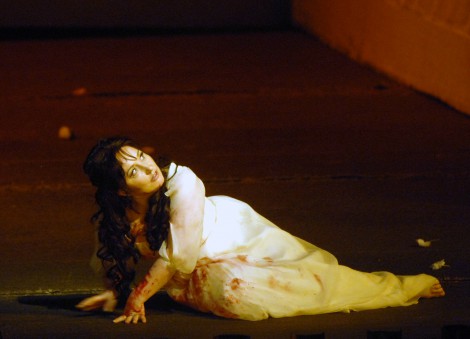
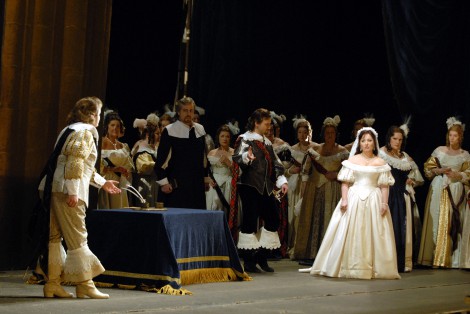
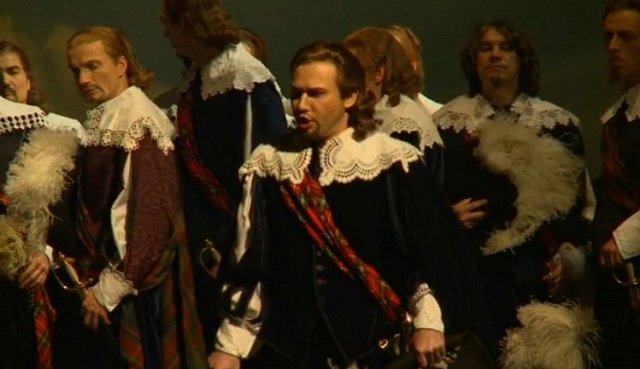
Director and set designer Filippo Sanjust’s production is set around the period that the work was written (1835). An interim curtain depicting a billowing royal blue curtain and the ghostly, fluttering dress of a girl is the device used to suggest the romantic theatrical space. The stage images remind us of reprint editions of ancient tomes. The black costumes, red sashes, white collars, plumes and gauntlets of the Scotsmen form an opulent contrast and a befitting frame for one of the major works of Italian bel canto.
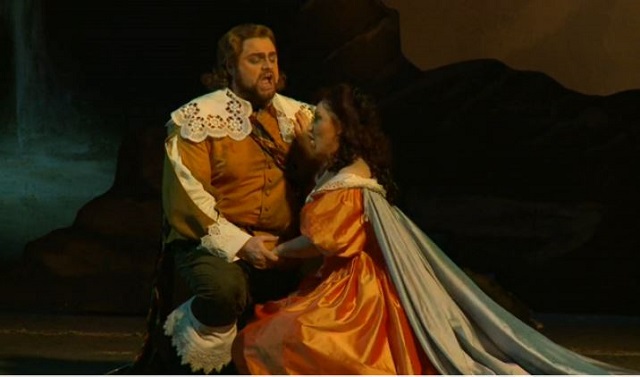
It was Maria Callas who gave a new lease of life to the works of Donizetti, works that had also been neglected in Italy. We know Callas’ intense, vibrato-free expression of feeling from vinyl recordings. Just as she did for many roles in the high dramatic Coloratura genre, Callas set a benchmark for the interpretation of Lucia.

Extreme passions dictate the actions of the protagonists – on the one hand Enrico’s hatred of Edgardo (Cavatina “Cruda … funesta smania’” Act 1), and of Lucia, who opposes his plans; on the other hand Lucia’s love for Edgardo (Cavatina “Regna nel silenzio”, Act 1). That this love will be Lucia’s downfall is masterfully portrayed by Donizetti’s music: the same Coloratura that describes how overwhelmed she is by love in Act 1 become indicators of her madness in her insanity aria at the climax of the opera.
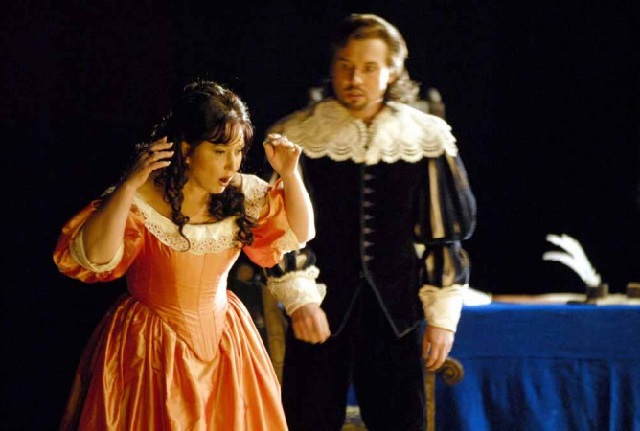
Another moment of high emotional drama comes in the sextet “Chi mi frena in tal momento” in Act 2. Giacomo Puccini wrote: “In one respect we Italians surpass the German composers: we are capable of expressing immeasurable sadness in the Major Key. Edgardo and Lucia are in despair, so much so that Lucia finally goes mad and Edgardo commits suicide; and what do we find in the vocal part? Sugared plums! Honeyed sweetness! – Although Lucia is singing: “I have been abandoned by heaven and earth! I would cry, but there are no tears for me. Desperation consumes my heart.” This sextet is rightfully seen as the most famous ensemble melody ever written for an opera – it is a polyphonic masterpiece …”
Pre-performance lecture (in German): 45 minutes prior to each performance



Gioachino Rossini
03. Oct. 2015 | 19.30
CAST

Press the button to watch the opera…


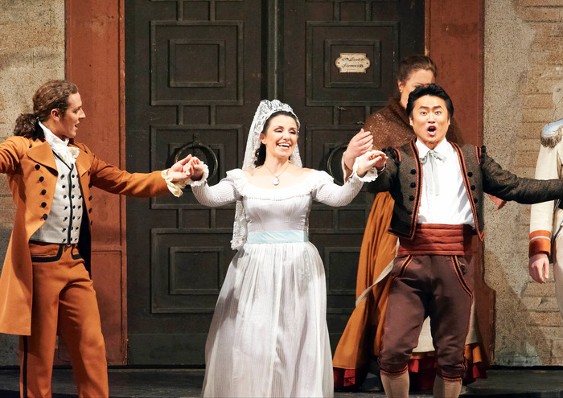
The square in front of Bartolo’s house
In a public square outside Bartolo’s house a band of musicians and a poor student named Lindoro are serenading, to no avail, the window of Rosina (“Ecco, ridente in cielo”; “There, laughing in the sky”). Lindoro, who is really the young Count Almaviva in disguise, hopes to make the beautiful Rosina love him for himself—not his money. Almaviva pays off the musicians who then depart, leaving him to brood alone. Rosina is the young ward of the grumpy, elderly Bartolo and she is allowed very little freedom because Bartolo plans to marry her, and her not inconsiderable dowry, himself – once she is of age.
Figaro approaches singing (Aria: “Largo al factotum della città”; “Make way for the factotum of the city”). Since Figaro used to be a servant of the Count, the Count asks him for assistance in helping him meet Rosina, offering him money should he be successful in arranging this. (Duet: “All’idea di quel metallo”; “At the idea of that metal”). Figaro advises the Count to disguise himself as a drunken soldier, ordered to be billeted with Bartolo, so as to gain entrance to the house. For this suggestion, Figaro is richly rewarded.
A room in Bartolo’s house with four doors
The scene begins with Rosina’s cavatina, “Una voce poco fa” (“A voice a little while ago”). (This aria was originally written in the key of E major, but it is sometimes transposed a semitone up into F major for coloratura sopranos to perform, giving them the chance to sing extra, almost traditional, cadenzas, sometimes reaching high Ds or even Fs.)
Knowing the Count only as Lindoro, Rosina writes to him. As she is leaving the room, Bartolo and Basilio enter. Bartolo is suspicious of the Count, and Basilio advises that he be put out of the way by creating false rumours about him (this aria, “La calunnia è un venticello” – “Calumny is a little breeze” – is almost always sung a tone lower than the original D major).
When the two have gone, Rosina and Figaro enter. Figaro asks Rosina to write a few encouraging words to Lindoro, which she has actually already written. (Duet: “Dunque io son…tu non m’inganni?”; “Then I’m the one…you’re not fooling me?”). Although surprised by Bartolo, Rosina manages to fool him, but he remains suspicious. (Aria: “A un dottor della mia sorte”; “To a doctor of my class”).
As Berta, the Bartolo housekeeper, attempts to leave the house, she is met by the Count disguised as an intoxicated soldier. In fear of the drunken man, she rushes to Bartolo for protection and he tries to remove the supposed soldier, but does not succeed. The Count manages to have a quick word with Rosina, whispering that he is Lindoro and passing her a letter. The watching Bartolo is suspicious and demands to know what is in the piece of paper in Rosina’s hands, but she fools him by handing over her laundry list. Bartolo and the Count start arguing and, when Basilio, Figaro and Berta appear, the noise attracts the attention of the Officer of the Watch and his men. Bartolo believes that the Count has been arrested, but Almaviva only has to whisper his name to the officer and is released right away. Bartolo and Basilio are astounded, and Rosina makes fun of them. (Finale: “Fredda ed immobile, come una statua”; “Cold and still, just like a statue”).
A room in Bartolo’s house with a piano
Almaviva again appears at the doctor’s house, this time disguised as a singing tutor and pretending to act as substitute for the supposedly ailing Basilio, Rosina’s regular singing teacher. Initially, Bartolo is suspicious, but does allow Almaviva to enter when the Count gives him Rosina’s letter. He describes his plan to discredit Lindoro whom he believes to be one of the Count’s servants, intent on pursuing women for his master. Figaro arrives to shave Bartolo. Bartolo demurs, but Figaro makes such a scene he agrees, but in order not to leave the supposed music master alone with Rosina, the doctor has Figaro shave him right there in the music room. When Basilio suddenly appears, he is bribed by a full purse from Almaviva and persuaded to leave again, with much discussion of how ill he looks. (Quintet: “Don Basilio! – Cosa veggo!”; “Don Basilio! – What do I see?”). Figaro begins to shave Bartolo, but Bartolo overhears the lovers conspiring. He drives everybody away.
The scene returns to the location of act 1 with a grill looking out onto the square. Bartolo orders Basilio to have the notary ready to marry him to Rosina that evening. He also explains his plot to come between the lovers. Basilio leaves and Rosina arrives. Bartolo shows Rosina the letter she wrote to “Lindoro”, and persuades her that this is evidence that Lindoro is merely a flunky of Almaviva. Rosina believes him and agrees to marry him.
The stage remains empty while the music creates a thunder storm to indicate the passage of time. The Count and Figaro climb up a ladder to the balcony and enter the room through a window. Rosina shows Almaviva the letter and expresses her feelings of betrayal and heartbreak. Almaviva reveals his identity and the two reconcile. While Almaviva and Rosina are enraptured by one another, Figaro keeps urging them to leave. Two people are heard approaching the front door, who later turn out to be Basilio and the notary. However, when the Count, Rosina, and Figaro attempt to leave by way of the ladder, they discover it has been removed. The Count quickly gives Basilio the choice of accepting a bribe and being a witness to his marriage or receiving two bullets in the head (an easy choice, Basilio says). He and Figaro witness the signatures to a marriage contract between the Count and Rosina. Bartolo barges in, but is too late. The befuddled Bartolo (who was the one who had removed the ladder) is pacified by being allowed to retain Rosina’s dowry. (From Wikipedia.org)


PERFORMANCES
 Thu 10/8/15 7:30pm
Sun 10/11/15 2:00pm
Tue 10/13/15 7:30pm
Fri 10/16/15 7:30pm
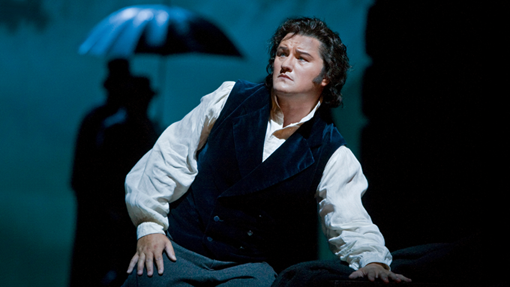
Wed 10/21/15 7:30pm
Sat 10/24/15 7:30pm
Wed 10/28/15 7:30pm
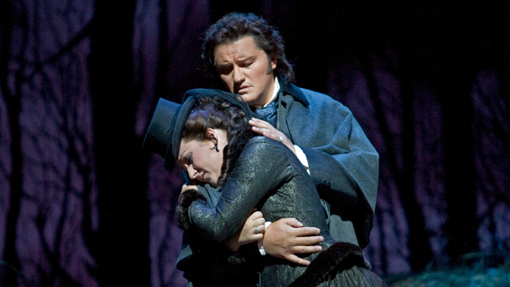


The conductor Nicola Luisotti


1 Oct. – 17 Oct., 2015
 The 70th National Arts Festival by the Agency for Cultural Affairs presents:
 Das Rheingold is Artistic Director IIMORI Taijiro’s first production for the second season. WAGNER spent 26 years of his life composing the four-part music drama, Der Ring des Nibelungen (The Ring of the Nibelung), and this work comprises the first part of it. The libretto, written by WAGNER himself, took its theme from the German Nibelungenlied (The Song of the Nibelungs)and Nordic myths.
The opera was directed by the internationally famous Götz FRIEDRICH, who was general director at the Deutsche Oper Berlin for nineteen years. This 1996 production is one from the last years of FRIEDRICH’s life, and was staged at the Finnish National Opera, Helsinki. The opera is sung by tried and true performers such as Jukka RASILAINEN, playing Wotan, and Stephen GOULD, playing Loge. It is conducted by Artistic Director of Opera, IIMORI Taijiro.
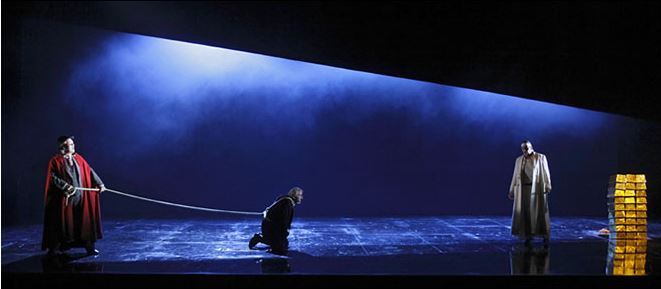
Conductor IIMORI Taijiro 1
Production Götz FRIEDRICH 2
Scenery and Costume Design Gottfried PILZ
Lighting Design Kimmo RUSKELA
 1 |
 2 |

Wotan Jukka RASILAINEN 3
Donner KURODA Hiroshi 4
Froh KATAYOSE Junya
Loge Stephen GOULD 5
Fasolt TSUMAYA Hidekazu 6
Fafner Christian HÜBNER 7
Alberich Thomas GAZHELI 8
Mime Andreas CONRAD 9
Fricka Simone SCHRÖDER 10
Freia ANDO Fumiko 11
Erda Christa MAYER 12
Woglinde MASUDA Noriko
Wellgunde IKEDA Kaori
Flosshilde SHIMIZU Kasumi
Orchestra Tokyo Philharmonic Orchestra

SYNOPSIS
Scene 1
The Rhinemaidens Woglinde, Wellgunde and Floßhilde are enjoying themselves in their element. Floßhilde is the only one who reminds them that they are actually guarding the Rhine gold. The Nibelung Alberich approaches the three maidens, full of longing for love and tenderness, but is scorned and rejected by them.
Alberich, between reeling with anger and swooning with increasing desire, has no idea of what he has seen when his eye is caught by the glint of gold in the light of the rising sun. But then Wellgunde reveals the deep, dark secret: anyone who fashions the gold into a ring will make himself ruler of the world, but only if he renounces love beforehand. Alberich has an outrageous idea: with such power he could perhaps not force somebody to love him but certainly to indulge his desires. He does what has previously been unthought of – he curses love and steals the gold.
Scene 2
Wotan has had the giants Fasolt and Fafner build the castle of Valhalla, from which he plans in future to order and rule the world. To pay for it he has promised to give the giants his sister-in-law Freia.
The castle is finished. Wotan attempts to stall the proceedings and calm his wife Fricka, who is worried about her sister. He has no intention of paying the price demanded. The giants insist that the contract should be honoured.
Loge, the God of Fire, whom Wotan has sent into the world to look for an equivalent form of payment instead of Freia, returns empty-handed. Nobody on earth can think of anything more valuable than happiness the love of a woman can give. Loge reports that he has heard of one person only, Alberich, who is said to have renounced love in order to forge a ring out of the Rhine gold. With the help of this ring he is said to have made himself ruler of his people, through whom he can get ever more gold from the depths, with the help of which Alberich seeks to rule the world.
The news about the gold and the ring arouses everyone’s interest. Fafner suggests a deal: Wotan should use Alberich’s gold as a ransom for Freia. The giants grant Wotan an extra day. As they leave with Freia as their hostage the Gods begin to wilt: it was the apples which Freia tended that had given them eternal youth. Wotan must act: accompanied by Loge he descends to Nibelheim.
Scene 3
Driven by Alberich’s brutality, the Nibelungs are extracting ever more gold and piling it up in a huge hoard. Alberich has had his brother Mime make a magic helmet, the wearer of which can assume any shape he chooses.
Alberich uses this invisibility to terrorize those he has subjugated. Wotan and Loge find Mime, who has been beaten and confides in the strangers, willingly revealing to them the secret of the helmet. Sure of his victory, Alberich tells the unbidden guests his plans for the future: he will seduce everybody with his gold and thus also conquer the gods.
Loge cunningly turns the conversation to the subject of the helmet. When he voices doubt about its powers, Alberich shows off by performing all his tricks: he first turns into a serpent, then into a toad. Wotan and Loge overpower him in this guise and abduct him from Nibelheim.
Scene 4
In order to buy his release, Alberich is forced to hand over the Nibelung hoard to Wotan. But Wotan is not satisfied with this and demands the ring as well. Alberich does not want to part with this at whatever cost and Wotan tears the ring from Alberich’s finger.
Once released, Alberich curses the ring: everyone will be envious of it and want to possess it, but instead of being of use to whoever possesses it, it will only bring sorrow, misfortune and death.
A space the height and width of Freia is measured out and the Nibelung hoard is piled up to match it, but the giants do not want to let Freia go until the ring is also in their possession. Urged on by the other gods Wotan refuses, but the wise old goddess Erda manifests herself out of the depths and appeals to his conscience: she warns him against the curse-laden ring and whispers secret things about an end in disaster. Disturbed by her appearance, Wotan hands over the ring and buys Freia’s freedom. Fafner quarrels with his brother about the ring and kills him.
Freia’s brothers Donner and Froh use magic to influence the weather and dispel the oppressive atmosphere. The gods enter Valhalla in a solemn procession. Loge prophesies their end in disaster. The Rhinemaidens can scarcely be heard as they call for justice from the depths.
The unsullied enchantment of E-flat major harmonies in the initial bars of Das Rheingold doesn’t last very long. Instead, a world comes into being; a world that fifteen hours of music later will be unable to stave off its own downfall. In this world, nature is violated, and laws are ignored. Greed, power and malediction are the order of the day. Alberich steals the gold from the Rhine Maidens, enslaves his workers and revels in the sweet smell of world domination. Wotan claims it for himself and joins forces with Loge to make off with the ring, the gold and the magic helmet. His construction project is envisioned as the foundation of existence for his family of gods – his wife objects. He must part with the accursed ring as payment to the two giants. Seething with envy, one giant murders the other. The glow of the gods’ castle first gleams after the tempest, but Loge sees the castle already headed for ruin. The threads of the tale get tangled in this eve of the tetralogy, the water loses its sheen, and the clouds are shrouded in darkness.

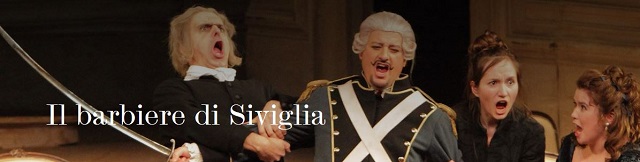
 Melodramma buffo in two acts
Composer Gioachino Rossini · Libretto by Cesare Sterbini
In Italian with German surtitles
Saturday, 10. October 2015
06:00 pm – 09:10 pm
Nationaltheater
Duration est. 3 hours 10 minutes · 1 Interval between 1. Akt and 2. Akt (est. 07:40 pm – 08:10 pm )
Family Performance: 8 years or older · Children’s Introductory Event: 05:15 PM
Open ticket sales. Children’s tickets can be bought via our online ticket order form by using the “Remarks” space (up to 2 months before the performance) or at the box office / via telephone (less than 2 months before the performance).

CAST
Musical Director Francesco Angelico
Production Director Ferruccio Soleri
Stage Director Carlo Tommasi
Costumes Ute Frühling
Choir Director Stellario Fagone

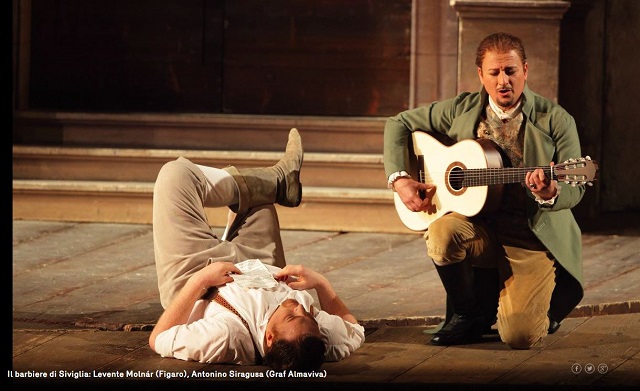
SYNOPSIS
Act I
Count Almaviva has fallen in love with Rosina, the ward of Dr. Bartolo, who keeps her assiduously under lock and key. He secretly sings her a serenade. Almaviva meets Figaro, the Barber of Seville, who performs the tonsorial duties in Bartolo’s home. Figaro tells the count that the old, penny-pinching Bartolo wants to marry Rosina so he can get his hands on her inheritance.

Rosina appears on the balcony. She intentionally drops a little note, which tells Almaviva that she would like to find out something more about her admirer.
When Bartolo goes out, the count presents himself to Rosina as Lindoro and proposes marriage to her. Almaviva gives Figaro a bribe to enlist the barber’s support toward winning Rosina’s hand. Figaro advises Almaviva he can get into Bartolo’s house disguised as a soldier.
Rosina is longing for Lindoro and writes him a letter. Bartolo returns and receives a visit from Don Basilio, the music teacher. He warns Bartolo that Count Almaviva is abroad and has taken an interest in Rosina. Basilio also knows a way to drive the count out of town: slander.

Figaro has listened into their conversation and tells Rosina about their conspiracy. She gives him a love letter for Lindoro.
Bartolo finds ink on Rosina’s hands, and notices that a sheet of letter paper is missing, which has aroused his suspicions.
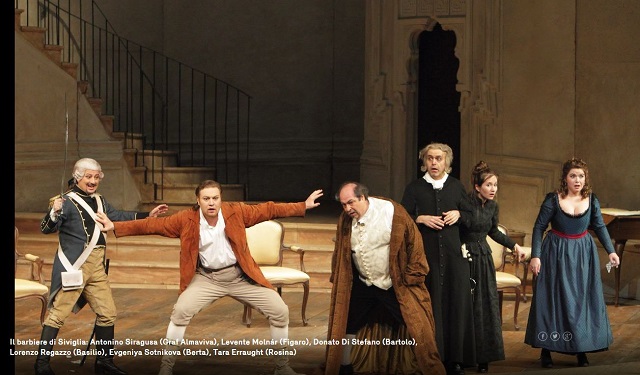
Almaviva appears in Bartolo’s house as a drunken soldier. He reveals himself to Rosina as Lindoro. Bartolo summons the guard to help him keep Almaviva from being quartered in his home. When they arrive, their commanding officer refuses to arrest Lindoro, having been tipped off about the situation, which triggers some general befuddlement amongst the others.
Act II
Almaviva reappears at Bartolo’s house, this time as music teacher Don Alonso, who says he is filling in for the indisposed Don Basilio. Rosina recognizes the disguised Lindoro immediately. The suspicious Bartolo doesn’t take his eyes off them. Lindoro wins his confidence when he gives him a letter from Rosina to Almaviva, revealing their secret connection. A music lesson is improvised, which calms Bartolo down, but he has no time for the modern style of music Alonso and Rosina are performing, whereupon he struts his stuff in a piece from his own youth.
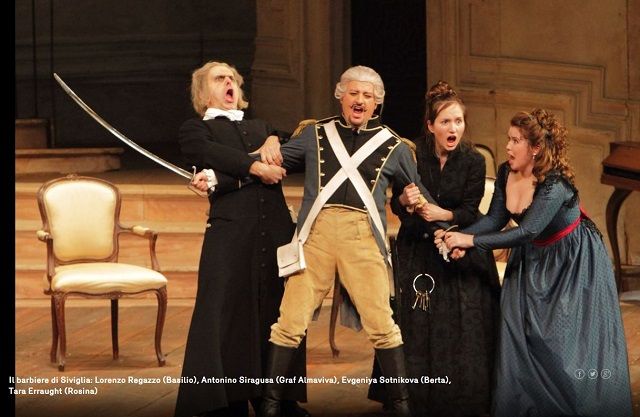
Figaro arrives to give Bartolo a shave, taking advantage of the situation to purloin Bartolo’s balcony key.
Unexpectedly the allegedly ill Basilio arrives, but with the aid of a well-filled purse from the count, he willingly departs from the scene.
Figaro and Almaviva plan to abduct Rosina at midnight. Rosina enthusiastically agrees to the plan, because she wants to go off with her beloved Lindoro. Bartolo suspects a plot and  chases them away. He sends Basilio to the notary to prepare his wedding with Rosina.
Then Bartolo slanders Lindoro to Rosina. He claims, showing her the letter Alonso/Lindoro had given him, that Lindoro is planning to turn her over to Almaviva.
The appalled Rosina then agrees to marry Bartolo and tells the old man of the plan to abduct her. Bartolo scurries off to alert the guard.
During a thunderstorm, the count and Figaro get into the house over the balcony. Almaviva then reveals his true identity to the reluctant Rosina.
Basilio returns with the notary and thwarts the escape of the three conspirators. A bribe helps Figaro convince Basilio to change sides and witness the wedding, whereupon a marriage contract between Rosina and the count is signed. The count turns over Rosina’s dowry to the duped Bartolo as compensation.
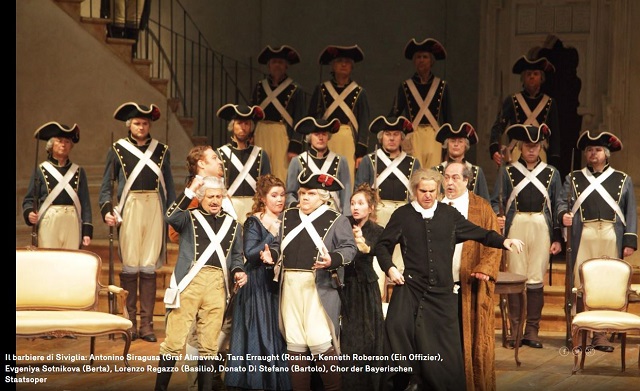
English translation by Donald Arthur
© Bayerische Staatsoper


NEXT show:2015-09-17 LAST show:2015-09-26
Artistic Team
Conductor: Lorenzo Viotti
Director: Enzo Dara
Sets: Stefano Crivellari
Costumes: Federica Miani
lighting: Elisa Ottogalli
CAST
Tobia | Omar Montanari
Fanny | Marina Bucciarelli
Edoardo Milfort | Francisco Brito
Slook | Filippo Fontana
Norton | Claudio Levantino
Clarina | Rossella Locatelli
Conductor | Lorenzo Viotti
Direction | Enzo Dara
Sets | Stefano Crivellari
Costumes | Federica Miani
Lighting | Elisa Ottogalli
La Fenice Opera House OrchestraLa Fenice Opera House production

Gioachino Rossini’s La Cambiale di Matrimonio (The Bill of Marriage) marked the beginning of his career as a composer on 3 November 1810 at Teatro San Moisè in Venice. The eighteen-year old musician worked together with Gaetano Rossi, an experienced librettist from Verona, who then went on to write Tancredi (1813) and Semiramide (1823) for him as well. Organised in eight musical numbers, at the heart of the libretto is the conflict between generations and traditions from distant countries. A young couple wish to get married, but a father-master is stopping them. Luckily the groom the father has in mind is a foreigner – a kind hearted Canadian: He defends the two lovers and finally gives his rival the document, a bill that will allow him to marry the young girl.

SYNOPSIS
A room in Tobia Mill’s house.
Norton and Clarina, servants of Tobia Mill, a rich English merchant, are eagerly discussing the latest news about the future of their master’s daughter, the lovely Fanny. The two gossipers have to break up their conference when old Mill comes into the room, intent upon studying – without being much enlightened – the map of the world: his preposterous notions of geography do not get him very far! Norton and Clarina come back with an important letter that has arrived from the New World; although reluctant to tear himself away from geography, Mill is overjoyed to recognize the handwriting of Slook, his colonial correspondent in America. In his letter, the American announces his impending arrival in order to pick up the «merchandise» quoted in the agreement that he has signed with Mill: the latter now reads out to the astonished Norton the promissory note by which Slook has commissioned Mill to find him a wife, stipulating all the necessary qualities. It is a «deal» of the greatest importance and Mill, without at all consulting the young lady in question, has decided that his own daughter Fanny shall be the «merchandise». Norton tries in vain to dissuade him: Mill intends to combine business with pleasure in marrying his daughter to the rich American.
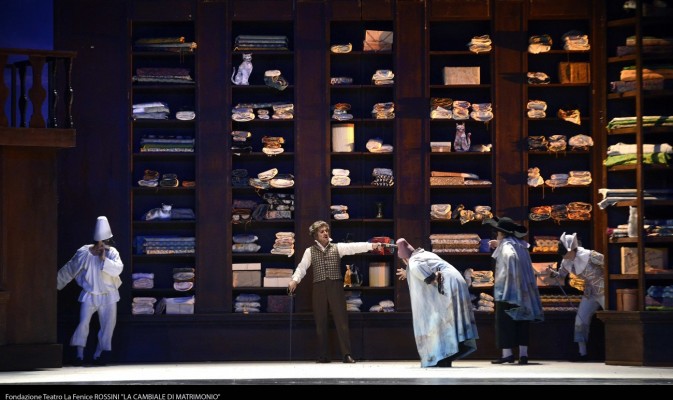
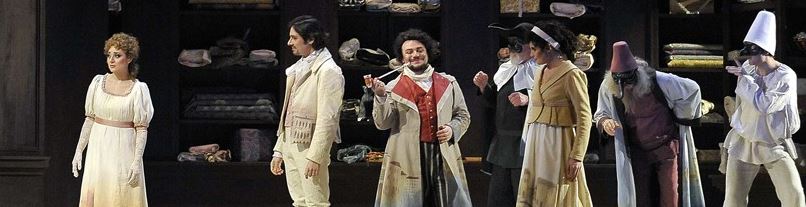
When the two men have left, Fanny comes in with her beloved, Edoardo Milfort. As Edoardo’s financial circumstances leave something to be desired, Fanny has never confessed her love to her father: the two young people are awaiting the arrival of Edoardo’s rich uncle before confessing their love. Norton joins the young couple and warns them of Fanny’s father’s intentions; Mill himself unexpectedly enters and Norton explains away the suspicious presence of a young man by introducing Edoardo as the new bookkeeper. His mind now at rest, Mill entrusts his daughter with a letter that she is to present to the foreigner who is about to arrive. This is none other than Slook: as soon as he comes in, he clumsily tries to show off his newly acquired «European» good manners without, however, forgetting that he is basically a man accustomed to «practical American simplicity». When at last he is left alone with Fanny, Slook learns from the letter that she is the girl whom Mill has selected to be his future wife. Fanny tries to persuade Slook to give up any idea of getting his hands on his «merchandise», and then Edoardo comes in and intimates that the American had better abandon the business entirely and not say anything about it to old Mill: Slook, afraid of having his eyes torn out, goes off with the young people without being able to understand why they are so threatening.

Clarina is worried about Fanny, whom she would like to see happy, and Norton comforts her, secure in his belief that the marriage to Slook will never take place. As soon as he has the chance, Norton insinuates to Slook that the goods in which he is about to invest (his future wife) are already mortgaged. His head spinning with all this, poor Slook goes to look for Mill and tells him that the deal is off, but the outraged Mill at once challenges him to a duel, feeling himself to have been tricked and insulted. When Mill has gone away,
Slook soon discovers that Edoardo and Fanny are in love and, moved by their words, proposes to sign the promissory note over to Edoardo whom, at the same time, he designates as his heir: the American cannot believe that in Europe a father would force a daughter into marrying against her will. Fanny, thanking him, expresses all her unbounded happiness.
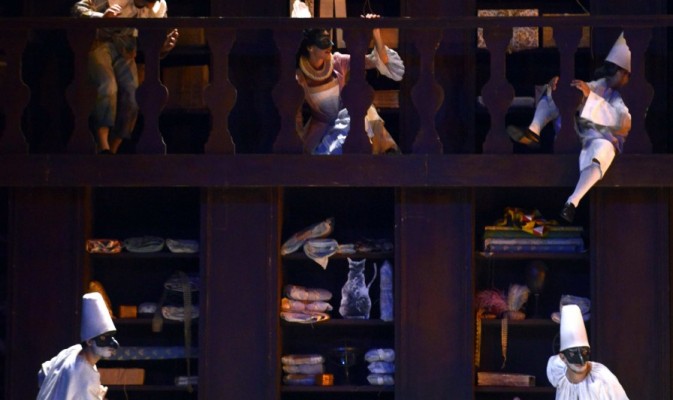
Meanwhile Mill, preparing for the duel, realizes that he might get the worst of it and becomes terrified: when Slook joins him and observes his lack of courage he teazes him until the others come in to break off the warlike preparations. Now Edoardo shows Mill the promissory note and demands the goods specified, but the astonished Mill will have none of it. Only Slook can persuade him to allow Fanny to marry Edoardo, promising him that he has nominated the young man his heir: now that the promissory note has been made out to Edoardo it will bring happiness to all, and within a year it will produce interest in the shape of a bouncing baby grandson.

Wed 09/16/15 7:30pm
Sat 09/19/15 7:30pm
Tue 09/22/15 7:30pm
Fri 09/25/15 7:30pm
Sun 09/27/15 2:00pm
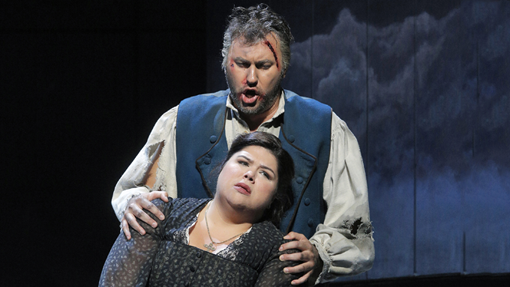
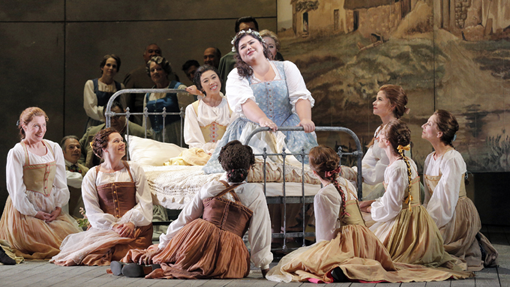
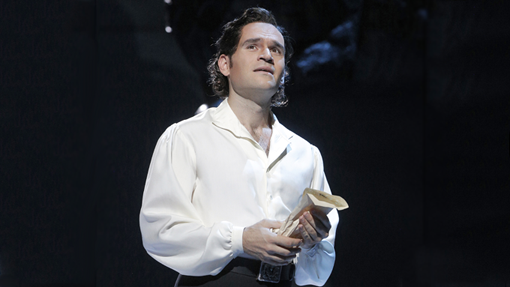
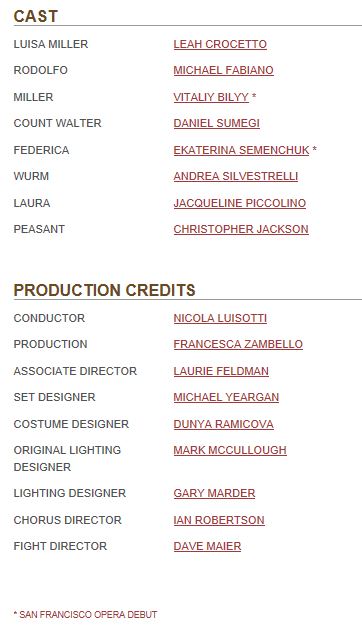
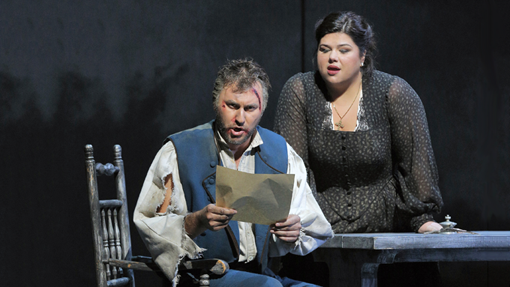
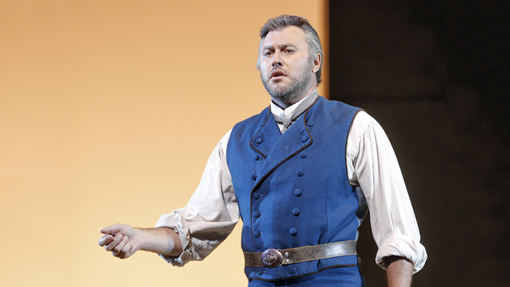
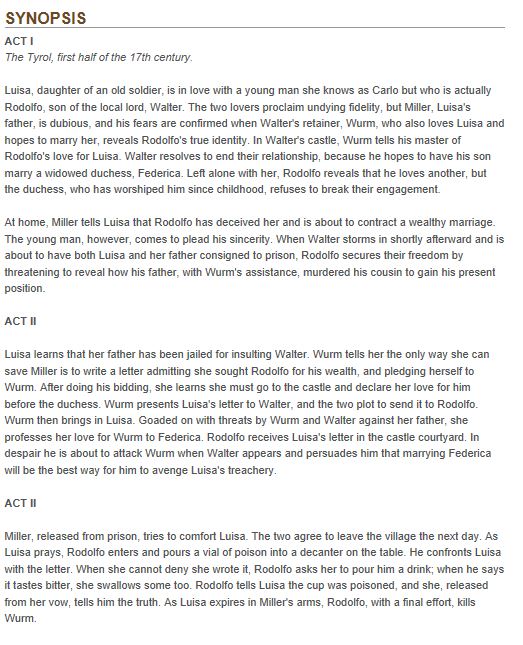
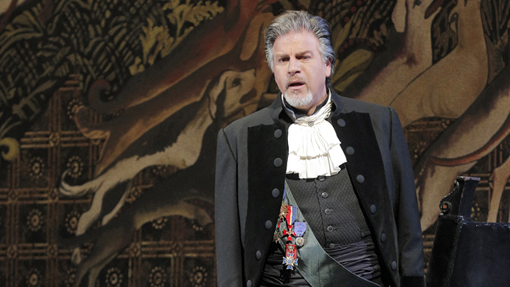
Verdi’s career was so remarkable that it works against a proper appreciation of his genius—there’s almost too much great Verdi work to comprehend. Anyone can weary of the superlatives: the “tragic grandeur” of Otello and Rigoletto, for example, or the “awesome vastness” of Don Carlo, or the “brilliantly penetrating psychology” of La Traviata. Yet the superlatives are justified and necessary. Throughout his career—and especially from around the time of Luisa Miller (1849) onward—Verdi composed a canon of masterpieces, each with its own tone or tinta as he called it, that amaze us by their diversity from each other as well as by their individual merits. And for clear, unaffected, gem-quality exploration of genuine human emotion, no opera exceeds Luisa Miller.
The crux of the drama is the confrontation of middle and upper class worlds. Representing the middle class on stage at all was an aspect of a radical new genre, the “bourgeois tragedy.” Before this time, tragedy was the exclusive domain of the nobility. This was more than mere elitism. Nobility and royalty by definition represent multitudes of people: hence Shakespeare’s confusing use of titles for characters, (cf. “Norway” in Hamlet). We see the same phenomenon in many languages (but not English) today: the vous/voi/vosotros forms in the Latin languages, ihr in German, etc. Important people were plural personages, and the outsized emotions of classic tragedy are right-sized. In the eighteenth century, German writers began ascribing the same grandeur to common individuals, and the result, while fascinating, seemed extreme. This is partly why people spoke of Sturm und Drang (storm and stress) to describe these dramas. The emotions had not grown; the people expressing them had “shrunk,” in a sense. Making this same transition from nobles to commoners was a similarly fraught process, and the operas of the later nineteenth century dealing with everyday people are the ones people think of as shrill. It was fine for royals in early operas to wail and gesticulate extravangantly, but when “common individuals” like Santuzza in Mascagni’s Cavalleria rusticana express the same levels of emotion, suddenly opera becomes overwrought for many people. Verdi negotiated the conflicting parameters brilliantly, especially in Luisa Miller.
In 1849, the opera was contracted for the great San Carlo opera house at Naples, whose reactionary air was uncongenial for the radical Verdi. In fact, he swore he would never produce another opera there (and he never did, despite a tortured attempt with Un Ballo in Maschera in 1859). But he did get to work again with the great Neapolitan librettist Salvadore Cammarano, with whom he had just collaborated on the sensationally patriotic opera La Battaglia di Legnano in Rome. More famously, Cammarano had written the excellent libretto for Donizetti’s Lucia di Lamermoor in 1835. (Verdi would collaborate with him once again on the intense Il Trovatore in four years, and Cammarano died before completing that libretto). Cammarano streamlined Schiller’s drama marvelously. There were few last minute changes, and no subsequent edits. What the seasoned professional Cammarano wrote is what we get today.
Naturally, the journey from drama to opera was not painless—it never is. But the necessary streamlining served to shift the focus of the story. Schiller’s critique of court life and the tyranny of petty German despots—the Kabale (Intrigue) of the title—is curtailed while Liebe (Love) is emphasized. This is not a case of Verdi pleasing the royalist censors of Naples (although he did accomplish that). The fact is that Verdi had found a deeper way to be political when he wrote Luisa Miller than he had formerly expressed as the chief musical mouthpiece of Italian patriotism.
From Nabucco (1843) on, Verdi had portrayed themes of national uprisings against unjust tyrannies, providing inspiration and (in many cases) actual rallying choruses for the emerging Italian unification movement, the Risorgimento. The point was to inspire members of the audience to walk out of the theater and immediately take up arms against the (mostly Austrian) enemy. By late 1849, the situation had changed. The wave of revolution that erupted in 1848 was fizzling out. By the time the year was over, the forces of reaction had clearly reestablished themselves more grimly than ever. The desired change would not happen on the barricades of Paris, Milan, Dresden, or anywhere else. The revolution would have to be something other than what had been imagined. Richard Wagner, exiled from Germany after his involvement on the front lines of the rebellion, would recalibrate his revolutionary hopes and find renewal in national mythology. Verdi would find it in individuals.
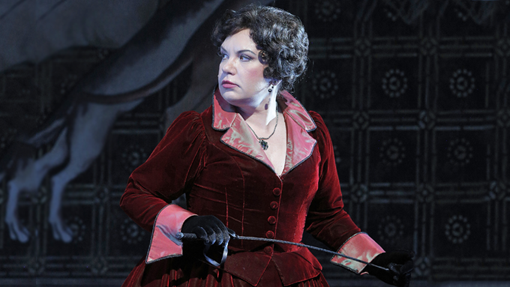
It is a mistake to think that “the political Verdi” refers only to the patriotic choruses of his early operas. Verdi’s true and radical political idea was expressed in the notion that the needs of the individual, no matter how humble, are as important as the needs of the great and mighty. Put another way, if we remember the concept of nobles as metaphors for groups of people: the needs of the one can outweigh the needs of the many. So it is in Verdi’s Aida (1870), when the slave girl—the socially lowest person on a stage teeming with kings, priests, and generals—shifts the focus of the entire massive vocal ensemble in the Triumphal Scene to herself with a solo vocal line. And so it is when the prostitute Violetta in La Traviata demonstrates that she alone is the moral compass of her social milieu. There are other cases of Verdi drawing riveting portraits of the individual against society and its dogmas (Stiffelio, Boccanegra, et al.). In Luisa Miller, this preference for the individual is present in both the story itself and in the choice of available material from Schiller.
As always in Verdi, we learn about a character’s true humanity through his or her singing. Melody would become suspect by the end of the nineteenth century and almost regarded as an enemy in the twentieth. In many operas of the early nineteenth century, however, it expresses levels of sincerity. In Donizetti’s Lucia di Lamermoor, the tenor Edgardo is not sympathetic in the synopsis. His quickness to believe the worst (a character defect common to operatic tenors) makes us question the sincerity of his love for Lucia. Yet no one who hears his melodies—especially his final Tomb Scene—can doubt his love. Melody validates him. This sounds tautological but it was not done the same way before Donizetti (perhaps with Cammarano’s influence). Mozart does not use melody in this dramatic way: you can’t tell who is sincere and who is not by the beauty of the melodies in Così fan tutte, just to cite the most glaring example. But Verdi learned Donizetti’s lesson well. In Luisa Miller, the tenor role, Rodolfo, doesn’t transcend the hoariest clichés about the species when we read the synopsis. His Act Two aria, however, (“Quando le sere al placido,” among the most beautiful Verdi ever composed) leaves us no doubt that he is a genuine person, and in love. Verdi’s accomplishment lies not only in conjuring up such ravishing melody, but in its dramatic aptness breathing humanity into the written character.
Verdi can also dispense with melody when necessary: the Act Two scene between two basses, as Count Walter (Rodolfo’s scheming father) and his henchman Wurm devise evil plots, is marvelously creepy. Another composer might have composed some sort of oath duet but here we have the voices winding in and out of each other, avoiding any obvious tune. It’s hard to tell which character is singing, a neat device when two people are planting ideas in each other’s brains, and a disturbing suggestion of a father’s inappropriate motivations toward his son’s beloved. A truly innovative use (and non-use) of melody comes in the curious finale to Act One. The orchestra carries the melody for several minutes while the characters sing in short phrases, some melodic, others almost spoken. Again, Donizetti had done much the same, but Verdi infuses each snippet with dramatic aptness. A great deal of information can be communicated efficiently, and characters’ motivations (often so unclear in the synopsis) become inevitable.
Act Three is a masterpiece of cohesion and humanity. There is a long scene between Luisa and her father, Miller, that can be as heart-rending as anything in Verdi (or anywhere else). Luisa contemplates suicide; Miller sympathetically talks her out of it; she agrees to live and, in order to escape the oppression of Count Walter and his cohorts, the two will wander the hills together as beggars. It will be difficult, but they will have each other, and the purity of their love as opposed to the corruption of the social world. There is gratitude for what they have, lamentation for what they’ve lost, and a sort of numbness from the life blows that have led them to this moment. It is a nexus of emotions so complex and nuanced it can only be depicted in the most austere musical terms (like the “Ah veglia, o donna, questo fior” duet in Rigoletto between Gilda and Rigoletto, another of Verdi’s celebrated father–daughter scenes). It is a wise person’s depiction of a quiet but life-defining moment, and it is inconceivable that this “Hymn to Hope-Within-Disappointment” was written by a man in his thirties. It is also entirely different from his previous opera La Battaglia di Legnano, and is actually more profoundly political. The plight of Luisa and her father sitting in their simple home and evaluating their lives and their future commands our sympathy as much as any king or queen in classical tragedy. The humble have become as significant as the mighty, and the individual as important as the multitude. In its humanity, Verdi’s art achieves what the revolutions of 1848 did not.
William Berger is a writer and radio producer for the Metropolitan Opera. His books include Wagner Without Fear, Puccini Without Excuses, and Verdi With a Vengeance
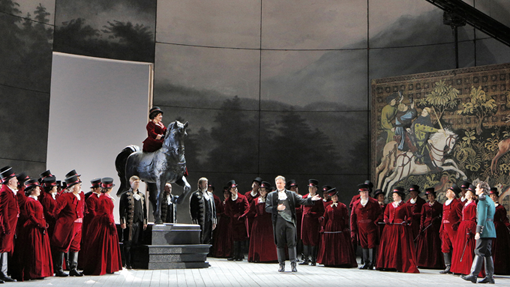

 AIDA
AIDA
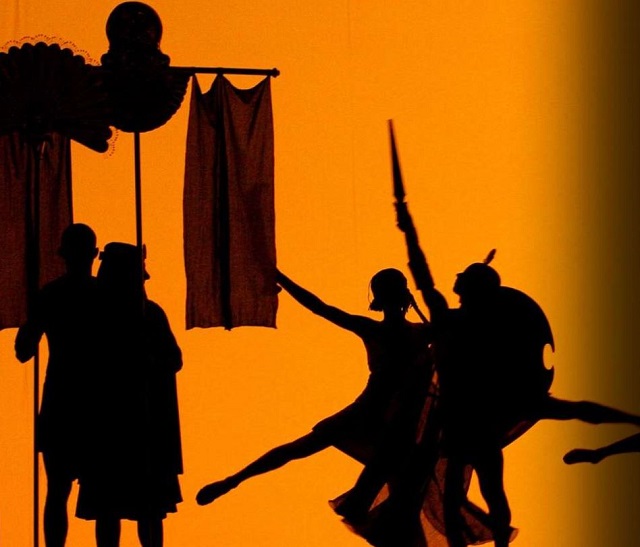
Opera in four acts
Libretto: Antonio Ghislanzoni after an outline by Auguste Mariette
World premiere: Cairo, 24 December 1871
Polish premiere: Warsaw, 23 November 1875
Premiere of this production: 24 April 2005
In the original Italian with Polish surtitles
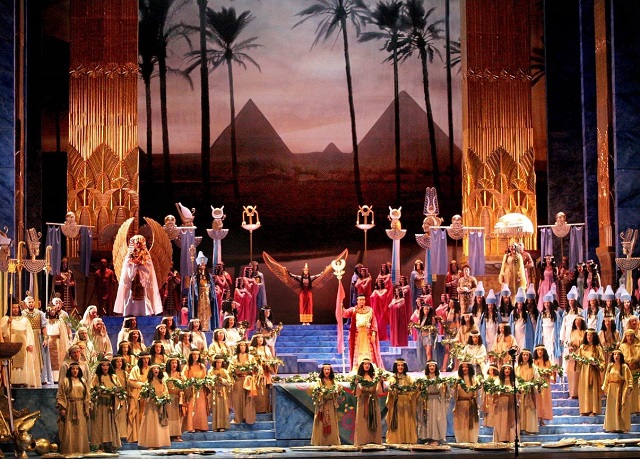
Aida has long formed part of the group of most popular operas of all time. The title maintains its status despite belonging to the genre of nineteenth century grand opera, for the most part discredited by posterity due to its pompous convention leaving a discernible mark on both ensemble scenes and main character psychology. Although the genesis of Aida is linked to the long celebrations of the Suez Canal’s opening and the construction of a new opera house in Cairo, Verdi managed to escape the pseudo-folkloristic local colour styling. Admittedly, he did not stint on impressive ballet numbers or the popular Triumphal March, but all the pages of this great score are filled exclusively with his own, entirely unique compositional style. Through focusing mainly on the musical characterization of his protagonists the composer once more reached the legendary pinnacles of melodic and instrumental inventiveness. The staging, successfully maintaining its place in the repertoire of Teatr Wielki – Polish National Opera for ten years, was created in the spirit of nineteenth-century idea of the correspondence of arts.
SYNOPSIS
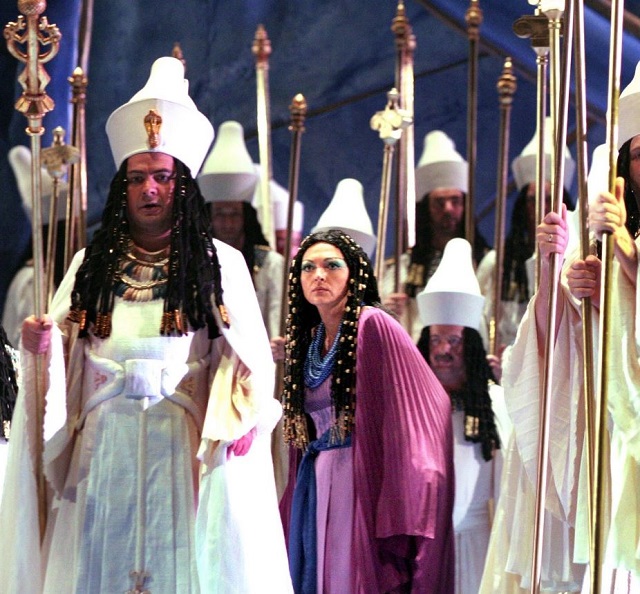
Act One The rumour that the Ethiopian army has attacked the country causes Radamès, the captain of the Egyptian Guard, to dream of leading the army into war. If he were to be victorious, he would like to marry his secret mistress Aida, who is a prisoner of war living as a slave at the Egyptian court. He has no idea of Aida’s true identity; she is in fact the daughter of the king of Ethiopia. Amneris, the daughter of the king of Egypt, is herself in love with Radamès and suspects that she has a rival in Aida. A messenger arrives and confirms the rumour; the Ethiopians have attacked the country under the leadership of their king, Amonasro.
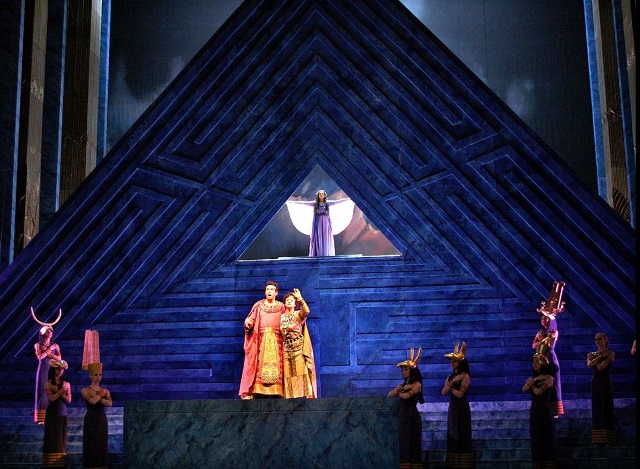
Radamès is proclaimed commander-in-chief of the Egyptian army. The king and the High Priest, Ramfis, lead the Egyptians in their rejoicing about the war. Amneris hopes that Radamès will return as victor. Aida joins in the general rejoicing but realizes the full meaning of her words when she remains alone. She imagines a scene in which Radamès has taken her father prisoner and begs the gods to let her die. Praise is offered to the god Phta in a solemn ceremony. Ramfis asks him to bring them success in war and equips Radamès with consecrated weapons.

Act Two Amneris has the slaves dance for her and dress her for the festivitiy with which the victorious army will be welcomed. She tricks Aida into admitting her secret love. Amneris taunts her slave with the fact that she is her rival and this makes Aida both proud and afraid at the same time. In order to demonstrate her superiority, Amneris orders Aida to accompany her to the festivities. The Egyptians and their priests assemble with the king to greet the triumphant army, and the prisoners of war are brought before the king, among them Amonasro.

When Aida catches sight of him, he begs her not to reveal his position as leader. He pretends to be someone else and allows the Egyptians to think that the Ethiopian king has been killed in battle. He begs the king of Egpyt for mercy. Ramfis and the priests remind the king of the gods‘ wish that the prisoners should be killed. When the king grants Radamès a special request, he begs that the prisoners be set free. Finally the king follows the advice of the High Priest, and Aida and her father are to be kept as surety. He rewards Radamès for the victory by giving him his daughter’s hand in marriage. Amneris rejoices, Aida is without hope and in despair. Radamès privately thinks that he would prefer a life with Aida to the throne of Egpyt.
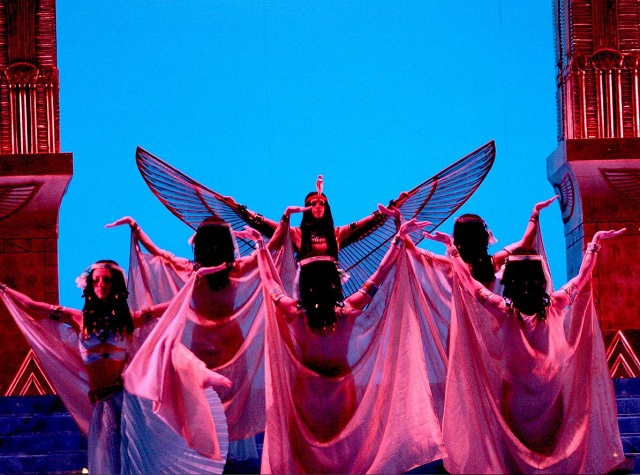

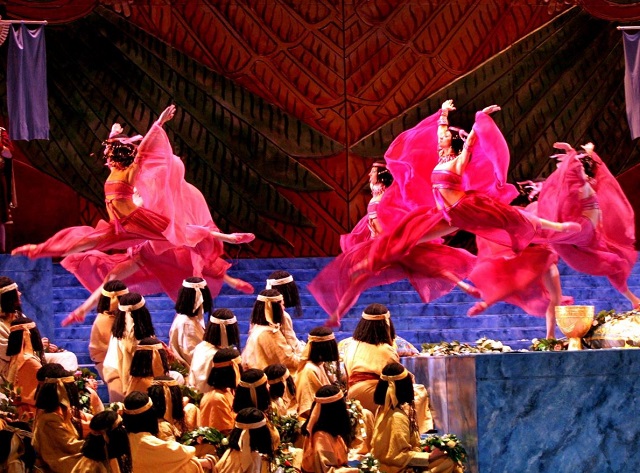
Act Three On the eve of her wedding, Amneris is taken to the Temple of Isis by Ramfis. She is to prepare herself for marriage by praying there. Aida and Radamès have arranged to meet not far away from the temple. Amonasro, who knows of her secret love, appears and uses his knowledge to put Aida under pressure to discover from Radamès the Egyptians‘ plan for the the next battle. When she refuses he reminds her of her duty to her country and threatens to disown her as his daughter. He hides and listens, with Aida’s knowledge, to her conversation with Radamès. She has doubts about the success of his plan to ask the king for her hand after the next battle and suggests that they should flee together. She manages to get him to reveal, unintentionally, the secret war plan, the place where the next attack is to take place.
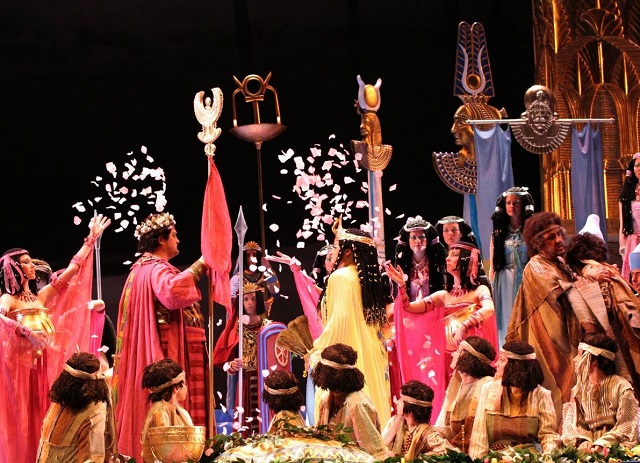
When Amonasro shows himself, Radamès learns the true identity of his beloved. He realizes in despair what he has done. Amneris, the priests and the guards come on the scene. Radamès makes it possible for Amonasro and Aida to flee and gives himself up to Ramfis.
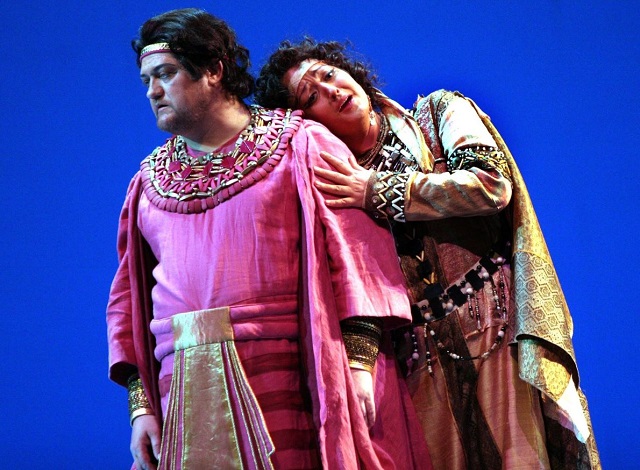
Act Four In spite of the fact that he is a traitor, Amneris still loves Radamès and wants to save his life at all costs. She wants to beg for mercy for him if he will only give up Aida. But Radamès spurns her, all he wants now is to die and he is led before the priests‘ court, accused of being a traitor. He emains silent in the face of the priests‘ accusations and is condemned to be locked up alive and left to die in a dungeon under the temple. Amneris curses the priests and maintains again and again that Radamès is innocent.

Radamès is awaiting death when he sees Aida, who has crept in to be with him. She wants to die in his arms. In their imagination they see the heavens opening to them. Aida collapses in his arms. Amneris begs for peace for Radamès.
Synopsis © Bavarian State Opera
CAST

STAFF


The full vocal score of this magnificent composition is AVAILABLE FROM AMAZON.COM or BARNES & NOBLE
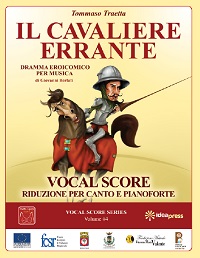
The full vocal score of this magnificent opera is AVAILABLE FOR THE FIRST TIME IN HISTORY FROM AMAZON.COM or BARNES & NOBLE
 The full vocal score is AVAILABLE FOR THE FIRST TIME IN HISTORY FROM AMAZON.COM or BARNES & NOBLE
The full vocal score of this magnificent opera is AVAILABLE NOW FROM AMAZON.COM


Torna a Trapani il Concorso Lirico Internazionale Giuseppe Di Stefano. L’Ente Luglio Musicale Trapanese – Teatro di Tradizione bandisce la XXI edizione, finalizzata alla scoperta e al lancio di emergenti voci liriche, in programma dal 13 al 16 maggio 2026, presso la Sala Grande del Complesso Monumentale San Domenico. Possono partecipare cantanti lirici di qualsiasi […]

Sold out e grande emozione nella Cattedrale di San Lorenzo, a Trapani, per il capolavoro incompiuto di Mozart, con la direzione di Nicola Kitharatzis e un cast di solisti di rilievo internazionale Trapani, 31 marzo 2026 – Si è aperta la 78ª Stagione del Luglio Musicale Trapanese con il Requiem in Re minore K. 626 […]

Al via il IV° “Sabbioneta chamber Opera festival – Residenze 2026” Un grande progetto internazionale dedicato ai giovani talenti della lirica e della musica antica Con grande entusiasmo, l’Associazione “Concetto Armonico APS”, in collaborazione con il Comune di Sabbioneta e la Fondazione Sabbioneta Heritage, annuncia il lancio della quarta edizione del “Sabbioneta chamber Opera festival – Residenze”, dove […]

Presentata la 78a Stagione del Luglio Musicale Trapanese Ventuno appuntamenti da marzo a dicembre. Si apre domenica 29 marzo con il Requiem di Mozart in Cattedrale: ingresso libero per la città. È stata presentata nella Sala Grande del Complesso San Domenico, a Trapani, la 78ª Stagione dell’Ente Luglio Musicale Trapanese, Teatro di Tradizione riconosciuto dal […]

La Società Dante Alighieri e il Teatro dell’Opera di Roma presenteranno mercoledì prossimo, 4 febbraio, alle ore 17.30 a Palazzo Firenze (Roma), “Inferno”, l’opera, in chiave contemporanea composta da Lucia Ronchetti, è ispirata alla prima cantica della Commedia di Dante Alighieri.Durante la conferenza interverranno Alessandro Masi, Segretario generale della Società Dante Alighieri, Giuliano Danieli, Fondazione Teatro dell’Opera di Roma, Lucia Ronchetti, Compositrice, […]

Il cuore del melodramma italiano e il romanticismo europeo approdano al Cairo per una grande serata di cultura. Un quintetto di artisti d’eccezione guiderà il pubblico in un viaggio emozionante tra le arie, i duetti e i capolavori pianistici più amati di sempre con “Opera Concert – Recital for 4 voices and piano”, in programma il 5 febbraio alle […]

Recensione di Salvatore Margarone La ripresa al Teatro Filarmonico di Verona del Don Giovanni di Mozart, nell’allestimento firmato da Enrico Stinchelli e già presentato nella stagione 2019, conferma le perplessità emerse fin dal suo debutto. La regia, improntata a un sostanziale rispetto letterale del libretto, si colloca su un piano prevalentemente illustrativo, rinunciando a un’elaborazione […]

L’imponente Aida di Giuseppe Verdi, nel leggendario allestimento firmato da Franco Zeffirelli, sarà in Australia a febbraio 2027. Dopo il rinvio annunciato alcuni mesi fa, sono ora state definite le nuove date dell’evento: venerdì 26 e sabato 27 febbraio 2027. La Fondazione Arena di Verona porterà in scena all’Adelaide Oval l’opera regina, nell’ambito dell’Adelaide Festival 2027.A 25 anni esatti dal suo debutto in Arena, […]

Articolo di Gianluca Macovez Il Maestro di canto pronto ad inaugurare l’Accademia del Belcanto nel New Jersey Su questo sito qualche tempo fa avevamo pubblicato un’intervista a Massimo Iannone, Maestro di canto di valore internazionale. Ci piace parlare di nuovo di questo artista, perché da allora la sua attività ha avuto un deciso incremento: lasciata […]

Sala gremita e grande partecipazione di pubblico per “Un viaggio a Venezia”, il concerto di Natale dedicato ad Antonio Vivaldi che ha concluso la prima serie di quattro appuntamenti musicali di “L’anima italiana – I Maestri della Musica Classica”, progetto ideato e promosso dalla Società delle Associazioni Italiane di Ginevra (SAIG) che rende omaggio a otto tra i più celebri compositori italiani, […]
Tiziano Thomas Dossena, Author & Editor
Di Raffaele Pisani
A memoir by Cav. Gilda Battaglia Rorro Baldassari


 Opera, My Love Magazine