Beethoven’s Missa Solemnis in Sidney

beethoven

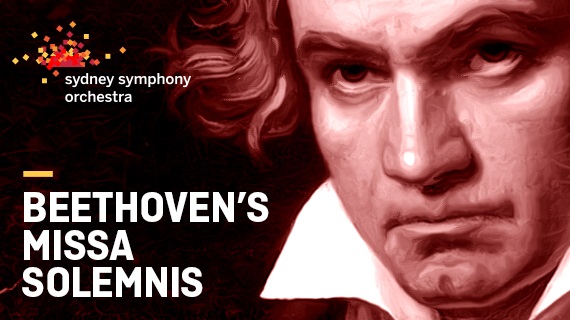
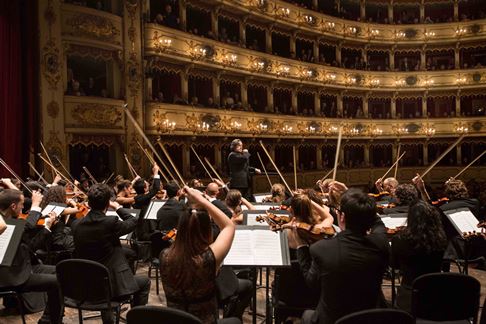
Beethoven’s Missa Solemnis

14 October 2015– 17 October 2015

Experience Beethoven at his most visionary and inspirational with solo voices, a grand choir and full orchestra. Magnificent, ambitious, glorious!

Description

Beethoven said his Missa Solemnis was ‘my greatest work’. He put his heart and soul into this music over a period of nearly four years – well and truly missing his deadline along the way – and the result is magnificent, ambitious and gloriously inspiring.

Beethoven wrote on the finished manuscript: “From the heart – may it return to the heart.” And our chief conductor David Robertson offers these concerts as a musical gift from the heart to Sydney audiences, bringing together the full forces of Sydney Philharmonia Choirs and an impressive line-up of soloists for Beethoven’s life-affirming and visionary creation.


Artist Information

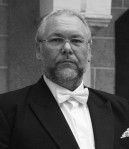
David Robertson conductor
Susanna Philips soprano
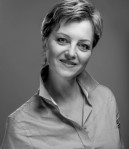
Olesya Petrova mezzo-soprano
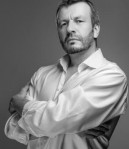
Stuart Skelton tenor
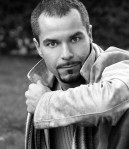
Shenyang bass
Sydney Philharmonia Choirs


Performance Dates

Wednesday 14 October 8pm
Friday 16 October 8pm
Saturday 17 October 8pm

Posted in Music | Leave a comment

ANNA BOLENA AT THE MET

bolena_met
metlogoSEP 26 – JAN 9

Soprano Sondra Radvanovsky embarks on her quest to vocally conquer all three of Donizetti’s historic Tudor queen operas in the same season, here as a young royal grasping at power and paying a terrible price. Bass Ildar Abdrazakov is King Henry VIII, not one of history’s kindest husbands; mezzo-soprano Jamie Barton is Jane Seymour, the king’s consort and the reason the queen loses her head. Tenor Stephen Costello plays the queen’s love interest in Sir David McVicar’s gripping period production. Marco Armiliato conducts.

anna-bolena_649x486

World premiere: Milan, Teatro Carcano, 1830. Met premiere: September 26, 2011. The first of Donizetti’s operas to achieve wide success, Anna Bolena is based on the historical episode of the fall and death of England’s Queen Anne Boleyn, second wife of Henry VIII. While many operas use history as a point of departure for storytelling, Anna Bolena stays closer to real events than most. The lead role was created by Giuditta Pasta, a great prima donna of her day who would also sing the premiere of Bellini’sNorma the following year.

 CREATORS

Donizetti, GaetanoGaetano Donizetti (1797–1848) composed about 75 operas in a career abbreviated by mental illness and premature death. Most of his works disappeared from the public eye after his death, but critical and popular opinion of his huge opus has grown considerably over the past 50 years. Felice Romani (1788–1865) was the official librettist of Milan’s Teatro alla Scala and worked with Donizetti on several other operas.

PRODUCTION Sir David McVicar

SET DESIGNER Robert Jones

COSTUME DESIGNER Jenny Tiramani

LIGHTING DESIGNER Paule Constable

CHOREOGRAPHER Andrew George

SETTING

The trial of Anne Boleyn took place on May 15, 1536, and her execution followed four days later. The opera’s first act is set during the weeks leading up to the trial, in Greenwich Castle near London. Act II takes place at the Tower of London, between trial and execution.

Anna_Bolena_02.9

MUSIC

One of the most striking characteristics of all of Donizetti’s works is the power and abundance of melody that, in context, reveals a deeper dramatic purpose. Nowhere in Anna Bolena is this combination more apparent than in the final scene. As Anne awaits her execution, she goes through a variety of emotions and mental conditions, including terror, illusory calm, and confusion bordering on hallucination—all leading to a final climactic outburst that is a masterpiece of musical insight and a superb example of opera’s ability to explore the human dimensions behind history.

bolena_met2

CAST

CONDUCTOR

Marco Armiliato

PERFORMING

ALL DATES

ANNA BOLENA

Sondra Radvanovsky

PERFORMING

ALL DATES

GIOVANNA SEYMOUR

Jamie Barton

PERFORMING

SEP 26
OCT 1,5,13
JAN 5,9

GIOVANNA SEYMOUR

Milijana Nikolic

PERFORMING

OCT 9

SMETON

Tamara Mumford

PERFORMING

ALL DATES

LORD RICCARDO PERCY

Stephen Costello

PERFORMING

SEP 26
OCT 1,5
JAN 5,9

LORD RICCARDO PERCY

Taylor Stayton

PERFORMING

OCT 9,13

ENRICO VIII

Ildar Abdrazakov

PERFORMING

ALL DATES
bolena_met
Posted in OPera | Leave a comment

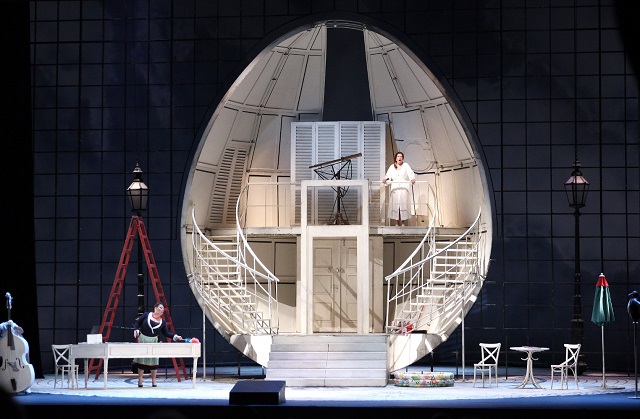
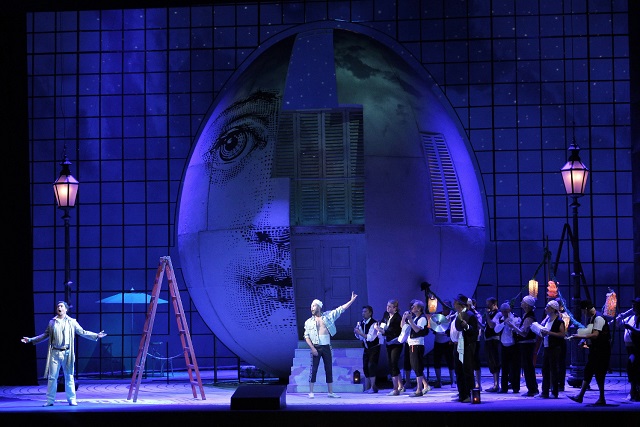
Il barbiere di Siviglia at the National Theatre in Prague

   barber4Il barbiere di Siviglia

Gioachino Rossini

OCTOBER 10 & 16, NOVEMBER 6

nationaltheatre


Libretto: Cesare Sterbini
Musical preparation: Enrico Dovico
Conductor: Enrico Dovico, Tomáš Brauner
Stage director: Martin Otava
Sets: Ján Zavarský
Costumes: Bettine Kirste
Chorus master: Adolf Melichar
Dramaturgy: Jitka Slavíková

State Opera Orchestra

State Opera Chorus

Premiere: September 29, 2005

barber3

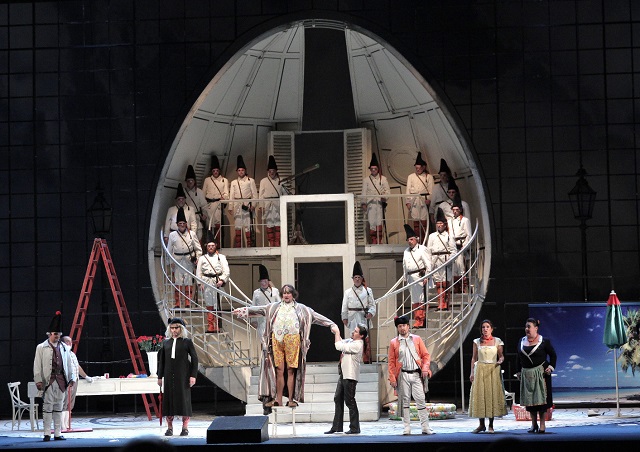
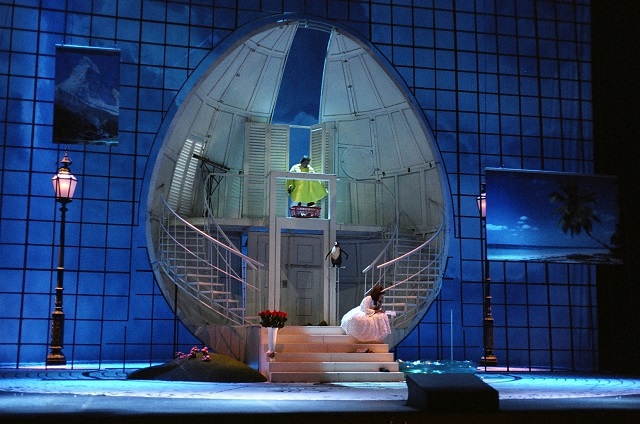
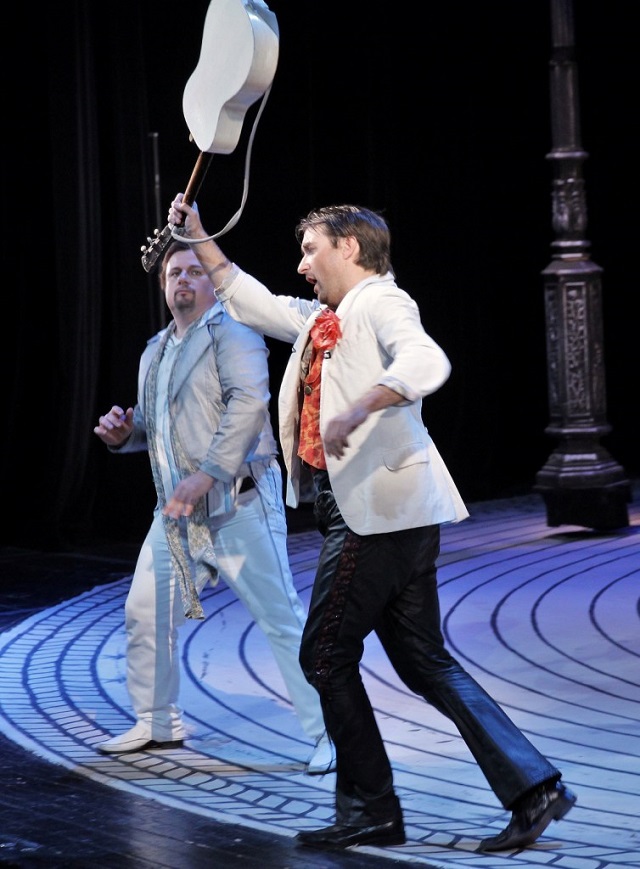
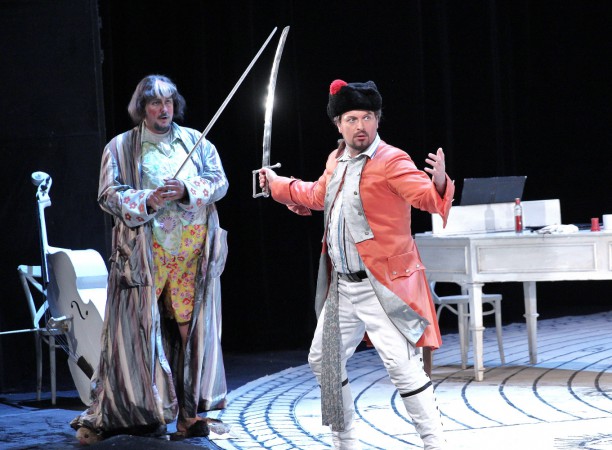
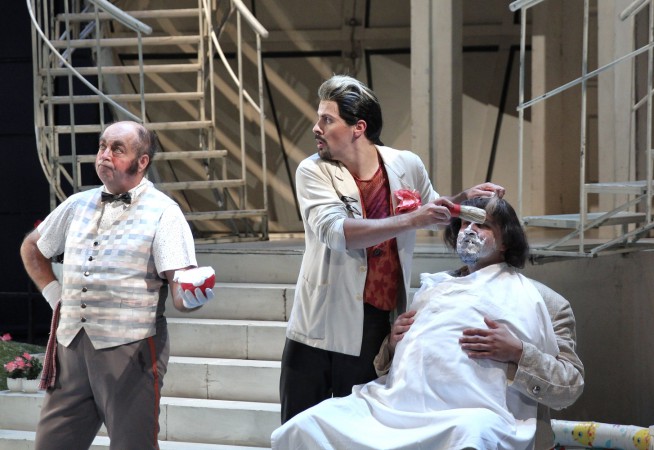
Figaro, the most famous barber of all time, whose wit, as sharp as his razor, helps Count Almaviva to win his beloved Rosina. Love, guile and intrigue, these are the ingredients of Rossini’s superlative comic opera. The sparkling charm of the music, the forcible virtuoso parts of the heroes – the impish Rosina with bravura coloraturas and the mettlesome Figaro – as well as the rapid tempo at which the action hurtles forward, have secured Il barbiere di Siviglia a permanent position in the global repertoire.

barber2

Today, it beggars belief that the premiere on 20 February 1816 in Rome caused one of the greatest scandals in opera history! The work teems with dashing comic scenes, yet more serious tones appear too – one such being in the famous aria of the music teacher Don Basilio about slander, which still holds true today.

barber5

Nevertheless, the author of the comedy Le Barbier de Séville, on which the libretto is based, the celebrated French playwright Pierre Beaumarchais, wrote that he above all wanted “to succumb to his merry temper and return the original joyful mood to theatre”. Rossini’s opera directly links up to this intention, and the same is the objective of the State Opera production, which was also received with great enthusiasm when performed in Salzburg in October 2007.

The opera is staged in Italian original version and Czech and English surtitles are used in the performance.

Duration of the performance: 3 hours, 1 intermission

barber1

CAST

Figaro

Jiri Brueckler

Jiri Brueckler

Sem Svatopluk

Sem Svatopluk

Count Almaviva

Count_Ales_Briscein

Ales Briscein

Count_brezina-jaroslav

Jaroslav brezina

Count_srejma-martin

Sreima Martin

Bartolo

Bartolo_jiri-sulzenko

Jiri Sulzenko

Bartolo_milos_horak

Milos Horak

Rosina

Rosina_adriana-kucerova03

Adriana Kucerova

Rosina_jana-horakova-levicova

Jana Horakova Levicova

Rosina_kapustova-michaela

Michaela Kapustova

Basilio

Basilio_hrachovec-ivo

Ivo Hrachovec

Basilio_mikulas-peter

Peter Mikulas

Basilio_zahradnicek-frantisek

Frantisek Zahradnicek

Berta

Berta_hilscherova-lucie

Lucie Hilscherova

Berta_mugrova-sylva

Sylva Mugrova

Fiorillo

matousekmartin

Martin Matousek

socha-ondrej1

Ondrej Socha

Igor Loskar

Igor Loskar

Jiri Hruska

Jiri Hruska

Ambrogio

miroslav-svoboda-038

Svoboda Miroslav

Libor Novak

Libor Novak


barber8 barber7

Posted in OPera | Tagged | Leave a comment

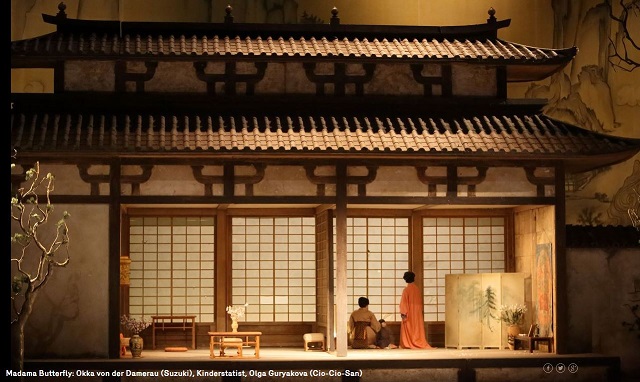
Madama Butterfly in Munich

butterflytitle

bayerischeoperalogoJapanese tragedy in three acts

Composer Giacomo Puccini · Libretto by Luigi Illica and Giuseppe Giacosa
In Italian with German surtitles

Saturday, 19. September 2015
07:00 pm – 09:55 pm
Nationaltheater

Duration est. 2 hours 55 minutes · 1 Interval between 1. Teil and 2. Teil (est. 08:00 pm – 08:30 pm )

butterfly1

CAST

Musical Director Keri-Lynn Wilson

Production Director Wolf Busse

Stage Director Otto Stich

Costumes Silvia Strahammer

Choir Director Stellario Fagone

butterfly2


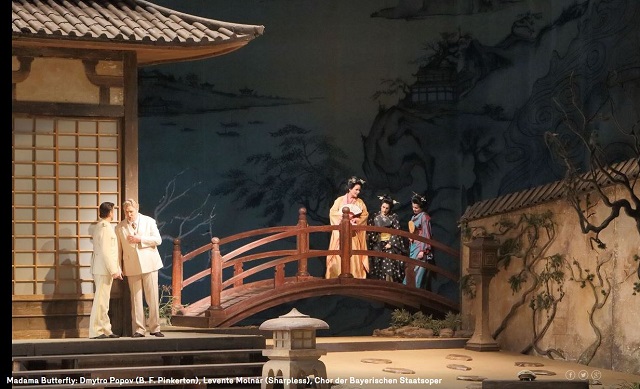
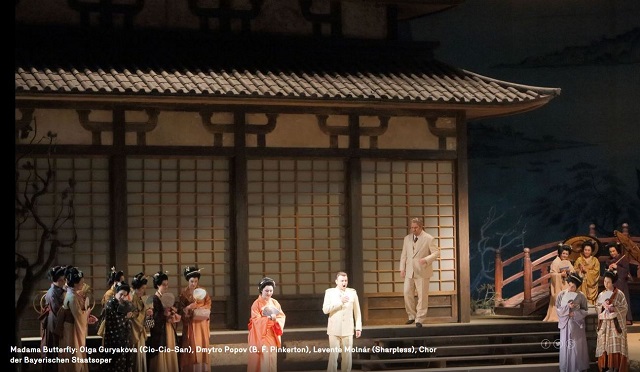
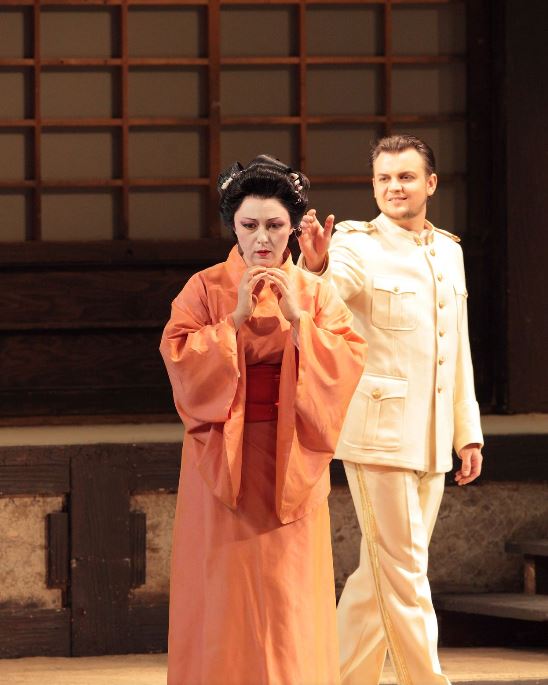
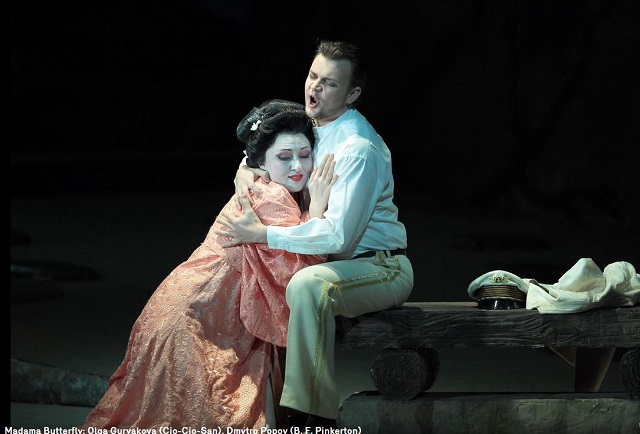
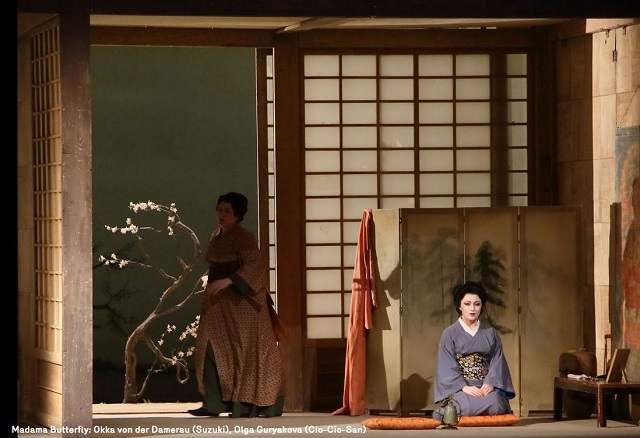
Cio-Cio-San Hui He
Suzuki Okka von der Damerau
B. F. Pinkerton Joseph Calleja
Sharpless Levente Molnár
Goro Nakodo Ulrich Reß
The Prince Yamadori Andrea Borghini
Onkel Bonzo Peter Lobert
Kate Pinkerton Marzia Marzo
Yakusidé Igor Tsarkov
The Imperial Commissioner John Carpenter
    • Bayerisches Staatsorchester
    • Chorus of the Bayerische Staatsoper

butterfly3

SYNOPSIS

Act I
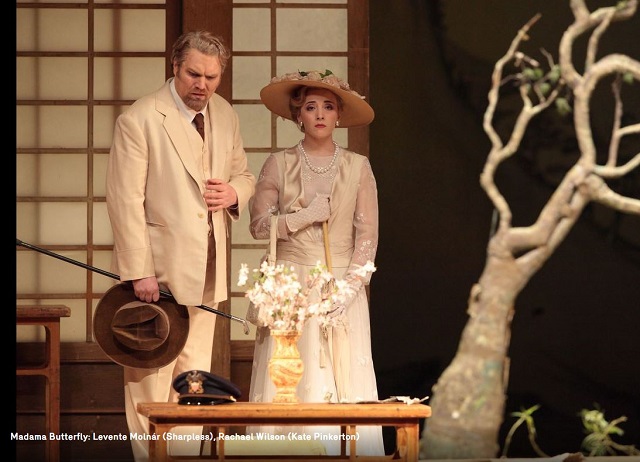
The U.S. naval officer Pinkerton, along with a marriage broker named Goro, comes to inspect a house near Nagasaki he has bought to live with the geisha Butterfly, whom he plans to marry according to Japanese law. This law however allows him to abandon his wife whenever he feels like it. He casually brushes off the warnings of the American Consul Sharpless, who has told him that Butterfly takes love and marriage very seriously.

butterfly7Before Butterfly appears, he drinks a toast “to a future marriage with a genuine American woman”. Butterfly now appears with her friends, attended by members of her family. Hardly has the marriage ceremony ended when Butterfly’s uncle arrives and curses the girl for having renounced the faith of her ancestors. Cast out by all the others, all Butterfly has left is her great love.

butterfly4

Act II
Three years have passed. After a brief period of happiness, Pinkerton has left Butterfly. She lives with her servant Suzuki, confidently waiting for her husband’s return, although she has not received a single sign of life from him. The consul comes to visit Butterfly. He explains to her that Pinkerton will never return.

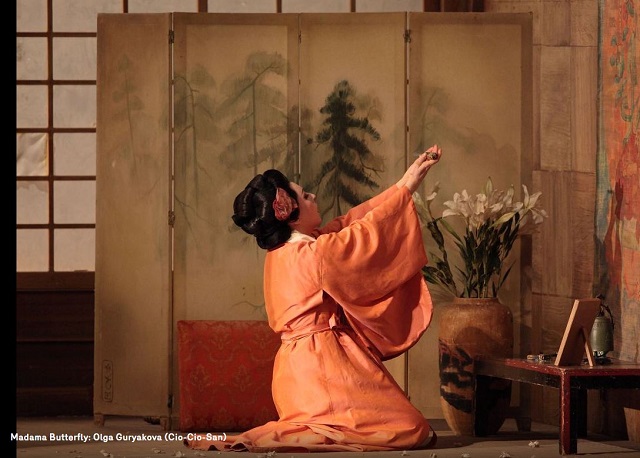
butterfly5He cannot bring himself to tell Butterfly that he has married an American woman. Then she triumphantly shows him Pinkerton’s child. Sharpless leaves the house after advising her to marry the rich Yamadori who has been courting her. She however feels bound to Pinkerton and refuses. Then the cannon in the harbor goes off. Butterfly recognizes Pinkerton’s vessel. Full of hope, she decorates the room and waits in her bridal gown for her beloved.

butterfly6

Act III
Morning dawns. Butterfly has been waiting in vain all night. Finally she goes into the next room with the child in her arms to get a little rest. Pinkerton and Sharpless arrive. Suzuki finds out the whole story. Lamenting, she promises to prepare Butterfly for the worst. Full of remorse, Pinkerton goes running off. Awakened by the sound of the voices, Butterfly returns to the room: full of hope she looks for Pinkerton. Suddenly a strange woman appears. Butterfly discovers the truth from Sharpless. As if this weren’t enough – they want her to turn over her child. All that remains for Butterfly is death.

butterfly8butterfly9butterfly10
butterfly11English translation by Donald Arthur

© Bavarian State Opera

Posted in OPera | Tagged , , , , , , , | Leave a comment

The Salzburg Festival continues with Riccardo Muti and Ernani

Motive Ernani, © Salzburger Festspiele / Luigi Caputo

Motive Ernani, © Salzburger Festspiele / Luigi Caputo

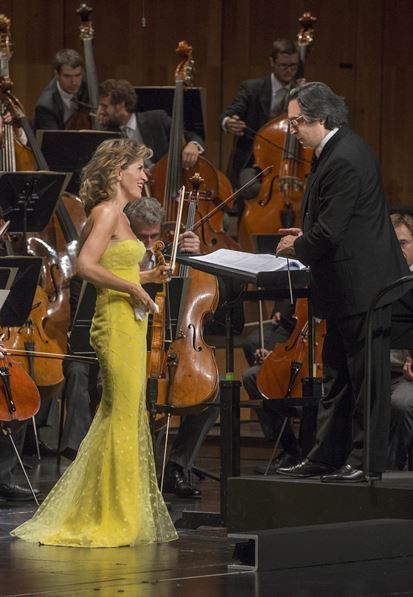
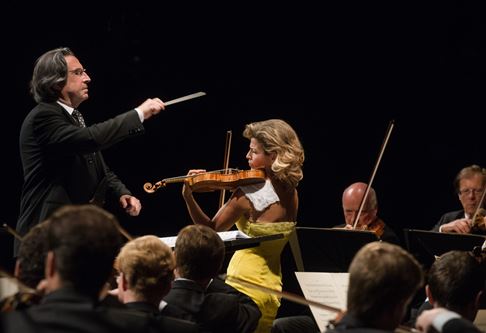
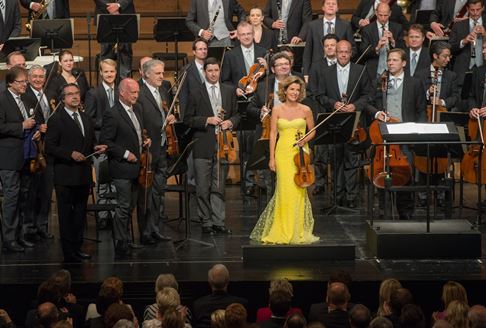
After directing the Vienna Philharmonic at the Salzburg Festival on August 14, 15 and 16:
PYOTR I. TCHAIKOVSKY • Concert for Violin and Orchestra in D, Op. 35
JOHANNES BRAHMS • Symphony No. 2 in D, Op. 73

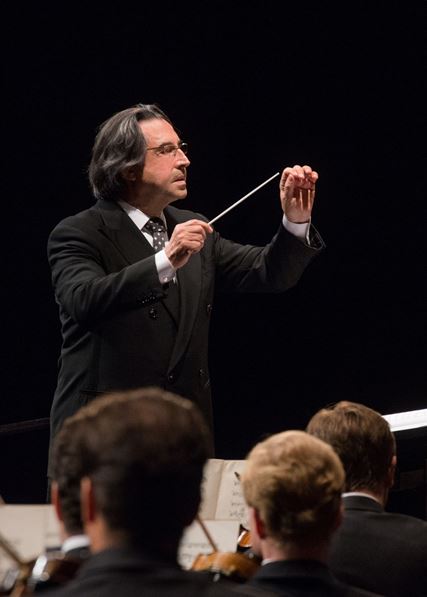
Riccardo Muti directs the Orchestra Giovanile Luigi Cherubini on August 27 and 29 at the same Festival in:

Giuseppe Verdi • Ernani

Dramma lirico in four acts by Giuseppe Verdi (1813–1901)
Libretto by Francesco Maria Piave (1810–1876) after Victor Hugo’s play Hernani, ou L’Honneur castillan (1830)

Concert performance
With German and English surtitels

Duration of the opera approx. 2 hours and 50 minutes.

This will be th 45th year of uninterrupted collaboration between the Maestro Riccardo Muti and the Salzburg Festspiele, and he will have stepped on the Salzburg podium 248 times, as of August 29!

logo_plus_en_2016

 At The Grosses Festspielhaus

Riccardo Muti, Conductor
Ernst Raffelsberger, Chorus Master
Giuseppe Montanari, Conductor Stage Music
Performers: Francesco Meli, Vittoria Yeo, Luca Salsi, Ildar Abdrazakov, Antonello Ceron, Gianfranco Montresor, Simge Büyükedes
Concert Association of the Vienna State Opera Chorus
Orchestra Giovanile Luigi Cherubini
Members of the Mozarteum Orchestra Salzburg

Salzburger_Festspiele_Marco_Borrelli4

web-Cherubini_c_Silvia_Lelli

Orchestra Giovanile Luigi Cherubini. Photo copyright Silvia Lelli

Orchestra Giovanile Luigi Cherubini

Founded by Riccardo Muti in 2004, the Luigi Cherubini Youth Orchestra was named after one of the leading Italian-born composers of all time who lived and worked throughout Europe. Like him, the orchestra combines a strong national identity with a natural inclination towards a European vision of music and culture. The youth orchestra forms a privileged link between the academic and professional worlds and has set up its residence in Piacenza, with the Ravenna Festival as its summer home. The Cherubini Youth Orchestra is an ensemble of young musicians under 30 coming from all over Italy. The members are selected by audition by a committee of leading players from prestigious European orchestras headed by Riccardo Muti. Dynamism and continuous renewal are the distinctive features of the orchestra and it is in this perspective that members are only appointed for a period of three years, which may lead them to a major professional orchestra.
In recent years, under Riccardo Muti, the orchestra has tackled a repertoire ranging from the Baroque to 20th-century music, giving concerts in several Italian cities, as well as important tours to Vienna, Paris, Moscow, Salzburg, Cologne, St Petersburg, Madrid, Barcelona, Buenos Aires and elsewhere. Besides intense activity under its founder’s baton, the orchestra has collaborated with artists such as Claudio Abbado, John Axelrod, Rudolf Barshai, Dennis Russell Davies, Gérard Depardieu, Michele Campanella, Kevin Farrell, Patrick Fournillier, Herbie Hancock, Leonidas Kavakos, Lang Lang, Ute Lemper, Alexander Lonquich, Wayne Marshall, Kurt Masur, Anne-Sophie Mutter, Kent Nagano, Krzysztof Penderecki, Donato Renzetti, Vadim Repin, Giovanni Sollima, Yuri Temirkanov, Alexander Toradze and Pinchas Zukerman.
The debut of Cimarosa’s Il ritorno di Don Calandrino at the 2007 Salzburg Whitsun Festival marked the first step of a five-year project undertaken by the Salzburg Festival and the Ravenna Festival with a view to rediscovering and reviving the legacy of the Neapolitan school of music of the 18th century. As orchestra in residence, the Cherubini Youth Orchestra was the protagonist in this project. The triumphal welcome of the Viennese audience at the Golden Hall of the Musikverein was followed, in 2008, by the prestigious Abbiati Award for best music project, for ‘the outstanding achievements which made [the Cherubini Youth Orchestra] an excellent ensemble, appreciated at home and abroad’.
The Cherubini Orchestra also lead such challenging projects as the ‘trilogies’ that the Ravenna Festival staged to celebrate the bicentenary of Verdi’s birth. The six operas, arranged in two trilogies, were conducted by Nicola Paszkowski and directed by Cristina Mazzavillani Muti at the Teatro Alighieri in Ravenna. 2012 saw Rigoletto, Il trovatore and La traviata on the same stage on three consecutive days and then on an extensive tour, culminating in Manama, the capital of Bahrain, for the grand opening of the local opera house. 2013 was the year of the Shakespearean trilogy: Macbeth, Otello and Falstaff, once again staged in the same theatre on three consecutive days. Also within the programme of the Ravenna Festival, the Cherubini Orchestra and Riccardo Muti have been the protagonists of a series of Le vie dell’amicizia concerts, the latest of which, in 2014, marking the centenary of World War I, took place at the Redipuglia military memorial, involving musicians from orchestras from all over the world.
The management of the orchestra is entrusted to the Cherubini Foundation, established by the municipalities of Piacenza and Ravenna, the Toscanini Foundation and Ravenna Manifestazioni. The orchestra’s activity is supported by the Ministry for Arts and Culture with the contributions of the Chamber of Commerce of Piacenza, the Piacenza and Vigevano Foundation, the Italian Manufacturers’ Association (Piacenza) and the Friends of the Luigi Cherubini Youth Orchestra Association.
http://www.orchestracherubini.it

Motive Vienna Philharmonic Salzburger Festspiele Luigi Caputo

Motive Vienna Philharmonic Salzburger Festspiele Luigi Caputo

Photos from concert with the Vienna Philarmonic are Copyright of Salzburger Festspiele, Marco Borrelli

PERFORMERS of the August 14, 15 1nd 16 concert:

Riccardo Muti, Conductor
Anne-Sophie Mutter, Violin
Vienna Philharmonic


Salzburger_Festspiele_Marco_Borrelli7

Salzburger_Festspiele_Marco_Borrelli3Salzburger_Festspiele_Marco_Borrelli2Salzburger_Festspiele_Marco_Borrelli5Salzburger_Festspiele_Marco_Borrelli1


Posted in Music | Tagged | Leave a comment

Vincenzo Bellini: a true Sicilian

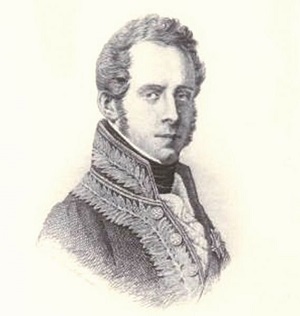
francescodi-bartolo-ritrattodibellini

Francesco Di Bartolo: portrait of Vincenzo Bellini, acquaforte.

As a true Sicilian man, I would like to explain the personality of Vincenzo Bellini (1801 – 1835) in a different point of view from the routine of music and historical criticism that you are used to read in magazines. To date, in fact, when you read something about this composer, only the vicissitudes of his life are told or only comments about his works. But Vincenzo Bellini, Sicilian, was not an ordinary person, in the sense that the personality of a Sicilian is a set of alchemy that arise and are rooted in the same ground.

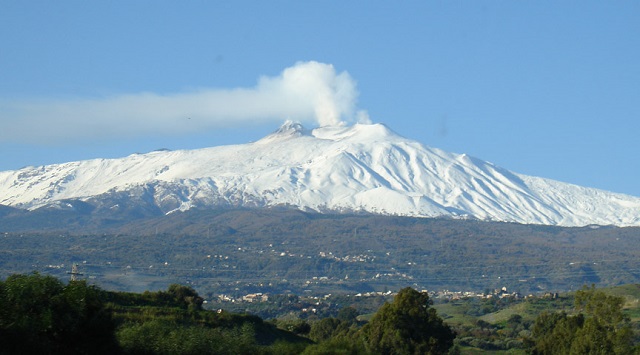
etna_myloveLand of sea, sun, wind and fire, elements of nature that are found everywhere, or almost, Sicily has them in a different way than in other parts of Italy.

To be born in Sicily means having the fire in the veins, a fire that burns inside, that destabilizes every day, a fire that gives joy and pain at the same time, virility and transience. Fire that comes from “a muntagna” (Etna), as the natives of Catania call it, that is the same towards which every day they look back north to understand how it will behave … if it has the steaming plume or it is quite.

So Bellini took inspiration for his compositions from that fire inside, that water from the crystalline sea, the breeze that caresses continually the city of Catania, the scents that intoxicate the senses, from the wild broom sticking with arrogance from the lava rocks of Etna.

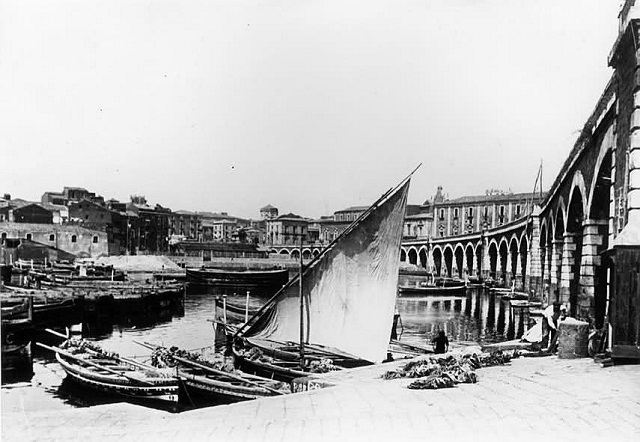
Catania, archi della marina; porto

Catania, archi della marina; porto

Catania, Archie della marina, porto.

Catania, Archie della marina, porto.

Yet, to date, rare were the performances of his works in which the elements of nature that inspired the Swan of Catania are concerned; more lyrical than dramatic art, that of Bellini, the melodic line pure and clear, stripped of extrinsic complexity, where the harmonies, counterpoints and instrumental effects have value only in relation to the song. Song that he loved and knew how to put in music in a recognizable way among many, unique, single and unrepeatable, but not sugary, which instead is found in modern performances.
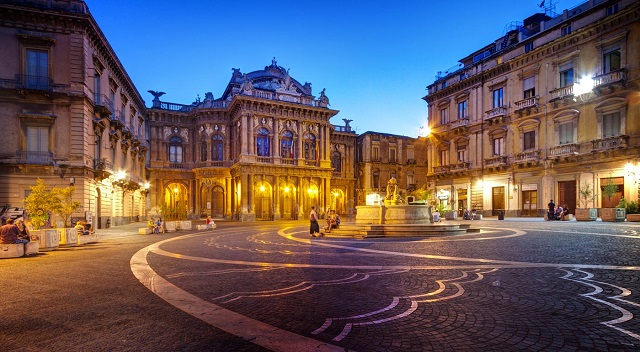
Bellini Theater in Catania

Bellini Theater in Catania

Catania; cathedral

Catania; cathedral

Bellini loved to walk in his city, in the streets of the old town: Via Etnea, Piazza Duomo, Via Crociferi, Piazza Stesicoro, all related to his childhood. Vincenzo loved also the sea, in fact, he was often at the “marina” (the port), close to breathe the sea air and watch the slow movement and undulating, who inspired him in his singable.

But being Sicilian also means having full awareness of death, a world with which it faces life in parallel, with fatality, just think of his Lyric Chamber, such as “Dolente immagine di Fille mia” (Sad image of my Phyllis) or “Bella Nice, che d’amore” (Beautiful Nice, that of love), which tell of death, or as “Il Pirata” (The Pirate), Sicilian subject drama and full of pathetic situations.

Portrait of Bellini by catanese artist Francesco Di Bartolo (1826-1913).

Portrait of Bellini by catanese artist Francesco Di Bartolo (1826-1913).

Perhaps all this has led the perpetrators of today to distort his personality even in those works, which are performed languidly, slowly, subdued, when in fact it is here that should emerge that fire that burns within, like lava, glowing, hatching inside “a muntagna”. Based on this assumption, in this writer’s opinion, the literature of Bellini’s music should be reviewed, full of mettle yet fatality.

Nowadays, in the birthplace of Bellini you can find the Bellini Museum, full of memorabilia, instruments and scores of the composer who deserve to be seen, not so much by tourists, but by musicians playing his music. Perhaps you will begin to get what the writer here wants you to understand: breathing that wonderful and sublime stale air of those rooms would lead to reflect not a little! Only then we would witness true music masterpieces.

© Salvatore Margarone

Translation by Ilenia Carraro

Posted in Article, Music | Tagged | Leave a comment

Verdi’s Requiem in Adelaide

adelaidelogo

requiem

requiem1Verdi Requiem

Presented by State Opera of South Australia

7:30pm: 26, 28 August 2015

Verdi’s mighty Requiem stands as one of the greatest choral masterpieces in the repertoire – part oratorio, part opera, and dramatic from beginning to end. It’s a one-hundred minute journey through some of the most exciting and sublime music Verdi ever wrote. From the soaring Sanctus to the pounding opening of the Dies Irae, with the massive bass drum heralding the explosive entry of the chorus, this is music of gut-wrenching force.

With the fabulous State Opera Chorus in its element, and the wonderful Adelaide Symphony Orchestra bringing Verdi’s superb orchestral writing to life, this is a stunning inclusion in State Opera SA’s 2015 season, to be performed during the season of Gounod’s Faust. Once heard, never forgotten.

CONDUCTOR Timothy Sexton
SOPRANO Teresa La Rocca
ALTO Elizabeth Campbell
TENOR Diego Torre
BASS Douglas McNicol

STATE OPERA CHORUS
ADELAIDE SYMPHONY ORCHESTRA

Sung in Latin

Posted in Music | Tagged , , , , , , | Leave a comment

THE MUNICH VERSION OF THE STABAT MATER BY TOMMASO TRAETTA

THE VOCAL SCORE OF THE MUNICH VERSION OF THE STABAT MATER BY TOMMASO TRAETTA IS NOW AVAILABLE!!!

StabatMaterVocalCOVERART-512x658

Tommaso Traetta (Bitonto 1727 – Venezia 1779)

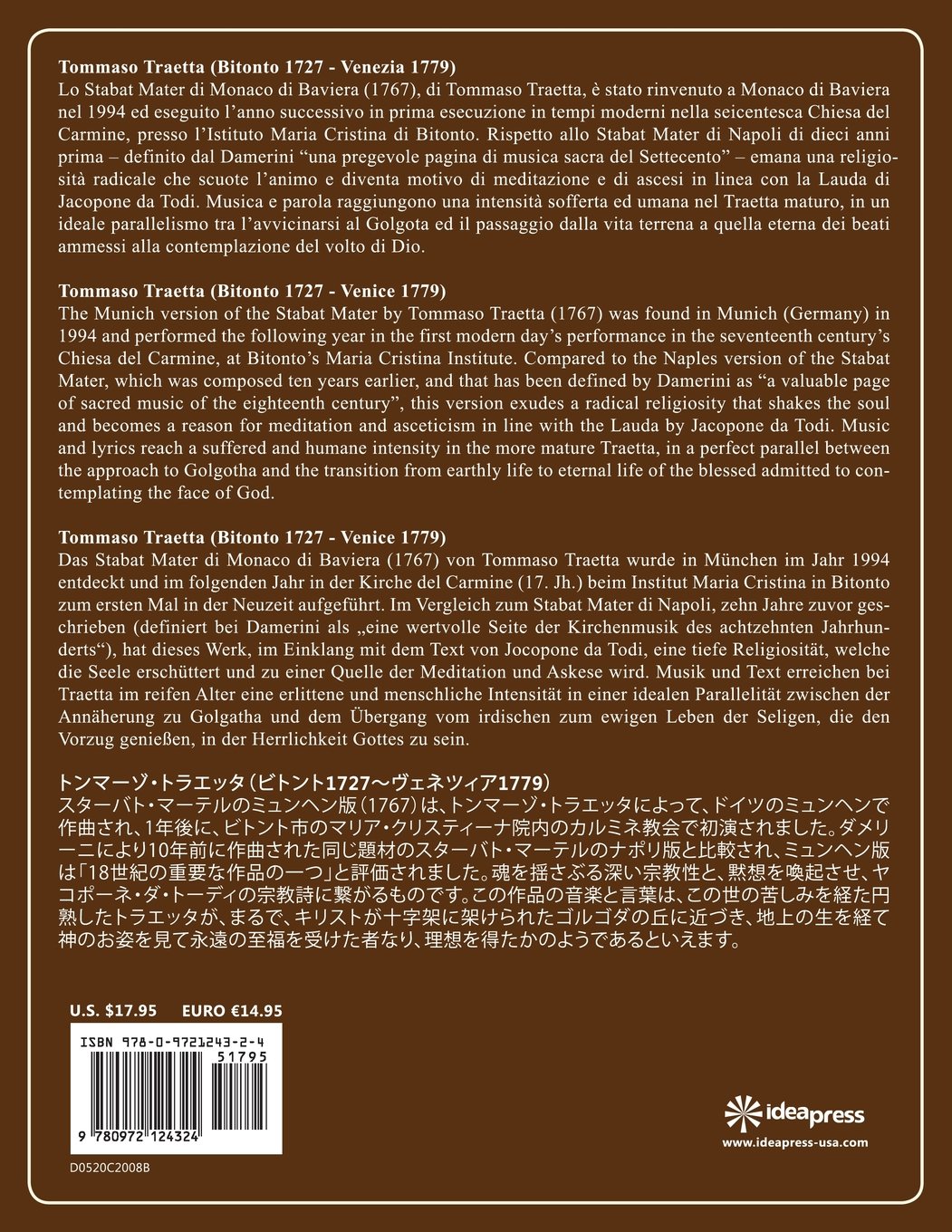
The Munich version of the Stabat Mater by Tommaso Traetta (1767) was found in Munich (Germany) in 1994 and performed the following year in the first modern day’s performance in the seventeenth century’s Chiesa del Carmine, at Bitonto’s Maria Cristina Institute. Compared to the Naples version of the Stabat Mater, which was composed ten years earlier, and that has been defined by Damerini as “a valuable page of sacred music of the eighteenth century”, this version exudes a radical religiosity that shakes the soul and becomes a reason for meditation and asceticism in line with the Lauda by Jacopone da Todi. Music and lyrics reach a suffered and humane intensity in the more mature Traetta, in a perfect parallel between the approach to Golgotha and the transition from earthly life to eternal life of the blessed admitted to contemplating the face of God.

The vocal score, published by Ideapress, is now available for sale on AMAZON.COM and Barnes and Noble.

Commentary on the classical composition is in four languages (English, Italian, German and Japanese).

stabat_retro

Posted in Books | Tagged , , , | Leave a comment

Free Streaming of Rossini’s Stabat Mater on August 22nd

logofestivalRossiniYou are not in Pesaro? Do not worry, you can still stream the Stabat Mater for FREE, live from Pesaro’s Teatro Rossini. Saturday August 22nd, at 20.30 (8:30 in the evening local time, 2:30 pm NYC time) Streaming from the site of the Rossini Opera Festival

If you have problems to visualize the Stabat Mater from their site, try their youtube channel.

 The true Rossini, in Rossini’s city and now in the whole world!

22agosto

Posted in Music | Tagged , , , | Leave a comment

Faust in Adelaide

adelaidelogofaust

faust1Faust

Presented by State Opera of South Australia

7:30pm: 22, 25, 27, 29 August 2015
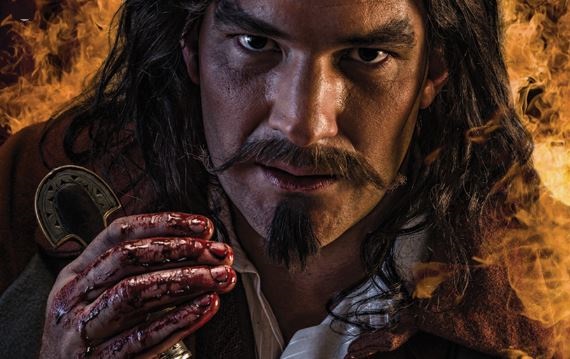
Faust, disillusioned with a life of study, laments the life and love that has passed him by. In vain, he tries to end it, but in frustration, strikes an infernal deal whereby he buys the services of Mephistopheles while on earth in exchange for his soul, which will belong to the Devil after death. Mephistopheles shows Faust a vision of the beautiful and chaste Marguerite. Through trickery and deception, Faust wins the heart of Marguerite, diverting her from young and honest suitors with gifts and jewels procured as part of his demonic contract. Having won her, she becomes pregnant to him and he abandons her, sending her on a spiral to oblivion. Meanwhile, Mephistopheles promises Faust the love of the most beautiful women in history, but it is Marguerite’s face that Faust sees. They are reunited briefly but Marguerite places her fate in the hands of God, whereupon she dies and is drawn up to heaven. Faust repents and Mephistopheles realises he’s been cheated of his prize – Faust’s soul.

James Egglestone sings the title role, with Teddy Tahu Rhodes brilliantly portraying the role of Mephistopheles. France-based Adelaide-born soprano Kate Ladner returns to round out a perfect operatic triumvirate, with a stellar supporting cast, the State Opera Chorus, a ballet troupe and the Adelaide Symphony Orchestra conducted by Kynan Johns.

CONDUCTOR Kynan Johns
ORIGINAL DIRECTOR Sir David McVicar
REVIVAL DIRECTOR Bruno Ravella
SET DESIGNER Charles Edwards
COSTUME DESIGNER Brigitte Reiffenstuel
LIGHTING DESIGNER Paule Constable

FAUST James Egglestone
MEPHISTOPHELES Teddy Tahu Rhodes (sponsored by Peter & Pamela McKee)
MARGUERITE Kate Ladner
WAGNER Joshua Rowe
VALENTIN Michael Honeyman
SIEBEL Cherie Boogaart
MARTHA Desiree Frahn

STATE OPERA CHORUS
ADELAIDE SYMPHONY ORCHESTRA

Sung in French with English surtitles (sponsored by James & Diana Ramsay Foundation)

An Opera Conference Production from the Royal Opera House, Covent Garden

Posted in OPera | Tagged , , , , | Leave a comment