“The Enchanted Wanderer” at the Mariinsky II in St. Petersburg

Mariinsky II:
34 Dekabristov Street

14 January
20:00
2014 | Tuesday

The Enchanted Wanderer

opera for three solo voices, chorus and orchestra

performed in Russian (the performance will have synchronised English supertitles)

Music by Rodion Shchedrin
Libretto by the composer after the novel by Nikolai Leskov The Enchanted Wanderer

Credits

Musical Director: Valery Gergiev
Stage Director: Alexei Stepanyuk
Set Designer: Alexander Orlov
Costume Designer: Irina Cherednikova
Lighting Designer: Yevgeny Ganzburg
Musical Preparation: Natalia Domskaya
Principal Chorus Master: Andrei Petrenko
Choreographer: Dmitry Korneyev

Cast

Ivan Severyanovich Flyagin, Storyteller: Sergei Aleksashkin

Bass

• People’s Artist of Russia (2005)
• Recipient of the Golden Sofit, St Petersburg’s most prestigious theatre prize (2002, 2004 and 2008)

Sergei Aleksashkin studied at the Saratov State Sobinov Conservatoire (1982). After graduating from the Conservatoire, he was engaged by the Saratov Academic Theatre of Opera and Ballet. He also trained at La Scala, Milan, from 1983–1984. Sergei Aleksashkin has been a Mariinsky Theatre soloist since 1989.

Roles performed at the Mariinsky Theatre include:
Ivan Susanin (A Life for the Tsar)
Ruslan (Ruslan and Lyudmila)
Boris Godunov, Varlaam (Boris Godunov)
Ivan Khovansky (Khovanshchina)
Konchak, Vladimir Yaroslavovich and Galitsky (Prince Igor)
Gremin (Eugene Onegin)
Rene (Iolanta)
Kochubei (Mazepa)
Mamyrov (The Enchantress)
Vasily Sobakin, Malyuta Skuratov (The Tsar’s Bride)
Sea King (Sadko)
Salieri (Mozart and Salieri)
Yuri Vsevolodovich (The Legend of the Invisible City of Kitezh and the Maiden Fevronia)
Tsar Dodon (The Golden Cockerel)
Old Gypsy (Aleko)
General (The Gambler)
Faust (The Fiery Angel)
Mendoza (Betrothal in  a Monastery)
Rostov, Kutuzov (War and Peace)
Boris Timofeyevich (Katerina Ismailova)
Sobakevich (Dead Souls)
Flyagin, Storyteller (The Enchanted Wanderer)
Zaccaria (Nabucco)
Banco (Macbeth)
Jacopo Fiesco (Simon Boccanegra in  concert)
Grand Inquisitor, Filippo II (Don Carlo)
Ramfis (Aida)
Méphistophélès (Faust)
Lindorf, Coppélius, Dapertutto, Dr Miracle (Les Contes d’Hoffmann)
Leporello (Don Giovanni)
the King (Lohengrin)

The singer’s repertoire also includes Méphistophélès in  Berlioz’ dramatic legend La Damnation de Faust and the bass roles in Verdi’s Requiem and Shostakovich’s Thirteenth and Fourteenth Symphonies.

Sergei Aleksashkin has toured to many countries throughout Europe and the USA, Australia and Japan, and he has worked with such conductors as Georg Solti, Valery Gergiev, Claudio Abbado, Gennady Rozhdestvensky, Yuri Temirkanov, Mstislav Rostropovich, Marek Jankowski, Rudolf Barshai, Alberto Zedda, Eliahu Inbal, Neeme Järvi, Eri Klas, Mariss Jansons and Alexander Lazarev among many others.

He has performed as a guest artist at the Metropolitan Opera (New York), La Scala (Milan), the Royal Opera House, Covent Garden (London) and opera houses in Washington, Rome and Hamburg. He has sung at top concert venues throughout Europe, among them the Concertgebouw (Amsterdam), the concert hall of the Accademia Santa Cecilia (Rome) and the Barbican Hall and the Royal Festival Hall (London); he has appeared several times at Salzburg’s Easter Festival and festivals in San Sebastian, Baden-Baden, Mikkeli and Savonlinna.

Sergei Aleksashkin’s recordings include CDs of the operas The Fiery Angel, Sadko, The Queen of Spades, La forza del destino, Betrothal in  a Monastery, Iolanta, Prince Igor and Shostakovich’s Thirteenth and Fourteenth Symphonies.

Flogged Monk, Prince, Magnetiser, Old Man in the Woods, Storyteller: Artyom Melikhov

Tenor

Prize-winner at international competitions
Born in Leningrad. In 2001 he graduated with distinction from the Glinka Choral School. He took professional lessons in clarinet and the organ as well as composition. In 2006 he graduated with distinction from the Faculty of Choral Conducting of the St Petersburg State Rimsky-Korsakov Conservatoire (class of Professor Yelizaveta Kudryavtseva). He is currently a student in the vocals faculty (class of Dmitry Karpov).
In 2009 he made his Mariinsky Theatre debut in several roles in the opera War and Peace. Since 2011 he has been a soloist with the Mariinsky Academy of Young Singers. In May 2013 he performed the lead role in a premiere of Wagner’s Rienzi at the Saratov Opera and Ballet Theatre (production by Alexei Stepanyuk).Repertoire at the Mariinsky Theatre includes:
Ovlur (Prince Igor)
Servant at the Ball, Prince Andrei’s Orderly, Prince Eugene’s Aide de Camp, Madman (War and Peace)
Nero (The Mystery of the Apostle Paul)
Selifan (Dead Souls)
and Brighella (Ariadne auf Naxos).Repertoire also includes: Lensky (Eugene Onegin), the Young Gypsy (Aleko), Lohengrin (Lohengrin), Rachmaninoff’s The Bells, Mozart’s Requiem, Verdi’s Requiem and Gubaidulina’s St John’s Passion.

In 2008 at the VIII Easter Festival at the Great Hall of the Moscow Conservatoire he performed the role of the Japanese Envoy in Stravinsky’s opera Le Rossignol under the baton of Valery Gergiev. He also made his debut as a soloist at the Concert Hall of the Mariinsky Theatre in Gavrilin’s Chimes.
In 2010 he performed the role of Nero in the world premiere of Nikolai Karetnikov’s opera The Mystery of the Apostle Paul at the Concert Hall of the Mariinsky Theatre. The same year, he made his debut at the Kennedy Center in Prokofiev’s opera War and Peace under Valery Gergiev.
At the Mariinsky Theatre in 2011 he performed the role of Ovlur in the opera Prince Igor. 2011 also saw appearances in premiere performances of the operas Dead Souls by Rodion Shchedrin (Selifan the Coachman, production by Vasily Barkhatov) and Ariadne auf Naxos by Richard Wagner (Brighella, production by Michael Sturminger. In 2013 he performed the tenor role in a stage version of Carl Orff’s Carmina Burana during a tour by Naples’ Teatro di San Carlo at the new stage of the Mariinsky Theatre.

Grusha the Gypsy, Storyteller: Kristina Kapustinskaya

Mezzo-soprano

• Prize-winner at the International Moniuszko Competition (2007)
• Prize-winner at the International Rimsky-Korsakov Competition (2006)
• Recipient of Russia’s Golden Mask theatre prize for her sole as Grusha the Gypsy in the opera The Enchanted Wanderer (nominated for “Best female role in opera”, 2009)

Kristina Kapustinskaya was born in Kiev. Studied at the Kiev State Glière High School of Music. In 2006 she graduated from the National Tchaikovsky Music Academy of Ukraine (class of Professor Diana Petrinenko). At the Youth Opera studio theatre of the National Music Academy of Ukraine she performed as the Old Gypsy (Aleko), Dunyasha (The Tsar’s Bride), Maddalena (Rigoletto) and Carmen (Carmen).
In 2007 she made her Mariinsky Theatre debut as Smeraldina in Sergei Prokofiev’s opera The Love for Three Oranges.

Roles performed at the Mariinsky Theatre include:
The Angel (The Demon)
Polina and Milovzor (The Queen of Spades)
Smeraldina (The Love for Three Oranges)
Grusha the Gypsy (The Enchanted Wanderer)
Servant (Elektra)
Agrafena Alexandrovna (The Brothers Karamazov)

The singer’s repertoire also includes the roles of Lyubasha and Dunyasha (The Tsar’s Bride), Maddalena (Rigoletto) and arias from operas by Donizetti, Gluck, Handel, Massenet, Moniuszko, Mozart, Rossini, Saint-Saëns, Tchaikovsky and Verdi, as well as songs and romances by Fauré, Glière, Grieg, Musorgsky, Rakhmaninov, Schubert, Richard Strauss and Sviridov.

In 2007, Kristina Kapustinskaya performed in the Russian premiere of Rodion Shchedrin’s opera The Enchanted Wanderer (as Grusha the Gypsy) during the Stars of the White Nights festival at the Mariinsky Theatre Concert Hall. She sang this role the same year at the Moscow Philharmonic at an opera festival to mark the seventy-fifth birthday of Rodion Shchedrin, and one year later at the Edinburgh Festival. In 2009, Kristina Kapustinskaya received a Golden Mask award for her interpretation of the role of Grusha (nominated for “Best female role in opera”).

The singer was also the first performer of the role of Agrafena Alexandrovna in Alexander Smelkov’s opera The Brothers Karamazov, which was premiered at the Mariinsky Theatre on 23 July 2008.

At the opening of the 2007-2008 season, Kristina Kapustinskaya performed the mezzo-soprano role in Sergei Prokofiev’s Alexander Nevsky cantata with the St Petersburg Philharmonic under Yuri Temirkanov. She has toured with the Mariinsky Opera Company to Sweden, the USA and the UK.

World premiere: 19 December 2002, Avery Fisher Hall, New York
Russian premiere: 10 July 2007, Concert Hall of the Mariinsky Theatre, St Petersburg
Premiere of this production: 26 July 2008, Concert Hall of the Mariinsky Theatre, St Petersburg

Materials presented by the publishers «SCHOTT», Mainz

Running time 1 hours 35 minutes
The performance without interval

In his story of the novice of the Valaam Monastery Ivan Severianovich Flyagin, where the main subject is his love for Grusha the gypsy girl who loves not him but rather the frivolous Prince and later begs Flyagin to kill her, Shchedrin avoids traditional operatic approaches. Here there are neither developed scenes as such nor sweet love duets, but there is an aural continuum of impossible beauty in which vocal and choral voices are blended together, underscored by a thousand different orchestral timbres, from the shepherd-like folk tunes of the oboe that tear at the soul to the laconic guslis, tender block flutes and, as always with Shchedrin, the glittering percussion. Also enchanting in The Wanderer was the countless number of shades of silence – melting, lulling, oppressive, terrifying, thoughtful: Shchedrin is one of few composers who have the skill to construct music not just from notes but from pauses too.
Vremya novostei

… The famous gypsy song Nevechernyaya, performed by Grushenka-Kapustinskaya to the refined accompaniment of the muted strings, resounds, like a peaceful requiem, as a funereal premonition-hymn of a tragic destiny. And at the other “pole” there is the scene of Tatar captivity, addressing both Borodin’s Polovtsian Dances and Stravinsky’s ballets – and the performance with incredible energy, “proprietarily” ascribed only to Gergiev… It bears repeating the axiom that the Mariinsky Theatre’s musicians and their conductor are on brilliant professional form today… The chorus deserves particular praise, under Gergiev’s baton sounding fresh and resilient yet at the same time powerful, a rare thing indeed.
Literaturnaya gazeta

 
SYNOPSISACT I
Ivan Severyanovich Flyagin, a novice at the monastery in Valaam, is reminiscing about former days. Before renouncing the material world, he once accidentally whipped a monk to death. The monk appeared in a vision, reproaching Ivan for taking his life before he could make his final confession. He told Ivan Severyanovich that he was God´s “promised” son and that he would die but never pass on until real “death” comes, so Ivan enters the monastery on the island of Valaam. And although Ivan Severyanovich did not believe in it, the monk´s prophesy came true. While on his travels, Ivan was captured by the Tatars and lived with them for ten years in Ryn-peski. He managed to flee from them, met with some shepherds on his way back to his native land and entered the service of a Prince, who admired him for his skill with horses. But after three years of devoted service Ivan Severyanovich took to drinking binges. At an inn, Flyagin met a landowner with the gift of hypnosis. The same night in another inn Ivan Severyanovich spent all the money entrusted to him by the Prince on Grusha, a beautiful gypsy songstress.

ACT II
When the Prince demands his five thousand roubles, Flyagin shows remorse and relates his tale of the beautiful gypsy. Having fallen in love with Grusha, the Prince paid her immense dowry of fifty thousand gold roubles and took her home with him. But the Prince is a fickle man and he soon tired of Grusha. During his trip to town, Ivan found out that his master planned to marry a rich noblewoman and, returning home, could not find the gypsy girl: the Prince secretly removed her to the swampy woodlands. But Grusha escaped her incarceration, met Flyagin and forced him to take a dreadful oath – to kill her, otherwise she would kill the unfaithful Prince and his young bride. In order to carry out Grusha´s request, Ivan Severyanovich throws her into a river from a cliff top. The chorus mourns her death. In his visions Ivan Severyanovich Flyagin hears the voices of the monk and the gypsy girl Grusha whom he murdered.

Posted in Music, OPera | Tagged , , , | Leave a comment

“Il trovatore” at the Mariinsky II Theatre in St.Petersburg

Mariinsky II:
34 Dekabristov Street

Il trovatore

opera in four acts

Music by Giuseppe Verdi
Libretto by Salvatore Cammarano

Musical Director and Conductor: Valery Gergiev
Conductor: Mikhail Sinkevich
Stage Director: Pier Luigi Pizzi
Set Designers: Pier Luigi Pizzi, Massimo Pizzi Gasparon
Costume Designer: Pier Luigi Pizzi

Pier Luigi Pizzi first worked as a set designer in 1951. For twenty years he worked at the renowned Compagnia dei Giovani together with Giorgio De Lullo, Romolo Valli and  Rossella Falk, creating almost all of the sets and  costumes for that company’s productions. In the 1960s the Compagnia dei Giovani visited Moscow and  Leningrad on tour.
1977 saw Pizzi’s debut as an opera director with Mozart’s Don Giovanni at the Teatro Regio in Turin (with Ruggero Raimondi in the lead role).
For over sixty years the stage director has worked with major theatres and  at the most prominent festivals. He has won numerous prestigious international awards, among them the Ordre de la Légion d’honneur, the Ordre des Arts et des Lettres (Officier), the Order of the Holy Cross of the Italian Republic (Honorary Cavalier), the Order for Services to Culture of the Principality of Monaco (Commander, 2006), the Order of St Agatha of the Republic of San Marino, Milan’s order of Golden Ambrosia and  Florence’s Order of the Golden Florin. Pizzi also holds the title of Honorary Doctor of the University of Macerata and  is a member of the Verona and  Parma Academies of Fine Arts and  a recipient of the Life for Music award.
In 1987 Pier Luigi Pizzi’s production of the opera Aida opened the first season at the Wortham Center in Houston, while in 1990 his production of Les Troyens opened the season at the Opéra Bastille in Paris.
Since 1982 Pizzi has been involved in the Rossini Festival in Pesaro on an annual basis. It is thanks to his efforts that many of Rossini’s operas have been revived, among them Tancredi, Guillaume Tell and  La pietra del paragone.
In 2000 the stage director won a seventh Abbiati Prize in the category “Best Opera Production of the Year” for Britten’s Death in Venice (Teatro Carlo Felice, Genoa).
At the opening of the Teatro delle Muse in Ancona there was a performance of Pizzi’s production of Idomeneo, and  he later returned to that theatre to stage Henze’s Elegie für junge Liebende and  Hindemith’s Neues vom Tage.
At many theatres throughout the world Pizzi has staged his production of Handel’s Rinaldo: this production has been seen in Reggio Emilia, Paris, Madrid, Lisbon, Geneva, Venice (La Fenice) and  Milan (La Scala). The stage director has also produced La traviata, A Midsummer Night’s Dream and  three operas by Monteverdi at the Teatro Real in Madrid in addition to offering his own new and  revolutionary reading of Verdi’s Un ballo in maschera at the Piacenza Expo exhibition centre. The latter production was subsequently performed at the Teatro Massimo in Palermo and  at the Sferisterio arena in Macerata.
Pizzi founded an opera festival in Macerata, of which he served as Artistic Director from 2006 to 2011. During his tenure the festival’s repertoire became enriched with many baroque and  contemporary operas.
The Opéra de Monte-Carlo performs Pizzi’s production of Il viaggio a Reims, staged to mark the occasion of Prince Albert II’s accession to the throne. In December 2004 the Teatro alla Scala opened its season following reconstruction work with Pizzi’s production of Salieri’s opera Europa riconosciuta. This opera had never been staged between its premiere right up to 2004. Pizzi has made a tremendous contribution to the revitalisation of La Scala’s theatre museum. Pizzi dedicates much of his time and  efforts to organising various exhibitions, among them Versailles and  Antiquity in Paris.
In 2004 Pizzi staged the opera Les Contes d’Hoffmann at the Sferisterio arena and  the operas Les mamelles de Tirésias by Poulenc and  Le Bel indifférent by Tutino at the Teatro Lauro Rossi in Macerata.
Productions by the stage director in recent years include Donizetti’s Maria Stuarda, Lehár’s Die Lustige Witwe and  Marschner’s Der Vampyr at the Teatro Comunale di Bologna and  the Teatro Massimo in Palermo, Riz Ortolani’s Il principe della gioventù at La Fenice in Venice and  the Teatro Arcimboldi in Milan, Reynaldo Hahn’s Mozart (directed by Sacha Guitry) at the Festival dei Due Mondi in Spoleto, Britten’s The Turn of the Screw at La Fenice in Venice, Adès’ Powder Her Face in Bologna and  Verdi’s Un giorno di regno, I vespri siciliani and  La battaglia di Legnano at the Verdi Festival in Parma. Recently Pizzi completed work on the Mozart and  Da Ponte trilogy.
Since 1968 the stage director has frequently worked with the Opera di Roma. His first production there was Verdi’s opera I due Foscari. He later returned to stage the operas Macbeth, Alceste, Faust, Mosè in Egitto, La Vie parisienne, Diabły z Loudun, La battaglia di Legnano, Die Zauberflöte and  Attila. One of his most recent productions at the Opera di Roma was Ponchielli’s La Gioconda. Pizzi rarely works in dramatic theatre, although his 2007 production of Una delle ultime sere di Carnevale after Goldoni’s play was well received by the critics as one of the best of the year in addition to garnering several awards. This production has also been performed in Moscow. Pizzi recently made his debut at the Bolshoi Theatre in Moscow with Bellini’s opera La sonnambula and  staged La Gioconda at the Opéra Bastille in Paris.
In October Pizzi took part in the opening of the Astana Opera (Kazakhstan). There he presented a production of the opera Attila (conducted by Valery Gergiev).

Lighting Designer: Vincenzo Raponi
Choreographer: Emil Faski
Musical Preparation: Marina Mishuk
Chorus Master: Pavel Teplov
Italian Language Coach: Maria Nikitina

 
12 January 19:00
10 February 19:30
11 February 19:30
17 February 19:00
   

Cast

St Petersburg premiere: 21 November 1855, Bolshoi Stone Theatre
Premiere of the production by Pier Luigi Pizzi: 27 December 2013

Running time 2 hours 45 minutes
The performance has one interval

Pier Luigi Pizzi on his production of the opera
In my opinion, Il trovatore is a stunning example of Verdian melodrama, a point of reference for many other composers in the 19th century. The perfection of the opera’s musical form, its engaging plot, vivid choral scenes and the unusual beauty of the melodies allowed Verdi to convey with great power human passions including love, hate and jealousy as well as revenge and death.
Returning once again to this opera, so adored by many, and doing so at a mature age, I plan to focus on the psychology of the characters. I will also focus particularly on the intense dramatic story being told. The characters of the protagonists seem to me to create a strong impression.
Azucena is, of course, the lead female character: she treacherously fans the flames of the conflict between Manrico and the Conte di Luna, two brothers unaware of their blood ties, and awakens feelings of rivalry and mutual hatred between them.
I find that the Conte di Luna is another protagonist on whom Verdi bestowed the most noble and passionate arias. The insistence with which he seeks out his lost brother, the ardent passion he feels for Leonora, his fervent desire and his malice at unrequited feelings make the Conte di Luna a powerful dramatic character.
In comparison with him, Manrico, who has the privilege of performing the opera’s most famous aria, remains vulnerable and immature, young and inexperienced  – a mere pawn in the hands of the gypsy woman. Of Leonora it could be said that she is one of the most romantic characters in the history of opera. Two arias that Verdi assigned to this role  – Tacea la notte placida and D’amor sull ali rosee  – rouse the most incredibly tender thoughts for this courageous woman who resolves to sacrifice herself for the sake of love.
This opera stirs powerful emotions in me, and I would like to convey this noble feeling to the audience.

Mariinsky II (New Theatre)


Il trovatore


Scene from the performance
     
SYNOPSIS

Ferrando, a confidant of Count di Luna, tells of tragic events that occurred many years ago. The old Count had two young sons. One morning a terrifying gypsy woman was found at the cradle of the youngest. The boy began to wither away – the witch placed a curse on him. She was caught and burned, but the gypsy’s daughter took revenge: she abducted the child and he has never been seen since. Where the witch was executed the burnt bones of a child were found. The old Count did not live long after that. Not believing in the death of his youngest son, he made the eldest – who is the present day Count – swear never to stop looking for his missing brother. Every search, however, has been in vain. The armed retainers are ill at ease: at midnight the ghost of the dead witch haunts the castle, taking on various forms. A bell rings in the distance – it is midnight. Gripped by superstitious terror, the servants flee.Leonora awaits the troubadour Manrico in delighted apprehension. She tells Ines of how she first met him at a competition of knights. Since then she has not seen the troubadour for a long time – war separated them. In vain Ines soothes Leonora – the latter has given her heart to Manrico forever. Count di Luna appears. He rushes towards Leonora’s balcony, but the troubadour’s song makes him freeze. Leonora hurries to meet Manrico. A quarrel breaks out between the rivals. Leonora implores the Count to have mercy on Manrico but, filled with envy, he unsheathes his sword and prepares to fight.

A gypsy camp in the hills near Biscay. Dawn. The gypsies set off for work singing songs. Only Azucena is sad. Left alone with Manrico, she tells how her mother was burned on the orders of Count di Luna. Azucena, having abducted the Count’s son, then resolved to throw him into the same fire but, driven mad with grief, she made a terrible mistake – she burnt her own child. Manrico is appalled at what he hears – does this mean he is not Azucena’s son? The gypsy calms him, reminding him she loves him. Manrico must take revenge for her and show Count di Luna no mercy as he did in their recent duel. The troubadour himself cannot explain his sudden surge of compassion: he was ready to finish off the prostrate count, but some mysterious voice stopped him. Now, however, he will be merciless. A messenger gives Manrico a letter from his friend Ruiz: Leonora, having received misleading news of Manrico’s death, has resolved to seek seclusion in a convent. In vain Azucena tries to restrain her son – he cannot live without Leonora.

Believing the troubadour to be killed, Count di Luna plans to abduct Leonora from the convent – now no-one will come between them. Leonora bids a fond farewell to Ines; she does not lament her fate: better the convent than life without Manrico. Together with the nuns she approaches the altar. Suddenly their path is barred by Count di Luna and his retainers: instead of the convent, they will be married. Manrico’s arrival stuns everyone. The Count is furious – his enemy has risen from the dead. Leonora cannot believe this merciful deliverance. Ruiz rushes in with the armed retainers and forces the Count’s servants to retreat.

The camp of Count di Luna. The soldiers are preparing to besiege the castle where Leonora and Manrico have taken refuge. The Count, tormented by jealousy, hopes to separate them once more. The soldiers bring in Azucena who has been captured as a spy. Ferrando recognises her to be the gypsy who once abducted Count di Luna’s younger brother. Azucena calls on Manrico in despair. The Count’s malicious joy knows no limits: he will not only avenge his brother but will execute the mother of his worst enemy into the bargain.

A shadow of alarm falls over the long-awaited marriage of Leonora and Manrico: the castle is surrounded by enemies and a bitter struggle lies ahead. The danger holds no fear for Manrico; Leonora’s love hardens his resolve. The anxious Ruiz relates that Azucena has fallen into the hands of Count di Luna and that di Luna is threatening to have her burned alive. Manrico is filled with determination to save his mother; his call inspires the soldiers to seize the castle.

The troubadour languishes in a tower, imprisoned. Leonora is prepared to save her beloved at any cost. In despair she begs the Count to free Manrico, but her entreaties only serve to increase his wrath and jealousy. At last, Leonora opts for the last remaining possibility: she swears she will become the Count’s wife, knowing that death will free her from the pledge she has made. While the Count gives his orders to the prison guard, Leonora swallows the poison hidden in her ring. Joy fills the young woman’s soul – now Manrico is saved.

In the gloomy cell Manrico and Azucena await death. Her troubles have broken down the gypsy woman’s spirit; she is tormented by terrible visions, and she sees the fire on which her own mother was burned alive. Manrico’s tender care appeases her; falling asleep, she dreams of her native mountains and her former carefree life. Leonora enters. She has brought Manrico his freedom: the prison doors are open to him, but she cannot go with him. Manrico furiously upbraids his beloved – she has forgotten her vows. He needs no such freedom, purchased at such a price. It is only when the poison begins to take effect that Manrico realises Leonora’s heroic self-sacrifice. Coming in, the Count sees his hopes are futile. He orders Manrico be executed. Azucena awakes in terror and tries to stop the Count – but it is too late, the execution has been carried out. The gypsy woman then reveals her frightful secret to the Count: he has killed his own brother. Her mother is now avenged.

Posted in Music, OPera | Tagged , , , , , | Leave a comment

Welsh National Opera presents “La traviata”

Welsh National opera presents:

“La traviata”

Giuseppe Verdi

WNO-La-traviata---3

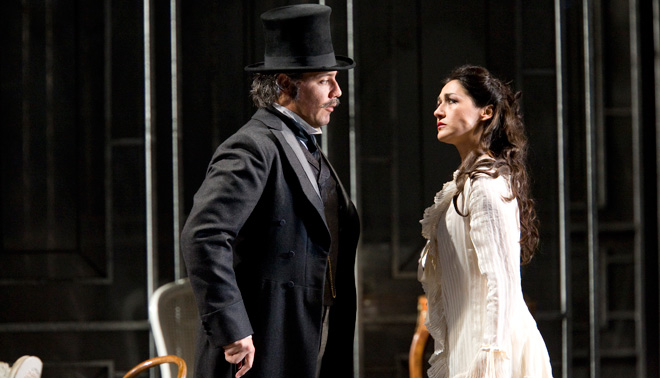
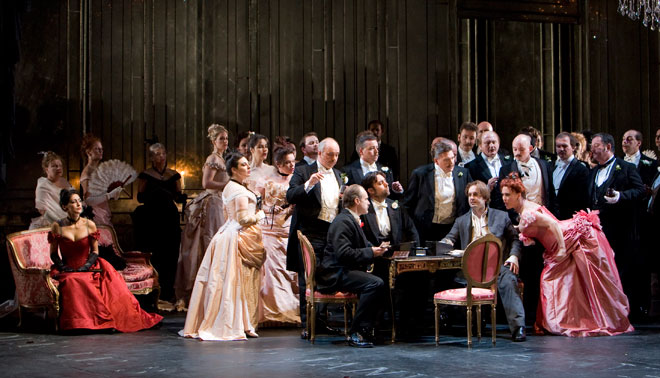
Giorgio Germont has made a terrible mistake. Germont has realised that Violetta, the fallen woman he drove away from his son, Alfredo, was the best thing that will ever happen to his inexperienced boy. His realisation comes late in the day as Violetta’s health is getting worse. Can Germont repair the damage before it’s too late?

La traviata is an attack on hypocrisy. It is also a life-affirming celebration of the fact that essential human qualities like compassion, love and self-sacrifice do exist. Most of all, La traviata is a supreme tear-jerker. David McVicar’s masterful production makes sure that few leave the theatre with dry eyes.

“McVicar’s darkly elegant production”
The Telegraph

‘I love this production because of watching the effect that the combination of a magical set, great music and intense drama has on our audience as they leave the theatre’
Ian Douglas
Company Manager

Cities

Free New to opera talks
Tuesday 11 February – Saturday 5 April
New to opera? La traviata is the perfect place to start. Join us for a special introduction to opera before selected performances of La traviata

The Whole Story
Thursday 6 February – Wednesday 19 March
The Whole Story is the perfect introduction to the Fallen Women season. Before the performances begin, our team of experts will guide you through the music, stories and background to each opera.

Literary inspirations
Friday 28 February
A special hour long talk looking at how the season’s operas draw on classics by Dumas and and Prévost.

David Pountney in Conversation
Friday 7 February
David Pountney and a key figure from the arts explore the Fallen Women theme.

SYNOPSIS.

Violetta, a courtesan under the protection of Baron Douphol, is giving a party. She is introduced to Alfredo Germont, a young man of solid Provençal family who confesses to being already in love with her. As she leads her guests off to dance, Violetta is overcome by a coughing fit. Her frivolous friends are unconcerned, but Alfredo is not. He again protests his love but she discourages him. Left alone when her guests finally depart, Violetta finds herself unexpectedly affected by the young man’s passionate declaration. Despite this she convinces herself that her only choice is to continue to pursue a life of hectic pleasure.

Violetta has given in to her feelings and she and Alfredo are now living together in the country, where her health has improved. When he accidentally discovers from her maid, Annina, that Violetta has been selling her possessions in order to pay their bills, Alfredo is overcome with shame and leaves for Paris in order to raise the necessary money.

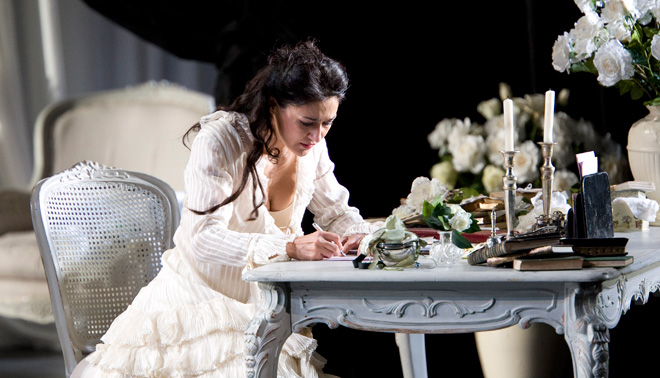
Violetta is surprised by an unheralded visit from Giorgio Germont, Alfredo’s father. Having assumed that his son has been squandering his inheritance on Violetta, he is shocked to discover that she has been paying for everything. He begs her to break away from his son as their relationship is threatening his daughter’s prospects of marriage into a respectable family. Germont persuades Violetta that she must make the sacrifice in order to protect the future happiness of both his son and daughter. A distraught Violetta finally agrees and sends word to Baron Douphol, signalling her return to Paris. When Germont leaves she writes a farewell note to Alfredo, to be given to him when she has gone.

When Alfredo reads the note he rejects his father’s attempts to console him and rushes back to Paris, determined to avenge himself for what he believes to be Violetta’s betrayal.

Another party is under way. Alfredo arrives alone, expecting to find Violetta back in her old circle. His fears are realized when she appears, on the arm of Baron Douphol. The two men play at cards and Alfredo wins a large amount of money. Desperate to prevent them fighting, Violetta tries to persuade Alfredo to leave the party. He refuses and forces her to say that she loves the baron. In a fury, Alfredo calls all the guests to witness the repayment of his debts and flings his winnings in Violetta’s face. She collapses. Germont witnesses his son’s outburst and reproaches him for his cruel behaviour.

Abandoned by her friends, Violetta is dying, alone and in penury, with only the faithful Annina for company. She reads a letter from Germont telling her that he has told Alfredo the truth and that they are both coming to beg her forgiveness.

The two lovers are reunited and plan feverishly for a happier future, but it is too late. Violetta dies in Alfredo’s arms.

Creative team includes
Conductor Simon Phillippo
Director David McVicar
Designer Tanya McCallin
Lighting Designer Jennifer Tipton
Choreographer Andrew George

Cast includes
Violetta Valéry Linda Richardson
Alfredo Germont Peter Sonn (until 1 March), Ji-Min Park (4, 8, 11 March), Leonardo Capalbo (from 15 March)
Giorgio Germont Alan Opie
Flora Rebecca Afonwy-Jones

All performances start at 7.15pm (except 16 February at 4pm)

Running time approximately 2 hours 40 minutes including two intervals

Sung in Italian with surtitles in English (and Welsh in Cardiff and Llandudno)

Co-production with Scottish Opera and Gran Teatre del Liceu, Barcelona

La traviata photo gallery

 Images by Bill Cooper

WNO-La-traviata-1 WNO-La-traviata-2 WNO-La-traviata---3 WNO-La-traviata---4

Posted in OPera | Tagged , , , , , , , , , , , | Leave a comment

“Don Quichotte” at the Mariinsky Theatre in St. Petersburg

11 January
19:30
2014 | Saturday
 

Don Quichotte

opera in five acts

performed in French (the performance will have synchronised Russian supertitles)


Music by Jules Massenet
Libretto by Henri Cain after the play Le Chevalier de la Longue Figure by Jacques Le Lorrain and the novel The Ingenious Gentleman Don Quixote of La Mancha by Miguel de Cervantes

World premiere: 19 February 1910, Opéra de Monte Carlo
Premiere at the Mariinsky Theatre: 4 April 1919
Premiere of this production: 28 December 2012

Running time 2 hours 30 minutes
The performance has one interval

Musical Director and Conductor: Valery Gergiev

Artistic & General Director of the Mariinsky Theatre

Valery Gergiev graduated from the Leningrad State Rimsky-Korsakov Conservatoire in symphony conducting under Professor Ilya Musin. At the age of twenty-three he won the Herbert von Karajan Conducting Competition in Berlin and, while still a student at the Conservatoire, was invited to join the Kirov Theatre (now the Mariinsky). At the age of thirty-five, Valery Gergiev was appointed Artistic Director of the Opera Company, and since 1996 he has been Artistic and General Director of the Mariinsky Theatre.

At the Mariinsky Theatre Gergiev has overseen the emergence of a plethora of world-acclaimed singers. Under his direction, the theatre’s opera and ballet repertoire has expanded significantly. Today it encompasses a broad range of works from 18th to 20th century classical masterpieces to works by contemporary composers.
Highlights include performances of every opera by Prokofiev and Shostakovich at the Mariinsky Theatre, as well as the return of Wagner’s operas Lohengrin, Parsifal, Der Fliegende Holländer and Tristan und Isolde to the St Petersburg stage. For the first time in the history of Russian theatre, Gergiev staged a production of Wagner’s tetralogy Der Ring des Nibelungen in the original German (2003), the Western European premiere of which in Baden-Baden (2004) was feted by the German media as a truly historic event in world music. in June 2005 Der Ring des Nibelungen was performed to great acclaim in Moscow, and later in South Korea and Japan. In the 2006–2007 season, Wagner’s tetralogy was performed in the USA, Great Britain and Spain. In 2009 Gergiev oversaw an international production of Berlioz’ operatic duologue Les Troyens, which resulted in a series of concert performances of this work by the Mariinsky Theatre Orchestra, Chorus and soloists in Russia, Israel and the USA.

Gergiev has established and directs such international festivals as the Gergiev Festival (the Netherlands), the Moscow Easter Festival and the Stars of the White Nights festival (St Petersburg), which Austria’s respected Festspiele Magazin listed as one of the world’s ten greatest festivals.

Thanks to the Valery Gergiev’s efforts, the Concert Hall was built in 2006, which has significantly broadened the repertoire possibilities of the company and the orchestra. This stunning theatre and concert complex is remarkable for its outstanding acoustics. The Concert Hall of the Mariinsky Theatre hosts performances of operas and philharmonic programmes, and it also produces recordings of works for the Mariinsky label. Established on the initiative of Valery Gergiev in 2009, the Mariinsky label has released twenty-one discs to date. In 2010 its recording of the opera The Nose – the label’s first project – received a MIDEM Classical Award.

The maestro devotes much attention to programmes for children and young people and he has revived the practice of offering subscriptions for this audience group as well as gratis concerts for students.

Valery Gergiev is also well-known for his active stance with regards to the protection of humanistic ideals. the maestro initiated the worldwide series of charitable concerts Beslan: Music for Life held in New York, Paris, London, Tokyo, Rome and Moscow. In August 2008 the maestro conducted a requiem concert in front of the ruined Government House of South Ossetia in Tskhinval).

Since 2007 Valery Gergiev has been Principal Conductor of the London Symphony Orchestra and he also collaborates with the Wiener Philharmoniker, the orchestra of La Scala and the New York and Rotterdam Philharmonic Orchestras. He is a member of the Council for Culture and Art of the President of the Russian Federation and heads the Organisational Committee of the XIV International Tchaikovsky Competition.

In February 2010 the Academic Council of the St Petersburg State University elected Valery Gergiev Dean of the Faculty of Arts.

For his services to music and to society, Valery Gergiev has been the recipient of numerous awards and prizes. These include the title of People’s Artist of Russia (1996), the State Prize of Russia (1994 and 1999), Germany’s Bundestverdienstkreuz, first class, “For Services”, Italy’s Grand’ufficiale dell’Ordine al merito, France’s L’Ordre des Arts et des Lettres, the Netherlands’ Knight of the Order of the Dutch Lion, Japan’s Order of the Rising Sun, the honorary title UNESCO Artist of the World and the  Polar Music Prize from the Swedish Royal Academy of Music. Of the three Russian orchestras included in the list, the Mariinsky was ranked highest. One of the maestro’s most recent awards was the prize of Great Britain’s Royal Society of Music as Conductor of the Year (2009). In 2009 Great Britain’s Royal Philharmonic Society named Valery Gergiev “Conductor of the Year”. One of the maestro’s most recent awards has been the European Glashütte Original Music Festival Prize for his support of talented young musicians. In 2011 Valery Gergiev was made Honorary President of the Edinburgh International Festival. In November 2011 respected French magazine Classica named him “Artist of the Year.” In April 2012 the Academic Council of the Moscow State University passed a resolution to award Valery Gergiev the title of Honorary Doctor of the Moscow State University while in November 2012 the maestro received the title of Honorary Professor of the St Petersburg Rimsky-Korsakov Conservatoire. In May 2013 Valery Gergiev was awarded the title of Hero of Labour of the Russian Federation.

Conductor(1): Christian Knapp,

Christian Knapp – one of the world’s most outstanding young conductors – regularly performs in concerts and festivals throughout the world. He was born in the USA and has studied for two degrees – as a pianist and as a philosopher. He initially studied conducting at the Accademia Musicale Chigiana (Siena, Italy) under Yuri Temirkanov, Myung-Whun Chung and Ilya Musin, later continuing his studies at the St Petersburg State Conservatoire with Ilya Musin and Leonid Korchmar. In 1999 he was awarded a prestigious post-graduate study grant by the Royal College of Music in London.
Christian Knapp is a highly accomplished operatic conductor. He began to work in this capacity at the experimental Broomhill Opera in London (2000 to 2003). He also helped to create its sister company in South Africa. The theatre’s innovative productions have brought it international recognition and resulted in several worldwide tours. Knapp has also conducted at the world’s leading opera houses, among them the English National Opera and the Seattle Opera; his repertoire includes such operas as Elektra, Salome, Ariadne auf Naxos, Der Fliegende Holländer, Der Ring des Nibelungen, Lohengrin, Don Giovanni, Le nozze di Figaro, Der Silbersee, Il trittico, La Bohème, Turandot, Carmen, The Turn of the Screw, A Midsummer Night’s Dream, Peter Grimes and The Rake’s Progress.

Christian Knapp collaborates with the Los Angeles Philharmonic Orchestra and the Milwaukee and Seattle Symphony Orchestra. The conductor has also appeared with the St Petersburg Philharmonic, the Royal Liverpool Philharmonic, the Baltimore Symphony Orchestra, the National Symphony Orchestra of Lithuania, the Houston, São Paulo and Indianapolis Symphony Orchestras, the Saint Paul Chamber Orchestra, the New World Symphony, the Oakland Philharmonic Orchestra and the Pacific Symphony among others.

Christian Knapp enjoys performing contemporary music and collaborates with youth ensembles throughout the world, among them the International Contemporary Ensemble (ICE) in New York.
Premieres that he has conducted that have had a wide resonance with the public and the press include the American premiere of Magnus Lindberg’s Zones at the  Mostly Mozart festival at the Lincoln Center in New York as well as performances of works by 20th and 21st century composers. Christian Knapp loves unearthing new talent and often invites contemporary composers to feature in his concerts, among them Pierre Boulez, John Adams, George Crumb, Thomas Adès, Julian Anderson, Kaija Saariaho, György Ligeti, Pascal Dusapin, György Kurtág, Philippe Hurel and Karlheinz Stockhausen to name but a few.

Conductor (2) Pavel Petrenko

Pavel Petrenko was born in St Petersburg. He studied music at the Glinka Choral School and the St Petersburg State Rimsky-Korsakov Conservatoire where he attended the faculties of choral and symphony conducting (classes of Professor Ye.P. Kudryavtseva and A.V. Titov).From 2004-2006 he worked with the St Petersburg Chamber Opera Company, where he conducted the operas Rita, Il campanello, The Falcon and Il matrimonio segreto. Since 2007 he has been a conductor at the Zazerkalye children’s musical theatre, where he has conducted performances of the operas Die Zauberflöte and La Cenerentola and the operetta Die Fledermaus. Since 2008 he has been Artistic Director and Principal Conductor of the Vyborg Music Theatre Studio where he has conducted performances of such operas as Kashchei the Immortal, I pagliacci and Iolanta.

As a guest conductor he regularly works with the St Petersburg State Academic Symphony Orchestra.

Pavel Petrenko has worked at the Mariinsky Theatre since 2003 as a chorus master, also appearing as a conductor of concert programmes and operas including such opera premieres as Nikolai Karetnikov’s The Mystery of the Apostle Paul and Rodion Shchedrin’s Dead Souls as well as performances of Antonín Dvořák’s Rusalka, Nikolai Rimsky-Korsakov’s Christmas Eve, a concert performance of Hector Berlioz’ opera Benvenuto Cellini and Gaetano Donizetti’s L’elisir d’amore.

Director and Set Designer: Yannis Kokkos
Costume Designers: Yannis Kokkos and Paola Mariani
Dramatist: Anne Blancard
Movement Director: Marco Berriel
Lighting Designer: Michael Bauer
Video Designer: Eric Duranteau
Musical Preparation: Larisa Gergieva
Chorus Master: Pavel Teplov
French language Coach: Ksenia Klimenko

Cast

The Beautiful Dulcinée: Anna Kiknadze

Mezzo-soprano• People’s Artist of the Republic of Northern Ossetia-Alania
• Prize-winner at the Operalia competition for young opera singers, established by Plácido Domingo (Paris, 2002)
• Prize-winner at the International Moniuszko Competition (Warsaw, 2001)
• Diploma-recipient at the IV Rimsky-Korsakov Young Opera Singers’ Competition (prize “For artistry and musicality”, St Petersburg, 2000)
• Diploma-recipient at the Republican Competition of Young Performers (Tbilisi, 1999)Anna Kiknadze was born in Tbilisi. She graduated from the Tbilisi State Saradzhishvili Conservatoire in 1999. In 1997 as a fourth-year student she was invited to join the Tbilisi Paliashvili Opera House, where her repertoire included Lyubasha (The Tsar’s Bride) and Carmen (Carmen). In 2001, she represented Georgia at the BBC Cardiff Singer of the World Competition and was a finalist. Twenty-five singers chosen from auditions throughout the world take part in the competition. Each country may forward just one singer, and just five performers take part in the final.
Soloist with the Mariinsky Academy of Young Singers from 2000.
Joined the Mariinsky Opera Company in 2009.Roles performed at the Mariinsky Theatre include:
Laura (The Stone Guest in concert)
Fekla (The Marriage)
Olga (Eugene Onegin)
Polina, Countess (The Queen of Spades)
Laura (Iolanta)
Ganna (May Night)
Solokha (Christmas Eve)
Dunyasha (The Tsar’s Bride)
Mother (Mavra)
Linetta (The Love for Three Oranges)
Clara (Betrothal in a Monastery)
Korobochka (Dead Souls)
Antonio (Cleopatra)
Marchesa Melibea (Il viaggio a Reims)
Maddalena (Rigoletto)
Amneris (Aida)
Meg Page, Mrs Quickly (Falstaff)
Lola (Cavalleria rusticana)
Suzuki (Madama Butterfly)
Carmen (Carmen)
Dalila (Samson et Dalila)
Concepción (L’Heure espagnole)
The Beautiful Dulcinée (Don Quichotte)
Cherubino (Le nozze di Figaro)
Dorabella (Così fan tutte)
Third Lady (Die Zauberflöte)
Grimgerde (Die Walküre)
Flosshilde, First Norn (Götterdämmerung)
Klingsor’s Flower Maiden (Parsifal)
Spirit (Dido and Aeneas)
Dryad (Ariadne auf Naxos)
Karolka (Jenůfa)
Voice of Antonia’s mother (Les Contes d’Hoffmann)
Ježibaba (Antonín Dvořák’s Rusalka).Has toured with the Mariinsky Opera Company to the USA, the UK, Austria, Finland, Germany, Japan, Korea, Denmark, France and Brazil as well as performing as a guest soloist at various theatres in Sweden, Austria, Germany and the Netherlands.Don Quichotte:


Don Quichotte: Askar Abdrazakov

Bass

• People’s Artist of the Republic of Bashkortostan• Prize-winner at the All-Union Mikhail Glinka Competition (1991)
• Prize-winner at the Unisa Transnet International Vocalists’ Competition in Pretoria (1994, Grand Prix)
• Prize-winner at the International Fyodor Chaliapin Vocalists’ Competition in Kazan (1994, 1st prize)
• Prize-winner at the International Maria Callas Competition in Athens (1995, Grand Prix)
• Prize-winner at the International Sergei Rachmaninoff Competition (1998, 1st prize)Askar Abdrazakov was born in Ufa, a city rich in cultural traditions, where Fyodor Chaliapin and Rudolf Nureyev began their careers and where Vladimir Spivakov was born. After graduating from the Ufa State Conservatoire (class of Professor M.G. Murtazina) he undertook a postgraduate study at the Moscow State Conservatoire (class of the legendary Irina Arkhipova). While still a student, the singer started winning international competitions at which he took first prizes and grand prix exclusively.In 1994 he was invited to perform Puccini’s Messa di Gloria at the Great Hall of the Moscow Conservatoire under the baton of Vladimir Fedoseyev, and he also performed in Rimsky-Korsakov’s opera The Legend of the Invisible City of Kitezh and the Maiden Fevronia at the Bregenz Festival (Austria). The same year, he made his debut at the Bolshoi Theatre in Moscow, appearing as Don Basilio (Il barbiere di Siviglia) and Konchak (Prince Igor).He went on to sign contracts with the world’s greatest opera houses, among them the Bolshoi Theatre, the Mariinsky Theatre, the Metropolitan Opera, the Washington Opera, the Teatro alla Scala, Barcelona’s Teatre del Liceu, NHK Hall in Tokyo, the Teatro Colón in Buenos Aires, Madrid’s Teatro Real, Paris’ Théâtre du Châtelet, the Bayerische Staatsoper, Berlin’s Deutsche Oper, the Staatsoper Berlin, the Hamburg Staatsoper, the Megaron Hall in Athens, Parma’s Teatro Regio, Florence’s Teatro Comunale and the Teatro Regio and Teatro Massimo in Turin.

Askar Abdrazakov has worked with such conductors as Pierre Boulez, Mstislav Rostropovich, Claudio Abbado, Valery Gergiev, Michel Plasson, Plácido Domingo, Marcello Viotti, Bruno Bartoletti, Lorin Maazel, Bertrand de Billy, Oleg Caetani, Maurizio Arena, Daniele Gatti, Alexander Anisimov, Vladimir Fedoseyev, Jean- Claude Casadesus, Daniel Oren, Mark Ermler, Jesús López-Cobos, Nello Santi, Mark Elder and Ralf Weikert to name but a few.

The singer has a vast repertoire including the roles of Boris (Boris Godunov), Attila (Attila), Filippo II (Don Carlo), Zaccaria (Nabucco), Banco (Macbeth), Fiesco (Simon Boccanegra), Don Quichotte (Don Quichotte), Méphistophélès (Faust), Mefistofele (Mefistofele), Kochubei (Mazepa) and Don Giovanni and Leporello (Don Giovanni).

Sancho Pança: Andrei Serov

Bass

The Montblanc New Voices award Winner (2012)

Andrey Serov was born in Klin, Moscow Region. In 2001 he graduated from the Institute of Contemporary Art (Moscow) and became a soloist with the Moscow Regional Philharmonic.
From 2005-2009 he was a soloist with the Helikon Opera (Moscow).
Soloist with the Mariinsky Academy of Young Singers since 2009.

Repertoire at the Mariinsky Theatre includes:
Grandfather Frost (The Snow Maiden)
Head of the Village (May Night)
Cook (The Love for Three Oranges)
Ivan Nikiforovich (The Opera of How Ivan Ivanovich Quarrelled with Ivan Nikiforovich)
Ivan Fyodorovich Shponka (Ivan Fyodorovich Shponka and his Aunt)
the General (The Carriage)
Mizhuev (Dead Souls)
Conte Rodolfo (La somnambula)
Figaro (Le nozze di Figaro)
Dr. Dulcamara (L’elisir d’amore)
Sarastro (Die Zauberflöte)
Sancho Pança (Don Quichotte)
Truffaldino (Ariadne auf Naxos)
the Water-Sprite (Antonín Dvořák’s Rusalka)
Bottom (A Midsummer Night’s Dream)
Lindorf, Dr Miracle, Coppélius, Dapertutto (Les Contes d’Hoffmann)
and Golaud (Pelléas et Mélisande).

In 2010 Andrey Serov was presented with the audience award from the St Petersburg Theatregoer society for the role of Sancho Pança (Massenet’s Don Quichotte). Under the baton of Valery Gergiev he has taken part in the Stravinsky Festival at the New York Philharmonic and performed Musorgsky’s cycle Songs and Dances of Death at the Konzerthaus in Vienna. He has appeared in concerts together with Larisa Gergieva, among them an appearance at Wigmore Hall in March 2012.

He has toured to France, Denmark, Israel, Germany, Hungary, Italy, South Korea and Estonia.

Pedro: Eleonora Vindau

Soprano

• Diploma-recipient at the IV All-Russian Nadezhda Obukhova Young Opera Singers’ Competition (Lipetsk, 2008)
• Diploma-recipient at the VIII International Rimsky-Korsakov Young Opera Singers’ Competition (St Petersburg, 2008)

Born in Kiev. Graduated from the National Tchaikovsky Academy of Music of Ukraine in 2009 (class of Professor Valery Buimister). At the Studio Theatre of the Academy of Music she performed the roles of Susanna (Le nozze di Figaro), Lauretta (Gianni Schicchi), Oxana (A Zaporozhian Cossack beyond the Danube) and Lucy (The Telephone).
Soloist with the Mariinsky Academy of Young Singers since 2007.

Her repertoire at the Mariinsky Theatre includes:
Xenia (Boris Godunov)
Brigitta (Iolanta)
Dunyasha (The Station Master)
Zerlina (Don Giovanni)
Susanna (Le nozze di Figaro)
Despina (Così fan tutte)
Papagena (Die Zauberflöte)
Pedro (Don Quichotte)
Echo (Ariadne auf Naxos)
the soprano role (Händel’s Messiah)

Her repertoire also includes:
Tatiana (Eugene Onegin), Louisa (Betrothal in a Monastery), Oxana (A Zaporozhian Cossack beyond the Danube), Lauretta (Gianni Schicchi), Barbarina (Le nozze di Figaro), Amore, Euridice (Orfeo ed Euridice), Lucy (The Telephone), Helena (A Midsummer Night’s Dream), Marguerite (Faust), Natasha Rostova (War and Peace) and the soprano role in Pergolesi’s Stabat Mater.

The singer’s concert repertoire includes arias from operas by Tchaikovsky, Rimsky-Korsakov, Mozart, Bellini, Donizetti, Handel, Gluck, Rossini and Gounod and songs and romances by Glinka, Rimsky-Korsakov, Schubert, Schumann, Poulenc, Debussy, Musorgsky and Strauss.

She has taken part in master classes given by Vladimir Atlantov, Elena Obraztsova, Mati Palm, Grayr Khanedanian and Larisa Gergieva at the International Summer Academy in Mikkeli (Finland, 2007) and by Kiri Te Kanawa and Frederica von Stade at the Georg Solti Summer Academy (Italy, 2008).
She has participated in a music festival in Japan, performing roles from works by Wolfgang Amadeus Mozart (conducted by Leo Hussain).

She has been accompanied by Larisa Gergieva on tour to London, Stirling, Cambridge, Rome and Venice. In 2009 she performed in concert programmes of the Moscow Easter Festival.
In March 2010 she performed the role of Brigitta in the opera Iolanta at the Théâtre du Capitole under the baton of Tugan Sokhiev (Toulouse, France).

In the summer of 2010 she took part in the Young Singers international project at the Salzburg Festival, taking part in master classes given by Sir Thomas Allen, Christa Ludwig, Jürgen Flimm, Marjana Lipovšek and Maestro Riccardo Muti.

She was the first performer of the role of Dunyasha in the world premiere of Alexander Smelkov’s opera The Station Master, staged at the Concert Hall of the Mariinsky Theatre in 2011.

Has toured with the Mariinsky Opera Company to Baden-Baden (Germany), Finland (Turku) and Spain (Gran Teatre del Liceu in Barcelona).

Garcias: Yulia Matochkina
Rodriguez: Andrei Ilyushnikov
Juan: Dmitry Koleushko

SYNOPSIS OF THE OPERA
Act I
On a square in a small town in Spain, the people are merrymaking and dancing. Visitors at the tavern praise the Beautiful Dulcinée while four admirers − Pedro, Garcias, Rodriguez and Juan − gather beneath her balcony. However, the Beautiful Dulcinée, despite the general adoration, feels some strange dissatisfaction − she longs to meet a true knight.
Laughter and merry voices can be heard − it is the crowd greeting Don Quichotte and Sancho Pança. Juan makes fun of the knight’s rueful countenance and his veneration for the Beautiful Dulcinée. Rodriguez is enchanted by the beauty of soul and the bravery with which the former protects widows and orphans. Don Quichotte is unruffled. The knight orders his armour-bearer Sancho Pança to give money to the poor and the crippled. The crowd disperses. Sancho heads for the tavern. Night falls.
The admiring knight sings Dulcinée a serenade. Jealous, Juan interrupts him and challenges him to a duel. Dulcinée appears and prevents the fight taking place. Don Quichotte declares to Dulcinée that henceforth he will serve her. She, laughing, asks him for proof of his devotion and to reclaim a necklace stolen from her by bandits. Don Quichotte sets out without delay.

Act II
The morning dawn sees Don Quichotte and Sancho on their way. In the morning mist some windmills can barely be made out. Don Quichotte selects rhythms for a song in honour of Dulcinée. Sancho is not pleased with this extravagant campaign, certain that the beautiful woman was laughing at them. Filled with hatred of his master, Sancho bursts into a furious tirade directed against every woman on Earth.
The mist dispels and Don Quichotte takes the windmills to be giants trying to stop him. To Sancho’s terror, he starts battling against them.

Act III
Don Quichotte pursues the bandits. When he stops to rest – standing up in his armour as befitting a knight – the bandits appear. Don Quichotte makes Sancho stand back and makes war with the bandits but is defeated and tied up. The bandits laugh at him and are ready to hang him. But Don Quichotte’s “deathbed” prayer and his eloquent story of the mission of a travelling knight are so touching that the stony hearts of the inveterate bandits soften, and their leader not only frees Don Quichotte but also returns Dulcinées necklace. Don Quichotte blesses the bandits and sets off for home, victorious.

Act IV
A party is underway in Dulcinée’s garden. Yet the beauty has become bored with her admirers. She thinks of how fleeting love is. But then her mood changes and she sings a song praising the joys of short hours of true passion.
When the guests move off to feast in the dining room, Sancho Pança appears and pompously announces Don Quichotte’s arrival. Don Quichotte, sensing that his adventures are approaching an end, promises Sancho an island or a castle as a reward for his loyal service. In the presence of the guests as they come back to the garden, he returns the necklace to Dulcinée and asks her hand in marriage. Dulcinée is delighted at the necklace but turns down the offer of his hand and heart. Sending her guests away, she consoles the despairing Don Quichotte by telling him she feels dedication and tenderness for him but is unworthy of his love.
The guests return once more and laugh at the poor knight. But then Sancho comes to the defence of his master and leads him away, crushed by Dulcinée’s rejection.

Act V
On a mountain path Don Quichotte is resting, leaning against a tree trunk. Sancho tries to console him as best he can. Feeling the approach of death, the old knight remembers his promise to reward Sancho with an island − an island of dreams.
Thinking of Dulcinée, Don Quichotte dies, reconciled and at peace. Sancho Pança weeps inconsolably.

Posted in Music, OPera | Tagged , , , , | Leave a comment

“Les Contes d’Hoffmann” in Munich

Bayerische Staatsoper  PRESENTS:

“Les Contes d’Hoffmann”

Les Contes d'Hoffmann: Giuseppe Filianoti, Dinara Alieva Les Contes d'Hoffmann: Giuseppe Filianoti, Kathleen Kim Les Contes d'Hoffmann: Olga Mykytenko, John Relyea

Jacques Offenbach

Libretto by Jules Barbier after the play by Jules Barbier and Michel Carré

Opéra fantastique in five acts
The protagonist of the opera is E.T.A. Hoffmann, the prototype of the German romantic period artist: his life is an artwork, his lower depths, his doubts, his grand inspirations – his crises. And all of these are connected with: women. Hoffmann in the opera tells of three types of woman in his tales, the “lifeless doll with a heart of ice”, the “virtuoso”, ill and destined to die, as well as the “shameless courtesan”.

Jacques Offenbach’s opera fantastique, premièred in 1881, is based on the play of the same name by Jules Barbier and Michel Carré, who drew from the biographies and works of E.T.A. Hoffmann, Adelbert von Chamisso and Alfred de Musset to create their own artist’s drama. It is not a literature opera – the protagonists from different romantic tales are connected to one another by a fictitious Hoffmann – but rather more of a message to the writer, telling him to make art his matter of the heart, or perhaps even open up his heart with brutal frankness.

Based on the edition by Michael Kaye and Jean-Christophe Keck, © Schott Music International 

In French with German surtitles

Coproduction with the English National Opera London

Performances:
Saturday, 8 February 2014, 6.00 p.m.
Tuesday, 11 February 2014, 6.00 p.m.
Friday, 14 February 2014, 7.00 p.m.
Nationaltheater
Playing time: 3 hours, 25 minutes (2 intermissions)

SYNOPSIS

Act One

Hoffmann, a poet, has not been able to write even a single sensible line since his affair with Stella, a prima donna, began. Stella wants to make an assignation with him, but he hides from her. Due to his doubts about himself he resorts to alcohol and begins to drink. Nicklausse,
his muse, tries his best to get him to write and offers what diversion he can: Lindorf, who has also been seen with Stella, three students by the names of Hermann, Wilhelm and Nathanael and a number of their drinking-mates. They all try to raise Hoffmann’s spirits with large amounts of alcohol and lusty songs. What they would really like, however, is to hear one of his exciting tales and Hoffmann does not disappoint them: he recites the poem about the ugly dwarf Kleinzack – but suddenly seems to fall into a reverie and rhapsodises about the features of his beloved. When his companions interrupt him and bring him back to reality he promises that he will tell them the catastrophic stories of the previous loves of his life.

Act Two: Olympia

Spalanzani has invented a doll which is deceptively life-like: Olympia. He is now bankrupt and can no longer pay Coppélius, from whom he bought the eyes for the doll, what he owes him.He hopes to make a fortune with his supposed ‚daughter‘ and to this end has invited a number of guests to whom he wishes to present his invention. He is able to get rid of Coppélius by giving him a bond.

Hoffmann, who is not at all interested in physics and technology, has fallen in love with Olympia. He has bought a pair of spectacles from Coppélius through which he sees the doll as a real person. Nicklausse has nothing but scorn for him. Hoffmann, however, finds the singing  of the doll just as simple and charming as her shyness. Spalanzani’s guests are also quite charmed by her. Spalanzani even hopes that Hoffmann will marry his daughter, but at the same time is afraid that too much activity might endanger his creation. When Hoffmann begins to waltz wildly with Olympia they both work themselves ever further into a frenzy.

Coppélius, on the other hand, seeks revenge. Spalanzani’s bond was not covered and so he gets control of the doll and destroys her. Only now does Hoffmann realize that he has fallen in love with a piece of machinery.

Act Three: Antonia

Hoffmann very much wants to see the singer Antonia again, with whom he has fallen deeply in love. Antonia also longs to see her lover but her father, Crespel, keeps her completely hidden from the outside world. In addition, he has also had all her music locked away and made her promise never to sing again. What she does not know is that her mother, who was also a famous singer, died of a mysterious illness the symptoms of which her father has now discovered in her. He is afraid that singing could also doom her to die. However Antonia manages to steal the key for her music from the servant Frantz, who dabbles in the art of singing himself.

Hoffmann also manages to outwit Frantz and gain entrance to Crespel’s house. Nicklausse, who is at least happy that Antonia is not a doll but a talented singer, urges Hoffmann to devote himself to his art. But nothing can stop Hoffmann: Antonia and he have at last found each other again. When Crespel unexpectedly returns, Hoffmann just manages to hide but is thus forced to overhear the argument between Antonia’s father and Dr Miracle: Miracle offers to treat Antonia’s illness but Crespel holds him responsible for the death of his wife and bids him leave.

Hoffmann is horrified and asks Antonia to promise him, too, that she will never sing again and then leaves. Antonia believes her lover has taken sides with her father. Uncertain and with a deep longing for her art she takes up the music and hears the voice of Miracle, who tempts her to give in completely to her desire to sing. When her mother’s voice also speaks to her there is nothing more to stop her. She sings and breaks down in mid song. Crespel and Hoffmann are not able to save her. She dies.

Act Four: Giulietta

Guilietta, a prostitute, has become a slave to the wealth of Dapertutto, who demands that she should obtain for him the reflections and souls of young men. Together with Schlémil and Pitichinaccio she is also very successful in this. Hoffmann, however, does not seem to be at all interested in her charms. After all his dreadful experiences, wine and cards seem to him to be more attractive. Nicklausse warns Hoffmann that this behaviour will only create new problems.

Dapertutto spurs Giulietta on to greater exertion with regard to Hoffmann’s soul by promising to give her a huge and valuable diamond. She immediately tries to capture Hoffmann’s affections by responding to his song. Hoffmann sits down to play cards with Schlémil and Pitichinaccio. At first he loses, but spurred on by Giulietta his luck changes. Schlémil is jealous of Giulietta’s affection for Hoffmann, who now declares his love for her, whereupon Pitichinaccio tries to get Nicklausse out of the way and prepares a drink mixed with poison. But Nicklausse does not feel like drinking. When Giulietta prepares to retire with Hoffmann, Schlémil attacks Hoffmann with a knife, but the latter is able to defend himself and in doing so kills Schlémil. Giulietta pretends she wants to protect him from further attacks. Hoffmann is meanwhile completely besotted by her so it is very easy for her to steal his reflection. Dapertutto thinks that he has won. Giulietta receives the diamond, with which she becomes enraptured, and reaches for a glass to refresh herself – and drinks the poison which was intended for Nicklausse. She dies, to the horror of Pitichinaccio and Dapertutto. Nicklausse seizes the opportunity to free Hoffmann from his spell.

Act Five

The students and their friends are both enthralled and horrified by Hoffmann’s tales. One thing is clear to all of them: all three types of women are pesonified in one women-Stella. Hoffmann is too drunk to care. He collapses and Stella turns away from him in disgust. So he begins to commit his story to paper. Nicklausse the muse and all the other characters surround Hoffmann as if they were explaining to him what he has learned through his experiences: „Laugh at your pain! The Muse will ease your woes. For love makes man great, but sorrow makes him greater still.“

CAST AND ARTISTIC TEAM:

Conductor

Constantin Trínks
<!–


–>


Production

Richard Jones
<!–


–>


Set

 
<!–


–>


Costumes

Buki Shiff
<!–


–>


Choreography

 
<!–


–>


<!–


–>


Dramaturgy

 
<!–


–>


<!–


–>


<!–


–>


Antonia

Eri Nakamura
<!–


–>


<!–


–>


Cochenille / Pitichinaccio / Frantz

Kammersänger Kevin Conners
<!–


–>


Lindorf / Coppélius / Dapertutto / Miracle

Laurent Naouri
<!–


–>


<!–


–>


Stimme aus dem Grab

Heike Grötzinger
<!–


–>


Hoffmann

Joseph Calleja
<!–


–>


Spalanzani

Ulrich Reß
<!–


–>


Nathanael

Dean Power
<!–


–>


<!–


–>


<!–


–>


<!–


–>


Crespel / Luther

Kristian Paul


Posted in Music, OPera | Tagged , , , , , , , , , | 1 Comment

“Ariadne auf Naxos” in Virginia

Ariadne auf Naxos

ShowPageHeader3-AriadneNEW

It’s party time! Vienna’s most lavish aristocrat is throwing the biggest bash of the season. Two groups of performers—a burlesque troupe and an opera company—are set to provide the entertainment, but when dinner runs late, the host orders both groups to perform together, creating a head-on collision between low humor and high art. When saucy flirt Zerbinetta, start of the burlesque troupe, tells Ariadne, the opera’s suicidal, lovelorn star, to ‘get over it’ and find another man, tragic opera suddenly becomes romantic comedy.

Soprano Christina Pier makes her mainstage debut in the demanding dual role of Ariadne and The Diva. Her rival in life and art, Zerbinetta, will be sung by Audrey Luna, whose recent Metropolitan Opera debut as Ariel in The Tempest caused a sensation. Stage virtuoso Sam Helfrich (Orphée, 2012 & A Streetcar Named Desire, 2013) returns to direct another bold production for the Company, while Berlin-based American conductor Garrett Keast makes his debut leading the Virginia Opera Orchestra. 

PERFORMANCE DATES:

ShowCalendar-3AriadneV2

Synopsis

Prologue

The richest man in Vienna is throwing a party in his grand home, complete with entertainment, fireworks, and a grand dinner.

The Major-Domo is directing preparations when he is accosted by the Music Master, who has heard a rumor that his pupil’s opera is to be followed by a comedy. When the Major Domo confirms that it is true, the Music Master is incensed, but there is little he can do.

An officer arrives, and rudely pushes aside a footman to get into the dressing room of the lead comedienne, Zerbinetta. The Composer arrives hoping for some more rehearsal with the violinists, but he cannot have them, because they are already playing at the master’s supper. He is struck by a melody, but the Tenor is too busy boxing the Wigmaker’s ears to listen to it.

The Music Master enters talking to an angry Prima Donna just as Zerbinetta emerges with her soldier. The Composer is attracted to Zerbinetta, but then the Music Master informs him of the new order of the program, and the Composer is horrified that his glorious work will be followed by such base comedy.  The Prima Donna and Zerbinetta bicker, and everyone is in turmoil.

Then the Major-Domo returns. There has been another change to the program—as the hour is late, the opera and the comedy must be performed simultaneously.

 After a moment of shock, the performers begin to rally and plan how to make this new combined performance work. The Composer tries to resist, but the Music Master reminds him that his paycheck depends on this performance, and the Composer begins to make cuts. The Prima Dona and Tenor each try to get the other to take a smaller role. The Dancing Master gives Zerbinetta the outline of the story of Ariadne – that she was a woman in love with Theseus, who when his love waned, abandoned her on a deserted island to die. This tale simply won’t do, so Zerbinetta comes up with an alternative – that her troupe perform as a happy band of travelers who happen upon the island….and they’ll figure it out from there.

The Composers seems to be coming around to the new arrangement, until he sees the comedians in full costume, he runs off in despair.

The Opera

Ariadne lies on the rocky shore of her island, inconsolable. She is surrounded by three Nymphs, who bemoan her sad fate. Enter the band of travelers—Zerbinetta, followed by Harlequin, Scaramuccio, Truffaldino, and Brighella. They try and cheer up the sad Ariadne, but she appears not to even hear them, instead vowing to die.

Zerbinetta asks for a moment alone with Ariadne, and tries to talk to her about the mysteries of love, and how though we want each man to be the only and forever, that can be forgotten before the next unforgettable man comes along. Ariadne is going to great lengths to ignore Zerbinetta, and eventually flees back to her cave.

Since Ariadne has left the stage, the comedians are free to cavort on their own—each of the men tries to seduce Zerbinetta, and only Harlequin can triumph.

The nymphs return, announcing that they have sighted a ship, which carries the young Bacchus, who is delighting in his escape from Circe. Ariadne emerges, thinking that death has at last come for her. But when Bacchus sees her he falls in love, and vows to turn her sorrows into joy. The curtain falls on the new couple, but not before Zerbinetta interjects: “When a newer god approaches, we surrender…”

– Claire Marie Blaustein

 About the Composer

Richard Strauss (1864 – 1949) became the foremost post-Wagnerian German composer during the late 19th and early 20th centuries. His fame was attributed to his genius as a composer of opera, lieder (or art songs), and symphonic tone poems. Strauss’s musical style was distinctly different from the hyper-Romanticism of his predecessor, Richard Wagner: his musical Expressionism was unique, individual, and possessed an independent musical signature.

Strauss was born and educated in Munich, the son of Franz Strauss, recognized at the time as Germany’s leading French horn virtuoso. From the age of 4, the young Richard devoted all of his energies to music: by age 18 his musical output had already become prodigious, and he had composed more than 140 works that included lieder, chamber, and orchestral pieces. Those early compositions were strongly influenced by his father: they were classical and rigidly formal in structure.

In 1884, at the age of 20, Strauss was commissioned by Hans von Bülow to compose the Suite for 13 Winds for the Meiningen orchestra: the young composer conducted the work’s premiere, which led to his appointment as assistant conductor of the orchestra, and henceforth, he became eminent throughout Europe as both composer and conductor. Strauss proceeded to conduct major orchestras in both Germany and Austria, achieving praise for his interpretations of Mozart and Wagner, which eventually led to his appointment as director of the Royal Court Opera in Berlin (1898-1919) and musical co-director of the Vienna State Opera (1919-1924).

Strauss’s musical compositions fall into three distinct periods. His first period (1880-87) includes a Sonata for Cello and Piano (1883), the Burleske for piano and orchestra (1885), and the symphonic fantasy, Aus Italien (1887), “From Italy,” the latter heavily influenced by the styles of Liszt and Wagner; in Strauss’s early compositions, he expressed his admiration for Wagner in secret so as not to affront the elder Strauss who detested Wagner both musically and personally.

In Strauss’s second creative period (1887-1904), his unique musical style burst forth, in particular, his unprecedented mastery of orchestration. Like Franz Liszt, Strauss abandoned classical forms in order to express his musical ideas in the programmatic symphonic tone poem, an orchestral medium that was totally free from the restrictive forms of classical styles. Strauss perfected the tone poem genre, imbuing it with profound drama that he achieved through the recurrence and interweaving of leitmotif themes, and the exploitation of the expressive power of a huge orchestra, the latter saturated with impassioned melodiousness, descriptive instrumentation, and harmonic richness.

Strauss’s symphonic poems dominated his musical output during his second creative period: Don Juan (1889), Macbeth (1890), Tod und Verklärung, “Death and Transfiguration,” (1890), Till Eulenspiegels lustige Streiche, “Till Eulenspiegel’s Merry Pranks,” (1895), Also Sprach Zarathustra, “Thus Spoke Zarathustra,” (1896), Don Quixote (1897), and Ein Heldenleben, “A Hero’s Life,” (1898), the latter portraying Strauss himself as the hero who was battling his adversarial critics. In 1903, he composed the Symphonia Domestica for a huge orchestra, its programmatic theme described a full day in the Strauss family’s household, a portrait that included duties tending to the children, marital quarrels, and even the intimacy of the bedroom.

Strauss endowed the tone poem form with a new vision and a new language through innovative harmonies and sophisticated instrumentation that vastly expanded the expressive possibilities of the modern symphony orchestra; nevertheless, his textures were always refined and possessed an almost chamber-music delicacy. His Expressionism is magnificently demonstrated in works such as Till Eulenspiegel’s Merry Pranks in which instrumental colors depict the 14th century rogue’s adventures amid the sounds of pots and pans, and the hero’s murmurs as he goes to the gallows: in Also Sprach Zarathustra, ostensibly a homage to Nietzsche, the essences of man and nature are brilliantly contrasted through varying tonalities; and in Don Quixote, the music magically captures images of sheep, windmills, and flying horses.

In Strauss’s third period (1904-49), he became the foremost opera composer in the world. Earlier, he had composed his first opera, Guntram (1894), but it was a failure, considered a slavish imitation of Wagner. Likewise, his second opera, Feuersnot (1902), “Fire-Famine,” was a satirical comic opera about small town prudery and hypocrisy that was also poorly received. Strauss was not yet in full command of his operatic powers.

In 1905, Strauss emerged into operatic greatness with Salome, a blasphemous, scandalous, explosive, and unprecedented “shocker” that portrayed female erotic obsessions. Salome immediately became a major triumph, although notable exceptions were in Vienna where the powerful prelates forbade Gustav Mahler to stage it, and at the New York Metropolitan Opera House, where it was canceled because of its scandalous subject matter. Strauss followed with Elektra (1909), his first collaboration with the Austrian poet and dramatist, Hugo von Hofmannsthal: Elektra, like Salome, became another exploration into female fixations, in the latter, a monomania for revenge.

Both Salome and Elektra were composed for the opera stage as one-act operas; as such, they possess intense and concentrated musical drama. Strauss, a contemporary of Zola, Ibsen, Wilde, and the fin du siècle malaise, demonstrated in these operas his mastery at conveying psychological shock and intense emotion through the power of his music. He was a musical dramatist par excellence – as well as a musical psychologist – who was most comfortable with emotionally complex and supercharged characters: Salome, Elektra, and later, the Marschallin in Der Rosenkavalier (1911). Both Salome and Elektra contain furious explosions of human emotion, pathological passion, perversity, horror, terror, and madness: nevertheless, both operas profoundly reflect the new discoveries in psychiatry that were evolving during the early 20th century.

Hugo von Hofmannsthal eventually exercised a profound influence on Strauss: they collaborated on six operas, all of which considered Strauss’s finest works. After Elektra, Strauss abandoned the violence and psychological realism of “shock” opera and composed Der Rosenkavalier, a “comedy in music” set in 18th century Vienna; a sentimental story evoking tenderness, nostalgia, romance, and humor, that is accented by the sentimentality of its anachronistic waltzes.

With Hofmannsthal, Strauss composed Ariadne auf Naxos (1912, revised 1916), a play-within-a-play that blends commedia dell’arte satire with classical tragedy, but combines the delicacy of Mozart with overtones of Wagnerian heroism: the philosophical Die Frau ohne Schatten (1919),“The Woman without a Shadow,” a symbolic and deeply psychological fairy tale in which the spiritual and real worlds collide; Intermezzo (1924), a thinly disguised Strauss with his wife, Pauline, in a “domestic comedy” involving misunderstandings emanating from a misdirected love letter from an unknown female admirer; Die äegyptische Helena (1928), “The Egyptian Helen,” based on an episode from Homer’s Odyssey; and Strauss’s final collaboration with Hofmannsthal, Arabella (1933), which returns to the ambience of Der Rosenkavalier’s Vienna and amorous intrigues.

After Hofmannsthal’s death, Strauss composed operas with other librettists, though never equaling his earlier successes: Die Schweigsame Frau (1935), “The Silent Woman,” a delightful comedy written to a libretto by Stefan Zweig after Ben Jonson; Friedenstag (1938), “Peace Day”; Daphne (1938); Midas (1939); Die Liebe der Danae, “The Love of Danae” completed in 1940 but not staged until 1952; and his final opera, Capriccio (1942), an opera-about-an-opera described by its authors as “a conversation piece for music” in which the relative importance of opera’s text and music is argued.

Strauss was most fertile in producing songs – lieder – some of the finest after those of Schumann and Brahms: among the most esteemed are Zueignung, “Dedication,” (1882-83) and Morgen, “Morning,” (1893-94). Other works include the ballet Josephslegende, “Legend of Joseph,” (1914), Eine Alpensinfonie, “Alpine Symphony,” (1915), and Vier Letzte Lieder, “Four Last Songs” (1948).

Strauss’s musical style was daring, brilliant, ornate, and ostentatious; a post-Romantic bravura that thoroughly pleased audiences during the late 19th and early 20th centuries. Although the successes of Salome and Elektra earned him accolades as an avant-garde composer, after Der Rosenkavalier, he became more conservative and classical, unaffected by experiments in serial and atonal music that were dominating his contemporary musical world. The greater part of his career – the 38 years following Der Rosenkavalier – was spent polishing his unique style, striving for a perfect fusion between the distinctive refinement and delicacy of Mozart, and the profound poetic and dramatic expressiveness of the Romantics.

Strauss lived in Germany during the Nazi period: he was neither interested nor skilled in politics, and none of his operas – before or after the Nazis – contains a political subtext or underlying ideological message. In 1933, after the National Socialists came into power, Strauss at first closely identified closely with the new regime, unwittingly allowing himself to be used by them; from 1933 to 1935, he served as president of the Reichsmusikkammer, the state’s music bureau. However, very soon thereafter, he came into conflict with government officials.

After Hofmannsthal’s death in 1929, Strauss collaborated with the Jewish dramatist Stefan Zweig on the lighthearted comedy, Die Schweigsame Frau, “The Silent Woman,” a relationship that became unacceptable and particularly embarrassing, if not scandalous to the Nazis. The Nazis eliminated Zweig’s name as the librettist, citing the story as an adaptation “From the English of Ben Johnson.” In an heroic protest and gesture of defiance, Strauss restored Zweig’s name to the libretto with his own hand, nevertheless, in 1935, after 4 performances, Die Schweigsame Frau was banned: Strauss was forced to resign as president of the Reichsmusikkammer, and was compelled to work with a non-Jewish librettist, Joseph Gregor.

Above all else, Strauss was a family man who used every shred of his influence as Germany’s greatest living composer to protect his Jewish daughter-in-law, Alice Grab, and his two grandchildren: Strauss seemingly collaborated with the Nazis by making an “arrangement”; he would not speak out against them, but they in turn, would leave his daughter-in-law and his two grandchildren alone.

Strauss was supposedly apolitical, claiming that art supersedes politics. He tried to ignore his perception of the Nazi’s disgrace to German honor, but he did become the compliant artist who quickly usurped the music posts of emigrating Jewish artists such as Bruno Walter. In 1933, after Toscanini protested and withdrew from a Parsifal performance at Bayreuth, he later met Strauss in Milan and greeted him with a reproachful remark: “As a musician I take my hat off to you. As a man I put it on again.” Nevertheless, Toscanini was not living in Germany, nor was he obliged to protect a Jewish daughter-in-law or Jewish grandchildren.

Life under the Nazis could not have been pleasant for Strauss: he was tolerated, but treated with contempt; at one point, an hysterical propaganda minister, Goebbels, forced him to relinquish his prized Garmisch villa and make it available for bomb victims. Strauss spent part of World War II in Vienna and in Switzerland where he was out of the limelight. After the war, an allied commission investigated him, and he was exonerated of any collaboration with the Nazis.

Strauss was no hero, nor was he a martyr. In historical hindsight, it would be presumptuous to stand in judgment of Strauss for his political silence. Strauss was another suffering artist, struggling for survival in a world that went mad: nevertheless, his less than heroic opposition to the Third Reich continues to shade perceptions of his works. In 1949, Strauss returned to Garmisch where he died three months after his 85th birthday.

CAST

Ariadne • Christina Pier
Bacchus • Robert Chafin
Zerbinetta • Audrey Luna
Composer • Stephanie Lauricella
Music Teacher • Jake Gardner
Dancing Master • Edwin Vega
Scaramuccio • Ryan Connelly
Harlekin • Christopher Burchett
Brighella • David Blalock
Truffaldin • Matthew Scollin
Najade • Amanda Opuszynski
Dryade • Courtney Miller
Echo • Jessica Julin
Major Domo • Mike Timoney
Wig Maker • Hunter Enoch
Lackey • Adrian Smith
Officer • Ben Kwak

CREATIVE TEAM

Conductor • Garrett Keast 
Director • Sam Helfrich
Set Designer • Andrew Lieberman
Costume Designer • Nancy Leary 
Lighting Designer • Aaron Black 
Wig and Makeup Designer • James McGough   

Posted in Music, OPera | Tagged , , , , , , , , | Leave a comment

Gioachino Rossini’s “Otello” in Belgium

VLAAMSE OPERA presents:

otello_webOtello

Gioachino Rossini (1792 – 1868)

From 07/02/2014 in Antwerp – from 28/02/2014 in Ghent


  • Alberto Zedda
  • Ryuichiro Sonoda
  • Moshe Leiser & Patrice Caurier
  • Gregory Kunde
  • Carmen Romeu
  • Josef Wagner
  • Musical direction: Alberto Zedda / Ryuichiro Sonoda
  • Director: Moshe Leiser & Patrice Caurier
  • Otello: Gregory Kunde
  • Desdemona: Carmen Romeu
  • Elmiro Barberigo: Josef Wagner
  • Rodrigo: Maxim Mironov 

The outsider Otello, a successful army general, gets married in secret to his great love Desdemona. Her father categorically disapproves of their relationship. Rodrigo, who is also seeking Desdemona’s hand, and by extension the whole community, throw a spanner in the works, awakening jealous demons in Otello’s head. The demons take on a life of their own and prove fatal to the happy couple…

Rossini’s choice of a Shakespearean tragedy as his inspiration was daring: it was unconventional to opt for a tragic dénoument rather than a happy ending. A Bel Canto work with demanding parts (for no fewer than 6 tenors!), which guarantees vocal fireworks. This piece heralds the return of native Antwerp director Moshe Leiser and his partner Patrice Caurier to Flanders Opera. They offer a fresh interpretation of the themes of jealousy and racism in this intelligent and inventive production.

Language: Italian. Surtitles: Dutch.

Tickets from € 14.00 to € 100.00

Calendar

Vlaamse Opera Antwerpen

Frankrijklei 3
Antwerpen


  • Fri 07 Feb 2014 – 19:30
  • Sun 09 Feb 2014 – 15:00
  • Wed 12 Feb 2014 – 19:30
  • Fri 14 Feb 2014 – 19:30
  • Sun 16 Feb 2014 – 15:00
  • Tue 18 Feb 2014 – 19:30
  • Vlaamse Opera Gent

Schouwburgstraat 3
9000 Gent


Team

Alberto Zedda, an masterly, audacious elder statesman among Rossini directors, will be causing every heart in the audience to beat faster in his fourth appearance at Flanders Opera. Cecilia Bartoli’s favourite directors’ duo has already garnered praise in Zürich for this production. They will undoubtedly continue this success in Flanders. In the key tenor roles, we will be hearing the pillars of the Rossini Opera Festival in Pesaro: Gregory Kunde, Maxim Mironov (Belmonte in Mozart’s Die Entführung aus dem Serail) and Robert McPherson (Idreno in Rossini’s Semiramide).

SYNOPSIS

Othello, a black African, is honoured as a hero by the Venetian authorities after he recaptures Cyprus from the Turks. In exchange, he requests citizenship of the state, which is granted immediately despite his origins. As an individual he goes even further. He secretly marries Desdemona, the daughter of Elmiro, a political heavyweight in this lagoon city. He hates Othello for the colour of his skin and wants to marry his daughter off to Rodrigo, a rich man’s son who is passionately in love with Desdemona.

Desdemona is concerned about a love letter she wrote to Othello but which fell into her father’s hands. So as not to arouse any suspicion, she tells him that the letter was meant for Rodrigo. She is afraid Othello will accuse her of infidelity if he discovers theletter in someone else’s possession. This fear becomes justified when lago gets hold of the letter. lago wants to take revenge on both Othello and Desdemona, who once rejected him. Elmiro rapidly announces Desdemona’s marriage to Rodrigo. Desdemona refuses. To the assembled party-goers Othello proclaims that Desdemona has promised him love and fidelity, which she confirms. Elmiro curses his daughter. Desdemona warns her beloved of Rodrigo’s threats. In the meantime lago has no trouble convincing Othello of Desdemona’s infidelity, using the letter as proof. He decides to kill her. Rodrigo and Othello duel to the death.

Desdemona is close to despair. Her father no longer wants to see her and Othello has been banished. But Othello steals into Desdemona’s room. Once again she tries to persuade him of her innocence. In vain. Othello tells her that lago killed Rodrigo and then he kills her. But Rodrigo survived the attack. He tells Othello about lago’s death after lago had admitted his false accusations. Rodrigo is prepared to give up Desdemona. The doge too advises reconciliation and this makes the marriage possible in Elmiro’s eyes. But these proposals come too late for Othello.

othello


Posted in OPera | Tagged , , , , , , , , | Leave a comment

“Moby-Dick” at The Kennedy Center in Washington

THE KENNEDY CENTER

Washington National Opera

Presents “Moby-Dick”Moby Dick (Cory Weaver- San Francisco Opera)

One man’s obsession leaves a lethal wake of destruction in Jake Heggie’s triumphant new opera of Melville’s literary masterwork–featuring massive nautical sets, dazzling visual effects, an achingly beautiful score, and a talented all-American cast.


Moby-Dick

Music by Jake Heggie
Libretto by Gene Scheer
Based on the novel by Herman Melville

PERFORMANCES:
FEBRUARY 22, 25, 28
MARCH 2, 5, 8

East Coast premiere
Commissioned by The Dallas Opera Company
Production co-owned by The Dallas Opera, State Opera of South Australia, Calgary Opera, San Diego Opera, and San Francisco Opera
 
One man’s obsession leaves a lethal wake of destruction in Jake Heggie and Gene Scheer‘s triumphant new opera of Herman Melville‘s 19th-century literary masterwork.
 
Bent on killing the fabled white whale that severed his leg, Captain Ahab relentlessly scours the ocean, without regard for the living souls who serve him aboard the Pequod. Among the loyal crew–including lookout Greenhorn, cabin boy Pip, and island native Queequeg–only first mate Starbuck recognizes the futility of their pursuits. As Ahab spirals further into madness with each rising wave, no one can escape the inevitable, epic showdown between man and beast, fanaticism and reason.
 
With its massive nautical sets, dazzling multimedia visual effects, and an achingly beautiful score, Jake Heggie’s critically acclaimed opera sweeps audiences straight out to the high seas–in what is perhaps the most technically challenging opera WNO has ever mounted. Renowned American director Leonard Foglia (The End of the Affair, Master Class) leads a talented all-American cast in performances conducted by Evan Rogister, a dynamic young American maestro in his WNO debut.
 
“Sumptuous and stirring! Theatrically stunning… epic in scale.”
San Francisco Chronicle

Captain Ahab: Carl Tanner
Ishmael (Greenhorn): Stephen Costello
Starbuck: Matthew Worth
Queequeg: Eric Greene
Pip: Talise Trevigne

Conductor: Evan Rogister
Director: Leonard Foglia
Set Designer: Robert Brill
Costume Designer: Jane Greenwood
Lighting Designer: Gavan Swift, based on an original design by Donald Holder
Projection Designer: Elaine McCarthy

Performed in English with projected English titles. Titles may not be visible from the rear of the orchestra.

~~~~~~~~~~~~~~~

COME EARLY FOR FREE OPERA INSIGHTS
Musicologist Saul Lilienstein leads the Friday, Feb. 28 Opera Insight, starting 1 hour and 15 minutes before the performance and lasting 35–40 minutes. All other Opera Insights start 1 hour before the performance and last 20–25 minutes.
Informative and entertaining, Opera Insights take you inside the composer’s mind, behind the scenes of planning a production, and into the history and social context of each opera. 
These lectures are free, but patrons must present a ticket from any performance of Moby-Dick.

STAY AFTER FOR A FREE ARTIST Q&A ON MOBY-DICK
Following these performances:
Tuesday evening, February 25

Sunday matinee, March 2
Join WNO artists for a unique opportunity to ask questions about the production. 
All discussions begin immediately after the performance and are free with your ticket.

~~~~~~~~~~~~~~~

Performance Timing: Act I – 82 min.; Intermission – 20 min.; Act II – 66 min. (Approx. 3 hours)

Artists

  • Carl Tanner (uncredited) Carl Tanner, Captain Ahab
  • Stephen Costello (Ken Howard) Stephen Costello, Ishmael (Greenhorn)
  • Matthew Worth (uncredited) Matthew Worth, Starbuck
  • Eric Greene (uncredited) Eric Greene, Queequeg
  • Talise Trevigne (Unknown) Talise Trevigne, Pip
  • Evan Rogister (uncredited) Evan Rogister, conductor
  • Leonard Foglio (uncredited) Leonard Foglia, director
  • general artist image Robert Brill, set designer
  • general artist image Jane Greenwood, costume designer
  • general artist image Gavan Swift, lighting designer
  • general artist image Elaine McCarthy, projection designer


Posted in Music, OPera | Tagged , , , , , , , , | Leave a comment

“Otello” at Mariinsky Theatre II in St. Petersburgh

Mariinsky II:
34 Dekabristov Street

7 January
19:30
2014 | Tuesday
 

Otello

opera in four acts
(new stage version of the 2007 production)
performed in Italian
Artists  

Conductor

Valery Gergiev

Cast

Otello: Kristian Benedikt
Iago: Alexander Krasnov
Cassio: Oleg Balashov
Lodovico: Yuri Vorobiev
Desdemona: Yekaterina Goncharova

Music by Giuseppe Verdi
Libretto by Arrigo Boito, after William Shakespeare´s tragedy Othello, or The Moor of Venice

<!–

Credits

–>

Musical Director and Conductor: Valery Gergiev
Stage Director: Vasily Barkhatov
Set Designer: Zinovy Margolin
Costume Designer: Maria Danilova
Lighting Designer: Gleb Filshtinsky
Principal Chorus Master: Andrei Petrenko
Musical Preparation: Alla Brosterman

SYNOPSIS


Act I
A harbour. Evening.
The triumphant arrival of Otello, the new governor, is interrupted by a sudden storm. The tempest has already taken the lives of dozens of sailors and townspeople while the sea continues to throw corpses and wrecked ships onto the shore. The lighthouse ceases to function. The townspeople look for Otello among the bodies – few believe it possible to survive such stormy seas…
Suddenly Otello’s voice can be heard above the panicked crowd. The people greet him, delighted that he has survived. The storm abates and the lighthouse is lit anew. The first attempts are made to clear away the debris of the disaster. Those who have been drenched and shaken are given warm clothing, food and drink.
Iago, Otello’s comrade-in-arms and retainer, is among those overseeing the clearing-up process, though he is deeply envious of his patron. Iago cannot forgive Otello for appointing the young Cassio and not him to a high rank. In revenge, Iago plots to incite the Venetian Roderigo against Cassio, Roderigo being in love with Otello’s wife Desdemona. Iago convinces Roderigo that the handsome young Cassio is his rival.
Provoked by Iago, Roderigo quarrels with Cassio. In vain Montano, the island’s former governor, tries to pacify them – beside himself, Cassio beats him mercilessly.
Hearing raised voices, Otello comes from his residence, followed by Desdemona. Otello punishes Cassio for his crime, stripping him of his military rank, and tells Iago to restore order.
Night. The deserted coastline.
Alone at last, Otello and Desdemona tenderly recall the past, caught up in the delight of being together. Affairs of State, disasters and bloodshed all cease to exist when they are alone together.Act II
Morning. Otello’s new study, as yet unusable following his arrival.
Iago and Cassio bring in their superior’s belongings. Widows of sailors lost in the storm are waiting in the antechamber.
Obsessed with his cunning plot, Iago assures Cassio that with Desdemona’s protection he can retrieve his lost honour and title: everyone knows that the new governor is hopelessly in love with his wife and will grant her every wish.
Desdemona herself appears: she is amused with Iago and his wife Emilia’s sons who are playing. As yet, her own marriage to Otello has not produced any children… Cassio approaches Desdemona and begins to speak. As if by chance, Iago draws Otello’s attention to them. Shamming anxiety he confidentially advises: “Temete, signor, la gelosia!”
Otello, though angry and disturbed, remains unshakable: Desdemona, whose beauty, grace and gentle nature are praised by the entire island, is incapable of adultery.
Desdemona turns to her husband, asking compassion for Cassio. Without realising it she thus aids Iago, fuelling Otello’s jealousy further. Not knowing the cause of his wrath, Desdemona wishes to cool her husband’s forehead with her handkerchief. Otello wrenches the cloth from his wife’s hands in fury and throws it on the floor. Emilia picks it up to give to her mistress but Iago seizes the handkerchief from his wife. It will be of use to him later…
Desdemona and Emilia leave. Otello alone is anxious – he both believes and disbelieves the tortuous suspicions that are tearing at his soul. Farewell to everything – love and happiness, glory and life! In anger Otello throws himself on Iago and swears to destroy him if he has defamed Desdemona. In a pretence of despair, Iago is ready to present proof – if he is forced to do so: once at night he heard Cassio say Desdemona’s name in his sleep and he has seen him with her handkerchief, a wedding present from Otello. Taking control of himself, Otello goes to the townspeople and relatives of those who died and makes an official speech to mark the day of mourning.Act III
Daytime.
The hall in the governor’s residence has been prepared to bid farewell to the sailors lost in the storm, and the event is to be attended by the various ambassadors in Venice. Otello is obsessed with the thought of his wife’s infidelity. Seeing Desdemona in the hall, Otello asks her to tie the handkerchief he gave her on their wedding day on his head. Unable to find the handkerchief and paying little attention to her husband’s request, Desdemona again begins to speak of Cassio. Otello is furious: he demands the handkerchief he gave her on their wedding day! In vain Desdemona assures him of her fidelity. Mad with jealousy, Otello drives her out. Alone, he cannot reconcile himself with the idea that he could lose his love: everything he has done and believed in will collapse.
Iago continues to weave his web of deceit: now he intends to convince Otello of his complete devotion, advising him to hide and carefully observe all that happens. Then, having summoned Cassio, Iago enters into an ambiguous conversation, subtly juggling the names of two women – Desdemona and Bianca, Cassio’s beloved. Iago asks Cassio to show him the handkerchief that he himself has placed in his room. The serene Cassio admires the beautiful handkerchief… Convinced of his wife’s disloyalty, Otello decides that he will kill her himself. He orders Iago to obtain poison, but the latter advises him to strangle Desdemona in bed. Iago himself undertakes to deal with Cassio.
The ambassadors arrive at the grand funeral ceremony for the sailors. Lodovico, one of the ambassadors, informs Otello that he has a new position and Cassio will be his successor. On hearing this Otello is enraged: a man he hates appointed to such an exalted position! The presence of Desdemona and her kind words about Cassio intensify the blow. Rudely insulting Desdemona, Otello demands that the guests leave the hall and falls senseless.
The people on the square praise Otello, chanting “Behold the Lion of Venice!”

Act IV
Night. Otello and Desdemona’s bedchamber.
In the morning man and wife are to leave the island. Desdemona is seized with dire premonitions. She sings an old, melancholy song about a poor girl who is abandoned by her lover and is transformed into a willow tree. In vain Emilia tries to comfort her mistress – despondent with gloomy thoughts, Desdemona bids her farewell and prays.
Otello appears. Unable to find the strength to carry out his plan, he attempts to make her admit to her sins – in vain Desdemona swears her innocence, in vain she begs for mercy. For the last time Otello takes his wife in his strong arms… Emilia runs in: Cassio has just killed Roderigo who attacked him, provoked by Iago. Otello admits murdering his wife. Hearing Emilia’s screams, people run in. Before all that have assembled she exposes Iago – it was he who took the handkerchief from her in order to defame Desdemona. Otello kills himself so he can share his wife’s fate…


Russian premiere: 26 November 1887, Mariinsky Theatre
Premiere of the new stage version of the 2007 production: 22 December 2013 <!–Running time 3 hours 40 minutes
The performance has two intervals
–>

Василий Бархатов

Vasily Barkhatov on his production of the opera Otello

What do you consider to be most important in this story? What accents are you focusing on?
– The most important thing is the human stories – about normal people. Naturally, Otello won’t be “blacked up”. A white Otello has not been an unusual idea for a long time. Between him and Desdemona what is important is not the difference in skin colour, and neither is it the difference in age – it is the difference in culture that matters. What did Verdi actually have in mind? Otello is a man with his own background – Arabic, Ethiopian, whatever you like – but what is important is that he has unbending and incredibly harsh principles. And Desdemona is a true European who has been raised liberally. Not impertinent, but much more free. She has no such great number of vetoes and limitations in her head.
Their love affair is just like the love between a Soviet diplomat and a French actress. Or between a soldier and a poetess – the nationality here is not at all important. And everyone says, looking at them, “Well, they won’t be together for long. They’re totally different. In a month at the outside they won’t have anything more to say to each other.”
He is, basically, not a bad man. But he has some kind of complex because for six hours she could chatter about the systems of Stanislavsky or Schopenhauer and he wouldn’t understand a single word. And he gets bored in the opera. She notices this. And then he might be told “You know, Desdemona and Cassio went to see Wagner last night, they sat there for five hours and left looking happy.” And he’d think “Damn! I’m an ignorant oaf!”
It is common to interpret Desdemona as a woman apologetic to Otello in all four acts. That always disturbed me because the role involves these Venetian passions! There are times when Desdemona understands that she is also an independent person in her own right. She is a woman who can easily say some sharp words or slap someone, and not just act slavishly towards Otello. It’s very important that she intercedes on Cassio’s behalf with absolute confidence.

– How important is Iago for you as a typical image of an operatic villain?
– You mustn’t confuse him with Gounod’s Méphistophélès who always underlines his wicked attractiveness. Iago is not working for the audience. His aria Credo is, outwardly, filled with pathos, albeit pathos within inverted commas. When a man is unable to speak seriously about certain things he will overact somewhat. Iago knows that there is no Satan, while there is data from the stock exchange that alters every day, there are currency rates, social welfare and other tangible, material things. He is not at all grasping. He knows neither devotion nor hatred. He’s just a systematic man. A faceless man. He has a specific business plan for the near future. As the saying goes, “it’s nothing personal, it’s just business.” It’s not that he deliberately wants to harm Otello, it’s not that he finds his position as Otello’s conspirator particularly demanding. This doesn’t really worry him – it’s just a certain stage of his business plan. He doesn’t torture people deliberately. He walks over anyone in his way, yet doesn’t reflect on this. He has no streak of narcissism. He does nothing superfluous to what is required. It’s simply that his system of actions has to lead to a specific result.
There is such a moment in the opera: Otello and Desdemona remain overnight in an abandoned boat on a beach. The head of the government, influenced by his young and freer wife, allows himself this. To Hell with protocol. They have sat down on the beach and they begin to recall the past. All lovers, even if they are together for no more than a week, have a favourite pastime – remembering how they met: “And do you remember telling me about the war?” and “Yes, yes, I remember!”
So Iago understands that, however strange it might seem, it is easier for a man who has just woken up happy with his wife to be convinced of her infidelity than it is for a man away on business who doesn’t see his wife for six months at a time. Such lunacy could only occur after a night of blissful love! People can be highly strung as it is, excited and somewhat disorientated. Another day he would have slept in and not killed his wife, while Desdemona herself would have packed up her belongings and gone home to her mother instead of putting her own neck in a noose. If you tell such a tale to a man who is in a state of euphoria, whose marriage still resembles a holiday romance, if you say that everything is exactly the opposite way around then he will take all the energy he has invested in his love and divert it in some other direction. And the very next night Otello murders his wife.
It is not at all diffi cult to understand Otello. In my production there is nothing that makes him any more prone to explode than other people. I believe that in similar circumstances anyone could act that way. Iago lays out the intrigue brilliantly. He needs only cruel and irreversible consequences, he doesn’t need for Otello and Desdemona to argue and then not speak for two weeks. Iago has no need to do anything nasty; he merely needs specific results.

– What other performing traditions with respect to this opera do you disagree with?
– In this opera there is a story of a huge number of people who drown during a storm. I’ve always thought it strange that the storm is generally interpreted as some kind of “attraction” in this opera. It is generally depicted vividly and so it does not appear again. Yet if those caught in the eye of the storm are so weather-beaten then probably not all have survived. Correspondingly, there are victims, and these victims naturally leave widows and Otello somehow has to answer for this. And beginning from Act II the widows and orphans are constantly fi lling Otello’s reception room – this is a global problem that has to be dealt with and which he cannot deal with at all because of his own personal circumstances.

Speaking with Yekaterina Biryukova

Posted in Music, OPera | Tagged , , , , , , , , , , | Leave a comment

“Le nozze di Figaro” at the Mariinsky Theatre in St. Petersburg

7 January
19:00
2014 | Tuesday

Le nozze di Figaro

opera buffa in four acts
performed in Italian (the performance will have synchronised Russian supertitles)
 
Scenes from the performance
     
Age category 12+

SYNOPSIS

Act I
It is the wedding day of Figaro, Count Almaviva´s faithful servant. He is to marry the mischievous Susanna, personal maid to the Countess.
There is no doubt that the wedding will not pass without incident, because the Count is involved! Even the matter of his wedding gift to the young couple is not without its complications: they have been promised a room linking his apartments with those of the Countess. So convenient – if either of them is needed, they can be on the spot in a moment. Figaro is pleased, but Susanna… Susanna has her suspicions. After all, if the room is so convenient, it means the Count can get to her: Almaviva, she says, wishes to make use of the right to “the first night”, the famous “droit de Seigneur” by which landlords may enjoy all the brides on their estates on their wedding night – before the husband may do so.
Figaro cannot believe his ears. After he married the beautiful Rosina, the Count promised to renounce this ancient right. But Figaro is not about to let himself be taken for a ride. He´s a good servant, but he is not prepared to stand by and be ridden over roughshod.
The marriage is opposed by the ageing duenna Marcellina and her former admirer, Doctor Bartolo. Bartolo can never forget how the cunning Barber of Seville–as Figaro was known at that time–made a fool of him when bringing together Almaviva and Rosina. Now the vengeful old man wishes to get his own back. Marcellina, meanwhile, lent Figaro money in return for a written promise to marry her if he did not repay it. Bartolo hopes to do his worst against the hated Figaro by forcing him to marry Marcellina, even though the duenna still has the power to arouse feelings in him.
Susanna, meanwhile, listens as the young page Cherubino tells of his love for the Countess. But not for her alone. The youth is in love with all the women in the castle and keeps finding himself in all sorts of unfortunate situations. Just recently, the Count found him alone with Barbarina, the young the niece of the gardener Antonio, and gave orders that the boy be expelled from the castle. Only the intervention of the Countess can soothe Almaviva´s anger and Cherubino asks Susanna to put in a good word for him with her mistress. But the Count himself appears at this moment. Hearing his approach, Cherubino hides in fright and thus involuntarily becomes a witness as Almaviva begs of Susanna a meeting. But his Grace too is forced to follow the page´s example, for in comes the music master, don Basilio, and the Count has no desire to be caught alone with Susanna. He too hides. Don Basilio relates the story of Cherubino´s love for the Countess and, beside himself; the Count leaps form his hiding place. His anger grows when he sees Cherubino.
Things are not going well for the page, but Susanna comes to his aid. Hinting that Cherubino has witnessed the Count´s outpourings. The girl manages to calm her master´s anger. Almaviva´s embarrassment increases when he is forced to listen to the assembled peasants who have come to thank their Lord for renouncing his “droit de Seigneur”. It is Figaro who has brought them to the castle in an effort to push forward his wedding to Susanna. Almaviva is forced to agree to the wedding and agrees to be a guest at the celebrations. Taking advantage of the Count´s confusion, Cherubino manages to gain his pardon, but only on condition that he join the army immediately. Figaro sets out before the pampered page all the “horrors” of military service.

Act II
The Countess´s Room
Susanna, the Countess and Figaro have decided to teach the Count a lesson. Susanna is to promise him a rendezvous but Cherubino will appear in her place, wearing her dress. Cherubino has the dress on when Almaviva is heard and the page is forced to hide in the neighboring room. But the Count notices that the door of the room is locked. He demands that the Countess give him the key, and when she refuses to give it to him, he goes off to get tools to break the door down, insisting that the Countess accompany him. Susanna immediately takes Cherubino´s place in the room, the page jumping from the window. The Count returns triumphant – now he can prove that his wife has been unfaithful. The door is broken open and Susanna emerges from the room. Covered in shame. Almaviva is forced to beg his wife´s pardon. But then the gardener Antonio unexpectedly appears with a broken flowerpot – someone just jumped from the window, he says, and damaged his flowers. Figaro comes to the rescue of the Countess and Susanna, declaring that it was he, again forcing the Count to apologize. Enter Bartolo, Don Basilio and Marcellina, come to lodge the old duenna´s claim for breach of promise. Figaro has no money to pay his debt – and he is to answer before a court.

Act III
A room in the castle
The court (in the person of Count) has made its decision in favor of Marcellina. Figaro is saved, however, when it becomes clear that he is in fact the son of Marcellina and Bartolo, who was stolen as a baby. The joyful parents decide to celebrate their wedding along with that of their newly found son.
During the wedding celebrations Figaro notices that the Count is reading a note. In it Susanna has appointed a meeting with the Count. She has agreed to change dresses with the Countess, and so the woman who will meet the Count in his garden that night will in fact be his wife. The note is sealed with a pin. If the Count agrees to be in the appointed place at the appointed time, he must return the pin to Susanna. Figaro, unaware of his wife´s plot, becomes suspicious and decides to follow the Count´s movements.

Act IV
The garden of Almaviva´s castle
In the moonlight, Barbarina is looking for a pin she has lost in the grass. In answer to Figaro´s question as to what she is doing, she answers that the Count has ordered her to deliver the pin to Susanna. Taken aback at his bride´s lack of faith, Figaro decides to lie in wait for the Count and Susanna. Susanna appears in the Countess´s dress – which leads to a multitude of misunderstandings. But all comes right in the end. The Count begs his wife´s forgiveness and the Countess grants it.
A day of commotion and confusion draws to a close in merry celebrations.

Artists Credits

Conductor

Zaurbek Gugkaev

Cast

Count Almaviva: Andrei Bondarenko
Bartolo: Nikolai Kamensky
Countess Almaviva: Yevgenia Muravieva
Figaro: Andrei Serov
Susanna: Anastasia Kalagina
Marcellina: Elena Sommer
Cherubino: Elena Tsvetkova

Authors

Music by Wolfgang Amadeus Mozart
Libretto by Lorenzo da Ponte, after the comedy by Pierre-Augustin Caron de Beaumarchais
Credits

Musical Director: Valery Gergiev
Stage Director: Yuri Alexandrov
Set Designer: Vyacheslav Okunev
Lighting Designer: Sergei Martinov
Musical Preparation: Larisa Larionova
Principal Chorus Master: Andrei Petrenko
Ballet-Master: Gali Abaidulov

World premiere: 1 May 1786, Burgtheater, Vienna
Premiere of this production: 23 October 1998, Mariinsky Theatre, St Petersburg
Running time 3 hours 20 minutes
The performance has one interval


Posted in Music, OPera | Tagged , , , , , , , , , , , , , | Leave a comment