“Ainadamar” in Philadelphia

OPERA PHILADELPHIA Presents:

Osvaldo Golijov

Ainadamar

Feb. 7, 9m, 12, 14, 16m, 2014 | Academy of Music
Opera at the Academy

(“Fountain of Tears”)
An Opera in Three Images

Poetry in emotion.

Famed poet and playwright Federico García Lorca now stands as one of Spain’s greatest icons. But in 1936, he found himself standing in front of the firing squad at Ainadamar (“fountain of tears” in Arabic)—quite literally caught in the middle of the Spanish Civil War. In a series of rousing flashbacks, Lorca’s muse Margarita Xirgu conjures up his controversial life and defiant death in this stunning production. With Argentinian composer Osvaldo Golijov’s Grammy Award-winning flamenco- and rumba-infused score, Ainadamar delivers a dreamlike passion play complete with everything from bullfighting and bravado to the artist’s struggle for love and free expression.

Cast


María Hinojosa Montenegro*
as Margarita Xirgu

Marina Pardo*
as Federico García Lorca

Sarah Shafer
as Nuria


Alfredo Tejada*
as Ramón Ruiz Alonso

Justine Aronson*
as First Solo Niña

Kelly Ann Bixby*
as Second Solo Niña


Patrick Guetti*
as José Tripaldi

Andrew Bogard
as Maestro

John Viscardi
as Torero


Compañía Antonio Gades*
as Guest Flamenco Dance Troupe

Ainadamar is an Arabic word meaning “fountain of tears” and is a natural spring located in the hills above the city of Granada, the site where the poet and playwright Federico García Lorca was executed in 1936. Ainadamar tells the story of the playwright’s life and death through the eyes of his lover and muse, actress Margarita Xirgu.

When the Spanish Civil War began, Xirgu was on tour in South America and she spent the rest of her life there in voluntary exile. Told in three images of flashbacks by Xirgu, the opera utilizes flamenco-accented orchestra sounds as Xirgu, who had a close working relationship with Lorca, reflects on her meetings with Lorca and his final execution for his progressive political ideals. The opera revisits themes from his most famous play, Mariana Pineda, premiered in 1927, a historic drama about a 19th-century Spanish folk heroine who was executed, similarly, for her political ideals. Margarita Xirgu played the title character in this play. The opera begins in the 1960s, with an 81-year-old Xirgu about to go onstage for what will be her last performance of Mariana Pineda.

First Image: Mariana

Uruguay, April 1969: Preparing for a performance, a group of young actresses sing the opening balada of Lorca’s play, Mariana Pineda. Margarita Xirgu looks back forty years to the premiere of Mariana Pineda, as she tries to convey the brilliance of this young author to her student, Nuria. She has a flashback of her meeting with Lorca in a bar in Madrid where he describes his play to her for the first time. It was inspired by a statue of Mariana Pineda that he saw as a child in Granada. Mariana was martyred for sewing a revolutionary flag and refusing to reveal the identity of the revolutionary leaders, including her lover, who deserted her as she then struggled to die with dignity. Margarita compares the eerie foreshadowing of the fate of Mariana and Federico’s subsequent execution. Ramón Ruiz Alonso, the Falangist who executed Lorca, interrupts the flashback. Over the state radio we hear the Falangists extinguish the beginnings of the revolution.

Second image: Federico

The actresses sing the balada from Mariana Pineda again. Margarita is taken back to the summer of 1936, the last time she saw Lorca. The Spanish Civil War has begun and the revolutionaries are in danger. Margarita begs Lorca to come with her theater company to Cuba, but he refuses and stays in Granada to write new plays and poetry.

The news of Lorca’s murder is an early warning to the world. Margarita imagines Ruiz Alonso arresting Lorca and leading him, a bullfighter, and teacher to Ainadmar, the fountain of tears, and making them confess their sins and then shooting them all.

Third Image: Margarita

The play starts one more time as Margarita is dying and the actresses sing the balada once again. She tells Nuria that an actor only lives for a moment but that the voice of the people will never die. The Spanish fascist head of state and military ruler, Francisco Franco, has never permitted Margarita Xirgu, the image of freedom, to come back to Spain, but Margarita has kept the plays of Lorca alive in Latin America while they were forbidden in Spain.

Lorca’s spirit enters the room to comfort Margarita and they walk toward delirium. Margarita dies as her courage and humanity are passed on to Nuria and the young actresses as they walk onto stage. Margarita sings the final lines to Mariana Pineda “I am the fountain from which you drink.” The performance can now begin.

<!–

Underwritten By

–>


Composer

Osvaldo Golijov, born December 5, 1960, grew up in an Eastern European Jewish household in La Plata, Argentina. Born to a piano teacher mother and physician father, Golijov was raised surrounded by classical chamber music, Jewish liturgical and klezmer music, and the new tango of Astor Piazzolla. After studying piano at the local conservatory and composition with Gerardo Gandini he moved to Israel in 1983, where he studied with Mark Kopytman at the Jerusalem Rubin Academy and immersed himself in the colliding musical traditions of that city. Upon moving to the United States in 1986, Golijov earned his Ph.D. at the University of Pennsylvania, where he studied with George Crumb, and was a fellow at Tanglewood, studying with Oliver Knussen.

In the early 1990s, Golijov began to work closely with two string quartets, the St. Lawrence and the Kronos. Both ensembles were the earliest to project Golijov’s volatile and category-defying style in its true, full form. In 2002, EMI released Yiddishbbuk, a Grammy-nominated CD of Golijov’s chamber music, celebrating ten years of collaboration with the St. Lawrence String Quartet, featuring clarinetist Todd Palmer. The Kronos Quartet released three recordings featuring their collaborations with Golijov: The Dreams and Prayers of Isaac the Blind, featuring David Krakauer, as well as Caravan, and Nuevo. Kronos also expanded Golijov’s musical family through collaborations with artists such as the Romanian Gypsy band Taraf de Haidouks, the Mexican Rock group Café Tacuba, tablas virtuoso Zakir Hussain, and legendary Argentine composer, guitarist and producer Gustavo Santaolalla, with whom Golijov continues to collaborate. For the past decade Golijov has been inspired by the voice of Dawn Upshaw, for whom he composed several works, including the Three Songs for Soprano and Orchestra, the opera Ainadamar, the cycles Ayre and She Was Here, and a number of arrangements.

In 2000, the premiere of Golijov’s St. Mark Passion took the music world by storm. Commissioned by Helmuth Rilling for the European Music Festival, to commemorate the 250th anniversary of J.S. Bach’s death, the piece featured the Schola Cantorum de Caracas, with the Orquesta La Pasión. For the premiere of Ayre, Golijov founded another virtuoso ensemble, The Andalucian Dogs. Together with Dawn Upshaw, they premiered the piece at Zankel Hall in 2005. The 2006 recording of the opera Ainadamar earned two Grammy awards, one for best opera recording and one for best contemporary composition.

Golijov has received numerous commissions from major ensembles and institutions in the U.S. and Europe. He is the recipient of a MacArthur Fellowship and the Vilcek Prize among other awards. He collaborates closely with directors Francis Ford Coppola and Peter Sellars who staged sold-out and critically acclaimed runs of Ainadamar at the Santa Fe Opera and Lincoln Center.

In 2007, he was named first composer-in-residence at the Mostly Mozart Festival. He is currently co-composer-in-residence, together with Marc-Anthony Turnage, at the Chicago Symphony. He has also been composer-in-residence at the Spoleto USA Festival, the Los Angeles Philharmonic’s Music Alive series, Marlboro Music, Ravinia, Ojai, Trondheim and Holland festivals. Golijov is Loyola Professor of Music at College of the Holy Cross in Worcester, MA, where he has taught since 1991. He also taught for several years at Tanglewood, has led workshops at Carnegie Hall with Dawn Upshaw and teaches in the summers at the Sundance Composers Lab.

Recently completed compositions include the soundtracks for Francis Ford Coppola’s Youth Without Youth and Tetro; Azul, a cello concerto for Yo-Yo Ma and the Boston Symphony; Rose of the Winds, premiered by the Silk Road Ensemble and the Chicago Symphony under Miguel Harth-Bedoya; and She Was Here, a work based on Schubert lieder premiered by Dawn Upshaw and the Saint Paul Chamber Orchestra. Future works include a new song cycle for Emanuel Ax, Dawn Upshaw and Michael Ward-Bergeman; a new opera, commissioned by New York’s Metropolitan Opera; a violin concerto for Leonidas Kavakos, co-commissioned by the Los Angeles Philharmonic, Berlin Philharmonic and London Symphony, to be premiered under Gustavo Dudamel in Los Angeles and Simon Rattle in Berlin; a new work for the St. Lawrence String Quartet, and a chamber orchestra piece commissioned by a consortium of 35 American orchestras in honor of Henry Fogel.

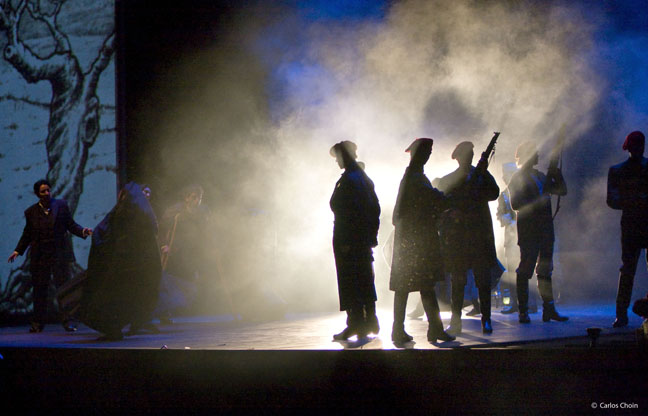
AINADAMARIIIbyCarlosChoin AINADAMARbyCarlosChoin AINADAMARbyFernandoDanielFernandez AINADAMARIIbyFernandoDanielFernandez

Posted in Music, OPera | Tagged , , , , , , , , | Leave a comment

“Maria Stuarda” in Moscow


PRESENTS:

January 21, 2014 (Tuesday 19:00)

Gaetano Donizetti

Maria Stuarda

Opera in concert after the Friedrich Schiller play

Epiphany Festival at Novaya Opera
Soloists and Orchestra of the Novaya Opera
Choir of the Popov Choral Academy
Conductor Andrey Lebedev
Choirmaster Rinat Biktashev

Mary Stuart Elvira Khokhlova
Elizabeth Anastasia Bibicheva
Leicester Alexander Bogdanov
Talbot Sergey Sheremet
Cecil Andrey Fetisov
Anna Irina Romishevskaya

Gaetano Donizetti’s tragic opera has had a complicated stage life. After its premiere in 1835 in La Scala, the opera was forbidden by censorship and was not staged until the middle of the 20th century. The Novaya Opera’s production of Donizetti’s masterpiece was its first staging in Russia. Premiered on 3 December 1992, it is one of the theatre’s oldest productions. The story of Scottish queen Mary Stuart rivaling with her cousin Queen Elizabeth I ran in the Novaya Opera for many years.
This rare opera is given a second birth during the Epiphany Festival as Maria Stuarda will be performed in concert in the composer’s original version.

The Kolobov Novaya Opera Theatre
3/2 Karetny Ryad (Hermitage Garden), Moscow, 127006, Russia
© 2011 The Kolobov Novaya Opera Theatre of Moscow
Posted in Music, OPera | Tagged , , , , , , , , , , , | Leave a comment

“Il barbiere di Siviglia” in Moscow

PRESENTS:

January 16 (Thursday 19:00)

Gioachino Rossini

Il barbiere di Siviglia

Comic opera in two acts based on the Pierre Beaumarchais comedy

Epiphany Festival at Novaya Opera

Kate Lindsey (USA) as Rosina
Bruno Praticò (Italy) as Bartolo
Conductor Felix Korobov

Stage Director Elijah Moshinsky
Set and Costume Designer Anne Tilby
Lighting Designer Sergey Skornetsky
Choirmaster Yulia Senyukova
Figaro Igor Golovatenko
Rosina Kate Lindsey
Count Almaviva Georgy Faradzhev
Basilio Vladimir Kudashev
Doctor Bartolo Bruno Praticò
Berta Svetlana Skripkina (debut)
Fiorello Alexander Popov
Officer Alexander Popov
Recommended for 6+

Biographies of cast members:

Kate Lindsey, Mezzo-soprano
A native of Richmond, Virginia, Kate. Lindsey holds a Bachelor of Music Degree with Distinction from Indiana University and is a graduate of the Metropolitan Opera’s Lindemann Young Artist Development Program.

Ms. Lindsey has already appeared in many of the world’s prestigious opera houses, including the Metropolitan Opera, Santa Fe Opera, Seattle Opera, Los Angeles Opera, Royal Opera House Covent Garden, the Glyndebourne Opera Festival, the Aix-en-Provence, Festival, Lille Opera, the Théâtre des Champs-Élysées, and the Bayerische Staatsoper. Her repertoire includes Rosina in Il barbiere di Siviglia, Cherubino in Le nozze di Figaro, Zerlina in Don Giovanni, Idamante in Idomeneo, Sesto in La clemenza di Tito, Angelina in La Cenerentola, Hansel in Hansel und Gretel, Kompanist in Ariadne auf Naxos and Nicklausse/The Muse in Les contes d’Hoffmann. She also created the title role in the premiere of Daron Hagen’s Amelia at the Seattle Opera.

An accomplished concert singer, Ms. Lindsey sang the premiere performances of a new commission by John Harbison with James Levine and the Boston Symphony Orchestra. She has also appeared with the New York Philharmonic, Cleveland Orchestra, St. Louis Symphony Orchestra, Met Chamber Orchestra (in Carnegie Hall), Cercle de l’Harmonie in Europe, and at the Tanglewood and Mostly Mozart festivals. She has worked with many of the world’s most distinguished conductors including Harry Bicket, James Conlon, Emmanuelle Haim, Thomas Henglebrock, Vladimir Jurowski James Levine, Lorin Maazel, David Robertson, Jeremie Rohrer, and Franz Welser-Möst In recital, she has been presented by the Metropolitan Museum of Art and Rockefeller University in New York City.

Ms. Lindsey recently starred in the Metropolitan Opera’s HD broadcast of its new production of Les contes d’Hoffmann. She was also featured in its broadcasts of La clemenza di Tito and The Magic Flute (which was subsequently released on DVD).

Her many awards include a prestigious 2011 grant from the Festival Musique et Vin au Clos Vougeot the 2007 Richard F. Gold Career Grant, the 2007 George London Award in memory of Lloyd Rigler, the 2007 Lincoln Center Martin E. Segal Award, and a 2006 Sullivan Foundation Grant.

Roles performed at the Novaya Opera

Rosina in Rossini’s Il barbiere di Siviglia
 

Bruno Praticò, Bass-baritone
Born in Aosta, after studying with baritone Giuseppe Valdengo Bruno Praticò attended the specialisation courses of Teatro alla Scala and of Rodolfo Celletti.He has established an extraordinary international career, performing regularly on the prestigious concert stages and opera houses, including New York MET Opera, London ROH Covent Garden, Wiener Staatsoper, Teatro alla Scala di Milano, Opéra National de Paris, Bayerische Staatsoper in Munich, Rossini Opera Festival of Pesaro, Rossini Festival in Wildbad, Maggio Musicale Fiorentino in Florence, Teatro Real in Madrid, New National Theatre of Tokyo, Opéra de Montecarlo, Teatro La Fenice in Venezia, Teatro dell’Opera in Rome, Teatro di San Carlo in Napoli, Teatro Regio in Parma, Losa Angeles Opera, San Francisco Opera, Florida Grand Opera of Miami, Houston Grand Opera.

He collaborated with such conductors as Claudio Abbado, Bruno Campanella, Riccardo Chailly, Gianluigi Gelmetti, Daniele Gatti, Donato Renzetti, Carlo Rizzi and Alberto Zedda.

Since 1993 Bruno Praticò has been a regular guest at the Rossini Opera Festival in Pesaro. In 1998, in the occasion of his interpretation of the role of Don Magnifico in La Cenerentola, he was awarded the “Rossini d’Oro Prize”. In 1999 he returned to Pesaro for Il viaggio a Reims, La Cenerentola, La Gazzetta, L’equivoco stravagante, Le comte Ory and more recently for Torvaldo e Dorliska.

The role of Bartolo in Rossini’s Il barbiere di Siviglia has become one of his signature parts. He performed Bartolo several times in her career in such venues as Teatro dell’Opera in Roma, Teatro San Carlo in Naples, Baltimore Opera Company, Arena di Verona, Opéra de Montecarlo, Opéra National de Paris, Teatro Massimo “V. Bellini” in Catania, Teatro dell’Opera in Roma, Bayerische Staatsoper, Teatro Real in Madrid. Other successful performances include his peformances of Don Magnifico in La Cenerentola at the Opéra National de Paris and at Bayerische Staatsoper, of Geronimo in /Il matrimonio segreto at the Théâtre des Champs Elysées de Paris and in Montecarlo and the role of Dulcamara in L’elisir d’amore at the Teatro La Fenice di Venezia and a the Teatro Comunale di Bologna.

During the 2012/13 season he gained a great success performing Il barbiere di Siviglia at New National Theatre of Tokyo, at Teatro Municipal de Santiago de Chile and at National Center for the Performance Arts in Beijing, Il Maestro di Cappella at Opéra de Nancy, La Cenerentola at Palm Beach Opera and L’italiana in Algeri at Atlanta Opera.

Recent seasons has brought him to perform Il viaggio a Reims at Teatro alla Scala and at the Monnaie di Bruxelles, Il signor Bruschino at the Concertgebouw in Amsterdam, Il barbiere di Siviglia at the Covent Garden in London, at the Metropolitan in New York, at the Los Angeles Opera, at the Florida Grand Opera of Miami, at the Teatro Regio di Parma, at the Teatro Comunale di Bologna and at the Teatro São Carlos in Lisbon, Così fan tutte in Lisbon, La cenerentola at the Bayerische Staatsoper di Monaco, at the Salle Pleyel de Paris, at the Festival Rossini in Wildbad, at the Tchaikovsky Hall in Moscow and at the Kungliga Teater in Stockolm, La forza del destino at the Teatro Carlo Felice di Genova, La finta semplice at the Theater an der Wien, Don Pasquale (title role) at the Teatro Massimo di Palermo, La fille du régiment (Sulpice) at the Houston Grand Opera and at the San Francisco Opera, Pulcinella at the Teatro Filarmonico di Verona, Divorzio all’Italiana by Giorgio Battistelli at the Opéra de Nancy, L’elisir d’amore at the Teatro del Maggio Musicale Fiorentino, Il turco in Italia, La gazza ladra and Il Signor Bruschino at the Rossini Festival in Wildbad and Le nozze di Figaro all’Opéra de Nancy.

His extensive discography includes Il barbiere di Siviglia (Bartolo) for EMI, L’elisir d’amore (Dulcamara) for Erato, Il signor Bruschino and La cambiale di matrimonio for Claves, Lakmè, Don Quichotte and Leoncavallo’s La bohème for Nuova Era, L’italiana in Algeri for Bongiovanni, Donizetti’s La romanziera e l’uomo nero for Opera Rara, L’italiana in Algeri for the BMG label and La Cenerentola under the baton of Alberto Zedda.

Roles performed at the Novaya Opera: Doctor Bartolo in Rossini’s Il barbiere di Siviglia

Felix Korobov, Chief Conductor of the Theatre in 2004–2006. Felix Korobov graduated from the Moscow State Conservatory (cello in 1996; opera and symphony conducting in 2002). He completed post-graduate studies at the Conservatory, specializing in string quartet (1998).In different years, he worked as leader of the cello group in the Yekaterinburg Maly Opera Theatre, the State Academic Symphony Choir of Russia directed by V. Poliansky, 1st leader assistant of the cello group in the State Academic Symphony Orchestra of Russia (GASO).

As a cellist, Korobov regularly works with the Tchaikovsky State Quartet, the Anima-Piano-Quartet and the Russian Baroque Soloists.

Since 1999, Korobov has worked in the Stanislavsky and Nemirovich-Danchenko Musical Theatre in Moscow, conducting Glinka’s Ruslan and Lyudmila, Verdi’s Ernani, Strauss’s Die Fledermaus, Gounod’s Faust, Puccini’s Tosca. He is the music director and conductor of Rimsky-Korsakov’s The Golden Cockerel, Tchaikovsky’s Eugene Onegin, Verdi’s La Traviata, and of two ballets: Prokofiev’s Cinderella, and Seagull (choreography by Neumayer, to music by Shostakovich, Tchaikovsky and Glennie). He was appointed the chief conductor of the theatre in 2004.

In 2000 – 2002, he worked as the chief conductor’s assistant in GASO, where he prepared concert programs featuring Placido Domingo, Montserrat Caballé, and Mstislav Rostropovich.

Felix Korobov joined the Novaya Opera Theatre of Moscow in 2003. He worked as the chief conductor between 2004 and 2006. In the Novaya Opera, he prepared a symphony program for a concert featuring Yuri Temirkanov and Natalia Gutman, for a concert dedicated to the 100th anniversary of the birth of Dmitry Shostakovich. He conducted concerts featuring Eliso Virsaladze (piano) and Jose Cura (tenor), “Cinemaphonia” (dedicated to the 60th anniversary of Victory in the Great Patriotic War). Felix Korobov was the music director and conductor of Rimsky-Korsakov’s The Tsar’s Bride and Bellini’s Norma. He conducted the performances “O Mozart! Mozart…”, Romances by Tchaikovsky and Rachmaninov, Tribute to Evgeny Kolobov and Opera@Jazz.

Felix Korobov has recorded more than 20 СDs. As a cellist and a conductor, he has participated in many domestic and international festivals. In 2002, he won an award of the International Contest of Chamber Ensembles (Druskininkai, Lithuania).

Felix Korobov is an Honoured Artist of Russia.

Productions

O Mozart! Mozart… (Requiem) — Conductor, Conductor
Opera&Jazz (Gala show) — Conductor
Bellini’s Norma — Conductor, Conductor
Rimsky-Korsakov’s The Tsar’s Bride — Conductor
Rossini’s Il barbiere di Siviglia — Conductor

Discography

Vincenzo Bellini. Norma (DVD) — Music Director and Conductor


Igor Golovatenko, baritone, studied at the Moscow Academy of Choral Art with Professor Dmitry Vdovin.

Since his debut in the 2006 Russian premiere of Delius’ Eine Messe des Lebens with the Russian National Philharmonic Orchestra conducted by Vladimir Spivakov, he has been quickly making a name for himself on both the concert and operatic stage.

Igor Golovatenko has been a soloist with the Novaya Opera since 2007 and a guest soloist at the Bolshoi Theatre of Moscow since 2010, where his roles have included Belcore in L’elisir d’amore, Germont in La traviata (at the Bolshoi premiered in 2012, directed by Francesca Zambello and conducted by Laurent Campellone), Figaro in Il barbiere di Siviglia (directed by Elijah Moshinsky), Olivier in Capriccio, Robert in Iolanta and the title role of Eugene Onegin.

In 2012 he made his debut at the Opera national de Paris as Lopakhin in a production of Philippe Fenelon’s La Cerisaie conducted by Tito Ceccherini and directed by Georges Lavaudant, having already sung the role to critical acclaim in the world premiere at the Bolshoi Theatre. He also debuted at the Teatro Massimo of Palermo as Shchelkalov and Rangoni in Boris Godunov (with Ferruccio Furlanetto as Boris and directed by Hugo De Ana), and at the San Carlo Theatre of Naples as Monfort in Les vepres siciliennes directed by Gianluigi Gelmetti.

Rossini

Equally at ease on the concert platform, Golovatenko has appeared with the Yaroslavl Symphony Orchestra in performances of Rachmaninov’s The Bells conducted by Murad Annamamedov, and with the Russian National Orchestra of Grieg’s Peer Gynt conducted by Mikhail Pletnev. He also appeared with the Goettingen Symphony Orchestra in concert performances of La traviata conducted by Christoph-Mathias Mueller and, most recently, with the Russian National Orchestra and Moscow State Chamber Choir in concert performances of Eugene Onegin conducted by Mikhail Pletnev at the Tchaikovsky Concert Hall. In addition, Igor Golovatenko regularly performs at the Russian National Orchestra Festival.

Highlights of the 2012/13 season include Renato in Un ballo in maschera at the Teatro Sociale di Rovigo, Opera Giocosa di Savona and Teatro Donizetti di Bergamo, Seid in Il corsaro at the Teatro Verdi Trieste, Rigoletto at the Opera Giocosa di Savona directed by Rolando Panerai, Il trovatore (Conte di Luna) and Aida (Amonasro) at the Novaya Opera, Moscow, Carlo Gustavo J. Foroni’s Christina regina di Svezia at the Wexford Opera Festival and also Don Carlo at the Bolshoi Theatre of Moscow directed by Adrian Noble and conducted by Vassily Sinaisky.

The singer also debuted at Bayerische Staatsoper as Shchelkalov in Boris Godunov conducted by Kent Nagano and directed by Calixto Bieito (2013).

Awards and Honours:

  • First prize winner of the St Petersburg Three Centuries of Classical Romance international piano-vocal duets competition (2008)
  • Second prize winner in Dresden’s International vocal competition, the Competizione dell’Opera (2011)

Roles performed at the Novaya Opera

Onegin in Tchaikovsky’s Eugene Onegin
Robert in Tchaikovsky’s Iolanta
Belcore in Donizetti’s L’elisir d’amore
Count di Luna in Verdi’s Il trovatore
Dr. Falke in Strauss’ Die Fledermaus
Figaro in Rossini’s Il barbiere di Siviglia
Germont in Verdi’s La Traviata
Olivier in Strauss’s Capriccio
Marco in Puccini’s Gianni Schicchi
Marullo in Verdi’s Rigoletto
Speaker of the Temple in Mozart’s Die Zauberflöte
He-Cat in Valdgardt’s The Cat’s House
Parts in the productions: Tribute to Evgeny Kolobov, Bravissimo! (opera mix), This is Opera! (dramatized performance), Maria Callas (Musical offering), Rossini (musical divertissement)

Discography


Georgy Faradzhev, tenor, graduated from the Sveshnikov Choral College with a degree in choral conducting and from the Gnessins Academy of Music with a degree in singing. In 2000–2001, he was a trainee at the Stanislavsky and Nemirovich-Danchenko Musical Theatre and in the International Opera Workshop in Zurich (Switzerland, 2001–2003). The singer performed in the Avant-Scene Opera in Switzerland. He has toured a lot in Russia and abroad. Georgy Faradzhev joined the Novaya Opera in 2008.


Awards and Honours

  • 2013 Moscow City Literature and Arts Prize

Roles performed at the Novaya Opera

Prince Shuisky in Mussorgsky’s Boris Godunov
Alfred in Strauss’ Die Fledermaus
Babylas in Offenbach’s A Dinner Party with Italians
Count Almaviva in Rossini’s Il barbiere di Siviglia
Nemorino in Donizetti’s L’elisir d’amore
Prince Ramiro in Rossini’s La Cenerentola
Bayan in Glinka’s Ruslan and Lyudmila
Triquet in Tchaikovsky’s Eugene Onegin
Tsar Berendey in Rimsky-Korsakov’s The Snow Maiden
An Italian Tenor in Strauss’s Capriccio
First Warrior in Mozart’s Die Zauberflöte
Nobleman of Brabant in Wagner’s Lohengrin
Yeroshka in Borodin’s Prince Igor (in concert)
Fourth Jew in Strauss’ Salome (in concert)
Tenor part in Puccini’s Messa di Gloria
Parts in the productions: Bravissimo! (opera mix), This is Opera! (dramatized performance), Opera&Jazz (Gala show), Maria Callas (Musical offering), Novaya Opera Tenors (Gala concert), Rossini (musical divertissement)

Discography


Posted in Music, OPera | Tagged , , , , , , | Leave a comment

“The Daughter of the Regiment” in Wisconsin

Madison Opera 

Presents:


Sung in French with projected English translations

Production dates:
Friday, February 7, 2014 | 8pm
Sunday, February 9, 2014 | 2:30pm

Run time:
approx. 2 hours 15 minutes, including one intermission

Related Events

Opera Up Close: The Daughter of the Regiment preview / February 2, 2014
Opera Talks: Pre-Opera lecture

Production

John DeMain
Conductor/Madison Opera Artistic Director
Madison Opera Debut: The Magic Flute

Recently with MO: Tosca, Acis & Galatea, A Masked Ball, Cinderella, Eugene Onegin

Recently: Lost in the Stars, The Music Man (Glimmerglass Festival), Show Boat (Lyric Opera of Chicago, Washington National Opera), Aida (Virginia Opera), Porgy & Bess (Seattle Opera), Pagliacci / Carmina Burana (Portland Opera)

Upcoming:  Dead Man Walking (Madison Opera); Show Boat (San Francisco Opera); Carmen (Virginia Opera)

Website: www.madisonopera.org/about/artistic_director

David Lefkowich
Stage Director
Madison Opera Debut: Acis and Galatea

Recently: Simon Boccanegra (Kentucky Opera); Il Barbiere di Siviglia, Pagliacci (Mill City Summer Opera); La Bohème (Fort Worth Opera Festival); Idomeneo, Le Nozze di Figaro (Ravinia Music Festival); Roméo et Juliette (Florida Grand Opera, Minnesota Opera); Il Trovatore (Fort Worth Opera Festival, New Orleans Opera); Così fan tutte (Opera Saratoga); Tosca (Boston Lyric Opera

Website: www.davidlefkowich.com

Caitlin Cisler
Marie

Madison Opera Debut: Opera in the Park 2012
Recently with MO:
A Masked Ball, Opera in the Park 2013

Recently: Barbarina, Le Nozze di Figaro, (Dayton Opera); The Child Ghost, Paranormal Playhouse  and Bonny Jo Loco, The Good, the Bad, The Divas (Fresco Opera); Papagena, Die Zauberflöte (Pittsburgh Opera Theatre); Gretel, Hansel and Gretel (Opera for the Young); Maria, West Side Story (Aspen Opera Theater Center); Norina, Don Pasquale (Candid Concert Opera)

Upcoming: Handel’s Messiah (Dayton Philharmonic)

Website:  www.caitlincisler.com

Javier Abreu
Tonio

Madison Opera Debut

Recently: Almaviva, Il Barbiere di Siviglia (Central City Opera, Lismore Music Festival); Don Ramiro, La Cenerentola (Nashville Opera, Lyrique-en-Mer); Ernesto, Don Pasquale (Opera Santa Barbara); Padre Rufiano, The Inspector (Wolf Trap Opera); Lindoro, L’Italiana in Algeri (Opera de Oviedo, Austin Lyric Opera)

Upcoming: Lindoro, Il barbiere di Siviglia (Santa Fe Concert Association); Carmina Burana (Pennsylvania Ballet)
Website: www.javierabreu.com

Nathan Stark
Sulpice

Madison Opera Debut: Don Giovanni

 Recently: The One-Armed Brother, Die Frau ohne Schatten (Metropolitan Opera); Il Commendatore, Don Giovanni and Pope / Barberini / Simplicio, Galileo Galilei (Cincinnati Opera); Hunding, Die Walküre and Friar Laurence, Roméo et Juliette (Dayton Opera); Nourabad, The Pearl Fishers and The King, Aida (Virginia Opera); The Bonze, Madama Butterfly (Arizona Opera); The Speaker, Die Zauberflöte (Cincinnati Opera) 

Upcoming: First Nazarene, Salome (Boston Symphony Orchestra); Verdi’s Requiem (Defiant Requiem Foundation); Beethoven’s 9th Symphony (Dayton Philharmonic)


Website: www.nathan-stark.com

Allisanne Apple
The Marquise of Berkenfield
Madison Opera Debut: Hansel and Gretel
Recently with MO: Galileo Galilei, Eugene Onegin, La Traviata

Recently: Lettice Douffet, Lettice and Lovage (Madison Theatre Guild); Aunt March, Little Women (Four Seasons Theatre)

Douglas Swenson
Hortensius

Madison Opera Debut: The Tenderland
Recently with MO: Eugene Onegin, Madama Butterfly

Recently:
Georg, She Loves Me and Candide, Candide (Four Seasons Theater); Uncle Billy, A Wonderful Life (Children’s Theater of Madison); Archibald, The Secret Garden (Music Theater Madison, First United Methodist Church)

The Story of the Opera

The Tyrolean mountains.

ACT I. On their way to Austria, the terrified Marquise of Berkenfield and her butler, Hortensius, have paused in their journey because a skirmish has broken out. When the Marquise hears from the villagers that the French troops have retreated, she comments on the rude manners of the French people. Sulpice, sergeant of the 21st regiment, assures everyone that his men will restore peace and order. He is joined by Marie, the mascot, or “daughter,” of the regiment, which adopted her as an orphaned child. When Sulpice questions her about a young man she has been seen with, she explains that he is a local Tyrolean who once saved her life. Troops of the 21st arrive with a prisoner: this same Tonio, who says he has been looking for Marie. She steps in to save him, and while he toasts his new friends, Marie sings the regimental song. Tonio is ordered to follow the soldiers, but he escapes and returns to declare his love to Marie.

The Marquise of Berkenfield asks Sulpice for an escort to return her to her castle. When he hears the name Berkenfield, Sulpice remembers a letter he found near the young Marie on the battlefield. The Marquise soon admits that she knew the girl’s father and says that Marie is the long-lost daughter of her sister. The child had been left in the care of the Marquise, but was lost. Shocked by the girl’s rough manners, the Marquise is determined to give her niece a proper education and to take her to her castle. Tonio has enlisted so that he can marry Marie, but she has to leave both her regiment and the man she loves.

ACT II. At the Berkenfield castle. The Marquise has arranged a marriage between Marie and the Duke of Krakenthorp. Sulpice is also at the castle and is supposed to be helping the Marquise with her plans. The Marquise gives Marie a singing lesson. Encouraged by Sulpice, Marie slips in phrases of the regimental song, and the Marquise loses her temper. Left alone, Marie thinks about the meaninglessness of money and position. She hears soldiers marching in the distance and is delighted when the whole regiment files into the hall. Tonio, Marie, and Sulpice are reunited. Tonio asks for Marie’s hand. The Marquise is unmoved by the young man’s declaration that Marie is his whole life. She declares her niece engaged to another man and dismisses Tonio. Alone with Sulpice, the Marquise confesses the truth: Marie is her own illegitimate daughter.

Hortensius announces the arrival of the wedding party, headed by the groom’s mother, the Duchess of Krakenthorp. Marie refuses to leave her room, but when Sulpice tells her that the Marquise is her mother, the surprised girl declares that she cannot go against her mother’s wishes and agrees to marry a man that she does not love. As she is about to sign the marriage contract, the soldiers of the 21st regiment, led by Tonio, storm in to rescue their “daughter.” The guests are horrified to learn that Marie was a canteen girl, but they change their opinion when she tells them that she can never repay the debt she owes the soldiers. The Marquise is so moved by her daughter’s goodness of heart that she gives her permission to marry Tonio. Everyone joins in a final “Salut à la France.”

Courtesy of The Metropolitan Opera

Posted in Music, OPera | Tagged , , , , , , , | Leave a comment

“LA FANCIULLA DEL WEST” at l’Opera de Paris

Logo_OnP

L’Opera National de Paris Presents:

THE GIRL OF THE WEST

LA FANCIULLA DEL WEST

OPERA IN THREE ACTS (1910)

MUSIC BY GIACOMO PUCCINI (1858-1924)

LIBRETTO BY GUELFO CIVININI AND CARLO ZANGARINI BASED ON DAVID BELASCO’S PLAY “THE GIRL OF THE GOLDEN WEST”

fanciullaFrance

Performed in Italian

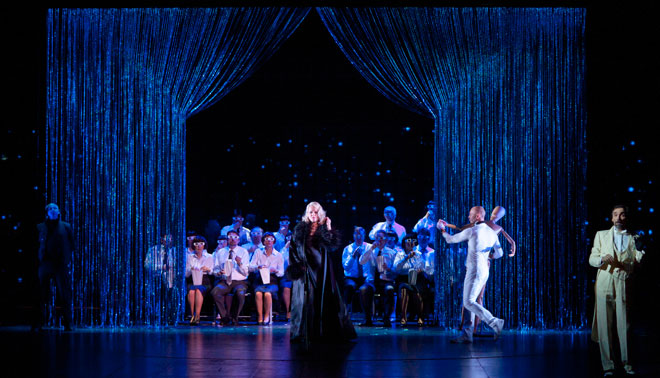
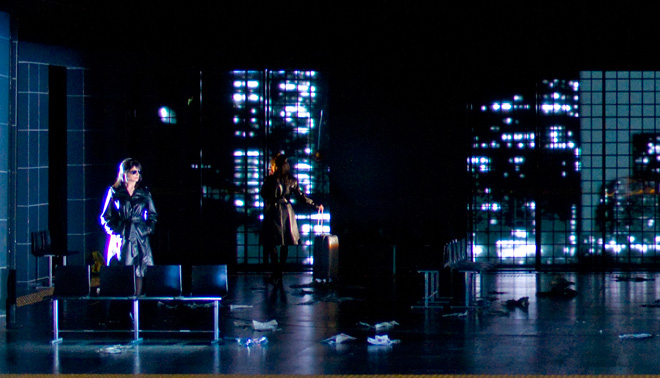
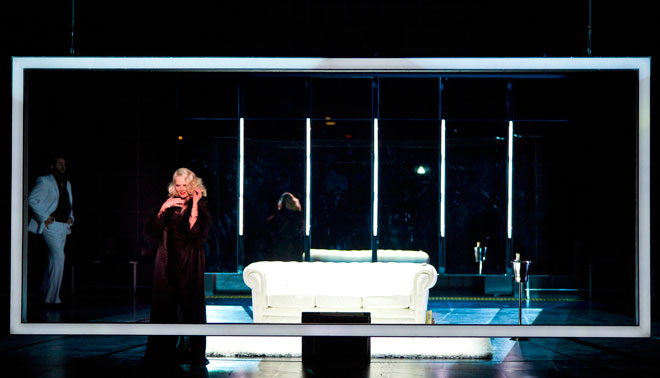
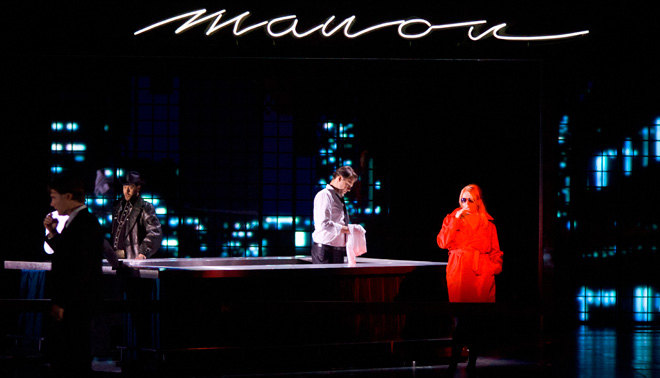
“In those strange days, people coming from God knows where, joined forces in that far Western land”. With the adventures of Minnie, who falls in love with a warm-hearted bandit, Puccini gave opera its first Western, a drama of souls stranded on the edge of the world.

Carlo Rizzi Conductor
Nikolaus Lehnhoff Stage director
Raimund Bauer Sets
Andrea Schmidt-Futterer Costumes
Duane Schuler Lighting
Jonas Gerberding Video
Denni Sayers Choreography
Patrick Marie Aubert Chorus master

Nina Stemme Minnie
Claudio Sgura Jack Rance
Marco Berti Dick Johnson
Roman Sadnik Nick
Andrea Mastroni Ashby
André Heyboer Sonora
Emanuele Giannino Trin
Roberto Accurso Sid
Igor Gnidii Bello
Eric Huchet Harry
Rodolphe Briand Joe
Enrico Marabelli Happy
Wenwei Zhang Larkens
Ugo Rabec Billy Jackrabbit
Anna Pennisi Wowkle
Alexandre Duhamel Jake Wallace
Matteo Peirone José Castro

Paris Opera Orchestra and Chorus 

PRODUCTION BY NEDERLANDSE OPERA, AMSTERDAM

Fille_far_west_visuel

“In those strange days, people coming from God knows where, joined forces in that far Western land, and, according to the rude custom of the camp, their very names were soon lost and unrecorded, and here they struggled, laughed, gambled, cursed, killed, loved and worked out their strange destinies in a manner incredible to us of to-day. Of one thing only are we sure – they lived!” Puccini prefaced his score with this quotation and, indeed, it is life itself that he aimed to capture, in a trail that would lead him to Paris in La Bohème, to Japan in Madama Butterfly and then as far as the Far West in a tale of passion, certainly, but also of humanity, brotherhood and compassion. In a saloon bar known as The Polka, gold diggers brood over mothers left behind in Italy whilst Minnie, behind the bar, reads to them from the Bible. Love will come to Minnie in the guise of a criminal but, seeing beyond mere appearances, she will recognise the true heart beneath the rough exterior and realise the possibility of happiness. In the wake of the first literary westerns and as cinema began to exploit the genre, Puccini gave opera its first ever western: a tale of souls stranded at the edge of the world, a tale of laughter and of tears, both exotic and overwhelming. First performed at the Metropolitan Opera of New York in 1910, this genuine masterpiece finally enters the repertoire of the Paris Opera.

Performance dates:

February 2014
Mon Tue Wed Thu Fri Sat Sun
          1 2
3 4 5 6 7 8 9
10 11 12 13 14 15 16
17 18 19 20 21 22 23
24 25 26 27 28  

Opéra de Paris Production     Logo France Television  logo CNC Partenaires techniques Viva l'Opéra

 
Fondation Orange Ciné Mécène des retransmissions audiovisuelles de l’Opéra national de Paris

telmondis distribution   Distributeur TV international d’Opéra de Paris Production  

  En direct au cinéma
EN DIRECT AU CINÉMA LE LUNDI
10 FÉVRIER 2014

Diffusion en différé sur France télévisions

 logo France Musique en direct sur France Musique et en UER le 22/02
Posted in Music, OPera | Tagged , , , , , , | Leave a comment

Welsh National Opera presents “Manon Lescaut”

Welsh National Opera presents:

“Manon Lescaut”

Giacomo Puccini

New Production

Manon-Lescaut---photo-credit-Forster---La-Monnaie-1_0

Manon has been seduced. As an impressionable young woman she wanted it all. She wanted to taste the tempting fruit of adult life. Now just months later she has discovered that the fruit is rotten at the core. Does Manon have any chance of salvation? 

Manon Lescaut is the classic Fallen Woman. Puccini charts her rapid descent from innocent to criminal with feverish intensity. If you enjoy La bohème, Madam Butterfly and Tosca you will want to explore Puccini’s breakthrough hit and first great opera.

“I’m looking forward to working on Manon Lescaut as I’ve never heard it before. I know whenever Puccini is in our repertoire I need to bring tissues to rehearsals, his music always moves me to tears.”

Katie Heath-Jones, Deputy Stage Manager

Cities

FREE pre-performance talks 
Prior to every performance of Manon Lescaut and Boulevard Solitude.

The Whole Story
Thursday 6 February – Wednesday 19 March
The Whole Story is the perfect introduction to the Fallen Women season. Before the performances begin, our team of experts will guide you through the music, stories and background to each opera.

Literary inspirations
Friday 28 February
A special hour long talk looking at how the season’s operas draw on classics by Dumas and and Prévost.

David Pountney in Conversation
Thursday 7 February
David Pountney and a key figure from the arts explore the Fallen Women theme.

Conductor Lothar Koenigs
Director Mariusz Trelinski
Set Designer Boris Kudlicka
Costume Designer Magdalena Musial
Choreography Tomasz Wygoda
Video Projections Bartek Macias
Lighting Designer Felice Ross

Cast includes
Manon Lescaut Chiara Taigi
Lescaut David Kempster
Chevalier des Grieux Gwyn Hughes Jones
Geronte di Ravoir Stephen Richardson

All performances start at 7.15pm

Running time approximately 2 hours 30 minutes including one interval

Sung in Italian with surtitles in English (and Welsh in Cardiff and Llandudno)

Co-production with Teatr Wielki, Warsaw and La Monnaie, Brussels

Manon Lescaut Gallery

Images by Forster

Manon-Lescaut---Photo-credit-Forster---La-Monnaie-8_0 Manon-Lescaut---Photo-credit-Forster---La-Monnaie-2 Manon-Lescaut---Photo-credit-Forster---La-Monnaie-3 Manon-Lescaut---Photo-credit-Forster---La-Monnaie-4_0 Manon-Lescaut---Photo-credit-Forster---La-Monnaie-5 Manon-Lescaut---Photo-credit-Forster---La-Monnaie-6_0 Manon-Lescaut---Photo-credit-Forster---La-Monnaie-7_0

Posted in OPera | Tagged , , , , , , , | Leave a comment

“Opera Unlimited” in Poland

Opera UnlimitedlogooperaKrakov

Opera Unlimited

Production team:

Artistic Director
Laco Adamik, Grzegorz Brajner, Elena Korpusenko, Bogusław Nowak, Marek Pacuła, Bożena Pędziwiatr


Cast:

SOLOIST A | Karolina Wieczorek, Katarzyna Oleś-Blacha

SOLOIST B | Magdalena Barylak, Marta Abako

SOLOIST C | Monika Korybalska, Agnieszka Cząstka

SOLOIST D | Krzysztof Witkowski, Michał Kutnik

SOLOIST E | Krzysztof Kozarek, Adam Sobierajski

SOLOIST F | Volodymyr Pankiv, Krzysztof Dekański

MASTER | Marek Pacuła, Sławomir Rokita

Assistant: Stanisław Knapik, Władysław Guzik
Tutor: Kristina Kutnik

Ballet
Gabriela Kubacka, Mizuki Kurosawa
Maksim Kileyeu, Aurimas Sibirskas

Dates

26.02.2014
time: 11:00 am
scene: Main Stage
duration: 1 hr. 30 min.

22.01.2014
time: 11:00 am
scene: Main Stage
duration: 1 hr. 30 min.

27.11.2013
time: 11:00 am
scene: Main Stage
duration: 1 hr. 30 min.

Opera Unlimited

An educational spectacle in which the orchestra and soloists of the Krakow Opera will stage fragments of the greatest opera, operetta, musical and ballet works. The purpose of the performance is to show young spectators how a theatre spectacle is created and to introduce them to names and the most eminent composers and performers of these works through an anecdote and an attempt to define genres of a musical theatre.

The host of the spectacle will be Marek Pacuła – a famous Krakow-based satirist, for years related to the artistic centre “Piwnica pod Baranami”, currently a journalist and an announcer. The spectacle will feature fragments of The Haunted Manor, Carmen, Madama Butterfly, The Merry Widow, Don Giovanni, Swan Lake and other.

Posted in Music, OPera | Tagged , , , , , , , | Leave a comment

A MASKED BALL (Un ballo in maschera) in Toronto

A MASKED BALL (Un ballo in maschera)

Giuseppe Verdi

Canadian Opera Company

An all-star cast includes Canada’s great diva Adrianne Pieczonka and the exciting tenor Dimitri Pittas.

Composed directly after his hugely successful Rigoletto, La Traviata, and Il Trovatore, Verdi’s A Masked Ball (Un ballo in maschera) depicts a deeply human tale of forbidden passion between two very grown-up lovers. This stunning production sets Verdi’s abiding love triangle in the American south of the 1960s, with its undertones of Kennedy-era tensions and power plays.

FEBRUARY 2 TO 22, 2014


On stage at the Four Seasons Centre, 145 Queen St. W., Toronto.
Performance time is approximately three hours including two intermissions.
Sung in Italian with English SURTITLES™.

Cast 

Amelia: Adrianne Pieczonka

Riccardo: Dimitri Pittas

Ulrica: Elena Manistina

Renato: Roland Wood

Oscar: Simone Osborne

Silvano: Gregory Dahl

Samuel: Evan Boyer

Tom: Giovanni Battista Parodi

Magistrate: John Kriter

Servant of Amelia: Owen McCausland

Creative Team


Conductor: Stephen Lord

Directors: Jossi Wieler & Sergio Morabito

Set Designer: Barbara Ehnes

Costume Designer: Anja Rabes

Lighting Designer: Olaf Freese

<!–Choreographer:

–>

Chorus Master: Sandra Horst

With the COC Orchestra and Chorus

Act I

Scene i, The governor’s house
Riccardo reviews his guest list for the coming masked ball. Seeing the name of Amelia, he is moved and privately expresses his guilty love for his secretary’s wife. Renato, his secretary, then enters to warn Riccardo about plots against Riccardo’s life, which the governor laughs off. The judge appears, requesting that Riccardo exile Ulrica, a fortune-teller suspected of supernatural practices. Oscar, the page, defends Ulrica and Riccardo decides to visit her in disguise to see for himself, inviting the court to follow him.

Scene ii, Ulrica’s dwelling
In hiding, Riccardo sees Amelia ask the fortune teller to rid her of the love that torments her. Ulrica tells her of a healing plant that grows in the graveyard nearby. Riccardo vows to follow Amelia on her quest. As his courtiers appear, he asks for his own fortune and is told he will soon die by the hand of a friend. Ulrica says the murderer will be the next person to shake his hand, a prophecy that seems absurd to Riccardo as Renato enters and greets him with a handshake. But Riccardo’s faith in his friend is unshaken. The people recognize Riccardo and all hail their beloved governor.


Act II

The graveyard
A terrified Amelia searches for the plant that will make her fall out of love, and prays for assistance in her ordeal. Riccardo appears and declares his love for her. At first reluctant, Amelia finally admits her love as well. At the sound of footsteps, she lowers her veil and conceals her identity. Renato appears, warning of approaching assassins. Riccardo agrees to leave only after Renato promises to take the unknown woman to the gates of the city, without speaking to her or looking at her. When the conspirators, Samuel and Tom, appear and find Riccardo gone, they decide to amuse themselves by revealing the face of the mysterious woman. When it becomes clear that Renato will fight rather than permit this, Amelia raises her veil. Renato is astounded and the conspirators break out in laughter. Enraged by his friend’s betrayal, Renato arranges to meet with the conspirators the next day.


Act III

Scene i, Renato’s study
Renato informs Amelia that she must die. Although she admits her love for Riccardo, she insists that she has not betrayed her husband and begs to see her young son once more. Renato meets with Samuel and Tom and vows to help them kill the governor. They elect to draw lots to decide who will strike the final blow. Renato forces Amelia to draw and she is horrified when she selects her husband’s name. Oscar enters, bringing invitations to a masked ball in the governor’s palace. Renato decides to take Amelia with him and carry out the assassination at the ball.

Scene ii, The governor’s study
Riccardo decides to sign an order sending Renato and Amelia back to England and muses on the loss of his love. He is brought an anonymous message warning that he risks assassination at the ball, but decides to see Amelia one last time.

Scene iii, The ballroom in the governor’s mansion
Renato, Samuel, Tom and their followers search for Riccardo. Renato persuades Oscar to reveal the governor’s disguise. Amelia enters, finds Riccardo and begs him to escape, revealing that she sent the anonymous note. He reiterates his love, but tells her that she must leave with her husband. As they bid a last, tender farewell, Renato throws himself between them and kills the governor. Before he dies, Riccardo bids his people to release Renato and assures him that his wife’s honour is intact. Everyone grieves as Riccardo dies.


(l – r) Catherine Naglestad as Amelia, Piotr Beczala as Riccardo, Dalibor Jenis as Renato, Anna Prohaska as Oscar, Oliver Zwarg as Samuel and Andreas Bauer as Tom in the Berlin Staatsoper production of Un ballo in maschera. Photo: Ruth Walz © 2008

Posted in Music, OPera | Tagged , , , , , , , , | Leave a comment

FALSTAFF in Stuttgart

Logo of the Oper Stuttgart

Presents:

Falstaff

Giuseppe Verdi
In Italian with German supertitles

In Shakespeare’s drama Sir John Falstaff, an aristocratic crook, loses his way and finds himself in Windsor – amongst hard-working citizens, who are now forced to defend everything they have worked for and have earned against that uninvited guest: their money, their children, their women. Windsor’s women and children, however, have minds of their own.
Half a century after his first success with Nabucco, 80-year-old Giuseppe Verdi concludes his life’s work with one of world literature’s best musical comedies ever.
Pre-performance Introduction (in German)
45 minutes prior to the start of every performance, Opera House, Grand Tier Foyer (Foyer I. Rang)

Late Night Talks (in German)
Directors, dramaturgs, singers and conductors of the productions answer questions by the audience.

  • Saturday, 26 October 2013
  • Wednesday, 13 November 2013

Opernhaus
Premiere
20 October 2013
Duration
Act I and Act II: approx. 1 hour 25 min
– Interval (after Act II): approx. 25-30 min –
Act III: approx. 45 min

Performance
02.01.2014 19:00 – 22:00 

ARTISTIC TEAM 
Conductor: Sylvain Cambreling, Till Drömann,

Director: Andrea Moses,

Stage Design: Jan Pappelbaum,

Costumes: Anna Eiermann,

Lighting: Reinhard Traub,

Chorus: Johannes Knecht,

Dramaturgy: Wilfried Buchholz, Moritz Lobeck

CAST

Sir John Falstaff: Albert Dohmen,

Ford: Gezim Myshketa,

Fenton: Atalla Ayan, Gergely Németi,

Dr. Cajus: Heinz Göhrig, Uwe Eikötter,

Bardolfo: Torsten Hofmann, Albrecht Kludszuweit,

Pistola: Roland Bracht,

Mrs Alice Ford: Simone Schneider, Christiane Iven,

Nannetta: Pumeza Matshikiza, Mirella Bunoaica,

Mrs Quickly: Hilke Andersen, Lindsay Ammann,

Mrs Meg Page: Sophie Marilley,

Der Wirt (stumme Rolle): Maarten Güppertz,

With: Staatsopernchor Stuttgart, Staatsorchester Stuttgart


Posted in Music, OPera | Tagged , , , , , , , , , | Leave a comment

The Lyric Opera of Chicago presents “The barber of Seville”

The Lyric Opera of Chiacgo presents

The Barber of Seville

  • by Gioachino Rossini
  • In Italian with projected English texts.Rossini’s The Barber of Seville is a new production.
  • Approximate running time: 3h 10m

February 1, 3, 6, 9, 12, 15, 18, 21, 25, 28 

Figaro! Figaro! Figaro! Rossini’s music sparkles like sunshine with one hit tune after another.

Not only is Figaro the Barber of Seville, he’s also the ultimate Mr. Fix-It! This time he’s out to ensure that Count Almaviva can marry lovely Rosina before her grumpy old guardian drags her to the altar himself.

  Anna ChristieA Streetcar Named DesireShrekCat on a Hot Tin RoofHow to Succeed in Business…Tony and Olivier Award-winning director Rob Ashford keeps racking up major hits. Whether working in comedy or drama, his productions “pull out all the stops.” The Independent, London

New Lyric Opera production of Gioachino Rossini’s The Barber of Seville generously made possible by the Gramma Fisher Foundation of Marshalltown, Iowa, the NIB Foundation, Randy L. and Melvin R. Berlin, and Margot and Josef Lakonishok

Starring

  • Nathan Gunn

    Figaro

    Nathan Gunn

    One of today’s most in-demand baritones, dashing Nathan Gunn “is a vibrant Figaro with a potent sexuality.” Opera News

  • Isabel Leonard

    Rosina

    Isabel Leonard 

    “With her passionate intensity and remarkable beauty, Isabel Leonard makes the role of Rosina her own.” The New York Times

  • Alek Shrader

    Almaviva

    Alek Shrader 

    Alek Shrader is an Almaviva with comic wit and matinee-idol good looks.” Opera News

  • Alessandro Corbelli

    Bartolo

    Alessandro Corbelli 

    When it comes to definitive interpretations of iconic buffo characters, Alessandro Corbelli is unsurpassed. “He could have created Bartolo, all bluster and great comic timing.” The Independent, London

    CAST

    Barber of Seville - Kyle Ketelsen   Basilio
    Kyle Ketelsen
    Barber of Seville - Tracy Cantin  Berta
    Tracy Cantin
    Barber of Seville - Will Liverman  Fiorello
    Will Liverman
    Barber of Seville - John Irvin  Sergeant
    John Irvin
    Barber of Seville - Michele Mariotti  Conductor
    Michele Mariotti*
    Barber of Seville - Rob Ashford  Director
    Rob Ashford*
      Set Designer
    Scott Pask* 
      Costume Designer
    Catherine Zuber* 
      Lighting Designer
    TBA
      Chorus Master
    Michael Black

    A NEW BARBER IN TOWN
    Rossini’s sparkler boasts stellar cast

    by Jack Zimmerman

    Figaro is a fixer, the guy who makes everything right for Rosina and Count Almaviva. He’s a man of many talents and the central character in Il barbiere di Siviglia (The Barber of Seville), one of the greatest comic operas ever written. We first get to know him as he tells us he’s needed by everybody and has many places to be in the famous “Largo al factotum.”

    Figaro’s clever, optimistic, and at times opportunistic, but always trying to help others. “He’s a modern man, and I try to get that across without turning him into a comedian,” says Lyric favorite Nathan Gunn, who sings Figaro in this new production of the Rossini classic. “I enjoy doing the part because it’s a big step out of who I actually am. Figaro’s an opportunist, but his intentions aren’t nefarious or selfish. He doesn’t want to hurt others, just do the right thing. He dislikes those who are corrupt and sneaky, and likes those who have good intentions and good will. I doubt I’d be his pal, but I’d probably enjoy having a drink with him once in a while.”

    Rossini’s best-known opera is packed with plenty of coloratura arias, laugh-out-loud scenes, and memorable characters. It’s become such a part of us that it’s received a fair share of pop-culture references – for instance, the Bugs Bunny cartoon The Rabbit of Seville, which has introduced countless kids and adults to the strains of “FigaroFigaroFIGARO.”

    Most impressive is the fact that Rossini’s classic has remained relevant – and more important, has remained funny – after almost 200 years of continual performance. By age 21, thanks to Tancredi and L’italiana in Algeri, Rossini was Italy’s most popular composer. He wrote Barber before he was 25 – not bad for a kid who apprenticed to a Bolognese pork butcher when he was 12!

    The Barber story was adapted from French playwright Beaumarchais’ Le barbier de Séville. Beaumarchais wrote three Figaro plays in all. His Le mariage de Figaro inspired Mozart’s Le nozze di Figaro. All three plays mirror the changing social attitudes around the time of the French Revolution.

    In The Barber of Seville the beautiful Rosina is pursued by Count Almaviva, but Bartolo, Rosina’s guardian, wants to marry her himself. Before it’s all over, the Count has assumed several identities: 1) a guy named Lindoro, 2) a drunken soldier, and 3) a music teacher, Don Alonso.

    There’s a close call with Rosina feeling betrayed and briefly considering marriage to Bartolo, but through it all, with a good deal of scheming by Figaro and several comedic encounters, Rosina winds up with the Count, and Bartolo, accepting his fate, gives the couple his blessing.

    While the story is amusing, it’s Rossini’s music that makes the opera so universally appealing. The opera is still entertaining because, as renowned opera scholar Philip Gossett puts it, “Rossini was careful to write into it his reactions to the conventions of Italian opera of his time. In his opening Introduzione, the Count sings his serenade to Rosina and the musicians follow with a typical Rossini crescendo. The point of the crescendo is to make more noise each time the melody is repeated, but the Count really wants the musicians to be quiet.

    “Likewise, Rossini plays with the cabaletta – the quick section that concludes a musical number. Convention holds that the theme will be repeated a second time. But in this case Figaro tries to hurry the lovers along, only to find they won’t be hurried, and the ladder by which they had planned their escape disappears from under them! This is all part of what keeps the opera so amusing and so fresh all these years.”

    For the past 25 years, the Barber seen at Lyric was the Magritte-inspired, John Conklin-designed production. This season Lyric audiences will experience director Rob Ashford’s take on the work with set designs by Scott Pask and costume designs by Catherine Zuber.

    All are making their company debuts with this new Lyric production.

    The Tony- and Olivier Award- winning Ashford comes from a dance background (he made his Broadway dance debut in the 1987 Lincoln Center revival of Anything Goes). A director of both drama and comedy, he’s scheduled to direct and choreograph Carmen at Houston Grand Opera next spring.

    Pask’s work on The Book of Mormon earned him the Tony Award for Best Scenic Design of a Musical. He made his Metropolitan Opera debut with designs for Benjamin Britten’s Peter Grimes and has designed, among other operas, Albert Herring for Opera North, in Leeds, England.

    “We wanted the scenic design to have the look and feel of 18th-century Seville,” says Pask, “infusing the comedic timing and movement of the opera throughout the transformation of the set, as it moves swiftly between locales, utilizing Rob’s extraordinary gift for musical storytelling.”

    Zuber was the costume designer for the Met’s Doctor Atomic and has worked with the Canadian Opera Company, New York City Opera, Glimmerglass, and the opera companies of Houston and Los Angeles. “When considering the costumes for The Barber of Seville,” she says, “Rob Ashford felt the characters should reflect the time period in which the piece was written and have the flavor of Seville. The characters have delightful parallels with commedia dell’arte, creating the challenge to imbue the costumes with a restrained humorous silhouette. We also thought about the movement that the costumes could provide in telling our story.”

    Italian-born Maestro Michele Mariotti, principal conductor of the Teatro Comunale di Bologna since 2008, will make his Lyric debut in this production. He conducted the Metropolitan Opera’s recent “Rat-Pack” Rigoletto.

    In Lyric’s production, Rosina is sung by mezzo-soprano Isabel Leonard in her much anticipated Lyric debut. She’s performed the role before, in Vienna and twice at the Met. But the very first time she sang Rosina was in Denver, six-and-a half months pregnant – and struggling with the altitude of the mile-high city. “That in itself was comic,” she says. 

    “I have never thought of Rosina as a spicy, manipulative, conniving person,” says Leonard. “She’s actually incredibly kind, sweet and gentle. This [marriage] is her last hope and she knows it. If this doesn’t work, she’ll have to marry Don Bartolo. She’s smart enough to take advantage of the situation.”

    Count Almaviva is sung by Alek Shrader, who debuted at Lyric as Tamino in 2011/12’s The Magic Flute. The ultimate interpreter of Italian comic roles, the legendary Alessandro Corbelli sings the role of Bartolo. Corbelli was Dulcamara in The Elixir of Love here in the 2009/10 season. Basilio is sung by Kyle Ketelsen, who starred in the title role of Mozart’s The Marriage of Figaro at Lyric in 2009/10.

    Figaro may be central to the opera, but as Gunn says, “It’s really a story about a number of characters. Figaro never draws attention to himself, but subtly distracts people so that something else can happen. His goal is to get the Count and Rosina together. That’s my point of view when I come into the opera. Everything I say and do has one goal, which is to get those two people together.”

    They do get together, and their story has delighted opera goers for close to 200 years. And it has delighted Lyricpatrons since the company’s first season 59 years ago, when Tito Gobbi was Lyric’s first Figaro. This production is sure to continue the tradition. As Figaro sings in “Largo al factotum”: “Ah, isn’t life good? How pleasant it is for a barber of class!”

Posted in Music, OPera | Tagged , , , , , , , , | Leave a comment