
Interview by Tiziano Thomas Dossena, Published on L’IDEA Magazine N.12, Vol.II, 2002, NY
Conductor Vincent La Selva has been a New York institution for almost 50 years. He founded the New York Grand Opera Company in 1973, which is unique in the world for presenting fully staged opera productions that are free to the public. Since 1974, he has chosen New York’s Central Park for his productions of grand opera, which have been attended by more than three million people. Maestro La Selva has earned special renown for leading performances that cut to the musical essence of these scores with a directness, lyricism and passion that has often invoked the conducting style of the late Arturo Toscanini. The New York Grand Opera Company, led by Mr. La Selva, is synonymous with grand opera, idiomatically performed—and accessible to all.
L’IDEA: Maestro, you have been awarded the prestigious Bridge Personality of the Year 2002 by the editors of Bridge Apulia USA. This, unlike the many other awards you receive, was presented to you by an Italian publisher. Is this the first time you receive an award from Italy, and how do you feel to be recognized by the land of your parents?
Maestro La Selva: Well, I thought it was wonderful to be honored by Apulia and the Bridge magazine. I was very honored by that because I have very strong feelings and ties to Italy even though I was born here. Now, in terms of publications, I think that the first award I did receive from Italy. I did receive, though, other acknowledgments, such as the Knighthood from the ItalianRepublic (Croce di Cavaliere). Furthermore, the mayor of Parma, who is also the director of the Opera House of that city, offered me a plaque, with his city keys, in the occasion of his visit to New York…
L’IDEA: Well, how deep are your Italian roots? That is, what does it mean for you to be an Italian American?
La Selva: My parents were born in Italy, I grew up in an Italian neighborhood, amongst my fathers’ friends, people who were all from Conversano and that area, Puglia, so I had always very, very close feelings and ties to Italy. I grew up very Italian. American, but with strong feelings about Italy and its customs. My grandparents were also born in Bari, both of them… very strong.
L’IDEA: You have been conducting since you were a teenager. Could you explain to our readers how you got to be interested into conducting, and how did it become the essence of your life, artistic and not.
La Selva: Well, it happened just by accident. When I was in Junior High School, in 7th grade, I was twelve, the director of the School orchestra asked me to conduct, so that’s how I started. I was advanced musically and the music that was being played by the orchestra and the band was too easy for me, so I started to lose interest in both of them. I’m sure the reason he asked me to conduct was to keep my interest going. I never thought about conducting. Who would think about conducting at that age? But, that’s how I started, and I have been doing it ever since.
L’IDEA: How did that develop now into a full time interest?
La Selva: Well, I kept conducting… It wasn’t only that one time; I was doing it all the time. I continued conducting throughout High School. I was the only one in the whole city that they never called in a substitute for. Also, when a conductor was sick, they would have me take over. Then, after High School, I came to NY, to the JulliardSchool. After a year I became a conducting major and I graduated with a degree in orchestral conducting.
L’IDEA: What would you say is the main attribute of a conductor, for him to be effective? What does it really mean to conduct? People see the conductor move the hands and keep the rhythm…
La Selva: Well, that’s a really good point that I make myself all the time. People really don’t know what a conductor does. They think you wave your arms and you keep everybody together. That’s an insult to me… an insult. In fact, I asked some conductors to try to explain to their relatives what a conductor does, but they didn’t know how. Even families of conductors really don’t know. It’s hard to put into words what a conductor is supposed to do. It’s not just to beat time. That’s not conducting. The whole idea of conducting is to make music. On what level you make music depends on what level you’re on. You can’t tell anybody anything, it depends on how well you know a piece, what your experience and your instincts are… An orchestra, singers or whoever, they either respect the conductor or not by whether they know how much the person knows. It’s like in any other business. If the head of a department in a corporation goes into a room, it doesn’t take any more than three minutes for everyone to know if he doesn’t know what he’s doing. If he’s got the job, but he really doesn’t have the experience and he doesn’t know, the workers recognize that, because their experience tells them so. It’s the same with the conductor: the musicians know very quickly what a conductor knows. You have to know what Verdi is, what’s his music means. What did he feel, what’s the impulse, what’s the drive, what’s the energy? It’s all those things that you see on the page. It’s not just black notes in black and white, its what those notes mean. There was his feeling behind it, so you have to try to capture what that feeling was. You also have to understand the styles of the different people…
The highest attribute of a conductor is the grasping of the music, what the composer intended, and the ability to teach that to everybody. A conductor is a ‘maestro’, which means teacher, and that’s basically who he is. You’re teaching the music to whoever you conduct. That, of course, is relative, because if you’re either conducting a great orchestra of the world or a college orchestra then you’re teaching them in different ways. In other words, you can only teach a subject to the extent that you know the subject. When a conductor gets up in front of a group, and he doesn’t know the piece really well, what is he going to teach, to rehearse, what is he going to tell them to do? Now, the level of the conductor is based on what he knows more than anybody else, and that’s what makes the different levels.
It’s also important how you communicate. There are some people that conduct who are good musicians, however they don’t communicate. They can’t show to people, and demonstrate in all ways, how to get what it is. They may have it up here, in the head, but it’s not in other places. Teacher’s instincts are very strong and deep. A person writes the notes and it looks beautiful on a piece of paper. A musician goes to play it and it’s a piece of junk, it doesn’t say anything. It’s like a person who looks good, but when they talk there is nothing to listen to.
Conducting, Wagner said it best, is to grasp the intention of the composer and stamp it on everybody. Verdi said the same thing in different words. What the intention of the composer was, that’s what you aim at. How do you know the intention of the composer? The first thing is that you have to have insight, and that is something you can’t teach anybody. So, a conductor has attributes that you can’t teach people. Simply said, conducting cannot be taught. You have to know the piece intimately, but not only do you have to know it, you have to teach people what it means.
L’IDEA: Which is the opera that you like most and why?
La Selva: That’s a hard question. Most of the time, the opera that you are doing at the moment is the greatest. That symphony’s the greatest, and then you’re doing another one, and THAT’S the greatest… When you’re dealing with pieces of great composers, it’s as if you’re captured by that piece at that moment… the greatness of it, the insight of the composer, the depth of what the composer reached. All this makes you have a never-ending relationship with the compositions. It’s like with Shakespeare; you never come to the end. You never come to the end with Beethoven, with Verdi, with any of those composers. It’ll take you five lifetimes and you still won’t be at the end. Because they put things down that you still strive to capture fully what they really mean.
I consider Verdi the biggest giant in opera, the greatest genius, because of the depth, the power and the insight that he had. As much as I love Puccini, and without taking anything away from his brilliant works, I believe Verdi is really the giant. Puccini could’ve never have written Othello.
L’IDEA: Which is the opera that you find most challenging or difficult to direct, and why?
La Selva: Don Carlos was difficult. Not to conduct, though, I didn’t have a problem conducting. Difficult in capturing the essence of what the piece is. Don Carlos was tough because I did the original French five act versions, which was one of the most difficult ones. Aida, as much as it’s a big spectacle, doesn’t have great conductorial difficulties. The bigger the opera, the bigger the spectacle, the easier it is to do. Everybody sees masses of people, they think it’s difficult, but they are easier, because it stays at the same tempo for bars at end. Whereas, in some other things, there are changes all over the place. Pagliacci, for example, is a very tough opera to conduct. Much more difficult then Boris (Godunov), or Aida. The comedies, also, are more difficult, because there is more movement, more words, more everything. Puccini is more difficult to conduct because there is so much movement, more acting on the stage, because of the complexity of the stories. In the early days, the stories were not as complex, and everything was blocked, with no movement…
L’IDEA: Who is your favorite composer and what characteristics of his music are most interesting for you?
La Selva: Well, if I talk about music in general, I think Beethoven is. Then, of course, Verdi, my favorite operatically, and Wagner. They’re the big three for me. I’ve done a lot of Beethoven, and symphonically, for me, he’s the top of the mountain. Beethoven was such a giant. As a composer, what he had to say, the depth of the things that he did… As Verdi said, when you mention the name Beethoven, you kneel. He said it because that’s what he thought of Beethoven, and he was right, as usual. He was always right. I feel more from Beethoven, more ‘drammatico’, more personality, more temperament, all those things that he brought into music… He was the first composer really to bring himself into music. His personality is in his music, which’s why I find it so great. It’s not only on top of the musical intellect, and he had musical intellect that was unbelievable, he changed the whole course of music, by putting his temperament into the music. Lots of people think that Mozart was greater. I won’t deny that he was a great genius, there wasn’t anything that he couldn’t do. But, Mozart didn’t do that. Beethoven was the one that really started that. Not in the very beginning, because he was still following the classic example, Haydn, Mozart, those people… After awhile, though, it started to show, it was him. And that’s what Verdi did himself too, because when he grew up it was Bellini, Donizetti and Rossini who were giants. But once the public had a taste of Verdi, he pushed them all aside, because people didn’t feel from them, as great as they were. They didn’t feel what they got from Verdi. That energy and drive from Verdi that conquered the public, well, that was something that they didn’t experience before.
L’IDEA: Tell me something of your creation, the New York Grand Opera.
La Selva: Well, actually, in 1969 I started something called the NY School of the Opera. After about a year or two, I started developing all these people and I said to myself: – – Well, since there’s a lot of talent around, I think maybe New York needs another opera company! – – So that’s what I did, simple as that; in 1973 I started the opera company…
L’IDEA: What are the future plans for the New York Grand Opera?
La Selva: It was 30 years ago that I started the company… I’m thinking a lot about what different kinds of things I might do, but I just don’t know. I like to do different kinds of things; I’ve always done that. I’ve done operas in the park that many people haven’t even heard of… We’ll see… Regarding the possibility of having a stable opera house, I have to say that it’s very hard to find a permanent inside home in NY, because there is no place available. Without having millions and millions of dollars, where do you find a theater building? You can’t, its almost impossible. My summer home is basically Central Park, while during the winter I’m at Carnegie Hall…
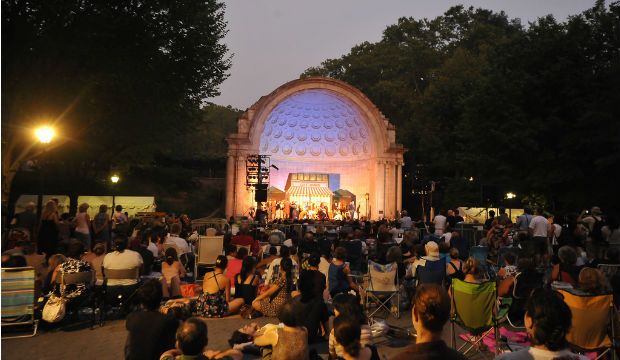
New York Grand Opera Company plays ‘La Boheme’ at the Naumberg Bandshell in 2011









 Opera, My Love Magazine