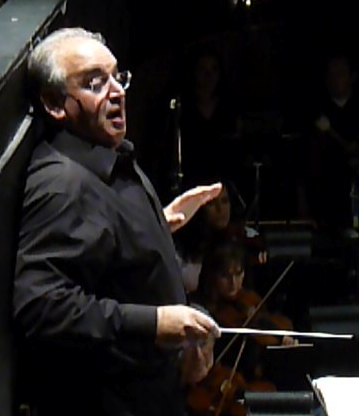
At the Rockford Concert titled “GIUSEPPE VERDI: HIS HEROES AND VILLAINS” (see previous blog), Maestro Michael Recchiuti demonstrated his showmanship went well beyond his composing and directing capabilities by presenting the evening with a fantastic wit and a great mixture of information and humor that allowed even the newcomers to the world of opera to appreciate to the fullest the evening’s program. The arias were introduced with a particular “twist”, unique to his style. What follows is his presentation (or what we could transcribe from the live recording). I enjoyed it immensely and I am sure all readers will:
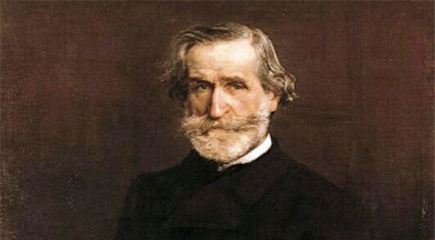
“Giuseppe Verdi. Born Oct. 9, 1813 in an out of the way village, near an out of the way town, attached to an out of the way Duchy that was still part of the French empire. Yes, the greatest composer of Italian music was born, thanks to Napoleon Bonaparte and his Italian invasion, a French citizen, listed in the town hall as Joseph Fortunin Francois Verdi. A year or two later the Austrians and Russians drove the French out, and the locals got to be Italians ruled by Austrians.
Verdi is educated by the local priests, studies music with the town organist, and shows a precocious gift for music. He attends the town music school, and graduates with honors. He even gets to play some masses on the organ, substituting for his indisposed master. Then the important thing happens; somebody who mattered, and could do something for him, noticed him. Antonio Barezzi, who really is the hero of the Verdi story, was a wealthy merchant in Bussetto, who was an avid amateur musician. He took notice of the boy and invited him to come and watch rehearsals of the town Accademia sinfonica – the band. Barezzi kept this group going – they rehearsed in his parlor, over his shop, and they appeared at all local festivities, and even played in the church. Next thing you know, Young Verdi is composing little pieces for the band – marches, serenades, concertos, and even some church music. Young Verdi moves into the palazzo, and begins to give Barezzi’s fetching young daughter piano lessons.
At the age of 18, it’s time for Verdi to expand his horizons, and his studies. Barezzi pays for him to go to Milano, and take the entrance exam for the conservatory. The exams go so badly that they don’t even tell Verdi that he wasn’t admitted. Barezzi had to write to the conservatory to hear the results. They declared firstly, that he was too old – the normal age limit was 15, and that his piano playing wasn’t up to snuff. Verdi is crushed. “That’s ok- says Barezzi – don’t worry about it. Stay in Milano, and study privately. I’ve got your back, I’ll pay for it. No worries.”
Verdi studies for three years with the chief conductor at La Scala. -counterpoint, harmony, musical form , studies all the important scores with his maestro, in the meantime, he marries Barezzi’s daughter, big surprise, and they set up house in Milano. Barezzi is still supporting him. An out of work musician wants to marry your daughter, and you like the idea. Think about it! A daughter is born, Verdi gets his first opera accepted for production at La Scala. Oberto – Conte di San Bonifacio. It’s kind of a success (It’s not really much of an opera – I prepared the first commercial recording of it about 20 years ago, and don’t remember a single phrase.) A son is born. Verdi gets a contract from LaScala to produce three operas. This is a big deal for a guy who a few years before couldn’t even get into the Conservatory.
Then, disaster! Within about a year and a half, the baby boy dies, the daughter dies, and his wife dies. Verdi goes into a tailspin depression. Even Barrezzi cannot pull him out of it. He vows never to write music again. He is completely lost. He hangs around Milano in despair, until one evening he meets the impressario of LaScala at a cafe, who insists that he have a look at a libretto that another composer had just rejected, Nabucodonosor. Verdi protests, the impressario rolls up the libretto, and sticks it into Verdi’s coat pocket. When Verdi gets home, he tosses the libretto onto the table, and it opens to a certain page. Verdi reads “Va, pensiero, sull’ali dorati….” the chorus of the Hebrew slaves, and he begins to think about music again. This, at least, is the story the way Verdi later told it.
Verdi goes on to write Nabucco, and it is his first truly great success. You know, we always say that opera was the great “popular” art form. But you have to do the math. If you took the number of available theater seats, and factored the population of Europe against it, I think there was always a relatively small number of people who actually WENT to the theater. However – a great many people came to know the music of the theater. There were the infamous organ grinders. There were bands playing potpourris, and excerpts in concerts. There was a flourishing sheet music publishing business that fed an insatiable appetite for musical novelty in the educated musical amateurs. Everybody played some instrument. And eventually, there was the phonograph.
One of the most common pastimes at social gatherings used to be to the play piano, both solos and duets. All of the symphonic repertory had been arranged for four hands. I, as a student, learned most of my repertory this way, back in the last millenium. So, to give you a taste of this vanished experience, I have invited my dear friend and colleague, Eric Malson, to join me at the mighty Steinway. Eric is an extremely accomplished concert pianist, and collaborator in chamber music, and with singers, in New York, and all over Europe. He played in the orchestra in Lisbon for a number of years, rendering him absolutely indispensible to me for any visit to a rodizio, or a restaurant like, say, the Azorean here in Gloucester. He is a much better pianist than I, so I shall severely limit his access to the instrument, this evening. He has kindly consented to act as my page turner, and, more importantly, to allow himself to be exhibited with me, in the four hand arrangement of the Overture to Verdi’s first great opera, Nabucco. So you will hear how most people probably first heard this piece.
The tenor: “Parmi veder le lagrime”
Opera is when a tenor and a soprano want to make love, and are prevented from doing so by a baritone . GB Shaw
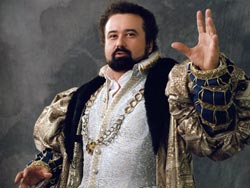 In Italian opera, the tenor is often the young, heroic, romantic figure. Often the nationalist, brave, and self sacrificing one. Excellent for my search for heroes! Verdi, however, complicates matters. He begins to be very selective about what stories he sets. He reads literally thousands of plays searching for a good story, for good characters. He learns that good characters generate good stories, and therefore good operas. He always said that it was the hardest part of his job. He also said, over, and over again, “You must never bore the public, because, if they are bored, they won’t come back to the theater.” I think this should be engraved on plaques, and posted in the office of every artist director, administrator, and theater director in the world. The more complicated these stories get, the harder it’s going to be to find heroes, and villains.
Just a word about technical musical stuff. The scene you are going to hear Raul sing is a full scene, a recitativo, an aria, and a cabaletta. The recitativo is the more spoken part of the piece where the character gives you some back story, and sets up the scene for you. The aria is the beautiful, sung part, usually apostrophizing his beloved, or communicating some sad feeling. Then, usually, someone or other runs in, and informs the character that something has happened that completely alters his mood, and he sings the cabaletta- the fast, contrasting part. This is a form that had been around in Italian opera for ages, and Verdi was beginning to bridle at the strict convention. It was, he decided, unnatural. And he was right, in a dramatic sense. But, thank God, before he did away with the form, he gave us some of the greatest examples of it.
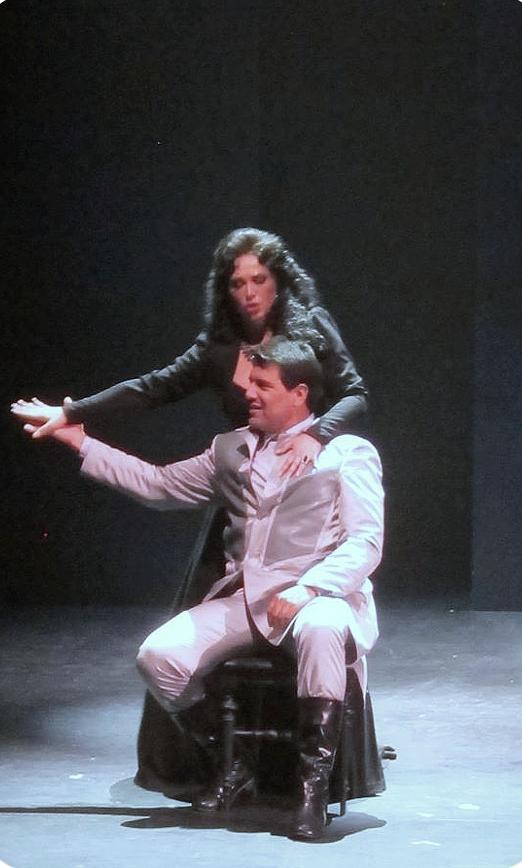
The Duke, in Rigoletto, is a libertine despot, who begins the opera at a party sizing up his courtiers’ wives, and discussing his conquests. He’s been meeting up with this young girl in the suburbs while her parents were out, but she’s disappeared. He comes running into room when he hears this news. He is sad, for a lyrical moment, at least. (ARIA)In come some of his boys saying that they’ve snatched the girl up, and brought her to him here in the castle, and she’s been deposited in the Duke’s bedchamber. Oh joy, he says, smacking his lips, and he sings the cabaletta. Not exactly hero material, this guy.
The Baritone: “Cortigiani, vil razza dannata”
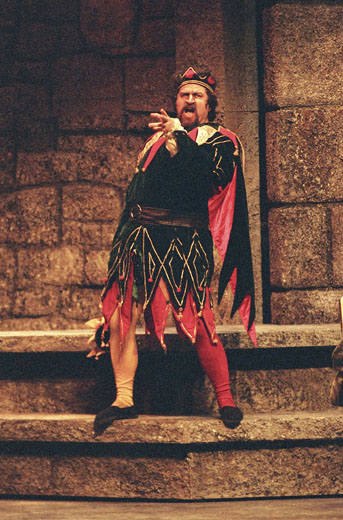
Peter Castaldi as Rigoletto
For all intents and purposes, Verdi invented the baritone. The low male voice was always the bass in Italian opera, and they usually played old men. The highest bass was called the “basso cantante”. They were hardly ever principle singers. Verdi took these singers, and pushed their range up just a little higher, giving them more resonance, and tension in their sound. The result is the Verdi baritone. He is often a father, a protector, a counselor. In Rigoletto, he is a protective father. But he is also a deformed, hunchback court jester working for a depraved libertine (the Duke), and he hides his daughter out of town to protect her. Should be a hero. But wait. When he finds out the duke has seduced and defiled his daughter, he goes to an assassin, and takes out a hit on him. No hero there. But, not really a villain, either. He is, with all his qualities, and faults, human. And here begins the genius of Verdi; the representation of the human.
The scene you will hear is the moment that Rigoletto, having discovered his daughter abducted and delivered to the duke’s bedchamber, breaks into the court, and curses the courtiers, demands the return of his daughter, and finally, pleads with them for her return as a father.
“O tu che in seno agli angeli”
Of the thousands of plays Verdi read, when searching for new material, many of them tended to be by Spanish authors, on Spanish themes. To other Europeans, Spain represented an exotic, magical, and somewhat mystical locale. There was the Moorish occupation for centuries. There were the gypsies. There were the mountains, and the smugglers. There was the dark, severe, Catholicism – nothing like the Italian rather flexible one. And there was the subject of HONOR. Nobody holds a vendetta like a Spaniard. The author of Princess Bride got it right – Mandy Patinkin spends an hour and a half running around telling people ” my name is Inigo Montoya; you killed my father, prepare to die.”
La Forza del Destino is one of these stories. Drawn from a Spanish play, Verdi decided there wasn’t already enough chaos in it, so he inserts a military encampment scene from Schiller’s “Wallenstein’s Lager”.
The tenor is loosely based on an actual historical figure. One of the last conquistadores married the daughter of the last Inca chief in order to calm things down, and consolidate power. And they had offspring. The play assumes that their son has gone back to Spain. He has fallen in love with the noble Leonora, and as he is meeting her father for the first time to ask for her hand in marriage, he drops his pistol, and of course, accidently kills him. He immediately goes on the lam. In this aria, he remembers his time in Sevilla with Leonora. He assumes Leonora is also dead by now, and he sings to her imploring her help from heaven.
A musical note. Verdi’s early experience, writing for the Bussetto town band gave him a love of woodwind instruments that stuck with him, and served him well throughout his career. Often in the introduction to musical numbers he would include what was essentially a little concerto for a solo instrument. In this introduction, it’s a clarinet, and I shall attempt my best Italian clarinet impersonation on the mighty Steinway.
“Con sangue sol cancellassi”
Verdi wrote La Forza del Destino on commission for the Czar of all Russians, to be performed in St. Petersburg. The contract called for Verdi to come to St. Petersburg, supervise the preparation, and conduct the performances. One of the most amusing documents we have is his wife, Giuseppina’s packing list for the trip: pasta, olive oil, wine, woolen underwear, and fur coats that they had made. Even a little one for LouLou the little dog that travelled with them. They went in 1861, but the tenor got sick, the season was cancelled, and they returned in 1862. The piece was a great success, and mounted throughout Europe.
Back to the story. Leonora will wind up not to have died, but in a cloister, from where she becomes a hermit to expiate the sin of having had a boyfriend without telling her father. The important guy now is Leonora’s brother, who will make a profession of hunting down Alvaro, the tenor, who has killed his father, and dishonored, so he thinks, his sister, who he also presumes is dead. He chases this tenor all over Spain, and finally locates him in a monastery, where he has gone to expiate his sins. He confronts him, tries to get a rise out of him, challenges him to a duel, but Alvaro is taking his religious calling very seriously, and presents a kind of Zen presence, refusing to be roused to a fight. Finally the baritone slaps him, and gets him riled up enough to exit to fight with him. The ultimate irony is that when they exit the cloister and find a deserted place for their duel, they wind up right in front of the cave, where Leonora is living her hermit’s existence. There are no heroes in this story, either.
Macbeth, Verdi said, was his favorite opera. It is the one that he dedicated to Antonio Barezzi, his greatest supporter, and father of his first, departed wife. Shakespeare was Verdi’s favorite author, and he knew all of the plays in Italian translation. By his bedside, at S. Agata, are two complete sets of the bard’s works, close at hand at any hour. He had also wanted to compose a King Lear, but never did
“Pietà, rispetto, onore”
This final scene of Macbeth, before the last battle of Byrnam Wood, is the low point of Macbeth’s life. His wife has gone mad, and then died. He has realized that his life has been meaningless. He leaves no legacy, and only curses will be his lullaby. His lines, from Shakespeare:
I have lived long enough. My way of life
Is fallen into the sere, the yellow leaf,
And that which should accompany old age,
as honor, love, obediance, troops of friends,
I must not look to have. But, in their stead,
Curses, not loud, but deep……
“Quando le sere al placido”
Luisa Miller comes at a strange time in Verdi’s development. He was beginning to break away from the old Italian styles and forms, but he didn’t have the revolutionary techniques yet that would lead to the big three, La Traviata, Il Trovatore, and Rigoletto in the next few years.
Let’s talk about Verdi’s vocal writing for a moment. He inherited the style called florid, and moved in the direction of the Syllabic. That is to say, previous composers put a lot of notes on every syllable, to ornament them. Like Rosina, in Rossini’s Barbier di Siviglia.”Io sono docile”. Verdi realized that this style ultimately did not give words the power that he wanted them to have, and he drastically reduced the number of notes per syllable, usually to one, so we say he wrote syllabically. Like the melody you will hear in this next aria. Sing “Quando le sere al placido”. The shapes of the melodies become more expressive.
Rodolfo, the tenor in Luisa Miller, is the son of the Count. He is operating in disguise in the village, where he falls in love with the lovely Luisa, daughter of an old soldier of the Count’s. He ultimately has completely honorable intentions, but his father can’t have him marry a commoner, and begins to muck things up. He has his henchman force Luisa to sign a letter stating she never really loved Rodolfo, and just wanted his title. The father then shows this to Rodolfo, who explodes with this aria, thinking that Luisa has betrayed their love. Of course, everybody dies in the end, for all the wrong reasons. Is Rodolfo a hero? Not really, but he’s about as close as you can get to one in this opera.
“Ehi! paggio!”
We finally come to the last two great masterpieces of Verdi’s old age, Otello, and Falstaff. Verdi was old, said he was tired, and didn’t want to deal with the theater any more. But then he spends some time with a certain younger man, who manages to re ignite the passion to compose in the old master.
Arrigo Boito was one of the greatest figures of nineteenth century Italy. Italian father, Polish mother, he was a writer, a composer, a poet, a polemicist. One of the great cultural polymaths. He read and spoke all the European languages. His Shakespeare, he knew in French, from Hugo and Dumas’ translations. He managed to produce librettos for Otello, and finally, Falstaff for Verdi, and said that the time he spent working with him were the highlight of his life. In Falstaff, Boito conflates Henry IV, and The Merry Wives of Windsor into a satisfying operatic plot, bathed in an autumnal glow.
Sir John wants to ignite his amorous intrigue, and he has written his two love letters, one for Meg, one for Alice, and orders his cohort Bardolfo to deliver them. Bardolfo, scoundrel that he is, refuses. Why , asks Falstaff. I am forbidden replies Bardolfo. By whom, inquires Falstaff. By honor, he replies.
Falstaff calls for his page, who takes the letters, and then turns on Bardolfo with a tirade on the word “honor” , arriving at the fact that “honor” is just a word, and made of nothing but air. He then chases his gang of lowlifes out of the tavern, to prepare himself for what he thinks will be his amorous adventure. Hero? Hardly. Villain? Corruptor of youth, but not really. But we do know that poor old Sir John will die a sad, lonely death, when Hal, his youthful companion in many escapades becomes king, and banishes him forever from court.
“Desdemona rea…”
I finally have a real, live, evil villain. IAGO. Not a redeeming virtue, pre-Freudian, Freudian, or post Freudian. Verdi thought that Iago should be tall, slim, and smooth. The very personification of the banality of evil. And it mattered what Verdi thought about every detail of his operas. He conceptualized every detail, musically, dramatically, and visually of every work, and got to the point where he could impose his will on every theater in which he worked. There is huge extant correspondence between Verdi, and the theater producers, his conductors, designers, and his publisher about every small detail of his operas. In rehearsal he was relentless with the singers, and the stage personnel. And he was always right. His instincts were incredible, and he had the technique to back them up.
In this scene from Act two of Otello, Iago has already planted the evil seed of Doubt in Otello’s head about Desdemona’s faithfulness. He suggests that there might be something going on with Cassio, the young lieutenant that Otello has just demoted, owing to a row that Iago himself instigated. In the scene immediately preceding ours, Desdemona has, as his friend, plead Cassio’s case for re instatement to Otello. Otello’s antennas go up, given Iago’s previous conversation, and he rudely dismisses her.
After everyone leaves Otello alone, Iago approaches him to set the hook. Otello is confused, wounded, and then finally furious. Iago recounts a scene in the quarters he shares with Cassio of watching Cassio have a dream. It is essentially the narration of Cassio’s, shall we say, nocturnal dream, about Desdemona. That’s all Otello needs to hear. He swears vengeance by heaven on his betrayers. Iago joins him. A musical note to listen for: to show you the absolute genius of Verdi in this scene. In the final part of the duet where he swears vengeance, Otello sings, “Si, pel ciel marmoreo giuro”. It’s not until Iago joins him in the pledge that we realize that IAGO is singing the actual tune, and what Otello sings is actually a background accompaniment. IAGO is literally calling the tune.”