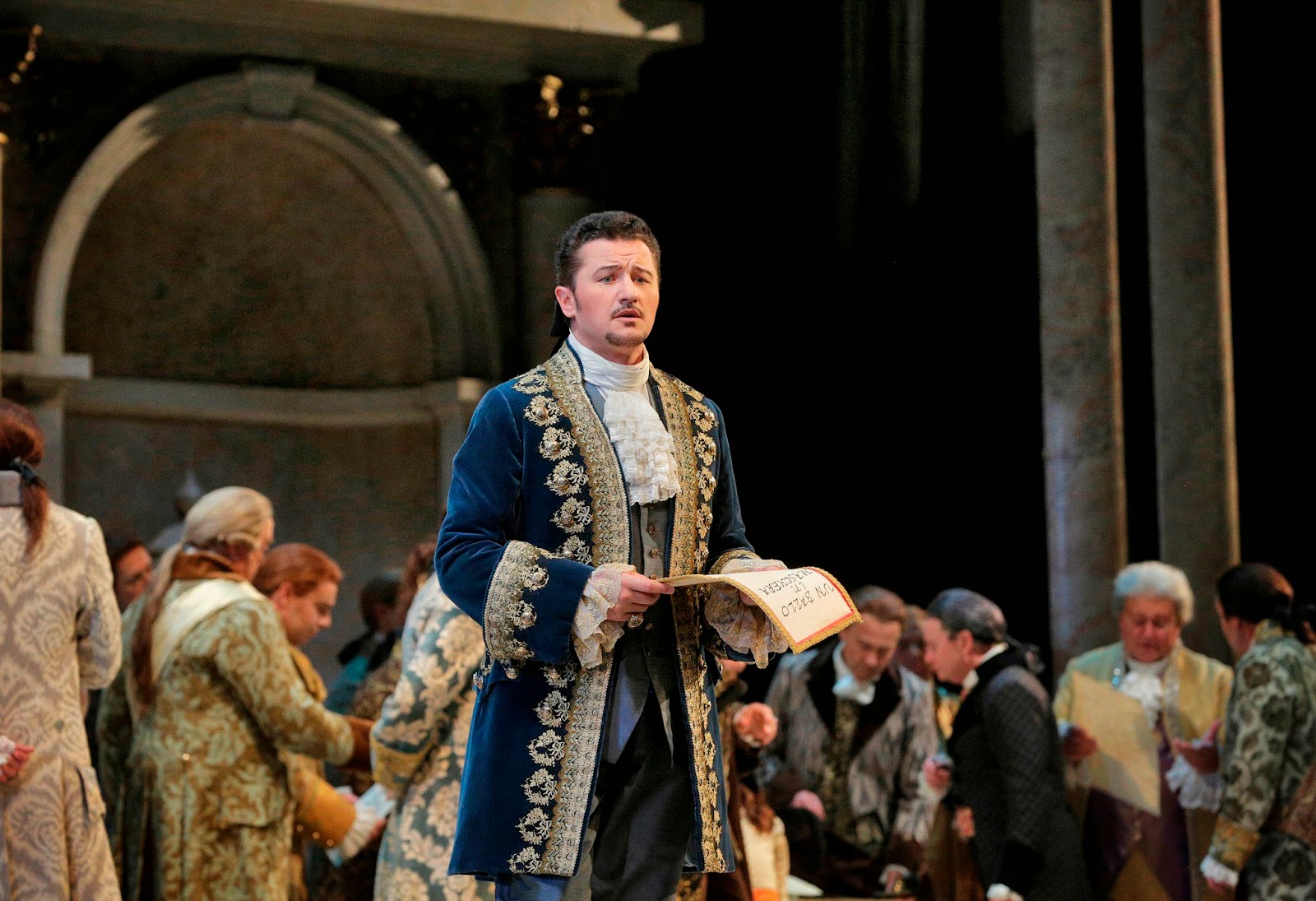
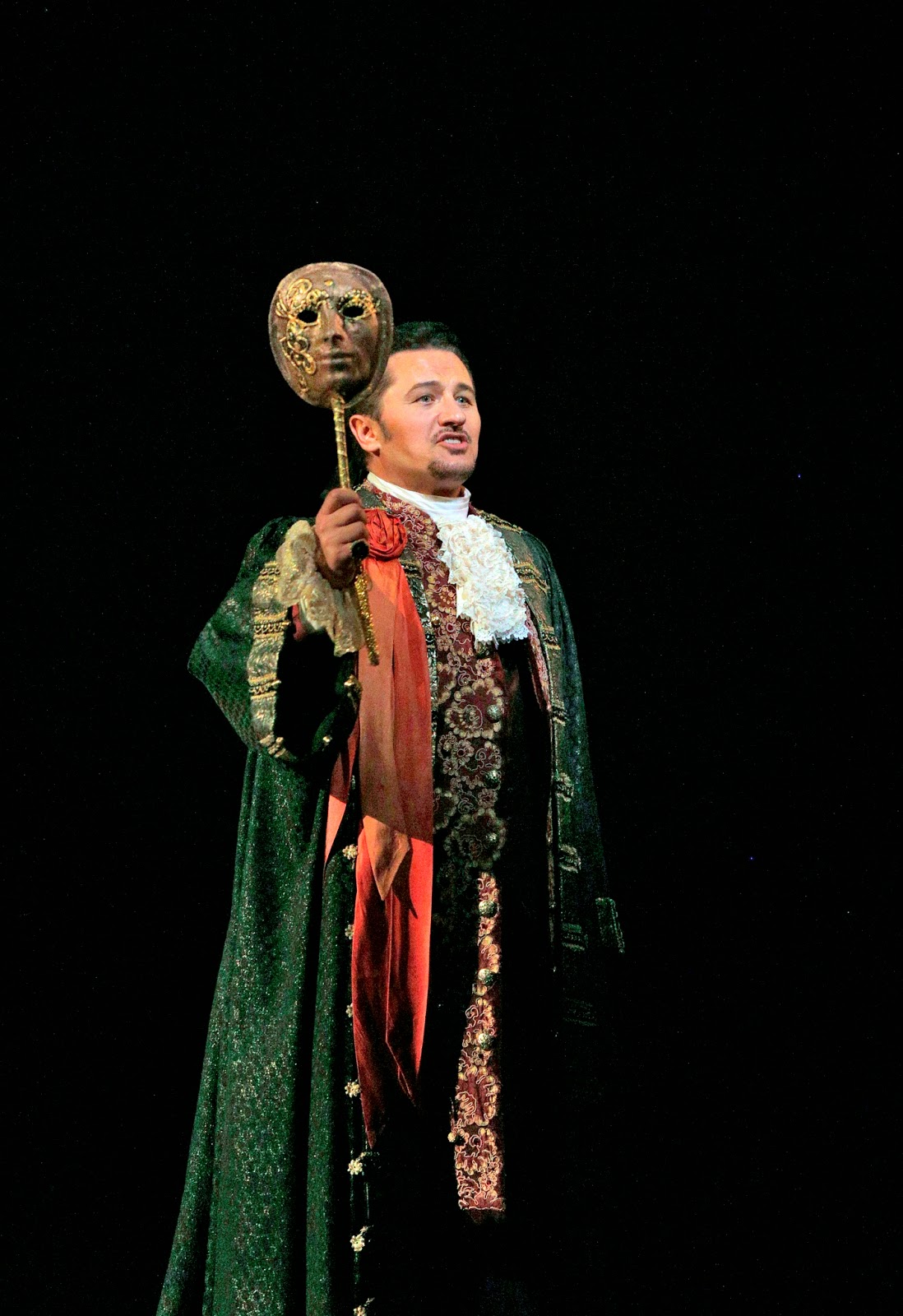
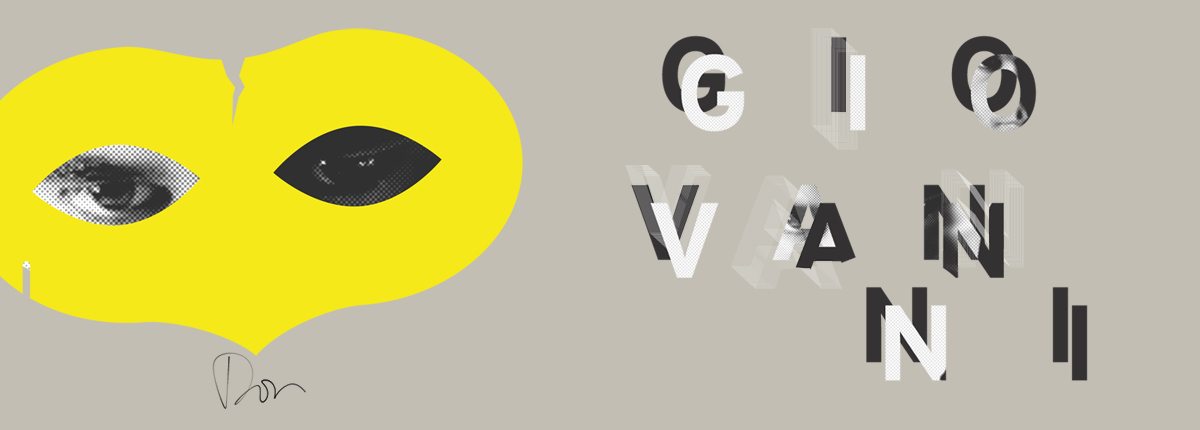
OPERA PHILADELPHIA Presents “DON GIOVANNI”

OPERA PHILADELPHIA Presents:
dongiovanniphiladelphia

Wolfgang Amadeus Mozart

Don Giovanni

Apr. 25, 27m, 30, May 2, 4m, 2014 | Academy of Music
Opera at the Academy

All he wanted was everything.

Who was that masked man? As the legendary rake Don Juan leaves a trail of jilted lovers and mayhem in his wake, Mozart’s alternately mischievous and harrowing masterpiece of mistaken identity reveals the charmer’s darkest side. With an ingeniously playful staging of masquerades, trapdoors and mirrored panels, witness the genre’s most infamous scoundrel in this timeless classic of comedy and tragedy. A cadre of the most prestigious alumni of the Curtis Institute of Music and the Academy of Vocal Arts come home to star in this lavish production.

OPERA AT THE ACADEMY

Venue:

Academy of Music
240 S Broad Street, Philadelphia, PA 19102

Schedule Details:

Friday, April 25, 2014 at 8:00 pm
Sunday, April 27, 2014 at 2:30 pm
Wednesday, April 30, 2014 at 7:30 pm
Friday, May 2, 2014 at 8:00 pm
Sunday, May 4, 2014 at 2:30 pm

Estimated Running Time:

Approximately three hours including one 20-minute intermission

Language:

Performed in Italian with English supertitles

Cast


Elliot Madore
as Don Giovanni

Michelle Johnson
as Donna Anna

Amanda Majeski
as Donna Elvira


David Portillo
as Don Ottavio

Joseph Barron
as Leporello

Cecelia Hall*
as Zerlina


Wes Mason*
as Masetto

Nicholas Masters*
as Commendatore

Creative Team

*Opera Philadelphia Debut

Synopsis

Time: 1930s

Place: Europe

Act 1

Scene 1: Leporello bemoans his destiny as a servant to Don Giovanni (“Notte e giorno faticar” – “Night and day I slave away”). His master and Donna Anna emerge from the palace struggling, as Anna tries to identify the disguised person who attempted to seduce her in her bedroom (Trio: “Non sperar, se non m’uccidi, Ch’io ti lasci fuggir mai!” – “Do not hope, unless you kill me, that I shall ever let you run away!”). Her father, Commandant of Seville, alarmed by his daughter’s cries, challenges the attacker. Don Giovanni kills the old nobleman. Donna Anna returns with her fiancé, Don Ottavio, but they are too late to save her father.

Scene 2: Donna Elvira, abandoned lover and would-be wife, arrives by train in search of the Don. Don Giovanni, who is on an amorous adventure at the train station, unwittingly approaches Elvira. He escapes, leaving Leporello to show Elvira to the Don’s “not-so-little black book” of conquests. (“Madamina, il catalogo è questo” – “My dear lady, this is the catalogue”)

A group of peasants arrive in a park for a pre-wedding celebration for Zerlina and Masetto. Giovanni immediately tries to charm the young bride, much to the chagrin of her fiancé, who dares to stand up for his rights (“Ho capito! Signor, sì” – “I understand! Yes, my lord!”). In vain, he is taken off by Leporello, leaving the Don to attempt further seduction (Duet: “Là ci darem la mano” – “There we will entwine our hands”). Elvira enters and warns the girl against the intentions of the traitor (“Ah, fuggi il traditor” – “Flee from the traitor!”). As the women leave, Anna and Ottavio arrive to ask Giovanni for help in finding her father’s assassin. Elvira interrupts and begs the two nobles not to trust Giovanni, who in turn, indicates that Elvira has lost her mind (Quartet: “Non ti fidar, o misera” – “Don’t trust him, oh sad one”). He then takes leave of the two, and Anna suddenly realizes that Giovanni is the man who attacked her. (Anna aria: “Or sai chi l’onore Rapire a me volse” – “Now you know who is the one having trying to rob me of my honour”). She asks Ottavio to avenge her father.

Scene 3: Before the party that he promised the peasants, we find Don Giovanni singing of his happy pursuit of love (“Champagne Aria”: “Fin ch’han dal vino calda la testa” – “Till they are tipsy”). Zerlina begs Masetto’s forgiveness for her behavior and assures him that she did not fall for the advances of the Don (“Batti, batti o bel Masetto” – “Beat o beat me, handsome Masetto”). However, when the Don appears, the jealousies of the bridegroom flare up again. Dance music is heard in the distance and Anna, Elvira, and Ottavio, who are masked, are invited to the party. They swear to punish the libertine (Trio: “Proteggra il giusto cielo” – “May the just heavens protect us”).

Scene 4: At the party, Giovanni takes advantage of the busy crowd to lead Zerlina into his private quarters. When she calls out for help, the three masked guests reveal their identities to the Don and Don Ottavio threatens Giovanni with a pistol. Giovanni escapes the wrath of his guests.

Act II

Scene 1: As Don Giovanni wants to attract the attention of Elvira’s maid, he exchanges cloaks and hats with Leporello and sings first to Elvira, while his servant is miming the words. As Elvira leaves with the disguised Leporello, Giovanni serenades the servant girl (“Deh vieni alla finestra” – “Ah, come to the window”). Masetto and a band of angry peasants, who are after the Don, are sent by Giovanni (in his Leporello disguise) in the wrong direction. He assalts Masetto. Zerlina consoles her groom with tender care “Vedrai carino” – “You’ll see, dear one”). Elvira is still furious at Giovanni for betraying her, but she also feels sorry for him. (“Mi tradì quell’alma ingrata” – “That ungrateful wretch betrayed me”).

Scene 2: Leporello, still in disguise, tries to flee from Elvira, but instead is met by Anna, Ottavio, Zerlina and Masetto, who all want their revenge. The servant finally unmasks, begs for forgiveness and flees the scene.

Scene 3: Don Giovanni and Leporello exchange their recent experiences and thereby mock the deceived women. As they are leaving the graveyard, they hear a voice and recognize the tomb of the slain Commandant. Don Giovanni insists that Leporello read the inscription on the tomb. “I wait to avenge my wrongful death.” Giovanni forces the petrified servant to invite the statue to dinner. Shaken, the two perceive a positive response to the invitation.

Scene 4: In her home, Anna, still in mourning, puts off Ottavio’s offer of marriage until her father is avenged (“Non mi dir” – “Tell me not”).

Scene 5: Don Giovanni is still leading a life of debauchery, interrupted only briefly by Elvira, who makes a final, desperate attempt to save the Don (“L’ultima prova dell’amor mio” – “The final proof of my love”). The Don becomes a victim of the demons of guilt that he has, until now, fended off through a dissolute life. In his alcoholic stupor, he perceives the avenging voice of the Commandant and is carried off to his own Hell.

Wolfgang Amadeus Mozart (1756-1791)


Wolfgang Amadeus Mozart was born on January 27, 1756 in Salzburg, Austria to Leopold Mozart and his wife, Anna Maria.  Leopold was a successful composer and violinist and served as assistant concertmaster at the Salzburg court.  Mozart and his older sister, Maria Anna, were the only two of the family’s seven children to survive infancy.  Both children showed great musical potential and Leopold began instructing them at a very early age.  His benefactor, the archbishop of the Salzburg court, Sigismung von Schrattenbach, was also very supportive of the Mozart children’s remarkable talents.

At the age of three Mozart was able to pick out tunes on the piano and by the time he was five he was composing minuets.  Both Mozart and his sister played the harpsichord exceedingly well and Mozart also mastered the violin.  Leopold was eager to exhibit both of his children’s musical abilities so, when his son was seven, he left his position at the Salzburg court to take his family on a concert tour of Western Europe.  Mozart and his sister performed in the major musical centers of Europe, including Mannheim, Mainz, Frankfurt, Brussels, Paris, London, and Amsterdam.  During this time, Mozart continued to compose, completing his first symphony at the age of nine and publishing his first sonatas that same year.  The family returned to Salzburg in 1766 but, after spending less than a year there, they left again for Vienna, where Mozart completed his first opera, La Finta Semplice, in 1768, when he was just 12 years old.  Shortly after, Mozart was appointed honorary Konzertmeister at the Salzburg court.

Mozart and his father traveled to Italy in 1769, where he toured for more than a year in Rome, Milan, Florence, Naples, and Bologna.  While in Italy, Mozart completed another opera, Mitridate, re di Ponto and also received a papal audience, during which the Pope conferred knighthood as a tribute to the boy’s genius.  In the next few years Mozart would make two more trips to Italy and complete two more operas, Alba in 1771 and Lucio Silla in 1772, as well as eight symphonies, four divertimentos, and several other works.

In 1771, Archbishop von Schrattenbach, who had been a great supporter of Mozart since his childhood, died and was succeeded by Hieronymus von Colloredo.  Although Mozart did not get along well with his new patron, he remained in his position in Salzburg for many more years.  In 1777 Mozart obtained leave from Salzburg and set out on tour with his mother, in hopes of securing a better position.  They traveled through Munich, Augsburg, and Mannheim, but Mozart was unsuccessful in finding a post.  The next year they continued to Paris, where Mozart composed the Paris Symphony.  While they were there, Mozart’s mother became ill and soon after the symphony’s premiere, she died.

Mozart returned to Salzburg and was given the post of court organist and Konzertmeister.  He produced numerous works during this period, including the Coronation Mass in 1779.  In 1780, he was commissioned to compose an Italian opera for Munich.  Idomeneo, re di Creta was completed the next year and became his first great operatic success.  Soon after, Archbishop Colloredo summoned Mozart back to Vienna, where the Salzburg court was in residence on the accession of a new emperor.  Fresh from the success of Idomeneo, Mozart was exacerbated to find himself back in the service of the court.  This, combined with his growing resentment of his employer, soon led to conflict and in 1781 he left his post.

Mozart remained in Vienna and in 1782 married Constanze Weber.  The couple had six children but only two of them survived.  That same year, he completed the opera Die Entführung aus dem Serail, which was an immediate success.  Also in 1782, Mozart was appointed to the position of chamber composer for Emperor Joseph II, a post that he held until 1787.  These years were very productive for Mozart, during which he met Italian librettist, Lorenzo da Ponte.  Their partnership produced three of the most popular and best loved operas of Mozart’s career, the first of which, Le Nozze di Figaro, premiered in Vienna in 1786.  Don Giovanni and Così fan tutte followed soon after in 1787 and 1790.

Despite these successes, Mozart and his wife lived well beyond their means and were in continual debt.  In 1787, Mozart was appointed to the post of Kammermusicus, although the salary did little to lessen the couple’s financial hardships.  In 1791, Mozart was commissioned to compose a score to Emanual Schikaneder’s Die Zauberflöte, which was inspired by the group they were both members of, the Free Masons.  The opera premiered in Vienna to large success.  Also in 1791 was the premiere of La Clemenza di Tito, which would be the last of the 20 operas Mozart wrote in his lifetime.  During this time of financial strain, Mozart also composed his last three symphonies: E flat, G minor, and the Jupiter in C.

In 1791, Mozart was commissioned to write a requiem, but he would never finish the piece.  He became quite ill, although he had never known very good health, and he died on December 5, 1791 at the age of 35.  His death, which gave rise to false rumors of poisoning, is thought to have resulted from rheumatic fever, a disease which he had suffered from repeatedly throughout his life.  Despite his unquestionable reputation as the greatest musical mind of his time, Mozart was buried with little ceremony in an unmarked grave in Vienna, as was legally required for all those without noble or aristocratic birth.


Posted in Music, OPera | Tagged , , , , , , , , | Leave a comment

“Roberto Devereux” in Toronto

Canadian Opera Company PRESENTS:

ROBERTO DEVEREUX

Gaetano Donizetti

The tumultuous final days of the reign of Queen Elizabeth I find powerful expression in Donizetti’s Tudor drama. 

Queen Elizabeth I, the central character in Roberto Devereux, has always attracted the foremost divas of their day. That tradition now continues with Sondra Radvanovsky, the world’s leading interpreter of the great 19th-century Italian prima donna roles. Donizetti’s show-stopping melodies and sumptuous period costumes bring the intrigue of the Elizabethan court to life within a Shakespearean-inspired Globe Theatre setting.

APRIL 25 to MAY 21, 2014


On stage at the Four Seasons Centre, 145 Queen St. W., Toronto.
Performance time is approximately three hours including two intermissions.
Sung in Italian with English SURTITLES™.

Cast 

Elisabetta: Sondra Radvanovsky

Nottingham: Russell Braun

Roberto Devereux: Giuseppe Filianoti

Sara: Allyson McHardy

<!–Lord Cecil:

Sir Gualtiero:

A Page:

A Servant of Nottingham:

–>

Creative Team

Conductor: Corrado Rovaris

Director: Stephen Lawless

Set Designer: Benoit Dugardyn

Costume Designer: Ingeborg Bernerth

<!–Lighting Designer:

–>

Chorus Master: Sandra Horst

With the COC Orchestra and Chorus


SYNOPSIS

Elisabetta has sent her beloved Roberto Devereux, the Earl of Essex, to lead a military expedition to Ireland. Against the Queen’s orders, Roberto has signed a peace treaty with the Irish rebels. Jealous of his favourable position with the Queen, her advisors seize this opportunity to push through a charge of treason against him.

 Act I

Scene i, 1598, London, England
Parliament prepares to discuss charges against Roberto Devereux. Sara, the Duchess of Nottingham and close friend of Queen Elisabetta, is plagued with guilt for having an affair with Roberto. Elisabetta arrives and expresses her love for Roberto, and confides to Sara that she suspects Roberto of being unfaithful. The Queen is interrupted by a visit from Lord Cecil and Gualtiero who convey the Parliament’s frustration over her leniency towards Roberto. To stall the Parliament, she demands more proof of guilt before making a decision. When a page arrives with a request from Roberto (who is under house arrest) to meet with the Queen, her heart is stirred with a hope that their affection will be rekindled and she agrees to the visit.

Elisabetta meets Roberto in private and reminds him of the ring she gave him, a special token that will guarantee his safety if he only sends it back to her. She tries to win his heart by reminding him of their happy days together. Roberto is shocked at Elisabetta’s tenderness towards him and accidentally reveals that he is in love with another woman. Seeing Elisabetta’s initial anger escalate to fury, he tries to deny everything but the damage has been done: Elisabetta is set on vengeance against Roberto and the woman who has won his affection.

With Elisabetta infuriated, Roberto’s only remaining ally is the Duke of Nottingham (Sara’s husband). Nottingham discloses to Roberto that he observed his wife sobbing while embroidering a blue scarf and expresses his concern over his wife’s secret suffering. Their exchange is interrupted by Lord Cecil who summons Nottingham on behalf of the Queen to a meeting of the Parliament to decide on Roberto’s sentence. Nottingham vows to save his friend.

Scene ii
Roberto can’t resist a secret meeting with his beloved Sara while Nottingham is out. He berates her for getting married while he was at battle. She explains that after her father’s death, the union was ordered by the Queen to ensure her financial stability. Sara also reminds him of his previous royal affection by pointing to his ring. They acknowledge their mutual love but realize that they can never be together. Roberto pledges his love by giving his ring to Sara as a parting gift and she gives him her blue embroidered scarf in return.


Act II

At the hall at Westminster, the Parliament reaches a decision and Lord Cecil informs the Queen of the verdict: the death penalty. Only Elisabetta’s signature is needed for the execution to be ordered. She dismisses the court for a private meeting with Gualtiero, one of her trusted spies. Gualtiero confirms that Roberto was arrested after being out until dawn; when searched, they found a blue scarf hidden under his shirt. Gualtiero produces the scarf as proof of his story. Upon careful examination Elisabetta notices love knots embroidered into the scarf, which verify her suspicions, and fuels her decision to agree to sign Roberto’s death warrant.

Nottingham begs the Queen to have mercy on Roberto. His pleas are silenced when Roberto is brought in and Elisabetta reveals the blue scarf demanding to know its owner. Recognizing the scarf as belonging to his wife, Nottingham is horrified at Roberto’s betrayal. In a fiery jealous rage, the Queen signs the death sentence.


Act III

Scene i
In a letter from Roberto, Sara learns of his imminent execution. In the letter, he implores her to take the ring back to Elisabetta, the one that is supposed to guarantee his life. Before she can leave, Nottingham returns and upon seeing the letter from Roberto, he demands to read it. Understanding that returning the ring may spare Roberto’s life, Nottingham orders Sara not to see the Queen.

Scene ii
Alone in the tower of London, Roberto reflects on his life of lies and indiscretions with great regret. He remains hopeful that Elisabetta will receive the ring and pardon him. The guards arrive and Roberto allows himself to be led to his execution without protest.

Scene iii
Elisabetta has unresolved feelings about signing Roberto’s death warrant. She desperately hopes Roberto will return her ring as a sign of his renewed devotion. To her horror, Cecil enters and informs her that Roberto is being led to his execution. At that exact moment, Sara bursts in and unable to speak, hands the ring to Elisabetta, silently identifying herself as the Queen’s rival. It is too late: a cannon shot is heard signifying the fatal blow has been delivered and Elisabetta lashes out at Nottingham and Sara for their part in Roberto’s death. They are taken into custody and the Queen laments the events that led to her bloodstained crown. Haunted by Roberto’s severed head and the destruction she has rained on her subjects, Elisabetta longs for death. The Queen gives up her royal power by declaring King James of Scotland, her nephew and heir to the throne, the new King of England.


Performance Dates & Times

  • Fri. Apr. 25, 2014 at 7:30 p.m.
  • Tues. Apr. 29, 2014 at 7:30 p.m.
  • Sat. May 3, 2014 at 7:30 p.m.
  • Sat. May 10, 2014 at 4:30 p.m.
  • Thurs. May 15, 2014 at 7:30 p.m.
  • Sun. May 18, 2014 at 2 p.m.
  • Wed. May 21, 2014 at 7:30 p.m.

Gaetano Donizetti

Born on November 29, 1797 in Bergamo, Italy, composer Gaetano Donizetti enjoyed tremendous popularity throughout Europe. His operas, together with Bellini’s, came to epitomize the Italian Romantic spirit of the 1830s.

Donizetti was given free admission to Simon Mayr’s school for choir boys when he was nine years old, and Mayr proved to be a major influence on the composer. In 1814, he provided Donizetti with the financial and moral support he needed to move to Bologna to study counterpoint (the use of multiple melodies). Three years later, when Donizetti returned to Bergamo having decided he would be a composer of opera, Mayr secured a contract for him with a company in Venice for which Donizetti wrote four operas.

Donizetti’s first notable work was his production of Zoraida di Granata in Rome in 1822. For the next several years he produced two to five operas a year, from one-act farces to full-length serious works; these were presented in Naples, Rome, Palermo and Genoa. In 1828 Donizetti married Virginia Vasselli, and although she bore them three children, none survived infancy. Virginia herself was stricken with cholera and died an early death in 1837. The loss of her companionship is said to have had a profound and lasting impact on the composer.

1830 saw Donizetti’s first international success with Anna Bolena, and by that time he had written 23 operas. Although his next opera was a fiasco, L’elisir d’amore, produced in 1832, set things right again. His controversial Maria Stuarda premiered in 1834.

In 1835, Rossini invited Donizetti to visit Paris to present Marino Faliero at the Théâtre-Italien. This was Donizetti’s first experience with opera in the grand tradition, and he was impressed with the artistic standards and the lucrative pay. Although he returned to Naples later that year to write and produce Lucia di Lammermoor (based on Sir Walter Scott’s novel, The Bride of Lammermoor), he did not stay long. The death of his wife and his disillusionment with the operatic world of Naples prompted Donizetti to move back to Paris in 1838.

During his first two years in France, Donizetti’s operas were performed in four Paris theatres, much to the chagrin of contemporary French composers. He rewrote the score of Lucia for a French production, and though not the artistic success of the Italian original, the exposure it received established his reputation as an eminent European composer. Among the many operas Donizetti wrote in his later years were La fille du régiment (1840), La favorite (1840), Don Pasquale (1843) and Dom Sébastien (1843). Don Pasquale became an overnight success at Paris’s Théâtre-Italien and was widely regarded as a comic masterpiece.

In rehearsal for his last opera, Dom Sébastien, Donizetti’s behavior became erratic and obsessive. It was discovered that Donizetti was suffering from cerebro-spinal degeneration of syphilitic origin, and he was sent to a sanatorium near Paris. Although he was returned home to Bergamo in October 1847, Donizetti was paralyzed and unable to speak more than monosyllables. He was attended by friends and family until his death on April 8, 1848.


Posted in Music, OPera | Tagged , , , , , , , , | Leave a comment

“THE MARRIAGE OF FIGARO” in Victoria

logoPACIFIC OPERA VICTORIA Presents:

THE MARRIAGE OF FIGARO

Music by W.A. Mozart
Libretto by Lorenzo Da Ponte
April 24, 26, 30, May 2, 2014, at 8 pm
Matinée May 4 at 2:30 pm

In Italian with English Surtitles

Mozart: The Marriage of Figaro


A riotous comedy with a revolutionary subtext, The Marriage of Figaro follows the Almaviva household through a single tumultuous day as Count Almaviva, his wife, his valet Figaro, and his servants spin a tangled web of love affairs, plots, and counterplots. The opera is based on the Beaumarchais play that caused an uproar in 18th century France for its subversive portrayal of uppity servants outwitting their aristocratic betters.

The opera charges along like Upstairs, Downstairs on steroids as the predatory Count tries to seduce Figaro’s fiancée Susanna on her wedding day. But even as the Count receives his comeuppance, the opera becomes a poignant study of love, jealousy, and ultimate forgiveness.

Mozart’s score is an absolute masterpiece, at once sunny and sublime, unrivalled for beauty, grace, and theatrical truth.

  • CONDUCTOR Timothy Vernon
  • DIRECTOR Brent Krysa
  • DESIGNER Cameron Porteous
  • COUNTESS ALMAVIVA Leslie Ann Bradley
  • COUNT ALMAVIVA Phillip Addis
  • SUSANNA Miriam Khalil
  • FIGARO Justin Welsh

Posted in Music, OPera | Tagged , , , , , , , | Leave a comment

La bohème in Tel Aviv

logoisraelioperaThe Israeli Opera Presents:

La bohème

Giacomo Puccini

The ultimate and most touching operatic love story. Mimi and Rodolfo fall in love in a shabby Parisian attic and when the curtain goes down on the same attic Mimi falls dead in the arms of her beloved. A new production conducted by Daniel Oren.

Libretto: Giuseppe Giacosa and Luigi Illica after Scènes de la Vie Bohème by Henry Murger

Conductor Daniel Oren
Director Stefano Mazzonis di Pralafera
Set Designer Carlo Sala
Costume Designer          Fernand Ruiz
Lighting Designer Franco Marri

Among the Soloists:

Rodolfo Giorgio Berruggi
Mimi Maria Agresta
Elena Mosuc
Ira Bertman
Marcello Gabriele Viviani
Ionut Pascu
Colline Carlo Striuli
Musetta Alla Vasilevitsky
Schaunard Ionut Pascu
Noah Briger

Special appearance by GASTON RIVERO. Read the interview with the renowned tenor: https://operamylove.wordpress.com/2014/02/25/interview-with-the-tenor-gaston-rivero/

The Israeli Opera Chorus
Chorus Master: Ethan Schmeisser
The Young Efroni Choir
The Opera Orchestra – The Israel Symphony Orchestra Rishon LeZion
Surtitles in Hebrew and English
Translation: Israel Ouval

New Production
Sung in Italian
Duration: Three hours

Day  Date Hour        back stage tours   Opera Talkback
*WED 23.4.14 20:00
THU 24.4.14 20:00 After the show
FRI 25.4.14 13:00
SAT 26.4.14 21:00 18:30
MON 28.4.14 20:00 18:30 After the show
TUE 29.4.14 20:00 18:30
WED 30.4.14 20:00 18:30 After the show
FRI 2.5.14 13:00
SAT 3.5.14 21:00
THU 8.5.14 20:00 After the show
FRI 9.5.14 13:00
SAT 10.5.14 21:00

* PREMIÈRE
** TOWARDS OPENING – 19.4.14 SAT 11:00

La boheme
Act I
An attic in Paris, December 24, evening

In their shabby attic, the painter Marcello and the poet Rodolfo complain of the cold. In order to light the stove, Rodolfo decides to sacrifice one of his manuscripts, and the two enjoy a moment of warmth before the fire fades away. Colline, their philosopher roommate, arrives having failed to sell some books. However at a moment of total despair, the fourth Bohemian, the musician Schaunard arrives triumphantly with wood, food, wine and money. He tries to tell his friends how he succeeded in obtaining this surprising fortune, but the other three are not interested in his tales and set the table for the meal they have craved for so many days. But Schaunard will have nothing of this. On Christmas Eve they will eat out he decrees. As the four are about to leave, Benoit, their landlord, appears and pronounces just a single word: “rent”. He is invited inside, offered some wine and begins to tell the four young Bohemians about his amorous adventures. And then in the name of virtue they throw the married landlord out and escape paying the rent one more time.

Rodolfo decides to stay behind in order to finish a newspaper article while his friends promise to wait downstairs. A weak knock is heard and the neighbor Mimi enters asking Rodolfo to light her candle which has blown out on the staircase. She is very weak and faints. Rodolfo assists her and as she revives, he lights her candle and she hurries out, immediately returning as the wind has blown out the candle once again. This time Rodolfo quickly blows out his own candle too and in the darkness Mimi drops her key. She asks Rodolfo to help her find it and when he does, he conceals it in his pocket and continues searching until his hand touches Mimi’s hand. “Your tiny hand is frozen,” says Rodolfo and in a beautiful aria tells her that he is a poet who loves life. In her own aria which follows, Mimi says that her real name is Lucia and that she does not know why everybody calls her Mimi. She tells him that she embroiders flowers for a living. The three Bohemians downstairs wonder what has happened to Rodolfo and call him to hurry. He sends them off, intending to spend the evening with Mimi inside. But she begs him to go and join his friends promising, in a very suggestive manner, a surprise for later in the evening. Rodolfo offers his arm to Mimi and the couple leaves together singing of their love to each other.

Act II
Outside the Cafe Momus in the Latin Quarter, later that evening

It is Christmas Eve and the Latin Quarter is crowded. Children rush after the toy seller Parpignol. The Bohemians discover that there is no free table inside the Cafe Momus and so they decide to dine outside on the pavement. Colline has had his beard trimmed, Schaunard has picked up a girl and only Marcello is alone. Rodolfo buys Mimi a bonnet and introduces her to his friends. Suddenly Marcello notices his old flame Musetta walk by expensively dressed on the arm of the old yet wealthy Alcindoro and followed by footmen loaded with parcels. Musetta also notices her former lover and sits close to him trying to attract his attention. She breaks plates, makes a fuss about her meal, yet Marcello remains indifferent and begins flirting with some other girls. Musetta does not give up, climbs on one of the tables and sings her beautiful waltz-like aria in which she describes how everybody stares at her as she walks in the streets. But in between the lines she is speaking directly to Marcello, asking him to stop his games and come and embrace her. Pretending that one of her shoes is pinching her feet she sends Alcindoro to get a new one and throws herself into Marcello’s arms. As the six merry makers are about to depart a waiter brings their bill, but they have no money left. Musetta adds their bill to hers and they all leave happily.

ACT III
Outside a tavern by one of the Paris toll gates. A cold, wet February dawn

Customs men are searching the peasants, milkmaids and the workers from the suburbs who are coming into the city to work. Musetta’s voice is heard from the nearby tavern. Mimi approaches looking for Marcello. She begs him to intervene on her behalf with Rodolfo as his jealousy has made their life together impossible. She hides when Rodolfo comes out of the tavern. He tells Marcello that he has had enough of Mimi and that he cannot stand her flirtations. But then he reveals the real truth: Mimi is very ill and his life of poverty will kill her, which is why they must part. Mimi overhears their conversation and for the first time actually realizes that her illness is indeed fatal. She faints and when she comes to her senses she accepts Rodolfo’s decision to part, but since they cannot bear to part immediately they agree to stay together until spring. Marcello and Musetta quarrel outside the tavern, Musetta arguing that she cannot stand his jealousy and the she hates lovers who behave like husbands. The bickering of the two lovers serves a perfect contrast to the peaceful and tranquil acceptance of love of Rodolfo and Mimi who leave hand in hand.

ACT IV
The attic, early summer

Just as in the opening act, Marcello and Rodolfo are trying to work, but without any success. Then it was the cold air that prevented them from concentrating. Now it is the cold feeling from inside. Both are alone and while pretending to be happy neither can forget the memory of his love. Colline and Schaunard come in with some food, but this time only bread and herring. They improvise a meal, pretend to be at a ball and even fight a mock duel, when Musetta bursts in telling them that Mimi is very ill but does not dare to come in. Rodolfo rushes outside and brings Mimi in, and Musetta says that as she heard Mimi was ill she searched for her all over Paris. When she finally found her, Mimi expressed one wish only, to come to and die near Rodolfo. To make her last moments easier everyone tries to satisfy Mimi’s last desires. Musetta gives her earrings to Marcello and asks him to buy Mimi a warm muff. Colline goes to pawn his coat and bring a doctor. Alone with Rodolfo, Mimi recalls their first meeting, their short spell of happiness, their dreams and their love. She thanks her friends as they return and closes her eyes. As Musetta prays for Mimi’s health Schaunard realizes that Mimi is dead and Marcello tries in vein to comfort Rodolfo.

The Israeli Opera, Sderot Sha’ul HaMelech 19, Tel Aviv-Yafo, Israel

Posted in Music, OPera | Tagged , , , , , , , , | Leave a comment

CINDERELLA in Omaha

OPERA OMAHA PRESENTS:

CINDERELLA

GIOACHINO ROSSINI

Friday April 25, 2014
Sunday April 27, 2014
Orpheum Theater

ABOUT THE PRODUCTION

AbouttheProduction

Bring the entire family to relive the cherished fairy tale of an impoverished girl tormented by two stepsisters in her stepfather’s dilapidated house. Mistaken identities and a glamorous ball give the kindhearted Cinderella the opportunity to transform her life. This story, full of humor and love, is told through some of Rossini’s finest writing and a colorful, whimsical production.

Led by a world-renowned international creative team, this colorful and comedic production of Cinderella has graced some of the world’s finest opera stages including Houston, Los Angeles, Seattle, and Toronto. Praised by critics and loved by audiences of all ages, this is your opportunity to see several returning Opera Omaha audience favorites in a phenomenal cast, in a larger-than-life production.

Approximate run time is 3 hours with one intermission.

CAST

Posted in Music, OPera | Tagged , , , , , , , | Leave a comment

SEATTLE OPERA PRESENTS: International Wagner Competition

wagner5SEATTLE OPERA PRESENTS: International Wagner Competition

A Special One-Night Only Event Returns at McCaw Hall

Thu, Aug 7, 2014 7:00 PM

The world will be watching as an elite group of up-and-coming Wagnerians take the stage for our third International Wagner Competition. Accompanied by full orchestra, each finalist will perform two selections from the Wagner canon. In addition to awards for orchestra and audience favorites, finalists will compete for a total of $50,000 in cash prizes, awarded by a distinguished panel of judges.

Seating is limited to Orchestra and Dress Circle levels for this exciting one-night-only event.

Performance at: McCaw Hall, 321 Mercer Street, Seattle, WA 98109

Finalists

Helena Dix

Helena Dix
Soprano

Australian-born Helena Dix recently won the Wagner Society’s 2012 Bursary Competition and has since performed in the 2012 Bayreuth Stipendiatenkonzert at the Festspielhaus and in Karlsruhe as part of the International Wagner prize. In 2005, Dix represented Australia in the 2005 BBC Cardiff Singer of the World competition. Her operatic repertoire includes Elettra in Idomeneo for Theater Lübeck; the title role in La Gioconda in Valladoliad; the Flowermaiden in Parsifal for English National Opera; Rosalinde in Die Fledermaus and Hanna Glawari in The Merry Widow for Scottish Opera; Fiordiligi in Così fan tutte, Donna Anna in Don Giovanni, and Nella in Gianni Schicchi for The Opera Project; Li-Li in Greed for the Glyndebourne Young Artist Project; and Musetta in La bohème for Opera Novella. Other roles include Felice inSchool for Fathers, Erste Dame in Die Zauberflöte, the title role of Thaïs, Cio-Cio-San in Madama Butterfly, Elvira in Ernani, Violetta La traviata, and Noémie in Massenet’sCendrillon.


Ric Furman

Ric Furman
Tenor

Ric Furman made his Seattle Opera debut as Florestan in Fidelio in 2012. He has performed Tito in La clemenza di Tito at Opera Company of Brooklyn, Don José inCarmen at Springfield Regional Opera, Dancaïre in Carmen at Cincinnati Opera, and Rinuccio in Gianni Schicchi at Pittsburgh Opera. For Cincinnati Opera he sang Augustin Moser in Die Meistersinger von Nürnberg. He has also appeared at Dayton Opera, Dicapo Opera, Indianapolis Opera, and Opera Omaha. Past roles include Rodolfo in La bohème, Alfredo in La traviata, the Duke in Rigoletto, both Roméo and Tybalt in Roméo et Juliette, Detlef in The Student Prince, Beppe in Pagliacci, and roles in AidaDon CarloAinadamarCarmenSalomeSamson et DalilaIl viaggio a ReimsLe nozze di FigaroGianni SchicchiDer Kaiser von AtlantisCosì fan tutte,The Tender Land, and Die Zauberflöte. He is a former Young Artist with Cincinnati Opera and Opera Omaha.

Suzanne Hendrix

Suzanne Hendrix
Soprano

Suzanne Hendrix made her Seattle Opera debut as Waltraute in Die Walküre in 2013. Other Wagner roles include Schwertleite in Die Walküre at San Francisco Opera and Mary in Der Fliegende Holländer at Lyric Opera of Kansas City. She recently performed the Fortune Teller in Arabella at Santa Fe Opera, Bianca in The Rape of Lucretia at Opera Memphis, and Azucena in Il trovatore at Wichita Grand Opera. Other roles include Suzuki in Madama Butterfly, Ma in The Tender Land, Zita in Gianni Schicchi, the Princess in Suor Angelica, and Florence Pike in Albert Herring. She is a former apprentice artist with Des Moines Metro Opera, Merola Opera Program, and the Santa Fe Opera. She won first prize in the 2012 George London Competition.


Roman Ialcic

Roman Ialcic
Bass

German bass Roman Ialcic covered the roles of Fafner and Hunding for Seattle Opera’s 2013 Der Ring des Nibelungen. His roles include Konchak in Prince Igor, Boris in Boris Godunov, Gremin in Eugene Onegin, and Fiesco in Simon Boccanegra. He also performed Sarastro in Die Zauberflöte at the Open Air Opera Festival in Isny. In 2006, he reached the final round of Plácido Domingo’s Operalia, and since September 2007 has been engaged as a soloist at the St. Gallen Theater, Switzerland, where his roles have included Escamillo in Carmen, Cascada in The Merry Widow, Lamoral in Arabella, Tomski in The Queen of Spades, Talbot in Giovanna d’Arco, Marchese d’Obigny in La traviata, and Kaspar in Der Freischütz.


Kevin Ray

Kevin Ray
Tenor

As a second year member in the Houston Grand Opera Studio, Kevin Ray’s roles have included Eisenstein in Die Fledermaus, the Third SS Officer in Weinberg’s The Passenger, scenes of Captain Ahab in Heggie’s Moby-Dick, Froh and Loge in Das Rheingold, and Don José in Carmen. Last season, he sang his first performances of the title role of Peter Grimes with Chautauqua Opera as well as Don José at the Lyrique-en-Mer/Festival de Belle-Île. His previous roles at Houston Grand Opera include Melot in Tristan und Isolde, the Messenger in Il trovatore, and Parpignol in La bohème. At Santa Fe Opera, he created the role of the Second Clubman in the world premiere of Moravec’s The Letter and has performed the role of the Poet in Menotti’s The Last Savage. He is a former member of the Santa Fe Apprentice Singer Program and the Merola Opera Program of San Francisco Opera.


Tamara Mancini

Tamara Mancini
Soprano

Tamara Mancini made her Seattle Opera debut as Ortlinde in Die Walküre in 2013. A former San Francisco Opera Adler Fellow, she performed in their mainstage productions as Freia in Das Rheingold and Helmwige in Die Walküre. She recently performed the title role in Turandot at Royal Opera Stockholm; Palácio de Bellas Artes, Mexico City; and Teatro Comunale di Bologna. Other roles include Amelia in Un ballo in maschera, Leonora in La forza del destino, Maddalena di Coigny in Andrea Chénier, Santuzza in Cavalleria rusticana, and the title role in Tosca, which she performed in her Vancouver Opera debut earlier this season. She has won the Giulio Gari Competition, the Licia Albanese Puccini Competition, and the Opera Index Competition.


Issacha Savage

Issacha Savage
Tenor

Grand prize winner of the 2012 Marcello Giordani International Competition, Issacha Savage has received awards and career grants from the Wagner Societies of New York, Washington, D.C., and Northern California, and two first place prizes in the Liederkranz Foundation competition. Savage has performed in the world premiere of Wynton Marsalis’s All Rise and Mark Antony in the world premiere of Leslie Savoy Burrs’ Egypt’s Nights at Philadelphia’s Opera North, and he has performed Radames inAida at Opera North Carolina and Houston Grand Opera. He has also participated in the Merola Opera Program at San Francisco Opera, the Evelyn Lear and Thomas Steward Emerging Singers Program, Dolora Zajick’s Institute for Young Dramatic Voices, and ACMA’s Wagner Theater program, where he performed scenes from Die Walküre,Parsifal, and Samson et Delilah.


Marcy Stonikas

Marcy Stonikas
Soprano

During Seattle Opera’s 2012/13 season, Marcy Stonikas debuted the title roles in productions of Turandot and Fidelio, and she returns to Seattle Opera in 2014 to sing Magda Sorel in The Consul. She recently performed Donna Anna in Don Giovanni at Wolf Trap Opera Company, the title role of at Utah Opera, and the title role of at Opera Santa Barbara. Upcoming engagements include Leonora at Volksoper Vienna and a performance in concert with the West Australian Symphony Orchestra. A graduate of the Young Artists Program at Seattle Opera, she performed the roles of Donna Anna,Fiordiligi in Così fan tutte, and the title role in Ariadne auf Naxos while a member of the program. She is a winner of the 2013 George London Foundation Vocal Competition and First Prize winner in the Wagner Division of the 2013 Gerda Lissner Foundational Vocal Competition.

Posted in OPera | Tagged , , , , , , , , , | Leave a comment

TOSCA at Florida Grand Opera

header image

Main Image

TOSCA

Music by Giacomo Puccini
Libretto by Giuseppe Giacosa and Luigi Illica

“Poetry and again poetry; tenderness mixed with pain; sensuality; a drama surprising and burning; and a rocketing finale.”
―Giacomo Puccini

The passionate and beautiful singer, Floria Tosca, is in love with a handsome young artist, Cavaradossi, but the lustful chief of police, Scarpia, has other plans. He makes a lecherous offer, allowing Tosca to save her lover. At first, she strikes an unholy bargain with the evil Scarpia, but her hatred for him gives her second thoughts. The results are bloody, deadly, and shocking.

Come see what Tosca means when she says, “This is Tosca’s kiss.” Tosca includes some of the most inspired and memorable music in all of opera. When it debuted in 1900, it was an immediate hit, and it has been an opera fan favorite for 113 years.

CAST

cast image

Conductor
Ramón Tebar

Stage Director
José Maria Condemi

Chorus Master
Michael Sakir

Production
Seattle Opera

Florida Grand Opera General Director and CEO Susan Danis calls this double cast of Tosca her “Dream Casts.”
footer image

Sung in Italian with English and Spanish projected titles.
Pre-opera lecture one hour before every performance.
Post-opera talk back following every performance.

The performance will last approximately two and a half hours.

Photo © by Richard Termine for Sarasota Opera

Performances
Saturday, Mar 29, 2014, 7:00PM, Miami
Sunday, Mar 30, 2014, 2:00PM, Miami
Tuesday, Apr 1, 2014, 8:00PM, Miami
Wednesday, Apr 2, 2014, 8:00PM, Miami
Friday, Apr 4, 2014, 8:00PM, Miami
Saturday, Apr 5, 2014, 8:00PM, Miami
Thursday, Apr 10, 2014, 7:30PM, Ft. Lauderdale
Saturday, Apr 12, 2014, 7:30PM, Ft. Lauderdale

Miami performances are at the Sanford and Dolores Ziff Ballet Opera House at the Adrienne Arsht Center for the Performing Arts of Miami-Dade County, 1300 Biscayne Boulevard, Miami.

Fort Lauderdale performances are at the Au-Rene Theater at the Broward Center for the Performing Arts, 201 SW 5th Avenue, Fort Lauderdale.

main art

A tale of love and treachery that will keep you on the edge of your seat from start to finish…

And what a finish! One of opera’s most famous! Don’t miss Puccini’s TOSCA. It’s in a class of its own, with riveting drama and thrilling music. Many people say it’s the perfect first opera, so bring your friends! They’ll be amazed and forever grateful!

Synopsis of the Opera

Act I
The Church of Sant’Andrea della Valle

Angelotti, an escaped political prisoner, takes refuge in a chapel of the church of Sant’Andrea della Valle in Rome. An elderly sacristan comes to tidy up, followed by Cavaradossi, who is painting a portrait of the Madonna. Cavaradossi compares his Madonna’s blonde-haired, blue-eyed charm with the dark beauty of his lover, the singer Floria Tosca.

Angelotti emerges to find Cavaradossi, his political ally, who promises to help him escape from Rome. Angelotti hides again at the sound of Tosca’s voice. Tosca jealously demands to know why the door was locked. Cavaradossi reassures her, and they join in a passionate duet.

Once Tosca has gone, Angelotti reappears, and he and Cavaradossi plan his flight. A cannon shot announces the discovery of Angelotti’s escape. They exit. The sacristan enters followed by clerics and choir boys excited by the rumors of Bonaparte’s defeat. Baron Scarpia, the chief of police, arrives with his henchman Spoletta in search of the escaped prisoner.

Tosca returns, and Scarpia plays upon her jealousy in hopes of discovering Angelotti’s whereabouts. When she leaves, Scarpia has her followed. As the crowd intones the “Te Deum,” Scarpia vows to bring Cavaradossi to the gallows and Tosca into his arms.

Act II
Scarpia’s study in the Palazzo Farnese; that evening

Alone at dinner, Scarpia reviews his plot. Spoletta reports that he and his men trailed Tosca to the villa and found no trace of Angelotti, but placed Cavaradossi under arrest. Cavaradossi is brought in and questioned. Scarpia has sent for Tosca, and she enters as Cavaradossi is taken away to be tortured. Upon hearing his cries, Tosca reveals Angelotti’s hiding place. Cavaradossi is dragged into the study. His anger at Tosca’s betrayal turns to joy when Sciarrone announces that Bonaparte has actually defeated Melas at Marengo. The enraged Scarpia sends Cavaradossi back to his cell.

Tosca asks the price of her lover’s freedom. Scarpia will accept only Tosca’s submission. Tosca sobs to herself: She has devoted her life to music and piety; why does God repay her with misery? Spoletta enters with the news that Angelotti has killed himself rather than be arrested. Ashamed, Tosca signals that she will give in to the Baron, on condition that Cavaradossi be set free. Scarpia explains that he cannot grant a pardon; he can only release Cavaradossi by faking his death in a mock execution. Tosca demands a note of safe passage for herself and Cavaradossi. While he is writing, Tosca catches sight of a knife on his dinner table and, unnoticed, takes it. Scarpia seals the note, then turns to embrace the diva. “This is Tosca’s kiss!” she cries, plunging the knife deep into his heart. Scarpia cries out for help as Tosca curses him. She takes the safe-conduct pass and slips out of the room.

Act III
The Castel Sant’Angelo; dawn of the following day

Soldiers bring Cavaradossi to the ramparts of the fortress. He reflects on his love for Tosca. Tosca rushes in with the note of safe passage and the story of Scarpia’s violent death. Cavaradossi praises her courage, saying that her gentle hands were not meant for murder. Tosca tells him of the plan of the feigned execution: after the gunshots he is to lie still until she gives him a signal. Tosca is filled with anxiety as her lover is led before the soldiers. They fire and Cavaradossi falls to the ground. Tosca whispers to him to remain motionless until everyone has gone. At last she tells him it is safe, but he does not respond. With a piercing scream, Tosca realizes Scarpia’s final deceit. She weeps over Cavaradossi’s body as Spoletta and Sciarrone, having found the Baron murdered, burst in to arrest her. Too quick for them, she runs to a parapet, shouts “Oh, Scarpia, we shall meet before God!” and hurls herself to her death.

Main Art

Posted in OPera | Tagged , , , , , , | Leave a comment

To Sing with Nature: Piotr Beczała at San Diego Opera

To Sing with Nature:

Piotr Beczała at San Diego Opera

By Erica Miner (Used by permission)

Gracious, charming, highly intelligent and perceptive, Polish-born artist Piotr Beczała (dubbed “Piotr the Great” in San Francisco), first graced the San Diego Opera stage in his 2010 Bohème debut, triumphed these past weeks in Verdi’s A Masked Ball, and will complete his “March madness” with Verdi’s monumentalRequiem. Acclaimed for both the beauty of his voice and for his ardent commitment to each character he portrays,  he is also an avid golfer, and loves being here in San Diego.

EM: What a pleasure it has been to welcome you back to SDO. It is such an honor to hear you sing, to be here talking to you.

PB: It is my honor to be here with this company.

EM: I really appreciate your coming in on your day off.

PB: No problem. I have until four o’clock tee time. I mean tee time golf. It’s the last possibility, actually, we can play golf, because tomorrow we start already with the orchestra rehearsal for the Requiem and it’s done. When I am singing I try to avoid too much sun, too much wind. I’m not very delicate, but you know, I have to be careful. It’s too serious. At a time when I did some small roles I could do everything, but it’s a long, long time ago. Sometimes we are somewhere and we have a good company, nice colleagues. But I’m not really social in that case because I have to say, “No thank you, I can’t go with you.” Of course people understand but it’s a little bit sad.

EM: But there’s so much other happiness to replace it, all these wonderful roles you’re singing.

PB: And I’m happy with that.

EM: How has your experience been here this time?

PB: It has been so harmonious, such a fantastic group to work with. Everyone contributes to create a wonderful experience on stage. They are always there for me, whatever I need, with costume, or anything. I don’t even have to ask. At La Scala… you may have heard about that.

EM: Yes, of course. That must have been so unpleasant for you.

PB: Not only the audience reaction, but also the experience as a whole. It is so much different at La Scala, the attitude of the people working there, from the States. Here, everyone cooperates to create a beautiful opera. At La Scala, they are not feeling a part of the whole process, they are more interested each one in themselves. They look at their watches, waiting for the rehearsal to be over. It’s not about making music. But here in San Diego, the group all works together harmoniously.

EM: And we have the privilege and honor of hearing you.

PB: I have the privilege to sing these kinds of roles. Sometimes when I speak with my colleagues they are more in German directions, more Strauss operas. It’s not really for me. It will be not challenging or fun enough to sing a Kaiser in Frau Ohne Schatten for example, or Bacchus, though I hope to do Lohengrin someday. But those Strauss roles, in my opinion, don’t fill the evening as a tenor. It’s hard singing, but fifteen minutes actually. It’s not enough.

EM: Plus you don’t have the opportunity to expand into the role, the way you’re so brilliant at doing. Your voice is glorious, of course, but also you infuse your characters so beautifully.

PB: If it’s so short, you can’t develop in the operas. Well, of course, they like it, too, to do this kind of music.

EM: À chacun son goût. Do you speak French?

PB: No, just un petit peu. All my French is Werther, Faust, des Grieux and Roméo. That’s all. But it’s old French and I can’t use it (laughs). I’m such a long time in America now, three and a half months. I will be now in Paris for three and a half weeks, for Bohème. I hope to have possibility to practice a little bit.

EM: I’m curious about your early background. You were born in… How do you pronounce it?

PB: Czechowice-Dziedzice. The difference between “Cze”, “Dze,” it’s really difficult for people out of Poland.

EM: Well, I have it on tape now so I can practice. But I wanted to ask you about the origin of the name. Is the first part named Czechowice because of the proximity to the Czech Republic and Slovakia, or is that coincidental?

PB: A lot of villages or towns in Poland are split by the river, for example, like Buda and Pest in Hungary. We had also a river but it was not the reason for the double name; it was the old part of the town and the new one. Dziedzice was the name of the aristocrat who owned the land. Czechowice was the town, and it comes together, Czechowice and Dziedzice.

EM: That makes perfect sense, if only I could pronounce it. What was your second language after Polish?

PB: In those days when I was a child it had to be Russian. But actually I consider German my second language.

EM: When did you leave Czechowice-Dziedzice?

PB: I was going away to study in Katowice.

EM: Which is about how far?

PB: Fifty kilometers. But I was living in Katowice, I wasn’t traveling. I had an opportunity, I got a stipendium and it was possible to have a room in the college dormitory.

EM: How old were you then?

PB: I was nineteen, nineteen and a half. Almost twenty.

EM: So really grown up enough to be on your own.

PB: Yes. I started, it was late, because for an opera singer, a musician, to start to do something with music seriously at nineteen is actually too late, because if you don’t have a possibility as a child to play an instrument, to do something with music, to read the music… you have to understand the language of music. It was very difficult for me to explore this kind of territory. It is better to have an education, to start a study in Poland, to be an opera singer. To be violinist, you have to make all the steps: grammar school, Conservatory, middle school, and then the study. As a tenor, the exam was pretty complicated, because you have also theory and history of music. I had to learn it all in couple of months so I could do the exam. Also reading the notes, the music, and solfeggio, it was really horrible because it was completely new for me. I was already almost a year in a chorus and it was some approach of the music. But I had to read the music. I had to learn somehow how it worked. In effect when I started to be a student, though the exam was positive, I realized I was the only one who really has no background in music. Everybody has three years violin, five years piano, as a child, then it’s much easier to manage what we have to learn.

EM: And all you had was chorus.

PB: Yes. It was tough. Actually, I realize two things. First, I really don’t have to play piano as a tenor. It was a big music academy, every instrument, and we also had pianists, who had to make the exam in accompaniment. And I was so nice to be ready when they asked me, “Could you sing the five songs for me with the exam?” and I said, “No problem.” I did it, and that way I had the song repertory through the years. I realized, okay, so many fantastic pianists, in any moment of my singer’s life I will find somebody who plays for me, I don’t have to play myself. But it would be easier, of course, if I could play on some level.

EM: But the most important instrument for you is just that glorious voice. I’m sure it was recognized, even if you didn’t start until you were nineteen. With voice, you still have to be very careful not to start too early, to push too early.

PB: That’s true. Your body has to be adult to sing opera seriously. When I hear now people, fourteen or fifteen, because the parents are so excited, they’re thinking, “Maybe he has a voice.” Of course maybe he or she has a voice, but the wait is so long to be opera singer. Especially in America, the young people have two semesters in college of vocal training and they think they are already opera singers.

EM: Speaking of young singers, was there a tenor who inspired you when you first started out?

PB: Fritz Wunderlich. When I came to study in Weimar I first heard his recordings. Not only the voice but how he sang with it, so much with Nature, not artificial or against Nature. Other singers, like Fischer-Dieskau, Peter Schreier, were such great artists, but everything was so precise. With Wunderlich everything was so natural. But we lost him too soon. So sad. He never reached his potential, and we’ll never know what it might have been.

EM: How would you describe the influence of your voice teachers, Pavel Lisitsian and Sena Jurinac, when you started singing seriously?

PB: They both were tremendous to me. Lisitsian was one of the greatest singing teachers of all time. He taught Pavarotti. His teaching technique was not to show but to explain how to sing, to make it your own, because each voice is different, unique, with its own qualities. After that, Jurinac invited me to study with her. She of course had so many years singing opera on the stage. She guided me to Mozart, to start with Tamino, and with Don Ottavio, which is by far the most difficult to sing. Then I was invited to my first year at Salzburg. I had the opportunity to watch and listen to all the great tenors of the time: Pavarotti, Domingo, Carreras, Alfredo Kraus, Araiza, all of them together. I learned so much of value at that time. After that I went to Linz for first major engagement and to Zurich, which is an international opera city. And I have been lucky to work with great conductors. Muti, Nello Santi. Santi taught me bel canto. And he knows so well how to sing Verdi, for example, the dotted rhythms. Verdi uses those as a guide for placing the voice, not just to be precise and staccato (sings).

EM: Since then your repertoire has included so many of the most popular romantic opera roles: Alfredo, Duca di Mantova, Riccardo, Werther, Faust, Roméo, Lensky, Tamino, Don Ottavio, the Italian Singer (Rosenkavalier). How would you compare those to the lesser-performed works you’ve sung in, such asRusalka, Iolanta, The Bartered Bride, Beatrice di Tenda? Which do you feel most comfortable in?

PB: Werther, Faust, Roméo, des Grieux, these are the favorite roles for me, my “meat” for my voice. Of course I love the Verdi, but the French composers, Gounod, Massenet, they knew how to write for the voice, to show off its best qualities. The line just goes to the best range and knows how long to stay there. Nothing feels better for me. With Verdi, one thinks Traviata and Trovatore. I haven’t sung Trovatore yet, but it’s actually Traviatathat’s heavier, deeper. Trovatore is a musician. He accompanies himself with his instrument (mimes playing, sings), much lighter than Traviata, except three and a half minutes “Di Quella Pirra” (sings). Next will come Aida and the later, heavier roles, and eventually maybe Otello. But that one is a long way off, even if I can do it.

EM: And Puccini?

PB: For Puccini, one has to sing differently. You can’t do Verdi and suddenly switch to Cavaradossi. You must prepare. It’s much heavier. A different kind of singing.

EM: Now that you’ve done des Grieux in Massenet’s Manon will you also sing des Grieux in Manon Lescaut? Is that also a different kind of singing from the Massenet?

PB: Totally different, but doable. And yes, I hope to sing it one day. But I canceledHoffmann in Vienna. It is a role that doesn’t give opportunity for character development. There is no transformation. With each act, he goes further and further down. I spoke with Neil Shicoff about it. As much as he did the role, he said it was difficult to deal with the character. So I decided not to do it now. But I won’t replace it with another engagement. I will do some charity concerts instead.

EM: How did you feel about the contemporary Rigoletto at the Met?

PB: I loved it. Fantastic. I thought the “Rat Pack” production really worked. When (Director) Michael Mayers first told me about it, he said it would be very different from the traditional. But I love those guys, you know, Sinatra, Dean Martin, Sammy Davis Junior. This “Las Vegas” Duke of Mantova is such a combination of all of their personalities. And it really worked.

EM: What about that translation?

PB: That was not so good. There are things going on when I am at the back of the stage, very serious things, with Rigoletto and Sparafucile. When I first heard the audience laugh I wondered why. Then I looked at the translation and understood that the language, the slang, was not appropriate for that moment. It was just too much. But I loved the concept of the production, and it was so much fun to do.

EM: Now, after your huge success with Ballo you have the Verdi Requiem. How would you compare performing this masterpiece with Verdi’s operas? Would you call it a religious experience?

PB: It is a great masterpiece, of course. What Verdi wrote was so much from his operas, parts of AidaOtello and others. There is of course the quartet, but not so much individual voices as all contributing to the whole, and so beautifully written. Each voice integrates perfectly with the others. Verdi was not so much a religious or pious man. And the Requiem is not part of the Mass, not prayer or being in church. It is its own piece, much more intimate than opera, but one’s own intimacy shared with something outside of oneself – with a Supreme Being.

EM: What is coming up for you in performances and recordings?

PB: After Paris Bohème I go to Prague for Tauber Heart’s Delight, which I do also in Salzburg and Vienna, then Faust in Vienna.

EM: But first we are to witness you in the magnificent Verdi Requiem this week. And what a pleasure it has been to spend time with you. Every moment has been precious. Thank you so much.

PB: Thank you.

—ooo—
 
Photos used by permission of San Diego Opera
Erica Miner can be contacted at emwriter@earthlink.net
Posted in Article | Tagged , , , , , , , , , , , , , , , , , , , | Leave a comment

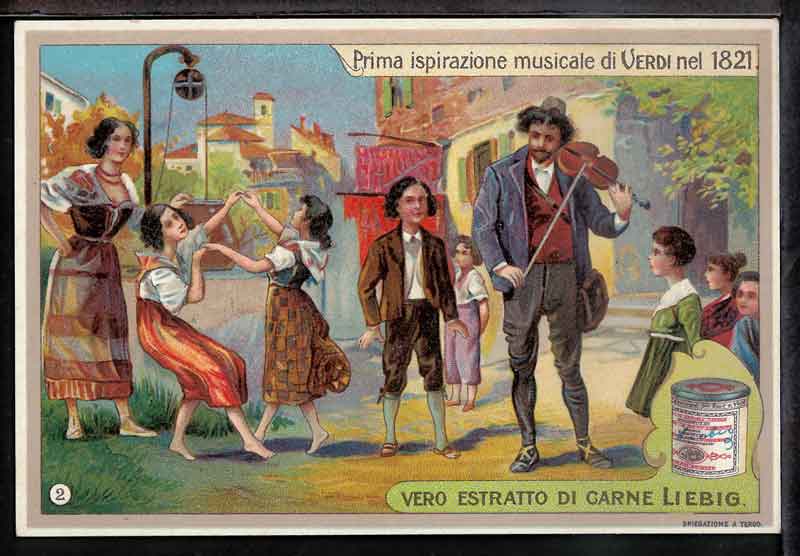
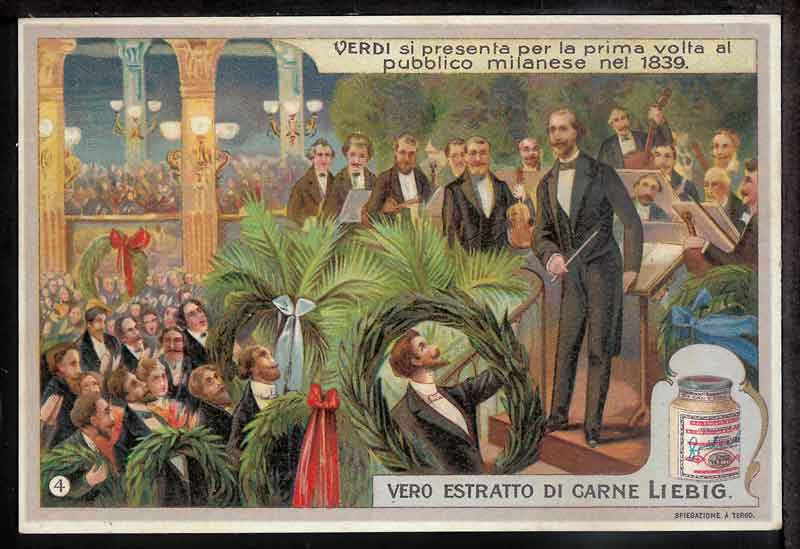
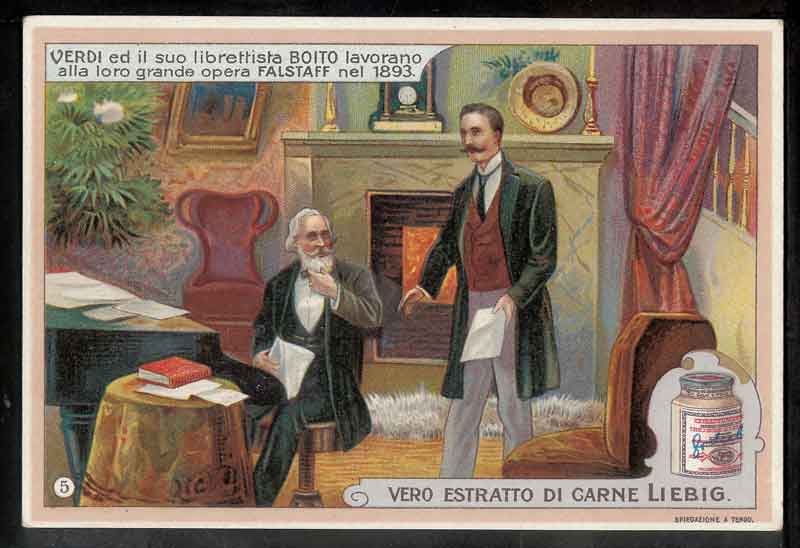
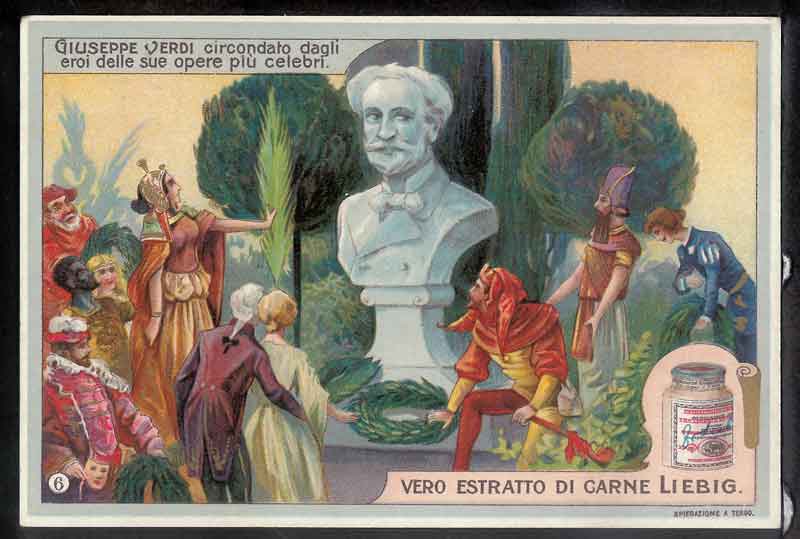
Verdi and his operas: Picture Cards

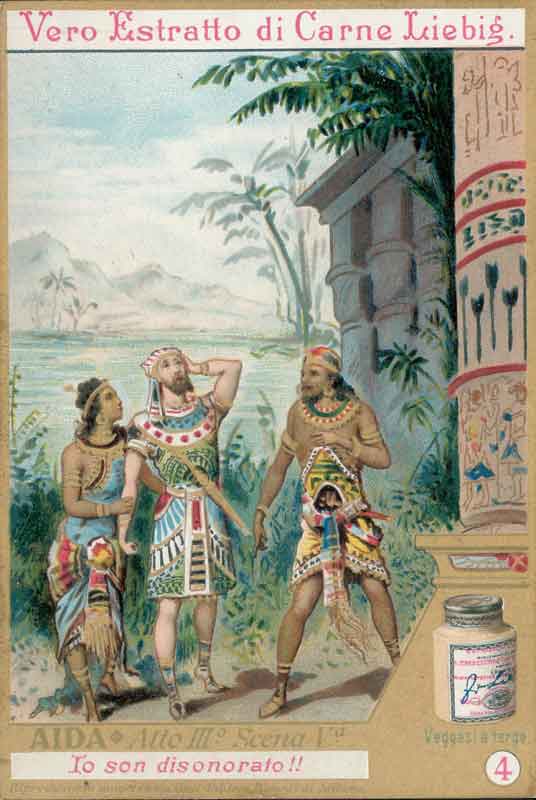
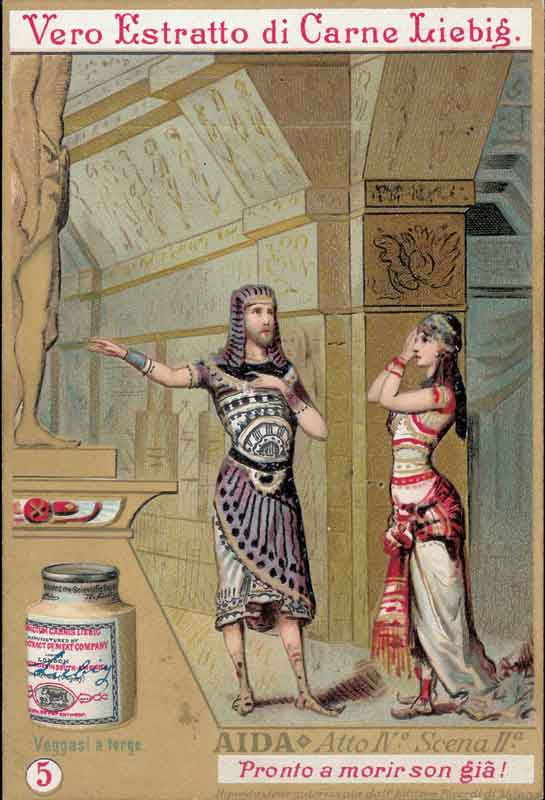
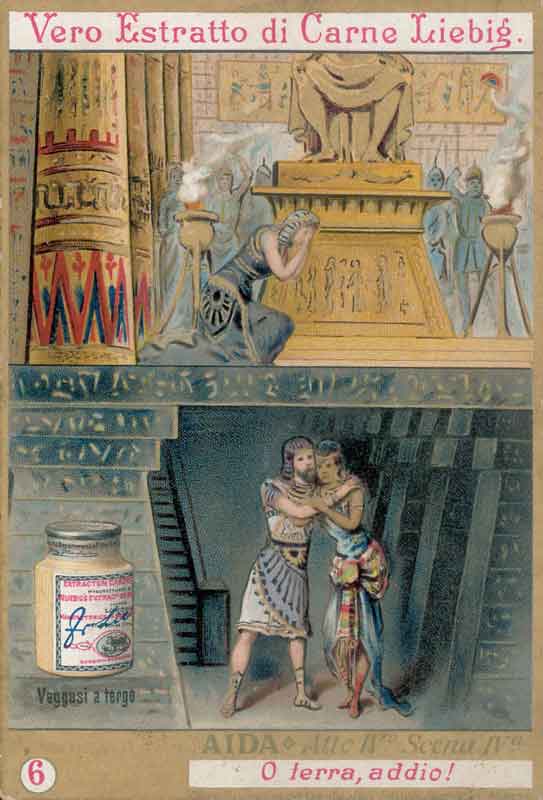
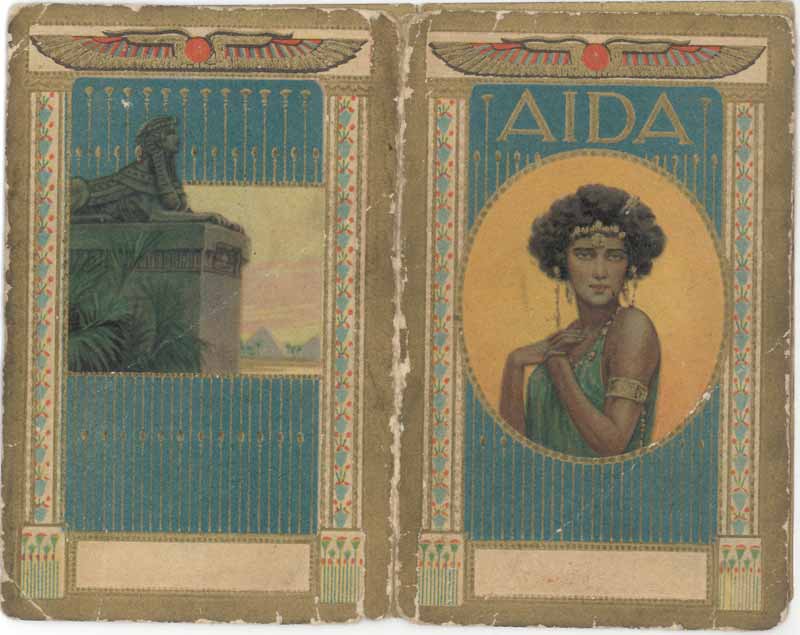
PICTURE CARDS: Aida, 1891

Based on drawings by Florence Edel (1871-1944)

Typography: Gebrüder Klingenberg; Detmold Liebig advertisement, London. Series of 6 picture cards

Museo della Figurina, Modena

02)-Aida,-1891           03)-Aida,-1891
Atto I Scena V                                      Atto II Scena I

04)-Aida,-1891            05)-Aida,-1891
Atto II Scena IV                                    Atto III Scena V

06)-Aida,-1891            01)-Aida,-1891
Atto IV Scena II                                    Atto IV Scena VI

Aida, 1933

Pocket calendar Museo della Figurina, Modena

23)-Aida,-1933

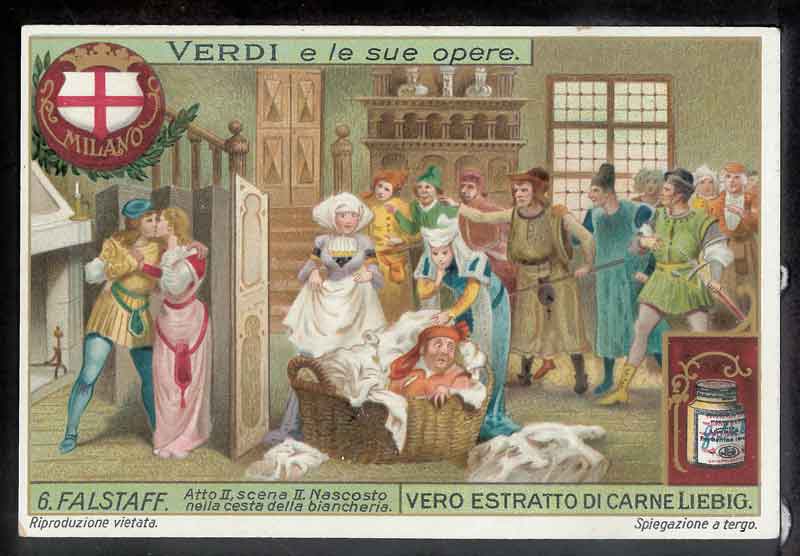
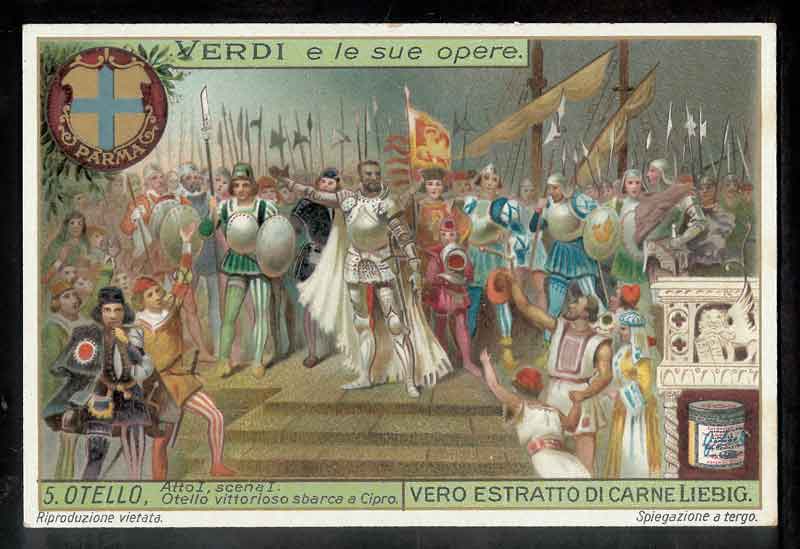
Verdi e le sue opere, 1913 (Verdi and his operas)

Based on drawings by Florence Edel (1871-1944) Typography: Fritz Schneller & Co., Norimberga. Liebig advertisement, London. Series of 6 picture cards. Museo della Figurina, Modena

4-Aida 6-Falstaff5-Otello

3-La-Traviata 2-Il-Trovatore 1-Il-Rigoletto

Centenario della nascita di Giuseppe Verdi, 1913

(1st Centennial of Giuseppe Verdi’s birth, 1913)

Borsari & C. advertisement , Parma Pocket calendar.

Museo della Figurina, Modena

1-18)-Centenario-della-nascita-di-Giuseppe-Verdi,-1913 2-18)-Centenario-della-nascita-di-Giuseppe-Verdi,-1913 3-18)-Centenario-della-nascita-di-Giuseppe-Verdi,-1913

Giuseppe Verdi, 1898

Suchard advertisement , Neuchâtel Picture card from the series Grands compositeurs. Museo della Figurina, Modena

15)-Giuseppe-Verdi,-1898---

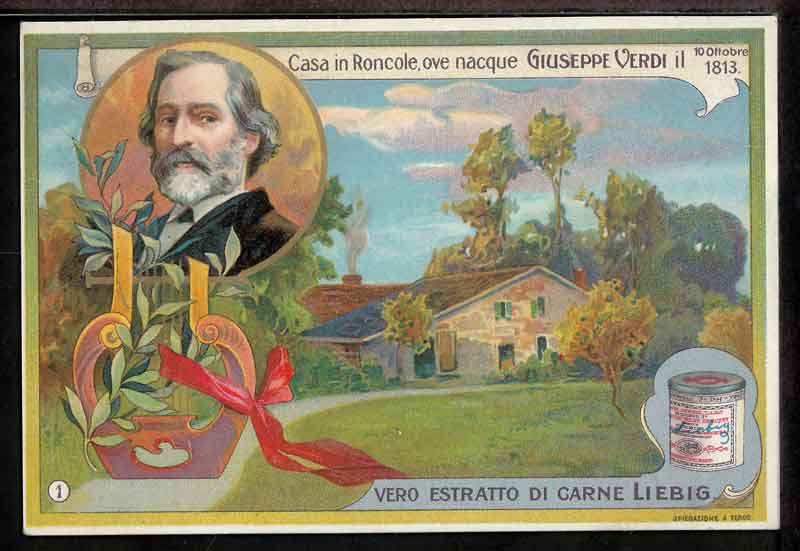
Giuseppe Verdi, 1902

Typography: Fritz Schneller & Co., Nuremberg Liebig advertisement, London. Series of 6 picture cards. Museo della Figurina, Modena

1 2 3 4 5 6

Posted in Exhibits | Tagged , , , | Leave a comment

“Le dernier jour d’un condamné”: Interview with Frédérico Alagna

(USA) “Le dernier jour d’un condamné”Interview with Frédérico Alagna

by Natalia DiBartolo. Translated from the original Italian text by Natalia DiBartolo.

As appeared on L’Idea Magazine, March 19, 2014 (www.lideamagazine.com)

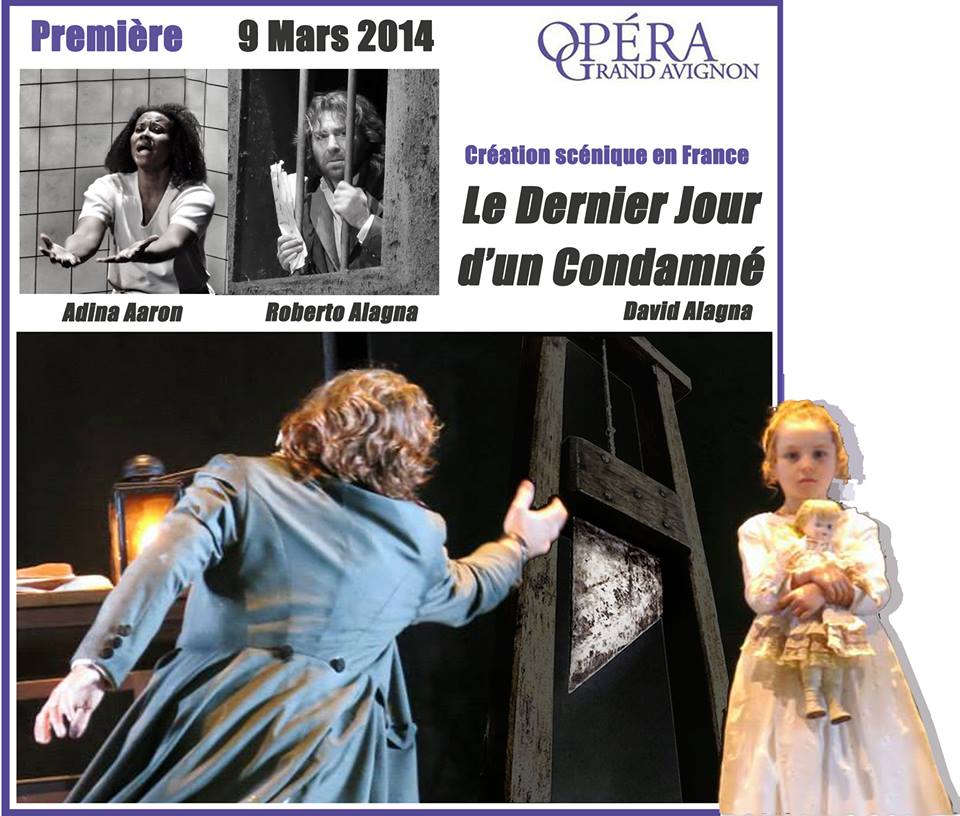
ALAGNO 13 Standing Ovation at the Opéra Grand Avignon on Sunday, March 9, 2014. An extraordinary success for an extraordinary event: the first French staging of the Opera “Le dernier jour d’un condamné” by the Alagna Brothers: Roberto’s brainchild, libretto by Frédérico, and music by David, based upon the famous novel by Victor Hugo: three brothers united in life and in art have given an extraordinary Work to the scenes, from a French Literature masterpiece.

In the role of Condamné, Roberto Alagna, indisputable and undisputed star, flanked by the beautiful Adina Aaron, his feminine alter ego in the Opera, and many other excellent performers. Orchestre Régional Avignon – Provence, directed by Maestro Balàzs Kocsar, the choir of the Opéra Grand Avignon l’Opéra de Tours directed by Aurore Marchand,  stage directed by Nadine Duffaut, with Emmanuelle Favre’s scenography, costumes by Katia Duflot, and lighting by Philippe Grosperrin.

ALAGNa-10-208x300Written in 1828, Hugo’s novel is a milestone in the history of literature that relates to the fight against the death penalty, more than ever in the modern theme, even today. It was an extraordinary idea to turn such a great novel into Opera; it came from a very strong inner and heartfelt urge, making it extremely engaging.

I have the privilege to talk about it, especially from the literary point of view, with Frédérico Alagna, sculptor, painter and graphic artist, poet and musician, name of art Fra Delrico, author of the libretto and present in the audience in the Avignon’s parterre as well as on the stage for the countless calls of the public at the end of the lyric performance.

L’IDEA: Fréderico, I saw you smiling and satisfied. I am glad and I congratulate you and your extraordinary brothers. How and when did you have the idea to compose this work?
Frédérico Alagna: Thank you for your interest: I had not yet had the opportunity to give my personal point of view, because I’ve been busy away from Avignon for my work, since they started the rehearsal until the premiere, which was, therefore, a nice surprise even for me, because I “discovered” the show directly “with” and “just like” the public.
To answer your question, we three brothers have always had the desire to create an Opera, because it is an art form that has given us so much: we three wanted to give something to Opera. Now it is done and we are happy.

L’IDEA: What prompted you to get so involved in this job?
Frédérico Alagna: With Roberto and David, but especially with David, we talk about everything since when we were kids. I have always worked together with him and it was natural to create this work in literature and music, as well as many other works that we have carved, painted or written together, always in the family home. We found the Condamné’s subject so important that we started working with heart and soul in the project.

L’IDEA: It is truly a family made of artists yours! How have you managed the project, along with your brothers and made it a reality?
ALAGNa-8Frédérico Alagna: Little by little, one by one, we found our role. Rob gave us the idea, I have made the most from the novel by Hugo, without changing a word written by him, and David began to write the music. We thought that we would write music together as always (we have written several songs and lieder together before the Condamné), but David felt so identified with the work that we decided that he alone would have been the composer. I therefore dedicated myself to write the libretto; meanwhile I was continuing to work on paintings and sculptures.

L’IDEA: According to what dramaturgical criteria did you turn the novel into a libretto? Why did you choose to keep unchanged the prose of Hugo?
Frédérico Alagna: Like everything else, it was a choice of all three of us, because we had an almost religious respect for Hugo at the time (we are talking about 15 years ago, almost); but even now it would not be any different.

L’IDEA: The work of Hugo is a literary masterpiece, also made up of shades and chiaroscuro, memories, descriptions and stories. Why was it trimmed and changed into a work in strong colors, in which all that is external to the cell and the microcosm of the convicted person has been excluded?
Frédérico Alagna: Nothing essential has been ruled out; we removed only the scenes a bit too ” melodramatic ” that were not helpful to the unfolding of the drama or that did not correspond to our musical or dramaturgical taste.

L’IDEA: What prompted you to give this libretto such cutting introspective, choosing what you did and removing what was not used?
Frédérico Alagna: This exclusion was decided by David: I have taken everything from the text that you could use for a play from a book. I wanted to give David the maximum, so that he, according to his musical inspiration or necessity, could remove and choose what he liked. With my full libretto, the work would last 4 hours!

ALAGNO 15L’IDEA: Was it your idea to introduce the African-American woman, doubling up the condemned? Why did you decide this step, which is central to the distribution of the parts from one character to two, settled in two different eras?
Frédérico Alagna: No, the idea was not mine, but it was a great idea by David. The main reasons are threefold.
First, a singer just could not sing the part of condamné: too ponderous. Second, with this female character, the musical score becomes richer and more colorful, with new shades. Third, this character is transmitted with a current message, because many countries have not yet ceased to condemn humans.

ALAGNO-11L’IDEA: How is the religious element, represented by the presence of Ministers and prayer, seen and why?
Frédérico Alagna: This is a part a bit special in Hugo’s novel: here the author wants to make clear that, sometimes, even the men in the service of God are just like other men, with the same weaknesses in which we can identify all us sinners. The spirit of the novel was also here absolutely respected.

L’IDEA: Are you still satisfied with your work and the overall result of the Opera? How are you feeling today about that experience? Would you write again as you have written or would you change anything? And if so, what?
ALAGNO-12-300x300Frédérico Alagna: Yes, I’m happy with what I have achieved and I can also say that I would not change anything about the job that I gave David to make his own choices. I still think that to keep all the book in the words of Hugo was the right option.

L’IDEA: What were your projects when you completed the Work? Representing it and then …maybe record it? Your projects have materialized?
Frédérico Alagna: Yes … and everything today has materialized. We are very happy, because we are all three self-taught. We wanted and we want our work to be considered like all the other works that we love in the operatic repertoire, from Monteverdi to contemporary composers. The future will tell if our work has deserved and got this result.

L’IDEA: What do you like most in this latest production at the Opéra Grand Avignon ?
Frédérico Alagna: The director Nadine Duffaut and her team have done an excellent job, in the spirit of the work, as we want. I especially loved the idea of making the final passage of each condemned in the time period of the other one. So the differences of time and mentality against the death penalty are annulled.

L’IDEA: It’s true: we all loved it; and the future? Maybe a project of direction of the Opera with Roberto and David ?
Frédérico Alagna: Who knows…

 L’IDEA: So, are you planning to repeat the musical experience in the future or do you prefer to dedicate yourself to the visual arts? Among other things, you’re the author of the beautiful poster of the Opera on stage in Avignon, with a painting from your own series “Omertà .”
Frédérico Alagna: Yes, it was the Opera Grand Avignon to choose one of my paintings from the series entitled “Omertà” (conspiracy of silence). I also created the original artwork for the Opera in Paris, given in the form of concert, and also one for the CD recorded for Deutsche Grammophon. I feel first a painter – sculptor – composer , I do not know if I’ll do other operatic jobs. Today I love the abstract: telling a story is not the thing I love the most; a picture says so much without telling anything at times, and it is the path that I follow. But we’ll see … I have so many ideas that I do not want to stop at a single style.

L’IDEA: Any personal projects of Frédérico as an artist?
Frédérico Alagna: Many, many projects, even those … Well, to have a clearer idea, better do another interview to Fra Delrico, won’t you? Thank you for your questions.

ALAGNO 16L’IDEA: We’ll interview you again with much joy ! Thank you, Frédérico, for your answers, but above all for your valuable work for the Condamné and the Art of the Opera.

…Unforgettable moments that remain on the scene in time, but above all in the mind and heart of the spectators.

Posted in Interview | Tagged , , , , | Leave a comment