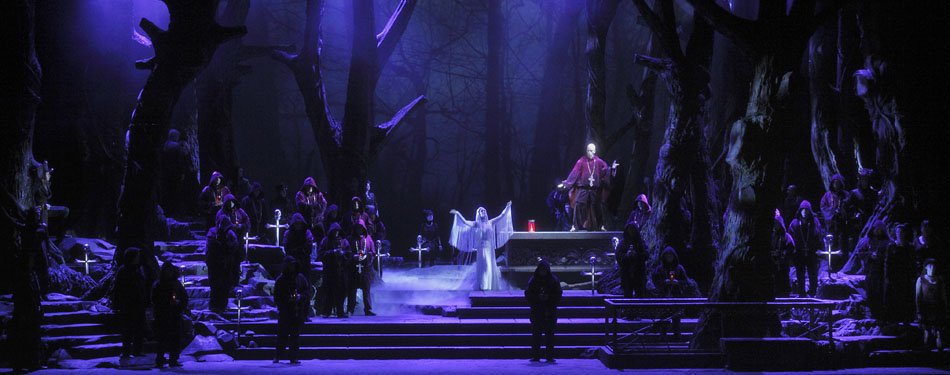
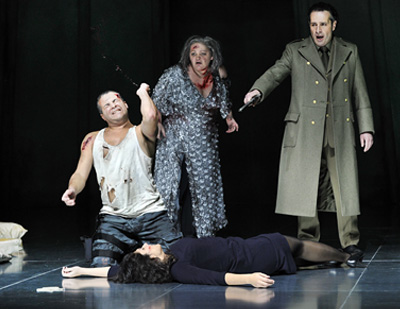
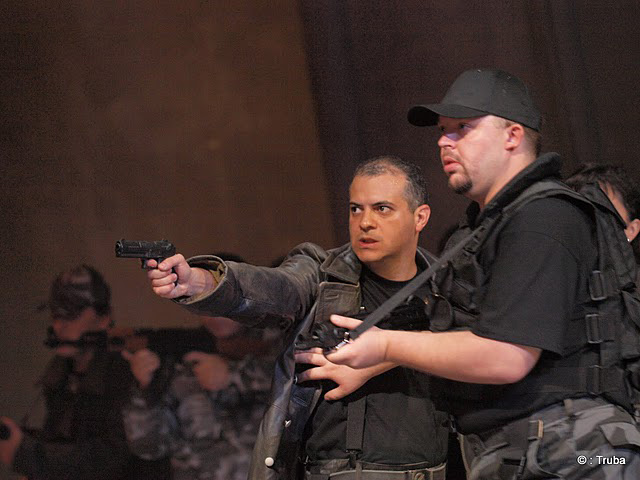
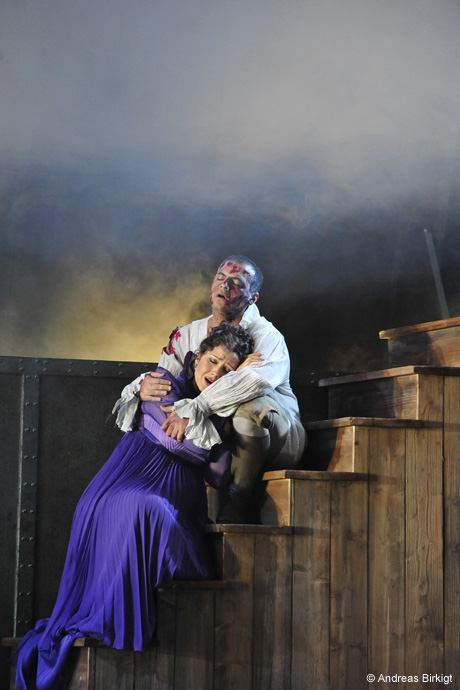
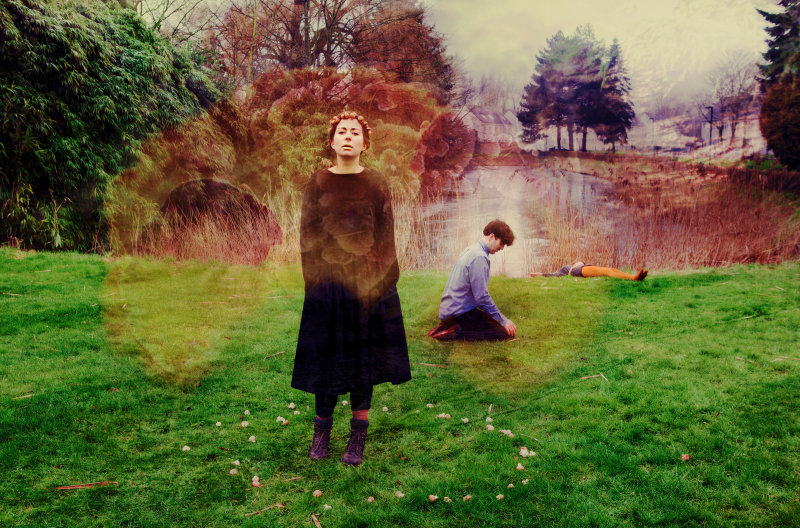
“Lady Macbeth of the Mtsensk District” (Dimitri Shostakovich) in Belgium

ladymacbeth_web

Vlaaamse Opera presents

“Lady Macbeth of the Mtsensk District”

Dmitri Sjostakovitsj [Dimitri Shostakovich] (1906 – 1975)

From 21/03/2014 in Antwerp


  • Dmitri Jurowski
  • Calixto Bieito
  • Ladislav Elgr
  • Musical direction: Dmitri Jurowski
  • Director: Calixto Bieito
  • Boris: John Tomlinson
  • Katerina: Ausrine Stundyte
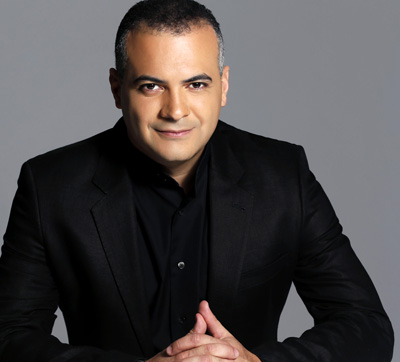
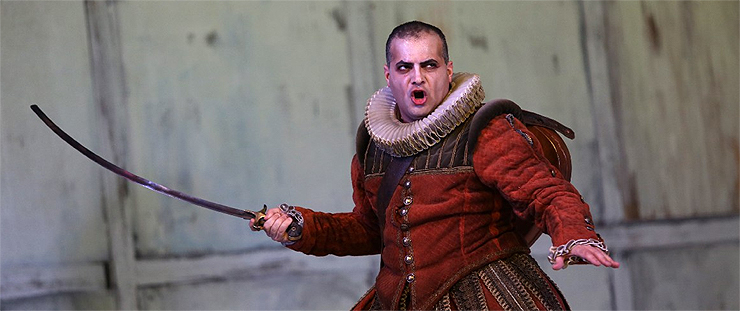
  • Sergej: Ladislav Elgr
  • Zinovi: Ludovit Ludha


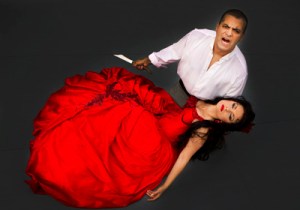
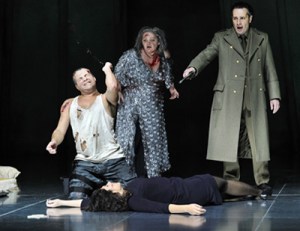
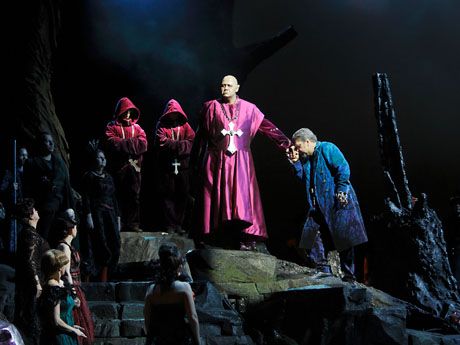
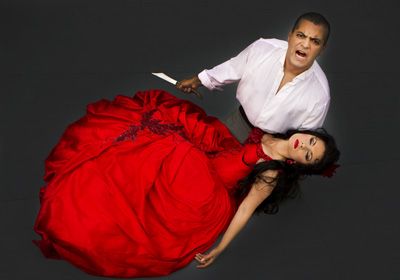
Oppressed by an impotent, rich spouse and an authoritarian father-in-law, Katerina Ismailova chooses to embark on a passionate love affair. Because of her hopeless situation, she seeks liberation in the arms of her attractive lover Sergei. When Sergei turns out to be equally cruel and untrustworthy, she gets caught up in a spiral of violence. Katerina’s dream is smashed to pieces.

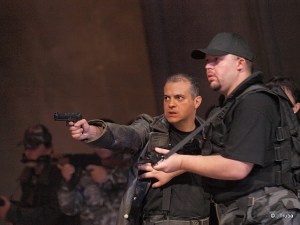
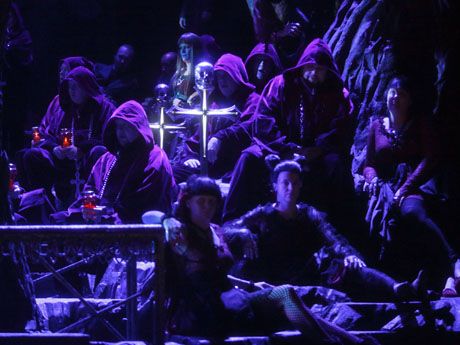
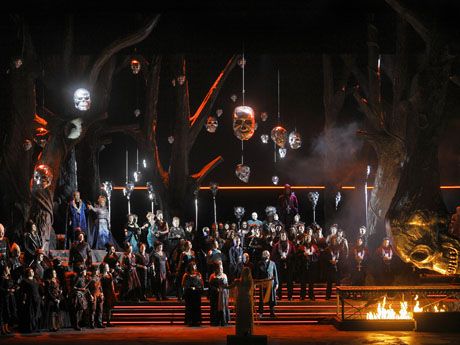
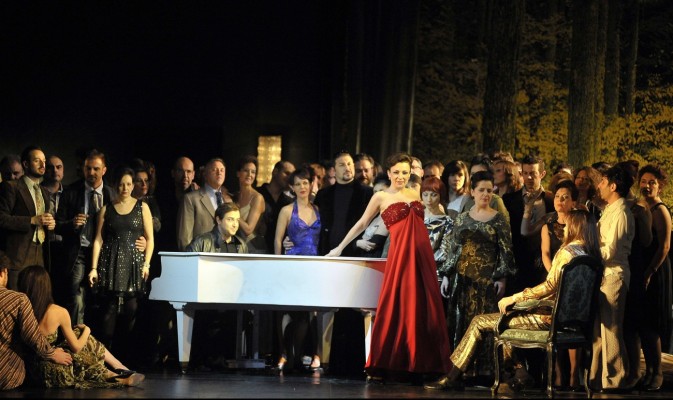
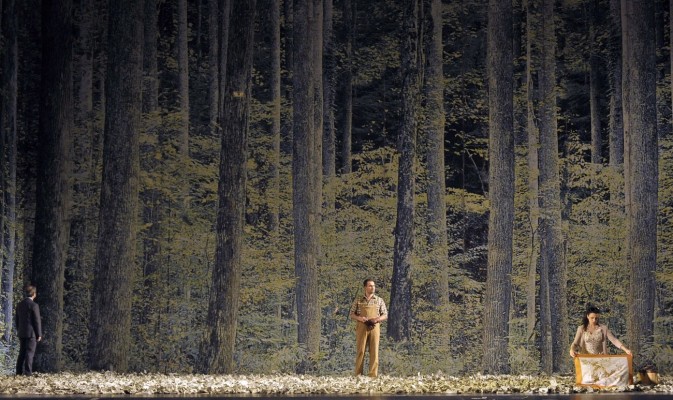
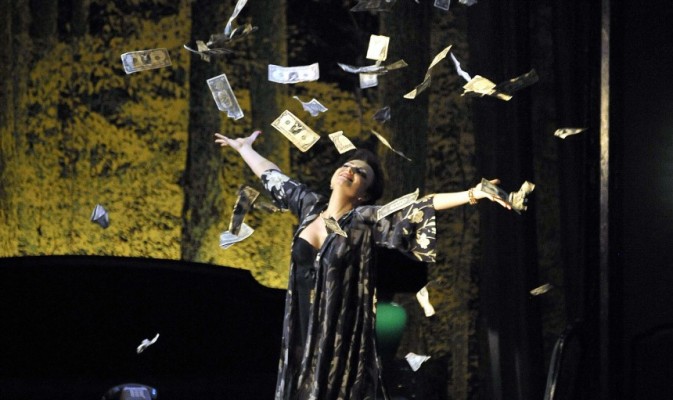
Shostakovich juxtaposes Katerina’s lyrical vocal lines with an explosive orchestral arrangement, full of shrill colours and hard dissonances. Despite its overwhelming success, the work was officially condemned by the Soviet regime. This spelt the immediate end of Shostakovich’s nascent opera career. The chaos-loving director Calixto Bieito is sure to deliver a radical but intelligent interpretation of Shostakovich’s capital opera. He places Katerina in a solitary cocoon in an amoral, post-apocalyptic world.

Language: Russian. Surtitles: Dutch.

Tickets from € 11.00 to € 100.00

Calendar

Vlaamse Opera Antwerpen

Frankrijklei 3
Antwerpen


  • Fri 21 Mar 2014 – 20:00
  • Sun 23 Mar 2014 – 15:00
  • Wed 26 Mar 2014 – 20:00
  • Sat 29 Mar 2014 – 20:00
  • Tue 01 Apr 2014 – 20:00
  • Thu 03 Apr 2014 – 20:00
  • Sun 06 Apr 2014 – 15:00
  • With his powerful, moving imagery, the Spanish director Calixto Bieito has by now created a special niche for himself. His Aufstieg und Fall der Stadt Mahagonny was enthusiastically received in Antwerp and Ghent in 2011. For Dmitri Jurowski, Shostakovich is familiar territory in which to demonstrate his mastery. The title role is reserved for Ausrine Stundyte, who previously sang the role of Nastashain Tchaikovsky’s The Enchantress with great passion. The Czech tenor Ladislav Elgr is to play Sergei and the British John Tomlinson, always a welcome guest in Bayreuth, will be getting under the skin of father-in-law Boris.

ladymacbeth1

SYNOPSIS

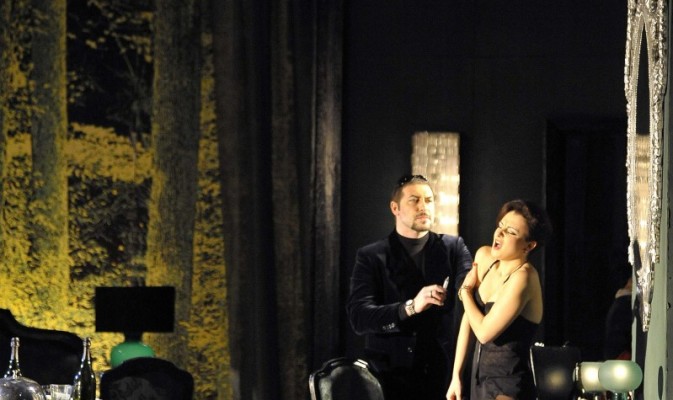
Katerina Ismailova is caught in a loveless marriage with the dreary merchant Zinovi. She is bored to tears. Her tyrannical father-in-law Boris blames her for the fact that after five years her marriage to Zinovi has not yet produced a child, but Katerina tells him that only his son can be held responsible for that. While Zinovi is on a business trip, the shifty Boris fancies trying his luck with the young woman, who is yearning for passion and sex. But Zinovi’s new servant Sergei has beaten him to it. The handsome Sergei, who has a reputation for womanising, openly makes advances to Katerina who, after some weak resistance, gives herself entirely. Boris catches Sergei out and has him beaten horribly in public. Katerina, determined to continue her steamy relationship with Sergei, is out for revenge and poisons her father-in-law with rat poison. When he returns home, Zinovi questions Katerina. He has been informed of what took place in his absence. Katerina denies it all, but Zinovi shows her no mercy. With Sergei’s help she kills her husband. Together they hide the body in the cellar. Katerina and Sergei get married. During their wedding party, a workman goes looking for drink in the cellar, where he finds Zinovi’s body. He reports it to the police. Katerina and Sergei are arrested and are sent to do forced labour in a Siberian prison camp. Sergei wants nothing more to do with Katerina. His dream of climbing the social ladder by means of this merchant’s wife has been shattered. He now takes up with Sonyetka, who wants a pair of stockings as proof of Sergei’s love. He cajoles Katerina out of a pair. When Katerina grasps that she is being deceived, she pushes Sonyetka in a river and jumps in after her. The two women drown, while the line of prisoners walks on.

Posted in OPera | Tagged , , , , , , , , , | Leave a comment

VERDI “LA TRAVIATA” IN VENICE

logofeniceVERDI “LA TRAVIATA”

Venice: Teatro La Fenice
conductors: Diego Matheuz/Stefano Rabaglia
director: Robert Carsen
sets & costumes: Patrick Kinmonth
choreography: Philippe Giradeau

running time: 2h55′
first part length: 0h35′
interval: 0h20′
second part length: 1h5′
interval: 0h20′
third part length: 0h35′

imgresize   cast

imgresize4Violetta Valery
Irina Lungu (15, 21, 25/2 – 6, 15/3)
Venera Gimadieva (16, 23, 27/2, 4, 8/3)

Alfredo Germont
Shalva Mukeria (15, 21, 25/2 – 6, 15/3)
Attilio Glaser (16, 23, 27/2, 4, 8/3)

imgresize1Giorgio Germont
Vladimir Stoyanov (15, 21, 25/2 – 6, 8/3)
Giuseppe Altomare (16, 23, 27/2, 4, 15/3)

Il marchese D’Obigny
Matteo Ferrara

Flora Bervoix
Elisabetta Martorana

Annina
Sabrina Vianello

Gastone
Iorio Zennaro

Il barone Douphol
Armando Gabba

Il dottor Grenvil
Mattia Denti

conductors
Diego Matheuz
Stefano Rabaglia (15/3)

director
Robert Carsen

sets & costumes
Patrick Kinmonth

Choreographer
Philippe Giraudeau

light designer
Robert Carsen e Peter Van Praet

imgresize3

La Fenice Opera House Chorus and Orchestra
Chorus master Claudio Marino Moretti

italian and english surtitles

Performance Dates

sat 2014-02-15 19:00

sun 2014-02-16 15:30

fri 2014-02-21 19:00

sun 2014-02-23 15:30

tue 2014-02-25 19:00

thu 2014-02-27 19:00

tue 2014-03-04 19:00

thu 2014-03-06 19:00

sat 2014-03-08 15:30

sat 2014-03-15     15:30
Conductor Stefano Rabaglia

Posted in OPera | Tagged , , , , , , , , , | Leave a comment

“Die Tote Stadt” by Erich Wolfgang Korngold in Dallas

The Dallas Opera Presents:

Die tote Stadt

by Erich Wolfgang Korngold

Before Hitchcock filmed Vertigo, Korngold created Die tote Stadt, the tale of one man’s dark obsession with the woman he loved and lost.

Featuring state-of-the-art projections and composed by a prodigy who evolved into one of the great masters of music for the Golden Age of Cinema (The Adventures of Robin Hood, Deception, The Sea Hawk), Die tote Stadt features an extraordinary cast that includes Jay Hunter Morris in the role of Paul, fresh from his triumphs as Ahab in the San Francisco Opera revival of Moby-Dick and as Siegfried in the Met’s new Ring Cycle; Ann Petersen in her American debut as Marietta; and Morgan Smith, the poignant voice of reason in TDO’s world premiere production of Moby-Dick, as Fritz. Paul’s fierce grip on the memory of his dead wife will be challenged by the equally determined Marietta. Can he let go of his fantasy in order to live again?

This production will leave you wondering, “Where has this opera been all my life?”

BuySeason subscriptions on sale now!

Sung in German with English supertitles

Performances (2014)

  • Fri 3/21/14 7:30pm
     
  • Sun 3/23/14 2:00pm
     
  • Wed 3/26/14 7:30pm
     
  • Sat 3/29/14 7:30pm
     
  • Sun 4/6/14 2:00pm
     
 
Starring
Jay Hunter Morris
Ann Petersen
Morgan Smith

Conductor
Sebastian Lang-Lessing

Director and designer
Mikael Melbye

Posted in OPera | Tagged , , , , , , , | Leave a comment

VERDI REQUIEM in San Diego

San Diego Opera

PRESENTS

NovUpdate_Home_Requiem

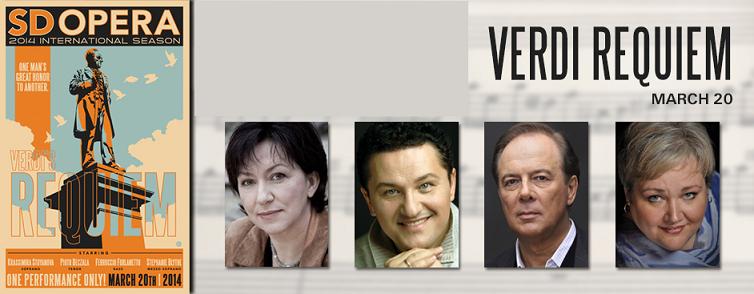
VERDI’S REQUIEM

by Giuseppe Verdi

Verdi’s powerful Requiem brings together extraordinary musical forces.

The combined San Diego Opera Chorus and the San Diego Master Chorale will be the largest chorus San Diego Opera has ever assembled on the stage of the Civic Theatre, as Krassimira Stoyanova, Stephanie Blythe and Piotr Beczala from the cast of A Masked Ball are joined by great Italian bass, Ferruccio Furlanetto, to complete a cast of soloists every opera house in the world would envy. Italian conductor Massimo Zanetti conducts the San Diego Symphony in this concert work which cries out for eternal rest, forgiveness and divine redemption.

Sometimes called an opera disguised as sacred music, and written to honor the great Italian writer Manzoni, the Requiem will leave you breathless.

There is only one performance of the Requiem, so add it to your subscription now or risk missing out on one of the greatest evenings in San Diego musical history.

The running time is approximately 1 hour and 30 minutes with no intermission.

NovUpdate_Home_Requiem1

THE CAST

Please click an artist’s name to read more.

Posted in Music | Tagged , , , , , , , , | Leave a comment

L’ELISIR D’AMORE at the Washington National Opera

THE KENNEDY CENTER

Washington National Opera: The Elixir of Love

Handsome Nemorino employs a “magical tonic” to win feisty Adina’s affections in Donizetti’s loveable comic opera–a warm and inspired masterpiece cherished for its whimsical wit, endearing characters, beautiful arias, and intoxicating duets.

The Elixir of Love (uncredited)

Gaetano Donizetti’s
The Elixir of Love
(L’elisir d’amore)
Libretto by Felice Romani
WNO revival
 
In Donizetti’s loveable comic opera, handsome peasant Nemorino has the misfortune to fall head over heels for fickle and feisty landowner Adina. Without money, he just can’t compete with wealthy Sergeant Belcore, Adina’s dashing yet pompous suitor.
 
Enter the elixir of love, peddled by an eccentric traveling quack, Doctor Dulcamara. Though it’s only cheap table wine, Nemorino is convinced this “magical tonic” has now empowered him to win Adina’s affections–even as her wedding to Sergeant Belcore leaps into full swing! Might his newfound confidence and uninhibited charm melt her heart after all?
 
One of the world’s most frequently performed operas, The Elixir of Love is cherished for its whimsical wit and endearing characters, not to mention the many intoxicating duets and “Una furtiva lagrima,” one of the most hauntingly beautiful of all tenor arias. Fresh from WNO’s Anna Bolena last fall, renowned British director Stephen Lawless returns with his warm and inspired take on Donizetti’s masterpiece, last seen by WNO audiences in 2006, but this time with a few new twists. The production also features an accomplished cast of new and familiar faces, along with young American conductor Ward Stare in his WNO debut. 
 
“Witty and mischievous at times, flashy and lovely at others!”
–LA Daily News
 
Adina: Sarah Coburn (3/20, 23, 25, 28), Ekaterina Siurina (3/22, 24, 26, 29)
Nemorino: Stephen Costello (3/20, 23, 24, 26, 28, 29), Daniel Montenegro (3/22 & 25)
Sergeant Belcore: Simone Alberghini (3/20, 23, 24, 26, 28, 29), Aleksey Bogdanov (3/22 & 25)
Dulcamara: Nicola Ulivieri (3/20, 23, 24, 26, 28, 29), Peixin Chen (3/22 & 25)
 
Conductor: Ward Stare
Director: Stephen Lawless
Set Designer: Johan Engels
Costume Designer: Ashley Martin-Davis

Performed in Italian with projected English titles. Titles may not be visible from the rear of the orchestra.

~~~~~~~~~~~~~~~

COME EARLY FOR FREE OPERA INSIGHTS
Musicologist Saul Lilienstein leads the Thursday, Mar. 20 Opera Insight, starting 1 hour and 15 minutes before the performance and lasting 35–40 minutes. All other Opera Insights start 1 hour before the performance and last 20–25 minutes.
Informative and entertaining, Opera Insights take you inside the composer’s mind, behind the scenes of planning a production, and into the history and social context of each opera.
These lectures are free, but patrons must present a ticket from any performance of The Elixir of Love.

STAY AFTER FOR A FREE ARTIST Q&A ON THE ELIXIR OF LOVE
Following these performances:
Sunday matinee, March 23
Monday evening, March 24
Join WNO artists for a unique opportunity to ask questions about the production.
All discussions begin immediately after the performance and are free with your ticket.

~~~~~~~~~~~~~~~

Performance Timing: Act I – 70 min.; Intermission – 20 min.; Act II – 56 min. (2-3/4 hours)

Artists

Posted in Music, OPera | Tagged , , , , , , , | Leave a comment

“Les Contes d’Hoffmann” in Israel

The Israeli Opera Presents:

contesIsrael3Les Contes d’Hoffmann

Jacques Offenbach

Hoffmann the poet falls in love with the mechanic doll Olympia in Paris, with the unhealthy singer Antonia in Munich and with Giulietta who hosts voluptuous parties in Venice. The three faces of Eve make the centre of one of the grandest operas written for the Parisian stage.

Libretto: Jules Barbier and Michel Carre
 

Conductor Frederic Chaslin
  Eithan Schmeisser
Director Harry Kupfer
Set Designer Hans Schavernoch
Costume Designers        Reinhard Heinrich & Elke Eckardt
Lighting Designer Hans Toelstede

Among the Soloists
 

Hoffmannn Gustavo Porta
  Yotam Cohen
The four villans Carlo Cigni
  Vladimir Braun
Olympia/Antonia/Giulietta       Lybov Petrova
  Eglise Gutierez
Niklausse Ionut Pascu
Cochenille/Franz/Pittichinaccio           Guy Mannheim
Spalanzani Given Nkosi
Crespel Noah Briger
Luther Oded Reich
Antonia’s mother Svetlana Sandler

The Israeli Opera Chorus
Chorus Master: Ethan Schmeisser
The Opera Orchestra – The Israel Symphony Orchestra Rishon LeZion
Surtitles in Hebrew and English
Translation: Israel Ouval

New Production
Sung in French
Duration: Three hours

Day                   Date                  Hour           back stage tours   Opera Talkback
* THU 20.3.14 20:00    
FRI 21.3.14 13:00    
SAT 22.3.14 20:00    
MON 24.3.14 20:00 18:30 After the show
TUE 25.3.14 20:00 18:30 After the show
THU 27.3.14 20:00    
FRI 28.3.14 13:00    
SAT 29.3.14 21:00    
MON 31.3.14 20:00 18:30 After the show
WED 2.4.14 20:00 18:30 After the show
FRI  4.4.14 13:00    
SAT 5.4.14 21:00    

* PREMIÈRE
** TOWARDS OPENING – 15.3.14 SAT 11:00 

Les Contes d’Hoffmann

PROLOGUE
Hoffmann, a poet and musician, is undergoing a severe crisis in his artistic career, as a result of his obsession with Stella, an opera prima donna. Councilor Lindorf intercepts a note from Stella to Hoffmann, setting a rendezvous at Luther’s tavern following her performance in Don Giovanni in the neighboring opera house. Lindorf vows that he will keep the appointment instead, and remains in the tavern with the operagoers who come in for a drink after the first act. Hoffmann enters with Nicklausse, his Muse in disguise, and to cheer himself up, sings a song about the dwarf Kleinzach. Lindorf taunts him and Hoffmann recognizes in him the spirit of evil, which continually pursues him. Hoffmann agrees to tell the people in the tavern the tales of his three loves.

ACT I: OLYMPIA
Hoffmann visits the inventor Spalanzani, who shows him his latest creation, the mechanical doll Olympia, who Hoffmann believes is Spalanzani’s daughter. Nicklausse mocks him for his infatuation. Coppelius, who gave Spalanzani Olympia’s eyes, arrives and sells Hoffmann a pair of magic eyeglasses, which transform the doll into the woman of his fantasies. Coppelius insists that, because he created her eyes, he is entitled to a share of Spalanzani’s invention. Spalanzani agrees but hands him a bad check. Spalanzani presents his new invention to an invited group of people. Olympia sings a delightful chanson and, despite some mechanical malfunctions, she triumphs. When the guests go in to dinner, Hoffmann declares his love for the doll. Coppelius, having discovered Spalanzani’s trickery, rushes back in and destroys the doll. Hoffmann’s magic glasses are smashed and he realizes that his beloved was only a mechanical toy.

ACT II: GIULIETTA
Hoffmann admires and fears the courtesan Giulietta. Giulietta’s lover Schlemil appears and is introduced to Hoffmann. The demonic Dapertutto shows Giulietta a diamond and, enchanted by the stone, he gives her his orders: just as she has conjured up the shadow of Schlemil, now she must capture Hoffmann’s reflection.
Although Nicklausse warns Hoffmann against the evil woman, pointing out the fate of unfortunate Schlemil, Hoffmann confesses to Giulietta his love for her, thus losing his reflection. Hoffmann kills Schlemil, before running off to Giulietta’s room, where he does not find anyone. Later he sees Giulietta with another admirer, Pitichinaccio. Nicklausse succeeds in helping Hoffmann to escape.

ACT III: ANTONIA
Hoffmann has followed his beloved, the ailing singer Antonia, to Munich, where her father Crespel has hidden her. Although Antonia has inherited her dead mother’s beautiful voice, it is dangerous for her health to sing. In spite of the efforts of the servant Franz, Hoffmann gains entry to the home and is reunited with Antonia. He hides when her father approaches, and, as if in a nightmare, watches, as the uncanny Dr. Miracle examines Antonia and conjures up the spirit of her dead mother, who induces Antonia to sing herself to death.

EPILOGUE
Back at Luther’s tavern, Hoffmann concludes his tales, as voices in the theater next door hail Stella, his present love. Nicklausse recognizes the allegory of the three tales – Stella is all three women in one. Hoffmann proposes they drown their sorrows in another bowl of punch. Stella appears but the drunk Hoffmann, lost in thought, does not respond to her. Seeing him in this condition, Stella leaves the tavern on the arm of  the triumphant Lindorf. Nicklausse, reverting to his true identity as the Muse, persuades Hoffmann to devote himself to his art.

The Israeli Opera, Sderot Sha’ul HaMelech 19, Tel Aviv-Yafo, Israel

contesIsrael9 contesIsrael1 contesIsrael2 contesIsrael4 contesIsrael5 contesIsrael6 contesIsrael7 contesIsrael8

Posted in Music, OPera | Tagged , , , , , | Leave a comment

Il trovatore at Milan’s La Scala

trovatore8

Il trovatore

Giuseppe Verdi

Drama in four parts
Libretto by Salvatore Cammarano

Teatro alla Scala Production

From 15 February to 7 March 2014

Running Time: 2 hours 50 minutes intermission included

Sung in Italian with electronic libretto in Italian, English
Notes on the performancesOpen

Direction
Conductor: Daniele Rustioni
Staging, sets and costumes: Hugo De Ana
Lights: Marco Filibeck
Choreographic movements: Leda Lojodice
Weapons Master: Renzo Musumeci Greco

CAST
Il Conte di Luna Franco Vassallo (15, 18, 22, 25 Feb.; 4, 7 Mar.)
Simone Piazzola (20 Feb.; 1, 6 Mar.)LeonoraMaria Agresta (15, 18, 22, 25 Feb.; 4, 7 Mar.)
Lucrecia Garcia (20 Feb.; 1, 6 Mar.)AzucenaEkaterina Semenchuk (15, 18, 22, 25 Feb.; 4, 7 Mar.)
Luciana D’Intino (20 Feb.; 1, 6 Mar.)ManricoMarcelo Álvarez (15, 18, 22, 25 Feb.; 4, 7 Mar.)
Carlo Ventre (20 Feb.; 1, 6 Mar.)FerrandoKwangchul Youn (15, 18, 22, 25 Feb.; 4, 7 Mar.)
Roberto Tagliavini (20 Feb.; 1, 6 Mar.)InesMarzia CastelliniRuizMassimiliano ChiarollaUn vecchio zingaroErnesto PanarielloUn messoGiuseppe Bellanca

NOTE: We inform you that Leo Nucci has decided to eliminate the role of the Conte di Luna from his repertoire because this is no longer suitable for him at this stage of his career.
The Management of the Theatre would like to thank Franco Vassallo who will perform the role of the Conte di Luna in the following performances: 15, 18, 22, 25/02, 4, 7/03.
We also inform you that Massimo Cavalletti will not perform in the production of Il Trovatore; the role of the Conte di Luna on 20/02, and on 1 and 6/03 will be performed by Simone Piazzola.

trovatore7

Synopsis

Act I (The duel)
Entrance hall of the palace of Aliaferia.

Ferrando, the captain of the guard under the Count di Luna, is waiting for his master. But the Count is delayed because he has fallen in love with a young lady and is closely watching her, due to his jealousy of a mysterious troubadour who has been serenading the girl (introduzione “All’erta, all’erta!”). Meanwhile those present beg Ferrando to tell them the story of the Count’s brother (“Di due figli vivea padre beato”), which he does. The old Count di Luna had two sons, but one morning the nurse had found a gypsy woman bending over the younger child’s cradle. The woman had been immediately chased away, but had evidently cast an evil spell on the child, whose health began to fail. The gypsy woman had therefore been pursued, caught and condemned to be burnt at the stake. To avenge her mother, the gypsy’s daughter had returned at once to the palace and abducted the infant. Later, the remains of a burnt child had been found in the ashes of the stake. The old Count had died a few days later, after making his elder son promise to continue the search for his brother.The clock strikes midnight.

The palace gardens.

Leonora, lady-in-waiting to the Princess of Aragon, confides to Ines that she loves an unknown knight (scena and cavatina “Tacea la notte placida”), whom she had met during a tournament; then, one night, Leonora had heard him singing beneath her window, to the accompaniment of his lute, and pronouncing her name. Since then she has been unable to forget him and feels sure that their destinies are intertwined forever. The Count di Luna now enters and would like to declare his love lo Leonora, but he is disturbed by the sound of a lute, on which a troubadour is playing a serenade (scena and romanza “Deserto sulla terra”). Leonora descends and is about to throw herself into the arms of the Count, whom she has mistaken for her beloved. But having realised her error, she tells the troubadour that she loves none other than him (trio “Qual voce!…Ah! dalle tenebre”). When the Count di Luna, in a rage, asks the young man to disclose his identity, he declares that his name is Manrico. The Count recognizes him as a follower of the rebel prince Urgel and challenges him to a duel. Despite Leonora’s pleading, the two men go off to fight.

Act II (The gypsy woman)

A gypsy encampment.

Towards dawn, a group of gypsies are working in their encampment (chorus “Vedi, le fosche notturne spoglie”). Next to the fire the gypsy Azucena breaks into song, drawing attention to herself. The fire reminds her of the flames of the stake at which her mother was burnt, and died invoking revenge (canzone “Stride la vampa!”). The gypsies go down into the valley and Azucena, left alone with her son Manrico, tells him the story related hitherto: that of his grandmother, who was burnt at the stake on the orders of the old Count di Luna (scena and story “Condotta ell’era in ceppi”). Azucena also recounts how she took her revenge by abducting one of the Count’s children, and threw him into the flames of her mother’s pyre. But later she realised that she had in her delirium killed not the Count’s child but her own son. Seeing Manrico’s astonishment, Azucena calms him, telling him that such grim memories can only drive her out of her mind. Then she gets her son – who had already met the Count in duel, but spared his life because of a mysterious celestial force felt within him – to promise that he will show no further mercy to the Count (scena and duet “Mal reggendo all’aspro assalto”). A messenger enters and summons Manrico to the defence of the recently captured Castellor fortress, and also informs him that Leonora is about to take vows in the belief that he is dead. Manrico, despite his mother’s alarm, sets out at once.

A convent near Castellor.
The Count di Luna can’t resign himself to the loss of Leonora and is preparing to abduct her with his henchmen (scena and aria “Il balen del suo sorriso”). Preceded by a chorus of nuns (“Ah! se l’error t’ingombra”), Leonora, who is about to take the veil, enters. The Count di Luna steps forward to abduct her, but Manrico intervenes unexpectedly. The general amazement (concertato “E deggio e posso crederlo?”) is broken by the arrival of Ruiz and of Urgel’s followers, who release Manrico and Leonora.

Act III (The gypsy woman’s son)

An encampment near Castellor.
The Count di Luna’s soldiers, encamped in sight of Castellor, are playing cards and singing (chorus “Or co’ dadi, ma fra poco”). Ferrando announces that they will storm the fortress tomorrow. The Count di Luna is determined to abduct Leonora from his hated enemy Manrico, but a tumult distracts him from his intentions. In a nearby field a gypsy woman has been caught and is now brought before him. She is Azucena, whom Ferrando recognizes as the gypsy who abducted the Count’s child long ago (scena and trio “Giorni poveri vivea”). And his conviction is borne out when he notices the woman’s fear on hearing the name of the Count di Luna, who has her arrested. When Azucena invokes the name of Manrico, the Count’s rage is redoubled. The bystanders call for the woman to be burnt at the stake.

A hall of the palace.

Manrico informs Leonora that a battle will be fought tomorrow and gives orders to Ruiz to supervise their defence. The two lovers, to the sound of an organ, are about to start their marriage ceremony (scena and cantabile “Ah sì, ben mio”), when Ruiz bursts in and, taking Manrico to the window, points to the pyre on which Azucena is about to be burnt. Manrico, in a fury (cabaletta “Di quella pira”), leaves his bride and rushes to his mother’s aid.

Act IV (The ordeal)

Near the Aliaferia palace.

Leonora is led by Ruiz to the place where Manrico is imprisoned. Glancing at the ring on her right hand and thinking of her beloved (scena and cantabile “D’amor sull’ali rosee”), she hears the song of the Miserere and the voice of Manrico, who is about to die and begs her not to forget him. Leonora declares that her destiny will forever be linked to his (cabaletla “Tu vedrai che amore in terra”). When she sees the Count coming out of a door and giving orders for the execution, she goes up to him and promises him her body in exchange for Manrico’s life (scena and duet “Qual voce!. .. come!… tu donna?”). Leonora secretly drinks the poison from her ring.

A prison.

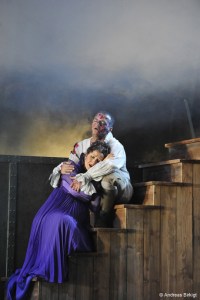
Manrico is seated beside his mother, who is lying on a mattress (finale ultimo “Madre… non dormi?”). In her delirium, the gypsy pictures again in her mind the burning of her mother. But her son calms her, and lulls her to sleep with memories of their home in the peaceful mountains (“Ai nostri monti… ritorneremo!”). Leonora appears and urges Manrico to escape, though she cannot herself follow him. When he hears the price she has paid for his freedom, he curses Leonora (concertato “Parlar non vuoi!… Balen tremendo!”), but repents on learning that she has poisoned herself in order never to belong to anyone else. She dies in his arms. The Count gives orders for Manrico to be executed. Only then does he learn from Azucena, with horror, that he has murdered his own brother. The gypsy woman has at last avenged her mother.

trovatore1 trovatore2 trovatore3 trovatore4 trovatore5 trovatore6

Posted in OPera | Tagged , , , , , | Leave a comment

“Turandot” in Utah

UTAH OPERA PRESENTS:

CAPITOL THEATRE

MARCH 15, 17, 19, 21 2014 (7:30 PM)
MARCH 23, 2014 (2 PM)

Turandot is Puccini’s “cruel princess.” She is vain, icy, and seemingly incapable of love. In keeping with her impenetrable persona, she announces that she will marry the man who can solve her three riddles but gravely punish those who cannot. Heads do roll until one clever prince appears and solves her trio of challenges. He then counters with a riddle of his own and Turandot is caught uncomfortably in a web of her own making.

Don’t miss this epic new production by design duo Renaud Doucet and Andre Barber that arrives in Salt Lake City after sold-out performances and rave reviews in Pittsburgh, Minnesota, and Seattle. From the spectacular music, including the sweeping aria “Nessun Dorma,” to the breathtaking pageantry of one of opera’s greatest hits, Turandot is certain to be the highlight of the season.

CAST

Turandot: Maida Hundeling
Timur: Richard Wiegold
Calaf: Jonathan Burton
Liu: Kelly Kaduce
Ping: Daniel Belcher
Pang: Julius Ahn
Pong: Joseph Gaines
Emperor Altoum: Todd Miller
A Mandarin: Shea Owens

Conductor: David Agler
Director: Renaud Doucet
Designer: André Barbe

Posted in Music, OPera | Tagged , , , , , , , , | Leave a comment

VersoVerdi, An unusual journey to the discovery of the great composer (App for I-Phone)

Verso Verdi_Icona

VersoVerdi

An unusual journey to the discovery of the great composer

(App for I-Phone downloadable from app store)

Verdi’s universe is rich, complex, multiethnic.
Verdi was great composer, but also a man of his time, cautious landowner, musical interpreter of the Italian Risorgimento, discreet philanthropist, reluctant politician, farmer of Roncole.

IBC and Bologna University IT Department inspired by Verdi’s versatile nature, on the occasion of the anniversary in 2013, planned VersoVerdi a free iPhone app anybody can download for App Store.

VersoVerdi is a journey inside Verdi’s universe constituted by 24 planets/Emilia-Romagna Museums recomposing Verdi’s world according to unpublished crossed-references and sense-related connections.

For example, in the application together with Verdi’s places par excellence – the unpretentious birth house in Roncole di Busseto, Villa Verdi in Sant’Agata and Barezzi House Museum in Busseto – appear other two museums dedicated to the Arts of the nineteenth century: the Ricci Oddi Gallery in Piacenza with his collection of Italian artists carefully divided by regions and schools, and the Boldini Museum in Ferrara dedicated to the author of the most famous portrait of the Maestro.

The interest in political events involving Verdi leads us to the Risorgimento Museum in Bologna which keeps the poster of the extraordinary performance of “The Lombards at the First Crusade” and to Villa Saffi in Forlì, site of secret meetings of the carbonari and later on residence of the Mazzinian Leader Aurelio Saffi and his wife Giorgina Craufurd.

Again, the exploration of the connection between Verdi and his homeland addresses us from Villa Verdi to the Museum of the Agriculture and the rural world in San Martino in Rio with its collections of objects witnessing both the peasant farmers’ work and the landowners’ life and the Cervi Museum to tell, in another historical context, the story of an extraordinary peasant family.

VersoVerdi obviously at the same time constitutes an eminently musical universe telling about Padre Martini, Mozart in Bologna, Rossini, Toscanini, and Mascagni, who – even if born in Leghorn- in our region, specifically in Bagnara di Romagna, left his heart and an extensive correspondence and many objects.

Each of the 24 museums is briefly introduced by videos, music, readings and photo slideshows.

VersoVerdi is an original and innovative interactive experience making use of sophisticated forms of emotional browsing for the recognition of emotions through facial expressions.

Posted in Uncategorized | Tagged , , | Leave a comment

“Rigoletto ” in Boston

BOSTON LYRIC OPERA PRESENTS:

Verdi | Rigoletto

Rigoletto_688x688

March 14, 16m, 19, 21, 23m, 2014

New BLO production. Sung in Italian with projected English translation.
March 14, 16m, 19, 21, 23m, 2014 at the Citi Performing Arts CenterSM Shubert Theatre.
Evening performances at 7:30pm. Matinees (m) at 3pm.

The Duke of Mantua is always in pursuit of his next romantic conquest. His jester Rigoletto is obsessed with protecting his innocent daughter, Gilda, from the corruption which has become a way of life in the Duke’s court. Rigoletto can lock his daughter away, but he cannot contain the passion stirring in her young heart. When a betrayed husband places a curse on the Duke and Rigoletto, a thirst for revenge leads to tragic results.

This Verdi favorite and new production is set in a rich and decadent Renaissance Italy and features some of opera’s most famous arias including “La Donna e Mobile,” and “Caro Nome.” Michael Mayes, Bruce Sledge, and Morris Robinson star with Nadine Sierra singing Gilda.

Creative Team  
Conductor Christopher Franklin*
Stage Director Tomer Zvulun*
Set Designer John Conklin
Costume Designer Victoria Tzykun*
Lighting Designer Robert Wierzel
Wigs and Makeup Designer Jason Allen
   

Cast  
The Duke of Mantua Bruce Sledge*
Rigoletto Michael Mayes*
Gilda Nadine Sierra
Count Monterone David Cushing*
Sparafucile Morris Robinson
Maddalena Audrey Babcock*
Marullo David Kravitz
Borsa Omar Najmi#
Count Ceprano Liam Moran#
Countess Ceprano Chelsea Basler#

* BLO debut
#BLO Emerging Artist

SYNOPSIS

Verdi ran into serious problems with the powerful censorship office when he was writing Rigoletto, based on a play by Victor Hugo, set in the licentious court of the French King Françoise I. He and his librettist, Piave, were forced to move this boldly dramatic story of a promiscuous monarch with its attendant aspects of seditious intrigues, rape, and murder from Paris to the physically smaller-scale, walled, Renaissance Italian city-state of Mantua ruled by an all powerful Duke. But perhaps, in the end, this enforced change works to the advantage of the piece. Rather than a great European capital, the world is now more isolated, more concentrated, more claustrophobic – a terrible kind of intimate crucible where the three central characters are inescapably forced together to confront and endure their desperately conflicting and ultimately fatal passions.

Part 1: The Court

Surrounded by a group of idle and sycophantic courtiers, The Duke confides to his henchman Borsa the details of his latest furtive amorous adventures – he has been following a young woman every Sunday as she leaves church. But he is soon distracted by the presence of the Countess Ceprano who he brazenly attempts to seduce in front of her furious husband egged on by his hunch- back favorite the jester Rigoletto. Rigoletto’s witty brutality, cruel tongue and closeness to the Duke have earned him the hatred of the rest of the court and they are maliciously delighted with the unexpected news that he has a mistress “Has the hunchback become a Cupid?” Together with Ceprano they plot revenge on their nemesis that night. Now yet another victim of the Dukes predatory hedonism is revealed – the daughter of an older courtier Monterone has been violated and abandoned. He arrives to seek retribution but he is savagely taunted by Rigoletto acting as the Duke’s spokesman. Furious Monterone turns on them both with a violent curse  – ” …and you, vile serpent who mock a father’s grief, my curse be upon you.” The Duke shrugs it off but Rigoletto is terrified and seems shaken to the depths of his being.

On his way home Rigoletto obsessively turns the curse over in his mind. He is accosted by Sparafucile an assassin-for-hire who offers Rigoletto his professional services. Rigoletto (after finding out the details) turns him down. As Sparafucile disappears into the shadows Rigoletto muses darkly – “We are alike. I wound with my tongue; he kills with his dagger.” In the ecstatic greeting of his daughter Gilda, Rigoletto’s panicked reaction to the curse is explained. His motherless child means everything to him – a figure of innocence and purity amidst the decadence and self disgust of his existence at court. He protects her at any cost – virtually imprisoning her (except for the Sunday church visit) under the eye of the housekeeper Giovanna. But the Duke disguised as a student has breached the walls and, as Rigoletto departs, sneaks into the house to see Gilda. Their passionate meeting is cut short by a nervous Giovanna who has heard a noise outside. The Duke leaves Gilda alone to rapturously muse in his absence on the very name of her lover. The courtiers arrive masked to execute their revenge on Rigoletto by abducting his mistress but when he arrives back unexpectedly they enlist him in their scheme convincing him that they here to kidnap the Countess Ceprano. He is completely duped and only after his daughter has been carried off does he realize what has happened. The despairing Rigoletto rushes into the empty house, crying out “La maladizione”.

Part 2: The Killing Ground

The Duke had returned to Gilda’s house but found it deserted. Back at the court, in a moment of unaccustomed gentleness he reflects on her mysterious disappearance and   her love – “She so pure, before whose innocent gaze, I often feel myself  overcome with virtue”. When the courtiers with malicious glee tell him of their successful capture of Rigoletto’s mistress he joyfully realizes what has really happened and rushes off  – “She shall know at last who loves her and who I really am” Rigoletto distraught and grief stricken also realizes what has occurred and, at first savagely, and then racked with bitter and pathetic grief begs the men (shocked to discover the truth) to restore his daughter . Alone with her father, Gilda admits both her love and her shame and dishonor. The darkly despairing words of Monterone as he is led to execution that his curse has been in vain causes Rigoletto to cry out “No,old man, you’re wrong, you shall be avenged.”  Gilda desperate begs for mercy for the Duke – “he betrayed me but I love him, O God” but Rigoletto vows   punishing vengeance – “The jester knows how to strike you like a thunderbolt hurled by God.”The Duke is up to his old games now toying with Maddalena the assassin Sparfucule’s sister (and decoy) Rigoletto attempts to cure Gilda of her obsession with this worthless man by showing her the Duke and his new conquest and she seems shaken by the betrayal. Rigoletto arranges the details of the killing with Sparafucile. It all seems to be going as planned but Madalena has fallen for the “charming ” man and convinces her brother to get his fee and then kill Rigoletto and dump him in the river. Sparafucile’s honor is challenged (“betray a client”?); they agree to an anonymous substitute. Gilda overhears this and decides to sacrifice herself – “May the man I go to save be happy” The deed is done; the money paid; the body delivered to Rigoletto. Suddenly the voice of the Duke is heard. Rigoletto discovers the dying Gilda. She lives only long enough to ask forgiveness for herself and for the Duke.  Rigoletto cries out for his own death but she is gone.

Posted in Music, OPera | Tagged , , , , , , , , | Leave a comment