“Tosca” in Wisconsin

Madison Opera 

Questo è il bacio di Tosca –
This is the kiss of Tosca!

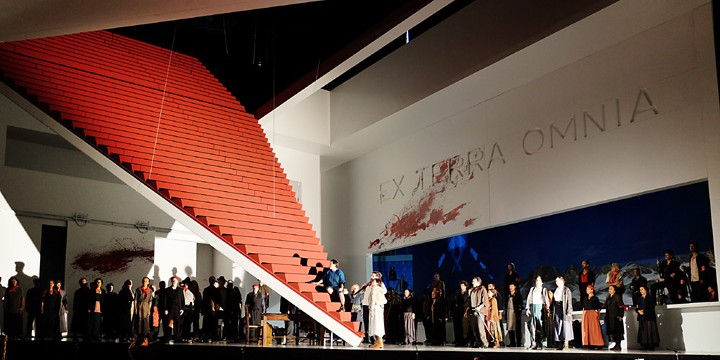
With those words, opera singer Floria Tosca stabs Scarpia, the evil police chief who has tortured her lover, the painter Cavaradossi, and now threatens her. One of the most tightly written and fast-paced of operas, Puccini’s Tosca is a tour de force that combines soaring music, true love, and political intrigue into three acts of headlong drama. Don’t miss this production of one of the most justifiably popular operas ever written. 

Cast


Melody Moore:Tosca

Madison Opera Debut: Opera in the Park 2008
Recently with MO: The Marriage of Figaro

Recently: Senta, The Flying Dutchman (Glimmerglass Festival); Tosca, Tosca (San Francisco Opera); Pamina, The Magic Flute (Opéra National de Bordeaux); Donna Elvira, Don Giovanni (Opera Colorado, Atlanta Opera); Julie, Show Boat (Houston Grand Opera); Régine Saint Lauren, world premiere of Prima Donna (New York City Opera); Susan Rescorla, world premiere of Heart of a Soldier (San Francisco Opera)

Upcoming: Marta, The Passenger, Freia, Das Rheingold (Houston Grand Opera); Alice Ford, Falstaff (Opera Santa Barbara)

Website:www.melodymooresoprano.com/


Scott Piper
CavaradossiMadison Opera Debut: La Traviata
Recently with MO: La Bohème, Madama Butterfly, Opera in the Park 2004

Recently: Calaf, Turandot (Minnesota Opera, Sarasota Opera); Turiddu, Cavalleria Rusticana (New Israeli Opera); Manrico, Il Trovatore (Utah Opera, Opera Roanoke), Don José, Carmen (Nashville Opera, Kentucky Opera); Rodolfo, La Bohème (Angers-Nantes Opera)

Upcoming: Luigi, Il Tabarro (Opera Köln); Cavaradossi, Tosca (Austin Lyric Opera)


Scarpia: Nmon Ford

Madison Opera Debut: Carmen

Recently with Madison Opera: Opera in the Park 2013

Recently: Macbeth, Macbeth (Long Beach Opera); Jochanaan, Salome (Opéra National de Bordeaux); Riolobo, Florencia en el Amazonas (Utah Opera); Zurga, The Pearl Fishers (Michigan Opera Theater); Don Giovanni, Don Giovanni (Teatro Communale di Bologna); Germont, La Traviata (Kalamazoo Opera); Escamillo, Carmen (Szeged Open-Air Festival, Teatro Sociale di Rovigo)

Upcoming: Carmina Burana (Atlanta Symphony); Sacred Service (Knoxville Symphony)

Website: www.nmonford.com/home.html
Angelotti: Ryan Kuster

Madison Opera Debut

 Recently: Escamillo, Carmen (San Francisco Opera); Masetto, Don Giovanni (Cincinnati Opera, San Francisco Opera, Los Angeles Philharmonic); Don Giovanni, Don Giovanni (Wolf Trap Opera); Mandarin, Turandot (Dallas Opera); Angelotti, Tosca (Pacific Symphony); Alidoro, La Cenerentola (Nashville Opera)

Upcoming: Colline, La Bohème (Arizona Opera); Escamillo, Carmen (Opera Colorado, Virginia Opera

Sacristan: Nikolas Wenzel

Madison Opera Debut

Recently: Sarastro, The Magic Flute and Don Magnifico, La Cenerentola (Opera in the Neighborhoods – Lyric Opera of Chicago); Fafner, Das Rheingold (Union Avenue Opera); Old Man, Alice in Wonderland and Lillas Pastia, Carmen (Opera Theatre of St. Louis)

Website: www.nikolaswenzel.com

Spoletta: Scott Brunscheen

Madison Opera Debut

Recently: Roderick (cover), The Fall of the House of Usher (Chicago Opera Theater), Toby (cover), Sweeney Todd (Opera Theatre of St. Louis); Belmonte, Die Entführung aus dem Serail (Candid Concert Opera); Don Ramiro, La Cenerentola (Lyric Opera of Chicago Outreach); Don Ottavio, Don Giovanni (Opera New Jersey)

Upcoming: Don Ramiro, La Cenerentola (Candid Concert Opera)

Sciarrone: Kenneth Stavert

Madison Opera Debut

Recently: Gregorio, Roméo et Juliette (Des Moines Metro Opera, Palm Beach Opera); Antonio, Le nozze di Figaro (Dayton Opera); Ben, The Telephone (Florida Opera Theatre);  Prince Yamadori, Madama Butterfly, Normanno, Lucia di Lammermoor, Sciarrone, Tosca (Palm Beach Opera)

Upcoming: Orff’s Carmina Burana (Voices of the Commonwealth); Handel’s Messiah (Dayton Philharmonic)

Production


Conductor: John DeMain

Director: A. Scott Parry


Sung in Italian with projected English translations

Production Dates:
Friday, November 1, 2013 | 8pm
Sunday, November 3, 2013 | 2:30pm

Run time:
approx. 2 hours 45 minutes, including two intermissions

Related Events

Opera Up Close: Tosca preview / October 27, 2013
Opera Talks: Pre-Opera lecture and Post-Opera Q&A session

The Story of the Opera

Rome, 1800.

ACT I. Cesare Angelotti, an escaped political prisoner, rushes into the church of Sant’ Andrea della Valle to hide in the Attavanti chapel. As he vanishes, an old Sacristan shuffles in, praying at the sound of the Angelus. Cavaradossi enters to work on his portrait of Mary Magdalene – inspired by the Marchesa Attavanti (Angelotti’s sister), whom he has seen but does not know. Taking out a miniature of the singer Floria Tosca, he compares her raven beauty with that of the blonde Magdalene. The Sacristan grumbles disapproval and leaves. Angelotti ventures out and is recognized by his friend and fellow liberal Cavaradossi, who gives him food and hurries him back into the chapel as Tosca is heard calling outside. Forever suspicious, she jealously questions him, then prays, and reminds him of their rendezvous that evening at his villa. Suddenly recognizing the Marchesa Attavanti in the painting, she explodes with renewed suspicions, but he reassures her. When she has gone, Cavaradossi summons Angelotti from the chapel; a cannon signals that the police have discovered the escape, so the two flee to Cavaradossi’s villa. Meanwhile, the Sacristan returns with choirboys who are to sing in a Te Deum that day. Their excitement is silenced by the entrance of Baron Scarpia, chief of the secret police, in search of Angelotti. When Tosca comes back to her lover, Scarpia shows her a fan with the Attavanti crest, which he has just found. Thinking Cavaradossi faithless, Tosca tearfully vows vengeance and leaves as the church fills with worshipers. Scarpia, sending his men to follow her to Angelotti, schemes to get the diva in his power.

ACT II. In the Farnese Palace, Scarpia anticipates the sadistic pleasure of bending Tosca to his will. The spy Spoletta arrives, not having found Angelotti; to placate the baron he brings in Cavaradossi, who is interrogated while Tosca is heard singing a cantata at a royal gala downstairs. She enters just as her lover is being taken to an adjoining room: his arrogant silence is to be broken under torture. Unnerved by Scarpia’s questioning and the sound of Cavaradossi’s screams, she reveals Angelotti’s hiding place. Cavaradossi is carried in; realizing what has happened, he turns on Tosca, but the officer Sciarrone rushes in to announce that Napoleon has won the Battle of Marengo, a defeat for Scarpia’s side. Cavaradossi shouts his defiance of tyranny and is dragged to prison. Scarpia, resuming his supper, suggests that Tosca yield herself to him in exchange for her lover’s life. Fighting off his embraces, she protests her fate to God, having dedicated her life to art and love. Scarpia again insists, but Spoletta interrupts: faced with capture, Angelotti has killed himself. Tosca, forced to give in or lose her lover, agrees to Scarpia’s proposition. The baron pretends to order a mock execution for the prisoner, after which he is to be freed; Spoletta leaves. No sooner has Scarpia written a safe-conduct for the lovers than Tosca snatches a knife from the table and kills him. Wrenching the document from his stiffening fingers and placing candles at his head and a crucifix on his chest, she slips from the room.

ACT III. The voice of a shepherd is heard as church bells toll the dawn. Cavaradossi awaits execution at the Castel Sant’Angelo; he bribes the jailer to convey a farewell note to Tosca. Writing it, overcome with memories of love, he gives way to despair. Suddenly Tosca runs in, filled with the story of her recent adventures. Cavaradossi caresses the hands that committed murder for his sake, and the two hail their future. As the firing squad appears, the diva coaches Cavaradossi on how to fake his death convincingly; the soldiers fire and depart. Tosca urges Cavaradossi to hurry, but when he fails to move, she discovers that Scarpia’s treachery has transcended the grave: the bullets were real. When Spoletta rushes in to arrest Tosca for Scarpia’s murder, she cries to Scarpia to meet her before God, then leaps to her death.

 –Courtesy of Opera News


Posted in Music, OPera | Tagged , , , , , , , | Leave a comment

VERDI’S 200TH ANNIVERSARY CELEBRATION: “Il Trovatore” at the Czech State Opera House

The Czech State Opera Presents

trovatoreCzehIl trovatore

Giuseppe Verdi

November 6, 2013

December 29, 2013

February 20, 2014

March 18, 2014

stage director Lubor Cukr

Libretto: Salvatore Cammarano
Conductor: Jan Latham-Koenig, Jiří Štrunc, Richard Hein
Stage director: Lubor Cukr
Sets: Josef Jelínek
Costumes: Josef Jelínek
Chorus master: Tvrtko Karlovič, Adolf Melichar

State Opera Orchestra

State Opera Chorus

Premiere: May 26, 2011

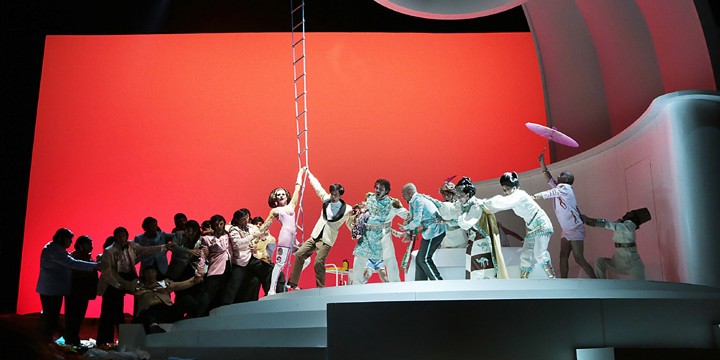
The romantic story set in 15th-century Spain about the troubadour Manrico and the Gypsy Azucena, replete with heroism, machinations, love, hatred and revenge, is rather intricate and its plot improbable to say the least. The celebrated tenor Leo Slezak, a favourite guest of the New German Theatre (today’s State Opera) and a superlative performer of Manrico, remarked: “I have sung the Troubadour at least a hundred times, and I still haven’t the slightest inkling as to what this opera is actually about!” Nevertheless, Giuseppe Verdi superbly negotiated all the unlikely plot twists and duly created one of his most forcible works. The melodies in Il trovatore are lavishly expressive and the celebrated Anvil Chorus “Vedi le fosche notturne” from Act 2 has experienced numerous paraphrases, including Glen Miller’s jazz arrangement. The premiere on 19 January 1853 at the Teatro Apollo in Rome was a triumph and opera stages were soon scrambling to stage the work. Alongside La traviata and Rigoletto, Il trovatore is the apex of Verdi’s creation, and the three operas are still record-breakers when it comes to the number of performances and visitors at opera houses around the world.

The opera is staged in Italian original version and Czech and English surtitles are used in the performance.

Duration of the performance: 2 hours and 30 minutes, 1 intermission

Earl Luna

Leonora

Azucena

Manrico

Posted in Music, OPera | Tagged , , , , , , , , , , , | Leave a comment

VERDI’S 200th ANNIVERSARY CELEBRATION: “Viva Verdi Concert in Singapore.”

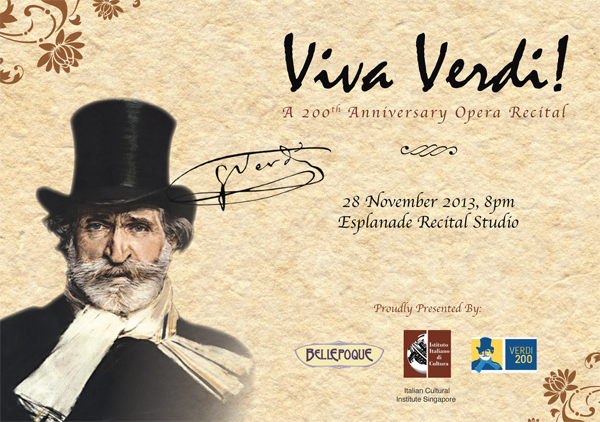
Postcard 7 (Final)Viva Verdi!

A 200th Anniversary Opera Recital –

28 november 2013, 8pm – Esplanade Recital Studio – Singapore

About Verdi
Born in a small village in the Parma region of Northern Italy, Giuseppe grew to become the leading composer of Italian opera of the 19th century. Two hundred years have passed since Verdi’s birth in 1813, yet his thirty operas are still relevant to the current world: ideals conflict with power, choices between love and duty. During the recital, a selection of Verdi’s most powerful songs from La Traviata, Un Ballo in Maschera, Aida and Falstaff will be presented. Join us for an unforgettable evening.

Music Director: Dr Robert Casteels (Belgium/Singapore); Stage Director: Alessandra Fel (Italy); Cast: Brendan Keefe Au (Tenor, Singapore), Angela Cortez (Soprano, Philippines), Edwin Orlando Cruz (Tenor, Philippines), Shaun Lee (Tenor, Singapore), William Lim (Baritone, Singapore), Satsuki Nagatome (Soprano, Japan), Sabrina Zuber (Soprano, Italy)

Organized by Italian Cultural Institute Singapore

Where and When:
Thursday, November 28, 2013
Singapore – Esplanade Recital Studio
8 pm
Posted in Music | Tagged , | 1 Comment

“L’elisir d’amore” in Florence, Italy

728x90_autunno

L’elisir d’amore

Gaetano Donizetti

Conductor Giuseppe La Malfa
Director Rosetta Cucchi
Scenes Tiziano Santi
Costumes Claudia Pernigotti
LightingDaniele Naldi
Video projections Roberto Recchia

Adina Rocio Ignacio
 Auxiliadora Toledano (16, 19, 21)
Nemorino Giorgio Berrugi
 Alessandro Scotto di Luzio (16, 19, 21)
Belcore Mario Cassi
 Julian Kim (16, 19, 21)
Il Dottor Dulcamara Marco Camastra
 Giulio Mastrototaro (16, 19, 21)
Giannetta Elena Borin

Orchestra e Coro del Maggio Musicale Fiorentino
Chorus Master Lorenzo Fratini

New production by the Teatro Comunale di Bologna and the Wexford Festival

Teatro Comunale
Friday November 15, 8:30 p.m.
Saturday November 16, 8:30 p.m.
Sunday November 17, 3:30 p.m.
Tuesday November 19, 8:30 p.m.
Wednesday November 20, 8:30 p.m.
Thursday November 21, 8:30 p.m

Listener’s guide
Friday November 15, 7:45 p.m.
Saturday November 16, 7:45 p.m.
Sunday November 17, 2:45 p.m.
Tuesday November 19, 7:45 p.m.
Wednesday November 20, 7:45 p.m.
Thursday November 21, 7:45 p.m

Synopsis

Act 1

Entrance to Adina’s farm.

Nemorino, a poor peasant, is in love with Adina, a beautiful landowner, who torments him with her indifference. When Nemorino hears Adina reading to her workers the story of Tristan and Isolde he is convinced that a magic potion will help him to gain Adina’s love. The self-important Sergeant Belcore appears with his regiment and immediately sets about courting Adina in front of everyone. Nemorino becomes anxious and, alone with Adina, declares his love for her. Yet Adina rebuffs him, saying she wants a different lover every day. Nemorino declares that his feelings will never change.
The village square.
The traveling quack doctor, Dulcamara (the self-proclaimed Dr. Encyclopedia), arrives, selling his bottled cure-all to the townspeople. Nemorino innocently asks Dulcamara if he has any of Isolde’s love potion. Despite failing to recognise the name ‘Isolde’, Dulcamara’s commercial talents nevertheless enable him to sell a bottle of the cure-all – in reality only cheap Bordeaux wine – to Nemorino. To make his escape, Dulcamara tells Nemorino the potion will not take effect for 24 hours, by which time, the doctor will be long gone. Nemorino drinks some, believing that he can feel its effects immediately. Emboldened by the elixir, Nemorino feigns indifference when he meets Adina. She becomes increasingly annoyed; perhaps she has feelings for Nemorino after all? Belcore returns and proposes marriage to Adina. Still riled by Nemorino, Adina promises to marry Belcore in six days time. Nemorino’s confidence is sustained in the belief that the elixir will facilitate his conquest of Adina the following day. However, when Belcore learns that his regiment must leave the next morning, Adina promises to marry him before his departure. This of course puts Nemorino in a panic, and cries out for Dr. Dulcamara to come to his aid. Adina, meanwhile, invites everyone to the wedding.
Act 2
Inside Adina’s farm.
Adina and Belcore’s wedding party is in full swing. Dr. Dulcamara encourages Adina to sing a duet with him to entertain the guests. The notary arrives to make the marriage official. Adina is annoyed to see that Nemorino has not appeared. While everyone goes to witness the signing of the wedding contract, Dulcamara stays behind, helping himself to food and drink. Having seen the notary, Nemorino appears, depressed, as he believes that he has lost Adina. He sees Dulcamara and frantically begs him for a more powerful, faster-acting elixir. Although Dulcamara is proud to boast of his philanthropy, upon discovering that Nemorino has no money he changes his tune and marches off, refusing to supply him anything. Belcore emerges, musing about why Adina has suddenly put off the wedding and signing the contract. He spots Nemorino and asks his rival why he is depressed. When Nemorino says he needs cash, Belcore suggests joining the army, as he’ll receive funds on the spot. Belcore tries to excite Nemorino with tales of military life, while Nemorino dreams of winning fame and thus Adina. Belcore produces a contract, which Nemorino signs in return for the money. Nemorino vows to rush and buy more potion, while Belcore muses about how sending Nemorino off to war has so easily dispatched his rival.
Rustic courtyard.
After the two men have left, Giannetta gossips with the women of the village. Swearing them all to secrecy, she reveals that Nemorino’s uncle has just died and left his nephew a large fortune. However, neither Nemorino nor Adina is yet aware of this. Nemorino enters, having spent his military signing bonus on a large amount of the fake elixir from Dr. Dulcamara. Hoping to share his fortune, the women approach Nemorino with friendly greetings. So out of character is this that Nemorino takes it as proof of the elixir’s efficacy. Adina sees Nemorino with the women, is rattled by his newfound popularity and asks Dr. Dulcamara for an explanation. Unaware that Adina is the object of Nemorino’s affection, Dulcamara explains that Nemorino spent his last penny on the elixir and joined the army for money to get more, so desperate was he to win the love of some unnamed cruel beauty. Adina immediately recognises Nemorino’s sincerity, regrets her behaviour and realises that she has loved Nemorino all along. Although Dulcamara seizes the opportunity to try and sell her some of his potion to win back Nemorino, Adina declares that she has full confidence in her own powers of attraction. Nemorino appears alone, pensive, reflecting on a tear he saw in Adina’s eye when he was ignoring her earlier. Solely based on that, he convinces himself that Adina loves him. She enters and asks why he has chosen to join the army and leave the town. When Nemorino explains that he was seeking a better life, Adina responds that he is loved and that she has bought back his military contract from Sergeant Belcore. She offers the cancelled contract to Nemorino and reassures him that, if he stays, he will be happy. As he takes the contract, Adina, ever the tease, turns to leave. Nemorino believes she is abandoning him and flies into a desperate fit, vowing that if he is not loved he might as well go off and die a soldier. Deeply moved by his fidelity, Adina finally declares that she will love Nemorino forever. Nemorino is ecstatic. Adina begs him to forgive her, which he does with a kiss. Belcore returns to see Nemorino and Adina in an embrace. When Adina explains that she loves Nemorino, the Sergeant takes the news in his stride, noting that there are plenty of other women in the world. Adina and Nemorino learn about the inheritance from his uncle. Dulcamara returns and boasts of the success of his elixir: Nemorino is now not only loved but also rich. He exults in the boost this will bring to the sales of his product. As he prepares to leave, everyone queues up to buy the elixir and hails Dulcamara as a great doctor.

Posted in Music, OPera | Tagged , , , , , | Leave a comment

Falstaff in Bari, Italy

logopetruzzelli

20 – 28 November 2013

Falstaff

Giuseppe Verdi

falstaff sch

Conductor Daniele Rustioni
Director Luca Ronconi
maestro del Coro Franco Sebastiani
Sir John Falstaff Roberto De Candia (20, 24, 28 novembre)

Carlo Lepore (22, 26 novembre)

Ford Artur Ruciński
Fenton Leonardo Cortellazzi
Dott. Cajus Raúl Giménez
Bardolfo Massimiliano Chiarolla
Pistola Domenico Colaianni
Mrs Alice Ford Serena Farnocchia
Nannetta Rosa Feola
Mrs Quickly Barbara Di Castri
Mrs Meg Page Monica Bacelli
Fondazione Petruzzelli Orchestra and Choir
Production by the Fondazione Petruzzelli
ia coproduction with Fondazione Teatro di San Carlo di Napoli
Posted in Music, OPera | Tagged , , , , | Leave a comment

“Turandot” at the Ukranian National Opera

Thursday, November 14, 2013

logoukraineopera

The Ukranian National Opera Presents:

Giacomo Puccini

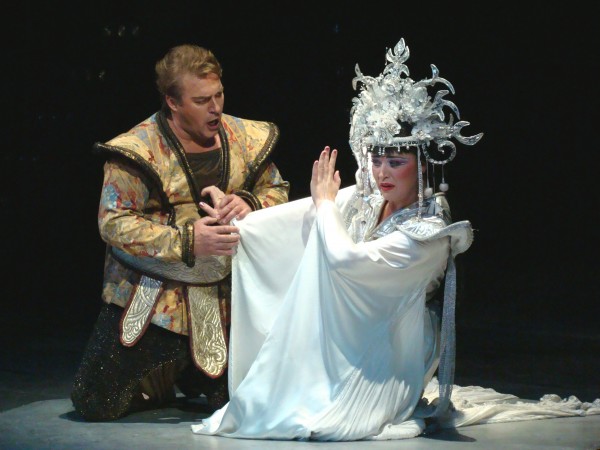
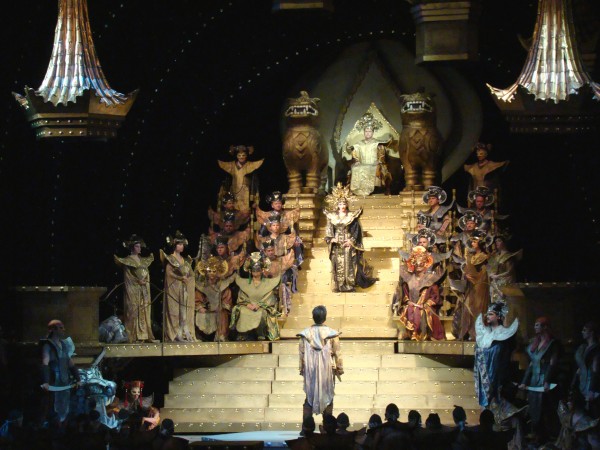
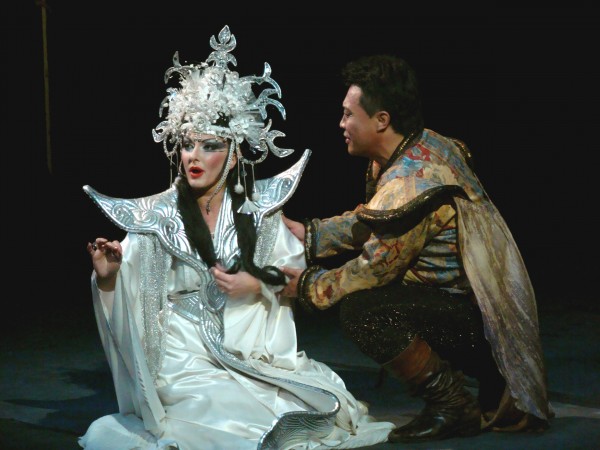
TURANDOT

turandotUkraine3

turandotUkraine1   turandotUkraine2
turandotUkraine4   turandotUkraine5
turandotUkraine6   turandotUkraine7
turandotUkraine8   turandotUkraine9
Posted in Music, OPera | Tagged , , , | Leave a comment

BORIS GODUNOV at the Ukranian National Opera

logoukraineoperaThe Ukranian National Opera Presents:

Modest Mussorgsky

BORIS GODUNOV

Opera in 3 acts

November 30, 2013

godunov


godunov3 godunov6 godunov9 godunov12 godunov15 godunov18 godunov21 godunov1 godunov4 godunov7 godunov10 godunov13 godunov16 godunov19 godunov22 godunov2 godunov5 godunov8 godunov11 godunov14 godunov17 godunov20


Posted in Music, OPera | Tagged , , , | Leave a comment

“I Capuleti e i Montecchi” at the Arena di Verona

Fondazione ARENA DI VERONAI Capuleti e i Montecchi

November 3, 2013 – at 15:30 –  Teatro Filarmonico   –  Series A
November, 5, 7, 9, 10, 2013
 

Tragedia lirica in 2 acts by Vincenzo Bellini

Libretto by Felice Romani


Conductor Fabrizio Maria Carminati
Director Arnaud Bernard
Set Alessandro Camera
Costumes Carla Ricotti
Interpreters
Capellio Paolo Battaglia
Giulietta Mihaela Marcu
Romeo Daniela Pini
Tebaldo Shalva Mukeria
Lorenzo Dario Russo
Posted in Music, OPera | Tagged , , | Leave a comment

VERDI’S 200th ANNIVERSARY: “FALSTAFF” AT THE MET.

metlogo

Friday, december 6, 2013, 8:00 pm

falstaffmet

Approximate running time 2 hrs. 50 min.

An undisputed master of Falstaff, Music Director James Levine conducts Verdi’s opera for the first time at the Met since 2005. Robert Carsen’s production—the first new Met Falstaff since 1964—is set in the English countryside in the mid-20th century. Ambrogio Maestri (last season’s Dulcamara in the Opening Night production of L’Elisir d’Amore) sings the title role of the brilliant and blustery Sir John Falstaff, opposite a marvelous ensemble that includes Angela Meade, Stephanie Blythe, Lisette Oropesa, and Franco Vassallo.

SYNOPSIS

Act I
The Garter Inn. Dr. Caius bursts into Sir John Falstaff’s room in the Garter Inn, accusing him of unseemly behavior the previous night. He further accuses Falstaff’s two henchmen, Bardolph and Pistol, of having robbed him while he was drunk. Unable to obtain reparations, Dr. Caius leaves in a fury. Falstaff contemplates the large bill he has run up at the inn. He informs Bardolph and Pistol that in order to repair his finances he plans to seduce Alice Ford and Meg Page, both wives of prosperous Windsor citizens. When Bardolph and Pistol refuse to deliver the letters Falstaff has written to the two ladies, Falstaff instructs a page to do so instead. He then ridicules Bardolph and Pistol’s newly discovered sense of honor, before throwing them out of his room.

The Garter Inn. Alice Ford and Meg Page laugh over the identical love letters they have received from Sir John Falstaff. They share their amusement with Alice’s daughter Nannetta, and with their friend Mistress Quickly. Ford arrives, followed by four men all proffering advice: Dr. Caius, whom Ford favors as Nannetta’s future husband; Bardolph and Pistol, who are now seeking advantageous employment from Ford; and Fenton, who is in love with Ford’s daughter Nannetta. When Ford learns of Falstaff’s plan to seduce his wife, he immediately becomes jealous. While Alice and Meg plan how to take revenge on their importunate suitor, Ford decides to disguise himself in order to pay a visit to Falstaff. Unnoticed in the midst of all the commotion, Nannetta and Fenton manage to steal a few precious moments together.

Act II
The Garter Inn. Feigning penitence, Bardolph and Pistol rejoin Falstaff’s service. They show in Mistress Quickly, who informs Falstaff that both Alice and Meg are madly in love with him. She explains that it will be easier to seduce Alice, since her husband is out of the house every afternoon, between two and three. Falstaff joyously anticipates his seduction of Alice. Bardolph now announces that a “Mister Brook” (Ford in disguise) wishes to speak to Falstaff. To Falstaff’s surprise, “Brook” offers him wine and money if he will seduce Alice Ford, explaining that he has long been in love with the lady, but to no avail. If she were to be seduced by the more experienced Falstaff, she might then be more likely to fall a second time and accept “Brook.” Falstaff agrees to the plan, telling his surprised new friend that he already has a rendezvous with Alice that very afternoon. As Falstaff leaves to prepare himself, Ford gives way to jealous rage. When Falstaff returns, dressed in his best clothes, the two men exchange compliments before leaving together.

Ford’s house. Mistress Quickly, Alice and Meg are preparing for Falstaff’s visit. Nannetta tearfully tells her mother that her father insists on her marrying Dr. Caius, but Alice tells her daughter not to worry. Falstaff arrives and begins his seduction of Alice, nostalgically boasting of his aristocratic youth as page to the Duke of Norfolk. As Falstaff becomes more amorous, Meg Page interrupts the tête-à-tête, as planned, to announce (in jest) that Ford is approaching. But just at that point Mistress Quickly suddenly returns in a panic to inform Alice that Ford really is on his way, and in a jealous temper. As Ford rushes in with a group of townsfolk, the terrified Falstaff seeks a hiding place, eventually ending up in a large laundry basket. Fenton and Nannetta also hide. Ford and the other men ransack the house. Hearing the sound of kissing, Ford is convinced that he has found his wife and her lover Falstaff together, but is furious to discover Nannetta and Fenton instead. While Ford argues with Fenton, Alice instructs her servants to empty the laundry basket out of the window. To general hilarity, Falstaff is thrown into the River Thames.

Act III
Outside the Garter Inn. A wet and bruised Falstaff laments the wickedness of the world, but soon cheers up with a glass of mulled wine. Mistress Quickly persuades him that Alice was innocent of the unfortunate incident at Ford’s house. To prove that Alice still loves him, she proposes a new rendezvous that night in Windsor Great Park. In a letter that Quickly gives to Falstaff, Alice asks the knight to appear at midnight, disguised as the Black Huntsman. Ford, Nannetta, Meg, and Alice prepare the second part of their plot: Nannetta will be Queen of the Fairies and the others, also in disguise, will help to continue Falstaff’s punishment. Ford secretly promises Caius that he will marry Nannetta that evening. Mistress Quickly overhears them.

Windsor Great Park. As Fenton and Nannetta are reunited, Alice explains her plan to trick Ford into marrying them. They all hide as Falstaff approaches. On the stroke of midnight, Alice appears. She declares her love for Falstaff, but suddenly runs away, saying that she hears spirits approaching. Nannetta, disguised as the Queen of the Fairies, summons her followers who attack the terrified Falstaff, pinching and poking him until he promises to give up his dissolute ways. In the midst of the assault Falstaff suddenly recognizes Bardolph, and realizes that he has been tricked. While Ford explains that he was “Brook,” Quickly scolds Falstaff for his attempts at seducing two younger, virtuous women. Falstaff accepts that he has been made a figure of fun, but points out that he remains the real source of wit in others. Dr. Caius now comes forward with a figure in white. They are to be married by Ford. Alice brings forward another couple, who also receive Ford’s blessing. When the brides remove their veils it is revealed that Ford has just married Fenton to Nannetta, and Dr. Caius to Bardolph. With everyone now laughing at his expense, Ford has no choice but to forgive the lovers and bless their marriage. Before sitting down to a wedding supper with Sir John Falstaff, the entire company agrees that the whole world may be nothing but a jest filled with jesters, but he who laughs last, laughs best. —Robert Carsen

Reprinted courtesy of the Royal Opera House, Covent Garden

Falstaff is a co-production of the Metropolitan Opera; Royal Opera House, Covent Garden;
Teatro alla Scala, Milan; the Canadian Opera Company, Toronto; and De Nederlandse Opera, Amsterdam.

Posted in Music, OPera | Tagged , , , , | Leave a comment

MEYERBEER’S “L’AFRICAINE” in Venice

logofeniceMEYERBEER

“L’AFRICAINE”

Saturday, November 23rd, 2013 – 6pm
dress code: black tie

LAST show:2013-12-01


conductor: Emmanuel Villaume

director: Leo Muscato

sets: Massimo Checchetto

costumes: Carlos Tieppo

cast

Inès
Jessica Pratt (23,26,29/11 – 1/12)
Zuzana Markova (27, 30/11)

Sélika
Veronica Simeoni (23,26,29/11 – 1/12)
Patrizia Biccirè (27, 30/11)

Vasco de Gama
Gregory Kunde (23,26,29/11 – 1/12)
Antonello Palombi (27, 30/11)

Don Alvar
Emanuele Giannino

Nélusko
Angelo Veccia (23,26,29/11 – 1/12)
Luca Grassi (27, 30/11)

Don Pédro
Luca dall’Amico

Don Diego
Davide Ruberti

Le grand inquisiteur de Lisbonne
Mattia Denti

Le grand-prêtre de Brahma
Ruben Amoretti

Anna
Anna Bordignon

conductor
Emmanuel Villaume

director
Leo Muscato

sets
Massimo Checchetto

costumes
Carlos Tieppo

light designer
Alessandro Verazzi

La Fenice Opera House Chorus and Orchestra
Chorus master Claudio Marino Moretti

italian and english surtitles

La Fenice Opera House new production
on the 150th anniversary of Meyerbeer’s death

meyerbeerVenezia

L’Africaine by Giacomo Meyerbeer

The 2013-2014 Opera Season will open at Teatro La Fenice on Saturday 23 November 2012 with a new production of L’Africaine [The African Woman], a five-act opera by Giacomo Meyerbeer to a libretto by Eugène Scribe; this was the composer’s last posthumous masterpiece, debuting at the Paris Opéra in 1865.

A key figure in nineteenth-century European opera, and born in Berlin in 1791, Giacomo Meyerbeer lived in Italy from 1815 to 1824 and in the following forty years went on to become one of the most important artifices of Parisian grand opera; several years ago it was to this composer that La Fenice dedicated the opening of the 2007 Opera Season with a modern-day première of the Crociato in Egitto, composed for the Venetian opera house in 1824 just before leaving Italy. 2014 marks the 150th anniversary of the composer’s death (Paris 1864): an opportunity not to be missed to continue with the rediscovery and common development of some of the greatest international opera houses.

The unfinished opera of a lifetime, Meyerbeer worked on L’Africaine from 1837 to 1864 and it had its debut posthumously on 28 April 1865 at the Paris Opéra. It seems to have combined the entire history of French opera in the nineteenth century, mixing the sumptuous monumentality of the grand opéra with the intimism of drama lyrique at the end of the century, with an exotic subject as its plot, focussing on the love between the slave-queen Sélika and the explorer Vasco de Gama.

Last performed at La Fenice in 1892 (but staged no less than four times with a total of 59 performances between 1868 and 1892), L’Africaine will be conducted by a specialist of French repertoire, Emmanuel Villaume (previously at La Fenice with Crociato in Egitto and Thaïs by Massenet), with a double cast that sees in the main roles the tenors Gregory Kunde (Premio Abbiati 2012 for Verdi’s Otello at La Fenice) and Antonello Palombi, Vasco de Gama; the sopranos Jessica Pratt and Zuzana Marková, Inès; the mezzo-sopranos Veronica Simeoni (who was met with great success as Carmen and Azucena at La Fenice) and Patrizia Biccirè, Sélika; and the baritones Angelo Veccia and Luca Grassi, Nélusko; the bass Luca Dall’Amico will be Don Diégo, Inès’ father, tenor Emanuele Giannino Don Alvar, the bass Mattia Denti the grand inquisitioner of Lisbon and Anna Bordignon Anna’s confidante.

The new production of this challenging project is entrusted to the hands of the forty-year old director from Puglia, Leo Muscato, with sets by Massimo Checchetto and costumes by Carlos Tieppo and lights by Alessandro Verazzi.

The preview on Saturday 23 November 2013 will be broadcast live by Rai Radio3 and there will be a recorded broadcast by the Euroradio circuit; it will be followed by another five performances on Tuesday 26 (subscription cycle A), Wednesday 27 (subscription cycle E) and on Friday 29 (subscription cycle D) at 18.00, Saturday 30 (subscription cycle C) and Sunday 1 December (subscription cycle B) at 15.30.

The opera will be performed in French with overtitles in Italian and English.

meyerbeerlocandina

Posted in Music, OPera | Tagged , , , , , | Leave a comment