“Prometeo, Tragedia dell’Ascolto” in Argentina


prometeo_main

Prometeo, Tragedia dell’Ascolto

– Prometeo, Tragedia dell’Ascolto, by Luigi Nono (1985, 150 minutes-long, for 11 soloists, chorus, ensemble, and real-time processing)

Teatro Colón Main Hall

London Sinfonietta (United Kingdom)
Orquesta Juvenil del Bicentenario
Coro Diapasón Sur

Music Director

Baldur Brönnimann (Switzerland)

Associate Music Director

Detlef Heusinger (Germany)

Chorus Coach

Mariano Moruja

Artistic Production Director

André Richard (Switzerland)

Sound Direction

Michael Acker, Reinhold Braig, Joachim Haas

Live Electronic Performance

Experimentalstudio des SWR (Germany)

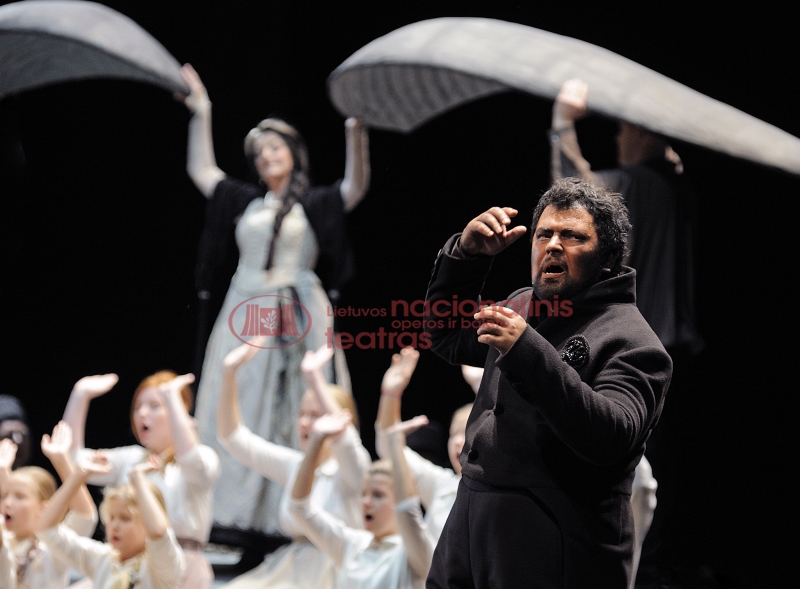
Prometeo (1985) is the last piece written by the Italian composer Luigi Nono. This monumental, 150-minute piece in nine cantatas tells the different versions of the Greek myth of Prometheus. Five vocal soloists, six instrumental soloists, a twelve-voice chorus, two percussionists, and four instrumental groups of 13 musicians each, two reciters, two directors, and electronic sounds surround the audience. Instruments and voices are electronically processed in real time to be played and relocated in different points of the hall. The piece will be directed by Baldur Brönnimann, the Freiburg Laboratory will be in charge of the electronic work, and the acclaimed London Sinfonietta will be performing together with an Argentine instrumental and vocal ensemble

The piece will be directed by Baldur Brönnimann and its artistic production will be under the direction of André Richard. Experimentalstudio des SWR will be in charge of the electronic work and the acclaimed London Sinfonietta will be performing with a large local instrumental and vocal ensemble, consisting of the Orquesta Juvenil del Bicentenario and Coro Diapasón Sur, under the direction of Mariano Moruja.

Listening to a live performance of this magnificent piece by Luigi Nono is a whole new experience that transcends the purely musical domain. This is an absolute premiere, not only in Argentina but also in Latin America, which makes it an unprecedented cultural event.

A music and architecture discussion will take place in Buenos Aires on the occasion of Luigi Nono’s important premiere. Well-known figures and some of Luigi Nono’s closest assistants will be guest attendees at the discussion, which will be supported by Fundación PROA.

Co-produced by Experimentalstudio des SWR and the London Sinfonietta. Supported by the British Council and Fundación PROA.

Performance schedule

11.16.2013 | 8:30 pm
11.17.2013 | 5:00 pm

 
Posted in Music, OPera | Tagged , , , , , , | Leave a comment

“The Bartered Bride”, the most famous Czech opera, performed in Brno

logobrno

The Bartered Bride

The most famous Czech opera about a beau who sold his sweetheart

Bedřich Smetana (1824-1884)

Janacek Theatre – Rooseveltova 1-7 |

2013: Wednesday November 6, Thursday December 19

2014: Tuesday February 11, Tuesday April 1, Tuesday June 17, Wednesday June 18

bartered1

Libretto: Karel Sabina

Conductor: Petr Vronský, Jaroslav Kyzlink
Director: Ondřej Havelka

Cast

Krušina,a peasant Pavel Kamas, Jiří Klecker
Ludmila, Krušina´s wife Natalia Romanová, Daniela Straková-Šedrlová, Jitka Zerhauová
Mařenka, Krušina´s daughter Eva Dřízgová-Jirušová, Daniela Straková-Šedrlová, Pavla Vykopalová
Mícha, a landowner Jan Hladík, Aleš Šťáva
Háta, Micha´s wife Adriana Hlavsová, Jana Iskrová
Vašek, Mícha´s son Zoltán Korda, Milan Rudolecký
Jeník, Mícha´s son from a former marriage Peter Berger, Aleš Briscein, Otokar Klein
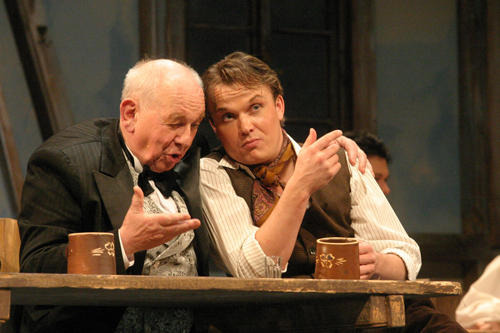
Kecal, a marriage broker Martin Gurbal’, Richard Novák, Zdeněk Plech, Jiří Sulženko
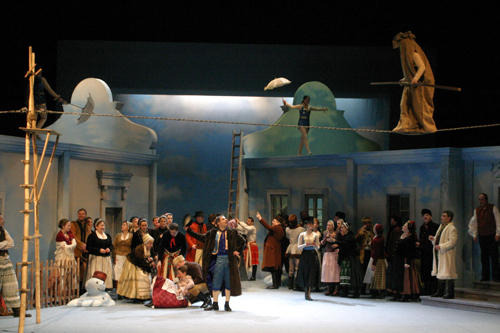
Ringmaster Zdeněk Šmukař, Martin Zbrožek
Esmeralda, a dancer and comedienne Kateřina Kněžíková, Tereza Merklová, Andrea Priechodská
Indian, an Indian comedian Jiří Klecker, Jakub Tolaš
Tightrope Walker Ladislav Kaiser

Janáček Opera Ensemble and Orchestra of the National Theatre Brno

 Premiere 24th March 2006, Janáček Theatre

The most famous Czech opera about a beau who sold his sweetheart

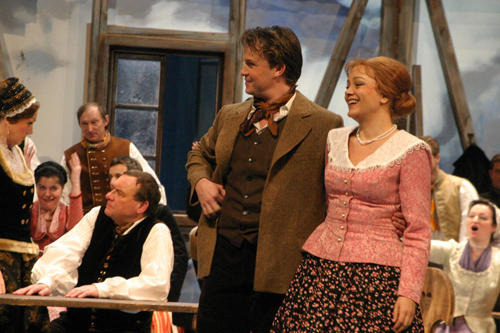
After the successful premiere of Smetana’s first opera, a drama called The Brandenburgers in Bohemia, he decided to compose a contrasting comic work that was truly rooted in Czech tradition. Together with the writer Karel Sabina, they chose a rural theme with realistic characters and the opera premiered in Prague in 1866. The story takes place in a small Bohemian village where two young lovers live, Mařenka and Jeník. However Mařenka’s parents, along with the marriage broker, want her to marry the son of the rich landowner, Mícha, to whom her father owes a debt. With both Mařenka and Jeník disguising their identities, whilst comically deceiving several characters, true love prevails and the happy couple are united.   

As a musical picture of Czech life, The Bartered Bride has become arguably the most popular Czech opera of all time and is a mainstay in opera houses around the world. Smetana’s operas established him as a founding father of Czech, classical music. In The Bartered Bride he uses traditional Bohemian dance forms such as the polka and furiant making the work quintessentially Czech in spirit. Smetana’s light-hearted masterpiece provokes not only national pride when played in its homeland, but also strikes the same inspirational chords when played abroad. The Bartered Bride promises a delightful evening full of fun and entertainment for the whole family. 

The beer for the production is provided by the brewery Starobrno.

bartered6 bartered2 bartered3 bartered4 bartered5

Posted in Music, OPera | Tagged , , , , , , , | 1 Comment

Rossini’s Cinderella in Greece

logogreekopera Presents: Gioachino Rossini’s

cinderellagreeceCinderella

Conductors: George Petrou (25, 26, 30/10, 1, 3, 10, 13/11)
                    Konstantinos Diminakis
(2/11)
Director: Rodula Gaitanou

PREMIERE 25 OCTOBER 2013
25, 26, 30 October 2013
1, 2, 3, 10, 13 November 2013

Olympia Theatre
Performances begin at 20.00


Set design – Lighting: Simon Corder
Costumes: Alexia Theodoraki
Chorus master: Agathangelos Georgakatos

Don Ramiro: Antonis (Αnthony) Koroneos (25, 30/10, 2, 10, 13/11) 
  Vassilis Kavayas (26/10, 1, 3/11)
Dandini: David Menendez (25, 30/10, 2/11)
  Haris Andrianos (26/10, 1, 3, 10, 13/11)
Don Magnifico: Carlos Esquivez (25, 30/10, 2/11)
  Dimitris Kassioumis (26/10, 1, 3, 10, 13/11)
Clorinda: Myrsini Margariti (25/10, 2/11)
  Elpiniki Zervou (26/10, 1, 3/11)
  Georgia Eliopoulos (30/10, 10, 13/11)
Tisbe: Eleni Davou (25/10, 2/11)
  Angelica Cathariou (26/10, 1, 3/11)
  Eleni Voudouraki (30/10, 10, 13/11)
Cinderella (Angelina):    Mary-Ellen Nesi (25, 30/10, 10/11)
  Irini Karaianni(26/10, 1, 3/11)
  Artemis Bogri (2, 13/11)
Alidoro: Petros Magoulas (25, 30/10, 2, 10/11)
  Tassos Apostolou (26/10, 1, 3, 13/11)

One of Rossini’s most delightful comic operas, Cinderella is, of course, based on the famous tale by Charles Perrault, but this time with a few major differences that relate to the period in which the piece was written. For example, it was inconceivable at the time for the leading lady to display her legs on stage, so there is no little glass slipper in the opera. Instead, the prince found his beloved thanks to a bracelet.
The new production, which kicks off the season for the GNO this year, also presents a few variations of its own. The action is set in the 20th century in a place and time that correspond with the narrative but include references that are more familiar to a contemporary audience.
The production’s young director, Rodoula Gaitanou, will be making her debut at the Greek National Opera, though her resumé includes important collaborations with the Royal Opera House in London and other significant British opera companies.
The main roles are performed by: Mary-Ellen Nesi, Irene Karayianni, Artemis Bogri, Antonis Koroneos, Vassilis Kavagias, David Menendez, Haris Andrianos, Carlos Esquivel and Dimitris Kasioumis

Posted in Music, OPera | Tagged , , , | Leave a comment

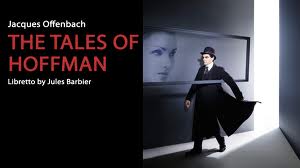
“The tales of Hoffmann” at the Oslo Opera House

logonorway

December 4, 2013 to December 31, 2013

The tales of Hoffmann

Jacques Offenbach


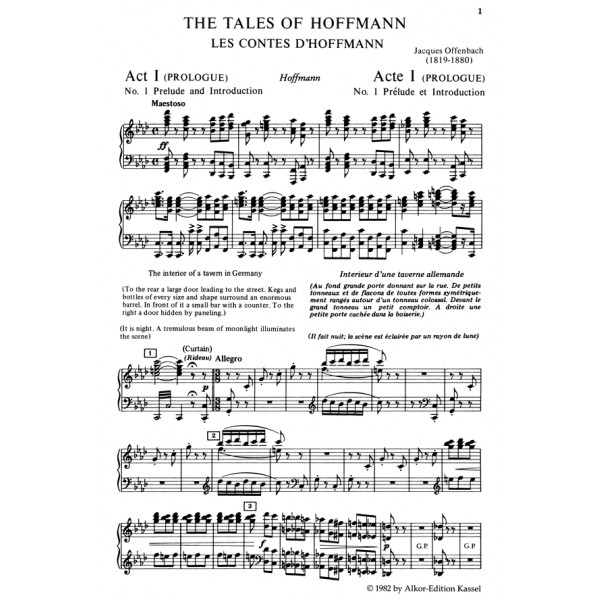
talesofhoffmanThe author and poet Hoffmann sits in a pub, quite inebriated, and telling stories from his life. So starts Jacques Offenbach’s only opera, The Tales of Hoffmann. Best known for his sharply satirical French operettas, Offenbach here takes as his point of departure three novels by the author E.T.A. Hoffmann, famous for his romantic, dark and bizarre stories. Offenbach intertwines these tales with Hoffmann’s own life to give a fascinating – and at times disturbing – fable about love, both of women and of art. I three dream sequences – or hallucinations – we meet Hoffmann’s three great loves: the doll Olympia, the singer Antonia and the courtesan Giulietta.

talesofHoffman2Offenbach died before the opera was finished, since when it has been presented in several different versions based on the outlines left by the composer. The Norwegian National Opera’s production is directed by Spain’s Calixto Bieito, known for his original and often controversial interpretations of both plays and operas. He has previously attracted attention with his productions of Ibsen’s Brand and Peer Gynt at the Bergen International Festival, which were both also performed at theNational Theatre in Oslo.

  • Music: Jacques Offenbach
  • Libretto: Jules Barbier
  • Conductor: Stefan Blunier
  • Direction: Calixto Bieito
  • Set Design: Rebecca Ringst
  • Costumes: Ingo Krügler
  • <:time datetime=”PT3H30M” itemprop=”duration”>3 hours and 30 minutes / 1 break
  • 7 productions / From December 4. to December 31.
  • Premier December 4. 2013 / Main House


Mainroles

  • Hoffmann

    Nils Harald Sødal
    Playing the following days
    • 12/4/2013
    • 12/9/2013
    • 12/12/2013
    • 12/17/2013
    • 12/27/2013
    • 12/29/2013
    • 12/31/2013
  • Lindorf/Dapertutto/Coppelius/Dr. Miracle

    Alex Esposito
    Playing the following days
    • 12/4/2013
    • 12/9/2013
    • 12/12/2013
    • 12/17/2013
    • 12/27/2013
    • 12/29/2013
    Simon Neal
    Playing the following days
    • 12/31/2013
  • Olympia

    Mari Eriksmoen
    Playing the following days
    • 12/4/2013
    • 12/9/2013
    • 12/12/2013
    • 12/17/2013
    • 12/27/2013
    • 12/29/2013
    • 12/31/2013
  • Antonia

    Marita Sølberg
    Playing the following days
    • 12/4/2013
    • 12/9/2013
    • 12/12/2013
    • 12/17/2013
    • 12/27/2013
    • 12/29/2013
    • 12/31/2013
  • Giulietta

    Randi Stene
    Playing the following days
    • 12/4/2013
    • 12/9/2013
    • 12/12/2013
    • 12/17/2013
    • 12/27/2013
    • 12/29/2013
    • 12/31/2013
  • Niklausse

    Ingeborg Gillebo
    Playing the following days
    • 12/4/2013
    • 12/9/2013
    • 12/12/2013
    • 12/17/2013
    • 12/27/2013
    • 12/29/2013
    • 12/31/2013

Other roles

December 4, 2013 Wed    Time   7:00 PM
December 9, 2013 Mon Time 7:00 PM
December 12, 2013 Thu Time 7:00 PM
December 17, 2013 Tue Time 7:00 PM
December 27, 2013 Fri Time 6:00 PM
December 29, 2013 Sun Time 6:00 PM
December 31, 2013 Tue Time 4:00 PM
Posted in Music, OPera | Tagged , , , , , , | Leave a comment

“Turandot” at the Czech State Opera

 Národní divadlo [The Czech State Opera] Presents

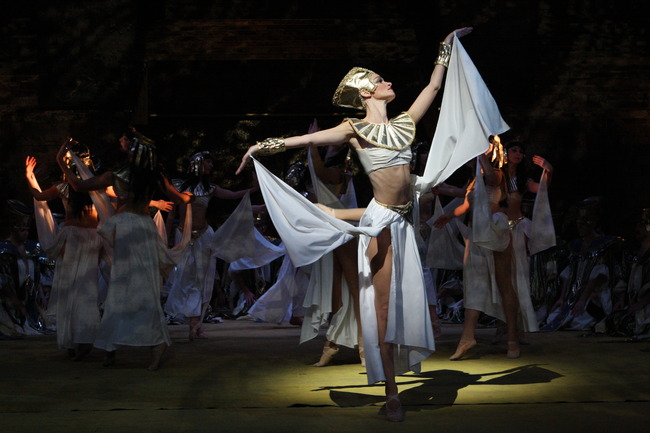
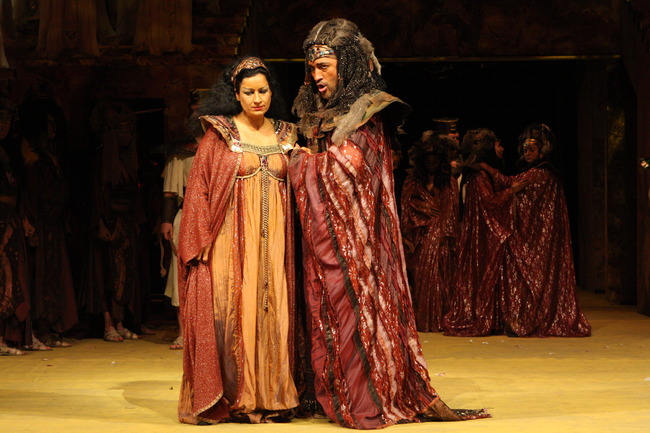
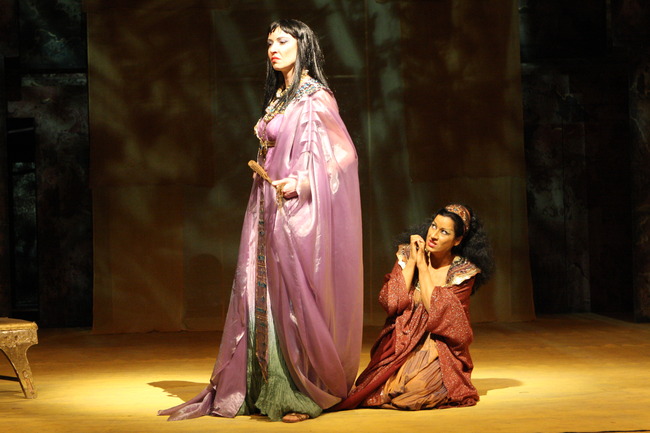
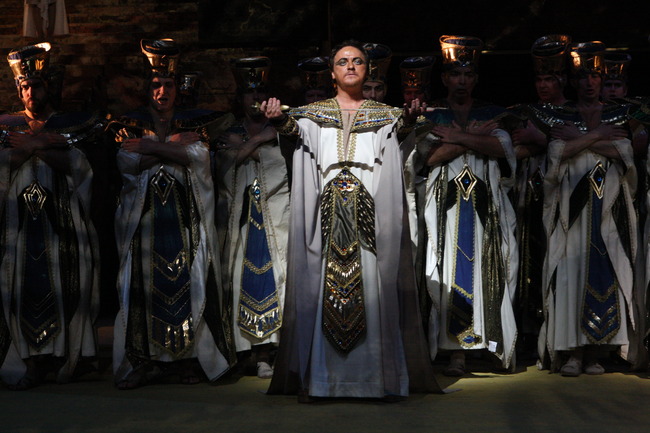
TurandotczechTurandot

Giacomo Puccini

November 24, 2013

December 14, 2013

February 22, 2014


stage director Václav Věžník

Libretto: Giuseppe Adami, Renato Simoni
Conductor: Enrico Dovico, Richard Hein, Jaroslav Kyzlink, Rastislav Štúr
Stage director: Václav Věžník
Sets: Ladislav Vychodil
Costumes: Josef Jelínek
Chorus master: Tvrtko Karlovič, Adolf Melichar
Choreography: Otto Šanda

State Opera Orchestra

State Opera Chorus

Czech National Opera Ballet

Premiere: September 15, 1995

The Persian fairy-tale Turandot from the dervish Mokles’s 17th-century collection The One Thousand and One Nights has inspired numerous poets and composers. Giacomo Puccini worked on Giuseppe Adami and Renato Simoni’s libretto, based on Carlo Gozzi’s play, in the final years of his life, when he was fighting cancer of the larynx. Just as in the case of Madama Butterfly, he diligently strove to gain thorough knowledge of the culture and songs of an exotic, faraway land (in this case China). Puccini died before he managed to complete the opera: the task was undertaken by his friend and pupil Franco Alfano, who drew upon the 36 pages of sketches left by the composer.

The opera was premiered on 25 April 1926 at Milan’s La Scala, conducted by Arturo Toscanini, who paid tribute to the late Puccini when in Act 3, after the words “Liu, poesia!”, he laid down his baton, turned to the audience and announced: “Here the opera ends, because at this point the maestro died”. Alfano’s finale was only included in the next performance. The cruel and beautiful Princess Turandot tests her wooers with riddles and when they fail they are duly executed. Only Prince Calaf succeeds, and his love ultimately overwhelms Turandot’s coldness.

The opera is staged in Italian original version and Czech and English surtitles are used in the performance.
Duration of the performance: 2 hours and 45 minutes, 2 intermissions

Turandot

Kalaf

Timur

Posted in Music, OPera | Tagged , , , , , , , | Leave a comment

“Rusalka” at the Brno National Theather in the Czech Republic

logobrnoRusalka

A fairy tale of love and betrayal together with Dvořák’s enchanting score

Antonín Dvořák (1841-1904)

Janacek Theatre – Rooseveltova 1-7 |
Sunday  November 3, 2013, Saturday December 28, 2013, Sunday January 1, 2014,
Saturday January 25, 2014, Friday february 28, 2014, Wednesday March 12, 2014
 

Libretto: Jaroslav Kvapil
Author: Antonín Dvořák
Musical Preparation: Jaroslav Kyzlink
Conductor: Jaroslav Kyzlink, Ondrej Olos
Director: Vladimír Morávek
Set Design: Daniel Dvořák
Costume Design: Sylva Zimula Hanáková
Choreographer: Ladislava Košíková
Chorus Master: Pavel Koňárek
Dramaturgist: Patricie Částková
Assistant Conductor: Daniel Simandl
Assistant Stage Director: Barbora Hamalová, Renata Fraisová, Kristýna Kopřivová
Video Projection: Tomáš Hrůza

Cast 3.11.2013 17:00

Rusalka, a water nymph Anna Wierzbicka
The Prince Richard Samek
Vodník, the water goblin Gustáv Beláček
The Foreign Princess Iveta Jiříková
Ježibaba, an old witch Veronika Hajnová Fialová
Kitchen Boy Martina Králíková
Gamekeeper Jiří Klecker
First Wood Sprite Tereza Merklová Kyzlinková
Second Wood Sprite Jitka Klečanská
Third Wood Sprite Hana Kopřivová
Hunter Igor Loškár

Dirigent představení: Jaroslav Kyzlink

Janáček Opera Ensemble and Orchestra of the National Theatre Brno

 Premiere 24th February 2012, Janáček Theatre


A fairy tale of love and betrayal together with Dvořák’s enchanting score

Rusalka is by far the most successful opera composed by Antonín Dvořák. The Czech poet Jaroslav Kvapil drew on a range of sources for the libretto, including The Little Mermaid by Hans Christian Andersen and Undine by Friedrich de la Motte Fouqué. The lyrical fairy tale tells the story of Rusalka, a water nymph, who falls in love with a mortal and strikes a terrible bargain with the witch Ježibaba to gain mortality herself. A tale of great love and betrayal, Dvořák’s music with is beautiful melodies and motifs, successfully balances the human and natural world. Moments of exquisite lyricism, such as Rusalka’s famous ‘Song to the Moon’ in Act I, are blended with earthy, folk-derived dances.

Dvořák’s Rusalka was first performed at the National Theatre in Prague in 1901 and has remained in the theatre’s repertoire ever since. The premiere was a great triumph at home and although initially slow to build in popularity in the rest of Europe, Rusalka is now regularly performed worldwide. In 2011 Rusalka celebrated its 110th anniversary since its premiere, however it hasn’t lost its freshness, appeal, and relevance for today’s audience.

rusalka15 rusalka1 rusalka2 rusalka3 rusalka4 rusalka5 rusalka6 rusalka7 rusalka8 rusalka9 rusalka10 rusalka11 rusalka12 rusalka13 rusalka14

National Theatre Brno
state-funded organisation
Dvorakova 11
Brno 657 70

Posted in Music, OPera | Tagged , , , , , , , , , | 1 Comment

LE NOZZE DI FIGARO in Lithuania

logolithuania

Wolfgang Amadeus Mozart

LE NOZZE DI FIGARO

November 8 & 9, 2013

February 26 & 27, 2014
an opera in 2 parts, sung in Italian with Lithuanian and English surtitles

Music Director and Conductor Martynas Staškus
Director Emilio Sagi (Spain)
Set Designer Daniel Bianco (Spain)
Costume Designer Renata Schussheim (Argentina)
Lighting Designer Eduardo Bravo (Spain, AAI)
Choreographer Nuria Castejón (Spain)
Chorus Master Česlovas Radžiūnas

Production of the LNOBT in collaboration with Teatro Real de Madrid, Teatro Pérez Galdós de Las Palmas de Gran Canaria ir Asociación Bilbaína de Amigos de la Opera (A.B.A.O.)

Premiere: 5 February, 2010

It is difficult to evaluate Mozart’s works and their impact. The more we know about him, the more valuable treasures we discover in his music. An ever-growing number of articles and books dedicated to this creator reveals only one thing – we will never manage to fully discover the essence of his personality. Every generation discovers something new in his works and also gains experience through his music. This music is like a universe – it envelops and transcends everything.

“Le nozze di Figaro” premiered on the 4th  of July in 1786 at the Burgtheater in Vienna and was conducted by Mozart himself. The audience asked to repeat all of the major numbers in the opera, thus the whole performance lasted twice as long than it was originally planned. Later the repeats became so frequent that Joseph II released an order which prohibited encores during this particular opera. Meanwhile Mozart wrote to his father: “Everybody is talking only about Figaro; no one plays, sings or whistles anything else but Figaro. And nobody goes to see any other opera – only Figaro!”

“Le nozze di Figaro” was a revolution of the operatic genre, and not only because of the complex plot. For the first time in history, music was speaking about real people, revealing their inner states and psychology. According to Wagner, “Le nozze di Figaro” is opera buffa that has been set free and turned into masterful musical comedy. No other opera – not even Mozart’s – can surpass the overwhelming harmony and naturalism of “Le nozze di Figaro”.

The quintessential axis of “Le nozze di Figaro” is the almighty Love that throughout the opera reveals itself in different shades: here we have the Count, who is driven by lust and sexual cravings, Cherubino, who is in love with love itself; the Countess is surrounded by gentle nostalgia and attempts to win back her husband’s love, Figaro is overtaken by jealousy and Susanna waits anxiously to discover all aspects of love… It is love that creates all turns in the plot and can be found even in the darkest corners of Almaviva’s castle.

At the LNOBT this French-Austrian-Spanish masterpiece was brought to life by the creative team from Spain: director Emilio Sagi, set designer Daniel Bianco, lighting designer Eduardo Bravo, choreographer Nuria Castejón, and a costume designer from Argentina Renata Schussheim. Music director and conductor of the production is Martynas Staškus, chorus master – Česlovas Radžiūnas. The main roles in “Le nozze di Figaro” are sung by Lithuania’s beloved soloists: Joana Gedmintaitė, Regina Šilinskaitė (Susanna); Sigutė Stonytė, Sandra Janušaitė (the Countess Rosina Almaviva); Vytautas Juozapaitis, Dainius Stumbras (the Count Almaviva); Egidijus Dauskurdis, Liudas Mikalauskas (Figaro); Vilija Mikštaitė, Marta Lukošiūtė (Cherubino) and others.

figarogr6_119 figarogr2_119 figarogr4_119 figarogr5_119

Lithuanian National Opera and Ballet Theatre, A. Vienuolio 1, 01104 Vilnius, Lithuania

Posted in Music, OPera | Tagged , , , , | Leave a comment

“Madama Butterfly” at the Oslo Opera House

logonorway

Madama Butterfly

Giacomo Puccini

From October 25, 2013 to November 9, 2013

“The performance was magisterial in every way” – wrote Norwegian daily Dagbladet when Madama Butterfly had its premiere in autumn 2012. Director Stephen Langridge sets Puccini’s opera in Japan in the years immediately following World War Two. American soldiers are occupying the country and there is desperate poverty and mass prostitution. Against this scenario, Butterfly and Pinkerton meet – she with a dream of the freedom that America represents, he with a longing for the exotic Far East, and both of them on a collision course with reality.

  • Music: Giacomo Puccini
  • Libretto: Luigi Illica / Giuseppe Giacosa
  • Conductor: Pier Giorgio Morandi
  • Direction: Stephen Langridge
  • Set design / costumes: Alison Chitty
  • Lighting Design : Chris Davey
  • <:time datetime=”PT3H0M” itemprop=”duration”>3 hours / 1 break
  • 5 productions / From October 25. to November 9.
  • Premier October 25. 2013 / Main House

Mainroles

  • Cio-Cio-San

    Playing the following days
    • 11/9/2013
    • 11/7/2013
    • 11/2/2013
    • 10/28/2013
    • 10/25/2013
  • Pinkerton

    Diego Torre
    Playing the following days
    • 10/25/2013
    • 10/28/2013
    Henrik Engelsviken
    Playing the following days
    • 11/2/2013
    • 11/7/2013
    • 11/9/2013
  • Suzuki

    Tone Kummervold
    Playing the following days
    • 11/9/2013
    • 11/7/2013
    • 11/2/2013
    • 10/28/2013
    • 10/25/2013
  • Sharpless

    Ole Jørgen Kristiansen
    Playing the following days
    • 11/9/2013
    • 11/7/2013
    • 11/2/2013
    • 10/28/2013
    • 10/25/2013

Other roles

First act

B F Pinkerton, a young American naval officer, hasrecently arrived in Japan. He has bought a house, a wife and servantsfrom a Japanese business man called Goro. The house purchasecontract is for 999 years, but can be abandoned at any moment. Themarriage contract is similarly loose.Goro runs through the order of the ceremony – which will beminimal – and lists who will be there: officials, family; a total of about two dozen.

The American Consul, Sharpless arrives. He is there both in his officialcapacity for the formalities, and as a friend of Pinkerton’s family. Sharpless councils Pinkerton to be careful not to hurt the Japanese girl. Stop fussing, says Pinkerton, and raises a glass to when he eventuallymarries an American girl in a real wedding. Goro rushes in and tells them the bride and her friends are coming. Pinkerton and Butterfly exchange stilted formalities. Butterfly is at pains to relate how she is from a family that used to be wealthy, but whom disaster reduced to poverty – the women in her family forced to work as Geishas. She says she is fifteen. Soon the rest of the family and the registar arrive.

Away from the celebrations Butterfly shows Pinkerton the few things she would like to keep with her in her new life: they include the sword with which her father committed suicide, and Otake, sacred representations of her ancestors.  Butterfly reveals that she has secretly been to the Christian mission, that she wishes todesert Shintoism and follow Pinkerton’s God – and to prove it shethrows away the Otake. The wedding ceremony itself is rapid, and once the papers are signed Sharpless and the Registar leave.

Pinkerton wants to get rid of the guests too, and as fast as possible, but his efforts are thwarted by the arrival of another Uncle, the Bonzo, a Shinto priest. He knows that Butterfly has been to the Christian mission and furiously accuses her of abomination. He and her whole family curse Butterfly and leave. Alone for the first time together, Pinkerton comforts Butterfly who isshaken by the violent turn of events at the wedding. Under a beautiful night sky they manage to laugh about the chaos of their wedding, and become increasingly lost in their passionate exchanges

Second Act

Pinkerton has left for America, promising that he will return when the robins next build their nests. But 3 years have passed and Butterfly and Suzuki, the maid, are running out of money. The Consulhas continued to pay the rent, but there is no word from Pinkerton. Butterfly watches every US ship that arrives in the port in case it is his.Suzuki fears the worst and points out that it has never been known for one of these foreign husbands to return, but Butterfly insists that he will return if she keeps the faith.

Goro arrives with Sharpless, who has a letter from Pinkerton asking him to prepare Butterfly for bad news. But his attemps to read theletter are interurped at first by an over excited Butterfly – who misinterprets the letter as good news – and then by the arrival of Yamadori, awealthy man who is offering to marry her. Deserted women are acceptedas divorced, explains Goro. Not in her country, America, says Butterfly. She rejects Yamadori.

Sharpless decides to speak directly rather than read Pinkerton’s letter. What would she do if Pinkerton never came back? He advises herto accept the marriage offer from Yamadori. Butterfly runs from theroom and returns with her baby. It is Pinkerton’s, born after he left, and about which he knows nothing. He might forget her, says Butterfly,but he will return for his son. Sharpless promises to tell Pinkerton about the child. The canon sounds from the port announcing the arrival of a ship.It is Pinkerton’s. Butterfly and Suzuki prepare to welcome him back:they decorate the house with flowers and lanterns, and Butterfly dressesas she was on her wedding day. Night falls and still he doesn’t arrive.Butterfly remains awake all night. By the morning she is exhausted, andSuzuki tells her to sleep, that she will wake her when he arrives. While she sleeps, Sharpless arrives with Pinkerton. They have comeearly so that they can ask Suzuki to help tell Butterfly the truth.Suzuki sees a woman with them and asks who it is. It is Pinkerton’swife, Kate. Sharples asks Suzuki to talk with Kate, explaining that she is a kind person who will look after the child properly. Suzukiis astounded that they would ask a mother to give up her child, butagrees to the conversation. Pinkerton is filled with remorse. He doesn’t have the courage to stay and face Butterfly, prefering to leave it to Sharpless and Kate. Heasks Sharpless to give her some money, and rushes away. Butterfly wakes. She is frightened to see Sharpless and not Pinkerton,and demands to know if he lives, if he will return. Suzuki tells hertruth. Butterfly sees Kate, and understands quickly that this is his new wife. Kate asks her to give up the child. Butterfly says that she will give the child only to Pinkerton himself. Tell him to return in half an hour,she says, and he can take the child. Sharpless and Kate leave.Alone, Butterfly prepares to end her life. She looks her child inthe eyes for the last time hoping that somehow he will always rememberher, then blind folds him, and kills herself with the same sword her father had used.When Pinkerton returns for the child she is already dead. But what happened to their child? Did he live a full life in America? Was he curious about his roots? Did Pinkerton ever tell him about his mother, her life and her death? Or did he have to wait until his father’sdeath to piece together the distant memories and fragments of evidence he could find?

Madama_Butterfly_2013 Madama_Butterfly_2013 Madama_Butterfly_12013 Madama_Butterfly_2013 Madama_Butterfly_2013 Madama_Butterfly_2013 Madama_Butterfly_2013 Madama_Butterfly_2013 Madama_Butterfly_2013

Posted in Music, OPera | Tagged , , , , , | Leave a comment

DONAUDY’S DOCUMENTARY BY MAESTRO MICHAEL RECCHIUTI

Stefano Donaudy (Palermo, February 21, 1879 – Naples, May 30, 1925), son of a French father and an Italian mother, was a minor Italian composer active in the 1890s and early 20th century, at a time when Palermo, his native city, was enjoying a period of relative splendor under the influx of rich Anglo-Sicilian families such as the Florios and the Whitakers.

CDcover1-300No biographical or musicological studies have so far been devoted to him, but it seems that Donaudy was very precocious, as a variety of sources date both his first opera Folchetto and one of his most popular songs, Vaghissima sembianza, to 1892, when he was only thirteen.


[A beautiful CD on Donaudy’s work, performed by renown sopranoElizabeth Blancke-Biggs is available:

http://www.elizabethblancke-biggs.com/CD/]

After studies with the director of Palermo’s Conservatoire, Guglielmo Zuelli (a rival of Giacomo Puccini in his early years), it seems that Donaudy made a living as singing teacher, coach and accompanist for some of Sicily’s wealthiest families, all while actively pursuing a career as a composer. He wrote mostly vocal music, dividing his efforts between opera and song, though he did also write chamber and orchestral music. Practically all his song texts and libretti were supplied by or written at four-hands with his brother, Alberto Donaudy (1880–1941), a poet whose style reflects the prevailing literary tastes of the period, from Arrigo Boito and Gabriele D’Annunzio to Guido Gozzano.
Today, Donaudy’s fame rests exclusively on his collection 36 Arie di Stile Antico, first published by Casa Ricordi in 1918 with revisions in 1922, but using material composed from 1892 onward. It’s still currently in print. Several of its songs have never disappeared from the concert repertoire of Italianate opera singers, and titles such as Vaghissima sembianza, Spirate pur, spirate, O del mio amato ben and the beautiful Amorosi miei giorni, have been given unforgettable renditions on record by singers like Enrico Caruso, Beniamino Gigli, Tito Schipa, Claudia Muzio, Luciano Pavarotti, Rosa Ponselle and more recently people like Arleen Augér, Marcello Giordani, Sumi Jo and Andrea Bocelli. All these songs reveal a perfect mastery of vocal technique and a deeply sensuous and elegant melodic vein, which make them a worthy testimony of that particular variant of Art Nouveau spirit known in Italy as Stile Liberty. Perhaps, the quickest way to epitomise Donaudy is calling him an Italian equivalent of Reynaldo Hahn.
The rest of his production is completely forgotten. This includes the operas Folchetto (Palermo, 1892), La scampagnata (Palermo, 1898), Teodoro Koerner (Hamburg, November 27, 1902 as Theodor Körner), Sperduti in buio (Palermo, April 27, 1907) and Ramuntcho (from Pierre Loti, Milan, March 19, 1921). Donaudy’s final opera was premiered at the Teatro di San Carlo in Naples on April 25, 1922: La Fiamminga was an unmitigated fiasco, and Donaudy was so hurt that he abandoned composition for the rest of his life. He died three years later, when he was barely forty-six.
Even less information is available on the rest of his output, which seems to include a cantata Il sogno di Palisenda, written before 1902, one symphonic poem, several smaller works for orchestra and «a quartet of compositions» for violin and piano.
(Text from the first page of Ricordi’s 36 Arie Di Stile Antico)
MRconducts-348

Watch the documentary by Maestro Michael Recchiuti on the composer:


Posted in Article | Tagged , , , | Leave a comment

The XXXIV edition of the Rossini Opera Festival closes with record figures

logofestivalRossini

The XXXIV edition of the Rossini Opera Festival closes with some record figures: the box office has registered about 17.000 audience members (the highest figure in the history of the Festival), with sales totalling about 1.123.000 euros (+ 11% with respect to 2012, the second highest amount ever taken by the Rof). The percentage of foreign visitors reached 68%, confirming the Festival’s possibilities for attracting audiences from every continent: France, Germany, England and Japan maintain their lead, whilst there continues to be an increasing number of Russian visitors: + 10% with respect to 2012. Good numbers also come from Austria, Switzerland, Belgium, Spain and the USA. Besides Italy, 37 nations are represented: apart from those already mentioned, spectators have come to Pesaro from Argentina, Australia, Canada, South Korea, Croatia, Denmark, Finland, Greece, Hong Kong, India, Ireland, Israel, Lebanon, Luxemburg, Norway, New Zealand, Holland, Poland, Portugal, The Czech Republic, Romania, Scotland, Slovakia, South Africa, Sweden, Thailand, the Ukraine.

festivalrossini

A large number of journalists also come from abroad: representatives have been sent from publications (apart from Italy) in 27 countries all over the world: Saudi Arabia, Argentina, Austria, Belgium, the Vatican, South Korea, Denmark, France, Germany, Japan, Greece, England, Israel, Luxemburg, Mexico, Holland, the Czech Republic, Russia, Slovakia, Spain, the USA, South Africa, Sweden, Switzerland, Taiwan, the Ukraine and Hungary.

The French national cultural TV channel France 5 sent a troupe to the city for three days to realize an hour-long documentary on Gioachino Rossini, which will be televised later in the year at prime viewing time as part of a cycle dedicated to the great composers. They filmed numerous interviews and scenes from the Rof  productions as well as sites in the city particularly connected with the life of Rossini. Besides this, for three days a troupe from the RAI 3 programme Prima della prima filmed interviews and scenes from rehearsals in Pesaro to realize an episode entirely dedicated to Guillaume Tell.

For Brigitte, one of the leading and most popular  ladies’ magazines in Germany, the writer Elke Heidenreich has composed a wide coverage of the Festival and of the town, which will be published next spring.

This year, too, the RAI Radio 3 has broadcast the Festival operas live to 12 countries on Euroradio in their series Radio Tre Suite: Australia, Austria, Canada, Denmark, Ireland, Holland, Poland, Portugal, Romania, Spain, Sweden and Switzerland. The three operas were also broadcast live through all the world on the website Rai Radio3.

Beside the great names of international music criticism, Pesaro was also visited by representatives of some of the leading opera houses and musical institutions: the Metropolitan Opera, New York, the Royal Opera House, London, the Bayerischer Staatsoper, Munich, the Opéra, Monte Carlo, Scottish Opera, Edinburgh, the Sibelius Foundation, Helsinki, the Staatstheater, Wiesbaden, the Centro Nacional de Difusiòn Musical, Madrid.

The Rossini Opera Festival for 2014 will offer two new productions: Aureliano in Palmira, for the first time ever in the critical edition of the score, the production entrusted to the skill of Mario Martone; Armida, which Luca Ronconi will bring to new life after having already directed it at Pesaro in 1993.

rossiniFesttival13c rossiniFesttival13a rossiniFesttival13b

For further information, visit: 

http://www.rossinioperafestival.it

Posted in Article | Tagged , , , | Leave a comment