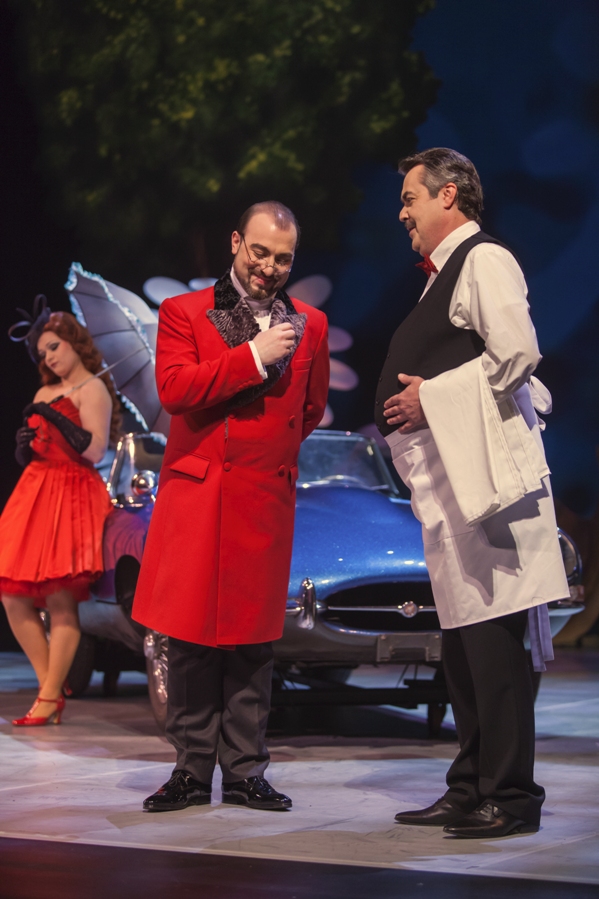
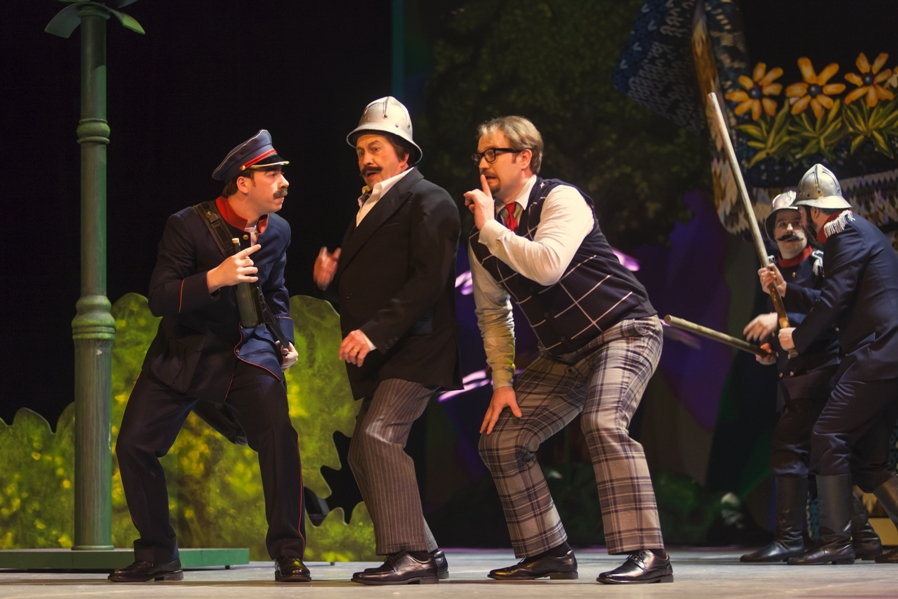
IN ARGENTINA, TEATRO COLON PRESENTS A NEW OPERA: “Bebe Dom and The City Planet”

bebe_dom_main

BUENOS AIRES, ARGENTINA

TEATRO COLON  PRESENTS:

Bebe Dom and The City Planet

Music: Mario Perusso  (Resident Composer of the Teatro Colón)

Libretto: Horacio Ferrer

World Premiere Music Director: Mario Perusso

Scene Direction, Scenery, Lighting and Costume Design: Marcelo Perusso

A production of the Teatro Colón

CAST:

Gustavo López Manzitti (Bebe Dom), Víctor Torres (Fargas), Florencia Machado (Geo), Victoria Gaeta (Lili)

After Fedra’s success, our resident composer undertakes a new opera project based upon a text by Horacio Ferrer, the utopia to turn the world into a city. With a pinch of bandoneon, and plenty of genuine lyric art, this piece promises to deliver more of his master’s expertise and artistry to compose for voices and orchestra, building upon his vast experience as master and director of the Teatro Colón.

Performance schedule

10.20.2013 • 5:00 pm
10.22.2013 • 8:30 pm
10.25.2013 • 8:30 pm
10.29.2013 • 8:30 pm

TEATRO COLÓN
Cerrito 628
Ciudad Autónoma de Buenos Aires
República Argentina
+5411 4378 7100
info@teatrocolon.org.ar
http://www.teatrocolon.org.ar


Posted in Music, OPera | Tagged , , , , | Leave a comment

“Le nozze di Figaro” in Japan…

mainmenuTokyo Presents:

nozzefigaro

Le Nozze di Figaro

    • 2013/2014 Season
    • Wolfgang Amadeus Mozart : Le Nozze di Figaro
      Opera in 4 Acts
      Sung in Italian with Japanese Supertitles
    • OPERA HOUSE
  • PERFORMANCES

    2013
    October 20 October 23 October 26 October 29
    Sun Wed Sat Tue
    2:00


    2:00
    *
    2:00


    6:30
    *


This Andreas Homoki production created a buzz with its stage art, which is rendered primarily in black and white. Wielding the baton will be Ulf Schirmer, a man who has conducted a number of previous NNTT opera productions. Marco Vinco will sing the title role, as part of a cast of rising stars currently working in some of the world’s finest opera houses. Susanna will be sung by Kushima Kanae, who continues to impress with her growth as an artist. Bartolo will be sung by Matsui Hiroshi, who currently works and lives in Germany. They will perform amid a cast of individualistic artists who promise to deliver a superb ensemble performance.

STAFF

Conductor : Ulf Schirmer
Production : Andreas Homoki
Scenery Design : Frank Philipp Schlossmann
Costume Design : Mechthild Seipel
Lighting Design : Franck Evin


(Conductor)
Ulf Schirmer

(Production)
Andreas Homoki

 CAST

Il Conte Almaviva : Levente Molnar
La Contessa : Mandy Fredrich
Figaro : Marco Vinco
Susanna : Kushima Kanae
Cherubino : Lena Belkina
Marcellina : Takemoto Setsuko
Bartolo : Matsui Hiroshi
Basilio : Ono Mitsuhiko
Don Curzio : Itoga Shuhei
Antonio : Shimura Fumihiko
Barbarina : Yoshihara Keiko

Chorus : New National Theatre Chorus
Orchestra : Tokyo Philharmonic Orchestra

Photos

(Il Conte Almaviva)
Levente Molnar
Photos

(La Contessa)
Mandy Fredrich
Photos

(Figaro)
Marco Vinco
Photos

(Susanna)
Kushima Kanae
Photos

(Cherubino)
Lena Belkina
Photos

(Marcellina)
Takemoto Setsuko
Photos

(Bartolo)
Matsui Hiroshi

New National Theatre Tokyo

1-1-1 Hon-machi, Shibuya-ku, Tokyo 151-0071
For more information, please call
NNTT Box Office: +81-(0)3-5352-9999
Opening Hours: 10:00 am – 6:00 pm

Posted in Music, OPera | Tagged , , , , | Leave a comment

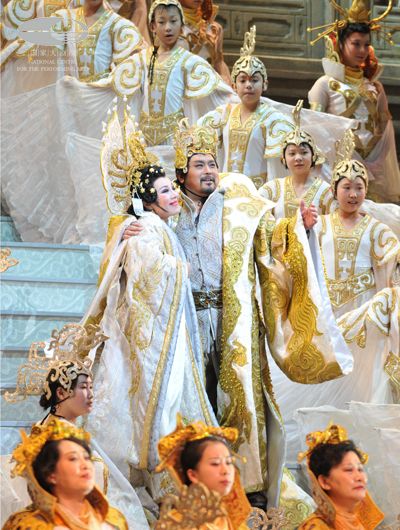
China: The eighth round of the National Center for the Performing Arts’ version of Turandot

The eighth round of NCPA’s version of Turandot


The eighth round of NCPA’s version of Turandot kicks off 
Photo by Ling Feng / chncpa.org 

On October 17th, the eighth round of NCPA’s version of Turandot kicked off. The performances of this round will be recorded and released worldwide as a DVD, presenting the elegant singing from the Chinese singers and the distinct artistic charm of NCPA’s version of Turandot


The excellent performance of the China NCPA Orchestra and Chorus is highly commended 
Photo by Ling Feng / chncpa.org

Daniel Oren created a strong scene with the prince and princess, and the China NCPA Orchestra and Chorus lit up the evening

The excellent performance of the China NCPA Orchestra and Chorus was highly commended. Famous conductor Daniel Oren affirmed the two ensembles’ strength and talent and said, “It’s our first collaboration and their performance was exciting. Young as they are, the Chorus showed the strength no less than any European counterparts.” In the evening, the orderly coordinated Orchestra offered a performance of mellow tone and clear sounds. 


Elisabete Matos’s clear and touching voice enchants the audience 
Photo by Ling Feng / chncpa.org

Elisabete Matos’s clear and touching voice enchanted the audience and left an imprint with her intricate way of acting, bringing out on stage the warmer and milder princess designed by director Chen Xinyi. The Calaf by Vladimir Galouzine surprised the audience and his brilliant “Nessun dorma” climaxed the show. The self-sacrificing Liu by Yao Hong touched the audience into tears and Tian Haojiang’s expressive performance vividly showed the inner world of an expelled old king. In the evening of October 18th, the all-Chinese cast will take the stage with Sun Xiuwei and Dai Yuqiang singing Turandot and Calaf respectively, which will mark their second collaboration in this year after Un Ballo in Maschera and the four in NCPA’s Turandot


This round of performance will be recorded as a DVD and have an international release 
Photo by Ling Feng / chncpa.org

China’s pilot opera movie featuring excellent singing in a NCPA’s fine production will be released in the overseas market 

NCPA has filmed Nabucco and Un Ballo in Maschera in 2013, which made it the first art organization to film the stage performance of a Western opera classic in China. 

As the most staged NCPA-produced opera, this revival of Turandot will be recorded and released in the overseas market. The opera featuring a Chinese story is also NCPA’s first opera production. NCPA looks to promote china’s excellent singers and fine opera productions in the overseas market by filming opera productions like Turandot

turandot1China

turandot2

Premiere: Mar 21, 2008

The three-act Turandot is one of the greatest works of Puccini, the Italian great opera master, and it is also his last work in his life. In 1924, when Puccini composed Scene II, Act III, unfortunately he passed away, stopped his passionate pen and left to the world an uncompleted piece of work. During the past eighty years since Puccini’s death, completing Turandot has always been the artistic focus of the world’s attention.

The NCPA’s version of Turandot is the first original excellent work that the NCPA composed with all its strength. Puccini Festival Foundation, as the specially invited partner in the NCPA version of Puccini’s Turandot, has rendered full support from opera creation to rehearsal. Hao Weiya, the Chinese young composer, entrusted by National Centre for Performing Arts, becomes the third composer of the world and also the first Chinese artist to complete Puccini’s Turandot. The famous director Chen Xinyi will be the general director and the famous stage designer Gao Guangjian will be the chief vision director and stage designer. They will decode the coldhearted Princess from an entirely new perspective and jointly open up a new artistic vista. The ancient Chinese Princess’s story, completed by a Chinese for the first time, is a performing gala of the capital’s cultural and artistic circle and moreover becomes a unique exquisite works of art in the gallery of NCPA.

turandot3

Turandot depicts a love story of mystery. Turandot, though she is a most beautiful Chinese Princess, is coldhearted, and she stipulates that any prince seeking to marry her must answer three riddles – and if he fails, he will be sentenced to death. Three poor princes have unfortunately lost their lives. Calaf, the prince of Tartary who is in exile in China, smitten with the princess’s beauty, determines to win her as his bride and answers all the questions correctly. However, Princess Turandot refuses to accept defeat. Calaf generously offers Turandot a riddle of his own: if she can learn his name by dawn, he will forfeit his life. Princess Turandot captures the father of the prince and his maid Liù and extorts a confession from them by torture. Liù kills herself to keep the secret. Liù’s death gives coldhearted Turandot a great shock. At dawn, Turandot still has no idea of the prince’s name. Calaf makes Turandot forced to kiss him and melts her icy heart and finally tells her his real name. Yet Princess Turandot does not announce the prince’s real name, on the contrary, she announces to the public that she will marry the prince and his name is Love.

Ending aria by Hao Weiya
Conductor: Daniel Oren
Director: Chen Xinyi
Stage Design/Diretor: Gao Guangjian
Presenters: China NCPA Orchestra, NCPA Chorus 

Cast
Tuandot by Elisabete Matos/Sun Xiuwei
Calaf by Vladimir Galouzine/Dai Yuqiang/Walter Fraccaro
Liu by Yao Hong
Timur by Tian Haojiang

The NCPA’s version of Turandot is the first western opera the NCPA launched since its inauguration. Puccini Festival Foundation, as the specially invited partner in the NCPA version of Puccini’s Turandot, has rendered full support from opera creation to rehearsal. Hao Weiya, the Chinese young composer, entrusted by National Centre for Performing Arts, becomes the third composer of the world and also the first Chinese artist to complete Puccini’s Turandot. It’ll be the seventh time for NCPA to stage this masterpiece. In 2011, NCPA’s production of Turandot were staged as the opening performance for the 2011-2012 season of Korean National Opera in Seoul.

Daniel Oren
With a natural talent,Daniel Oren developed his own particular interest for the Opera by the great Leonard Bernstein who in 1968 chose him, just thirteen years old, as lead vocalist in his Chichester Psalms’s for the inauguration of the Israel Television; in reality it was the mother to start the young Daniel, still at an early age, a complete musical education by studying not only the piano and cello, but with singing and harmony. Maestro Oren then perfected his studies in Europe, devoting himself almost exclusively to conducting and taken part in 1975, winning, the prestigious competition ‘Herbert von Karajan’ for young conductors: from that moment the young artist began an international career.  

After debuting in the United States, his reputation also consolidated in Italy: in fact he became the stable conductor in Rome and, subsequently, at the Teatro Verdi in Trieste (where he was recently music director), at the San Carlo Theatre in Naples and at the Carlo Felice in Genoa. Even in recent years he has continued to successfully manage in the major Italian theaters (Florence, Parma, Turin, Venice), cultivating close relationships with the most influential European and American theaters, including the Metropolitan Opera in New York, Covent Garden in London, the Staatsoper in Vienna, the Colon in Buenos Aires, Tokyo Opera, the Opera Houses in Houston, Dallas, San Francisco and the Opera Bastille in Paris where he obtained a great success with Leo Nucci, Roberto Alagna and Angela Gheorgiu.

Next to his love for the Opera, with a repertoire that embraces the most important Italian repertoire, Oren joins the passion for symphonic music, which has enjoyed great success conducting major orchestras such as the Accademia di Santa Cecilia in Rome (conducted for the first time in 1978), Maggio Musicale Fiorentino’s Orchestra, the Israel Philharmonic, the Berlin Philharmonic, and the radio orchestras of Monaco, Cologne, Stuttgart, Frankfurt and Berlin, among many others.

His participation in Verdi’s Nabucco inaugural season of the New Israeli Opera in December 1994 represented a particularly significant moment in his career: this musical event has managed to coincide his passion for the world of opera with the love for his homeland. Oren as a musician believes that the music is the best vehicle for peace, tolerance, and the only language that unites us all.

He’s Artist Director of Teatro Verdi in Salerno where he often conducts during the opera season. He’s also regular guest in Paris, at the Royal Opera House Covent Garden as well as in Tel Aviv,Verona, Florence, Madrid, Cologne and Barcelona. \

   Turandot  Calaf
 Oct. 17  Elisabete Matos  Vladimir Galouzine
 Oct. 18  Sun Xiuwei  Dai Yuqiang  Oct. 19  Elisabete Matos  Walter Fraccaro  Oct. 20  Sun Xiuwei  Dai Yuqiang
Chen Xinyi Director

Chen Xinyi is a fruitful director who has been actively engaged in the creation of theatrical drama for decades. She has created more than 80 plays; in addition to stage play, opera and Peking Opera, she is found as well involved in musical drama, children’s play and local dramas. The works directed by Chen have won Cao Yu Drama Literature Award, and Splendor Award (for professional theatrical artworks) (Ministry of Culture) even for 12 times (of which four works were given grand prizes).

As a female director, she imparts her works a subtle and understated mood as well as the sensational impact and flavor. 

Gao Guangjian Stage Design/Director
He is a stage supervisor of NCPA and a national level-I stage designer, an outstanding expert of the Ministry of Culture. He has acted as stage designer in more than 100 stage plays and large-scale performances. He has won “Wenhua Award for Stage Art Design” conferred by the Ministry of Culture for several times. Main works: operas Turandot, La Traviata, Rigoletto, Plain, dance dramas Dream of Dunhuang, The Old Summer Palace, Marco Polo, etc. 

Elisabete Matos as Turandot
Elisabete Matos was born in Braga, Portugal, where she studied singing and violin at the local conservatory. Later, she moved to Madrid, Spain, where she finished her studies at the Madrid School of Singing with a scholarship from the Gulbenkian Foundation.  

She was awarded several prizes at singing competitions, including second place at the Belvedere Vienna Singing Competition. 

Recently, she has had her debut at Viena as Abigaille (Nabucco) and at Los Angeles Opera as Senta, conducted by Conlon, and after her huge success as Minnie (Fanciulla del West) at Metropolitan Opera House, she has returned on November for Nabucco‘s Abigaille and will be back on December 2013 for Tosca. Next engagements also include Rienzi (Irene) at Liceu de Barcelona, Turandot at Chile, Berlin and Capitole de Toulouse and her debut as Salome at Palma de Mallorca. 

Ms. Matos is also a frequent guest of various concert halls. Her concert repertory goes from Bach to contemporary music, including lieder and symphony. She was recently invited to perform Beethoven’s 9th Symphony in Cagliari (conducted by Lorin Maazel), Manuel de Falla’s El Sombrero de Tres Picos with the Chicago Symphony Orchestra and Daniel Baremboim. 

Her recordings include von Suppé’s Requiem with the Gulbenkian Foundation Chorus and Orchestra conducted by Michel Corboz (Virgin Classics), as well as the title role in La Dolores for Decca (with Placido Domingo), for which she was awarded a Grammy in 2000.

Sun Xiuwei as Turandot
Sun Xiuwei was born and grew up in Liao Ning, China. On leaving school, she moved to Shanghai to study at the Conservatory under her first singing teacher, Professor Gao Zhilan. She then moved to Italy to continue her training under Rita Orlandi Malaspina, probably the last great soprano of Verdi music. As well as improving her general command of Italian and its pronunciation, of key importance for voice emission, Sun Xiuwei widened her repertoire to include Bel Canto.

Sun Xiuwei entered several international vocal music contests, winning six of them: Varallo Val Sesia, Parma, Piacenza, Adria, G. Simionato, Pavia and Busseto.

In 1994, her Italian début at the G. Verdi Theatre, Trieste in the role of Norma was acclaimed by public and critics alike. She then appeared in Madama Butterfly as Cio Cio San, a role that was to bring her accolades around the world: the Arena of Verona , the Opéra de Nice, Opern des Stadt Bonn, Deutsche Opern Berlin, Bilbao, Genoa, Oslo, Aachen, Palermo, Helsinky, Rome, Santiago of Chile, Detroit, Philadelphia, Trieste, Washington, Toronto, Maiorca, Pacific Opera California, Bologna, Karlsruhe, Los Angeles, Torre del Lago, Trieste, Macao and, in 2006, Washington once more to celebrate her 170th performance.

In 2000, a rising opera star in Italy, Sun Xiuwei was invited to sing at the Paul VI Hall in the Vatican before Pope John Paul II. She has also been a regular feature of the Puccini Festival at Torre del Lago, a must for a natural Puccini soprano like herself, singing in Madama Butterfly and as Liù, a role she was to perform in many other theatres, including Washington where she would later return to sing the leading role in Turandot. While performing Butterfly around the world, Sun Xiuwei worked on extending her repertoire to include other operas like Andrea Chenier, Il Corsaro, Attila, Nozze Istriane, Il Trovatore and La Traviata, performing in Tokyo, the Arena d’Avenches and Budapest. Hong Kong saw her triumphant début in the role of Lady Macbeth in Verdi’s Macbeth. Subsequently, once more at the Arena d’Avenches, Sun Xiuwei was widely acclaimed for her Abigaille in Nabucco with Renato Bruson, Leo Nucci and Juan Pons. 

Vladimir Galouzine as Calaf
Vladimir Galouzine is indisputably one of the world’s leading dramatic tenors, known for his unrivaled stentorious voice and extremely vivid characterizations of some of the most demanding roles.

He started his career as a member of the Mariinsky Theater in Saint Petersburg, Russia, performing a myriad of leading roles from both the Russian and the Italian repertoire, including, amongst others: the title roles in Verdi’s Otello and Don Carlo and Rimsky-Korsakov’s Sadko, Radames in Verdi’s Aida, Calaf in Puccini’s Turandot, Des Grieux in Puccini’s Manon Lescaut, Cavaradossi in Puccini’s Tosca, Alexey in Prokofiev’s The Gamblers, Sergey in Shostakovich’s Lady Macbeth of Mtsensk, Khovansky in Mussorgsky’s Khovanschina, Canio in Leoncavallo’s I Pagliacci; and the role of which he is widely considered the world’s most outstanding performer: Hermann in Tchaikovsky’s The Queen of Spades.

He is in much demand internationally, performing regularly during the last two decades as a guest of most of the world’s most prominent opera houses, concert halls and festivals, including: New York’s Metropolitan Opera, Chicago’s Lyric Opera, the San Francisco Opera, the Houston Grand Opera and the Los Angeles Opera in the United States; London’s Royal Opera House, Covent Garden, in the United Kingdom; Milan’s Teatro alla Scala; Venice’s La Fenice, the Teatro Verdi in Trieste, the Teatro Comunale in Bologna as well as Florenc’s Teatro Comunale; the Vienna State Opera in Austria; the Opéra National (Bastille) and Théatre de Chatelet, both in Paris, as well as Toulouse’s Théatre de Capitole and the Marseille Opera in France; Madrid’s Teatro Real and Barcelona’s Grand Teatre del Liceu in Spain; both the Mariinsky Theater in St. Petersburg and the Bolshoi Theater in Moscow, Russia; Amsterdam’s Nederlandse Opera in The Netherlands; the Deutsche Oper Berlin, the Cologne Opera and the Baden-Baden Festspielhaus in Germany; the New National Theater in Tokyo, Japan; the New Israeli Opera; and the Teatro Colón in Buenos Aires, Argentina. In addition, he has performed at the Salzburg, Bregenz and Edinburgh Festivals and Washington’s Kennedy Center; London’s Royal Albert Hall; the Chorégies d’Orange and the Arena di Verona.

Vladimir Galouzine has collaborated with many of the world’s most important conductors including Valery Gergiev, Carlo Rizzi, James Conlon, Dennis Russell Davies, Marcello Viotti, and stage directors such as Franco Zeffirelli, Graham Vick, August Everding, Giancarlo Del Monaco and Elijah Moshinsky.  


Dai Yuqiang as Calaf
Dai Yuqiang is a remarkable tenor of China instructed by a number of celebrated musicians, such as Yan Keting, Han Dezhang, Ma Qiuhua, Jin Tielin and Wu Qihui. He works at the Opera Troupe of the General Political Department of the Chinese People’s Liberation Army since he entered in 1990.

His opera leading appearances include Il Trovatore, Rigoletto, La Boheme, Carmen, Turandot, one-act opera Mid-autumn at Vast Sandy Land, a full-length musical White Reed Flowers and Red Kapok Flowers. Judging from his outstanding contribution to opera, the Ministry of Culture of China granted him the ‘Cultural Performance Award’. Mr. Dai’s performance in various activities won tons of rave reviews from experts, scholars and audience and received many honor titles and rewards from the General Political Department of PLA.

The world-famous tenor and maestro Pavarotti pleasantly took Mr. Dai as his first student from Asia after heard his singing; and an opera fan from Japan appraised him as ‘the Pride of Chinese Opera’. Mr. Dai, along with Maria Guleghina and Samuel Ramey, has collaborated in Tosca at Royal Opera House, Convent Garden, being showered with praise and hailed by local media as ‘a dazzling star on the stage.’ 


Walter Fraccaro as Calaf
Walter Fraccaro is regularly invited to perform on the world’s most prestigious stages, including: Teatro alla Scala in Milan;  Wiener Staatsoper;  the Metropolitan Opera in New York; Bayerische Staatsoper in Munich;  Deutsche Oper Berlin;  Teatro Real in Madrid; San Francisco Opera; Hamburgische Staatsoper; Opernhaus Zürich; Gran Teatre del Liceu in Barcelona;  Arena di Verona; Maggio Musicale in Florence; Teatro La Fenice in Venice; Teatro San Carlo in Naples; Opera in Rome; Teatro Massimo in Palermo; and Teatro Carlo Felice in Genoa.  

His vast repertory includes, among many others: Aida (Radames); Stiffelio (title role); Un Ballo in Maschera (Riccardo); Nabucco (Ismaele); Attila (Foresto); Simon Boccanegra (Gabriele); Macbeth (Macduff); La Forza del Destino (Alvaro); Don Carlo (title role); Luisa Miller (Rodolfo); Il Trovatore (Manrico); La Bohème (Rodolfo); Tosca (Cavaradossi); Madama Butterfly (Pinkerton); Mefistofele (Faust); Carmen (Don José); La Gioconda (Enzo); Turandot (Calaf); Manon Lescaut (Renato Des Grieux); Andrea Chenier (title role); La Fanciulla del West (Dick Johnson); and Cavalleria Rusticana (Turiddu). 

In 2013 he has already performed Turandot at Met in New York and in Seoul, Madama Butterfly in Nice and Athens, Aida in San Diego, Otello in Como, Il trovatore in Belem (Brazil) and Mexico City.  

His recent and future plans include Manon Lescaut in Siviglia, Turandot in Turin, Cavalleria Rusticana and Pagliacci in Tokyo.  

img alt=”” src=”http://www.chncpa.org/module/performancemanager/manager/images/artist/1378451747909.jpg” width=”158″ name=”perImg” />

Yao Hong as Liu
Yao Hong, China’s famous soprano, is a first-grade national actress. Among her numerous awards, she has won the First Prize at the ‘Concord’ International Opera Competition in Marseilles, the First Prize at the First National Vocal contest organized by the Ministry of Culture, the Sixth Wenhua Award by the Ministry of Culture, and the ‘Plum Blossom Award’ by Chinese Dramatists Association. In 2001, she performed on stage with the world’s three major tenors at the Meridian Gate, Forbidden City. In 2005, she played the role of ‘Liu’ in Puccini’s opera Turandot directed by China’s famous director Zhang Yimo successively in Paris and Munich, for which, her performance has been widely praised by international media and critics. 


Tian Haojiang as Timur
Tian Haojiang is a Chinese opera performing artist working with the Metropolitan Opera House for 19 consecutive years and has cooperated with over 30 significant opera houses such as Berlin State Opera and Washington Opera House. He has performed more than 40 operas (about 1,300 sessions) including 11 operas presented with world-renowned tenors Pavarotti and Domingo. In 2001, Mr. Tian presented Turandot at the Met, Guo Wenjing’s Poet Li Bai in Hong Kong, multi-media opera Turandot directed by Zhang Yimou in Taiwan, China, as well as starred in the modern opera Matteo Ricci in Hong Kong and the premiere of The Soul of a Painter in Taiwan, China. In 2009, the National Public Radio produced a special TV program named From Mao to the Met wih Tian Hao Jiang. Furthermore, Tian’s English biography My Wild Ride from Mao to the Met that included into the book series of the Lincoln Centre for the Performing Centre was published in 2008.


Liu Songhu as Ping
Liu Songhu, a tenor and an associate professor of the Academy of Opera, Peking University, had been the resident solo of Nurnberg State Opera and visiting lecturer of Nurnberg Academy of Music. So far, he has starred in over 500 operas, with The Fall of The House of Usher been elected as the annual ‘Best Opera’ by the German Ministry of Culture. In addition, he won a series of awards at German ‘New Voice’ International Voice Competition, Toulouse International Voice Competition and other competitions. In 2007, he, as the first Chinese singer, won the top award at the Germany ‘La Voce’ International Artistic Songs Competition.

Li Xiang as Pang
Li Xiang, a young tenor of Central Opera House, was graduated from the Central Conservatory of Music and entered the Master Class in Beijing lectured by American soprano Cheryl Studer and Professor Robert White from the Juilliard School. From 2002 to 2004, he was invited for three times by world-renown conductor Seiji Ozawa to learn at the Seiji Ozawa Ongaku-Juku Academy and performed operas such as Madam Butterfly, Die Fledermaus and La Boheme. In Jan. 2008, he traveled to America and impersonated Wu Hou in Farewell to Concubine. He also starred many versions of Turandot and played leading roles in quite a few operas such as A Woman’s Heart, The Weddning of Figaro and Carmen


Chen Yong as Peng
Chen Yong won Bel Canto Gold Award of Professional Group of the 10th National TV Contest of Young Singers and 2010 national audience favorite singer award ‘Gold Award’ and attended Ferraro International Vocal Maestro Class, Shanghai International Opera Maestro Class and Italia International Opera Maestro Class. Additionally, he won French Government Scholarship for two consecutive times and studied at Opera House de Paris and Opera/Theatre de Saint-Etienne. In 2005, Chen won Italian Government Scholarship and studied at Conservatorio Giuseppe Verdi di Milano and Accademia lirica Italiana. It is worth mentioning that Chen served as member of judging panel of the 12th CCTV young singers contest.  

Chen also performed in or held solo concerts in countries such as Japan, Hong Kong, Italia, Austria and Malaysia around the world. In 2008, he released his solo album in World Chinese Singer Serials. Additionally, Chen was invited to perform in Turandot directed by Zhang Yimou at Bird’s Nest and successfully played Li Wenguang in Female Teacher in Village and Zhao Wu in The Orphan of Chao at NCPA as well as stared Sino-French opera Les Contes d`Hoffmann and opera Les Pêcheurs de Perles.  


Yang Yi as Herald
Graduated from the Vocal Department of the Central Conservatory of Music, Yang Yi has starred in quite a few operas such as Marco Polo, Turandot, Carmen and Rigoletto. In 2001, he was elected by the Ministry of Culture to go in for the International Voice Competition of Bilbao, Spain and won the superior award. Currently, he is a solo of Berlin State Opera (since 2002) and studies German artistic songs at Karlsruhe National Music Academy and takes lessons from vocal masters such as Dietrich Fischer-Dieskau and Schwarzkopf. In 2003, he won the top prize at the Hugo Wolf International Artistic Songs Competition. 


Liu Naiqi as Emperor
As a tenor actor from China National Symphony Orchestra Chorus, Liu starred in the operas such as Turandot, Gianni Schicchi, Le Nozze di Figaro, Le Barbier de Séville, Salome, Tosca, Un Ballo in Maschera and Il Trovatore. It is worth mentioning that Liu was in the spotlight for he put in an excellent performance in Gianni Schicchi at NCPA. As the Music Weekly comments: ‘Young tenor actor Liu Naiqi who played Gerardo stands out from others and his beautiful voice bears comparison with the great Italian tenor Stefano at his early life.’ 

In 2002, Liu won golden prize in National Adolescent Talent Contest and other prizes in national contests such as CCTV young singers contest and Golden Bell Awards. 


NCPA Chorus
NCPA Chorus was established on December 8, 2009, whose members were carefully selected from famous music schools in and out of China. Now the Chorus has Wu Lingfen as the conductor, with many artists well-known in China and abroad giving instructions. Affiliated to NCPA, the highest palace of performing arts in China, the Chorus adheres to NCPA’s guiding principles of ‘for the people, for the arts, and for the world’. The Chorus mainly stages operas and concerts, and also takes part in kinds of cultural communication events.The Chorus presented its debut performance in NCPA Opera Festival 2010, and has taken part in and gained critical acclaim from the performances of NCPA’s Xi Shi, Carmen, La Traviata, L’elisir d’amore, Turandot, A Village Teacher, Tosca, Die Fledermaus, and The Chinese Orphan. As NCPA’s resident chorus, it took part in Turandot (NCPA version) on the tour to Seoul Arts Center in January 2011 and gained high praise. 

The Chorus has offered a great number of performances including Road to Revive, To the Music (debut), Roam About the Classics, To Our Motherland– NCPA Chorus Concert for the Army Day, Arias of Love, Beethoven’s ninth symphony, and Mahler’s second symphony.  

The Chorus has cooperated with top artists like directors  Francesca Zambello and Giancarlo del Monaco; conductors Lorin Maazel, Lu Jia, and Li Xincao; singers Inva Mula, Juan Pons,Brandon Jovanovich, Dai Yuqiang, Warren Mok, Zhang Yalun, Zhang Liping, Sun Xiuwei, and Liang Ning. Its over-one-hundred performances have taken an active role in the further development of NCPA. 


Turandot depicts a love story of mystery. Turandot, though she is a most beautiful Chinese Princess, is coldhearted, and she stipulates that any prince seeking to marry her must answer three riddles – and if he fails, he will be sentenced to death. Three poor princes have unfortunately lost their lives. Calaf, the prince of Tartary who is in exile in China, smitten with the princess’s beauty, determines to win her as his bride and answers all the questions correctly. However, Princess Turandot refuses to accept defeat. Calaf generously offers Turandot a riddle of his own: if she can learn his name by dawn, he will forfeit his life. Princess Turandot captures the father of the prince and his maid Liù and extorts a confession from them by torture. Liù kills herself to keep the secret. Liù’s death gives coldhearted Turandot a great shock. At dawn, Turandot still has no idea of the prince’s name. Calaf makes Turandot forced to kiss him and melts her icy heart and finally tells her his real name. Yet Princess Turandot does not announce the prince’s real name, on the contrary, she announces to the public that she will marry the prince and his name is Love.

NCPA Orchestra
China NCPA Orchestra is the resident orchestra of the National Centre for the Performing Arts of China (NCPA), balancing a busy and distinguished performance schedule with a reputation as one of China’s most adventurous and dynamic orchestras. Established in March 2010, the orchestra is composed of distinguished musicians from around the world, performing more than a dozen operas, ballets and regular symphonic seasons every year. Maestro Lu Jia took up the post of Principal Conductor in February 2011, succeeding Chen Zuohuang, the current Laureate Conductor, NCPA’ Music Artistic Director and also one of the founders of the orchestra.The NCPA Orchestra demonstrates an abiding commitment to high levels of artistic excellence and prides itself on its long-term collaborations with the finest musicians of our day. Artists associated with the orchestra in the past two years include Lorin Maazel, Christoph Eschenbach, Vladimir Ashkenazy, Yan Pascal Tortelier, Gunter Herbig, Gilbert Varga, Lang Lang, Stephen Kovacevich, Leo Nucci, Wang Yuja and Han-Na Chang. Maestro Lorin Maazel praised the orchestra as “a hard-working excellence with great passion” after a series of concerts and the NCPA’s new La Traviata in June 2010.    

In its first season of 2011, China NCPA Orchestra gained critical acclaim for its performances in NCPA’ new productions of Tosca (Directed by Giancarlo Del Monaco), Il Barbiere di Siviglia (co-produced with Castleton Festival), Die Fledermaus, and a new composed opera The Chinese Orphan. Apart from that, the orchestra was also deeply involved in NCPA’ 2011 Gustav Mahler Project. Under the batons of maestros including Christoph Eschenbach, Yoel Levi, Jun Maerkl and Chen Zuohuang, the orchestra completed Mahler’s Symphonies No. 1, 2, 3, 8 and 10.  

In the season of 2012, China NCPA Orchestra won a highly successful acclaim for two NCPA’s new productions: Der Fliegende Hollander and Lohengrin, both Wagner’s operas were Chinese premiere. It continually collaborates with prominent musicians around the world for concert programs, including Maestro Vladimir Ashkenazy, Yan Pascal Tortelier and the legendary pianist Rudolf Buchbinder.  

In addition to its extensive domestic performances, the NCPA Orchestra also received a widespread international praise in 2012. The orchestra was invited by Kissingen Summer Music Festival and Schleswig-Holstein Musik Festival in July 2012, and kicked off his first German tour in Nürnberg, Hamburg and Berlin under the baton of Christoph Eschenbach and Chen Zuohuang. This was followed by a successful concert at the Sydney Opera House with Maestro Chen Zuohuang in November. 

In the season of 2013, the NCPA orchestra presents colorful programs on the commemoration of Wagner, Verdi and Britten, highlighting the Ring without words with 12 principals from Berlin Philharmonic under the baton of Lorin Maazel. NCPA’s new opera productions that the orchestra is involved include Les Contes d’Hoffmann, Otello and Nabucco, which features her second successful collaboration with Placido Domingo.    

The NCPA orchestra aims to build up a world-class orchestra with operation and management conforming to global practices while incorporating Chinese characteristics. Devoted to educational and outreach activities, the Orchestra also has presented a series of Weekend Matinee Concerts since its establishment. With specially selected repertoire, performances of high quality and extremely low ticket prices, these concerts have won great acclaim from both audience and critics. The orchestra is now embarking on a similar path with the complete Beethoven symphonies with Maestro Lu Jia

 
Posted in Music, OPera | Tagged , , , , | Leave a comment

“La boheme” in Slovenia

La-boheme-naslonica-net3

logoThe Opera Balet Ljubljana Presents:

Giacomo Puccini”s

LA BOHÈME

An Opera in Four Acts

A Repeat Performance from the Season 2005 / 2006 (Premiere: 16th March 2006)

14 November 2013 19:30 SNG Opera in balet Ljubljana
16 November 2013 19:30 SNG Opera in balet Ljubljana
19 December 2013 19:30 SNG Opera in balet Ljubljana
21 December 2013 19:30 SNG Opera in balet Ljubljana
9 January 2014 19:30 SNG Opera in balet Ljubljana
11 January 2014 19:30 SNG Opera in balet Ljubljana

SetRatioSize900900-La-boheme-net7One of the most popular operas of the entire opera repertoire was inspired by the novel Scènes de la vie de bohème by Henry Murger and remade for the libretto by the Italians Luigi Illica and Giuseppe Giacosa. Giacomo Puccini (1858–1924) created a stunning musical illustration of the lives of Parisian bohemians, full of hopes and dreams, joys and disappointments.

La-boheme-net2La bohème was first performed on 1st February 1896 at the Teatro Regio in Turin. It was conducted by the young Arturo Toscanini. The opera was not a glorious success at all. Although it was well received by the audience, the critics found it too cheap and sentimental. Today, La bohème is constantly performed by all the opera theatres around the world. Its success with the audience is hidden in its wonderful melodies, well-founded plot and sophisticated mixture of pleasure and pain. Many opera connoisseurs find La bohème Puccini’s best work, in which his incredible talent for creating melodies convincingly intertwines with the impressionist musical and dramatic procedures as well as with his unmistakable sense of details.

La-boheme-net3La bohème was first performed in Ljubljana’s German Theatre already in 1898 and first staged with the Slovene authors in 1903 (the production was conducted by H. Benišek and directed by F. Lier). This performance, premiered in the season 2005/2006, is already a fourteenth in a row. Although the audience usually takes this opera for romantic and full of emotion, the director Vinko Möderndorfer decided to expose in it the cruelty and poverty of the artistic life as well. He also updated the theme and adapted it to our environment and time. Thus he interlaced the realistic scenes of the bohemian life with the dreamy and symbolic world of puppets.

Posted in Music, OPera | Tagged , , , , , , , , , | Leave a comment

Tannhäuser in Estonia

Tannhaeuser_1Tannhäuser

Thursday, November 14 2013, 19:00
Estonian National Opera, Estonian Avenue 4, Tallinn

PROGRAM

Wagner, Richard
Tannhäuser – Romantic opera in three acts by Richard Wagner, World premiere in Dresden Hoftheater on October 19, 1845, Premiere at the Estonian National Opera on March 14, 2013

Program is subject to change

wagner-tannhauser-overtureABOUT THE EVENT

In 2013 all the world will celebrate the 200th anniversary of Richard Wagner’s birth. For this occasion, “Tannhäuser” will be staged at the Estonian National Opera by an internationally renowned stage director Daniel Slater, who debuted at Opera North with Smetana’s opera “The Bartered Bride” (1998).

Slater’s productions are known for their originality, humanity, intelligence and modernity. His award-winning productions have been successfully staged in Great Britain, Germany, France, Switzerland, Sweden, Norway, Spain, USA and New Zealand.

Synopsis
Having left the Castle of Wartburg in Thuringia with a quarrel, the knight and Minnesinger Tannhäuser has fallen for the charms of Venus and lives with the goddess on Venusberg. After a year, he grows tired of heavenly pleasures and asks Venus to release him. The goddess curses Tannhäuser and foretells that he will return to her on the hour of utmost despair. Tannhäuser finds himself near the Wartburg Castle, where he meets his old friends, who remind him of Elisabeth, the Landgrave Hermann’s niece who was once in love with him. Tannhäuser is moved by the news, joins the court again and begs for Elisabeth’s forgiveness. The Landgrave announces a song contest in which the winner will be crowned by Elisabeth. Tannhäuser’s best friend Wolfram, who is secretly in love with Elisabeth, praises the purity of true love. Angered Tannhäuser interrupts him, saying that real love is not pure but passionate and breaks into a hymn in praise of Venus. The court realises that during his absence, Tannhäuser was in Venusberg and they want to attack him for his shameful behaviour, but Elisabeth asks them for mercy. The Landgrave sends Tannhäuser together with other pilgrims to the Pope in order to ask the Pope to pardon him. After half a year, other pilgrims return to Wartburg, but Tannhäuser is not among them. Elisabeth prays to the Virgin Mary to be allowed to die and, through her death, to redeem Tannhäuser. Wolfram, wandering in the woods, meets the weary Tannhäuser, who tells him that the Pope refused to pardon him, saying “You can find no more forgiveness than the Pope’s staff could blossom”. In great despair, Tannhäuser returns to Venusberg. Wolfram tries to prevent him from yielding to the charms of Venus, reminding him of Elisabeth who still loves him. A procession passes that announces the death of Elisabeth. Grief-stricken Tannhäuser cries out Elisabeth’s name and Venus vanishes. Tannhäuser collapses dead with the cry “Holy Elisabeth, pray for me!” The pilgrims and the crowd announce that a miracle has happened: the Pope’s staff has blossomed! Tannhäuser’s soul is saved.

Staging team
Conductor: Vello Pähn
Stage Director: Daniel Slater (UK)
Designer: Leslie Travers (UK)
Choreographer: Kati Kivitar
Lighting Designer: Anton Kulagin


EVENT DATES

 
Thursday 14 November 2013 19:00  
Saturday 16 November 2013 19:00  
Saturday 07 December 2013 19:00  
Wednesday 29 January 2014 19:00
Posted in Music, OPera | Tagged , , , | Leave a comment

Das Rheingold in Leipzig

Rheingold1

Das Rheingold


Sunday, November 10 2013, 18:00

Oper Leipzig, Augustusplatz 12, Leipzig, Germany

PROGRAM

Wagner, Richard
Das Rheingold
Program is subject to change


Rheingold-2ABOUT THE EVENT


Wagner’s opera ‘Das Rheingold’ will be performed at the Oper Leipzig.

In his Ring Cycle, Wagner describes the story of the contradiction between love and power, based on the old Germanic myths.

The opera offers a taste of Wagner’s work. In 2013, Wagner’s home town, Leipzig, has planned to celebrate the 200th birthday of the great composer with various concerts and operas. 

Conductor Ulf Schirmer 
Director Rosamund Gilmore 

Cast

Wotan, Tuomas Pursio
Donner, Jürgen Kurth
Loge, Thomas Mohr
Froh, Randall Bills
Fafner, James Moellenhoff
Fasolt, Stephan Klemm
Alberich, Jürgen Linn
Mime, Dan Karlström
Freia, Sandra Trattnigg
Erda, Nicole Piccolomini
Woglinde, Eun Yee You
Wellgunde, Kathrin Göring
Floßhilde, Sandra Janke

Gewandhausorchester

Posted in OPera | Tagged , , , , , | Leave a comment

Nikolai Rimsky-Korsakov’s “The Golden Cockerel” at The Bolshoi in Moskow

bolshoiNikolai Rimsky-Korsakov’s

“The Golden Cockerel”

Opera in three acts

Premiered on June 19, 2011.

golden-cockerel-smLibretto by Vladimir Belsky based on Alexander Pushkin’s fairy-tale

October 31, 2013      19:00
November 1, 2013    19:00
November 2, 2013    12:00

Music Director: Vassily Sinaisky
Stage Director: Kirill Serebrennikov
Set and Costume Designers: Kirill Serebrennikov, Galya Solodovnikova
Lighting Designer: Damir Ismagilov
Chorus Master: Valery Borisov
Video mapping — Russian Visual Artists

CAST
 
Conductor: Alexander Soloviev
Tsar Dodon: Vladimir Matorin
Tsarevitch Gvidon: Boris Rudak
Tsarevitch Afron: Mikhail Diyakov
Polkan, voivode: Nikolai Kazansky
Amelfa, the royal housekeeper: Tatiana Erastova
The Astrologer: Mikhail Seryshev
The Tsaritsa of Shemakha: Venera Gimadieva
The Golden Cockerel’s Voice: Anna Khvostenko

Synopsis

Act I

In the palace preparations are underway for a ’session’ of the boyars’ Duma.
They are waiting for the Tsar.
The Astrologer appears and addresses those present:

I’m a wizard. I’m endowed by
occult knowledge with rare gifts — to
call up shades and fill anew a
lifeless breast with magic being.

Here before you, comic masks will
bring to life an ancient fable.
Though a tale, the moral’s true —
Good young people, mark it well.

A hubbub breaks out. The Astrologer disappears. Enter the Tsar.
The Tsar appeals to his boyars for advice on how to keep his kingdom safe from attack. His eldest son suggests bringing the army back from the frontier and posting it round the capital. Many support this idea. General Polkan, however, disapproves of the plan. The Tsar’s youngest son suggests the army should be disbanded altogether and only mobilized again at the appearance of the enemy. Dodon is delighted at the idea! But Polkan turns this suggestion down too. The Duma is at a loss to know what to do. They suggest that beans or kvas grains should be consulted.
Enter the Astrologer. He presents Dodon with a magic Golden Cockerel who will always give warning of danger. The Tsar promises the Astrologer any reward he likes to name:

Your first wish I will fulfill
Like it were my very own.

Exit the Astrologer. His fears allayed, Dodon goes to sleep. He has a sweet dream.
The Cockerel starts to crow:

Cock-a-doodle-doodle-doo!
Be alert! Be on your guard!

Noise and bustle. The Tsar mobilizes two armies which march off to the scene of war led by his sons. He then goes back to sleep. Dodon’s terrible dream. Again the Cockerel warns of danger. Having gathered together a force, Dodon now goes off to war himself accompanied by General Polkan.

Act II

Tsar Dodon, accompanied by his army, sees the bodies of his two dead sons. A horrified Dodon mourns his children. Suddenly a mysterious tent appears before him. A beautiful woman steps out of the tent and sings a hymn to the rising sun. It is the Tsaritsa of Shemakha. Dodon is bewitched by her beauty and her singing. By guile and artifice, the cunning Tsaritsa seduces Dodon who offers her his hand in marriage. His offer is accepted. The Tsaritsa of Shemakha and Dodon set off for the capital.

Act III

The populace are awaiting the return of their Tsar. Dodon and the Tsaritsa of Shemakha appear to the sound of trumpets. The populace greet them. The Astrologer makes his way through the crowd. He reminds the Tsar of his promise and asks for the Tsaritsa of Shemakha. Dodon tries to make the old astrologer see sense, offering him at least half his kingdom, but the latter is adamant. Loosing his temper, Dodon rough-handles the old man and chases him off. The Astrologer dies. The Golden Cockerel flies down off the tower and pecks Dodon on the forehead. Dodon dies. The Tsaritsa of Shemakha and the Cockerel vanish. The people are totally disorientated:

Oh what will the new dawn bring?
How’ll we live without our Tsar?

Epilogue

The Astrologer appears from the crowd. He now concludes his tale:

That is how the story ends.
But the bloody denouement,
though distressing it may be,
really should not worry you.
Only I and the Tsaritsa
were the real live people here. The
others were delirium — a
dream, a pale specter, a void…

Posted in Music, OPera | Tagged , , , , , , , | Leave a comment

TACONIC OPERA DEBUTS THE WORLD’S MOST FAMOUS OPERA, “NORMA”

165625_189298904428432_4323742_aTACONIC OPERA DEBUTS THE WORLD’S MOST FAMOUS OPERA, “NORMA”

Opening its sixteenth season in Westchester, Taconic Opera will debut Bellini’s famous masterpiece, Norma, in Yorktown and White Plains. No other opera has received as much attention and acclaim as the story of the Druid princess. The title role has been sung by almost every famous soprano in the world during the past 180 years. Perhaps none have made the role more famous than Maria Callas, who performed the role eighty-nine times on stage, in addition to her seminal recordings.

“Every opera lover has an opinion about Norma. Callas has a cult following as do many others who have portrayed the great heroine,” says Dan Montez, General Director of Taconic Opera. “All you have to do is go to Amazon.com and read the comments from the recent release of Cecilia Bartoli’s Norma, and you will find hundreds of intellectually vitriolic reactions to the recording. These strong opinions make opera companies want to shy away from performing the work, but we won’t.”

In an unusual turn, the company will feature only one cast in both locations. Starring in the lead role is a soprano whom Dan Montez describes as “one of the best sopranos in the world.” Francesca Mondanaro, now singing leading roles in top opera houses, returns to sing this role after making her debuts with Taconic Opera in Macbeth and Nabucco.” This is what musicalcriticism.com has to say about her: “[Mondanaro’s] could well be the best interpretation of Abigaille I have ever heard live or on record, one that compares favorably with Maria Callas’s and Marisa Galvany’s, to name two….Mondanaro’s voice conjures up shades of a kind of Verdi soprano that has seemingly all but vanished. The voice itself is unforgettable – voluminous, lush, and beautiful, with a contralto-like darkness and an attractive vibrato. Chest notes were powerful and incisive, and the role’s perilous leaps were nailed without the smallest hesitancy or misstep in intonation. The voice sliced cleanly through the most voluminous ensembles like a hot knife through butter.”

Tickets to the event can be obtained online atwww.taconicopera.org or by calling their toll-free number at 1-855-88-OPERA (6-7372). Prices are posted on the website, with generous reductions for seniors and students. Performances will be held at the Yorktown Stage, 1974 Commerce St., Yorktown Heights, NY on Sunday, October 20 at 2:00 pm, and in White Plains, NY at the theater at Archbishop Stepinac High School on Saturday, October 26, at 7:30 pm.


Home Page
http://www.taconicopera.org

Posted in Music, OPera | Tagged , , , | Leave a comment

“The Barber of Seville” in Cape Town, South Africa

IL BARBIERE DI SIVIGLIA (Barber of Seville) Presented by Cape Town Opera in collaboration with the UCT Opera School

THE 2013 SEASON COMES TO A HIGH-SPIRITED CONCLUSION WITH ROSSINI’S EVERGREEN COMIC CLASSIC

“I’m gentle, respectful, obedient, sweet and loving – but push me too far and I’ll become a viper!”

The nimblest barber in Seville, Figaro is the go-to man for a close shave. And there will be close shaves a-plenty when Figaro helps the lovestruck Count Almaviva abduct his sweetheart Rosina from her nasty guardian Don Bartolo in this hilarious opera buffa, our hair-raising contribution to the month of ‘Movember’.

The Barber of Seville combines knockabout humour with music of great virtuosity and brilliance, from its cheeky overture to showstopping arias including ‘Largo al factotum’ and ‘Una voce poco fa’. Following her warm-hearted and witty stagings of L’elisir d’amore and Die Entführung aus dem Serail for CTO and UCT, Christine Crouse helms a whimsical new production of this sparkling. With the “Cape Town Festival Orchestra”.


Conductor: Kamal Khan
Director: Christine Crouse

Posted in Music, OPera | Tagged , , , , , | Leave a comment

VERDI’S 200th ANNIVERSARY: “Rigoletto” at the Metropolitan Opera.

metlogo

RIGOLETTO.

Approximate running time 3 hrs. 2 min.

Dmitri Hvorostovsky sings the title role of Verdi’s tragic masterpiece for the first time at the Met in Michael Mayer’s dazzling production set in Las Vegas—the neon-bedecked hit of the 2012–13 season. Aleksandra Kurzak is the beautiful Gilda, in thrall to Matthew Polenzani’s womanizing Duke.

SYNOPSIS

Las Vegas 1960
Act I
At his casino, the Duke boasts of his way with women. He dances with the Countess Ceprano, while Rigoletto, the Duke’s hunchbacked sidekick and sometime comedian, mocks the countess’s enraged but helpless husband, Count Ceprano. Marullo, one of the Duke’s entourage, bursts in with the latest gossip: Rigoletto is suspected of keeping a young mistress at his place. Rigoletto, unaware of the news, continues to taunt Ceprano, who plots with the others to punish him. Monterone, an Arab tycoon, forces his way into the crowd to denounce the Duke for seducing his daughter and is viciously ridiculed by Rigoletto. Monterone is arrested and curses Rigoletto.

Rigoletto is disturbed by Monterone’s curse. He encounters Sparafucile, a hitman, who offers his services. Rigoletto reflects that his own tongue is as sharp as the murderer’s knife. Arriving at home he warmly greets his daughter, Gilda. Afraid for the girl’s safety, he warns the housekeeper, Giovanna, not to let anyone into the apartment. When Rigoletto leaves, the Duke appears and bribes Giovanna, who lets him in. He declares his love for Gilda, who has secretly admired him at church, and tells her he is a poor student. After he has left, Gilda tenderly thinks of her newfound love before going to bed. The Duke’s entourage gathers, intending to abduct Rigoletto’s “mistress.” Rigoletto appears and they quickly change their story, telling him they are abducting the Countess Ceprano, and enlist his aid in their scheme. But they have deceived him and it is Gilda they carry off, with Rigoletto’s unwitting assistance. He rushes in to discover that his daughter is gone and collapses as he remembers Monterone’s curse.

Act II
At the casino, the Duke is distraught about the abduction of Gilda. When his entourage returns and tells him the story of how they took the girl from Rigoletto’s apartment and left her in the Duke’s rooms, he hurries off to her. Rigoletto enters, looking for Gilda. The entourage is astonished to find out that she is his daughter rather than his mistress, but they prevent him from storming into the Duke’s apartment. Rigoletto violently denounces them for their cruelty, then asks for compassion. Gilda appears and runs in shame to her father, who orders the others to leave. Alone with Rigoletto, Gilda tells him of the Duke’s courtship, of her abduction, and her seduction by the Duke. Monterone is brought in as he is being taken away by the Duke’s men, and Rigoletto swears that both he and the old man will be avenged. Gilda begs her father to forgive the Duke.

Act III
Rigoletto and Gilda arrive at a seedy club on the outskirts of town where Sparafucile and his sister Maddalena live. Inside, the Duke laughs at the fickleness of women. Gilda and Rigoletto watch through the window as the Duke amuses himself with Maddalena. Rigoletto tells Gilda to leave town disguised as a man and pays Sparafucile to murder the Duke. Gilda returns to overhear Maddalena urge her brother to spare the handsome stranger and kill the hunchback instead. Sparafucile refuses to murder Rigoletto but agrees to kill the next person who arrives at the club, so that he will be able to produce a dead body. Gilda decides to sacrifice herself for the Duke. She knocks, enters the club, and is stabbed. Rigoletto returns and Sparafucile presents him with the body, which is wrapped in a trenchcoat with its face covered. Assuming it is the Duke’s, Rigoletto gloats over the body, when he hears his supposed victim singing in the distance. Frantically pulling the covering aside, he finds his daughter, who dies asking his forgiveness. Horrified, Rigoletto remembers Monterone’s curse.

Metropolitan Opera NYC

Metropolitan Opera NYC

Metropolitan Opera NYC

Metropolitan Opera NYC

Metropolitan Opera NYC

Metropolitan Opera NYC

Metropolitan Opera NYC

Posted in OPera | Leave a comment