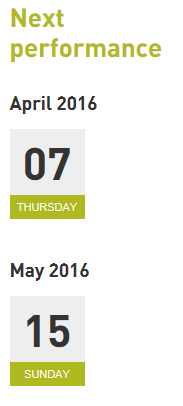
Il barbiere di Siviglia in Prague

nationaltheatre
lazbnik-so-df-272web
CaptureLibretto: Cesare Sterbini
Conductor: Tomáš Brauner, Enrico Dovico
Stage director: Martin Otava
scheduleSets: Ján Zavarský
Costumes: Bettine Kirste
Chorus master: Adolf Melichar
Dramaturgy: Jitka Slavíková

State Opera Orchestra
State Opera Chorus

Premiere: September 29, 2005

Figaro, the most famous barber of all time, whose wit, as sharp as his razor, helps Count Almaviva to win his beloved Rosina. Love, guile and intrigue, these are the ingredients of Rossini’s superlative comic opera. The sparkling charm of the music, the forcible virtuoso parts of the heroes – the impish Rosina with bravura coloraturas and the mettlesome Figaro – as well as the rapid tempo at which the action hurtles forward, have secured Il barbiere di Siviglia a permanent position in the global repertoire.
Today, it beggars belief that the premiere on 20 February 1816 in Rome caused one of the greatest scandals in opera history! The work teems with dashing comic scenes, yet more serious tones appear too – one such being in the famous aria of the music teacher Don Basilio about slander, which still holds true today. Nevertheless, the author of the comedy Le Barbier de Séville, on which the libretto is based, the celebrated French playwright Pierre Beaumarchais, wrote that he above all wanted “to succumb to his merry temper and return the original joyful mood to theatre”. Rossini’s opera directly links up to this intention, and the same is the objective of the State Opera production, which was also received with great enthusiasm when performed in Salzburg in October 2007.

The opera is staged in Italian original version and Czech and English surtitles are used in the performance.
Approximate running time, including intermission: 2 hours, 40 minutes, one 20-minute intermission.

GALLERY


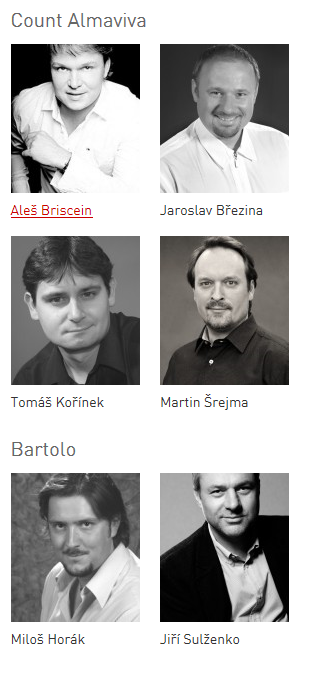
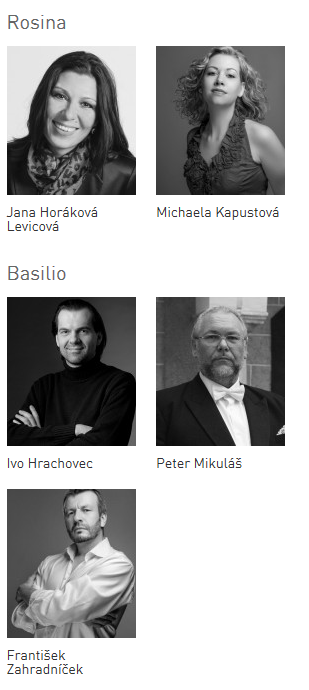
CAST cast1
cast2

cast3

cast4

Posted in OPera | Tagged , , , | Leave a comment

Roberto Devereux at the Metropolitan Opera

devereux title1devereuxtitlemetlogo

duration2Soprano Sondra Radvanovsky takes on the extraordinary challenge of singing all three of Donizetti’s Tudor queen operas in the course of a single season, a rare feat made famous by Beverly Sills—and not attempted on a New York stage since. In this climactic opera of the trilogy, she plays Queen Elizabeth I, forced to sign the death warrant of the nobleman she loves, Robert Devereux. Tenor Matthew Polenzani is Devereux, and mezzo-soprano Elīna Garanča and baritone Mariusz Kwiecien complete the principal quartet in the bel canto masterpiece, conducted by Donizetti specialist Maurizio Benini. As with the earlier Anna Bolena and Maria Stuarda, the production is by Sir David McVicar, who with this staging completes an enormously ambitious directorial accomplishment.

Production a gift of The Sybil B. Harrington Endowment Fund

The presentation of Donizetti’s three Tudor Queen operas this season is made possible through a generous grant from Daisy Soros, in memory of Paul Soros and Beverly Sills

Roberto Devereux is a co-production of The Metropolitan Opera and Théâtre des Champs-Elysées

roberto_devereux_introductionWorld premiere: Teatro San Carlo, Naples, 1837. First performed two years after Maria Stuarda and Lucia di Lammermoor, Roberto Devereux shows Donizetti at the height of his musical and dramatic powers. The opera’s story was inspired by a historical incident—the execution for treason of Robert Devereux, the favorite of Queen Elizabeth I—but, as in many works of the time, history is used merely as a springboard from which the operatic imagination can soar. Roberto Devereux mirrors the successful structure of the earlier Lucia di Lammermoor: a first act that lays out the issues at stake and introduces the musical language; a second act fashioned as a single dramatic arc; and three intense shorter scenes for the final act.

Creators

Gaetano Donizetti (1797–1848) composed about 75 operas plus orchestral and chamber music in a career abbreviated by mental illness and premature death. Most of his works disappeared from the public eye after his death, but critical and popular opinion of the rest of his huge opus has grown considerably over the past 50 years. The Neapolitan librettist Salvadore Cammarano (1801–1852) worked with Donizetti on a number of operas, including Lucia di Lammermoor, and also collaborated with Verdi.

Production Sir David McVicar

Set Designer Sir David McVicar

Costume Designer Moritz Junge

Lighting Designer Paule Constable

Choreographer Leah Hausman

CAST

castd1castd2

SETTING

The opera is set in London, at Westminster Palace and the Tower. Historical facts place the action between 1599 and 1601 (the year of Devereux’s death).

roberto_devereux_setting

GALLERY (Photo copyright by Metropolitan Opera)

Music

Donizetti’s gift for melody and understanding of the human voice are on full display in Roberto Devereux, but the score goes beyond that, revealing the dramatic possibilities inherent in the best of the bel canto tradition. Just one remarkable example is the trio finale to Act II for Devereux, Nottingham, and Elizabeth, which contains a range of emotions and psychological states in one cohesive musical structure: the anxious lover, the betrayed husband and friend, and the scorned woman are all given full expression. The opera’s finale belongs entirely to Elizabeth, in a variation of the classic mad scene as an internal journey and spiritual crisis. A nod to local color is found in the overture, which (anachronistically) quotes “God Save the Queen.”

SYNOPSIS

Act I

London, 1601. At the Palace of Nonsuch, Sara, Duchess of Nottingham, is in tears while reading a book. Unknown to the other ladies of the court, she is distressed not about the story she’s reading but about her own situation—she is in love with Robert Devereux. Queen Elizabeth enters and tells Sara that she has decided to follow her husband Nottingham’s advice and receive Devereux, although she is worried that his affections have turned to another woman. Robert has returned from Ireland accused of treason, but Elizabeth is prepared to pardon him as long as he still loves her. Lord Cecil demands that the queen sign Robert’s death warrant, but she tells him she is not convinced of his disloyalty. Robert enters and Elizabeth dismisses the courtiers. She tells him she is ready to pardon him and reminds him of a ring she gave him as a pledge of his safety. But his cool reaction to her talk of their past love increases her suspicions. When she asks directly for the name of her rival, Robert denies that he is in love with anyone else. Now furious, Elizabeth is convinced he has betrayed her. The Duke of Nottingham arrives to greet Robert, who shrinks from his embrace. Nottingham is worried about his friend’s safety but also concerned about his unhappy wife, whom he lately found crying over a blue scarf she was working on. Cecil returns to summon Nottingham to the council meeting that will decide Robert’s fate. Before he leaves, Nottingham assures Robert he will do what he can to defend him.

In Nottingham’s apartments, Sara thinks of Robert and the danger he is in. He suddenly appears and reproaches her for marrying Nottingham while he was away in Ireland, but she replies that she did so on Elizabeth’s orders. Sara in turn reminds Robert that he is wearing the queen’s ring. He tears it off and assures her of his love. Sara implores him to flee and gives him the blue scarf as a pledge of her affections. After a painful goodbye, Robert departs.

Act II

At Nonsuch, the court awaits news of Robert’s fate. Elizabeth enters, then Cecil, who announces that in spite of Nottingham’s defense the council has decided on the death sentence. Sir Walter Raleigh reports that he has arrested Robert according to the queen’s orders. When searched, Raleigh says, Robert was found to have concealed in his clothes a blue scarf, which Elizabeth now angrily examines. Nottingham brings the death warrant for the queen to sign but again pleads for his friend and dismisses all accusations as slander. Elizabeth refuses to relent. When Robert is led in, she turns on him furiously and shows him the scarf. Both Robert and Nottingham are shocked. His astonishment quickly turning into a jealous fury, Nottingham calls for his sword. Elizabeth once again demands to know the name of her rival, but Robert won’t reveal it. Now blind with rage, Elizabeth signs the death warrant.

Act III

Alone in her apartment, Sara receives a letter from Robert in which he asks her to take the ring to Elizabeth and hope for her mercy. Before she can do so, Nottingham appears. He reads the letter, ignores Sara’s protestations of innocence, and orders her to be confined.

In his cell in the Tower, Robert hopes that he will be able to clear Sara’s name before his death. When soldiers appear to take him to his execution, he realizes that all that’s left to him is to pray for her in heaven.

The queen, surrounded by her silent ladies, waits in her rooms, wondering why Sara is not there to comfort her. In spite of everything, she wants Robert to live and hopes that he will send her the ring, but instead Cecil appears to tell her that Robert is on the way to the block. When Sara runs in with the ring and confesses that she is Elizabeth’s rival, the queen orders the execution stopped, but it is too late: a cannon shot announces Robert’s death. Nottingham arrives and Elizabeth turns on him and Sara, demanding to know why they didn’t bring her the ring sooner. Nottingham proudly replies her that all he wanted was revenge. Elizabeth orders them both taken away. Haunted by a vision of the beheaded Robert, she now only longs to be free of her role as queen.

Posted in OPera | Tagged , , , , | Leave a comment

A brief History of the Bayerische Staatsoper (Bavarian State Opera) and its Theaters

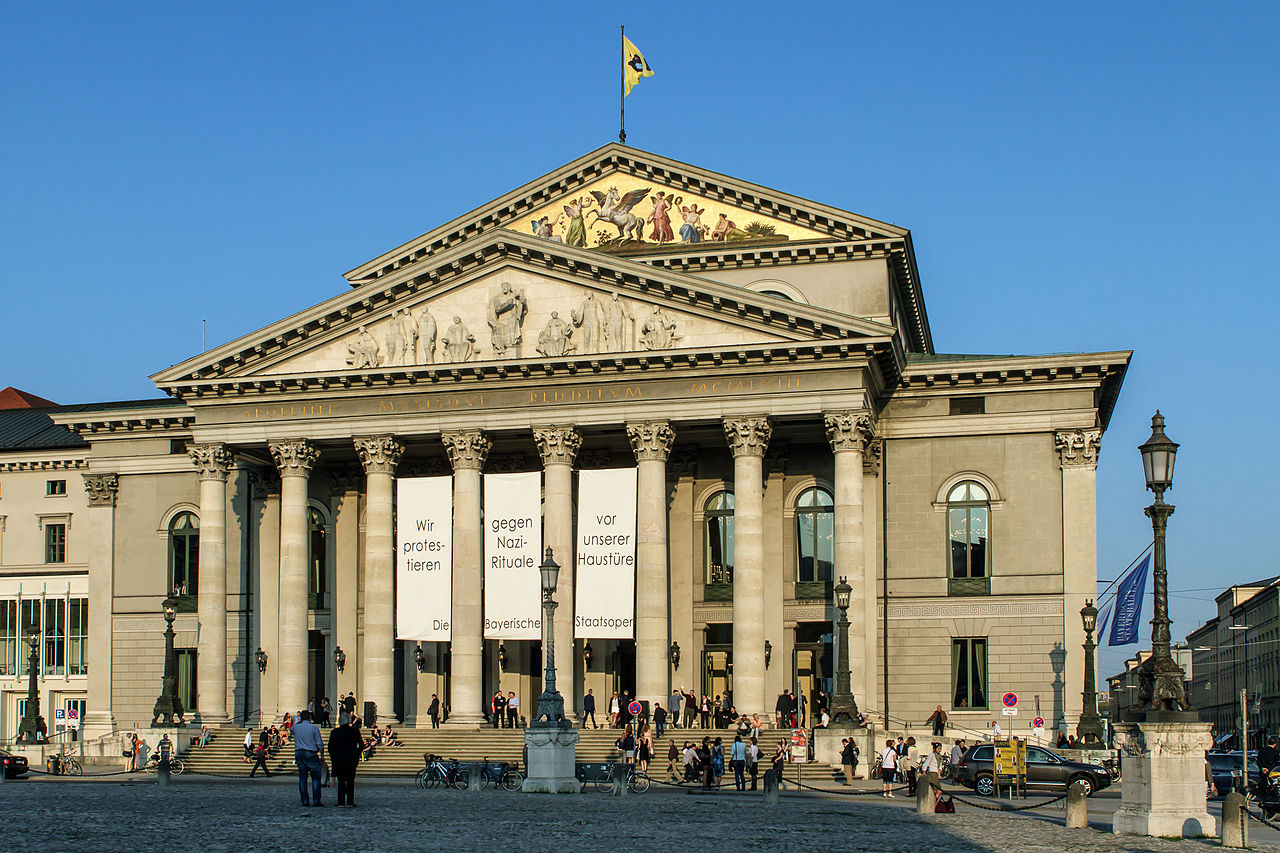
History of the National Theater

The National Theater in 1963

The National Theater in 1963 (from the Bayerische Staatsoper web site)

Building of the National Theater

The Cuvilliés-Theater, completed in 1755, proved to be too small for the quickly increasing Munich population. So, in 1792, the then Elector of Bavaria Karl Theodor commissioned a new opera house to be built by Court Architect Maximilian von Verschaffelt. However, the project was far too complex and time-consuming and was never completed, and so the new Elector Max IV Joseph decided to call a competition. All those who were engaged with architecture were invited to send in their ideas for the building of the century. The project particularly appealed to a young man, Karl von Fischer, who was barely twenty years old, born on the 19th of September 1782 in Mannheim. Influenced by the French Revolution’s ideals of citizen rights, he designed an open theatre, where the seats were no longer divided by rows and boxes.

By Avda - Own work, CC BY-SA 3.0, https://commons.wikimedia.org/w/index.php?curid=27425403

The Theater in 2013. By Avda – Own work, CC BY-SA 3.0, https://commons.wikimedia.org/w/index.php?curid=27425403

The Director of the Royal Theatre Josef Marius von Babo established a stock company for the building of the Nationaltheater, but plans were postponed due to the Napoleonic Wars. In 1806, the Elector Max I Joseph became King of Bavaria, and Karl von Fischer was his leading architect. The King was so impressed by a visit to the Théâtre de l’Odéon in Paris that he ordered a test be carried out to see whether the “Paris Model” could work in Munich. In March 1811, Karl von Fischer’s edited plans were approved by the King and on the 26th of October that same year Prince Ludwig set down the founding stone.

The execution proved to be as difficult as the planning. Just after a year of building work, finances were exhausted. The tough winter of 1813 and the Russian campaign led to a halt in construction. Since there were no new sponsors to win over, the King bought back the stocks and continued building at the cost of the state. Finally, on the 12th of October 1818, the theatre was opened. Having received much criticism during the construction, Karl von Fischer did not see his great project completed: he died on the 12th of February 1820, barely 40 years old.


Rebuilding 1823-1825

During a performance on the 14th of January 1823, a fire broke out on the stage set. The theatre was burnt down to its foundations. The King was inconsolable and the entire country mourned with him. In the end, the city of Munich took over the entire cost of rebuilding, which amounted to 800,000 Guilders. Under the direction of Leo von Klenze, the theatre was reconstructed within just two years, including a few small corrections. On the 2nd of January 1825, the Nationaltheater was reopened.


Destruction and Rebuilding 1943-1963

In the Second World War, the theatre was destroyed for the second time. In the night of the 3rd of October 1943, explosives and fire bombs struck the theatre. The heat was so intense that it melted the iron-framed stage. The rebuilding of the Residenztheater in 1951 had already exceeded the budget, so that the Landtag (State Parliament) opposed the rebuilding of the Nationaltheater. Not only that, but city planners wanted to remove the ruins completely to make more room for transport services in the city centre. For this reason, a citizen’s group called “Friends of the Nationaltheater” was founded in 1952, which collected additional funds and won over public support for the reconstruction of the theatre.

In 1954, a competition was established for the new building. At first, a design true to the original construction seemed out of the question. The Ministry of Culture decided to develop a draft submitted by Gerhard Graubner. Working together with the then Government Architect, Karl Fischer, they created more variations on Graubner’s design, making the possibility of reconstruction seem achievable.

In the end, the original plan by Karl von Fischer was chosen, cleared of Leo von Klenze’s additions during his reluctant reconstruction of the theatre as well as other changes of the 19th Century. The work of rebuilding lasted five years and cost 62 Million Marks. On the 21st of November, the company – which in the meantime had been housed at the Prinzregententheater – took possession of its theatre.

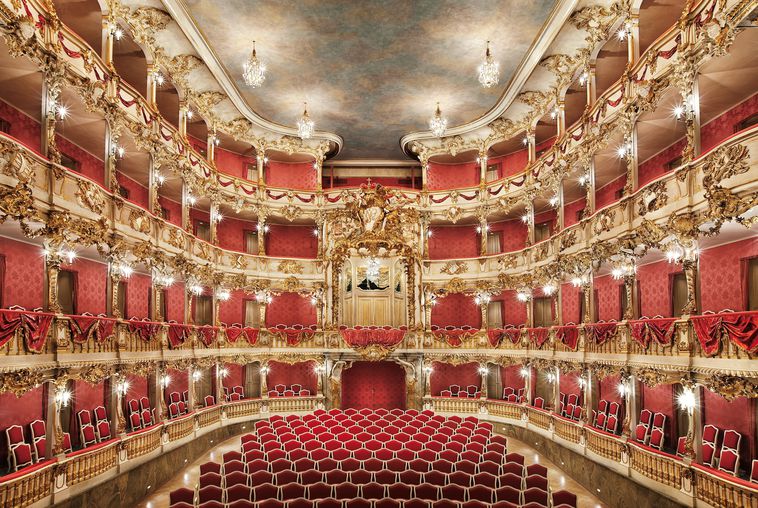
History of the Cuvilliés-Theater

Cuvillies-Theater

Cuvillies-Theater (from the Bayerische Staatsoper web site)

In the 18th Century, Munich received its second opera house with the Cuvilliés-Theater, originally called the “Residenztheater”. The Elector of Bavaria, Max III Joseph, gave the commission to the Court Architect Francois Cuvilliés the Elder and, just three years later, on the 12th of October 1753, the splendid German Roccoco theater was opened with Ferrandini’s opera seria Catone in Utica. With its rotating stage and adjustable stalls, which could be set horizontally on festive occasions, the “New Opera House” was a significant technical accomplishment.

Originally, the “New Opera House at the Royal Residence” was only for courtly use; however, when the opera house at Salavtorplatz was forced to close, the Elector of Bavaria decided in 1797 to establish the Cuvilliés-Theater as a Royal and National Theatre, making German opera and theatre accessible to the people.

In 1823, the Cuvilliés-Theater was renovated as a result of damages caused by the fire which burnt down the Nationaltheater in 1817. King Ludwig I decided to shut down the theatre completely in 1831, and from 1834 onwards it was used as a warehouse for the Nationaltheater’s stage sets. As a result of Director Franz von Dingelstedt’s insistence, the theatre was finally reopened in 1857.

More recently, the theatre shut again at the beginning of 1944. In order to keep it safe from bomb attacks during the Second World War, the entire interior was removed and housed in two different locations outside the city. On the 18th March, the external walls of the bare building were destroyed during an air raid. After the war, the new Residenztheater was built on its foundations. The former Cuvilliés-Theater, which had never possessed a facade, was reconstructed in 1957/58 on the Apotheke Floor of the Residenztheater in its original Roccoco style, based on designs taken from the archives of Ecole Bavaroise de l´Architecture.

The Bayerische Staatsoper has a wonderful virtual tour of their theaters. The following gallery is just a sample of the magnificent 360 degrees images available on the tour.

GALLERY

Munich’s operatic history

Königliches Hof- und Nationaltheater

Königliches Hof- und Nationaltheater (from the Bayerische Staatsoper web site)

Munich’s operatic history began with the courtly splendor of the young Italian “dramma per musica”, that new, initially exclusive, yet later – in Venice – universally popular form of musical theatre. Elector Ferdinand Maria installed a theatre in the Hercules Hall of the Residence, where the first Italian opera performances were staged for the members of the court society. Concurrently, following a his father Maximilian I’s plan, he also built the first free-standing opera house in Germany by taking the old grain storehouse, the so-called “Haberkasten” (“Oat Bin”), on Salvatorplatz, and reconstructing it as a baroque theatre. The courtly period operas were generally based on mythology and used allegorical figures to pay homage to the ruler and his court.  Often the technical apparatus with its flying machines, sea battles and triumphal marches vied for primacy with the music.

During the reign of Elector Max II Emanuel, between 1679 and 1726, Italian opera continued its own triumphal march in Munich. His successor, Maximilian III Joseph, then commissioned François Cuvilliés to construct the “teatro nuovo presso la residenza”, the Residence Theatre – to this day the Cuvilliés-Theater is a household name for opera lovers all over the world. The “dramma per musica” had meanwhile become the “opera seria” with the featuring the cult of the aria, the bel canto style, the prima donnas and the castrati. Gradually folk operas and musical entertainments emerged from the middle class. Mythological subjects and homages to rulers began yielding to more life-like subject matter drawn from everyday life. New decisive impulses came from such sources as the French revolutionary “opéra comique” and the “singspiel” from Vienna and Leipzig.

The “opera buffa”, a combination of a vast array of different style elements, determined the style of La finta giardinera, the opera 19-year old Wolfgang Amadeus Mozart was commissioned to write for Munich. Six years later, on commission from Elector Karl Theodor, he composed his first “opera seria”. The world première of this work Idomeneo – re di Creta on January 29, 1781 in the Residence Theatre marked a major breakthrough for the 25-year old composer.


The artistic and political trends in the first quarter of the 19th century were determined by Max IV Joseph, who ruled from 1799 on as Elector, then, following the elevation of Bavaria to the status of kingdom, from 1806 to 1825 as King Max I. In 1802, the old “Haberkasten” on Salvatorplatz was torn down. The “Hof-National-Schaubühne” (“Court-National Theatrical Stage”) moved into the Cuvilliés Theatre becoming the “Churfürstliches Hoftheater” (“Electoral Court Theatre”). One of the last decisive acts of Bavaria’s King Max was the laying of the cornerstone for the Royal Court and National Theatre on Marstallplatz in 1811. This house, built to plans by Carl von Fischer, burned down on January 14, 1823, but thanks to the willingness of the Munich citizenry to make sacrifices, it was restored under the direction of architect Leo von Klenze and was able to reopen its doors only two years later.

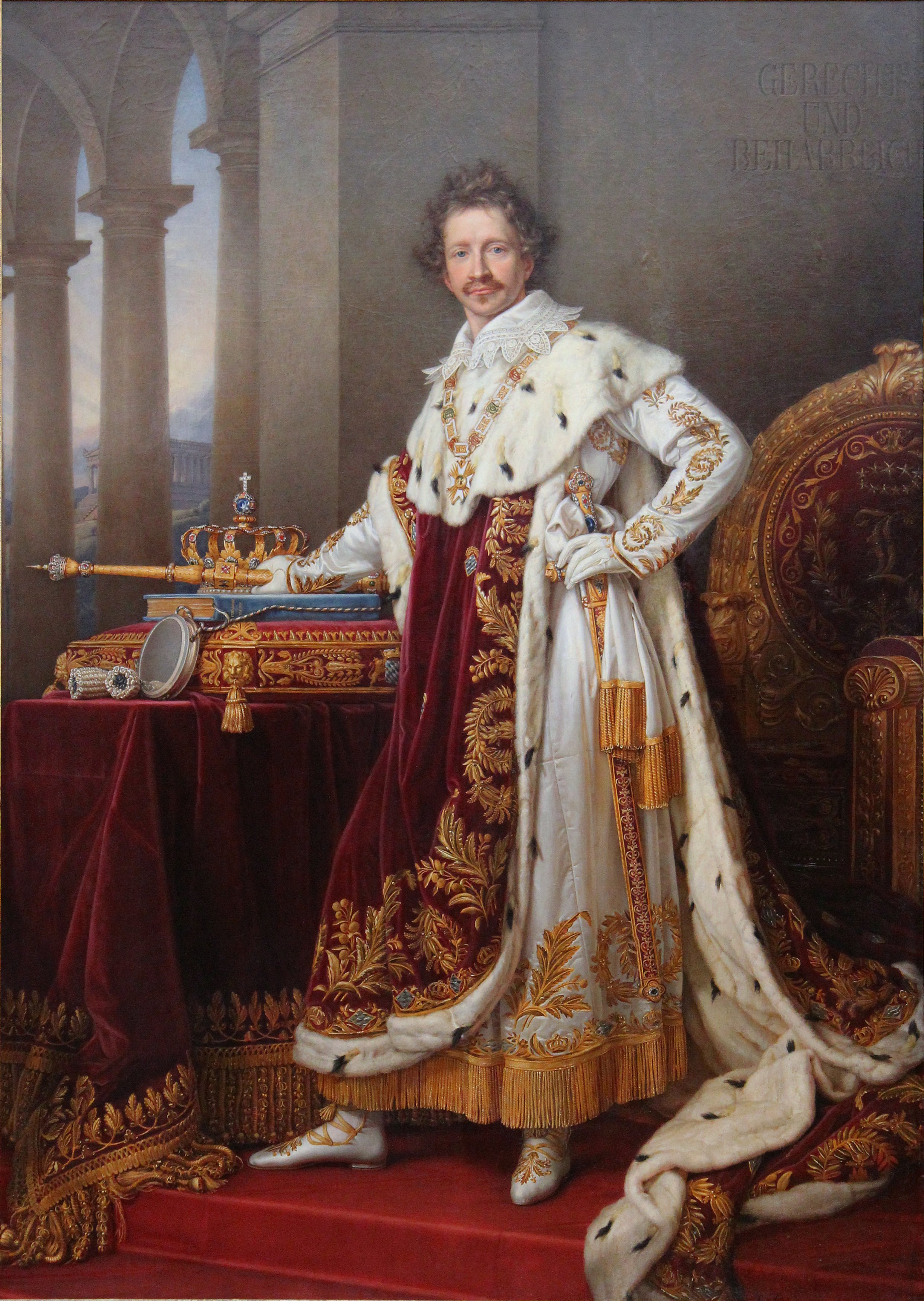
With the accession of King Ludwig I, who continued his father’s tradition from 1825 to 1848, and the revival of the new National Theatre, another new epoch in Munich’s operatic history began. Measures undertaken by the king included the closing of the “Volkstheater” at the Isartor and the final dissolution of the Italian opera. This opened the way for local forces as well as for a number of new trends emanating from all over Europe.

King Ludwig I of Bavaria

King Ludwig I of Bavaria


The reign of Bavaria’s opera-enthusiast story-book King Ludwig II from 1864 to 1886 is closely tied in with the name of Richard Wagner. Shortly after his accession, the 19-year old king, who had been totally enchanted by Wagner’s Lohengrin, brought the totally debt-ridden composer to Munich. The controversial friendship between monarch and musician, which ended in a political wrangle, ushered in a new heyday for opera in Munich – indeed for opera itself. Milestones in this development included the world premières of four masterworks by Richard Wagner. On June 10, 1865 the new court conductor Hans von Bülow conducted Tristan und Isolde, and three years later Die Meistersinger von Nürnberg. There followed on September 22, 1869 and June 26, 1870 the world premières of Das Rheingold and Die Walküre under the musical direction of Franz Wüllner. In 1888, Die Feen was given its world première. The Royal Court and National Theatre was in the limelight of the European musical world.

lohengrin-stamp-1933

The administration of General Director Franz von Perfall, from 1867 to 1893, saw the initiation of the Opera Festival. He put on a festival summer for the first time in 1875, featuring operas by Mozart and music dramas by Wagner. Over the course of time, the festival idea began to demand its own festival playhouse – and so, under the new General Director Ernst von Possart, the Prinzregententheater was constructed one year after the turn of the 20th century, fulfilling a wish on the part of Munich’s citizens and fostered by the art-loving Prince Regent Luitpold. The grand opening on August 21, 1901 with Die Meistersinger under Hermann Zumpe was a veritable popular festival and inaugurated a magnificent era for the Munich Opera Festival.


Zumpe’s successor, Felix Mottl, prepared the ground for Richard Strauss in his home town of Munich, even if audiences may initially have been shocked by the first performances of Salome, Elektra and the revival of the satirical operatic poem, Feuersnot. Mottl’s last major conducting assignment was the Munich première of the Rosenkavalier on February 1, 1911, at which point in time Richard Strauss joined Wolfgang Amadeus Mozart and Richard Wagner to form the harmonious triad of the Munich Opera Festival. Illustrious artists such as Enrico Caruso, Karl Erb and Maria Ivogün were making the Munich Opera world famous back then.

Rosenkavalier

Bruno Walter’s premières opened up brand-new worlds of sound with the major works of Franz Schreker, Erich Wolfgang Korngold, Max von Schillings and Richard Strauss’s Ariadne auf Naxos. Starting in 1922, Bruno Walter’s successor Hans Knappertsbusch began a continuous 14-year period that left a no less indelible imprint on the Munich Opera. During his administration, Munich witnessed the emergence of such conductors as Robert Heger, Karl Elmendorff, Paul Schmitz, Karl Böhm and Carl Tutein. Wilhelm Furtwängler and Hans Pfitzner were on the podium for performances in the National Theatre and the Prinzregententheater. When Hans Knappertsbusch was forced out of the theatre along with Clemens von Franckenstein, both victims of political ostracism, the Munich theatre was virtually orphaned for two years. Knappertsbusch’s name, however, became the stuff legends are made of.


During the Third Reich, Munich was slated to get another opera house. With Clemens Krauss, who served in the joint capacity of general manager and general music director, Munich was able to develop even further despite oppression and war. Clemens Krauss supplied highlights both in his career and in the history of the National Theatre with the world premières of three works by his friend Richard Strauss, three fantastic anachronisms which nevertheless became artistic reality: Friedenstag in 1938, Verklungene Feste in 1941, and Capriccio in 1942. During an Allied bombardment in the night of October 3 / 4, the National Theatre was turned into an eerie ruin. Further damage and destruction as well as the proclamation of “total war” silenced the State Opera for a while.

The arduous tasks of restoring the theatre to life were assumed by General Manager Georg Hartmann and his General Music Director Georg Solti. After they had successfully introduced works by Paul Hindemith and Heinrich Sutermeister, and Werner Egk had established himself in 1948 with his Faust ballet Abraxas, Hartmann and Solti put on the first post-war Munich Opera Festival in 1950, creating on a firm foundation to pass on to their successors.

Rudolf Hartmann served as general manager for fifteen years from 1952 to 1967, working side-by-side with general music directors Rudolf Kempe, Ferenc Fricsay and Joseph Keilberth. Two significant events occurred during the Hartmann era: the return to the restored Cuvilliés Theatre with Le nozze di Figaro in 1958 and the reopening of the National Theatre on November 21, 1963. With the aid of the “Friends of the National Theatre” it rose in old classicistic glory like a phoenix from the ashes in accordance the plans of Gerhard Graubner and Karl Fischer.


A new era at the Munich Opera began in 1967 when Günther Rennert assumed the reins. Together with Wolfgang Sawallisch, who functioned as general music director from 1968, Rennert took his comprehensive concept of a well-balanced blend of avant-garde theatre and music theatre and turned it into reality in the form of world theatre with a view toward modernism. His plans also included world-renowned guest artists, including such eminent stage directors as Boleslav Barlog, August Everding, Leopold Lindtberg, Oscar Fritz Schuh, Vaclav Kašlik, Bohumil Herlischka and Jean-Pierre Ponelle. With the 1976 Festival, Günther Rennert took his leave of the Munich Opera.

After an interim year under the leadership of Wolfgang Sawallisch, August Everding became general manager until 1982. His repertoire from Monteverdi to Reimann comprised both traditional operas and contemporary music theatre works. The high point of August Everding’s five-year administration, during which many international opera stars made their first appearances in Munich, was the world première of Aribert Reimann’s Lear in a production by Jean-Pierre Ponnelle, presented on July 9, 1978. In 1983, Everding assumed new responsibilities as General Director of Bavaria’s State Theatres. Wolfgang Sawallisch as State Opera Director, combined the posts of theatre and music director making him artistic director of the Bavarian State Opera.

Wolfgang Sawallisch

Wolfgang Sawallisch

Wolfgang Sawallisch found it an appealing idea to put the extraordinary options and efficiency of “his” house to the test by presenting large work cycles. In 1983 he offered audiences the unique opportunity of witnessing all 13 of Richard Wagner’s music dramas. In 1988, he opened all of Richard Strauss’s works to discussion in an unprecedented full cycle of the composer’s stage works. In 1987 he brought out a completely new production of Wagner’s Ring during the regular season in the short space of 10 days. At a time when the top productions of the major houses were always interchangeable as far as selection of works and casting were concerned, he sought individual artistic paths. In the ten years of his administration as State Opera Director he tried to stress the unique profile of the Munich Opera, among other things by placing greater weight on dramatic operas and lending special emphasis to classic modern works.


From 1993 until the end of the season 2005/06, Sir Peter Jonas was general manager of the Bavarian State Opera. This Englishman of German descent was previously artistic director of the Chicago Symphony Orchestra and the English National Opera in London. With all respect for tradition, Sir Peter has concentrated more strongly than his predecessors on the theatrical element in opera, including the visual aspect. New stage directors and designers have given the traditional house an innovative, adventurous profile, which was also communicated to the general public through a contemporary approach to PR.

Sir Peter Jonas (knighted in 1999 by Queen Elizabeth in recognition of his services to the Bavarian State Opera) has managed, after a long period of neglect, to restore baroque opera to the repertoire and, in a joint effort with conductor Ivor Bolton and such stage directors as Richard Jones, David Alden and Martin Duncan, he has developed and established a new Munich baroque style. The Festival program has also been expanded: the Prinzregententheater was regained as a performance venue. “Opera for All” appeals to a wide segment of the general public. The cross-over, experimental Festival+ series not only enhances the Festival program but also brings new influences from other art forms into our concept of theatre.

From 1998 until 2006, with Zubin Mehta, another major conductor was guiding the musical destiny of the house, again with great respect for tradition but also with an inquisitive eye toward the future.


Sir Peter Jonas and Zubin Mehta have decided not to extend their contracts beyond 2006. Kent Nagano has assumed his post as Bavarian General Music Director starting with the 2006/2007 season. He also served as interim State Opera Director in collaboration with Dr. Roland Felber, Ronald H. Adler and Dr. Ulrike Hessler until 2007/2008.

Beginning in the 2008/2009 season Nikolaus Bachler has become the general manager of the Bayerische Staatsoper. At the 2013/2014 season Kirill Petrenko has become the Bavarian General Music Director.

Text and pictures courtesy of the Bayerische Staatsoper web site.

Posted in Theaters' history | Tagged | 4 Comments

L’Elisir d’Amore at the Metropolitan Opera

elisir_titlemetlogo

March 10 – April 7

Everyone in the village loves the spry Adina and the slow-but-likeable Nemorino—but when will they admit their love for each other? Soprano Aleksandra Kurzak and tenor Vittorio Grigolo bring their magnetism to the two lead roles, with the renowned Alessandro Corbelli as the loveable con man who sells the “magic elixir” of love. Enrique Mazzola conducts Bartlett Sher’s vibrant production.

649x486_elisir_introduction

World premiere: Teatro alla Canobbiana, Milan, 1832. Met premiere: January 23, 1904. L’Elisir d’Amore has been among the most consistently popular operatic comedies for almost two centuries. The story deftly combines comic archetypes with a degree of genuine character development rare in works of this type. Its ending is as much a foregone conclusion as it would be in a romantic comedy film today—the joy is in the journey, and Donizetti created one of his most instantly appealing scores for this ride.

durationtimes

Creators

Gaetano Donizetti (1797–1848) composed about 75 operas in a career abbreviated by mental illness and premature death. Most of his works disappeared from the public eye after his death, but critical and popular opinion of his huge opus has grown considerably over the past 50 years. Felice Romani (1788–1865) was the official librettist of Milan’s Teatro alla Scala and worked with Donizetti on several other operas.

Production Bartlett Sher

Set Designer Michael Yeargan

Costume Designer Catherine Zuber

Lighting Designed by Jennifer Tipton

 GALLERY (All Photos copyright by Metropolitan Opera)

CAST

cast1cast2SETTING

The opera is set in a small village in rural Italy. Some early editions indicate a location in Basque country. The important fact is that it’s a place where everyone knows everyone and where traveling salesmen provide a major form of public entertainment. The Met’s production sets the action in 1836, when the Risorgimento, the movement for Italian independence, was beginning to gather momentum.

649x486_elisir_setting
MUSIC
What separates L’Elisir d’Amore from dozens of charming comedies composed around the same time is not only the superiority of its hit numbers, but the overall consistency of its music. It represents the best of the bel canto tradition that reigned in Italian opera in the early 19th century—from funny patter songs to rich ensembles to wrenching melody in the solos, most notably the tenor’s showstopping aria “Una furtiva lagrima” in Act II. Its variations between major and minor keys in the climaxes are one of opera’s savviest depictions of a character’s dawning consciousness.

Posted in OPera | Tagged , , , , , | 1 Comment

Charles Gounod’s FAUST at the Estonian National Opera

faustTitle

Opera by Charles Gounod
Premiere on September 20, 2012
Libretto by Jules Barbier and Michel Carré after Carré’s play “Faust and Marguerite” and Johann Wolfgang von Goethe’s tragedy “Faust”
World premiere on March 19, 1859 (Théātre Lyrique)

  • Opera in two acts, approx. running time 3 h
  • Performed in French, subtitles in Estonian and English

W, 20 April 2016 / 19:00
T, 5 May 2016 / 19:00
F, 13 May 2016 / 19:00

The classic story of the Faust legend is brought to life by Dmitri Bertman’s and Ene-Liis Semper’s fantastic vision in one of the most famous operas of all times. In 2007 the same team brought to stage Erkki-Sven Tüür’s award-winning opera “Wallenberg”. In Gounod’s opera Faust sells his soul to the devil Mephistopheles in exchange for youth, and is tempted by the innocent but fateful beauty of Marguerite. But there are no winners, when making a pact with the devil – within a moment Faust humiliates the man who adores Marguerite, kills her brother and drives her into madness. Gounod’s music is enticing throughout with memorable hits, such as Marguerite’s “Jewel Song” of the 3rd act and soldiers’ chorus of the 2nd act.

Barbier and Carré based their libretto on the first part of Goethe’s play, later adding scenes from the 2nd act. By the death of Gounod in 1893, “Faust” had been performed in Paris over a thousand times. The opera was so popular in the US that for decades in the 19th century, the New York opera season was opened with “Faust”.

faust1

Staging team

  • Conductors: Vello Pähn, Jüri Alperten, Risto Joost
  • Stage Director: Dmitri Bertman (Helikon-Opera, Moscow)
  • Designer: Ene-Liis Semper (NO 99)
  • Choreographer: Edvald Smirnov

GALLERY

Posted in OPera | Tagged , , | Leave a comment

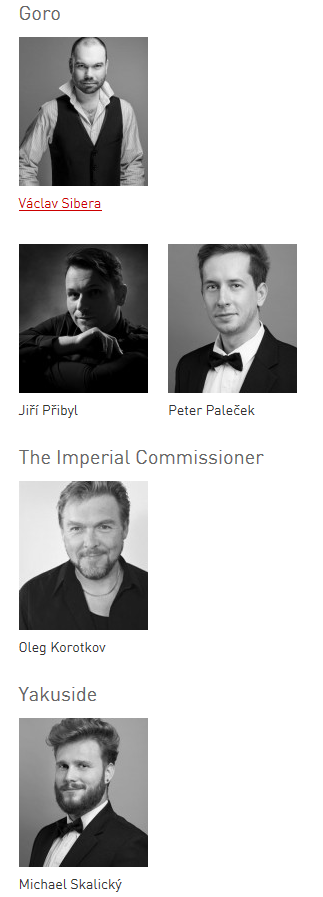
Madama Butterfly at the National Theatre in Prague

nationaltheatre

titleLibretto: Giuseppe Giacosa, Luigi Illica
Musical preparation: Martin Leginus
Conductor: Martin Leginus
Stage director: Jiří Heřman
Sets: Jiří Heřman, Jan Lukášek
Costumes: Alexandra Grusková
Motion cooperation:
Light-design: Daniel Tesař
Chorus master: Adolf Melichar
Dramaturgy: , Ondřej Hučín

butterfly-g-1074

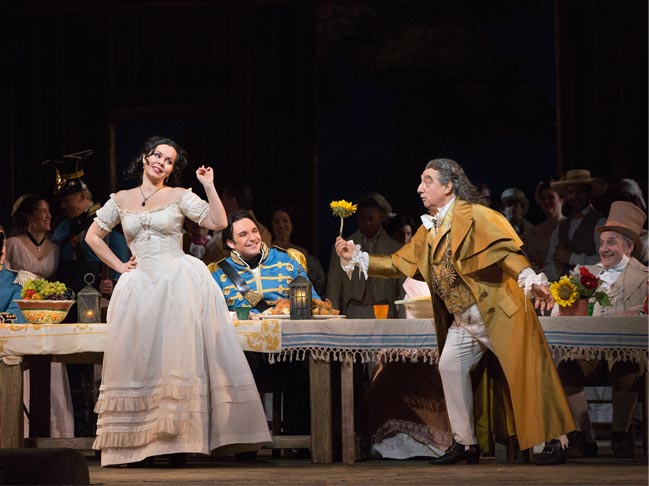
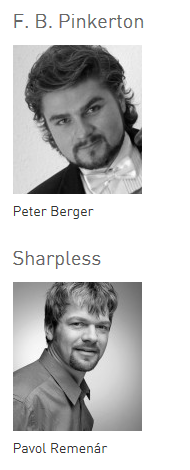
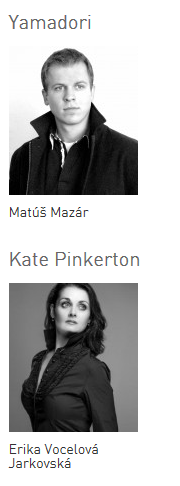
schedulebutterfly“Butterfly” is indisputably one of the most popular and most artistically valued operas of all time. Notwithstanding the fact that it has perhaps the simplest plot of all Puccini’s operas: a “Yankee”, Lieutenant F. B. Pinkerton, enchanted by the picturesque Japanese milieu and the 15-year-old Cio-Cio San, nicknamed “Butterfly”, decides to marry and spend the honeymoon in Nagasaki. He soon abandons his young wife, but after a long time returns so as to take away the child Cio-Cio San has given birth to in the meantime. In this work, Puccini eschewed intricate action and boisterous dramatic events, opting instead for an intimate story and highlighting the psychology of the characters, fleshing out by his music the tiniest details, oscillations and extreme emotional surges, the essential contrast between the Japanese and “Western” mentality, which he also aptly renders by means of many a time surprisingly modified quotations of the US national anthem, as well as giving a forcible depiction of the local colour of Japan, where the story is set. The opera is named after the short story Madame Butterfly by the American lawyer and author John Luther Long, which served as the basis for a drama by the New York impresario and playwright David Belasco, which in turn directly inspired Puccini to compose his celebrated opera. Following the poor reception of the original version at La Scala, Puccini went on to revise Madama Butterfly four times, between 1904 and 1907, before it became a global hit. Our new production, which will replace the current one, performed for three decades, will be prepared by the conductor and music director of the State Opera, Martin Leginus, together with the renowned opera director Jiří Heřman.

Approximate running time, including intermissions: 3 hours, 15 minutes, two 20-minute intermissions

 GALLERY

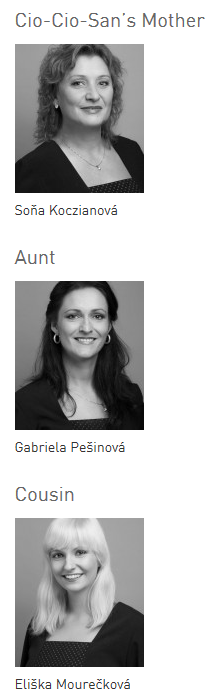
cast1cast2cast3cast4 cast5CAST

Posted in OPera | Tagged , , | Leave a comment

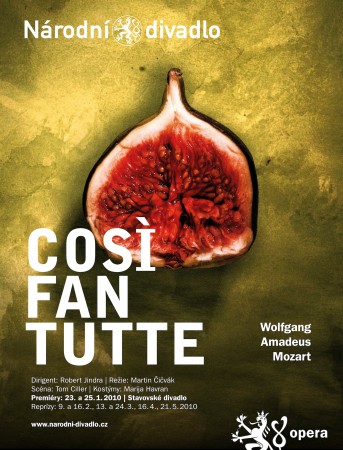
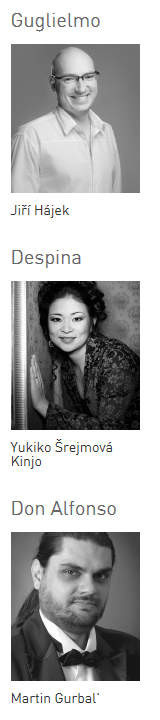
Così fan tutte in Prague

cosititlenationaltheatre

cosi-fan-tutte

MARCH 17, 2016

Musical preparation: Robert Jindra
Conductor: Jan Chalupecký
Stage director: Martin Čičvák
Sets: Tom Ciller
Costumes: Marija Havran
Chorus master: Martin Buchta
Dramaturgy: Ondřej Hučín

National Theatre Orchestra

National Theatre Chorus

Premiere: January 23, 2010

Così fan tutte is Mozart’s final and most intimate Italian comic opera. Lorenzo da Ponte’s libretto, replete with irony and extremely unflattering to (not only) women, was originally supposed to be set to music by Antonio Salieri, who renounced his intention in the very beginning. Mozart, however, amid Da Ponte’s extremely chamber-like story came into his element. Using a mere six characters, at the turn of 1790 he created a work so inspired musically that it would become one of the apices of his oeuvre. The opera Così fan tutte (or Thus Do They All), with the subheading The School for Lovers, is a black comedy exploring human flightiness, defencelessness against one’s own emotions, and the nature of love, which – fidelity or infidelity – is actually always absolutely “sincere”. The Slovak-Czech stage director Martin Čičvák examines the timelessness of this “cruel joke” and in a symbolically circular space depicts a merry-go-round of amorous trifles.

The opera is staged in Italian original version and Czech and English surtitles are used in the performance.

Photo: Diana Zehetner
Approximate running time, including intermission: 3 hours, 10 minutes, one 20-minute intermission

GALLERY

 CAST

cast1cosi cast2cosi

Posted in OPera | Tagged , , , | Leave a comment

Verdi’s Macbeth in Israel

logoisraelioperaMacbeth

Giuseppe Verdi

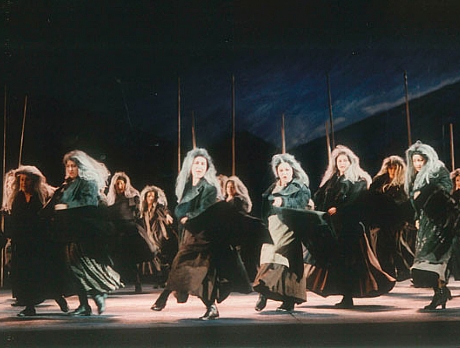
The Scottish tyrant and his crown thirsty wife rule with daggers and assassins in order to preserve the throne. Mysterious witches play with destinies in Verdi’s first Shakespearean opera.

From the repertoire | Sung in Italian | Duration: 2 hours and 45 minutes

Libretto: Francesco Maria Piave

MacbethSchedulemakbetb1

Conductor Emmanuel Joel-Hornak
Yuval Zorn
Choreographer Yoram Karmi
Director Jean-Claude Auvray
Set & Costume Designer Kenny MacLellan
Lighting Designer Avi Yona Bueno (Bambi)

Among the soloists:

Macbeth Lucio Gallo
Vittorio Vitelli
Lady Macbeth Maria Pia Piscitelli
Ira Bertman
Banco Riccardo Zanellato
Gocha Datusani­
McDuff Gaston Rivero
Salvatore Cordella
Malcolm Eitan Drori
Doctor Yair Polishook
Servant Anat Czarny

The Israeli Opera Chorus
Chorus Master: Ethan Schmeisser

The Opera Orchestra – The Israel Symphony Orchestra Rishon LeZion
English & Hebrew Surtitles
Translation:  Israel Ouval

*PREMIÈRE – TUE, 17.5.16, 20:00

makbetb2

Act I
After a victorious campaign against rebel forces, Macbeth and Banquo, generals in the army of King Duncan of Scotland, meet a group of witches, who hail Macbeth as Thane of Cawdor and future king, Banquo as father of kings thereafter. Messengers from Duncan approach, proclaiming Macbeth the new Thane of Cawdor, thus fulfilling the prophecy. Amazed at this turn of events, Macbeth muses on his chances of becoming king.
Lady Macbeth reads a letter from her husband describing his meeting with the witches. Exulting in the prospect of power, she vows to add her own cunning and boldness to Macbeth’s ambition. When a servant brings word that the king will spend the night in the castle, she invokes powers of darkness to achieve her aims. Macbeth enters, and his wife persuades him to murder Duncan that night. Duncan arrives, retiring at once. Macbeth, dreading his task, imagines a dagger before his eyes. As a night bell sounds he steals into the royal chamber. Lady Macbeth meets her husband as he staggers from the room, telling her the deed is done. She coolly takes the dagger from his trembling hands and goes to smear blood on the royal guards, who have been drugged.
Macduff and Banquo enter, discover the murder and summon the entire court.

Act II
Malcolm has fled to England for safety. Macbeth and his wife plot the murder of Banquo and his son, to prevent him gaining the crown as the witches prophesied. A group of assassins awaits Banquo and kill him, but his son Fleance escapes. At a state banquet, Lady Macbeth toasts her guests in a drinking song. Macbeth, secretly informed of the murder of Banquo, complains to the assembly of his absence. Suddenly, to the guests’ astonishment, he imagines that he sees the general’s ghost in front of him.
Lady Macbeth chides her husband, and he momentarily regains his calm, but Banquo’s phantom continues to haunt him, and the guests comment on his behavior. Macbeth decides to go and question the witches.

Act III
Macbeth visits the witches to learn his fate and is confronted with several apparitions. The first tells him to beware of Macduff; the second, a bloody child, assures him no man “of woman born” can harm him; finally a crowned child reveals that Macbeth will rule invincible till Birnam Woods march against him. Comforted, he asks the witches if Banquo’s sons will ever reign in Scotland; in reply they invoke the spirits of eight kings, who pass before the terrified Macbeth. Last of the line is Banquo, holding a mirror that reflects the other kings. Macbeth loses consciousness and the witches disappear. Lady Macbeth finds him, and the couple vows to kill all enemies.

Act IV
Near Birnam Woods Scottish refugees bewails their oppressed homeland, caught in the grip of Macbeth’s tyranny and mourn their families. Macduff, grieving over his murdered wife and children, is joined by Duncan’s son Malcolm; they order their soldiers to cut branches from the trees as camouflage for an attack against  Macbeth’s forces.
A Doctor and a Lady-in-Waiting observe the guilt-wracked Lady Mac¬beth as she wanders in her sleep, wiping imaginary blood from her hands. In her delirium she confesses her crimes and those of her husband.
Macbeth clings to the hope he can withstand the forces of Malcolm and Macduff, but curses his fate. Word of his wife’s death reaches him. Messengers bring the astounding news that Birnam Woods is advancing. Macbeth leads some of his men to battle. Macduff seeks out Macbeth and exclaiming that he is not “a woman born” of woman but torn prematurely from his mother’s womb, kills the tyrant. A chorus of exultation salutes the death of the usurper and the ascent of the throne by Malcolm, the new king.

Posted in OPera | Tagged , , , , , , , , | Leave a comment

Andrea Chenier in Tokyo

tokyo_logo

Andrea Chenier

Music by Umberto GIORDANO
Opera in 4 acts
Sung in Italian with Japanese supertitles
Opera Palace

andreacheniertokyo

Andrea Chénier by Umberto GIORDANO is a well-known work of verismo opera. It portrays a tragic love affair against the turbulent backdrop of the French Revolution between the actual, historical poet, Andrea Chénier, and the daughter of a count, Maddalena. The production by Philippe ARLAUD makes skillful use of devices such as a prop that serves as a metaphor for the guillotine, a revolving stage, light and shadow, and colour.

The young, Italian conductor, Jader BIGNAMINI, makes his first appearance at the NNTT. The title role is played by Carlo VENTRE, Maddalena by Maria José SIRI, a soprano from Uruguay, and Gérard by Vittorio VITELLI.

chenierCalendar

Staff

staffConductor Jader BIGNAMINI 1

Production  Philippe ARLAUD 2

Scenery and Lighting Design  Philippe ARLAUD 2

Costume Design Andrea UHMANN
Lightining Design  TASTUTA Yuji
Choreographer  UEDA Haruka
Revival Director  SAWADA Yasuko
Stage Manager  SAITO Miho

Cast

Andrea Chénier Carlo VENTRE 3

Maddalena di Coigny Maria José SIRI 4

Carlo Gérard Vittorio VITELLI 5

Roucher KAMIE Hayato 6

Un Incredibile MATSUURA Ken 7

La Contessa di Coigny MORIYAMA Kyoko 8

Bersi SHIMIZU Kasumi 9

Madelon TAKEMOTO Setsuko 10

Mathieu OKUBO Makoto 11

Fléville KOMADA Toshiaki 12

L’Abate KAMOSHITA Minoru 13

Fouquier Tinville SUDO Shingo 14

Dumas  OMORI Ichiei 15

Il Maestro di Casa/Schmidt OKUBO Mitsuya 16

Chorus Master MISAWA Hirofumi

Chorus New National Theatre Chorus

Orchestra Tokyo Philharmonic Orchestra

Artistic Director  IIMORI Taijiro

castTokyoAndrea

Synopsis

Time: 1789-94.
Place: In and around Paris.

Act 1

Palace of the Countess of Coigny

Servants are preparing the Palace for a ball. Carlo Gérard, the majordomo, is filled with indignation at the sight of his aged father, worn out by long years of heavy labour for their noble masters. Only the Countess’ daughter Maddalena escapes his hatred, since he is besotted with her. Maddalena jokes with Bersi, her mulatto servant girl. The Countess rebukes Maddalena for dallying around when she should be dressing for the ball.

The guests arrive. Among them is an Abbée who has come from Paris with news about the poor decisions of King Louis XVI’s government. Also among the guests is the dashing and popular poet, Andrea Chénier.

The soirée begins with a “pastoral” performance. A chorus of shepherds and shepherdesses sing idealized rustic music and a ballet mimics a rural love story in stately court fashion. The Countess asks Chénier to improvise a poem but he says that inspiration has abandoned him. Maddelena asks Chénier to recite a verse, but he refuses her also, saying that “Fantasy is not commanded on cue.” The laughter of the girls draws the Countess’ attention, and Maddelena explains mockingly that the Muse of poetry is absent from the party. Chénier now becomes angry and improvises a poem about the suffering of the poor, ending with a tirade against those in power in church and state, shocking the guests. Maddalena begs forgiveness.

The guests dance a gavotte, which is interrupted by a crowd of ragged people who ask for food, Gérard ushers them in announcing that “Her Greatness, Misery” has arrived to the party. The Countess confronts Gérard who repudiates his service and throws his livery at the feet of the Countess, taking his father with him, who threw himself at the feet of the Countess. She orders them all out, and comforts herself by thoughts of her gifts to charity. The ball continues as if nothing had happened.

Act 2

Café Hottot in Paris, during the Reign of Terror

Bersi, now a merveilleuse, chats with an incroyable. She asks him if he is he a spy for Robespierre, but he says that he is a mere “observer of the public spirit”. Bersi asserts she has nothing to hide as “a child of the Revolution”.

A tumbrel passes, bearing condemned prisoners to the guillotine, mocked by the crowd. Bersi leaves. The Incroyable notes that she was with a blonde woman he is looking for; he also notes that Chénier is at a nearby table waiting nervously and that Bersi had made signs at him.

Chénier’s friend Roucher enters. He reminds Chénier that he is under suspicion for his association with disgraced General Dumoriez and urges him to flee. He offers Chénier a false passport. Chénier refuses: his destiny is love; he has been waiting for a mysterious woman who has sent him letters. Roucher sees the last letter, and dismisses it as from a prostitute and he warns Chénier that love is dangerous during the Révolution. He persuades Chénier to take the passport.

A procession of revolutionary leaders passes, including Robespierre and Gérard, who enters the café. The Incroyable reports to him about Bersi and the possible connection with the blonde, whom Gérard has been seeking, saying that she will come to the café that night. Bersi returns, and pleads with Roucher to keep Chénier there. She leaves for a dance with the Incroyable. Roucher persuades Chénier to leave, but the old woman Madelon tells Chénier to wait for a woman called “Speranza” (Hope); all leave, except the Incroyable, who returns and hides.

A hooded woman enters. It is “Speranza”. She uncovers herself, and Chénier recognizes her as Maddalena de Coigny. The Incroyable leaves to tell Gérard. Despite the danger, Chénier and Maddalena proclaim their love in a passionate duet.

As they prepare to leave they are discovered by Gérard. Chénier sends Maddalena away with Roucher and wounds Gérard in a swordfight. Believing he is dying, Gérard warns Chénier to flee from the wrath of the prosecutor Fouquier-Tinville, Chénier’s enemy, and asks him to protect Maddalena. The Incroyable returns with soldiers and a crowd, but Gérard tells them that his assailant is unknown to him. All blame the Girondists.

Act 3

The Revolutionary Tribunal

The sans-culotte Mathieu calls on the people to give money for the army of the Revolution, but they refuse. Gérard, who has recovered, enters and renews the appeal and the people react with enthusiasm. A blind woman comes in with her grandson, whom she gives to be a soldier of the Revolution. The crowd disperses.

The Incroyable reports to Gérard that Chénier has been arrested in the Parisian suburb of Passy and interned in the Luxembourg Palace, and it is only a matter of time before Maddalena will come for him. He urges Gérard to write down the charges against Chénier for his trial. Gérard hesitates but the Incroyable convinces him that a conviction by the Tribunal will only secure Maddalena’s appearance. Alone, he muses that his Revolutionary ideals are being betrayed by his false charges, therefore he is still a slave: formerly of the nobles, now of his own lust. Finally desire triumphs and he signs the indictment in a mood of cynicism. (Gérard: “Nemico della patria?!”) The Incroyable takes it to the Tribunal.

Maddalena enters to plead for Chénier’s life. Gérard admits that he had Chénier arrested to control Maddalena. He has been in love with her since they were children and he remembers the time when they were allowed to play together in the fields of her house, how when he was handed his first livery, he watched in secret Maddalena learning to dance at the time when he was in charge of opening doors, but now he is a powerful man and will have his way. Maddalena refuses: she will shout out her name in the streets and be executed as an aristocrat, but if her virtue is the price for Chénier’s life, then Gérard can have her body.

Gérard is about to take her but recoils when he realizes the love that she professes for Chénier. Maddalena sings how the mob murdered her mother and burned her palace, how she escaped, and how Bersi became a prostitute to support them both. She laments how she brings disgrace to all that she loves and finally how Chénier was the force that gave life back to her.

Gérard searches for the indictment to cancel it, but it has already gone. He pledges to save Chénier’s life even at the cost of his own. A clerk presents the list of accused persons, including Chénier. A crowd of spectators enter, then the judges, presided over by Fouquier-Tinville, then the prisoners. One by one, the prisoners are hastily condemned. When Chénier is tried, he denies all the charges, and proclaims his honour.

Chénier’s plea has moved everyone and Fouquier-Tinville is forced to take up witnesses. Gérard approaches the Tribunal and confesses to the falsity of his indictment but Fouquier-Tinville takes up the charges himself. Gérard defies the Tribunal: justice has become Tyranny, and “we murder our poets.”

Chénier embraces Gérard, who points out Maddalena in the crowd. The Tribunal condemns Chénier to death and he is led off with the other prisoners.

Act 4

St. Lazare Prison

Chénier awaits his execution with Roucher, writing verses of his faith in truth and beauty. Roucher leaves, as Mathieu sings the Marseillaise outside.

Maddalena enters with Gérard for a last meeting with Chénier. Maddalena bribes the jailer Schmidt to let her change places with a condemned noblewoman. Gérard leaves to make a last appeal to Robespierre.

The lovers sing about their love and their deliverance from this world after death. As dawn approaches, Schmidt calls their names. They go to face the guillotine joined in love.

(Source: Wikipedia.org)

Noted arias

  • “Un dì all’azzurro spazio”, also known as “L’improvviso” (One day in azure space – Chénier);
  • “Come un bel dì di maggio” (Like a beautiful day in May – Chénier) [This among the comparatively few musical passages that can be excerpted from the work’s verismo flow];
  • “Vivere in fretta” (To live in a hurry – Bersi);
  • “Nemico della patria” (The enemy of his country – Gérard)
  • “La mamma morta” (My mother died … – Maddalena)
Posted in OPera | Tagged , , | Leave a comment

Charles Gounod’s Romeo et Juliette in Israel with Gaston Rivero

logoisraelioperaRomeo et Juliette
Charles Gounod

The star crossed lovers from Verona, whose sweet love ends in a double suicide, reach the opera stage in Gounod’s larger than life French masterpiece.

New Production | Sung in French | Duration: 3 hours

Libretto: Jules Barbier

RomeoSchedule

Romeo2
 

Conductor Francesco Cilluffo
Karin Ben-Josef
Director Jean-Louis Grinda
Set Designer Eric Chevallier
Costume Designer Carola Volles
Choreographer Elisabetta Acella
Lighting Designer Roberto Venturi

Among the soloists:

Romeo Gaston Rivero  Read a previous interview with the tenor Gaston Rivero on OperaMyLove
Nagmiddin Mavlynov
Juliette Aurelia Florian
Hila Baggio
Friar Lawrence Petri Lindroos
Yuri Kissin
Stephano Na’ama Goldman
Anat Czarny
The Duke Vladimir Braun
Mercutio    Enrico Maria Marabelli
Oded Reich
Capuelt       Radu Pintillie
Noah Briger
Tybalt Yosef Aridan
Gertrude        Shay Bloch
Anat Czarny
Paris Oded Reich
Yair Polishook
Gregorio Yair Polishook
Gabriel Lowenheim
Benvolio Liran Kopel

The Israeli Opera Chorus
Chorus Master: Ethan Schmeisser
The Opera Orchestra – The Israel Symphony Orchestra Rishon LeZion
English & Hebrew Surtitles
Translation: Israel Ouval

*16.4.16 – The performance is dedicated to the memory of our beloved Shimshon Zelig
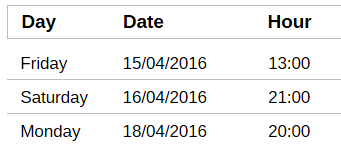
**PREMIÈRE – 18.4.16, 20:00

GALLERY (Photos by Israeli Opera)

This slideshow requires JavaScript.

SYNOPSIS

ACT I
A ball at the Capulets’ Palace.
After the prologue-overture which, as in Shakespeare’s play, presents an outline of the drama, the curtain rises on a dazzling ball in the palace of the Capulets. They are celebrating Juliet’s birthday. Her father, Count Capulet, the master of the palace, has promised her to Count Paris. Everyone admires the young girl’s beauty, and her father bids the guests to enjoy themselves. Two masked members of the rival Montague clan, Romeo and Mercutio, have slipped incognito into the ball. Romeo has dark forebodings, but his friend jokes teasingly that Mab the Queen of Dreams must have paid him a visit during the night. Suddenly Romeo sees Juliet at a distance and is immediately smitten with love for her. Juliet confesses to her nurse, Gertrude that she would like to enjoy her youth before getting married. Seeing that Gertrude has been called away, Romeo approaches Juliet and declares his love for her, which arouses tender emotions inside her. The arrival of Tybalt, Juliet’s cousin, brutally shatters the enchantment. Romeo realizes that his beloved is the daughter of his enemy Capulet, while Tybalt recognizes the voice of the hated Romeo. The lovers are horrified to discover that they belong to two families separated by an ancient and hate-filled feud. The rules of hospitality forbid Tybalt from venting his anger, and Capulet orders the festivities to proceed.

ACT II
Juliet’s garden.
Night has fallen. Romeo is alone and enters Juliet’s garden. He sees her at her window and compares her beauty to that of the rising sun. Juliet steps out onto her balcony and the two lovers pledge their love for each other. But their idyll is interrupted by the arrival of a group of servants led by Gregorio searching for some Montagues suspected of slipping into the ball. Gertrude sends them away and then calls Juliet in, scolding her for not being in bed. The lovers reluctantly take leave of each other, promising to meet again the next day.

ACT III
Scene i
Friar Lawrence’s cell.
At sunrise Romeo and Juliet go to Friar Lawrence’s cell. Deeply moved by the force of their love he agrees to marry them in secret. Gertrude, who has arrived in the meantime, shares their joy.

Scene ii
The public square in front of the palace of the Capulets.
Shortly afterwards Romeo’s page, Stephano, comes looking for his master. He mockingly compares the Capulets’ palace to a vultures’ nest where Juliet, a white dove, is living in bad company. The reaction is swift: Gregorio challenges him to a duel. Mercutio rushes in to help Stephano. Then Tybalt rushes into the affray. Romeo runs in to calm everyone down and refuses to fight against Tybalt who is now his cousin by marriage. But Mercutio is mortally wounded and Romeo immediately avenges his death by killing Tybalt. The Duke of Verona observes the disaster and after pronouncing very harsh words against both families he banishes Romeo from Verona.

ACT IV
Juliet’s room.
Romeo has joined Juliet for one last night. She forgives him for killing Tybalt. The song of the lark announces the dawn, the moment of their heart-rending farewells before Romeo’s departure. Capulet enters, accompanied by Friar Lawrence who has to prepare Juliet for her imminent marriage to Paris. Alone with Juliet, who wants to die, Friar Lawrence persuades her to drink the potion. The friar leaves and Juliet begins to feel the effects of the poison.

ACT V
The tomb of the Capulets.
Believing that Juliet is dead, Romeo takes one final look at her and then drinks the poison. Juliet slowly wakes from her deep sleep. Their joy at being reunited is short lived. Romeo weakens. Juliet sees the empty phial and realizes what has happened. She stabs herself and the lovers die in each other’s arms, imploring God’s forgiveness.


Posted in OPera | Tagged , , | Leave a comment