Carmen at the Teatro alla Scala

scala

Carmen

Georges Bizet

Orchestra and Chorus of the Teatro alla Scala

Treble Voices Chorus of the Teatro alla Scala

Teatro alla Scala Production

From 22 March to 16 June 2015

Running Time: 3 hours 25 minutes intermissions included

Sung in French with electronic libretto in Italian, English, French

carmen7Notes on the performances

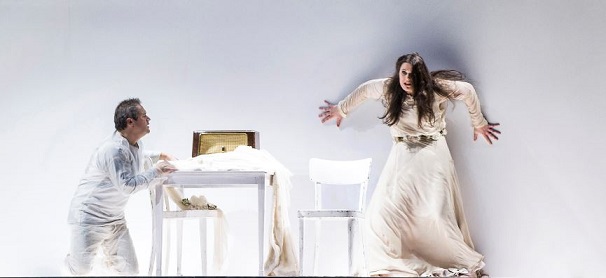
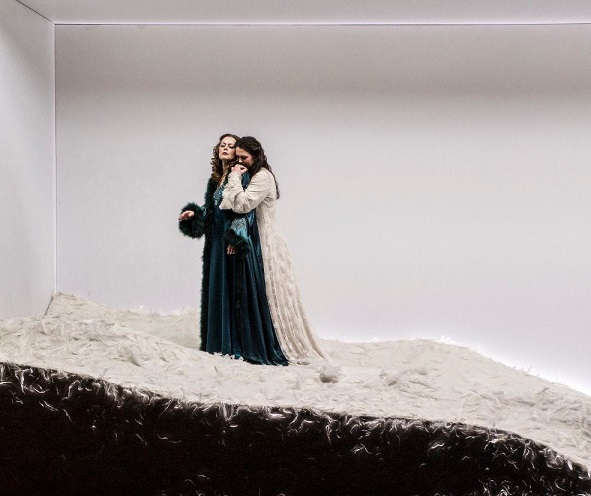
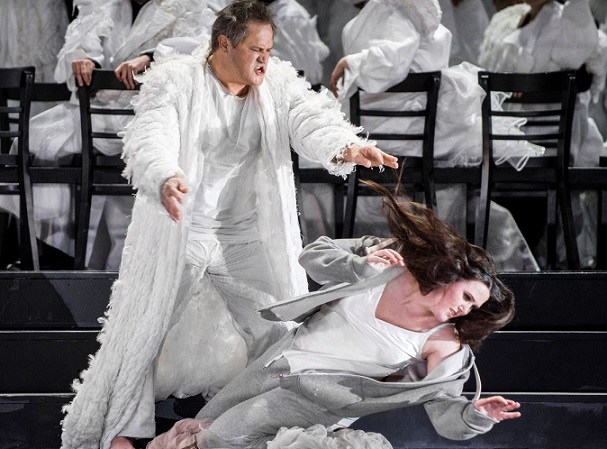
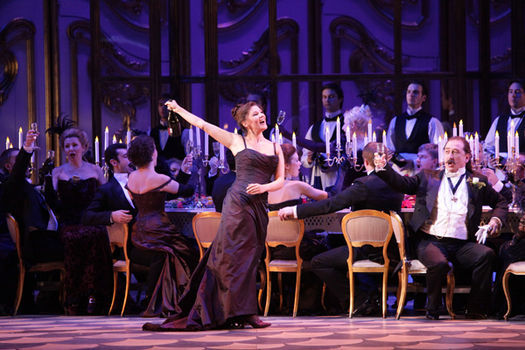
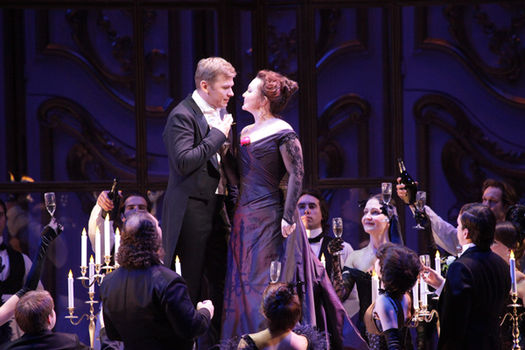
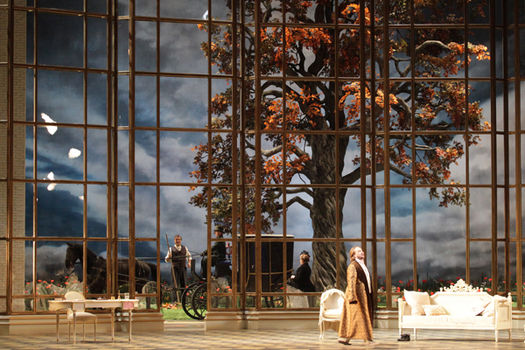
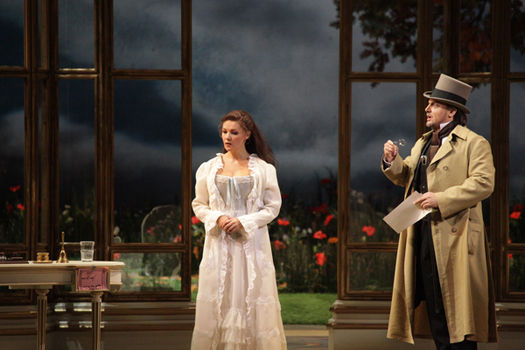
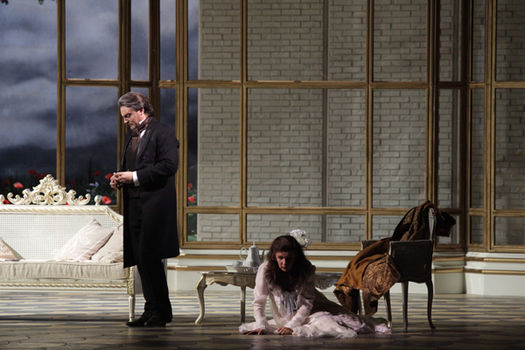
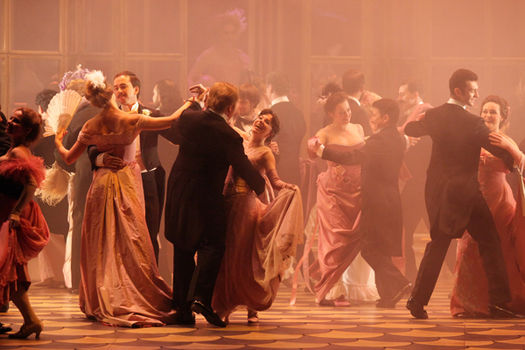
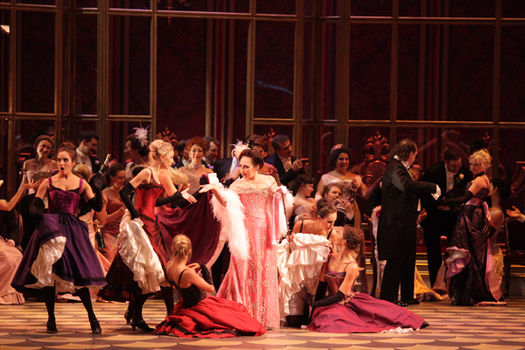
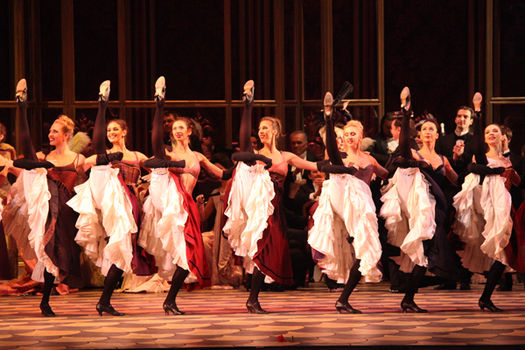
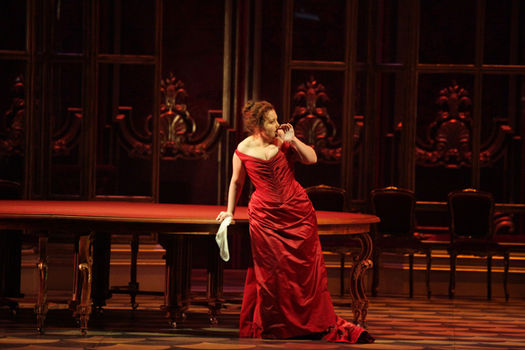
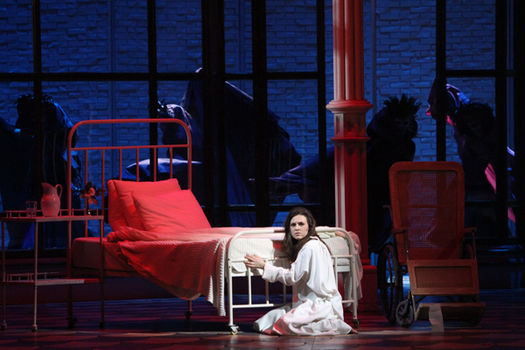
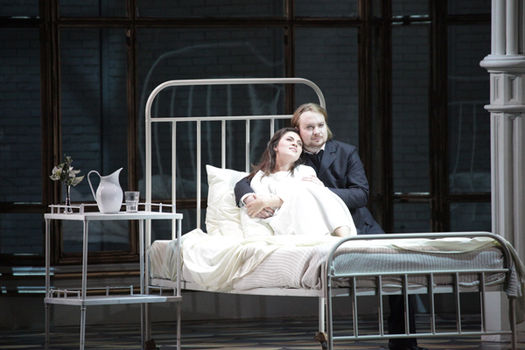
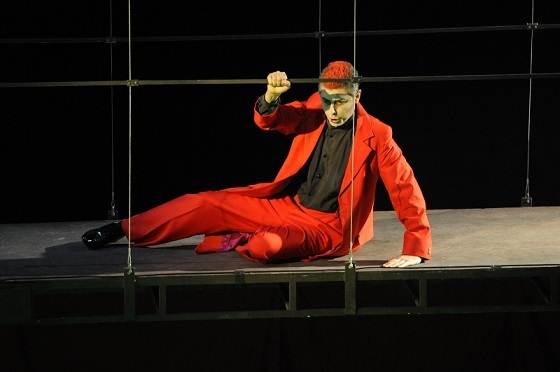
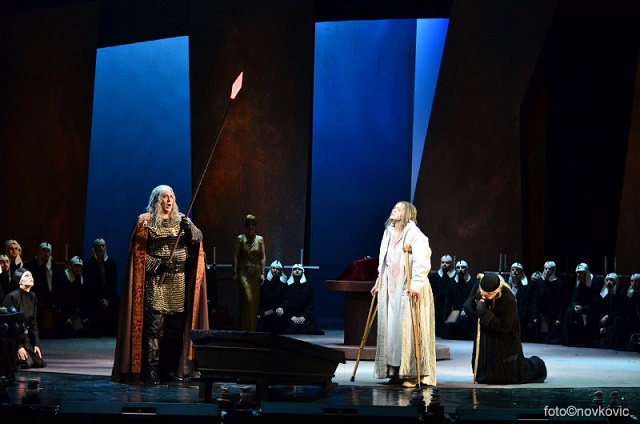
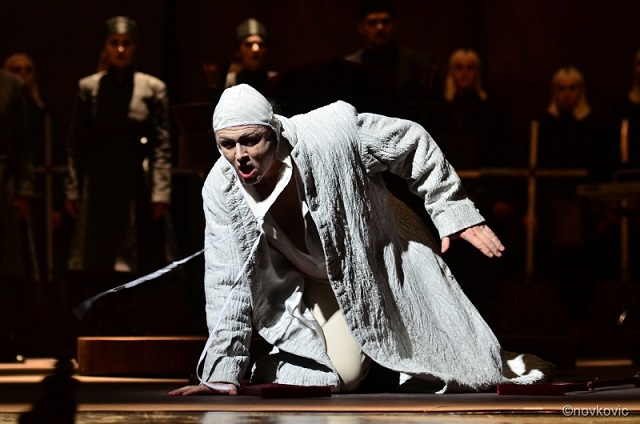
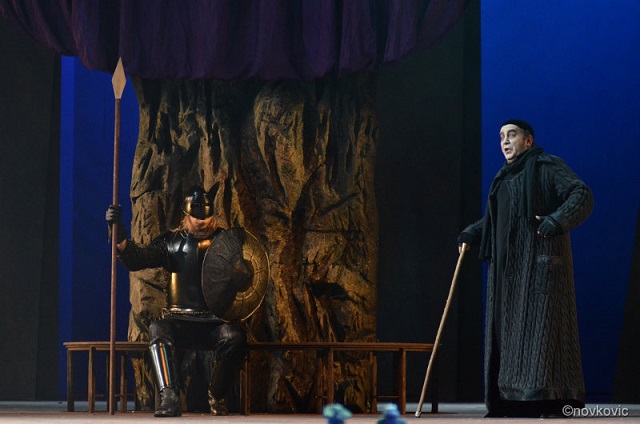
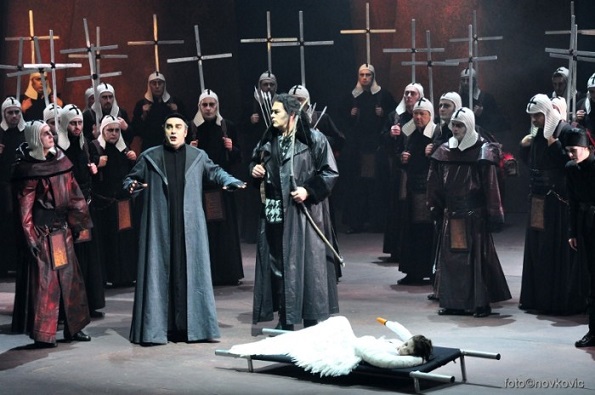
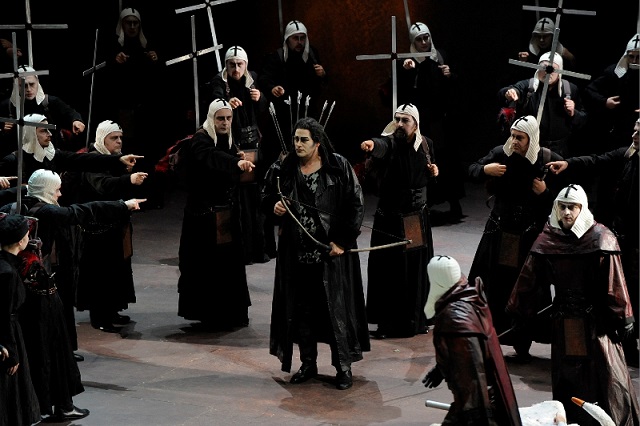
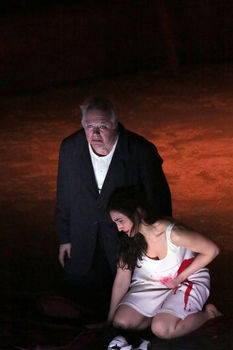
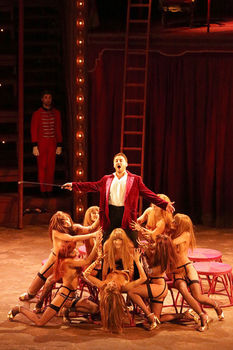
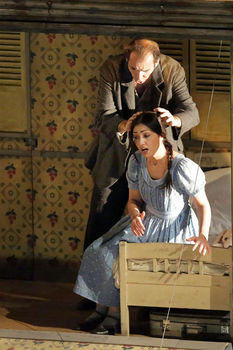
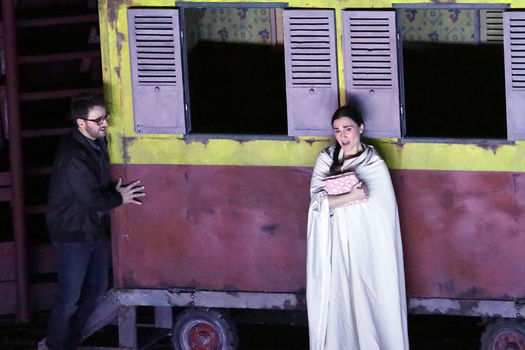
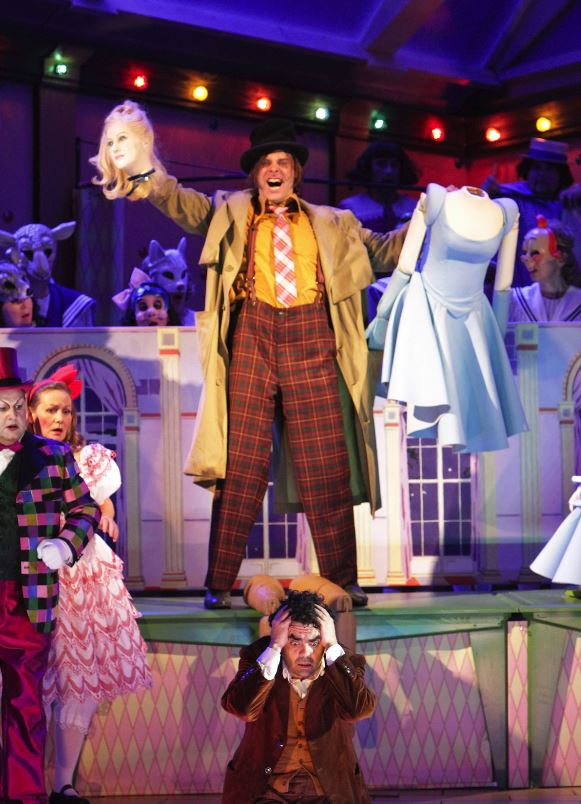
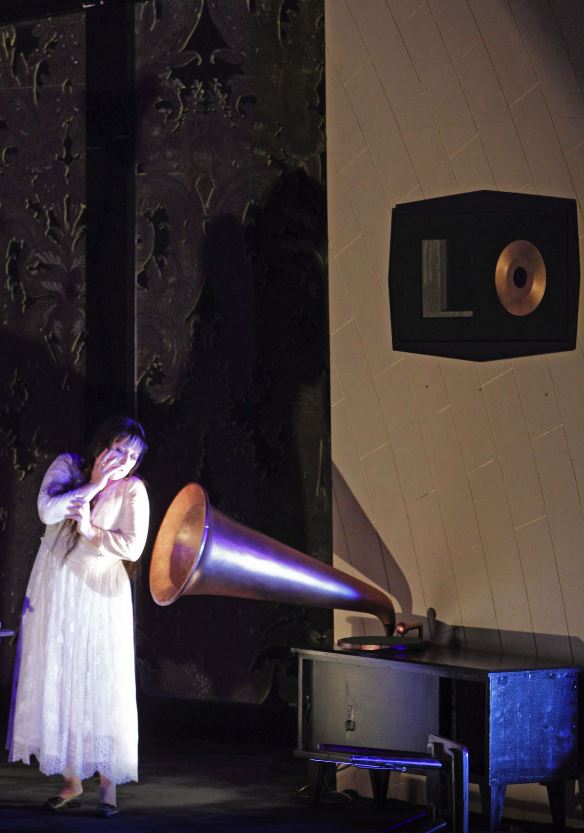
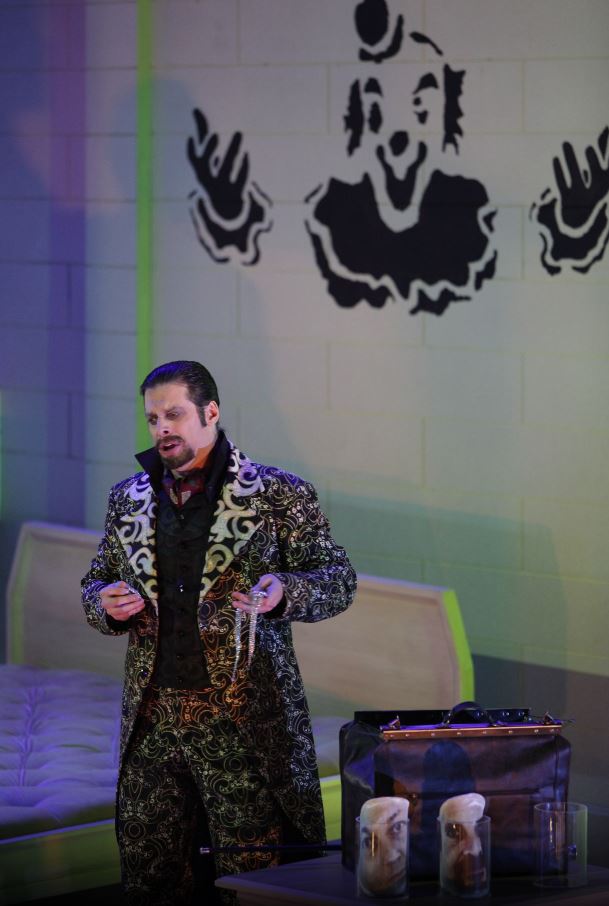
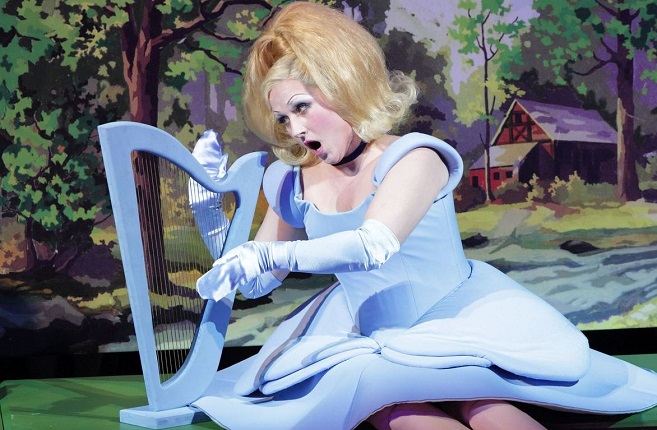
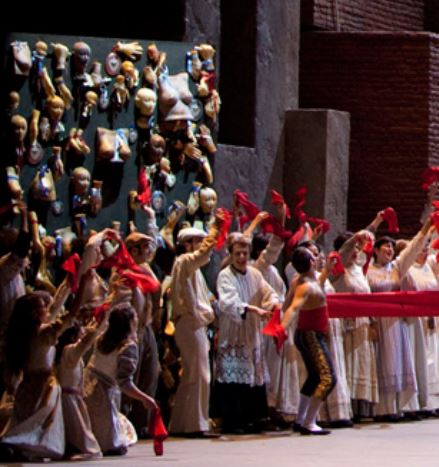
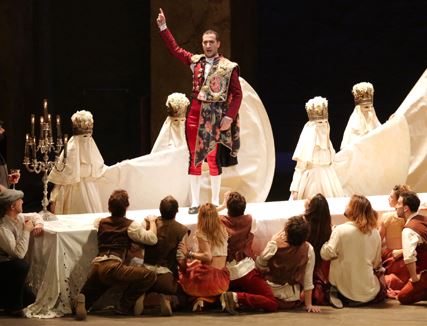
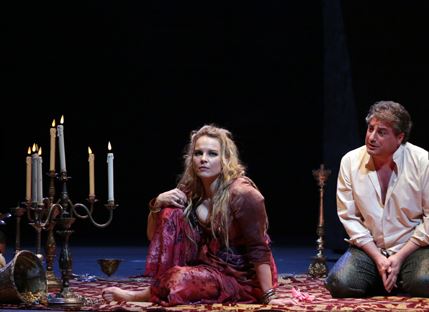
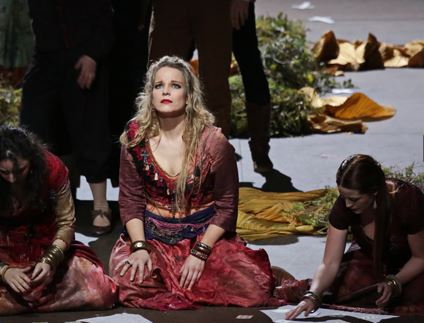
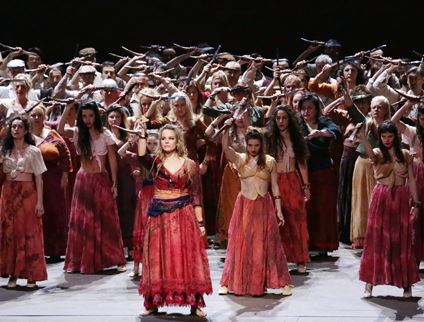
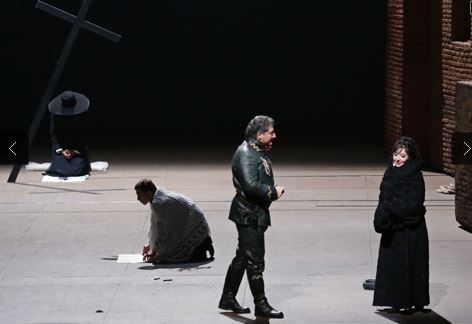
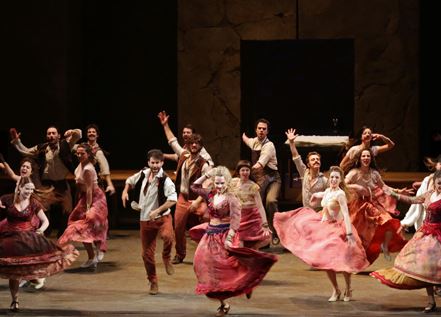
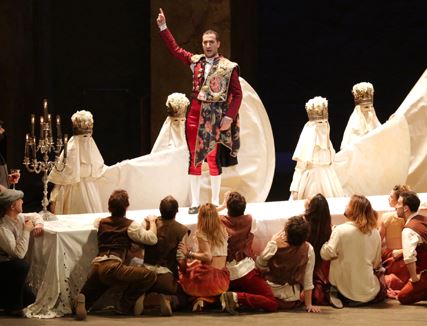
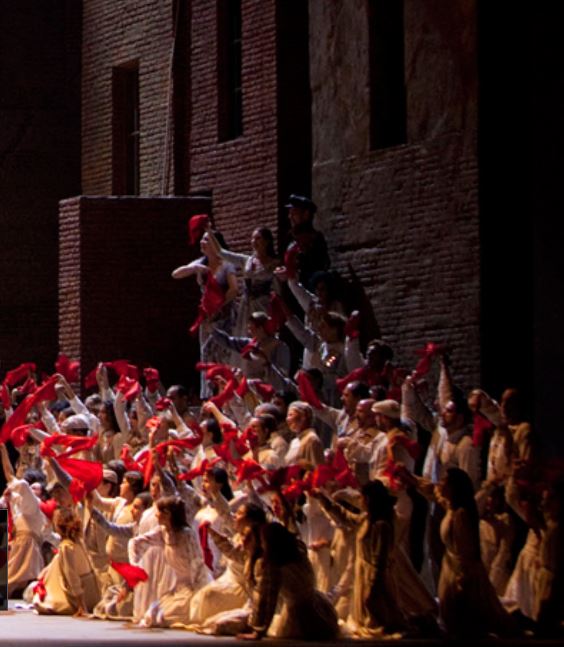
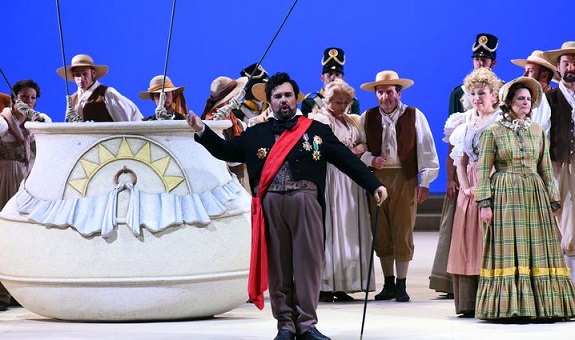
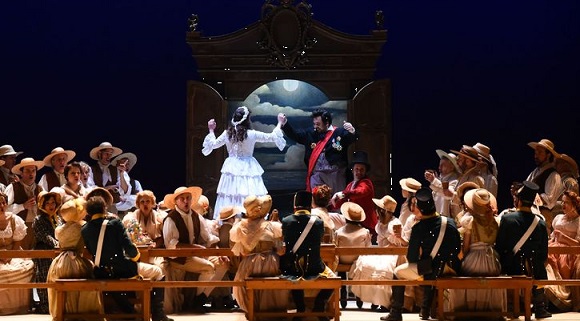
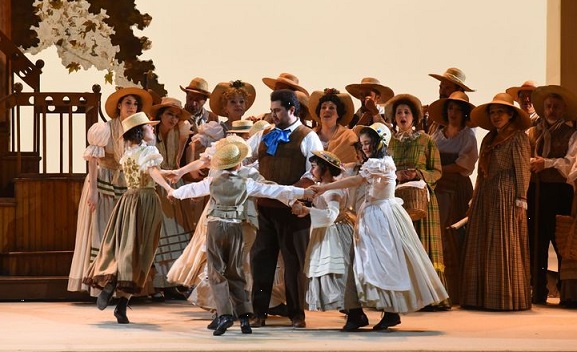
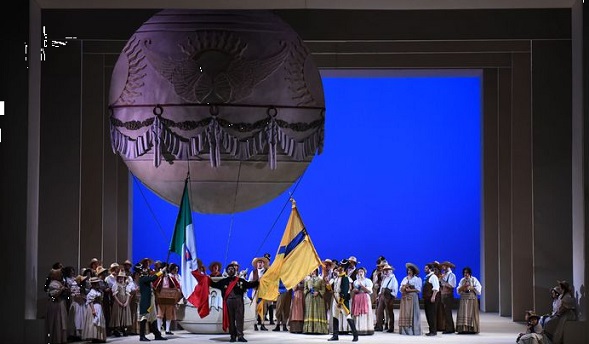
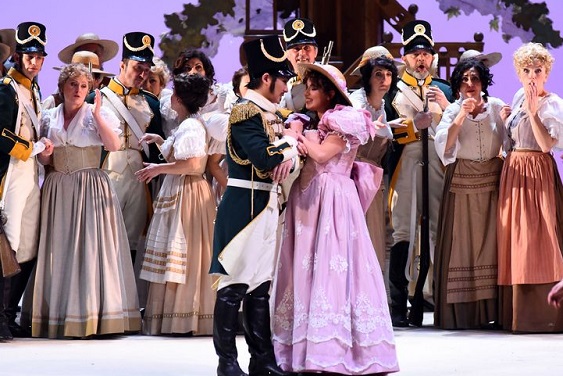
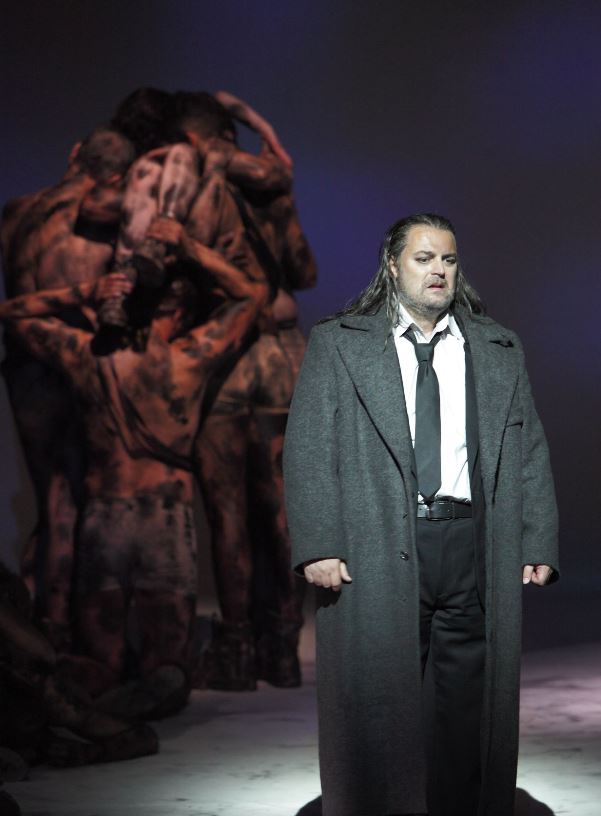
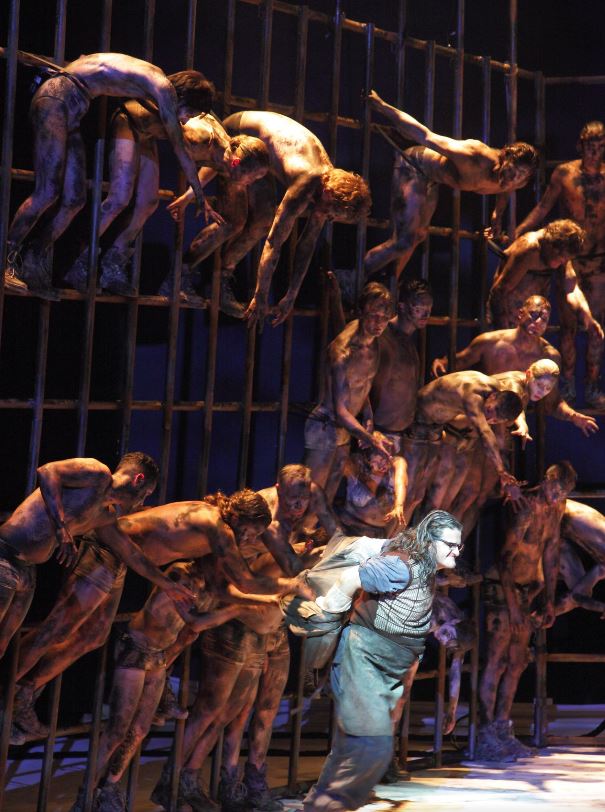
By now an acclaimed classic with a stream of revivals, this is the Emma Dante show that so shocked part of the gallery on its opening night in 2009. A free, secular and rebellious Carmen, mired in a world of grey and dusty decay, bedecked with religious ornaments, votive offerings and blood-red gashes. A maiden Carmen, untouched by social hypocrisy, an unsullied martyr, almost angelic. The leads were played by Elīna Garanča and José Cura, then revisited by Anita Rachvelishvili (making her debut to great acclaim in this show) and Francesco Meli. The baton is wielded by the world-renowned opera specialist Massimo Zanetti.

Carmen4Direction

Conductor
Massimo Zanetti

Staging

Emma Dante
Sets
Richard Peduzzi
Costumes
Emma Dante
Lights
Dominique Bruguière
Choreographic movements
Manuela Lo Sicco

Carmen12 CAST

Don José José Cura (March); Francesco Meli (June)
Escamillo Vito Priante (March); Artur Ruciński (June)
Le Dancaïre Michal Partyka
Le Remendado Fabrizio Paesano
Moralès Alessandro Luongo
Zuniga Gabriele Sagona
Carmen Elīna Garanča (March); Anita Rachvelishvili (June)
Micaëla Elena Mosuc (March); Nino Machaidze (June)
Frasquita Hanna Hipp
Mercédès Sofia Mchedlishvili*
Une marchande d’orange Alessandra Fratelli
Un bohemien Alberto M. Rota
Lillas Pastia Rémi Boissy
Un guide Carmine Maringola

*Soloist of the Teatro alla Scala Academy

Synopsis

Act I
A square in Seville.
Outside the cigarette factory, soldiers on guard duty watch the passers-by (Scena and Chorus: “Sur la place, chacun passe”). From a distance is heard a military march, followed by a band of urchins: it’s the changing of the guard (Chorus: “Avec la garde montante”). The factory bell rings, and everybody presses forward to see the cigarette girls come out, and especially to court the most seductive of them all: the gypsy Carmen (Chorus: “La cloche a sonné”). Impudent and indifferent, the girl sings a song (Habanera: “L’amour est un oiseau rebelle”) and throws a flower to Don José, a corporal in the Dragoons. He is perturbed by her gesture. The arrival of his fiancée Micaëla, who brings greetings from his distant mother, seems to take Don José’s mind off Carmen (Duet: “Parle-moi de ma mère”). But then a furious row breaks out in the factory, started by the comely cigarette girl (Chorus: “Au secours! N’entendez-vous pas?”). She is promptly arrested and handed over to Don José. During the brief interrogation, conducted by lieutenant Zuniga, Carmen refuses to answer questions. Instead she cheekily hums to herself (Song: “Tra la la la la la la la”). Then, alone with Don José, she strikes up another song to convince the corporal to let her escape: in exchange she promises him a rendezvous at Lillas Pastia’s inn (Seguidilla and Duet: “Près des remparts de Séville”). Bewitched by the gypsy girl, Don José has himself thrown to the ground, thus enabling Carmen to take to her heels, amidst laughter from the cigarette girls (Finale: “Voici l’ordre, partez”).Carmen13

Act II
At Lillas Pastia’s inn.
Carmen sings and dances with two of her female friends (Frasquita and Mercédès) in Lillas Pastia’s ill-reputed tavern (Song: “Les triangles des sistres tintaient”). Also among the somewhat dubious people in the establishment is lieutenant Zuniga, who woos the gypsy girl. Later, with his retinue of admirers (Chorus: “Vivat! Vivat le toréro”), the toreador Escamillo enters, singing his famous couplets (“Votre toast, je peux vous le rendre”). Carmen resists his advances too, for she is in love with Don José and is waiting for him to be released from prison, into which he has been thrown for having let her get away. It is closing time. Everybody comes out except Lillas Pastia and the other members of the band of smugglers to which Carmen also belongs. They are preparing a robbery for that night and try to convince Carmen to join them (Quintet: “Nous avons en tête une affaire”). Meanwhile a song is heard off stage: it is sung by Don José who is gradually approaching (“Halte-là! Qui va là?”). The soldier and the gypsy remain alone, and she dances for him, accompanying herself on the castanets (Duet: “Je vais danser en votre honneur”). A stand-easy is heard from the streets, and Don José, who has been demoted to the rank of private, says he must now return to barracks. Carmen inveighs against him and makes fun of him. In the meantime lieutenant Zuniga returns and attempts to seduce the beautiful gypsy. Blind with jealousy, Don José flings himself at him, but the smugglers enter, separate them and lead Zuniga away (Finale: “Holà! Carmen, holà!”).

Carmen8 Carmen9 Carmen10 Carmen11

Act III
A wild and remote spot.
The scene opens in the smugglers’ den. It is night (Sextet and Chorus: “Écoute, écoute, compagnon”). Don José, who has followed Carmen into the mountains, creeps about uneasily while thinking with remorse of his old mother. Carmen has already tired of him and, turning her back on him, she reads the cards with Frasquita and Mercédès (Trio: “Mêlons! Coupons!”), but her fate is sealed: the cards indicate death for her and for Don José. The smugglers go off with the women to do their shady business (Ensemble:

“Quant au douanier, c’est notre affaire”). Micaëla enters, accompanied by a guide: she is looking for Don José (Aria: “Je dis que rien ne m’épouvante”). The latter, who still desperately loves the woman for whom he has ruined his life, clashes with Escamillo (Duet: “Je suis Escamillo”) who has come up the mountains to see Carmen. The two men are fighting with knives when Carmen arrives, just in time to separate them. Escamillo invites the gypsy to the bullfight and goes out. Micaëla arrives to tell Don José that his mother is dying and beseeches him to follow her. Don José, stricken with sorrow and jealousy, and threatening Carmen who defies and taunts him mockingly, follows Micaëla out (Finale: “Holà! Holà, José”).Carmen3 Carmen5 Carmen6 Carmen8

Act IV
A square in Seville near the Arena.
The square is filled by a many-coloured and noisy crowd (Chorus: “À deux cuartos”) awaiting the arrival of the torero to acclaim and cheer him. Escamillo enters, with Carmen (March and Chorus: “Les voici! Les voici!”). Frasquita and Mercédès warn their friend of Don José, whom they have seen lurking in the neighbourhood. They all go into the Arena except the two exlovers (Duet and Final chorus: “C’est toi? / C’est moi!”). In vain Don José implores Carmen to come back to him and to love him again. But the gypsy is adamant. She tosses away the ring which he had given her, while from the Arena are heard acclamations of the torero’s victory. As Escamillo steps out of the Arena surrounded by the festive crowd, Don José stabs Carmen to death and falls sobbing over her corpse, calling out her name in despair.

carmen1

CARMEN: A BRIEF OVERVIEW

BY EMILIO SALA

The most reliable experts swear that the opera is the most widely performed in the world. However, when it was first staged at the Opéra-Comique in Paris on 3 March 1875, it was given a rather frosty reception. The fact that the public did not understand it was a cause of deep sorrow to Bizet, who died three months later at the age of only thirty-six. Even so, Carmen ran for

48 consecutive performances, which can hardly be considered a negligible figure, although ironically, the audiences were drawn by the opera’s reputed indecency and its condemnation by the press. “Our stages are increasingly invaded by courtesans. This is the class from which our authors so like to re- cruit the heroines of their dramas and their opéras-comiques”, wrote Achille de Lauzières in his review published in La Patrie on 8 March. He went on: “It is the fille in the most repugnant sense of the word [that has been set on stage]; the fille who is obsessed with her body, who gives herself to the first soldier that passes, on a whim, as a dare, blindly; […] sensual, mocking, hard-faced; miscreant, obedient only to the law of pleasure; […] in short, well and truly a prostitute off the streets”. The critic for the Petit Journal on

6 March said of the interpretation of Carmen: “Madame Galli-Marié has found how to make the character of Carmen more vulgar, more hateful and more abject than it already was in Mérimée. Her interpretation is brutally re- alistic, in the manner of Courbet”. We shall return to the realism and to Célestine Galli-Marié, the first to play the role of Carmen; however, it should be strongly underlined that perceiving Carmen as a fille, a prostitute, is a de- fensive reaction, typical of the bourgeoisie, and of which there is no evi- dence in the opera. If anything, she is the opposite: Carmen never sells her- self; she is a free woman (this is the real scandal), wholly coherent and un- compromising. “Jamais Carmen ne cédera, libre elle est née et libre elle mourra” [Never will Carmen cede, free she was born and free she will die].Carmen14

If we wish to measure the distance that separates Bizet’s Carmen from an average opéra-comique of the time, we might refer to a previous adaptation of Mérimée’s story, La fille d’Égypte (1862) by Jules Barbier, with music by Jules Beer. Browsing through this banal work, writes Hervé Lacombe, “it is easier to understand the formidable challenge of Bizet’s score to the melliflu- ous conventions of the opéra-comique”. However, it should also be pointed out how, at the same time, Bizet’s Carmen went against the poeticising ten- dency typical of the period (see Thomas’s Mignon of 1866), which was push- ing the opéra-comique towards the delicate sentimentalism of the opéra- lyrique. Bizet himself had also moved in this direction with his Djamileh, staged at the Opéra-Comique in 1872. And the same can be said of the re- vival of Gounod’s Roméo et Juliette under the direction of Bizet at the Opéra Comique in 1873. So, with Carmen, Bizet doubly dissociates himself, from the opéra-comique on the one hand, and from the opéra-lyrique on the oth- er. The category to which Carmen belongs, however, is still not clear today and something of a problem. “They say that I am obscure and complicated,”

Bizet tells his mother-in-law, “but this time I have written an opera that is completely clear, lively, colourful and melodious.” Like the dramatic mecha- nisms used, it is elementary music.

It may be easier to understand Carmen by looking firstly at Daudet’s L’Arlé- sienne, a play for which Bizet wrote some beautiful incidental music in
1872.
The use of pre-existing material taken from the Provencal folk tradi- tion, in order to create a musical background against which to set the ac- tion, anticipated one of the features of Carmen: let us not forget that the fa- mous Habanera from the first act is based on a then popular Spanish song, El Arreglito, by Sebastián de Yradier. The effect of contrast between the painful explosion of the individual drama and the jubilant sound of the inci- dental music describing the action with its festive folk sound closely links the finales of the first and fourth tableaux in L’Arlésienne with the last act of Carmen. And indeed, the enhancement of the theatrical dimension in Bizet’s last opera is extremely evident. If the mixed forms of drama appeared to the opéra-lyrique to be a throwback to the past (Roméo et Juliette, mentioned above, was performed with the recitatives sung), the spoken dialogues in Carmen acquire considerable importance. The same can be said for the mélodrames (the simultaneous presence of spoken dialogue and music) al- ready experimented in L’Arlésienne. Nowadays, we are not wholly aware of this, because even in the most “philological” productions the spoken parts are unashamedly cut. The famous realism of Carmen lies firstly in the struc- ture: the amount of incidental music, justified by the action and the back- drop against which it takes place, is very surprising and corresponds to the enhancement of the theatrical dimension mentioned previously. Carmen’s songs in the first and second acts would be as pertinent even if we were to imagine the opera as a spoken theatrical drama. Then, of course, there is Don José’s song performed off-stage and again the first part of his duet with Carmen in the second act, which are pure theatre, pure incidental music. Célestine Galli-Marié was the singer who first starred as Carmen, and who worked closely with Bizet on modelling the character. As Hervé Lacombe ex- plains, her interpretation of the part was based more on the effectiveness of her acting than on her voice or her ability to sing. The first success of Car- men came with its production in Vienna during the autumn of 1875 and co- incided with a series of interventions including additions, rewritings, indica- tions for its execution, which were more or less justified and had the inten- tion of normalising/lightening Bizet’s original score, and which became the standard in Ernest Guiraud’s version. Following Fritz Oeser’s questionable critical version of the Sixties, musicologists from around the world have be- gun to look at the opera again and to clean it up with the aim of returning to a version that is as close as possible to what Bizet intended. Robert Did- ion’s version for La Scala is without a doubt a further step in this direction.

Posted in OPera | Tagged , , , , , , , | Leave a comment

L’ELISIR D’AMORE in Parma

regioelisir

Sunday 22nd, March 2015, at 20.00 turn A
Thursday 26th March 2015, at 20.00 turn B
Sunday 29th March 2015, at 15.30 turn D
Tuesday 31st March 2015, at 20.00 turn C

regio1

Playful melodrama in two acts, libretto by FELICE ROMANI

Music by GAETANO DONIZETTI

Characters Cast
Adina JESSICA NUCCIO
Nemorino CELSO ALBELO
Belcore JULIAN KIM
Il dottor Dulcamara ROBERTO DE CANDIA
Giannetta ELEONORA CONTUCCI


regio2Conductor
FRANCESCO CILLUFFO

Direction
MARCELLO GRIGOROV

Scenes and costumes
NICA MAGNANI

Lights
ANDREA BORELLI

Chorus Master
MARTINO FAGGIANI

ORCHESTRA REGIONALE DELL’EMILIA ROMAGNA
CORO DEL TEATRO REGIO DI PARMA
Settings by Teatro Regio di Parma

Coproduction with
Fondazione Teatro Comunale di Modena
With overtitles

Performance lasts 2h 20′
Act I: 70′ – Interval: 20′ – Act II: 50′elisir1 elisir2

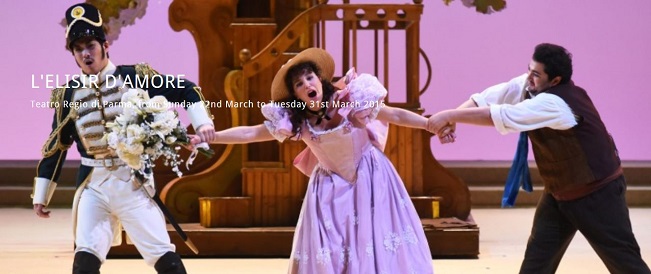
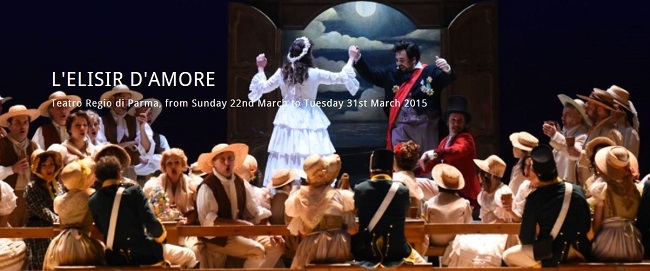
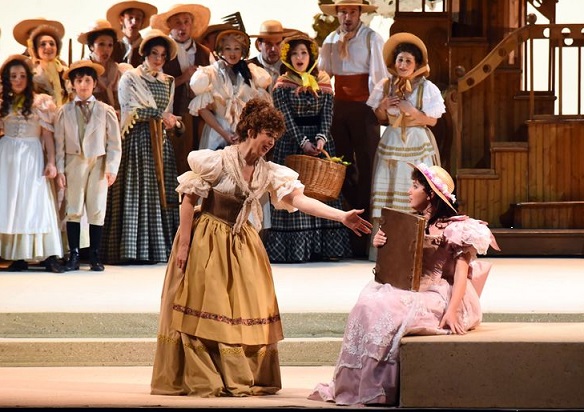
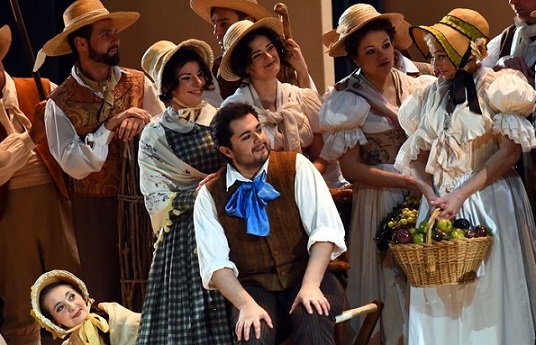
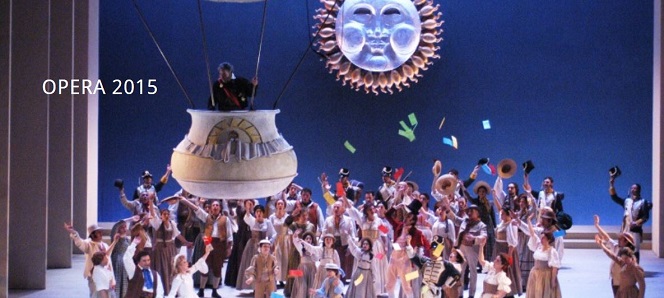
Open spaces and soft colours, a large tree, a hot air balloon, a painted backdrop: “Listen, listen”, Doctor Dulcamara’s Elisir d’Amore is returning to the Teatro Regio. Directed by Marcello Grigorov, Donizetti’s love potion returns to ensnare capricious hearts in the 1988 production created by Francesca Zambello with scenes and costumes by Nica Magnani. A framework of purity for the voices of Jessica Nuccio, Celso Albelo, and Roberto de Candia with the Orchestra Regionale dell’Emilia Romagna and the Chorus of the Teatro Regio in Parma directed by Francesco Cilluffo.

regio3

elisir3 elisir4 elisir5BEFORE THE SHOW…

Together with Giuseppe Martini, we discover the genesis and history as well as interesting anecdotes about the operas which will be performed. Students from the Conservatoire of Music “A. Boito” in Parma will interpret the most famous pieces from the operas to a piano accompaniment.

Ridotto del Teatro Regio di Parma

Free Admission
Saturday 21st March 2015, at 17.00

L’elisir d’amore

Introduced by GIUSEPPE MARTINI

Soprano
GIOVANNA IACOBELLIS

Tenor
LORENZO CALTAGIRONE

Baritone
LORENZO BONOMI

Piano
PAOLO GOBBI

Pupils of the Conservatorio “Arrigo Boito” di Parma

Vocal coach
DONATELLA SACCARDI

elisir6elisir7

regio

Posted in OPera | Tagged , , | Leave a comment

Wagner’s Siegfrid in Munich

bayerischeoperalogo

siegfridTitle

Second Day of “Der Ring des Nibelungen”

Composer Richard Wagner · Libretto by Richard Wagner
In German with German surtitles

Thursday, 26. March 2015
04:00 pm – 09:20 pm
Nationaltheater

Duration est. 5 hours 20 minutes · Intervals between 1. Akt and 2. Akt (est. 05:20 pm – 06:00 pm ) between 2. Akt and 3. Akt (est. 07:15 pm – 07:55 pm )

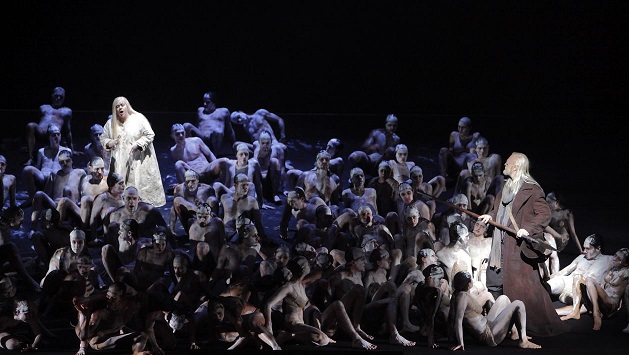
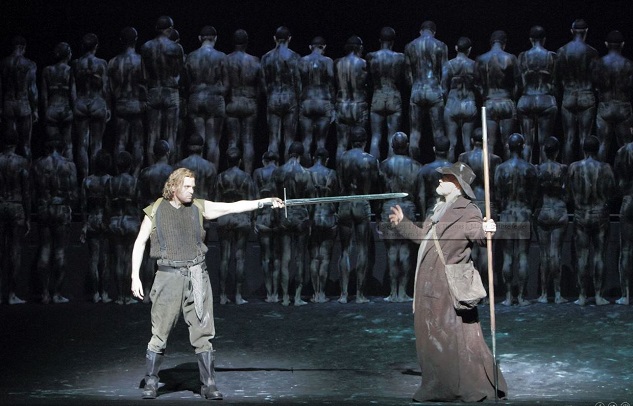
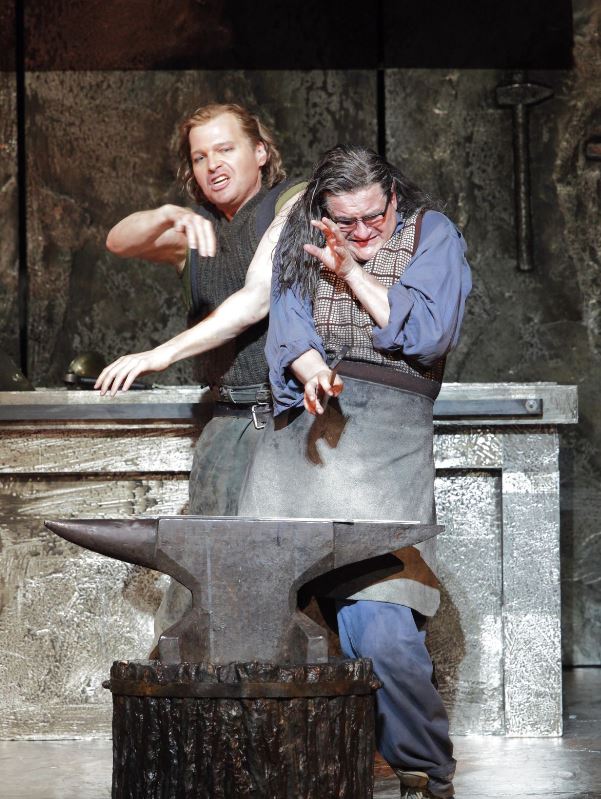
Only an individual without fear can turn Mime’s dream into reality, forge the shattered sword anew, slay Fafner the dragon, snatch the ring away from him and walk straight into Mime’s knife – and all the power will be Mime’s. But he himself is too frightened of the Wanderer, in whose puzzle game he loses his head, of the dragon, whom he wants his foster son to slay, of his brother, whom he meets in the forest, and of the fearless Siegfried, who thanks to a message from a prophetic bird helps himself to the ring and slaughters Mime.

But Wotan’s plan for a free hero also comes to naught: Siegfried smashes his spear with the sword and stands fearlessly before Brünnhilde. The sight of her body sets him atremble, and he finally learns the true meaning of fear. In the glow of the sun, the two discover their love.

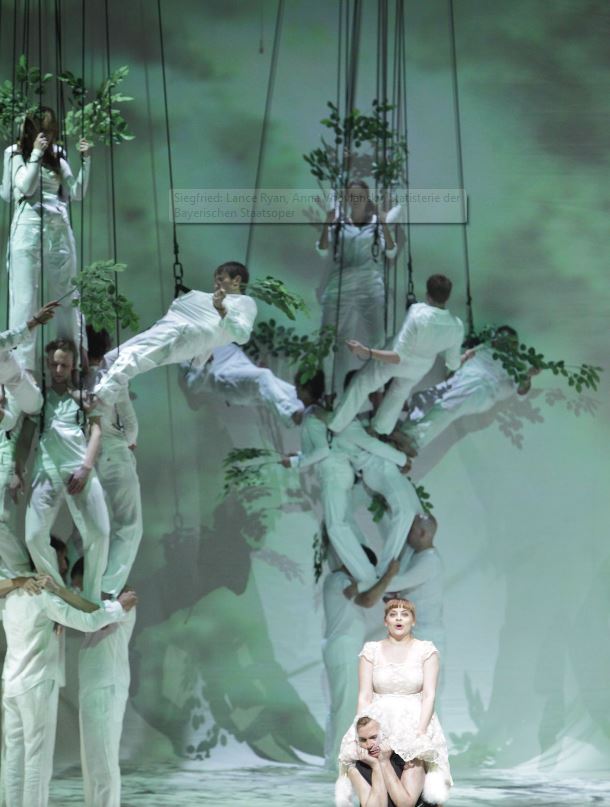
Mountain cave. Forest. Wilderness. Mountain peak. The second day of the work belongs to nature. But the guise of the harmless, nature-loving Wanderer fails to protect the father of the gods from his curse.

JillGrove-ThomasMayer Ryan-ThomasMayer siegfrid3 siegfrid4 siegfrid6 Sperrhacke-Koch

SYNOPSIS

Past History

The giant Fafner, in the form of a dragon, guards the Ring which Alberich, the Nibelung, forged from the Rheingold and which gives the person possessing it great power. Alberich’s brother, Mime, a blacksmith, is brooding about how to re-possess the ring with the help of his foster son Siegfried. Siegfried is the son of the Wälsungs Siegmund and Sieglinde and was left in the care of Mime by his mother as she died giving birth to him, all she left him was the name Siegfried and the pieces of Siegmund’s smashed sword Nothung. Mime has a plan, of which Siegfried is ignorant, namely that Siegfried is to kill the dragon and bring him the Ring.

Wotan had smashed the sword with his spear so that Siegmund would be killed by Hunding in a fight. Because, however, his daughter, the Valkyrie Brünnhilde, wanted to protect Siegmund, Wotan punished her by condemning her to sleep. At Brünnhilde’s request the rock on which she was to lie was encircled by fire from which only a fearless hero would be able to claim her.

LanceRyanCatherineNaglestad LanceRyanWolfgangAblinger-Sperrhacke

Act One

Mime is trying desperately to fashion a sword worthy of Siegfried. When he returns from the woods with a bear to frighten Mime, Siegfried shatters the new sword. Only when Siegfried pesters him to tell him something about his origins does Mime tell him the story of his birth and show him the fragments of his father’s sword Nothung. Siegfried challenges Mime to forge a new sword for him out of the pieces.

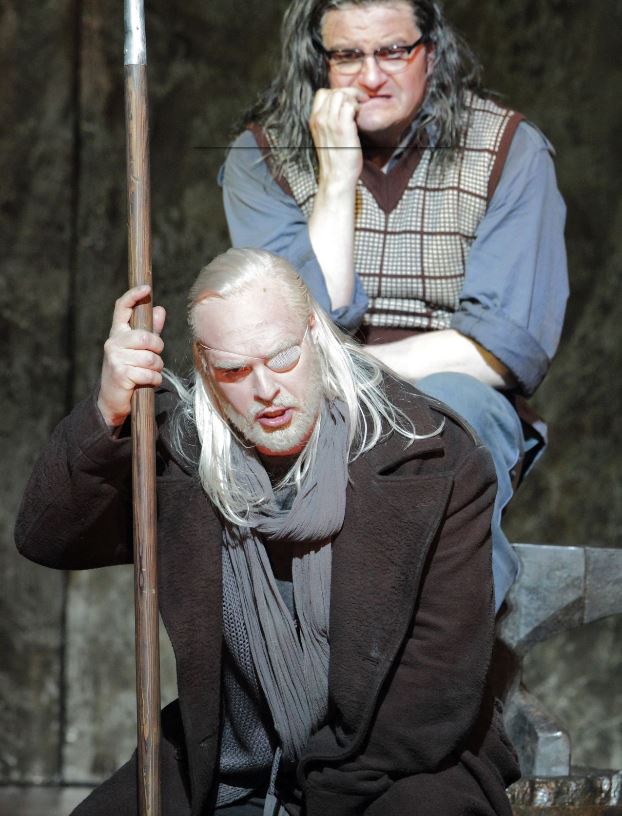
Wotan, disguised as a Wanderer, comes to see Mime and persuades him to take part in a wager of knowledge, the forfeit being the head of the loser. The Wanderer has no trouble answering Mime’s questions about the people who inhabit the bowels of the earth, the earth and the cloudy heights. Mime is able to answer the question about the Wälsungs and the name of the sword Nothung with which Siegfried must kill Fafner. He is, however, unable to answer the third question about who is forging the new sword and thus loses the wager. The Wanderer explains to him that only a fearless hero would be able to do this and leaves Mime’s forfeited head to this hero.

Mime is afraid and asks Siegfried if he has ever known fear, but this is something Siegfried has never experienced. Mime hopes that Siegfried will learn what fear is from Fafner. Faced with Mime’s inability to fashion a new sword, Siegfried succeeds, against all the rules of the trade, in doing it himself. Meanwhile Mime mixes a potion with which he plans to kill Siegfried once he has brought him the sword.

Ryan-AnnaVirovlansky

Act Two

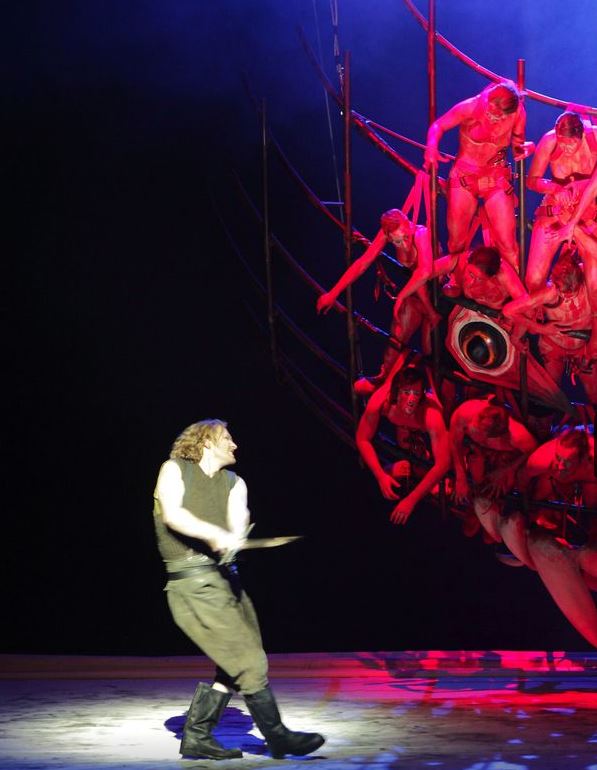
Alberich is lying in wait outside Fafner’s cave in order to regain possession of the Ring once the giant is dead. He realizes the true identity of the Wanderer who comes by and who warns him about Mime and Siegfried. Alberich suggests to Fafner, who has been woken by the Wanderer, that he will thwart Siegfried’s attempt to kill him in return for the Ring, but Fafner merely yawns and declines. Mime has led Siegfried to Fafner’s cave and leaves him there with orders to kill the dragon. Left alone in the woods, Siegfried’s thought turn longingly to his unknown mother. A singing woodbird catches his attention but he fails in his attempt to copy the bird’s song with his horn. He has instead woken Fafner with the sound of his horn. Siegfried kills him with his sword. Once he has tasted the dragon’s blood on his lips he is able to understand the woodbird, who advises him to fetch the Ring and the Tarn helmet from the cave and warns him about Mime.

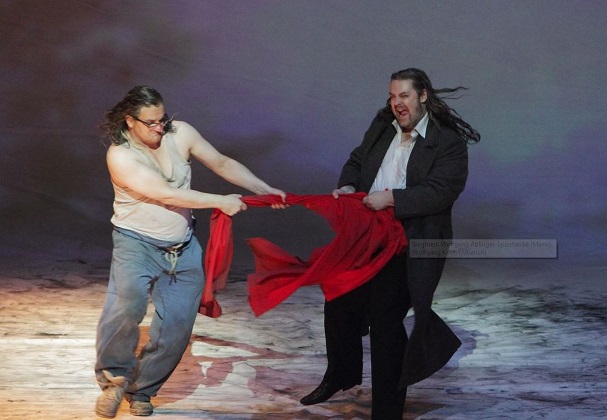
Alberich angrily refuses Mime’s off er to share the treasures Siegfried has acquired and hides. Wh en Siegfried returns with his booty, Mime off ers him the poisonous potion as refreshment. The dragon’s blood has, however, made Siegfried able to realize Mime’s true intentions. He kills his foster father. Once again he hears the song of the woodbird telling him the way to Brünnhilde’s rock, where he is to rouse the woman from her sleep.Mayer-Ablinger

Act Three

The Wanderer rouses Erda from a deep sleep; she had once warned him about his own downfall and is the woman with whom he fathered Brünnhilde. Initially remembering her knowledge about how he could prevent the end she had prophesied, he sees her wisdom fade. He tells her about his plan for Siegfried, who will soon, together with Brünnhilde, redeem the world and sends her to everlasting sleep.

Accompanied by the woodbird, Siegfried encounters the Wanderer, who does not want to allow him access to Brünnhilde’s rock. Instead he asks pertinent questions to ascertain how much Siegfried knows about his mission. Wh en he realizes that Siegfried is completely without fear he holds out his spear towards him. Siegfried recognizes his father’s murderer and shatters the spear with his sword. The Wanderer disappears, the way to Brünnhilde is now open.

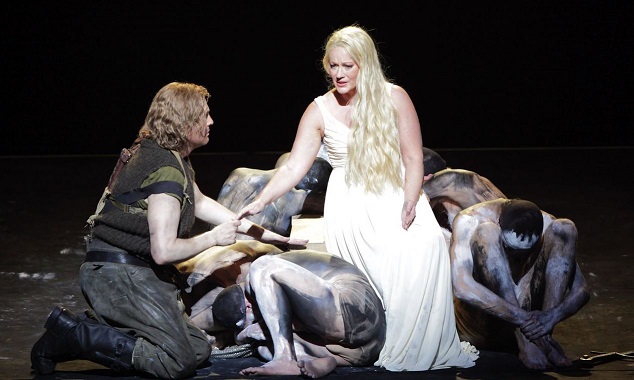
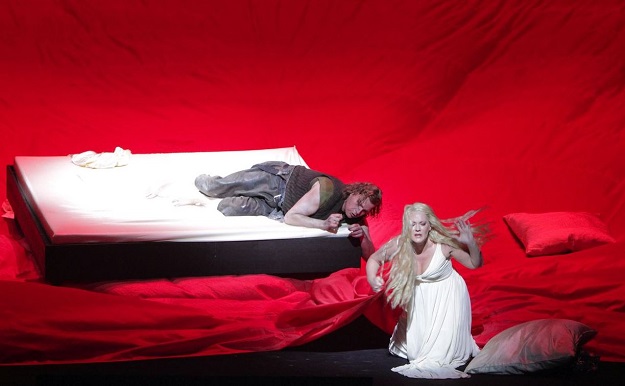
Striding through the fire, Siegfried finds the sleeping Brünnhilde. When he removes Brünnhilde’s protective shield he sees a woman for the first time in his life. He thinks what he feels is fear and wakes Brünnhilde with a kiss. She sees in him the hero with whom she will realize Wotan’s plans, the twilight of the Gods. Siegfried overwhelms her with his love, to which they both abandon themselves.siegfrid1 siegfrid7

Cast

Musikalische Leitung
Kirill Petrenko
Inszenierung
Andreas Kriegenburg
Bühne
Harald B. Thor
Kostüme
Andrea Schraad
Licht
Stefan Bolliger
Choreographie
Zenta Haerter
Dramaturgie
Marion Tiedtke
Dramaturgie
Olaf A. Schmitt

Siegfried
Stephen Gould
Mime
Andreas Conrad
Der Wanderer
Thomas J. Mayer
Alberich
Tomasz Konieczny
Fafner
Christof Fischesser
Erda
Qiu Lin Zhang
Brünnhilde
Catherine Naglestad
Stimme eines Waldvogels
Iulia Maria Dan
siegfrid8
Posted in OPera | Tagged , | Leave a comment

Wagner’s Das Rheingold at the Bayerische Staatsoper

bayerischeoperalogorheingold

Eve of “Der Ring des Nibelungen”

Composer Richard Wagner · Libretto by Richard Wagner
In German with German surtitles

Sunday, 22. March 2015
06:00 pm – 08:25 pm
Nationaltheater

Duration est. 2 hours 25 minutes

rheingold2

SYNOPSIS

Scene 1

The Rhinemaidens Woglinde, Wellgunde and Floßhilde are enjoying themselves in their element. Floßhilde is the only one who reminds them that they are actually guarding the Rhine gold.

The Nibelung Alberich approaches the three maidens, full of longing for love and tenderness, but is scorned and rejected by them.

Alberich, between reeling with anger and swooning with increasing desire, has no idea of what he has seen when his eye is caught by the glint of gold in the light of the rising sun. But then Wellgunde reveals the deep, dark secret: anyone who fashions the gold into a ring will make himself ruler of the world, but only if he renounces love beforehand. Alberich has an outrageous idea: with such power he could perhaps not force somebody to love him but certainly to indulge his desires.

He does what has previously been unthought of – he curses love and steals the gold.

rheingold1 rheingold3 rheingold4

Scene 2

Wotan has had the giants Fasolt and Fafner build the castle of Valhalla, from which he plans in future to order and rule the world. To pay for it he has promised to give the giants his sister-in-law Freia.

The castle is finished. Wotan attempts to stall the proceedings and calm his wife Fricka, who is worried about her sister. He has no intention of paying the price demanded. The giants insist that the contract should be honoured.

Loge, the God of Fire, whom Wotan has sent into the world to look for an equivalent form of payment instead of Freia, returns empty-handed. Nobody on earth can think of anything more valuable than happiness the love of a woman can give. Loge reports that he has heard of one person only, Alberich, who is said to have renounced love in order to forge a ring out of the Rhine gold. With the help of this ring he is said to have made himself ruler of his people, through whom he can get ever more gold from the depths, with the help of which Alberich seeks to rule the world.

The news about the gold and the ring arouses everyone’s interest. Fafner suggests a deal: Wotan should use Alberich’s gold as a ransom for Freia. The giants grant Wotan an extra day. As they leave with Freia as their hostage the Gods begin to wilt: it was the apples which Freia tended that had given them eternal youth. Wotan must act: accompanied by Loge he descends to Nibelheim.

rheingold5 rheingold6 rheingold7 rheingold8

Scene 3

Driven by Alberich’s brutality, the Nibelungs are extracting ever more gold and piling it up in a huge hoard. Alberich has had his brother Mime make a magic helmet, the wearer of which can assume any shape he chooses.

Alberich uses this invisibility to terrorize those he has subjugated. Wotan and Loge find Mime, who has been beaten and confides in the strangers, willingly revealing to them the secret of the helmet. Sure of his victory, Alberich tells the unbidden guests his plans for the future: he will seduce everybody with his gold and thus also conquer the gods.

Loge cunningly turns the conversation to the subject of the helmet. When he voices doubt about its powers, Alberich shows off by performing all his tricks: he first turns into a serpent, then into a toad. Wotan and Loge overpower him in this guise and abduct him from Nibelheim.rheingold9 rheingold10 rheingold14

Scene 4

In order to buy his release, Alberich is forced to hand over the Nibelung hoard to Wotan. But Wotan is not satisfied with this and demands the ring as well. Alberich does not want to part with this at whatever cost and Wotan tears the ring from Alberich’s finger.

Once released, Alberich curses the ring: everyone will be envious of it and want to possess it, but instead of being of use to whoever possesses it, it will only bring sorrow, misfortune and death.

A space the height and width of Freia is measured out and the Nibelung hoard is piled up to match it, but the giants do not want to let Freia go until the ring is also in their possession. Urged on by the other gods Wotan refuses, but the wise old goddess Erda manifests herself out of the depths and appeals to his conscience: she warns him against the curse-laden ring and whispers secret things about an end in disaster. Disturbed by her appearance, Wotan hands over the ring and buys Freia’s freedom. Fafner quarrels with his brother about the ring and kills him.

Freia’s brothers Donner and Froh use magic to influence the weather and dispel the oppressive atmosphere. The gods enter Valhalla in a solemn procession. Loge prophesies their end in disaster. The Rhinemaidens can scarcely be heard as they call for justice from the depths.rheingold13

The unsullied enchantment of E-flat major harmonies in the initial bars of Das Rheingold doesn’t last very long. Instead, a world comes into being; a world that fifteen hours of music later will be unable to stave off its own downfall. In this world, nature is violated, and laws are ignored. Greed, power and malediction are the order of the day. Alberich steals the gold from the Rhine Maidens, enslaves his workers and revels in the sweet smell of world domination. Wotan claims it for himself and joins forces with Loge to make off with the ring, the gold and the magic helmet. His construction project is envisioned as the foundation of existence for his family of gods – his wife objects. He must part with the accursed ring as payment to the two giants. Seething with envy, one giant murders the other. The glow of the gods’ castle first gleams after the tempest, but Loge sees the castle already headed for ruin. The threads of the tale get tangled in this eve of the tetralogy, the water loses its sheen, and the clouds are shrouded in darkness.

rheingold15 rheingold112

Cast

Musikalische Leitung
Kirill Petrenko
Inszenierung
Andreas Kriegenburg
Bühne
Harald B. Thor
Kostüme
Andrea Schraad
Licht
Stefan Bolliger
Choreographie
Zenta Haerter
Dramaturgie
Marion Tiedtke
Dramaturgie
Miron Hakenbeck

Wotan
Thomas J. Mayer
Donner
Levente Molnár
Froh
Dean Power
Loge
Norbert Ernst
Alberich
Tomasz Konieczny
Mime
Andreas Conrad
Fasolt
Günther Groissböck
Fafner
Christof Fischesser
Fricka
Elisabeth Kulman
Freia
Golda Schultz
Erda
Okka von der Damerau
Woglinde
Hanna-Elisabeth Müller
Wellgunde
Jennifer Johnston
Floßhilde
Nadine Weissmann
rheingold16 rheingold17
Posted in OPera | Tagged , , , , | Leave a comment

Wagner’s The Ring of the Nibelungs in Munich

bayerischeoperalogo

“Der Ring des Nibelungen”

Composer Richard Wagner · Libretto by Richard Wagner
German with German surtitles

ring2

SYNOPSIS

Prologue

The three Norns, the daughters of the omniscient Erda and guardians of fate, are passing the golden rope of fate from one to the other and discussing the progress of events: Wotan had drunk from the source of wisdom, lost an eye and whittled himself from the ash-tree an invincible spear which had laws carved into it with the help of which he was able to gain for himself power over the world. Siegfried smashed the spear in a duel with his sword Nothung. The ash-tree has withered since then, the source has dried up. Wotan had the wood from the ash-tree piled up around the castle of the gods, Valhalla, and is now awaiting his end. The Norns are unable to see further into the future as the rope suddenly breaks: the twilight of the gods begins.

Siegfried leaves Brünnhilde after a night of requited love and gives her the ring of the Nibelungs as a pledge of his love and devotion. In order to protect him, Brünnhilde draws runes on his body but leaves out his back. She gives him her horse, Grane. They affirm their love for each other and take their leave.

Act One

The Gibichungs rule along the Rhine. Both Gunther and his sister Gutrune want to seal their wealth and their power through marriage. Hagen, Alberich’s son, wants to possess the ring of the Nibelungs which promises power over the world. He tells his half-brother Gunther about the most beautiful woman in the world who can only be freed from the ring of fire which encircles her by the strongest of heroes: Brünnhilde. He adds that Siegfried is this hero, who grew up in the forest after the death of his parents, conquered the dragon and carried off the ring of the Nibelungs and the treasure. Hagen suggests that Gunther should win Brünnhilde with Siegfried’s help and that Gutrune should give him a magic potion to drink.This potion would make the hero forget his former love and at the same time fall in love with Gutrune. Siegfried appears at the court and Hagen’s plan is fulfilled step by step. The homeless Siegfried, happy at being accepted into a royal family and made submissive as a result of the magic potion, plans to win Brünnhilde for Gunther with the help of his helmet Tarn and marry Gutrune. Siegfried and Gunther swear an oath of blood-brotherhood to add substance to their plans for a double wedding.

Brünnhilde’s sister, the Valkyrie Waltraute, visits Brünnhilde on her rock, in spite of her father having forbidden it, to tell of the imminent end of the gods and Wotan’s last wish: if the ring of the Nibelungs were to be given back to the Rhine maidens, the world would be freed from curses and disaster. Brünnhilde will not do this.

As far as she is concerned, the ring is a pledge of love which is of greater importance than the well-being of the gods. Scarcely has Brünnhilde sent her sister away when she believes she is experiencing Siegfried’s return. Instead of this a stranger approaches her – Siegfried transformed to look like Gunther – who tears the ring from her finger and forces her into the marriage bed. As a sign of his loyalty to his blood brother Gunther he lays his sword between himself and his bride.

Act Two

Hagen is surprised from sleep by his father, who fathered him to use him as a tool to win back the ring. Brought up to hate, Hagen disassociates himself from him in order to win the ring for himself. Siegfried tells Hagen and Gutrune about his success with Brünnhilde. Hagen calls his men together. They are to make the appropriate preparations to welcome the couple. Brünnhilde is presented by Gunther as his bride. She realizes that Siegfried no longer recognizes her and loves another. Finally she discovers the ring on his finger, which she believes Gunther took from her by force to make her his bride. Deeply hurt at this double betrayal, Brünnhilde openly accuses Siegfried of breaking faith with her. Siegfried does not take her anger seriously and wants to get on with the wedding celebrations. In vengeance Brünnhilde tells Hagen about the spot where Siegfried is vulnerable. Together with Gunther they decide to murder Siegfried during the hunt. Gunther and Brünnhilde believe that in this way they have had their revenge, Hagen meanwhile only has regaining the ring in mind.

Act Three

During the hunt Siegfried meets the Rhine maidens, who demand that he should return the ring and prophecy his death. Siegfried does not fall victim to their temptations and threats. While resting from the hunt, he tells Gunther and Hagen the story of his life and as a result of another potion he is able to remember his love for Brünnhilde. Gunther now considers himself completely betrayed. Hagen plunges his spear into the defenceless back of the unsuspecting hero. As he dies, Siegfried takes leave of his beloved.
Startled by bad dreams, Gutrune a waits Siegfried’s return, only to be told by Hagen of his death. Gutrune accuses her brother of murder. Hagen admits to the deed as a revenge for Siegfried’s perjury and demands the ring for himself.

Gunther stands up to him, Hagen kills him as well. Brünnhilde follows her beloved Siegfried into the flames on her horse, Grane, having returned the ring to the Rhine maidens beforehand, sets fire to Valhalla and thus brings about the end of the rule of the gods. At the sight of the Rhine maidens, Hagen plunges into the waters to snatch the ring back from them. He drowns.ring2

Wagner had begun work on his cycle with the prose sketch Siegfrieds Tod (Siegfried’s Death), then rolled it back into the past, like the Norns, who, at the beginning of the Third Day, try to tie together the ropes of yesterday and tomorrow. Hagen and Siegfried – the sons continue the duel of their fathers. But Hagen plays with different weapons – sorcery, mendacity and betrayal. Siegfried declares the ring, which came about through the malediction of love, to the symbol of his love. Nevertheless, the curse is stronger. Siegfried betrays his love. Brünnhilde betrays Siegfried. Siegfried swears an oath on the weapon that only a short time later will penetrate his heart. The gods gaze impotently on their own downfall. The struggle for power transfers to the humans who survive the catastrophe and will perhaps understand everything now that they know the end.

ring12 ring10

Friday, 20. March 2015
04:00 pm – 09:35 pm

Sunday, 29. March 2015
04:00 pm – 09:35 pm

Thursday, 02. April 2015
04:00 pm – 09:35 pm

Sunday, 05. April 2015
04:00 pm – 09:35 pm

Duration est. 5 hours 35 minutes · Intervals between Akt I and Akt II (est. 05:55 pm – 06:35 pm ) between Akt II and Akt III (est. 07:40 pm – 08:20 pm )

   ring1 ring3 ring5 ring7

Cast

Musikalische Leitung
Kirill Petrenko
Inszenierung
Andreas Kriegenburg
Bühne
Harald B. Thor
Kostüme
Andrea Schraad
Licht
Stefan Bolliger
Choreographie
Zenta Haerter
Dramaturgie
Olaf A. Schmitt
Dramaturgie
Marion Tiedtke
Chöre
Sören Eckhoff

Siegfried
Stephen Gould
Gunther
Alejandro Marco-Buhrmester
Hagen
Hans-Peter König
Alberich
Tomasz Konieczny
Brünnhilde
Petra Lang
Gutrune
Anna Gabler
Waltraute
Okka von der Damerau
Woglinde
Hanna-Elisabeth Müller
Wellgunde
Jennifer Johnston
Floßhilde
Nadine Weissmann
1. Norn
Okka von der Damerau
2. Norn
Jennifer Johnston
3. Norn
Anna Gabler
    • Bayerisches Staatsorchester
    • Chorus of the Bayerische Staatsoper

ring4ring6ring9ring10

Posted in OPera | Tagged , , , , , , | Leave a comment

Ildebrando Pizzetti’s MURDER IN THE CATHEDRAL at the Oper Frankfurt

frankfurtlogoMURDER IN THE CATHEDRAL

Ildebrando Pizzetti 1880 – 1968
Tragedia musicale in two acts and one intermezzo
Libretto by Ildebrando Pizzetti after the play Murder in the Cathedral by T.S. Eliot
English version: Geoffrey Dunn
First performed March 1st 1958, Teatro alla Scala, Milan
Sung in English with German surtitles
Duration c. 1 1/2 hrs., no interval

Performances
——————————————————————————–
Saturday 18.04.2015
26.04.2015 |08.05.2015 |14.05.2015 |25.05.2015

1Murder

About the Piece


On the 29th of December 1170 Thomas Becket, Archbishop of Canterbury, and one time Lord Chancellor of King Henry II, was murdered in his cathedral by four noblemen in the service of the king. This bloody deed triggered powerful political and religious consequences and led to a cult of veneration for the murdered religious crusader, who was soon to be canonized. Historians still argue about whether it really was the king who ordered his death but it is a fact that Henry paid public penance at the martyr’s grave in 1174. 2MurderIn T. S. Eliot’s dramatic masterpiece, written in 1935, modelled on information about life in the middle-ages but crafted in modern verse, ends with the poeple singing about an age of fear and desperation: »We confess that the sins of the world come down on the head of our king, the blood of a martyr, the death of a saint.«. Eliot’s Becket is: »a tool of God who longs for nothing for himself, let alone martyrdom.« Ildebrando Pizzetti, whose aesthetic marked a new entity of drama and lyric which went against Italian verismo still prevalent at the time, showed his play to Eliot, who was doing the same for literature, in 1956. Their mutual reverence for the Gregorian past is obvious – especially in the great choral passages.3Murder

Cast


Conductor
Karsten Januschke
Director
Keith Warner
Revival rehearsed by Hans Walter Richter
Stage Designer Tilo Steffens
Costume Designer Julia Müer
Lighting Designer Olaf Winter
Dramaturge Norbert Abels
Chorus Master Tilman Michael
Children’s Chorus Master Markus Ehmann
4Murder5Murder

Archbishop Tommaso / Thomas Becket
Sir John Tomlinson
Ein Herold
Michael McCown
Priest
Hans-Jürgen Lazar
Priest
Dietrich Volle
Priest
Vuyani Mlinde
1st Tempter / Knight
Beau Gibson
2nd Tempter / Knight
Simon Bailey
3rd Tempter / Knight
Sebastian Geyer
4th Tempter / Knight
Alfred Reiter
Koryphäe
Britta Stallmeister
Koryphäe
Jenny Carlstedt

Oper Frankfurt’s Orchestra

Oper Frankfurt’s Chorus & Children’s Chorus6Murder

7Murder

Synopsis


Bitter conflicts destroyed the once friendly relationship between Henry II and his former Lord Chancellor, Thomas Becket. During the seven years he spent in exile the faithful have been longing for his reinstatement as Archbishop, but fear the King’s anger. A messenger announces that Becket is on his way. Thomas’ arrival puts an end to a battle of words between the women and priests.
Four tempters appear to Thomas to test him. The first three attempt to seduce him with worldly pleasures, political power and persuade him to use his spiritual task for worldly ends. They all recall his pride and ambition. Thomas rejects them. The fourth tempts him with the glory of martyrdom, his secret wish for eternal glory. Thomas wrestles with these and triumphs over his internal struggle.8Murder
At mass on Christmas morning he preaches that he rejects all worldly desires, entrusting himself entirely to the will of God.
Four knights, who say have been sent by the King, appear and demand to see the Archbishop. They accuse Thomas of betraying the King. Thomas rejects their accusation, saying that he serves no other than God alone. While the knights withdraw to arm themselves and pump themselves up with drink, the priests urge Thomas to celebrate vespers, and try to bolt the doors to the cathedral. The women grow frantic as Thomas finds the centre of his faith in simplicity. He orders the Priests to open the doors because God’s church must always remain open, even to the enemy. The knights find their way back in and kill him. The knights explain, in political jargon that it was Thomas’ stubborn pride that led to his return and death: a kind of suicide.
A congregation begin singing a Gloria for the new martyr.9Murder11Murder 12Murder

Posted in OPera | Tagged , , | 1 Comment

Wagner’s Die Walkure in Munich

bayerischeoperalogodie
First Day of “Der Ring des Nibelungen”

Composer Richard Wagner · Libretto by Richard Wagner
In German with German surtitles

Monday, 23. March 2015
05:00 pm – 10:05 pm
Nationaltheater

Duration est. 5 hours 05 minutes · Intervals between 1. Akt and 2. Akt (est. 06:05 pm – 06:40 pm ) between 2. Akt and 3. Akt (est. 08:10 pm – 08:55 pm )

die1die2die3die4

SYNOPSIS
Past History

The Ring which Alberich, after renouncing love, had had fashioned and which was to secure for him power over the world has fallen into the hands of Fafner, the giant, as a result of Wotan’s deception. Years have past in the meantime. Fafner, living in a wood in the form of a lindworm, guards the treasure, which both Alberich and Wotan long to possess. Alberich has lovelessly fathered a son, who is to help him regain the Ring. Wotan also has plans about how to regain possession of the Ring and at the same time protect himself from the threat from Alberich and his army. Valkyries, daughters who carry out his will, bring him an army of dead heroes to Valhalla. He fathered his son Siegmund with a human woman and Siegmund is to bring him the Ring as a free hero. Siegmund and his twin sister Sieglinde were born into the house of Wälsungen but were separated while still children in the confusions of war. For years Wotan brought up Siegmund, in the guise of a wolf, to be a rebel until he disappeared without trace.

die5  die8

First Act

Fleeing from his persecutors and in search of shelter, an unarmed stranger finds refuge from a heavy storm in a hut built around an ash-tree. The woman of the house gives him something to drink, both are immediately attracted to each other. Her husband, Hunding, with whom she lives in a loveless marriage, returns home. He also off ers hospitality, invites the stranger to eat with them and learns from his guest’s story that he is in fact the enemy of his family. He grants him protection for the one night but challenges him to a duel the next morning.

die6

The unarmed stranger remembers his father’s promise to provide him with a sword in his hour of greatest need. The woman has meanwhile given Hunding a sleeping draught. She wants to help the stranger escape and shows him a sword embedded in the trunk of the ash-tree which so far nobody has been able to pull out. In the course of telling their life stories they recognize each other, Sieglinde calls her brother by his correct name: Siegmund. They find their identity as twins and happiness in each other in a night of love and then flee, taking the sword with them.

die9die10

Second Act

Wotan instructs his favourite daughter, the Valkyrie Brünnhilde whom he fathered with the goddess Erda, to help Siegmund in his flight. His wife Fricka persuades him to change his mind, however, by pointing out to him that Siegmund and Sieglinde have failed to uphold the vows of marriage and that Wotan’s son is by no means the free hero who can regain possession of the hord and the Ring. Siegmund is Wotan’s tool and so Wotan has to promise his wife that he will allow him to die at Hunding’s hand.

die11

Wotan can see no way out of his dilemma. He confides to his daughter Brünnhilde his despair, his hopes, his dependence and the constraints which do not allow him to act diff erently. He commands Brünnhilde to take the side of Hunding. Brünnhilde is deeply shocked. She comes across Siegmund who is watching over Sieglinde as she sleeps, exhausted by their flight. She predicts his death and promises to take him to Valhalla to her father’s army of heroes. Siegmund, however, rejects this idea when he learns that he will not meet Sieglinde there. Realizing how inseparable the couple are makes Brünnhilde aware for the first time of the power of Love and she decides to disobey her father: the two Wälsungen will live. Hunding has meanwhile caught up with the two fugitives and challenges Siegmund to a fight. In spite of his sword and Brünnhilde’s help, Siegmund falls a defenceless victim to Hunding, as Wotan interposes his spear and shatters Siegmund’s sword. Fricka’s will has been done. Hunding is then murdered by Wotan. Brünnhilde gathers up the pieces of Siegmund’s shattered sword, Nothung, and flees with Sieglinde.

die13 die14

Third Act

The Valkyries gather to accompany the dead heroes to Valhalla. Brünnhilde begs them for their help so that she can protect herself and Sieglinde from Wotan’s anger. But her Valkyrie sisters do not want to rebel against their father. Sieglinde wants no future without Siegmund.

She is only persuaded diff erently when Brünnhilde tells her that she is pregnant with her brotherʼs child. Brünnhilde gives the unborn baby the name of Siegfried and begs Sieglinde to keep the pieces of his father’s sword, for the man who will one day become the greatest hero in the world. Sieglinde flees into the wood in which Fafner lives, the only place where she is safe from Wotan. Brünnhilde faces Wotan and he, angry about her disobedience, deprives her of her divinity, sends her into a deep sleep and makes her the defenceless prey of the first man to come along. All Brünnhilde manages to do is to get her father to surround her with flames so that only a fearless hero will be able to reach her.
The clash of the clans nourishes the battlefield. The Valkyries, the children of the god, are just instruments of the father to gather together an army of the dead for him.

die15

Wotan’s progeny are to secure his power: the twins, Siegmund and Sieglinde, seem born to this task. The brother lands at the home of his enemy – finds his sister there after a separation of many years and wins her heart. All of this runs according to plan, and yet the two siblings have violated the laws. The father must sacrifice his son. Brünnhilde, his favorite daughter, defies her father for the first time and protects the incestuous couple – in vain.

die16

On the first day of Der Ring des Nibelungen, in Die Walküre, first performed in 1870 in Munich, the father-god’s plans to undo the entanglements come to naught. At the end, his children are either murdered or punished and exiled. All Wotan can do is wait for the hero of the next generation – Sieglinde now carries him in her womb, the seed of her brother, somewhere on her flight through the forest.

Cast

Musikalische Leitung
Kirill Petrenko
Inszenierung
Andreas Kriegenburg
Bühne
Harald B. Thor
Kostüme
Andrea Schraad
Licht
Stefan Bolliger
Choreographie
Zenta Haerter
Dramaturgie
Miron Hakenbeck
Dramaturgie
Marion Tiedtke

Hunding
Günther Groissböck
Wotan
Thomas J. Mayer
Sieglinde
Anja Kampe
Brünnhilde
Evelyn Herlitzius
Fricka
Elisabeth Kulman
Helmwige
Susan Foster
Gerhilde
Karen Foster
Ortlinde
Golda Schultz
Waltraute
Heike Grötzinger
Siegrune
Roswitha Christina Müller
Roßweiße
Alexandra Petersamer
Grimgerde
Okka von der Damerau
Schwertleite
Nadine Weissmann
Siegmund
Christopher Ventris
    • Bayerisches Staatsorchester

die7

Posted in OPera | Tagged , , , , , , | Leave a comment

LA CENERENTOLA at the Oper Frankfurt

frankfurtlogoLA CENERENTOLA (Cinderella)

Gioacchino Rossini 1792 – 1868
Dramma giocoso in two acts
Libretto by Jacopo Ferretti
First performed January 25th 1817, Teatro della Valle, Rome
Sung in Italian with German surtitles

Performances

——————————————————————————–
Saturday 11.04.2015
17.04.2015 |23.04.2015 |29.04.2015 |10.05.2015 |16.05.2015 |23.05.20151cenerentola

Cast


Conductor
Alexander Soddy
Director
Keith Warner
Revival rehearsed by
Caterina Panti Liberovici
Stage Designer
Jason Southgate
Costume Designer
Nicky Shaw
Lighting Designer
Simon Mills
Dramaturge
Norbert Abels
Chorus Master
Tilman Michael2cenerentola

Angelina (Cinderella)
Nina Tarandek
Clorinda
Sofia Fomina
Tisbe
Judita Nagyová
Don Ramiro
Martin Mitterrutzner
Don Magnifico
Simon Bailey
Dandini
Björn Bürger
Iurii Samoilov
Alidoro
Vuyani Mlinde

Oper Frankfurt’s Orchestra and Chorus3cenerentola

About the Piece


The story unfolds like a dream on silken threads. Charles Perrault’s free adaptation of the fairy tale, which was first performed
The story unfolds like a dream on silken threads. Charles Perrault’s free adaptation of the fairy tale, which was first performed only a year after the world premiere of Il barbiere di Siviglia, replaces the evil stepmother with an ambitious but simple father, the good fairy with Alidoro, a magician and Prince Ramiro’s teacher, and the shoe lost at midnight with a bracelet. Rossini’s and Ferretti’s La Cenerentola is based on various versions of the Cinderella story. 4cenerentolaKeith Warner’s production was praised by press and public when it first opened: his interpretation conveys Rossini’s humour and dramaturgical profundity at the highest possible level.5cenerentola

Synopsis


Don Magnifico’s daughters, Clorinda and Tisbe, treat their step-sister, Angelina (La Cenerentola), like dirt. Ramiro, a young Prin
Don Magnifico’s daughters, Clorinda and Tisbe, treat their step-sister, Angelina (La Cenerentola), like dirt. Ramiro, a young Prince, is looking for a wife. His teacher, the magician Alidoro, wants to help him. Alidoro, in disguise, is treated rudely by the hard-hearted sisters. Angelina greets him warmly. Courtiers deliver an invitation to a ball. Clorinda and Tisbe are very excited. The Prince, disguised as his valet Dandini, calls at the house. He and Angelina are immediately drawn to each other. Dandini arrives, disguised as Ramiro, who is amused to watch Magnifico and his daughters grovel. Angelina begs her father to allow her to go to the ball, but he refuses. Alidoro sees from his register that Magnifico has three daughters and asks where the third one is. 6cenerentolaMagnifico says that she died. When the others have left, Alidoro gives Angelina a gown and matching bracelets…. The courtiers make fun of Magnifico. Clorinda and Tisbe try to attract the Prince’s attention. A stranger is announced. Angelina enters – a veiled, mysterious beauty. Her resemblance to Angelina astonishes her family. The supposed Prince tries to woo the unknown beauty but she tells him that she loves his valet. Ramiro, eavesdropping, proposes to her immediately. Alidoro intervenes: Ramiro should see Angelina and learn to love her in her true guise. Angelina gives Ramiro one of her bracelets, and leaves. The Prince and his valet resume their true identities. Magnifico and his daughters, unamused, leave. Ramiro sets off to find his love. Alidoro conjures up a thunderstorm. The Prince seeks refuge in Magnifico’s house. Ramiro recognizes the bracelet on Angelina’s wrist and proposes again. Angelina forgives her father and step-sisters.7cenerentola9cenerentola

Posted in OPera | Tagged , , , , | Leave a comment

“Nabucco” performed by the Israeli Opera

israeli operaNabucco

Giuseppe Verdi

nabuccoVerdi’s “Jewish” opera showcases who destroys the temple in Jerusalem and exiles the Israelites to Babylon where they sing the immortal slave chorus. Verdi’s true first operatic success returns to the Israeli Opera in a new production conducted by Daniel Oren.

New Production | Sung in Italian | Duration: Two hours and 45 minutes

Libretto: Temistocle Solera

Conductor Daniel Oren
Francesco Ivan Ciampa

Francesco Ivan Ciampa

Conductor


Francesco Ivan Ciampa
Stefano Mazzonis di Pralafera

Stefano Mazzonis di Pralafera

Director

Stefano Mazzonis di Pralafera
Set Designer Alexandre Heyraud
Costume Designer Fernand Ruiz
Lighting Franco Marri, lighting designer, was born in Italy. He designed the lighting for some prestigious set designers and directors, such as Luca Ronconi, Lina Wertmuller, Filippo Crivelli, Alberto Fassini, Pierluigi Pieralli, Dario Fo, Hugo de Ana and Stefano Vizioli. He has designed lighting for many opera including Tancredi, Il barbiere di Siviglia, L’Italiana in Algeri, Semiramide (Rossini), Don Pasquale, L’elisir d’amore (Donizetti), Madama Butterfly (Puccini), I Lombardi, Falstaff, Il trovatore, Nabucco, Oberto, Don Carlo, I Masnadieri, Rigoletto (Verdi), Il matrimonio segreto (Cimarosa), Norma (Bellini), Carmen (Bizet) and many others in opera houses in Italy and all over Europe. This is his first work for the Israeli Opera.

Among the soloists


Alberto Gazale as Nabuco

Alberto Gazale as Nabuco

Alberto Gazale, baritone

Alberto Gazale, baritone

Nabucco

Alberto Gazale, baritone, was born in Italy.  His repertoire includes Renato in Un ballo in maschera, Amonasro in Aida, the title role in Rigoletto, Macbeth, Di Luna in Il trovatore, Germont in La traviata, Iago in Otello (Verdi), Alfio in Cavalleria rusticana (Mascagni), Gerard in Andrea Chenier (Giordano), Barnaba in La Gioconda (Ponchielli), Tonio in Pagliacci (Leoncavallo) and many others. He performs in La Scala in Milan, the Vienna Staatsoper, the Arena di Verona and the opera houses of Berlin, Barcelona, Firenze, Venice, Zurich, Madrid, Paris, Bologna, Trieste, Monte Carlo, Genova and others. At the Israeli Opera he performed the title role of Nabucco (Verdi) at Masada.
Ionut Pascu
Sebastian Catana
Carlo Colombara, bass

Carlo Colombara, bass

Zaccaria

Carlo Colombara, bass, was born in Italy. His repertoire includes the title role in Mefistofele (Boito), Escamillo in Carmen (Bizet), Brogni in La Juive (Halevy), the title role in Don Pasquale (Donizetti), the Four Villains in Les Contes d’Hoffmann (Offenbach), the title role in Don Giovanni (Mozart), Scarpia in Tosca, Timur in Turandot (Puccini), as well as most Verdi bass roles including Fiesco in Simon Boccanegra, Silva in Ernani, Procida in I vespri Sicilliani, Banco in Macbeth, Zaccaria in Nabucco, Ramfis in Aida, Filippo in Don Carlo in both Italian and French and many other roles. He performs at all the world’s leading opera houses including La Scala in Milan, the Arena di Verona, the Vienna Staatsoper, Royal Opera House Covent Garden, as well as the opera houses of Parma, Prague, Savonlinna, Stuttgart, Salerno, Beijing, Paris, Trieste, Salzburg, Modena, Bilbao, Bologna, Rome, Venice, Tokyo, Berlin and others. At the Israeli Opera he performed Colline in La boheme (Puccini).
Anna Pirozzi, sopranoAbigaile
Anna Pirozzi, soprano, was born in Italy. Her repertoire includes Abigaille in Nabucco, Elvira in Ernani, Amelia in Un ballo in maschera, Leonora in Il trovatore, Lady Macbeth in Macbeth (Verdi), Santuzza in Cavalleria rusticana (Mascagni), the title role in Tosca (Puccini) and other roles. She performs at the Salzburg Festival and at the opera houses of Rome, Parma, Palermo, Turin, Bologna, Sao Paulo, Cagliari, Beijing, Florence, Kiel, Stuttgart and others. This is her Israeli Opera debut.
Elisabete Matos
Tatiana Melnychenko
Fenena Na’ama Goldman
70-PIX-6The High Priest of Baal Carlo Striuli , bass-baritone, was born in Italy. He performs regularly at the Arena di Verona and leading Italian and European opera houses. His repertoire includes Silva in Ernani, Ferrando in Il trovatore, Wurm and Walter in Luisa Miller, Sparafucile and Monterone in Rigoletto, the leading role in Attila (Verdi), Timur in Turandot (Puccini), Rodolfo in La sonnambula (Bellini) and others. At the Israeli Opera he performed many roles including Colline in La boheme (Puccini), Oroveso in Norma (Bellini), Raimondo in Lucia di Lammermoor (Donizetti), Ruggero in La Juive (Halevy), the grand priest of Baal in Nabucco and The Kind in Aida (Verdi) at Masada.At the Israeli Opera he performed: La boheme: Colline (1997) La Juive: Ruggero (2000) Nabucco at Masada: the grand priest of Baal (2009) Norma: Oroveso (2011) Aida at Masada: The King (2011) Lucia di Lammermoor: Raimondo (2012) Luisa Miller: Wurm (2013)
Abdallo Guy Mannheim
Anna Alla Vasilevitsky

The Israeli Opera Chorus
Chorus Master: Ethan Schmeisser

The Opera Orchestra – The Israel Symphony Orchestra Rishon LeZion

English & Hebrew Surtitles
Translation: Israel Ouval

Day Date Hour Back Stage Tours Opera Talkback
* TUE 7.4.15 20:00
WED 8.4.15 20:00 After the show
THU 9.4.15 13:00
SAT 11.4.15 21:00
SUN 12.4.15 20:00 18:30 After the show
MON 13.4.15 20:00 18:30
TUE 14.4.15 20:00 18:30
THU 16.4.15 20:00 After the show
FRI 17.4.15 13:00
SAT 18.4.15 21:00
SUN 19.4.15 20:00 18:30 After the show
FRI 24.4.15 13:00
SAT 25.4.15 21:00

* PREMIÈRE – 7.4.15
** Towards Opening – SAT 28.3.15, 11:00
*** A pre-performance lecture (in Hebrew) is held one hour before every performance. Free admission for tickets holders.

Verdi-Nabucco-Libretto-Ricordi-1923

Part I | Jerusalem
Thus said the Lord: Behold, I shall deliver this city into the hands of the King of Babylon, and he will destroy it by fire (Jeremiah, 34:2)

In the Temple of Solomon in Jerusalem, the Israelites bewail their fate: Nabucco (Nebuchadnezzar), King of Babylon, has attacked them with his hordes and is desecrating the city. As they offer payers, Zaccaria, the High Priest, enters with his sister Anna and Nabucco’s daughter, Fenena, whom the Jews are holding hostage. He counsels his people to remain steadfast as peace is within their reach, and reassures them that the Lord will not forsake them. Ismaele, nephew of the King of Jerusalem and leader of the military forces, enters with soldiers to say Nabucco is sweeping all before him.
Zaccaria hopes for a miracle and hands over Fenena to Ismaele for safekeeping. When the others leave we learn that Ismaele and Fenena, who had met in Babylon, are in love. Fenena’s jealous sister Abigaille, was in love with Ismaele too. As they talk, Abigaille bursts in, wearing warrior garb, leading a band of Babylonians (disguised as Hebrew soldiers) to occupy the Temple. She greets Ismaele with scorn, then privately tells him he can save his people and earn a new kingdom if he returns her love. Saying he cannot, he offers to forfeit his life for his people, while Fenena prays to the God of Israel to shield Ismaele. The Israelites reappear, frightened because Nabucco is approaching. As the conqueror enters the Temple, Zaccaria confronts him, denouncing his blasphemous arrogance and threatening to stab Fenena. But Ismaele wards off Zaccaria’s blow and delivers Fenena to her father. As Zaccaria and the other Jews revile Ismaele, Nabucco orders the Temple looted and burned.nabuccoGazale

Part II | The Impious one
Behold, the storm of the Lord goes forth in fury, a raging tempest; it shall whirl down upon the head of the wicked (Jeremiah, 30:23)

In Nabucco’s palace in Babylon, Abigaille has found a document that could cause her ruin, since it certifies that she is not Nabucco’s daughter but the child of slaves. She swears vengeance on Nabucco and his appointed heiress, Fenena, but wistfully reflects that the love she felt for Ismaele could have changed her life. The High Priest of Baal comes to say that Fenena has freed the Israelites prisoners. The religious authorities have decided to offer Abigaille the throne instead, telling the people that their king has fallen in battle. She rejoices that the daughter of slaves will now have everyone at her feet. Elsewhere in the palace, Zaccaria prays for the ability to persuade the Babylonians to put aside their false idols. He will begin by converting Fenena, whose apartment he enters. Two Levites, sent for by Zaccaria, appear and are surprised to meet the outcast Ismaele. As they upbraid him, Zaccaria, accompanied by Fenena and Anna, pardons Ismaele, for he has saved a fellow Hebrew – the newly converted Fenena. The aged palace adviser Abdallo rushes in to tell Fenena about the reports of the king’s death and to warn that her life is in danger. Before she can escape, the High Priest of Baal, followed by Abigaille and a crowd of Babylonians, proclaims Abigaille ruler and pronounces a death sentence on the Hebrews. When Abigaille demands the royal scepter, Fenena refuses to yield it. At that moment, to the astonishment of all, Nabucco enters, takes the crown and places it on his own head. Everyone trembles in dread before the irate monarch, who announces he is not only king but god, having overthrown both Baal and the God of the Israelites. As he tries to force Zaccaria and Fenena to prostrate themselves before him, lightning strikes him and knocks the crown from his head; it also renders him insane. Abigaille retrieves the crown.

nabucco1Part III | The Prophecy
Babylon shall become rubble, a den for jackals, an object of horror and hissing without inhabitant (Jeremiah, 51:37)

Scene i
In the Hanging Gardens of Babylon, the High Priest of Baal and the crowd hail Abigaille as ruler. The High Priest presses her to put the Israelites to death, but before she can sign the warrant, the disheveled Nabucco wanders in, hoping to sit once more on his throne. Abigaille dismisses the others and explains to Nabucco that she is now serving as regent, since he is not well enough to rule; she gives him the warrant, hoping to trick him into ordering his own daughter’s death. When she taunts him for lack of resolution, he signs. Then Nabucco remembers Fenena. She too will die, retorts Abigaille. When Nabucco looks for the document proving Abigaille to be an imposter, she confronts him with it and tears it to pieces. Nabucco calls the guards but learns they are no longer faithful to him; their orders are to keep him locked up. His pleading with Abigaille for Fenena’s life is to no avail.
Scene ii
By the banks of the Euphrates, the Israelites are resting from forced labor. Their thoughts go back to their lost homeland. Zaccaria predicts they will be released from captivity and destroy Babylon with the Lord’s help.
Part IV
The Broken Idol
Say: Babylon is captured, Baal is shamed, Merodach is dismayed; her idols are shamed, her fetishes dismayed (Jeremiah, 50:2)

Scene i
In his royal apartment, Nabucco awakens from a restless sleep to hear voices outside calling Fenena’s name. She is being led to execution. Trying the door, Nabucco realizes he is a prisoner. Desperate, he kneels to pray to the God of the Israelites for forgiveness, pledging to convert himself and his people. His reason returns and, when Abdallo and his soldiers come to see why he is trying to force the door, he convinces them that he is his old self again. Calling for a sword, he rallies his followers to regain the throne.

Scene ii
In the Palace Garden, executioners stand ready to kill Zaccaria and his followers. The old man hails Fenena as a martyr and she asks the Lord to receive her into heaven, but Nabucco arrives and orders the statue of Baal destroyed. As if by some supernatural power, it falls by itself. Abigaille takes poison and confesses her crimes, urging that Ismaele and Fenena be reunited; Dying, she prays to the God of Israel to pardon her. Nabucco tells the Israelites to return to their native land and rebuild their Temple, declaring that he himself now serves the God of the Israelites. The crowd acknowledges a miracle and praises God.

Posted in OPera | Tagged , , | Leave a comment

“Tamerlano” and “Alcina”performed by the Belgian Opera company La Monnaie/De Munt available for view online until 10 March 2015

Tamerlano

Opera in tre atti HWV. 18 (1724)
George Frideric Handel
Libretto di Nicola Francesco Haym
Premiere King’s Theatre Haymarket, London, 31/10/1724
Full opera available for view online until 10 March 2015: http://www.lamonnaie.be/en/mymm/media/2236/Tamerlano%20-%20George%20Frideric%20Handel/
Tamerlano---George-Frideric-Handel

Tamerlano, inspired by the historical confrontation of 1402 between Sultan Bayezid I and Timur Lenk, tells the story of the clash of two strong personalities : Tamerlano as the victor, Bajazet as the loser who has no intention of grovelling humbly in the dust. Following the success of Giulio Cesare in Egitto, Handel completed his highly expressive Tamerlano after numerous revisions. The underlying tone of the work is serious ; the composer tried to give depth to the characterisation of the historical figures. The scene preceding the death of Bajazet – a major part which, exceptionally, was written for a tenor – is the climax of the opera. Tamerlano is to be performed in alternation with Alcina. Pierre Audi designed both productions for the splendid baroque theatre at Drottningholm in Sweden. Both sets, designed by Patrick Kinmonth, are based on the principles of perspective, with wings in the form of painted panels. Their vision of baroque opera is modern and pared-down, but does not lose sight of tradition ; this creates a fascinating tension.

tamerlano1 tamerlano2
New production

Production La Monnaie / De Munt, De Nationale Opera (Amsterdam)
Original producer Drottningholms Slottsteater (Stockholm)
With the support of SWIFT
Music direction ¦ Christophe Rousset
Director ¦ Pierre Audi
Set design & costumes ¦ Patrick Kinmonth
Lighting ¦ Matthew Richardson
Tamerlano ¦ Christophe Dumaux
Bajazete ¦ Jeremy Ovenden
Asteria ¦ Sophie Karthäuser
Andronico ¦ Delphine Galou
Irene ¦ Ann Hallenberg
Leone ¦ Nathan Berg
Zaide ¦ Caroline D’Haese
Orchestra ¦ Les Talens Lyriques

Alcina

Dramma per musica in tre atti, HWV. 34 (1735)
George Frideric Handel
Libretto anonimo, dall’Orlando furioso di Ariosto
Premiere Convent Garden, London, 16/4/1735
Full opera available for view online until 10 March 2015: http://www.lamonnaie.be/en/mymm/media/2235/Alcina%20-%20George%20Frideric%20Handel/

Alcina---George-Frideric-Handel

Like Handel’s Orlando (1732) and Ariodante (1734), Alcina derives from the narrative material in Ariosto’s Orlando furioso. The story of the sorceress Alcina, an initially hedonistic, manipulative woman who later finds herself a victim of love, fits into the genre of the ‘magical opera’ with numerous magical elements, but Handel achieved considerable emotional authenticity in his characterisations. This makes Alcina one of the most deeply felt and multifaceted operas. ‘You may despise what you like ; but you cannot contradict Handel,’ said the Irish playwright George Bernard Shaw. As in Tamerlano, Pierre Audi based this production on the stage at the baroque theatre at Drottningholm, for which he originally developed the directing concept. The set, designed by Patrick Kinmonth, is based on the principles of perspective, with wings in the form of painted panels. The result is marvellous modern musical theatre in a historizing frame.

alcina1 alcina2
New production

Production La Monnaie / De Munt, De Nationale Opera (Amsterdam)
Original producer Drottningholms Slottsteater (Stockholm)
With the support of SWIFT
Music direction ¦ Christophe Rousset
Director ¦ Pierre Audi
Set design & costumes ¦ Patrick Kinmonth
Lighting ¦ Matthew Richardson
Chorus direction ¦ Benoît Giaux
Alcina ¦ Sandrine Piau
Ruggiero ¦ Maite Beaumont
Bradamante ¦ Angélique Noldus
Morgana ¦ Sabina Puértolas
Oberto ¦ Chloé Briot
Oronte ¦ Daniel Behle
Melisso ¦ Giovanni Furlanetto
Astolfo ¦ Edouard Higuet
Orchestra ¦ Les Talens Lyriques
Chorus ¦ Choeur de Chambre de l’IMEP
Posted in OPera | Tagged , , , | Leave a comment