“Turandot” in Utah

UTAH OPERA PRESENTS:

CAPITOL THEATRE

MARCH 15, 17, 19, 21 2014 (7:30 PM)
MARCH 23, 2014 (2 PM)

Turandot is Puccini’s “cruel princess.” She is vain, icy, and seemingly incapable of love. In keeping with her impenetrable persona, she announces that she will marry the man who can solve her three riddles but gravely punish those who cannot. Heads do roll until one clever prince appears and solves her trio of challenges. He then counters with a riddle of his own and Turandot is caught uncomfortably in a web of her own making.

Don’t miss this epic new production by design duo Renaud Doucet and Andre Barber that arrives in Salt Lake City after sold-out performances and rave reviews in Pittsburgh, Minnesota, and Seattle. From the spectacular music, including the sweeping aria “Nessun Dorma,” to the breathtaking pageantry of one of opera’s greatest hits, Turandot is certain to be the highlight of the season.

CAST

Turandot: Maida Hundeling
Timur: Richard Wiegold
Calaf: Jonathan Burton
Liu: Kelly Kaduce
Ping: Daniel Belcher
Pang: Julius Ahn
Pong: Joseph Gaines
Emperor Altoum: Todd Miller
A Mandarin: Shea Owens

Conductor: David Agler
Director: Renaud Doucet
Designer: André Barbe

Posted in Music, OPera | Tagged , , , , , , , , | Leave a comment

VersoVerdi, An unusual journey to the discovery of the great composer (App for I-Phone)

Verso Verdi_Icona

VersoVerdi

An unusual journey to the discovery of the great composer

(App for I-Phone downloadable from app store)

Verdi’s universe is rich, complex, multiethnic.
Verdi was great composer, but also a man of his time, cautious landowner, musical interpreter of the Italian Risorgimento, discreet philanthropist, reluctant politician, farmer of Roncole.

IBC and Bologna University IT Department inspired by Verdi’s versatile nature, on the occasion of the anniversary in 2013, planned VersoVerdi a free iPhone app anybody can download for App Store.

VersoVerdi is a journey inside Verdi’s universe constituted by 24 planets/Emilia-Romagna Museums recomposing Verdi’s world according to unpublished crossed-references and sense-related connections.

For example, in the application together with Verdi’s places par excellence – the unpretentious birth house in Roncole di Busseto, Villa Verdi in Sant’Agata and Barezzi House Museum in Busseto – appear other two museums dedicated to the Arts of the nineteenth century: the Ricci Oddi Gallery in Piacenza with his collection of Italian artists carefully divided by regions and schools, and the Boldini Museum in Ferrara dedicated to the author of the most famous portrait of the Maestro.

The interest in political events involving Verdi leads us to the Risorgimento Museum in Bologna which keeps the poster of the extraordinary performance of “The Lombards at the First Crusade” and to Villa Saffi in Forlì, site of secret meetings of the carbonari and later on residence of the Mazzinian Leader Aurelio Saffi and his wife Giorgina Craufurd.

Again, the exploration of the connection between Verdi and his homeland addresses us from Villa Verdi to the Museum of the Agriculture and the rural world in San Martino in Rio with its collections of objects witnessing both the peasant farmers’ work and the landowners’ life and the Cervi Museum to tell, in another historical context, the story of an extraordinary peasant family.

VersoVerdi obviously at the same time constitutes an eminently musical universe telling about Padre Martini, Mozart in Bologna, Rossini, Toscanini, and Mascagni, who – even if born in Leghorn- in our region, specifically in Bagnara di Romagna, left his heart and an extensive correspondence and many objects.

Each of the 24 museums is briefly introduced by videos, music, readings and photo slideshows.

VersoVerdi is an original and innovative interactive experience making use of sophisticated forms of emotional browsing for the recognition of emotions through facial expressions.

Posted in Uncategorized | Tagged , , | Leave a comment

“Rigoletto ” in Boston

BOSTON LYRIC OPERA PRESENTS:

Verdi | Rigoletto

Rigoletto_688x688

March 14, 16m, 19, 21, 23m, 2014

New BLO production. Sung in Italian with projected English translation.
March 14, 16m, 19, 21, 23m, 2014 at the Citi Performing Arts CenterSM Shubert Theatre.
Evening performances at 7:30pm. Matinees (m) at 3pm.

The Duke of Mantua is always in pursuit of his next romantic conquest. His jester Rigoletto is obsessed with protecting his innocent daughter, Gilda, from the corruption which has become a way of life in the Duke’s court. Rigoletto can lock his daughter away, but he cannot contain the passion stirring in her young heart. When a betrayed husband places a curse on the Duke and Rigoletto, a thirst for revenge leads to tragic results.

This Verdi favorite and new production is set in a rich and decadent Renaissance Italy and features some of opera’s most famous arias including “La Donna e Mobile,” and “Caro Nome.” Michael Mayes, Bruce Sledge, and Morris Robinson star with Nadine Sierra singing Gilda.

Creative Team  
Conductor Christopher Franklin*
Stage Director Tomer Zvulun*
Set Designer John Conklin
Costume Designer Victoria Tzykun*
Lighting Designer Robert Wierzel
Wigs and Makeup Designer Jason Allen
   

Cast  
The Duke of Mantua Bruce Sledge*
Rigoletto Michael Mayes*
Gilda Nadine Sierra
Count Monterone David Cushing*
Sparafucile Morris Robinson
Maddalena Audrey Babcock*
Marullo David Kravitz
Borsa Omar Najmi#
Count Ceprano Liam Moran#
Countess Ceprano Chelsea Basler#

* BLO debut
#BLO Emerging Artist

SYNOPSIS

Verdi ran into serious problems with the powerful censorship office when he was writing Rigoletto, based on a play by Victor Hugo, set in the licentious court of the French King Françoise I. He and his librettist, Piave, were forced to move this boldly dramatic story of a promiscuous monarch with its attendant aspects of seditious intrigues, rape, and murder from Paris to the physically smaller-scale, walled, Renaissance Italian city-state of Mantua ruled by an all powerful Duke. But perhaps, in the end, this enforced change works to the advantage of the piece. Rather than a great European capital, the world is now more isolated, more concentrated, more claustrophobic – a terrible kind of intimate crucible where the three central characters are inescapably forced together to confront and endure their desperately conflicting and ultimately fatal passions.

Part 1: The Court

Surrounded by a group of idle and sycophantic courtiers, The Duke confides to his henchman Borsa the details of his latest furtive amorous adventures – he has been following a young woman every Sunday as she leaves church. But he is soon distracted by the presence of the Countess Ceprano who he brazenly attempts to seduce in front of her furious husband egged on by his hunch- back favorite the jester Rigoletto. Rigoletto’s witty brutality, cruel tongue and closeness to the Duke have earned him the hatred of the rest of the court and they are maliciously delighted with the unexpected news that he has a mistress “Has the hunchback become a Cupid?” Together with Ceprano they plot revenge on their nemesis that night. Now yet another victim of the Dukes predatory hedonism is revealed – the daughter of an older courtier Monterone has been violated and abandoned. He arrives to seek retribution but he is savagely taunted by Rigoletto acting as the Duke’s spokesman. Furious Monterone turns on them both with a violent curse  – ” …and you, vile serpent who mock a father’s grief, my curse be upon you.” The Duke shrugs it off but Rigoletto is terrified and seems shaken to the depths of his being.

On his way home Rigoletto obsessively turns the curse over in his mind. He is accosted by Sparafucile an assassin-for-hire who offers Rigoletto his professional services. Rigoletto (after finding out the details) turns him down. As Sparafucile disappears into the shadows Rigoletto muses darkly – “We are alike. I wound with my tongue; he kills with his dagger.” In the ecstatic greeting of his daughter Gilda, Rigoletto’s panicked reaction to the curse is explained. His motherless child means everything to him – a figure of innocence and purity amidst the decadence and self disgust of his existence at court. He protects her at any cost – virtually imprisoning her (except for the Sunday church visit) under the eye of the housekeeper Giovanna. But the Duke disguised as a student has breached the walls and, as Rigoletto departs, sneaks into the house to see Gilda. Their passionate meeting is cut short by a nervous Giovanna who has heard a noise outside. The Duke leaves Gilda alone to rapturously muse in his absence on the very name of her lover. The courtiers arrive masked to execute their revenge on Rigoletto by abducting his mistress but when he arrives back unexpectedly they enlist him in their scheme convincing him that they here to kidnap the Countess Ceprano. He is completely duped and only after his daughter has been carried off does he realize what has happened. The despairing Rigoletto rushes into the empty house, crying out “La maladizione”.

Part 2: The Killing Ground

The Duke had returned to Gilda’s house but found it deserted. Back at the court, in a moment of unaccustomed gentleness he reflects on her mysterious disappearance and   her love – “She so pure, before whose innocent gaze, I often feel myself  overcome with virtue”. When the courtiers with malicious glee tell him of their successful capture of Rigoletto’s mistress he joyfully realizes what has really happened and rushes off  – “She shall know at last who loves her and who I really am” Rigoletto distraught and grief stricken also realizes what has occurred and, at first savagely, and then racked with bitter and pathetic grief begs the men (shocked to discover the truth) to restore his daughter . Alone with her father, Gilda admits both her love and her shame and dishonor. The darkly despairing words of Monterone as he is led to execution that his curse has been in vain causes Rigoletto to cry out “No,old man, you’re wrong, you shall be avenged.”  Gilda desperate begs for mercy for the Duke – “he betrayed me but I love him, O God” but Rigoletto vows   punishing vengeance – “The jester knows how to strike you like a thunderbolt hurled by God.”The Duke is up to his old games now toying with Maddalena the assassin Sparfucule’s sister (and decoy) Rigoletto attempts to cure Gilda of her obsession with this worthless man by showing her the Duke and his new conquest and she seems shaken by the betrayal. Rigoletto arranges the details of the killing with Sparafucile. It all seems to be going as planned but Madalena has fallen for the “charming ” man and convinces her brother to get his fee and then kill Rigoletto and dump him in the river. Sparafucile’s honor is challenged (“betray a client”?); they agree to an anonymous substitute. Gilda overhears this and decides to sacrifice herself – “May the man I go to save be happy” The deed is done; the money paid; the body delivered to Rigoletto. Suddenly the voice of the Duke is heard. Rigoletto discovers the dying Gilda. She lives only long enough to ask forgiveness for herself and for the Duke.  Rigoletto cries out for his own death but she is gone.

Posted in Music, OPera | Tagged , , , , , , , , | Leave a comment

Georges Bizet’s Carmen in Tampa

OPERA TAMPA PRESENTS 

“THE FLORIDA OPERA FESTIVAL”

Georges Bizet’s Carmen

March 14 – 16, 2014 Carol Morsani Hall

Carmen is a beloved classic among opera audiences and the perfect production for someone trying opera for the first time. Bizet’s immortal score features one recognizable melody after another, from the overture to the seductive “Habanera” to the stirring “Toreador’s Song.”

Carmen
packs all the sizzle of Spanish culture into a sexy thriller that traces Don José’s ill-fated obsession with the seductive gypsy Carmen –
the ultimate femme fatale.

He sacrifices everything to be with her. Once a prominent and respected soldier, Don José’s life is in ruins – a fugitive on the run. When handsome matador Escamillo captures Carmen’s affections and Don José is cast aside, his jealousy and vengeance consume him. A fiery confrontation ensues outside the bullring with deadly consequences.

Sung in French with English translations projected above the stage.

Meet The Artists

Italian mezzo-soprano ALESSANDRA VOLPE (Carmen) has already made a strong impact on the opera world, having made her Teatro alla Scala debut to rave reviews in Die Lustige Witwe conducted by Maestro Asher Fisch. Her United States debut soon followed, performing the role of Isabella in L’Italiana in Algeri for the Florentine Opera of Milwaukee, in which she was said to have “a bell-like voice that makes the evening delightful.” Upcoming engagements include the title role in Carmen with Opera Lyra Ottawa; Nabucco in Tenefiere, Italy; and she joins the Metropolitan Opera roster for their productions of I Puritani and A Midsummer Night’s Dream. Worldwide engagements have included performances of Emilia in Otello in her Bayerische Staatsoper of München debut; her Glyndebourne Festival debut in Rusalka; Rosina in Il barbiere di Siviglia in Santiago de Compostela; La Cenerentola at Reggio Emilia’s Theater; and Clotilde in Norma at the Parco della Musica in Rome under Maestro Kent Nagano. Volpe has performed frequently with the Foundazione Lirico Sinfonica Petruzzelli di Bari as Tisbe in La Cenerentola, Jenny in Britten’s A Beggar’s Opera, in Suor Angelica, Kurt Weill’s Mahagonny, and in Debussy’s Damoiselle Elue. Volpe graduated summa cum laude from the Conservatoirio Niccolò Piccinni in Bari in piano and vocal studies. In October 2010, she won the 11th International Competition of Maria Kraja in Tirana.

JOHN PICKLE (Don José) is quickly making a name for himself.  Last season, Pickle enjoyed performances as Riccardo in Un Ballo in Maschera with Opera Tampa, Erik with the Lyric Opera of Kansas City and the Utah Festival and Opera, Erik in Der fliegende Holländer, a role in which he just debuted with Los Angeles Opera. Additional appearances included Calaf in Turandot with Mobile Opera; Canio in I Pagliacci with Michigan Opera Theatre; Turiddu and Canio in Opera Delaware’s double-bill production of Cavalleria Rusticana/Pagliacci; the title role of Candide with Fresno Grand Opera; Cavaradossi in Tosca, Erik in Der fliegende Holländer; Rodolfo in La bohème for Baltimore Concert Opera; the Duke in Rigoletto with Center City Opera Theater; and Judge Danforth in The Crucible with Utah Festival Opera. He made his Carnegie Hall debut in 2008 performing the Mozart Requiem conducted by John Rutter and Schubert’s Mass in G, and performed the Mozart Requiem in the famed hall again last spring. Additional work has included Florentine Opera’s Gala Concert, an opera highlights concert with the Jefferson City Symphony; Victor Herbert’s 150th Birthday Celebration with Little Orchestra Society; and a concert of opera’s greatest hits with Opera Idaho and the Boise Philharmonic.

JASON HOWARD (baritone) Raised in the rich singing tradition of South Wales, Howard is recognized as one of the United Kingdom’s leading performers on the international operatic stage. Long known as an outstanding performer in the French and Italian repertoire, his most recent success as Wotan in David McVicars’s wonderful production of Wagner’s Ring Der Nibelungen at the Opera National du Rhin in Strasbourg, one review described his recent debut in Die Walkure, as ‘the Wotan of his generation.’ Upon leaving his first career as a fireman he took up studies in London at Trinity and the Royal Colleges of music with John Wakefield and Norman Bailey respectively. He commenced his career at Scottish Opera, subsequently singing with all the major UK opera companies and orchestras. Highlights included his debut at the Royal Opera House and Paris Opera as Marcello in Puccini’s La Boheme and his debut at Chicago Lyric Opera as Adam Brant in Mourning Becomes Electra (also performed in Seattle and New York) and Alfio in Cav/Pag for Washington National Opera. In the winter of 2009, 19 years after his performances of Ravenal in the RSC/Opera North production of Showboat he returned to the stage musical with performances of Emile de Beque in the Lincoln Center Theater production of South Pacific.

NATHALIE PAULIN (Micaëla) Soprano Nathalie Paulin has established herself in the United States, Canada, Europe and the Far East as an interpretive artist of the very first rank. Winner of a Dora Mavor Moore Award for Outstanding Opera Performance, reviewing from Chicago, John van Rhein noted that “Paulin in particular is a real find; her rich, agile voice possesses great depth and allure, her manner radiates sensuous charm.” She debuted for L’Opéra de Montréal as Mélisande in Pélléas et Mélisande and for Chicago Opera Theater as Galatea in Acis and Galatea and as Susanna in Le Nozze di Figaro for Cincinnati Opera. Other roles include Adina in L’elisir d’amore, Despina in Cosi Fan Tutte and Oscar in Un Ballo in Maschera. Frequently heard on both the French and English CBC networks, she is a past winner of the Montréal Symphony Competition and holds a Master’s Degree from the University of Montréal. She won the Dvorak prize and has also received awards and prizes from the George London Foundation in New York, the Young Mozart Singers’ Competition in Toronto and the Canadian Music Competition.

DANIEL LIPTON is widely regarded as one of today’s most exciting and creative conductors, whose superb performances of opera and the concert repertoire have gained him international acclaim. He was appointed music director and chief conductor of the Anhaltische Philharmonie and general music director of the opera company in Dessau, Germany. He became artistic director of Opera Ontario, Canada, and presented the Canadian premieres of Giordano’s Andrea Chénier, Verdi’s I Due Foscari and Massenet’s Portrait de Manon, along with other major operas. Under Lipton’s direction, Opera Ontario has enjoyed not only the highest artistic accolades, but also notable financial success, while greatly expanding the audiences in the process. He has been primarily responsible for the growth of Opera Ontario, making it one of Canada’s most important and artistically innovative companies. His annual POPERA™ galas have met with widespread popularity and acclaim. Before his time in Ontario, Lipton was appointed music director and principal conductor of the Orquesta Sinfonica de Colombia in Bogotà and conducted 33 programs a year with them. In Colombia he rebuilt the symphony orchestra and created a national opera company. He was appointed artistic director of the Opera de Colombia and produced 30 operas. Both organizations were raised to the highest international standard of performance because of his unwavering commitment to excellence. Previous posts include music director with Houston Grand Opera and artistic director of the San Antonio Festival. He has also held positions with the Zürich Opera, the Teatro Comunale in Bologna and Florence, American Ballet Theatre and the Denver Symphony Orchestra. In 2001, he was appointed artistic director of the EurOrchester for the European Classic Festival, (Triennale) for which he has conducted during the past 11 years.

FRANK MCCLAIN (Co-director) is the managing director for Opera Tampa and was formally the artistic director of Florida Opera Theatre, the opera/musical theatre production manager for the Orlando Philharmonic Orchestra. For Opera Tampa, McClain has directed The Merry Widow, Anton Coppola’s Fond Farewells Concert and Bon Appétit. Recent directing projects include Rigoletto and La Bohéme for the Orlando Philharmonic, I Pagliacci and Don Pasquale for Vero Beach Opera, The Barber of Seville and Gian Carlo Menotti’s The Medium for Florida Opera Theatre, Porgy and Bess for the Akron Symphony Orchestra, Carousel and How to Succeed… for The Orlando Philharmonic, Company for Mad Cow Theatre in Orlando, Guy and Dolls and Porgy and Bess both co-productions between the Orlando Philharmonic and Mad Cow Theatre. He was the resident stage director and co-director of the Studio Artist Program for Orlando Opera where he directed Il Trovatore, L’elisir d’amore, Candide, Le nozze di Figaro and numerous out reach productions. Addition non opera directorial credits include the Beaumarchais play The Marriage of Figaro at the University of Central Florida, Bouncers, Mass Appeal, Why We Have A Body and Joan Crawford’s House Party which received a Patron’s Pick Award at the Orlando International Fringe Festival. He holds a bachelor of arts degree in vocal performance from Clarke College in Dubuque, Iowa, and has performed as a singer and actor all across the country, including  at Walt Disney World and Universal Studios Florida.

About the Show

Music by: Georges Bizet
Libretto by: Henri Meilhac and Ludovic Havléy, after the novella by Prosper Mèrimèe
Premiere: Paris Opèra Comique, March 3, 1875

Synopsis:

ACT I. Corporal Moralès and the soldiers while away the time watching the passers-by, among whom is Micaëla, a peasant girl from Navarre. She asks Moralès if he knows Don José, and is told that he is a corporal in another platoon expected shortly to relieve the present guard. Avoiding their invitation to step inside the guardroom, Micaëla escapes. A trumpet call heralds the approach not only of the relief guard but also of a gang of street urchins imitating their drill. As the guards are changed, Moralès tells José that a girl is looking for him. Zuniga, the lieutenant in command of the new guard, questions Corporal José about the tobacco factory. A stranger in Seville, Zuniga is apprehensive of the dangerous atmosphere of the locale.

The factory bell rings and the men of Seville gather round the female workers as they return after their lunch break. The gypsy Carmen is awaited with anticipation. When the men gather round her, she tells them love obeys no known laws (Habañera: “L’amour est un oiseau rebelle”). Only one man pays no attention to her — Don José. Carmen throws a flower at him. The women go back into the factory and the crowd disperses.

Micaëla returns, bringing news of José’s mother. She has sent Micaëla, who lives with her, to give him a letter (“Parle-moi de ma mère”). José feels that his mother is protecting him from afar. When he starts to read her letter, Micaëla runs off in embarrassment since it suggests that he marry her. At the moment that he decides to obey, a fight is heard from within the factory. The girls stream out with sharply conflicting accounts of what has occurred, but it is certain that Carmen and one of her fellow workers quarreled and that the other girl was wounded. Carmen, led out by José, refuses to answer any of Zuniga’s questions. José is ordered to tie her up and take her to prison. Carmen entices him to go dancing at Lillas Pastia’s tavern outside the walls of Seville (Séguedille: “Près des remparts de Séville”). Mesmerized, José agrees to help her escape. He unties the rope and, as they leave for prison, Carmen slips away. Don José is arrested.

ACT II. Carmen and her friends Frasquita and Mercédès entertain Zuniga and other officers (“Les tringles des sistres tintaient”). Zuniga tells Carmen that José has been released this very day. A torchlight procession in honor of the bullfighter Escamillo is heard, and the officers invite him in. He describes the excitements of his profession, in particular the amorous rewards that follow a successful bullfight (Toreador’s Song: “Votre toast”). Escamillo then propositions Carmen, but she replies that she is engaged for the moment. He says he will wait. Carmen refuses to leave with Zuniga, who threatens to return later.

When the company has departed, the smugglers Dancaïre and Remendado enter. They have business in hand for which their regular female accomplices are essential (“Nous avons en tête une affaire”). Frasquita and Mercédès are game, but Carmen refuses to leave Seville: she is in love. Her friends are incredulous. José’s song is heard in the distance. (“Dragon d’Alcala”). The smugglers withdraw. Carmen tells José that she has been dancing for his officers. When he reacts jealously, she agrees to entertain him alone (Finale: “Je vais danser en votre honneur”). Bugles are heard sounding the retreat. José says that he must return to barracks. Stupefied, Carmen mocks him, but he answers by producing the flower she threw and telling her how its faded scent sustained his love during the long weeks in prison (Flower Song: “La fleur que tu m’avais jetée”). But she replies that he doesn’t love her; if he did he would desert and join her in a life of freedom in the mountains. When, torn with doubts, he finally refuses, she dismisses him contemptuously. As he leaves, Zuniga bursts in. In jealous rage José attacks him. The smugglers return, separate them, and put Zuniga under temporary constraint (“Bel officier”). José now has no choice but to desert and join the smugglers.

ACT III. The gang enters with contraband and pauses for a brief rest while Dancaïre and Remendado go on a reconnaissance mission. Carmen and José quarrel, and José gazes regretfully down to the valley where his mother is living. Carmen advises him to join her. The women turn the cards to tell their fortunes: Frasquita and Mercédès foresee rich and gallant lovers, but Carmen’s cards spell death, for her and for José. She accepts the prophecy (Card Song: “En vain pour éviter les réponses amères”). Remendado and Dancaïre return announcing that customs officers are guarding the pass: Carmen, Frasquita, and Mercédès know how to deal with them (“Quant au douanier”). All depart. Micaëla appears, led by a mountaineer. She says that she fears nothing so much as meeting the woman who has turned the man she once loved into a criminal (“Je dis que rien ne m’épouvante”). But she hurries away in fear when a shot rings out. It is José firing at an intruder, who turns out to be Escamillo, transporting bulls to Seville (“Je suis Escamillo”). When he refers to the soldier whom Carmen once loved, José reveals himself and they fight. Carmen and the smugglers return and separate them. Escamillo invites everyone, especially Carmen, to be his guests at the next bullfight in Seville. José is at the end of his tether. Micaëla is discovered, and she begs José to go with her to his mother but he furiously refuses (“Dût-il m’en couter la vie”). Micaëla then reveals that his mother is dying. José promises Carmen that they will meet again. As José and Micaëla leave, Escamillo is heard singing in the distance.

ACT IV. Among the excited crowd cheering the bullfighters are Frasquita and Mercédès. Carmen enters on Escamillo’s arm (“Si tu m’aimes”). Frasquita and Mercédès warn Carmen that José has been seen in the crowd. She says that she is not afraid. José enters. He implores her to forget the past and start a new life with him. She tells him calmly that everything between them is over. She will never give in: she was born free and free she will die. While the crowd is heard cheering Escamillo, José tries to prevent Carmen from joining her new lover. Carmen finally loses her temper, takes from her finger the ring that José once gave her, and throws it at his feet. José stabs her, and then confesses to the murder of the woman he loved.

— Rodney Milnes
Metropolitan Opera

Bizet’s Carmen – musical selections
These are the musical selections you will hear during the opera with a brief explanation of the scene.

Georges Bizet composed Carmen – the last of his sic completed operas – when he was only 36 years old. Although it ultimately found its place as Bizet’s finest operatic masterpiece, judged by many as one of the greatest operas ever written, it came at the end of a musical career fraught with anxiety and disappointment. 

Act I

“Sur la place, chacun passe” (The place, everyone goes)
A group of soldiers relaxes in the square, waiting for the changing of the guard and commenting on the passers-by.

“Avec la garde montante” (With the new guard)
José arrives with the new guard, which is greeted and imitated by a crowd of urchins

“La cloche a sonné” (The bell’s rung, break is over)
As the factory bell rings, the cigarette girls emerge and exchange banter with young men in the crowd.

“L’amour est un oiseau rebelle” (Love is a rebellious bird)
Carmen enters and sings her provocative habanera on the untameable nature of love.

“Parle-moi de ma mère!” (Tell me about my mother!)
Micaëla returns and gives José a letter and a kiss from his mother.

“Tra la la… Coupe-moi, brûle-moi” (Tra la la … cut me, burning me)
When challenged, Carmen answers with mocking defiance.

“Seguidilla” (Seguidilla is a dance she refers to)
Carmen sings of a night of dancing and passion with her lover—whoever that may be.

Act 2

“Les tringles des sistres tintaient” (Rods, sistrums jingled)
Carmen and her friends Frasquita and Mercédès are entertaining Zuniga and other officers.

“Vivat, vivat le Toréro” (Viva, viva the bullfighter)
Outside, a chorus and procession announces the arrival of the toreador Escamillo.

“Votre toast, je peux vous le rendre” (Your toast, I can make – Toreador Song),
Escamillo introduces himself and sets his sights on Carmen, who brushes him aside.

“Nous avons en tête une affaire” (We have a case in mind)
The smugglers Dancaïre and Remendado arrive and reveal their plans to dispose of some recently acquired contraband.

“Je vais danser en votre honneur … La la la” (I will dance in your honor)
 Carmen treats José to a private exotic dance, but her song is joined by a distant bugle call from the barracks.

“La fleur que tu m’avais jetée” (The Flower Song – The flower that you threw me)
When José says he must return to duty, she mocks him, and he answers by showing her the flower that she threw to him in the square.

“Suis-nous à travers la campagne” (Follow us through the countryside)
Having attacked a superior officer, José now has no choice but to join Carmen and the smugglers.

Act 3

“Écoute, écoute, compagnons” (Listen, listen, companions)
Carmen and José enter with the smugglers and their booty.

“En vain pour éviter” (Card Aria – It is in vain to try to avoid)
Carmen reads her fortune from a deck of cards and finds that they predict death for her. Again and again she tries but it still comes up death. She then sings that fate is unavoidable for the cards never lie.
 
“Je dis que rien ne m’épouvante” (I say that nothing frightens me)
Micaëla enters with a guide, seeking José and determined to rescue him from Carmen.

“Je suis Escamillo, toréro de Grenade” (I, Escamillo, the badge of a bullfighter)
José and Escamillo fight over Carmen.

“Holà, holà José” (Stop, stop José)
The fight is interrupted by the returning smugglers and girls.

Act 4

“Les voici ! Voici la quadrille!” (Here they are! Here is the quadrille!)
Note: a quadrille is a set of four horsemen in a tournament.
 Zuniga, Frasquita and Mercédès are among the crowd awaiting the arrival of the bullfighters.

“Si tu m’aimes, Carmen” (If you love me, Carmen)
Escamillo enters with Carmen, and they express their mutual love.

“C’est toi ! C’est moi !” (It’s you. It’s me.)
Alone, Carmen is confronted by the desperate José

“Ah! Carmen! ma Carmen adorée!” (Ah! Carmen! Carmen my beloved!)
José kneels and sings as the crowd exits the arena. José confesses to killing the woman he loved.

Program notes by Gene Cropsey, Opera Tampa League member 

Georges Bizet composed Carmen—the last of his six completed operas—when he was only 36 years old.  Although it ultimately found its place as Bizet’s finest operatic masterpiece, judged by many as one of the greatest operas ever written, it came at the end of a musical career fraught with anxiety and disappointment. 

Like most French composers, Bizet shaped his musical skills at the Paris Conservatorie.  Having entered at the age of 9, he capped his exceptional student career by winning the coveted Prix de Rome.  In 1860, following three relatively unproductive years in that city, he returned to Paris where, for the rest of his life, he faced unrelenting personal and professional setbacks.  His opera, Les Pêcheurs de perles (The Pearl Fishers) premiered in 1863, but garnered little public support and was treated severely by the critics.  Bizet went on to complete three more operas during the next decade, but all were received with little enthusiasm.  The Parisian critics caustically branded them “Wagnerian.”  His operas were premiered only at the smaller Parisian theaters, the elite Paris Opèra having rebuffed him, unwilling to take on a composer  it considered a mere beginner.

Throughout his career, Bizet was distressed over his critics’ unwillingness and inability to embrace his music.  His failures weighed heavily on him, causing him to develop insomnia, as well as an argumentative and nervous disposition, made worse by his neurotic wife and mother-in-law.  To make matters more intolerable, he suffered from angina and painful abscesses of the throat. 

“They make out that I am obscure, complicated, tedious,” Bizet once wrote, “more fettered by technical skill than lit by inspiration.”  His contemporaries, however—  Gounod, Berlioz, Halevy, Saint-Saens and others—took Bizet’s work seriously, recognizing its unique originality.

In 1872, Camille du Locle, co-director of the Opèra Comique, asked Bizet to collaborate with librettists Henri Meilhac and Ludovic Halévy on a new full-length opera.  By this time, Bizet’s health was worsening, but he eagerly accepted, proposing that it be based on Prosper Merimee’s novella Carmen.  He knew many French critics were prejudice against him, but when the opera was completed in 1875, Bizet was certain they would at last be satisfied.  “This time,” he wrote, “I have composed a work that is all clarity and vivacity, full of color and melody.”  But once again he was to be disappointed.

Opèra Comique was an operatic genre designed to appeal to families of bourgeois respectability who wanted to be artificially entertained.  But with Carmen, Bizet transformed it by vividly expressing the torments inflicted by sexual passion and jealousy.  It proved to be too much for the Parisian audience, who were shocked by the blatant expression of sexual desire, girls smoking and fighting on stage, and the brutal murder.

The critics responded more fiercely than ever.  They branded it “educated noise,” “audacious Wagnerism,” “shocking and repugnant.”  One proclaimed that the stage of the  Opera Comique was no place for “characters who have sunk to the sewers of society.”  Librettist Jean Dupin groused, “Your Carmen is a flop, a disaster!  The music never stops.  That’s not music!  That’s not an opera!  A man meets a woman.  He finds her pretty…He loves her, she loves him… She doesn’t love him anymore… He kills her… And you call that an opera?  It’s a crime, do you hear me, a crime!” 

Three months after the premiere, Bizet died believing his work a failure.  Later that year, Carmen was produced in Vienna with the spoken dialogue replaced by recitatives composed by Ernest Guiraud.  Soon, Carmen began to conquer the entire operatic world, with audiences, critics and musicians singing its praises.  Richard Strauss believed it to be unrelieved perfection.  “If you want to learn how to orchestrate,” he said, “don’t study Wagner’s scores, study the score of Carmen.”

Although he composed Carmen in the traditional framework of aria and spoken dialogue in an era dominated by Verdi and Wagner, Bizet achieved a vital and original music drama whose naturalism and tragic power profoundly influenced the realistic verismo composers to follow, notably Mascagni and Puccini.

Carmen had its New York premiere, sung in Italian, on Oct. 23 1878 at the Mapleson Academy of Music.  The Metropolitan Opera first performed it, also in Italian, on Jan. 5, 1884.  It was first performed by Opera Tampa on December 2, 2005, under the baton of Maestro Anton Coppola

Posted in Music, OPera | Tagged , , , , , , , | 1 Comment

RIGOLETTO in Colorado

OPERA COLORADO PRESENTS:

Rigoletto

By GIUSEPPE VERDI

When:
Saturday, March 15, 2014 at 7:30 PM
Tuesday, March 18, 2014 at 7:30 PM
Friday, March 21, 2014 at 7:30 PM
Sunday, March 23, 2014 at 2:00 PM

Where:
All performances take place at the Ellie Caulkins Opera House at the Denver Performing Arts Complex, 14th & Curtis Streets.

Synopsis:
Who:
The Artists
Leonardo Vordoni, Conductor
Bernard Uzan, Director

Gordon Hawkins, Rigoletto
Rene Barbera, Duke of Mantua
Rachele Gilmore, Gilda
Dana Beth Miller, Maddalena

Posted in Music, OPera | Tagged , , , , , , , , | Leave a comment

Operatic double bill by Marc-Antoine Charpentier in Victoria

logo

PACIFIC OPERA VICTORIA Presents:

Orphée

La descente d’Orphée aux Enfers
La Couronne de Fleurs

by Marc-Antoine Charpentier

Boston Early Music Festival
Friday, March 14, 2014, 8 pm
Saturday, March 15, 2014, 8 pm
McPherson Playhouse

A stunning operatic double bill by Marc-Antoine Charpentier
Presented by
Pacific Opera Victoria and the Early Music Society of the Islands

Boston Early Music Festival - Charpentier Opera

Scene from BEMF's original production in November, 2011. Photo: André Costantini

Two jewels of the early Baroque, these operas are a brilliant fusion of music, drama, and dance, staged by one of the world’s leading baroque ensembles. Paul O’Dette and Stephen Stubbs, reigning authorities on early music, lead the internationally acclaimed singers, instrumentalists, and dancers of the Boston Early Music Festival.

Playful, elegant, and haunting, this performance is a perfect melding of consummate musicianship and exhilarating theatricality.

A must-see for those who love the art of the Baroque!

La Couronne de Fleurs, based on a text by Molière, depicts a musical contest in tribute to Louis XIV as shepherds vie for a crown of flowers from the goddess Flora for the most beautiful and eloquent aria. The short opera La Descente d’Orphée aux Enfers is presented as a further entry in the poetic contest, telling the famous story of Orphée, who decends into the underworld to use his musical powers to rescue his beloved Euridice. These miniature masterpieces showcase one of the great composers of the French Baroque.

When Eurydice dies … it was quite simply grief in motion and music, extraordinarily moving. It happened again, in a chilling way, when Orphée, told he cannot look back at his love, walks with her behind him very slowly … That doomed walk of theirs is what I will remember
Susan Miron, The Arts Fuse

One fully felt the power of music … the fragility of its status and the scariness of its possible disappearance.
Charles Warren, The Berkshire Review

The orchestra, led by BEMF musical directors Paul O’Dette and Stephen Stubbs, was nearly flawless in their performance, both technically and artistically. The singers offered strong performances as soloists, as well as stellar ensemble performances. In keeping with Baroque theatrical tradition, the musical ensemble was also joined by dancers, all of whom executed their part in expert fashion. Both works featured outstanding performances by the leads.
Joel Schwindt, Boston Musical Intelligencer


Boston Early Music Festival Chamber Opera Series

  1. Paul O’Dette & Stephen Stubbs, Musical Directors
  2. Gilbert Blin, Stage Director
  3. Anna Watkins, Costume Designer
  4. Melinda Sullivan, Choreographer

Boston Early Music Festival Vocal Ensemble

  1. Aaron Sheehan, Orphée
  2. Mireille Asselin, Flore and Proserpine
  3. Jesse Blumberg, Apollon and Pan
  4. Tyler Duncan, Silvandre and Pluton
  5. Danielle Reutter-Harrah, Hyacinte
  6. Jason McStoots, Forestan and Ixion
  7. Carrie Henneman Shaw, Rosélie and Euridice
  8. Teresa Wakim, Amarante and Enone
  9. Brenna Wells, Daphné
  10. Zachary Wilder, Mirtil and Tantale

Boston Early Music Festival Chamber Ensemble

  1. Cynthia Roberts, concertmaster
  2. Tekla Cunningham, violin
  3. Laura Jeppesen, viola da gamba
  4. Christel Thielmann, viola da gamba
  5. Beiliang Zhu, viola da gamba
  6. Geoffrey Burgess, oboe & recorder
  7. Kathryn Montoya, oboe & recorder
  8. Avi Stein, harpsichord
  9. Paul O’Dette, Baroque guitar and theorbo
  10. Stephen Stubbs, Baroque guitar and theorbo

Boston Early Music Festival Dance Ensemble

  1. Olsi Gjeci
  2. Caitlin Klinger
  3. Alexis Silver
  4. Andrew Trego
  5. Ryan Began, Actor

Pacific Opera Victoria | 1815 Blanshard Street, Suite 500 | Victoria, BC V8T 5A4


Posted in Music, OPera | Tagged , , , , , , , | Leave a comment

Jean-Claude Petit’s “Colomba” in Marseille

Marseille Opera Presents:

from March 8th – 16th, 2014

Colomba

Jean-Claude Petit

Saturday March 8th, 2014 > 8:00PM
Tuesday March 11th, 2014 > 8:00PM
Thursday March 13th, 2014 > 8:00PM
Sunday March 16th, 2014 > 2:30PM
 

The portrait and struggles of a far-from ordinary Mediterranean heroine, target of an insatiable desire for vengeance, a merciless vendetta.


Colomba

Opera in 4 acts
Libretto by Benito PELEGRÍN, from a novel by Prosper MÉRIMÉE.
First performed at Marseille Opera

WORLD PREMIERE

NEW PRODUCTION
Commissioned by the City of Marseille

Conductor : Claire GIBAULT
Director : Charles ROUBAUD
Costume Designer : Katia DUFLOT

CAST

Colomba : Marie-Ange TODOROVITCH
Lydia : Pauline COURTIN
Miss Victoria / Une Voix : Lucie ROCHE
Servant : Cécile GALOIS

Colonel Nevil : Jean-Philippe LAFONT
The Prefect : Francis DUDZIAK
Orso : Jean-Noël BRIEND
Giocanto Castriconi : Cyril ROVERY
Orlanduccio Barricini / A Sailor : Bruno COMPARETTI
Vincentello Barricini : Mikhael PICCONE
Barricini Father : Jacques LEMAIRE

Posted in Music, OPera | Tagged , , , , , | Leave a comment

CARMEN in Virginia

Carmen

ShowPageHeader4-Carmen

When she’s not making cigarettes at the factory in Seville, Carmen is busy making trouble. This gypsy should come with a warning label! Unfortunately, naïve army corporal, Don José, is out of the loop. Boy meets girl and becomes so besotted that he wrecks his career and his life for her. When she drops him for the next man to come along—a dashing Toreador—her fancy decides her fate. Bizet’s masterpiece is the perfect combination of passion and drama, featuring the most seductive score in opera!

Sultry mezzo-soprano Ginger Acosta Jackson makes her mainstage debut as opera’s most notorious vixen while Dinyar Vania and Ryan Kuster fight for her affections on stage as the smitten solider and his bullfighting rival. Corrine Winters gets caught in the middle of this triangle as girl-next-door, Micaëla. This never-before-seen production also heralds the return of two creative masterminds to Virginia Opera: conductor John DeMain (Aida, 2011) and director Tazewell Thompson (The Pearl Fishers, 2012).

PERFORMANCE DATES:

ShowCalendar-4Carmen-Beach

Synopsis

ACT I

Moralès and the other soldiers stand about in a public square in Seville, waiting for the change of the guard. A young woman, Michaëla, arrives, looking for a soldier named Don José. He will not arrive until the next shift, and timid of waiting with the soldiers, she runs off.

A trumpet sounds, announcing the changing of the guard, which includes Don José. Zuringa, the lieutenant, wants to know more about the girls who work in the tobacco factory. José knows that they are “of easy virtue,” but as far as being pretty, he hasn’t noticed – his thoughts are on the lovely Michaëla, who is an orphan brought up by José’s mother. 

The factory bell rings, and the girls emerge to exchange words and flirt with the men gathered outside. Many of the men wait for one woman—the entrancing gypsy, Carmen. Carmen appears, singing of the transitory nature of love, that it is something to be sized as it passes. She tosses a flower at the one man who is not paying attention to her—José.

The bell rings again, and the women retreat back to the factory. Michaela returns, and finds José. She has a letter from his mother, but she cannot stay to watch him read it – it asks Jose to marry Michaela. He has resolved to do as his mother wishes, when there is a commotion from inside the factory. Amidst the confusion it becomes clear that a fight broke out, and Carmen has wounded one of the other women. Carmen refuses to speak to the soldiers, and Zuringa orders José to take her to jail. She starts to seduce José, describing how they will dance together at Lillas Pastia’s tavern. José cannot resist her, and agrees to help her escape. Loosening the ropes around her wrists, he falls when she pushes him, and she runs off, laughing. 

ACT II 

It is about two months later. Carmen, Frasquita, and Mercédès are in Lillas Pastia’s tavern with some soldiers, including Zuringa and Moralés. The bar is closing, and the soldiers ask the women to accompany them to the theater, but the women refuse. Zuringa tells Carmen that Don José was demoted and arrested because of her escape, but that he was let go just that day.

From outside, celebrations can be heard – the townspeople are cheering for the bullfighter Escamillo. Escamillo enters the bar, and extolls the glory of the fight between man and beast. He approaches Carmen, but she brushes him off, and he and Zuringa and the crowd leave.

The smugglers El Remendado and Le Dencaïre enter – they wish Carmen and her friends to help them with a big job. Carmen says she cannot leave – she is waiting for a man she loves. The smugglers beseech her – she is integral to their plan. She still refuses, but says she will try and persuade Don José to join them all. 

Don José enters, and declares his love for Carmen. But then the bell tolls, and he says he must return to his barracks. She taunts him, saying if he loved her, he would defy his rank and stay with her. He protests, but then Zuringa returns.  He and José begin to fight over Carmen, and she calls for her friends to help them. They take Zuringa captive, and José has no choice but to follow.

ACT III

Several months later, and the band of smugglers is returning to their lair in the mountains. Carmen and José are fighting – he looks down at Seville and laments having betrayed his mother’s trust; Carmen says that perhaps it would be better if he left. José gets angry and threatens Carmen, she brushes him off and goes to read fortunes in cards with Mercédès and Frasquita. They both see love in the cards, but Carmen sees only death, for both her and José.

José stays behind to guard the spoils as the others depart for another opportunity. Michaëla approaches, having faced her fears and found the smugglers hideout. She calls out and José fires his rifle, forcing Michaëla to duck behind a rock to avoid being shot. At that moment, Escamillo enters – he also narrowly avoided the bullet. José questions what the bullfighter is doing there. Escamillo has come seeking his love – the gypsy Carmen. Jose reveals himself as Carmen’s lover, and the two men fight.  It is broken up when the smugglers return. Escamillo departs, inviting them to the bullfight the next week, saying that those who love him will attend.

The smugglers find Michaëla hiding in the bushes. She begs José to return home with her, and Carmen agrees that he should leave. José is so consumed by anger at Carmen that at first he refuses. But when he hears that his mother is dying, he relents and goes with Michaëla, but not without  a parting threat –Carmen may think she has won, but they will meet again.

ACT IV

A crowd has gathered in front of the bullring, awaiting the famous bullfighter. Escamillo enters, with Carmen at his side. Escamillo asks Carmen to watch him win, and she declares that she will, and that she has never loved anyone as she loves him. Escamillo goes inside, and Frasquita and Mercédès come to warn Carmen – Don José is hiding in the crowd. She laughs them off, saying that she will run from no man.

When the street empties, José approaches Carmen. He begs her to put aside the past and run away with him. She refuses, and tells him that she no longer loves him. He refuses to believe her, and when hearing the crowds shouting inside the arena, demands that Carmen tell him to his face that she loves Escamillo. She does and throws a ring that José had given her at him. José pulls out a knife and stabs Carmen. Standing over her, he awaits is arrest. 

– Claire Marie Blaustein

About the Composer

Georges Bizet, born October 25, 1838, was named Alexandre César Léopold Bizet. However, he was christened “Georges” and that became the name he used. Like many other well-known composers he was born into a musical family. His father, Adolphe Bizet, was a voice teacher. His mother came from the famous musical family Delsarte and was an excellent pianist. Georges’ uncle, Francois Delsarte, was a celebrated singer. It came as no surprise when Georges showed signs of musical talent at a very early age. He was admitted to the Paris Conservatory at the age of nine.

He quickly rose to prominence in the school. His most important teacher was Jacques Halévy, who taught Charles Gounod, and was a prominent opera composer. Bizet was mentored by Gounod as well. At age eighteen he competed for the coveted Prix de Rome. The judges awarded no first prize that year and Bizet won second prize. He entered again the following year, 1857, and won. The Prix de Rome, founded in 1666 by Louis XIV, was a scholarship that could be awarded to musicians, painters, sculptors or architects. In the 1850s the winner spent time abroad, particularly in Rome, studying in their field. In addition, living expenses were provided for five years. At the end of each year the student had to submit a specified work so that the judges could determine their progress. Other famous Prix winners were Berlioz, Massenet, Gounod and Debussy.

In 1857, Bizet departed for Rome and spent three years there. He studied the landscape, the culture, Italian literature and art. Musically he studied the scores of the great masters. At the end of the first year he was asked to submit a religious work as his required composition. As a self-described atheist, Bizet felt uneasy and hypocritical writing a religious piece. Instead, he submitted a comic opera. Publicly, the committee accepted, acknowledging his musical talent. Privately, the committee conveyed their displeasure. Thus, early in his career, Bizet displayed an independent spirit that would be reflected in innovative ideas in his opera composition.

When Bizet returned to Paris and became self-supporting, he composed, gave piano lessons, produced orchestrations and piano transcriptions and wrote operas. Financially, he found his chosen profession “a splendid art, but a sad trade.” He endured no less than five operatic failures before writing Carmen, but his critics clearly recognized his abilities as a composer. In 1867 he became engaged briefly to Géneviève Halévy, the daughter of the noted composer of La Juive, his former teacher at the Paris Conservatory. The family of Bizet’s mother objected to the marriage because the Halévy’s were Jewish and the Halévy family objected because of Bizet’s atheism, bohemian lifestyle and financial irresponsibility. The two finally married in 1869 but it was not to be a happy marriage. A son was born in 1872.

The Franco-Prussian War of 1870-1871 spurred Bizet’s patriot spirit and he joined the National Guard in defense of Paris. The war also had an effect on the opera world. Prior to the war, composer Jacques Offenbach had reigned in Paris. After the war, his light-hearted satires were no longer as appealing to the Parisians. Bizet was asked to write a one-act comic opera for the Opera-Comique in 1872. It was a failure, but the work won high praise for its music. As a result Bizet was commissioned to write a full, three-act opera by the Opera-Comique. The libretto was to be furnished by Ludovic Halévy, Géneviève’s cousin, and Henri Meilhac, a very popular libretto team of the time. The novel Carmen by Prosper Mérimée was chosen as the source for the opera. This “nouvelle,” written in 1845, contained sex, dishonor and murder. The management of the Comique was very unhappy with the subject matter. Their patrons were used to respectable family entertainment. Blatant sexuality and a violent on-stage murder had never been seen on the stage of the Comique.

Bizet was enthusiastic and took an active part in writing the libretto. He was committed to the realistic nature of the characters and the plot. Bizet’s music captured the exoticism and flair of Spain while remaining true to his lyrical French roots. His brilliant orchestration and originality brought a new dimension to the operatic stage. By the time the opera went into rehearsal a furor had arisen over it. Management tried to change the ending and newspapers were suggesting that the Opera-Comique would no longer be a family theater. In rehearsal chorus members were unhappy being asked to move about the stage freely and act while they sang. The orchestra found the music “unplayable.” By the night of the opening, however, everyone involved with the production was fully supportive.

On March 3, 1875, the opera had its premiere. It was deemed a colossal failure. Bizet’s music was assailed, the character Carmen was too lewd and the whole event was too sordid for the respectable public. It did have forty-eight performances, but played to smaller and smaller audiences. Bizet’s health, never robust, suffered, and he became depressed. Georges Bizet died at his country estate on June 3, 1875, believing he was a failure. It was three months to the day of the opera’s premiere, and it was also his sixth wedding anniversary. He was thirty-six years old. Four thousand people attended his funeral, and Charles Gounod served as one of the pallbearers.

History

France was the operatic capitol of Europe during the first half of the nineteenth century. During this period a type of musical drama was established that came to be known as “grand opera.” This term helped to differentiate it from the less serious or more melodramatic opéra comique which had spoken dialogue in between the musical numbers. In addition to sung dialogue, called recitative, grand opera had other essential features. These included subject matter of a serious and heroic nature, and a grandiose treatment of the subject with regard to singing, instrumental music and staging. Over time, opéra comique broadened its scope to include more serious subjects, but the tradition of spoken dialogue remained. As the century progressed, grand opera became somewhat more predictable and less original and the opéra comique became the venue for the introduction of new and more innovative works. This was particularly true after the Franco-Prussian war of 1870-1871 which shocked the French body politic and created ripple effects that reached into the world of opera.


Literary trends in France also had an impact on the arts and eventually, opera librettos. In a reaction to the prevailing spirit of Romanticism there was a desire to challenge idealism and replace it with realism. Eventually, literary realism evolved into a movement called naturalism. These developments resulted in vérisme opera in France and eventually, verismo opera in Italy. There was a desire by writers, artists and opera composers to portray everyday life, the common man in his personal struggles, and even those who were considered immoral or degenerate.


The opera Carmen is based on a literary work, the novella “Carmen” by Prosper Mérimée. It was written in 1845 and is an early example of realism. In addition to its unsentimental view of its characters’ lives, it contained other elements that fascinated the public, such as the allure of the foreign and the exotic. Its setting was in southern Spain and the main character was a gypsy, which highlighted an ethnic group the public found titillating. Mérimée used the framing device of a narrator, and his characters were coarse and unscrupulous. Carmen herself was a thief and the leader of a band of smugglers and bandits, of whom Don José was a member.

When Bizet was commissioned by the Opera-Comique theater to write a full-length opera in 1873, he actively pushed for the Mérimée novella to be used as the basis for the libretto. He worked closely with the librettists, Ludovic Halévy and Henri Meilhac, to shape the libretto, even writing some of the words himself. The resulting opera differed from Mérimée’s story in several ways. The realist setting was retained but the narrator was eliminated. The Carmen character became one of the smugglers, not the leader, and her criminal activities were minimized. She was portrayed more as a femme fatale and in many ways her character was ennobled. The role of Don José was also softened, showing his downfall and making him more of a victim. The characters Micaëla and Escamillo were created to serve as foils for Carmen and Don José. These changes streamlined the story and heightened the drama.

In the opera, Bizet clearly defines Carmen as a woman who had deliberately thought through her philosophy of life and refuses to depart from it. For Carmen, to be free and independent is primary. She has rejected all restraints of accepted society. The fact that Carmen is a gypsy reinforces this independent, outside-respected-society image. Conversely, Don José has been raised in a small village with a strict, moral upbringing. For him marriage is a commitment by two people to be faithful to one another. The conflict between them arises when Don José is confronted with Carmen’s philosophy, which is in direct opposition to his own. The introduction of Micaëla and Escamillo sharpen this conflict.

Micaëla represents the moral society in which Don José was raised and symbolizes his ideal woman. Don José feels great passion for Carmen but also wants the same relationship with her that he might have had with Micaëla. Carmen does not share his values and therein lies Don José’s downfall. Escamillo is Carmen’s ideal lover. He is patient and does not require her eternal faithfulness. He adores her but doesn’t need to possess her. The opera Carmen is more about the downfall or transformation of Don José than about Carmen herself. Even though Carmen is the central focus of the opera, she is the catalyst that undermines Don José’s life.

Some of these changes were a result of the needs of stage adaptation and the intent of the librettists and composer to be true to their art and present a work of significance. Other changes, however, were clearly an attempt to fashion a plot that would be acceptable to the patrons of the Opéra-Comique. Unfortunately, the brilliance of the opera, its directness, its characterizations and its musical realism was too much for the opening night audience, the critics and even Parisian society at large.


The failure of this early example of French vérisme opera and its subject matter has been well-documented. After the end of the fourth act (an act received in icy silence by the audience), Bizet walked the streets of Paris all night, frustrated by the public’s inability to understand his music and what he was trying to achieve. He retired to the country, depressed by the outpouring of criticism, and believed his greatest work was a failure. Within three months he was dead, having suffered two heart attacks.


Interest in the opera was not dead, however. Many famous composers were effusive in their praise. Some in the musical community felt the opera might be better received as a grand opera. A fellow composer and friend of Bizet, Ernest Guiraud, composed recitatives to replace the spoken dialogue so that Carmen could be presented as a grand opera for its premiere at the State Opera House in Vienna on October 23, 1875. In little more than four months after Bizet’s untimely death, his opera was a resounding success. Carmen had been produced in Vienna as a spectacle, with a ballet added in Act IV using music from another Bizet opera, as well as an expanded bullfighters procession. The composer Johannes Brahms saw the Viennese production twenty times and was fulsome in his praise. Soon afterward the opera was presented in Brussels with the newly-composed recitatives but without the extra ballet and spectacle. Again, it was a sensation. In the next few years Carmen made the rounds of the great opera houses of the world before returning to success in Paris eight years later.

The triumph of Bizet’s Carmen had been predicted by a towering figure of the music world, the Russian composer Peter Illyich Tchaikovsky. He had seen an early performance of Carmen and stated in a letter, “Carmen is a masterpiece in every sense of the word; that is to say, one of those rare creations which expresses the efforts of a whole musical epoch….I am convinced that in ten years Carmen will be the most popular opera in the whole world.” Those prophetic words have been borne out by history.

CAST

Carmen • Ginger Costa-Jackson
Don Jose • Dinyar Vania
Escamillio • Ryan Kuster
Micaela • Corinne Winters
Zuniga • Matthew Scollin
Morales • Hunter Enoch
Frasquita • Jeni Houser
Mercedes • Courtney Miller
Le Remendado • David Blalock
Le Dancaire • Andre Chiang
Lilias Pastia • Bryan Dunoon
A Gypsy • Adrian Smith
A Vendor • Shannon Jennings

CREATIVE TEAM

Conductor • John DeMain
Director • Tazewell Thompson
Set Designer • Donald Eastman
Costume Designer • Merrily Murray-Walsh 
Lighting Designer • Robert Wierzel 
Wig and Makeup Designer • James McGough

Posted in Music, OPera | Tagged , , , , , , , , | 1 Comment

Gounod’s FAUST in Atlanta

The Atlanta Opera


Faust

Charles Gounod

<!–

–>  

Saturday, March 08, 2014 at 8:00 p.m.
Tuesday, March 11, 2014 at 7:30 p.m.
Friday, March 14, 2014 at 8:00 p.m.
Sunday, March 16, 2014 at 3:00 p.m.
 
 
Music by Charles-François Gounod
Libretto by Jules Barbier and Michel Carré

Conducted by Carl and Sally Gable Music Director Arthur Fagen
Directed by Louisa Muller

Sung in French with projected English translations

In Gounod’s operatic retelling of the famous legend, an elderly scholar sells his soul to the devil Méphistophélès for a chance to seduce the beautiful Marguerite. Faust’s diabolical struggle between good and evil must surely end in tragedy…
Or does it?


Noah Stewart
Faust
Mary
Dunleavy
Marguerite
Alexander
Vinogradov
Méphistophélès
Arthur Fagen
Carl & Sally
Gable Music
Director
    Louisa
Muller
Stage
Director


Synopsis

Act I
Alone at his desk, Faust peers into the dark chasm of his being. Bitter and disillusioned, he contemplates the vial of poison before him. Voices of happy villagers carry through the open window; he curses them and their maker and invokes the name of Satan. Much to Faust’s surprise, Méphistophélès appears and offers him exactly what he wants — another chance at life — in exchange for his soul. The philosopher hesitates, but after seeing an image of the fair Marguerite, he heartily accepts the bargain. Drinking the vial, now an elixir of youth, Faust goes out into the village with Méphistophélès as his companion.

Act II 
At the county fair, villagers, soldiers and country folk amuse themselves with a drinking song. Valentin has a final moment with his friends, Wagner and Siébel, before going off to war. He laments having to leave his sister alone with no family. Siébel offers his services as protector, and Valentin solemnizes the oath with a prayer to God.

Méphistophélès joins in the villagers’ revelries. He offers a song of his own — a tribute celebrating the biblical Golden Calf and the bacchanals that go along with it. Wagner offers a glass of wine, but Méphistophélès instead grabs the student’s hand, noting a dark future present in its lines. For Siébel, Méphistophélès prophesizes that any flower the ardent young man shall touch will wither away; for Valentin, death, not in battle, but at the hand of someone known to him. Angered, Valentin provokes Méphistophélès into a fight, but Méphistophélès easily breaks the soldier’s sword at its first stroke. Now realizing his opponent’s true nature, Valentin uses the cruciform hilt of the sword to fend off evil as he and his colleagues fall in retreat. 

The community gathers for a dance. Faust is among them, hoping to encounter Marguerite. She arrives presently, just back from church. Siébel attempts to attract her attention but is prevented by Méphistophélès at every opportunity. Faust introduces himself and gallantly offers to escort Marguerite, but she modestly declines and returns home alone.

Act III 
Siébel waits in Marguerite’s garden. He hopes a gift of flowers will make her understand the depth of his affection. Although the posies wilt as soon as the young man touches it (as Méphistophélès predicted), Siébel finds a little holy water does the trick, and he leaves the revived bouquet on Marguerite’s doorstep. Faust and Méphistophélès lurk in the thicket, observing Siébel’s actions. They present an offering of their own — a casket packed with jewels — and place it strategically next to Siébel’s offering. Marguerite arrives, still distracted by the man who approached her in the square. She casually acknowledges the bouquet, but her attention is caught up in the treasure trove, and once clad in the jewels, she imagines herself transformed into a princess.

Marthe, an older neighbor, observes her gaiety. Hardly concerned by the mysterious nature of the gift, she advises Marguerite to keep the jewels, as they must be from an admirer. Méphistophélès returns with Faust and discloses that Marthe’s missing husband is, in fact, dead. The widow experiences a moment of remorse but is easily comforted by the alluring stranger. As Faust makes overtures to Marguerite, Marthe and Méphistophélès explore their new feelings together.

Marguerite unveils her sad lot to Faust. With both mother and sister gone, and Valentin off to battle, she is completely alone in the world. Faust offers his love and protection, but Marguerite is guarded. She puts her faith in a daisy and begins a childish game of plucking the petals. Only when the flower reveals the depth of Faust’s passion does her resolve begin to crumble, and the scene ends with a rapturous love duet. 

Act IV 
Scene One:
In her room, Marguerite is taunted by the village girls outside. Faust has deserted her just as she is about to expect their child. She laments the consequences of her actions. Siébel, her only remaining friend, vows to kill Faust for his heartless behavior. She begs him to let it be — in spite of all that has happened, her love for Faust has not diminished.

Scene Two:
Valentin and the other soldiers return victorious from battle. He happens upon Siébel and immediately asks of his sister’s welfare. Siébel hesitates and, as they approach Marguerite’s home, he tries to prevent Valentin from going inside. The ploy is unsuccessful — Valentin enters and is shocked to find Marguerite has had Faust’s child. Meanwhile, Méphistophélès and Faust have returned to the village, for the latter regrets abandoning Marguerite. Méphistophélès sings a serenade to lure Marguerite out of the house but Valentin appears instead, and enraged by their presence, challenges Faust to a duel. With Méphistophélès’s unearthly assistance, Faust is the easy victor, and mortally wounded, Valentin places a curse upon his sister as she rushes to his side.

Scene Three:
Marguerite prays for salvation at the local church, but Méphistophélès torments her with a hellish fate — God has turned his back in her hour of need. A mortal struggle between redemption and eternal damnation ensues as invisible voices from beyond offer Marguerite little comfort.

Act V 
Scene One:

As a distraction Méphistophélès invites Faust to celebrate the feast of Walpurgis Night, the evening before May 1. In the darkness of the Harz Mountains, a witches’ sabbath is in process. Fearful at first, Faust eventually joins in toasting everlasting oblivion with the attending witches, demons and courtesans of antiquity, who dance an infernal ballet. In the drunken chaos, Faust sees another vision of Marguerite, this time on death row with a blood-red circle around her neck. With sudden sobriety, Faust vows to set her free.

Scene Two:
Marguerite has been imprisoned for the crime of infanticide. Faust gains entry to the prison cell and begs her to escape with him. Demented with guilt, Marguerite refuses his proposal and somberly awaits her march to the scaffold. Méphistophélès is troubled by Faust’s insistence that she leave — with the execution, he believes another soul will be placed in his care. He demands that Faust leave at once, or be cast aside. Marguerite sees the demon for who he really is and implores the celestial powers to save her. As she dies, Méphistophélès is vexed when Marguerite, judged and forgiven of her crimes, ascends to the heavens.

Courtesy of The Minnesota Opera


The original oil paintings for each opera were painted by Atlanta-based artist Matt Hughes. Over the years, Matt has evolved his painting style, refining his craft to become internationally recognized as a respected and highly sought-after artist. At left, Matt puts finishing touches on the painting of Faust and Méphistophélès. Matt’s portrait and conceptual work can be seen at MattHughesArt.com.

The oil paintings will be on display at the Cobb Energy Centre for each production and auctioned to the highest bidder at The 2013 Atlanta Opera Ball Puccini’s Palazzo, on October 26, 2013 at the St. Regis–Atlanta

Posted in Music, OPera | Tagged , , , , , , , , | Leave a comment

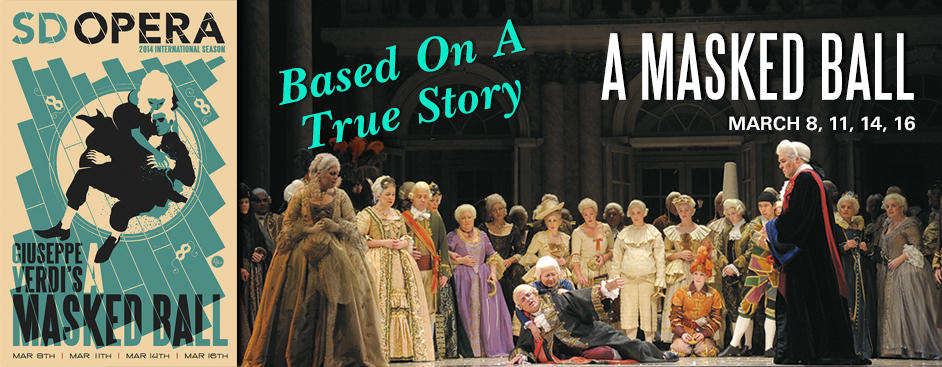
“A MASKED BALL” in San Diego

San Diego Opera 

Presents

A Masked Ball

A MASKED BALL

by Giuseppe Verdi

MARCH 8, 11, 14, 16, 2014

What a cast! Polish tenor Piotr Beczala is today’s hot lyric tenor and a star at every major opera house in the world including La Scala, the Metropolitan Opera, Paris Opera and Munich; Bulgarian soprano Krassimira Stoyanova is hailed in Germany as the Stradivarius of sopranos and beloved at Covent Garden, the Metropolitan Opera, the Paris Opera and Vienna State Opera; and the great American mezzo-soprano, Stephanie Blythe, brilliant at the Metropolitan Opera, Covent Garden and Berlin, make up a cast any great opera house would be proud to have for Verdi’s A Masked Ball.

Although the close relationship between Sweden’s King Gustav III and Amelia, wife of his best friend, Count Anckarström, has never crossed the line, jealousy and politics cause Anckarström to join a band of conspirators and ultimately to murder the King in front of his wife at a masked ball. As he dies, Gustav reveals the truth, and in operatic tradition, pardons Anckarström.

Inspired by the real-life assassination of King Gustav III after which Anckarström was actually beheaded, A Masked Ball is powerful, threatening, dangerous and romantic. The music is some of Verdi’s best and with artists of the caliber we have assembled, this production promises to be one of the most powerful, musical and dramatic ever seen on our stage. Italian conductor, Massimo Zanetti, in demand at the Deutsche Oper Berlin, Dresden and Munich makes his debut, joined by Lesley Koenig, director of last season’s hugely successful Samson and Delilah.

The running time is approximately 3 hours including two intermissions.
Sung in Italian with English translations displayed above the stage.

SYNOPSIS OF A MASKED BALL

ACT I

The King of Sweden, Gustav III, scoffs at news from Count Anckarström, his friend and secretary, that conspirators are plotting against him. A judge demands that a woman be accused of witchcraft be banned from the city, but the page Oscar jumps to her defense. The king decides it might be amusing to disguise himself and visit the woman to see if she is indeed in league with the devil, and invites his court and staff to join him.

Gustav is the first to arrive at the home of Madame Arvidson, the suspected witch, and notices a servant of Amelia – Anckerström’s wife, whom Gustav secretly loves. The servant asks Madame Arvidson for a private visitation by his mistress, and Gustav hides himself in order to observe Amelia. Amelia admits to Madame Arvidson that she loves a man who is not her husband, and that man is Gustav. She seeks peace from this love for her husband’s best friend, and Madame Arvidson advises her to go to the gallows at midnight and pick an herb that will stop her from loving Gustav.

When Amelia leaves, the crowd returns and Gustav comes out from his hiding place. He asks Madame Arvidson to read his palm. To the crowd’s horror, she pronounces that Gustav will soon die by the hand of a friend. He laughs at the gullibility of the crowd, which is shocked at the prediction.

ACT II

Just prior to midnight, Amelia finds her way to the gallows. Gustav’s arrival surprises her and she begs him to leave, but eventually admits her love for him. Anckerström soon arrives and Amelia immediately covers her face with a veil. Anckerström has followed Gustav to protect him from conspirators who are, at the moment, surrounding them with plans to kill Gustav. Amelia and Anckerström convince Gustav to flee. The conspirators arrive and, realizing they’ve caught the wrong man, ask the woman to remove her veil. Anckerström steps forward, willing to fight to protect the veiled woman’s identity. When a duel seems imminent, Amelia steps forward, removing her veil. Furious that his wife was meeting with his friend in the night, Anckerström asks the conspirators to visit him at his home the next day.

ACT III


When the conspirators arrive, Anckerström tells them he plans to join their plot against the king. They draw lots to see who will kill Gustav, and Anckerström wins. Oscar arrives with an invitation for them all to attend a masked ball and Anckerström vows to kill Gustav at the party.


The king arrives at the party in costume. A woman in disguise advises him to leave at once – his life is in danger. Gustav recognizes her as Amelia and he tells her he is sorry for betraying his friend and plans to send her and her husband back to their homeland. Anckerström now recognizes Gustav with Amelia and rushes forward to mortally wound him. The guests are outraged as Anckerström is revealed as the killer, but Gustav insists that he is still soverign over them. He grants Anckerström a reprieve and admits that he loves Amelia, but that she is innocent. He gives Anckerström a sealed commission for his safe departure.

THE CAST

Please click an artist’s name to read more.

San Diego Opera’s performances take place at the Civic Theatre, at the intersection of Third Avenue and B Street in downtown San Diego.

Posted in Music, OPera | Tagged , , , , , , , , | Leave a comment