Gounod’s FAUST in Atlanta

The Atlanta Opera


Faust

Charles Gounod

<!–

–>  

Saturday, March 08, 2014 at 8:00 p.m.
Tuesday, March 11, 2014 at 7:30 p.m.
Friday, March 14, 2014 at 8:00 p.m.
Sunday, March 16, 2014 at 3:00 p.m.
 
 
Music by Charles-François Gounod
Libretto by Jules Barbier and Michel Carré

Conducted by Carl and Sally Gable Music Director Arthur Fagen
Directed by Louisa Muller

Sung in French with projected English translations

In Gounod’s operatic retelling of the famous legend, an elderly scholar sells his soul to the devil Méphistophélès for a chance to seduce the beautiful Marguerite. Faust’s diabolical struggle between good and evil must surely end in tragedy…
Or does it?


Noah Stewart
Faust
Mary
Dunleavy
Marguerite
Alexander
Vinogradov
Méphistophélès
Arthur Fagen
Carl & Sally
Gable Music
Director
    Louisa
Muller
Stage
Director


Synopsis

Act I
Alone at his desk, Faust peers into the dark chasm of his being. Bitter and disillusioned, he contemplates the vial of poison before him. Voices of happy villagers carry through the open window; he curses them and their maker and invokes the name of Satan. Much to Faust’s surprise, Méphistophélès appears and offers him exactly what he wants — another chance at life — in exchange for his soul. The philosopher hesitates, but after seeing an image of the fair Marguerite, he heartily accepts the bargain. Drinking the vial, now an elixir of youth, Faust goes out into the village with Méphistophélès as his companion.

Act II 
At the county fair, villagers, soldiers and country folk amuse themselves with a drinking song. Valentin has a final moment with his friends, Wagner and Siébel, before going off to war. He laments having to leave his sister alone with no family. Siébel offers his services as protector, and Valentin solemnizes the oath with a prayer to God.

Méphistophélès joins in the villagers’ revelries. He offers a song of his own — a tribute celebrating the biblical Golden Calf and the bacchanals that go along with it. Wagner offers a glass of wine, but Méphistophélès instead grabs the student’s hand, noting a dark future present in its lines. For Siébel, Méphistophélès prophesizes that any flower the ardent young man shall touch will wither away; for Valentin, death, not in battle, but at the hand of someone known to him. Angered, Valentin provokes Méphistophélès into a fight, but Méphistophélès easily breaks the soldier’s sword at its first stroke. Now realizing his opponent’s true nature, Valentin uses the cruciform hilt of the sword to fend off evil as he and his colleagues fall in retreat. 

The community gathers for a dance. Faust is among them, hoping to encounter Marguerite. She arrives presently, just back from church. Siébel attempts to attract her attention but is prevented by Méphistophélès at every opportunity. Faust introduces himself and gallantly offers to escort Marguerite, but she modestly declines and returns home alone.

Act III 
Siébel waits in Marguerite’s garden. He hopes a gift of flowers will make her understand the depth of his affection. Although the posies wilt as soon as the young man touches it (as Méphistophélès predicted), Siébel finds a little holy water does the trick, and he leaves the revived bouquet on Marguerite’s doorstep. Faust and Méphistophélès lurk in the thicket, observing Siébel’s actions. They present an offering of their own — a casket packed with jewels — and place it strategically next to Siébel’s offering. Marguerite arrives, still distracted by the man who approached her in the square. She casually acknowledges the bouquet, but her attention is caught up in the treasure trove, and once clad in the jewels, she imagines herself transformed into a princess.

Marthe, an older neighbor, observes her gaiety. Hardly concerned by the mysterious nature of the gift, she advises Marguerite to keep the jewels, as they must be from an admirer. Méphistophélès returns with Faust and discloses that Marthe’s missing husband is, in fact, dead. The widow experiences a moment of remorse but is easily comforted by the alluring stranger. As Faust makes overtures to Marguerite, Marthe and Méphistophélès explore their new feelings together.

Marguerite unveils her sad lot to Faust. With both mother and sister gone, and Valentin off to battle, she is completely alone in the world. Faust offers his love and protection, but Marguerite is guarded. She puts her faith in a daisy and begins a childish game of plucking the petals. Only when the flower reveals the depth of Faust’s passion does her resolve begin to crumble, and the scene ends with a rapturous love duet. 

Act IV 
Scene One:
In her room, Marguerite is taunted by the village girls outside. Faust has deserted her just as she is about to expect their child. She laments the consequences of her actions. Siébel, her only remaining friend, vows to kill Faust for his heartless behavior. She begs him to let it be — in spite of all that has happened, her love for Faust has not diminished.

Scene Two:
Valentin and the other soldiers return victorious from battle. He happens upon Siébel and immediately asks of his sister’s welfare. Siébel hesitates and, as they approach Marguerite’s home, he tries to prevent Valentin from going inside. The ploy is unsuccessful — Valentin enters and is shocked to find Marguerite has had Faust’s child. Meanwhile, Méphistophélès and Faust have returned to the village, for the latter regrets abandoning Marguerite. Méphistophélès sings a serenade to lure Marguerite out of the house but Valentin appears instead, and enraged by their presence, challenges Faust to a duel. With Méphistophélès’s unearthly assistance, Faust is the easy victor, and mortally wounded, Valentin places a curse upon his sister as she rushes to his side.

Scene Three:
Marguerite prays for salvation at the local church, but Méphistophélès torments her with a hellish fate — God has turned his back in her hour of need. A mortal struggle between redemption and eternal damnation ensues as invisible voices from beyond offer Marguerite little comfort.

Act V 
Scene One:

As a distraction Méphistophélès invites Faust to celebrate the feast of Walpurgis Night, the evening before May 1. In the darkness of the Harz Mountains, a witches’ sabbath is in process. Fearful at first, Faust eventually joins in toasting everlasting oblivion with the attending witches, demons and courtesans of antiquity, who dance an infernal ballet. In the drunken chaos, Faust sees another vision of Marguerite, this time on death row with a blood-red circle around her neck. With sudden sobriety, Faust vows to set her free.

Scene Two:
Marguerite has been imprisoned for the crime of infanticide. Faust gains entry to the prison cell and begs her to escape with him. Demented with guilt, Marguerite refuses his proposal and somberly awaits her march to the scaffold. Méphistophélès is troubled by Faust’s insistence that she leave — with the execution, he believes another soul will be placed in his care. He demands that Faust leave at once, or be cast aside. Marguerite sees the demon for who he really is and implores the celestial powers to save her. As she dies, Méphistophélès is vexed when Marguerite, judged and forgiven of her crimes, ascends to the heavens.

Courtesy of The Minnesota Opera


The original oil paintings for each opera were painted by Atlanta-based artist Matt Hughes. Over the years, Matt has evolved his painting style, refining his craft to become internationally recognized as a respected and highly sought-after artist. At left, Matt puts finishing touches on the painting of Faust and Méphistophélès. Matt’s portrait and conceptual work can be seen at MattHughesArt.com.

The oil paintings will be on display at the Cobb Energy Centre for each production and auctioned to the highest bidder at The 2013 Atlanta Opera Ball Puccini’s Palazzo, on October 26, 2013 at the St. Regis–Atlanta

Posted in Music, OPera | Tagged , , , , , , , , | Leave a comment

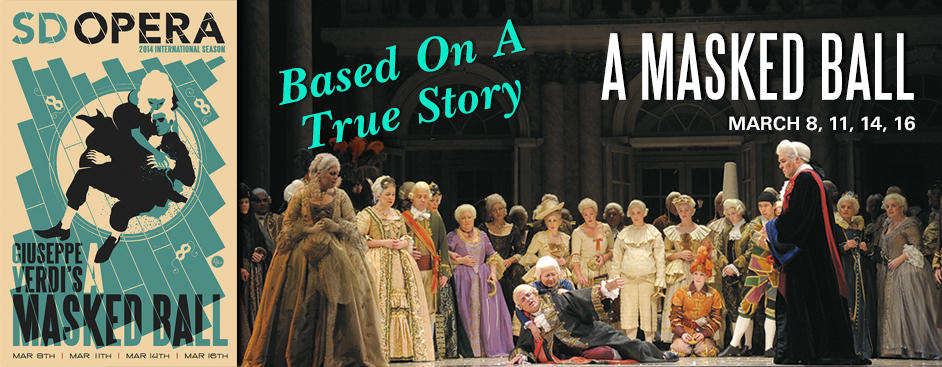
“A MASKED BALL” in San Diego

San Diego Opera 

Presents

A Masked Ball

A MASKED BALL

by Giuseppe Verdi

MARCH 8, 11, 14, 16, 2014

What a cast! Polish tenor Piotr Beczala is today’s hot lyric tenor and a star at every major opera house in the world including La Scala, the Metropolitan Opera, Paris Opera and Munich; Bulgarian soprano Krassimira Stoyanova is hailed in Germany as the Stradivarius of sopranos and beloved at Covent Garden, the Metropolitan Opera, the Paris Opera and Vienna State Opera; and the great American mezzo-soprano, Stephanie Blythe, brilliant at the Metropolitan Opera, Covent Garden and Berlin, make up a cast any great opera house would be proud to have for Verdi’s A Masked Ball.

Although the close relationship between Sweden’s King Gustav III and Amelia, wife of his best friend, Count Anckarström, has never crossed the line, jealousy and politics cause Anckarström to join a band of conspirators and ultimately to murder the King in front of his wife at a masked ball. As he dies, Gustav reveals the truth, and in operatic tradition, pardons Anckarström.

Inspired by the real-life assassination of King Gustav III after which Anckarström was actually beheaded, A Masked Ball is powerful, threatening, dangerous and romantic. The music is some of Verdi’s best and with artists of the caliber we have assembled, this production promises to be one of the most powerful, musical and dramatic ever seen on our stage. Italian conductor, Massimo Zanetti, in demand at the Deutsche Oper Berlin, Dresden and Munich makes his debut, joined by Lesley Koenig, director of last season’s hugely successful Samson and Delilah.

The running time is approximately 3 hours including two intermissions.
Sung in Italian with English translations displayed above the stage.

SYNOPSIS OF A MASKED BALL

ACT I

The King of Sweden, Gustav III, scoffs at news from Count Anckarström, his friend and secretary, that conspirators are plotting against him. A judge demands that a woman be accused of witchcraft be banned from the city, but the page Oscar jumps to her defense. The king decides it might be amusing to disguise himself and visit the woman to see if she is indeed in league with the devil, and invites his court and staff to join him.

Gustav is the first to arrive at the home of Madame Arvidson, the suspected witch, and notices a servant of Amelia – Anckerström’s wife, whom Gustav secretly loves. The servant asks Madame Arvidson for a private visitation by his mistress, and Gustav hides himself in order to observe Amelia. Amelia admits to Madame Arvidson that she loves a man who is not her husband, and that man is Gustav. She seeks peace from this love for her husband’s best friend, and Madame Arvidson advises her to go to the gallows at midnight and pick an herb that will stop her from loving Gustav.

When Amelia leaves, the crowd returns and Gustav comes out from his hiding place. He asks Madame Arvidson to read his palm. To the crowd’s horror, she pronounces that Gustav will soon die by the hand of a friend. He laughs at the gullibility of the crowd, which is shocked at the prediction.

ACT II

Just prior to midnight, Amelia finds her way to the gallows. Gustav’s arrival surprises her and she begs him to leave, but eventually admits her love for him. Anckerström soon arrives and Amelia immediately covers her face with a veil. Anckerström has followed Gustav to protect him from conspirators who are, at the moment, surrounding them with plans to kill Gustav. Amelia and Anckerström convince Gustav to flee. The conspirators arrive and, realizing they’ve caught the wrong man, ask the woman to remove her veil. Anckerström steps forward, willing to fight to protect the veiled woman’s identity. When a duel seems imminent, Amelia steps forward, removing her veil. Furious that his wife was meeting with his friend in the night, Anckerström asks the conspirators to visit him at his home the next day.

ACT III


When the conspirators arrive, Anckerström tells them he plans to join their plot against the king. They draw lots to see who will kill Gustav, and Anckerström wins. Oscar arrives with an invitation for them all to attend a masked ball and Anckerström vows to kill Gustav at the party.


The king arrives at the party in costume. A woman in disguise advises him to leave at once – his life is in danger. Gustav recognizes her as Amelia and he tells her he is sorry for betraying his friend and plans to send her and her husband back to their homeland. Anckerström now recognizes Gustav with Amelia and rushes forward to mortally wound him. The guests are outraged as Anckerström is revealed as the killer, but Gustav insists that he is still soverign over them. He grants Anckerström a reprieve and admits that he loves Amelia, but that she is innocent. He gives Anckerström a sealed commission for his safe departure.

THE CAST

Please click an artist’s name to read more.

San Diego Opera’s performances take place at the Civic Theatre, at the intersection of Third Avenue and B Street in downtown San Diego.

Posted in Music, OPera | Tagged , , , , , , , , | Leave a comment

Lecture: Richard Strauss at 150 (The Kennedy Center in Washington)

THE KENNEDY CENTER

Richard Strauss (uncredited)Richard Strauss at 150 with Saul Lilienstein

Musicologist Saul Lilienstein examines the creative genius of composer Richard Strauss as he looks at three of his most frequently performed operas.

Der Rosenkavalier. And just before it came the ear-bending Elektra. Just after, that “opera within an opera within an Italian comedy,” Ariadne auf Naxos. Is this the same composer who writes all three, within a five-year period? With these three distinctive pieces, Strauss’s expansive imagination conjures an avant-garde challenge, a romantic comedy, and a multi-leveled tour de force. Saul Lilienstein demonstrates how Richard Strauss embodies a recognizable creative presence in these operas.

Performance Timing: 90 minutes

  • Sat., Mar. 8, 2014, 3:00 PM
  • Terrace Gallery
  • 90 minutes
  • $15.00

The John F. Kennedy Center for the Performing Arts
2700 F Street, NW Washington, DC 20566

Posted in Lectures | Tagged , , , , , , , | Leave a comment

La traviata in Phoenix

La Traviata

La Traviata

Composed by Giuseppe Verdi

La Traviata is an opera in three acts by Giuseppe Verdi set to an Italian libretto by Francesco Maria Piave. It is based on the novel La Dame aux Camélias by Alexandre Dumas, fils, published in 1848.

Performance Dates & Times

2011-03-04 Friday 7:30 pm
2011-03-06 Sunday 2:00 pm

SYNOPSIS

ACT I 

In her Paris salon, the courtesan Violetta Valéry greets party guests, including Flora Bervoix, the Marquis d’Obigny, Baron Douphol, and Gastone, who introduces a new admirer, Alfredo Germont. This young man, having adored Violetta from afar, joins her in a drinking song (Brindisi: “Libiamo”). An orchestra is heard in the next room, but as guests move there to dance, Violetta suffers a fainting spell, sends the guests on ahead, and goes to her parlor to recover. Alfredo comes in, and since they are alone, confesses his love (“Un dì felice”). At first Violetta protests that love means nothing to her. Something about the young man’s sincerity touches her, however, and she promises to meet him the next day. After the guests have gone, Violetta wonders if Alfredo could actually be the man she could love (“Ah, fors’è lui”). But she decides she wants freedom (“Sempre libera”), though Alfredo’s voice, heard outside, argues in favor of romance.

ACT II

Some months later Alfredo and Violetta are living in a country house near Paris, where he praises their contentment (“De’ miei bollenti spiriti”). But when the maid, Annina, reveals that Violetta has pawned her jewels to keep the house, Alfredo leaves for the city to settle matters at his own cost. Violetta comes looking for him and finds an invitation from Flora to a party that night. Violetta has no intention of going back to her old life, but trouble intrudes with the appearance of Alfredo’s father. Though impressed by Violetta’s ladylike manners, he demands she renounce his son: the scandal of Alfredo’s affair with her has threatened his daughter’s engagement (“Pura siccome un angelo”). Violetta says she cannot, but Germont eventually convinces her (“Dite alla giovine”). Alone, the desolate woman sends a message of acceptance to Flora and begins a farewell note to Alfredo. He enters suddenly, surprising her, and she can barely control herself as she reminds him of how deeply she loves him (“Amami, Alfredo”) before rushing out. Now a servant hands Alfredo her farewell note as Germont returns to console his son with reminders of family life in Provence (“Di Provenza”). But Alfredo, seeing Flora’s invitation, suspects Violetta has thrown him over for another lover. Furious, he determines to confront her at the party.

At her soirée that evening, Flora learns from the Marquis that Violetta and Alfredo have parted, then clears the floor for hired entertainers – a band of fortune-telling Gypsies and some matadors who sing of Piquillo and his coy sweetheart (“E Piquillo un bel gagliardo”). Soon Alfredo strides in, making bitter comments about love and gambling recklessly at cards. Violetta has arrived with Baron Douphol, who challenges Alfredo to a game and loses a small fortune to him. Everyone goes in to supper, but Violetta has asked Alfredo to see her. Fearful of the Baron’s anger, she wants Alfredo to leave, but he misunderstands her apprehension and demands that she admit she loves Douphol. Crushed, she pretends she does. Now Alfredo calls in the others, denounces his former love and hurls his winnings at her feet (“Questa donna conoscete?”). Germont enters in time to see this and denounces his son’s behavior. The guests rebuke Alfredo and Douphol challenges him to a duel.

ACT III

In Violetta’s bedroom six months later, Dr. Grenvil tells Annina her mistress has not long to live: tuberculosis has claimed her. Alone, Violetta rereads a letter from Germont saying the Baron was only wounded in his duel with Alfredo, who knows all and is on his way to beg her pardon. But Violetta senses it is too late (“Addio del passato”). Paris is celebrating Mardi Gras and, after revelers pass outside, Annina rushes in to announce Alfredo. The lovers ecstatically plan to leave Paris forever (“Parigi, o cara”). Germont enters with the doctor before Violetta is seized with a last resurgence of strength. Feeling life return, she staggers and falls dead at her lover’s feet.

La Traviata Cast Members

Julia Koci (Violetta)

Viennese born soprano Julia Koci graces our stage with her emotionally packed interpretation of Violetta.

Jesus Garcia (Alfredo)

Internationally acclaimed tenor, Jesus Garcia, has performed on major stages all over the world.


Gaetan Laperriere (Germont)

The breadth of Gaétan Laperrière’s lyric baritone repertoire reaches into the heroic Italian roles so suited to his instrument.

Trav10

Posted in OPera | Tagged , , , , , , , , | Leave a comment

LA CLEMENZA DI TITO in Chicago

The Lyric Opera of Chicago presents

LA CLEMENZA DI TITO

La Clemenza di Tito

  • by Wolfgang Amadeus Mozart
  • In Italian with projected English texts.Mozart’s La Clemenza di Tito is a new-to-Chicago production. Production of The Festival d’Aix-en-Provence, in coproduction with le Théâtre du Capitole de Toulouse and l’Opéra de Marseille.
  • Approximate running time: 2h 50m

 2014: MARCH 5, 8, 11, 14, 17, 20, 23

Sex and power are front and center in Mozart’s riveting La Clemenza di Tito.

Can a Roman emperor forgive a woman who either wants to marry him or murder him? And can he pardon the would-be assassin who’s supposedly his best friend? Find out in this spellbinding Sir David McVicar production that got rave reviews at France’s Aix-en-Provence Festival.

A highlight of the prestigious 2011 Aix-en-Provence Festival, this production is filled with theatrical urgency and fire. “McVicar’s direction is characteristically sharp, adding psychological complexity and bringing the drama to life.” The Telegraph, London

Lyric Opera presentation of Wolfgang Amadeus Mozart’s La Clemenza di Tito generously made possible by Julie and Roger Baskes, The Negaunee Foundation, and Roberta L. and Robert J. Washlow.

Starring

  • Matthew Polenzani

    Tito

    Matthew Polenzani

    Matthew Polenzani: “Great lyricism…magnificent voice…a remarkable tenor who gives the listener true joy.” Le Monde, Paris

  • Joyce DiDonato

    Sesto

    Joyce DiDonato 

    Joyce DiDonato: “The perfect 21st-century diva…an effortless combination of glamour, charisma, intelligence, grace, and remarkable talent.” The New York Times

  • Amanda Majeski

    Vitellia

    Amanda Majeski 

    Amanda Majeski “sings an extraordinary Vitellia…her gleaming soprano displaying fluent coloratura…which she uses to hair-raising effect.” Opera News

    La Clemenza di Tito - Cecelia Hall Annio
    Cecelia Hall † †
    La Clemenza di Tito - Emily Birsan Servilia
    Emily Birsan † 
    La Clemenza di Tito - Christian Van Horn Publio
    Christian Van Horn ††
    La Clemenza di Tito - Sir Andrew Davis Conductor
    Sir Andrew Davis
    La Clemenza di Tito - Sir David McVicar Original Director & Set Designer
    Sir David McVicar
      Revival Director
    Marie Lambert     
    La Clemenza di Tito - Jenni Tiramani Costume Designer
    Jenni Tiramani* 
    La Clemenza di Tito - Jennifer Tipton Lighting Designer
    Jennifer Tipton 
    Chorus Master
    Michael Black 
      Choreographer
    David Greeves* 
      Associate Set Designer
    Bettina Neuhaus

    POWER PLAYS
    DiDonato & Polenzani star in La Clemeza di Tito

    by Tracy Galligher

    Political intrigue, spurned overtures, murderous plots, and uncertain consequences–if it sounds like a page out of current primetime television listings, it’s just confirmation that human nature is as ever-constant today as it was in Mozart’s time.

    The composer’s final operatic masterpiece, La clemenza di Tito, tells an intensely psychological story surrounding the Roman Emperor Titus, or Tito. Power-obsessed Vitellia, daughter of the recently-deposed emperor, is determined to have Tito as her husband–or have him murdered. When Tito chooses another as his empress, a seething Vitellia turns to Sesto, Tito’s best friend, who is fiercely consumed with lust for her. Seductive, desperate, and fixated, Vitellia convinces Sesto to assassinate the Emperor. When their plot fails and their ultimate betrayal is revealed, Tito grants Vitellia and Sesto clemency, showing that power and mercy may go hand in hand–a popular theme for works of art that were commissioned by royalty, as this one was for the coronation of Leopold II, Holy Roman Emperor, as King of Bohemia.

    If the opera centers on a single, overarching idea, director Sir David McVicar says that it’s “how to be in a position of power and hold on to your humanity. It’s a very mature piece in its storytelling, its composition, and what it’s looking at – the way people can behave when they want power.” Making each character multidimensional and believable, he says, is key to its success. “If you refuse to accept the conventions of these characters and the way they’re often played, you find the strength and you find the interest.”

    Lyric has assembled an internationally sought-after star cast and artistic team to produce this opera for the first time in 25 years. Tenor Matthew Polenzani, a Ryan Opera Center alumnus and a longtime favorite with Lyric Opera audiences (most recently triumphing in the title roles of Werther and The Tales of Hoffmann), makes his much-anticipated debut in the title role. “I think the biggest challenge is bringing the required depth and gravity to the character,” Polenzani says. “I often thought that even though the part was right for me vocally, I didn’t have the life experience to wrestle with the feelings and emotions that face Tito with any veracity. I’m at a place now in my life that I can imagine and understand better what Tito faces. The depth of his love and compassion is something I’m just now able to appreciate.”

    Sir Andrew Davis, who leads the Lyric Opera Orchestra for this production, agrees with Polenzani. “The thing about Tito is if you don’t present him in the right way, he seems rather weak. But in fact he has a huge heart and a great propensity for forgiveness. You need an artist of real maturity to bring him off, and though Matthew’s still a relatively young man, he has the gravitas.”

    Scheming against Tito as Vitellia is Ryan Opera Center alumna Amanda Majeski, who wowed Lyric audiences last season as Eva in Die Meistersinger von Nürnberg. “Vitellia is a woman who goes to extremes in every way,” Majeski says, emphasizing the complex layers to the role. “She is vindictive, jealous, angry, feisty…but also quite remorseful and sensitive in the end. She feels emotion strongly and sincerely, whether she’s rational or not. Mozart is an expert at writing music to enhance the character, so a singer is required to sing at the extremes of her range, spinning out both long legato lines and fiery coloratura. I think portraying her honestly and allowing the music to speak for itself allows the audience to understand her humanity.”

    “Vitellia’s problem with Tito is absolutely legitimate,” says McVicar. “It’s not about, ‘He doesn’t love me, he doesn’t choose me.’ Tito’s father Vespasian was the victor in a civil war and killed her father, the former Emperor Vitellius, so Tito has what once belonged to her family. In Roman society, as a woman, she can’t actually hold the reins of power, but if she can marry him, she’ll get what she feels is rightfully hers. In her relationship with Sesto, you have two people with very negative energies feeding off each other and setting out to do things that in any normal circumstance they wouldn’t contemplate doing. It’s a kind of vacuum of need. His need is for her–this incredible, erotic longing–and she has an emptiness inside her–a longing for power that Sesto can’t fill.”

    “Sesto is one of the most tortured characters in opera,” says acclaimed mezzo-soprano Joyce DiDonato, whose return to Lyric Opera in this “pants” role is eagerly awaited by audiences. “There is a big discussion as to whether Sesto is weak or not, but I don’t think he’s weak at all: I think he’s blinded by passion, completely torn between loyalty to the friend and ruler he loves and the woman he loves. He most fully emerges in his second-act aria, ‘Deh per questo,’ because in earlier scenes he is more a puppet to his lust, infatuation, and love for Vitellia. But at this moment, he assumes responsibility for his actions and asks, most sincerely, for forgiveness. It is a pure masterpiece. It seems to me that Mozart had a special place in his heart for Sesto; I don’t think he wrote a single extraneous note for him.”

    The 35-year-old Mozart was just months away from his death when he was commissioned to write Clemenza in July 1791. Mozart’s last five extraordinary years had produced The Marriage of Figaro (1786), Don Giovanni (1787), Così fan tutte (1790), and nearly all of The Magic Flute, which was written concurrently with Clemenza and premiered just after it. For this opera, he turned to the opera seria style, identified by its noble theme and drawing from Baroque-era musical conventions. The libretto by Pietro Metastasio had already been set by nearly 40 composers and was tweaked by court poet Caterino Mazzolà before Mozart began his writing. It would premiere in September.

    “There is so much sublime music in this opera–as with all of Mozart’s operas,” says Polenzani. By turns ethereally beautiful and filled with passionate intensity, it features some of Mozart’s most magnificent choral work. 

    David McVicar adds, “You can’t help but think about what operas Mozart could have gone on to write if he had lived, because this piece is a model. Mozart has taken an old text, mashed it up, and produced something that strikes me as completely modern with its psychological complexity and veracity. Instead of being Baroque relics, these characters are completely convincing modern people.”

    The production, which was conceived and designed by McVicar and is directed by his associate Marie Lambert (who remounted his Meistersinger at Lyric last season), premiered at the Festival d’Aix-en-Provence, where The Telegraph praised the direction for “adding psychological complexity and probing the Enlightenment’s darker side.” Set at the moment the 18th century becomes the 19th, McVicar says, “The scenery and lighting are very influenced by the works of [French Neoclassical painter] Jacques-Louis David. It’s got a huge staircase, which is an image of power. Tito spends a lot of time on the staircase, separate–isolated and shielded by his Praetorian guard. We emphasize his loneliness and how difficult it is for him to make contact with other human beings. That’s why his relationship with Sesto is so vital to him.”

    For opera lovers, this production offers the chance to enjoy a rarely-performed gem of the repertoire. DiDonato, who returns to Clemenza after a number of years, can’t wait. “The biggest strength, aside from the glorious music, is its pure humanity. Sesto is blinded by love. Vitellia is blinded by power. Tito is the one who stands up against his pain and betrayal, to do what is right. Isn’t it amazing that we can still learn – more than 200 years later – from this masterpiece?”

Posted in Music, OPera | Tagged , , , , , , , , , | Leave a comment

Opera Master Class: Sarah Coburn at The Kennedy Center

THE KENNEDY CENTER

Opera Master Class: Sarah Coburn

Observe the creative process as pre-professional performers receive instruction from some of the greats in opera.

  • Tue., Mar. 4, 2014, 7:00 PM
  • Terrace Gallery
  • 90 minutes
  • $12.00

Witness how great performers are made, hear some of opera’s great voices of tomorrow, and observe the creative process. During this session, emerging artists from the Domingo-Cafritz Young Artists Program and others hone their craft under the guidance of one of opera’s great performers. Hailed by the New York Observer for having “qualities that have made legends out of so many of her predecessors,” soprano Sarah Coburn coaches the next generation of singers.

Performance Timing: 90 minutes

The John F. Kennedy Center for the Performing Arts
2700 F Street, NW Washington, DC 20566

Posted in Lectures | Tagged , , , , , , , | Leave a comment

FLORIDA GRAND OPERA Presents “TOSCA”

FLORIDA GRAND OPERA Presents:

Tosca

Giuseppe Verdi

ToscaThis opera favorite recounts the melodramatic story of a beautiful opera singer, Floria Tosca, and a lecherous police chief, Baron Scarpia, who unleashes a lustful plan. The tale plays out to a murderous and powerful ending. Composer Giacomo Puccini has never been better.

Kara Shay Thomson Tosca (Mar 29, Apr 1, 4, 10, 12)
Jouvanca Jean-Baptiste Tosca (Mar 30, Apr 2, 5)
Rafael Davila Cavaradossi (Mar 29, Apr 1, 4, 10)
Diego Torre Cavaradossi (Mar 30, Apr 2, 5, 12)
Todd Thomas Scarpia
Ramón Tebar Conductor
José Maria Condemi Stage Director
Seattle Opera Production

MIAMI
Adrienne Arsht Center for the Performing Arts
of Miami-Dade County
Sanford and Dolores Ziff Ballet Opera House
Mar 29, 2014, at 7 p.m. – Opening Night
Mar 30, 2014, matinee at 2 p.m.
Apr 1, 2, 4 & 5, 2014, at 8:00 p.m.


FORT LAUDERDALE
Broward Center for the Performing Arts / Au-Rene Theater
Apr 10 & 12, 2014, at 7:30 p.m.

Posted in OPera | Tagged , , , , , , , , | Leave a comment

TOSCA in Barcelona

logoliceu 

Presents:

Tosca

Giacomo Puccini

8, 9, 11, 12, 13, 14, 15, 17, 18, 19, 20, 21, 22, 23 and 25 March 2014

tosca1_01A triangle of passions

Three is a number of special relevance to Tosca: three settings in Rome in the year 1800, three main characters (Tosca, Cavaradossi and Scarpia), and the three rules of classical drama – action, place and time – which, surprisingly, still underlie this work from the dawn of the 20th century. Paco Azorín chooses to apply the number three to yet another dimension and his production – dominated by a huge, strikingly realistic altarpiece – spans three centuries: the period of the action, that of the premiere, and that of the present audience. Thus there are three levels of interpretation, one for each act, and his Tosca starts off as a work of realism, evolves into the sphere of symbolism, and concludes with a metaphorical vision of this tale of passions. For every passion that is part of contradictory human nature – from love to power lust – finds its place in the three settings and each is expressed with forcefulness and violence. 


Melodramma in three acts. Libretto by Giuseppe Giacosa and Luigi Illica after the melodrama La Tosca by Victorien Sardou (1831-1908). Music by Giacomo Puccini. Premiered on 14 January 1900 at the Teatro Costanzi in Rome (nowadays Teatro dell’Opera). First staged at the Gran Teatre del Liceu on 30  March 1902. Most recent performance at the Gran Teatre del Liceu: 21 June 2004.

Conductor
Paolo Carignani

Stage direction and Scenography
Paco Azorín

Costume
Isidre Prunés

Lighting
Pascal Mérat

New Co-production
Gran Teatre del Liceu / Teatro de la Maestranza (Sevilla)

Symphony Orchestra and Chorus of the Gran Teatre del Liceu

Cor Savina del Conservatori de Cervera

Direction of children’s choir
Núria Mas

CAST

  
 Sondra Radvanovsky         Martina Serafin                Fiorenza Cedolins

<:section>

 
Floria Tosca Sondra Radvanovsky 8, 11, 14, 17, 20 and 23 Mar
Martina Serafin 9, 13, 18, 21 and 25 Mar
Fiorenza Cedolins 12, 15, 19 and 22 Mar
Mario Cavaradossi Riccardo Massi 8, 11, 14, 17, 20 and 23 Mar
Jorge de León 9, 12, 15, 19 and 22 Mar
Alfred Kim 13, 18, 21 and 25 Mar
Baró Scarpia Ambrogio Maestri 8, 11, 14, 17, 20 and 23 Mar
Scott Hendricks 9, 13, 18, 21 and 25 Mar
Vittorio Vitelli 12, 15, 19 and 22 Mar
Cesare Angelotti Vladimir Baykov 8, 11, 12, 14, 15, 17, 19, 20, 22 and 23 Mar
Alessandro Guerzoni 9, 13, 18, 21 and 25 Mar
Sagristà Valeriano Lanchas  
Spoletta Francisco Vas 8, 11, 14, 17, 20, 22 and 23 Mar
José Manuel Zapata 9, 12, 13, 15, 18, 19, 21 and 25 Mar
Sciarrone Manel Esteve  
Carceller    
Un pastor Elena Copons

tosca3_01 tosca2_01

Photos: Scale models of the new production

Posted in Music, OPera | Tagged , , , , , | Leave a comment

“Madame Butterfly” performed on the water’s edge in Australia

Handa Opera on Sydney Harbour - Madama Butterfly

Handa Opera on Sydney Harbour – Puccini’s “Madama Butterfly”

Opera on Sydney Harbour, Fleet Steps, Mrs Macquaries Point March 21 – April 11, 2014

NEW PRODUCTION

What is opera to you? The rush of adrenalin as a soprano or tenor’s voice soars, the hum of the chorus, the larger-than-life costumes and scenery, the moving stories, or just the whole sense of occasion?

Handa Opera on Sydney Harbour is all this and more.

Come down to the water’s edge and let the story begin.

We’re in Japan. A young American acquires a bride to keep him company during his stay. It’s clearly a financial transaction rather than a love match but on their wedding night the stars come out, their eyes meet and magic happens.

We dare you to hear Cio-Cio-San and Pinkerton’s exquisite love duet and remain unmoved, especially when it takes place against the backdrop of the Sydney Opera House and Harbour Bridge.

The stars will be there, for real. Magic too?

Silken arias and fragile butterfly wings float on the water

There’s a moment in March where several hundred people collectively hold their breath on the harbourfront.

It’s when two enormous cranes lift a 40-tonne stage from 10 barges onto 16 pylons buried deep in the ocean floor.

“The highest risk is in that moment,” explains Louisa Robertson, whose job title could well be “chief-problem solver” for Handa Opera on Sydney Harbour.

Now in her third year as executive producer for the annual event, Robertson has encountered nearly every obstacle imaginable when it comes to mounting an opera on Sydney’s most spectacular – and unpredictable – stage. These range from the trivial – “Trees are always a challenge. They grow, and suddenly your design doesn’t fit!” – to the seemingly insurmountable.

“Each new design offers its own challenges. We had one crane in 2012, then for Carmen in 2013 the designer wanted two. We had to reinforce everything.” 

More than 700 people turn their hands to the project before a single note is heard over the Botanic Gardens.

It takes 8,000 hours of manual labour to build the stage and the elaborate underworld of the orchestra pit and dressing rooms beneath the stage. Making the costumes takes another 10,000 hours. The inventory of batteries, light globes, nuts, bolts and screws adds up to mindboggling numbers.

It is a truly gargantuan effort, Robertson says. “There are a lot of firsts on site from a technological and design perspective.” They range  from the spectacular – fireworks and chandeliers – to the mundane: “The toilets won an Event award for Best Innovation!”

Create a night to remember

The harbour-front site will be transformed into an exquisite Japanese garden hosting a superb range of Japanese-inspired dining options and bars.

Create a night to remember and add pre-show dinner or interval drinks at The Platinum Club.

The venue is open from 5pm each evening. 

Pre-Performance Dinner $250

Three-course dinner with drinks overlooking Sydney Harbour

Conductor Brian Castles-Onion
Director Alex Ollé
Assistant Director Susana Gómez
Set Designer Alfons Flores
Costume Designer Lluc Castells
Lighting Designer Alexander Koppelmann
   
Cio-Cio-San Hiromi OmuraHyeseoung Kwon
Suzuki Anna Yun
Pinkerton Georgy Vasiliev
Andeka Gorrotxategi
Sharpless Michael HoneymanBarry Ryan
Goro Graeme Macfarlane

Australian Opera and Ballet Orchestra

Opera Australia Chorus

Running time: approx two hours and forty minutes with one interval of thirty-five minutes

Performed in Italian with English surtitles.

Synopsis

Act I

B.F. Pinkerton arrives in Japan and inspects a house overlooking harbour that he is leasing from the marriage broker, Goro. The house comes with three servants and a geisha wife named Cio-Cio-San, known as Madama Butterfly. The American consul Sharpless arrives. Pinkerton describes his life of roaming the world in search of experience and pleasure. He intends to go through with the marriage ceremony even though he says that someday he will take a real, American wife. Butterfly views the marriage differently. She is heard climbing the hill with her friends for the ceremony. After the formal introduction Butterfly explains that her family was once prominent but lost its position, and she has had to earn her living as a geisha. Her relatives arrive. Cio-Cio-San shows Pinkerton her few possessions, and tells him she will embrace her husband’s religion. The Imperial Commissioner reads the marriage agreement, and the relatives congratulate the couple. Suddenly, a threatening voice is heard – it is the Bonze, Butterfly’s uncle, a priest. He curses the girl for converting to Christianity. Pinkerton orders them to leave and as they go the Bonze and the shocked relatives reject Cio-Cio-San. She is helped by Suzuki into her wedding kimono, and joins Pinkerton in the garden.

Act II – Part 1

Several years have passed, and Cio-Cio-San awaits her husband’s return. Suzuki prays to the gods for help, but Butterfly berates her, telling her that Pinkerton has promised to return one day. Sharpless appears with a letter from Pinkerton. Goro arrives with the latest potential husband for Butterfly, the wealthy Prince Yamadori. Butterfly politely serves the guests tea but insists she is not available for marriage. She dismisses Goro and Yamadori. Sharpless attempts to read Pinkerton’s letter and suggests that perhaps Butterfly should reconsider Yamadori’s offer. Butterfly shows the consul her small child. Sharpless is too upset to tell her more of the letter’s contents. He leaves, promising to tell Pinkerton of the child. A cannon shot is heard in the harbour announcing the arrival of Pinkerton’s ship. Overjoyed, Butterfly joins Suzuki in strewing the house with flower petals. Night falls, and Butterfly, Suzuki, and the child settle into a vigil awaiting Pinkerton’s arrival.

Act II – Part 2

Dawn breaks, and Suzuki insists that Butterfly get some sleep. Butterfly carries the child into another room. Sharpless appears with Pinkerton and Kate, Pinkerton’s new wife. Suzuki realises who the American woman is. Pinkerton is overcome with guilt and leaves rather than face Cio-Cio-San. Cio-Cio-San rushes in hoping to find Pinkerton, but sees Kate instead. Grasping the situation, she agrees to give up the child but insists Pinkerton return for him. Dismissing everyone, Butterfly takes out the dagger with which her father committed suicide, choosing to die with honour rather than live in shame. She is interrupted momentarily when the child comes in. After an impassioned farewell, she blindfolds the child then stabs herself as Pinkerton calls her name. 

Posted in Music, OPera | Tagged , , , , , , | Leave a comment

New Production of “Die tote Stadt” at the New National Theatre of Tokyo

mainmenuTokyo

Presents:

dietotestadt

Die tote Stadt

    • 2013/2014 Season
    • [New Production]
      Erich Wolfgang Korngold : Die tote Stadt
      Opera in 3 Acts
      Sung in German with Japanese Supertitles
    • OPERA HOUSE
  • PERFORMANCES

    2014
    March 12 March 15 March 18 March 21 March 24
    Wednesday Saturday Tuesday Friday Monday
     
     
    2:00
    *
     
     
    2:00
    *
    2:00
     
    7:00


    7:00
    *


Otaka Tadaaki chose Die tote Stadt by Erich Wolfgang Korngold as one of the works to unveil as a new production during his fourth season as Artistic Director. Korngold was a composer who was buffeted by the winds of his era. In 1920, when Korngold was age 23, he enjoyed great success with his opera Die tote Stadt, but soon after fled Austria for America. There Korngold worked on Hollywood film scores, a fact which led to his being ostracized from the world of classical music in the post-war years; he lived out his later years in relative obscurity. In Germany, performance of Korngold’s music was prohibited by the Nazis, and for a time he was largely forgotten. But starting in the 1970s, there has been a reappraisal and growing appreciation of his work in the US and Europe. His operas started to be performed once again, and his music has been featured in a large number of concerts and recordings.

This production was directed by Kasper Holten. The NNTT has rented the stage art and costumes for the production from the Finnish National Opera (Helsinki). Holten productions are based on clear-cut interpretations, yet display a distinctive sense of style. He is recognized as one of the most dynamic directors on the world scene. Mr. Holten has served as Director of London’s Royal Opera since the start of their 2012/2013 season. Conducting the opera will be Jaroslav Kyzlink, making his return to the NNTT. He gave a much-lauded performance on the podium for the 2011 production of Rusalka. Die tote Stadt is not frequently performed, due in part to the difficulty of the main parts for soprano and tenor. In these roles we are proud to present Torsten Kerl as Paul, and Meagan Miller as Marie/Marietta. The role of Frank/Fritz will be sung by Thomas Johannes Mayer.

STAFF

Conductor : Jaroslav Kyzlink
Production : Kasper Holten
Scenery Design : Es Devlin
Costume Design : Katrina Lindsay
Lighting Design : Wolfgang Gobbel


(Conductor)
Jaroslav Kyzlink

(Production)
Kasper Holten

CAST

Paul : Torsten Kerl
Marietta/Marie : Meagan Miller
Frank/Fritz : Thomas Johannes Mayer
Brigitta : Yamashita Makiko
Gaston/Victorin : Ohara Keiroh
Juliette : Hirai Kaori
Graf Albert : Itoga Shuhei
Lucienne : Ono Wakako

Chorus : New National Theatre Chorus
Orchestra : Tokyo Symphony Orchestra

Photos

(Paul)
Torsten Kerl
Photos

(Marietta/Marie)
Meagan Miller
Photos

(Frank/Fritz)
Thomas Johannes Mayer
Photos

(Brigitta)
Yamashita Makiko
Photos

(Gaston/Victorin)
Ohara Keiroh
New National Theatre Foundation
1-1-1 Hon-machi, Shibuya-ku, Tokyo
151-0071, Japan
Tel. +81-3-5351-3011
Posted in Music, OPera | Tagged , , , , , | Leave a comment