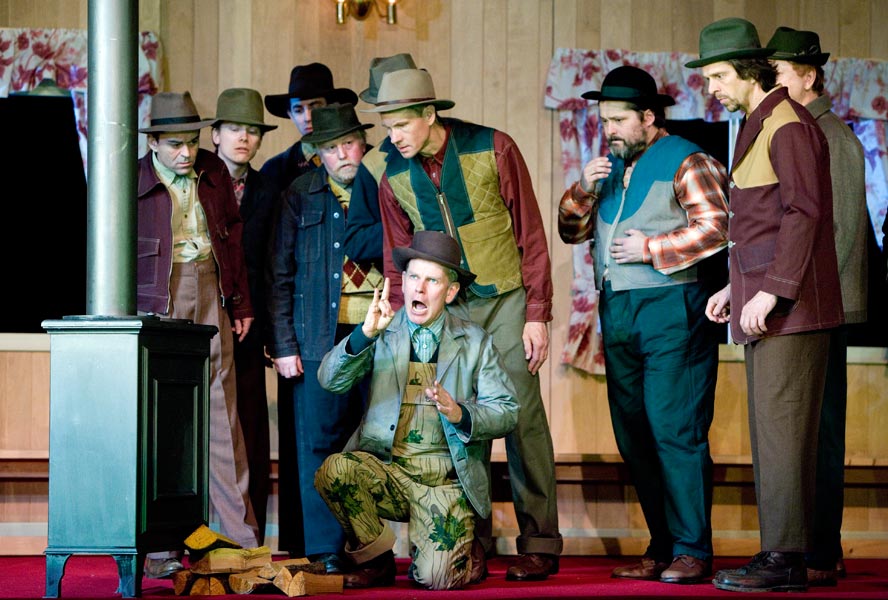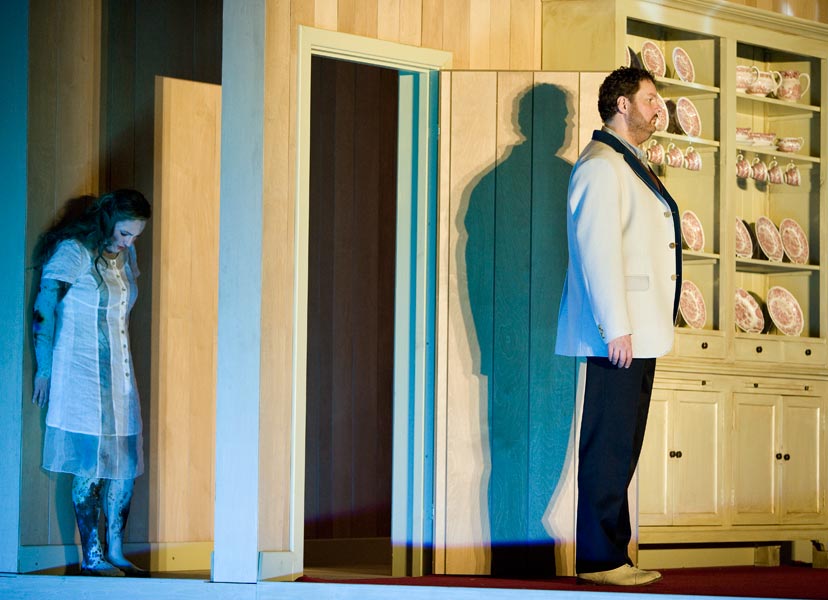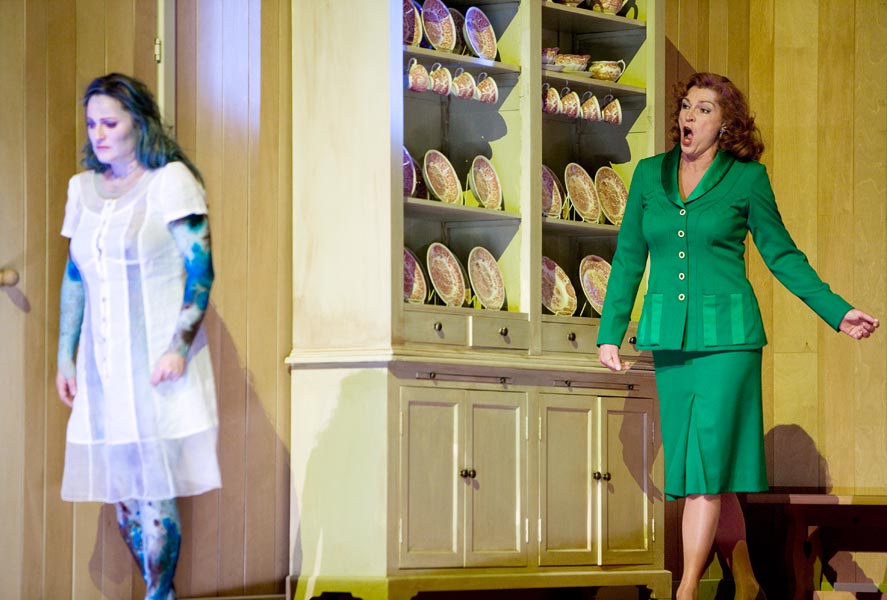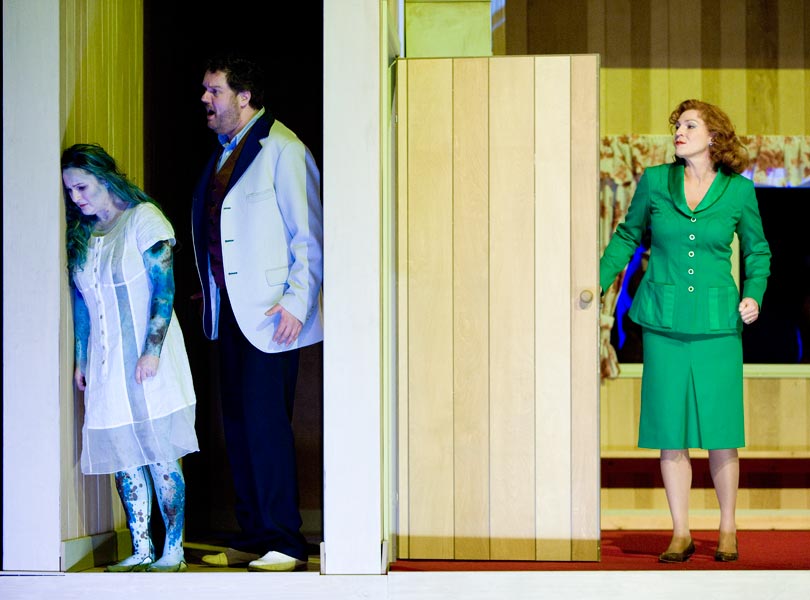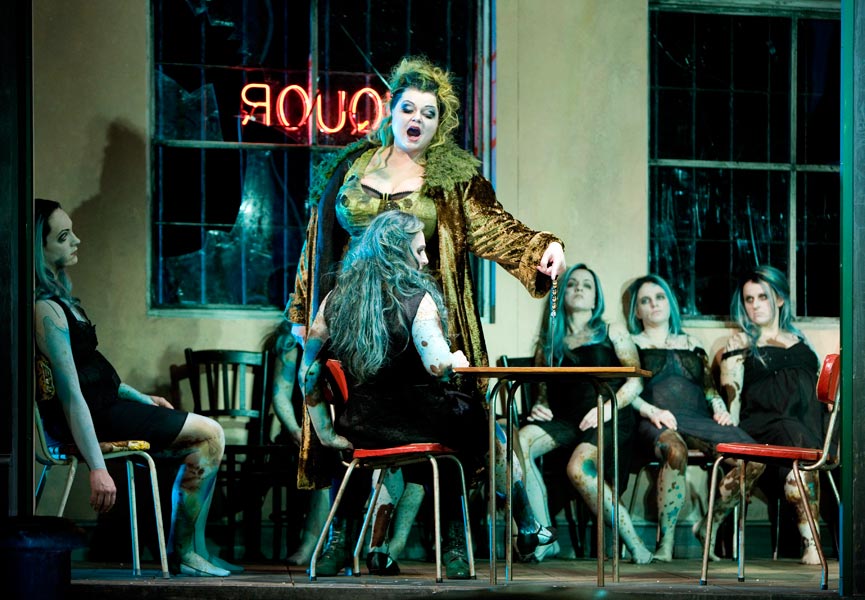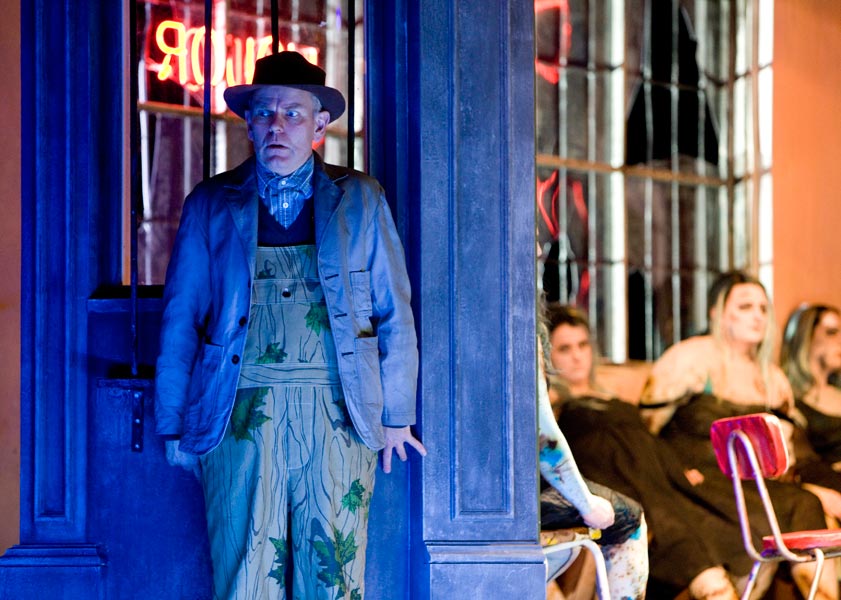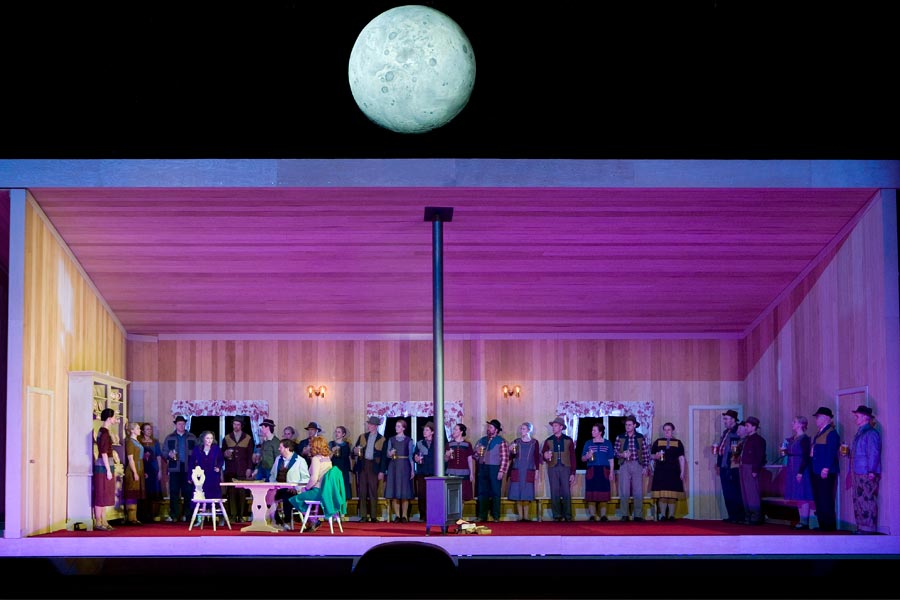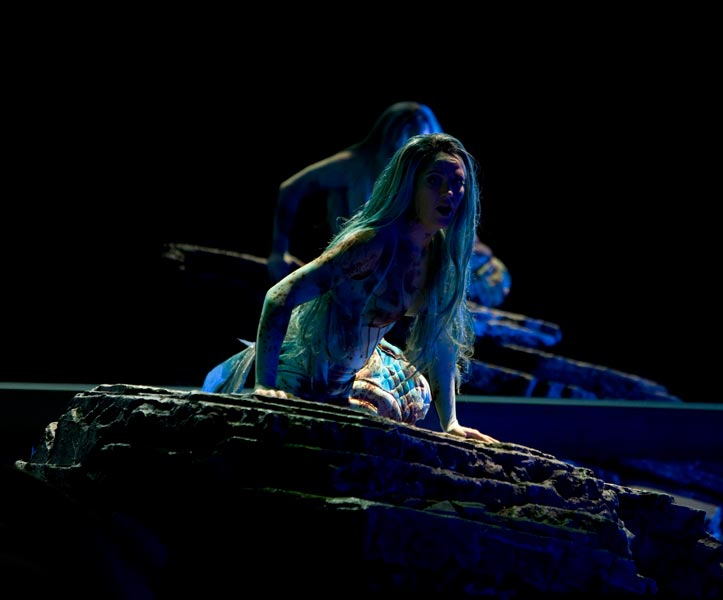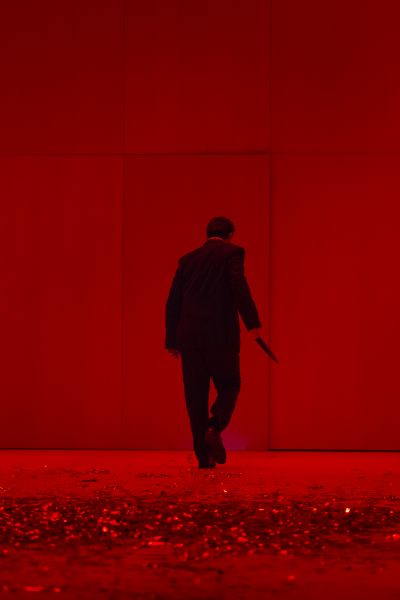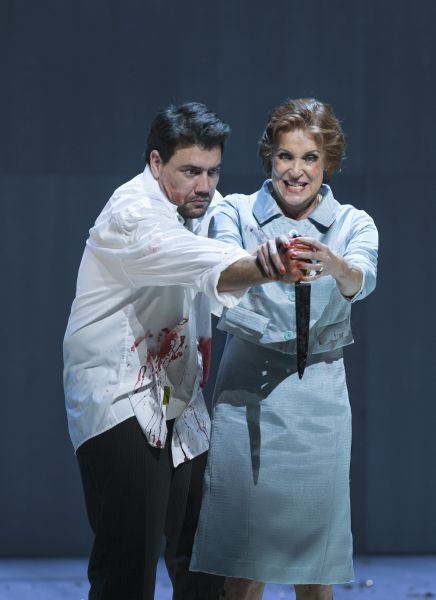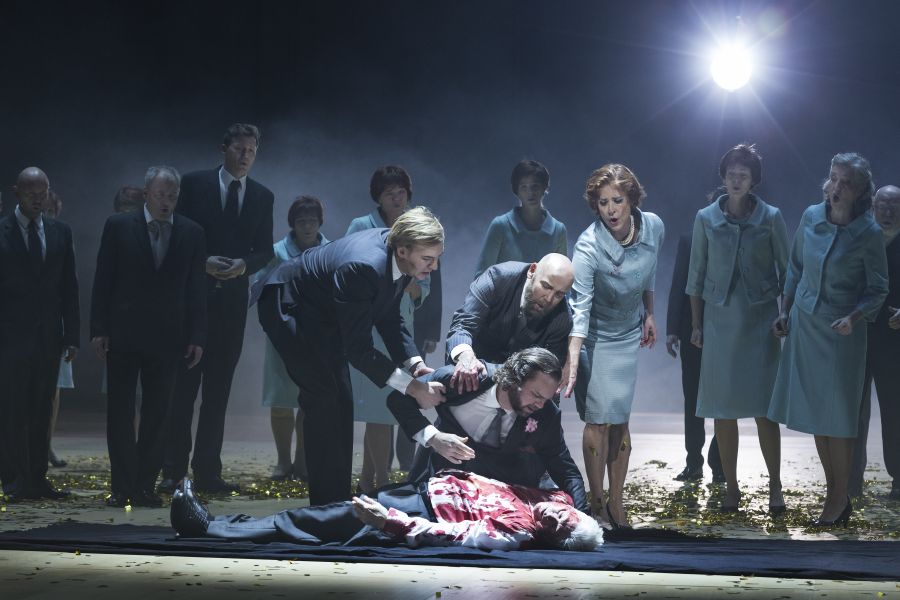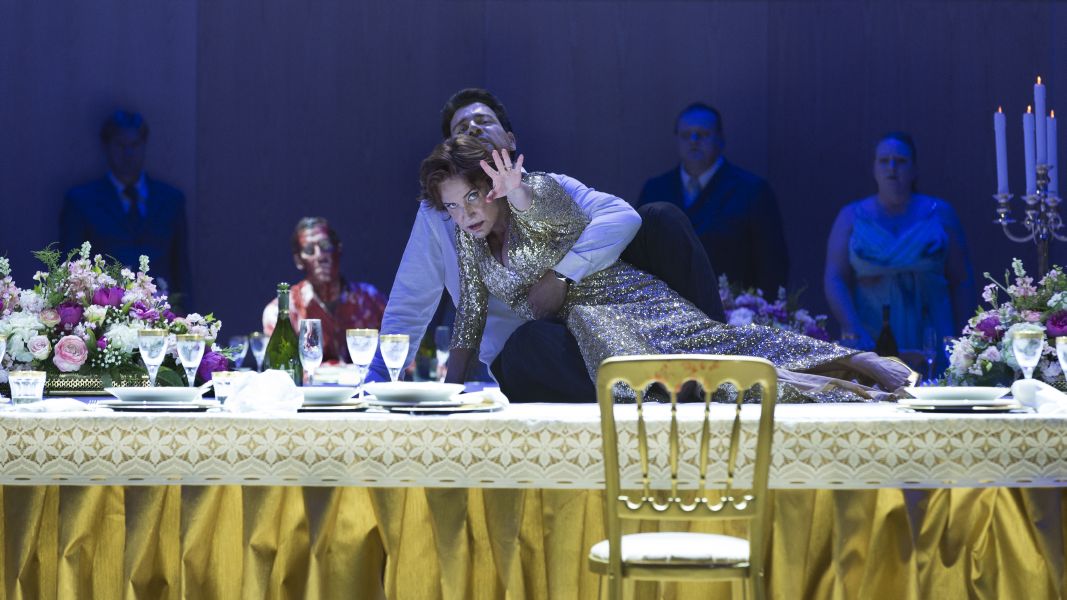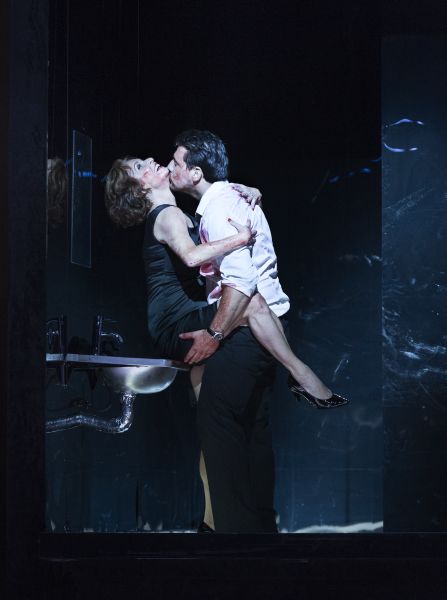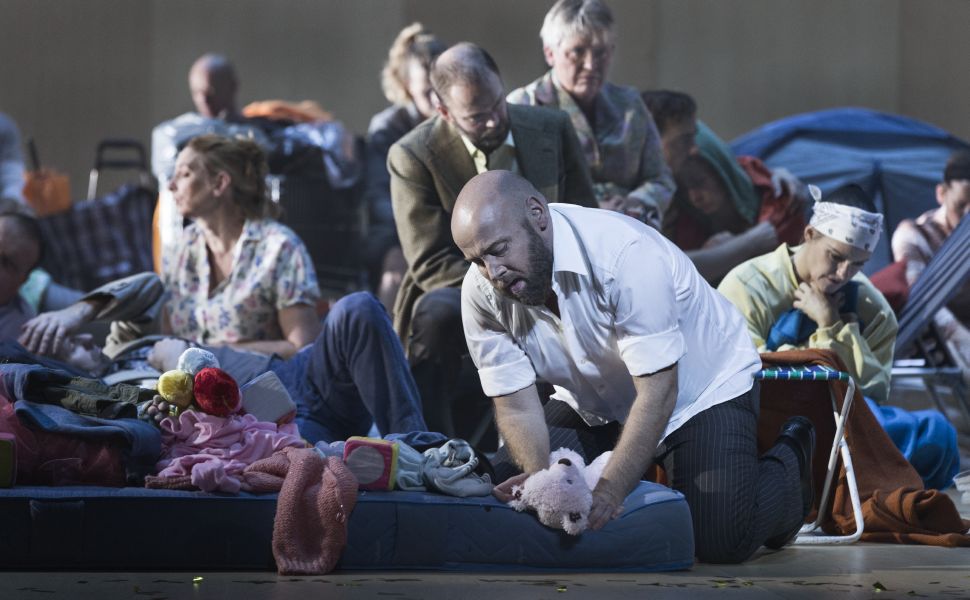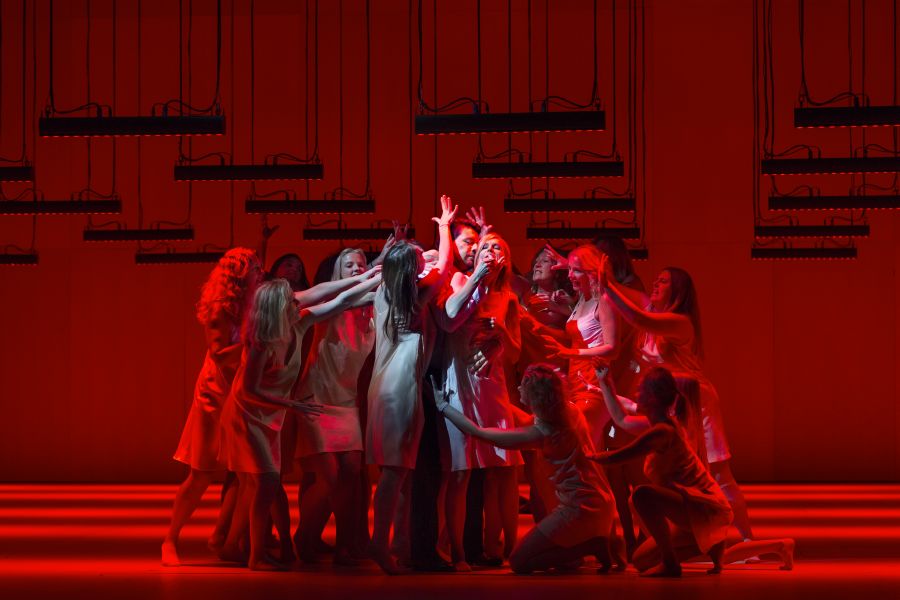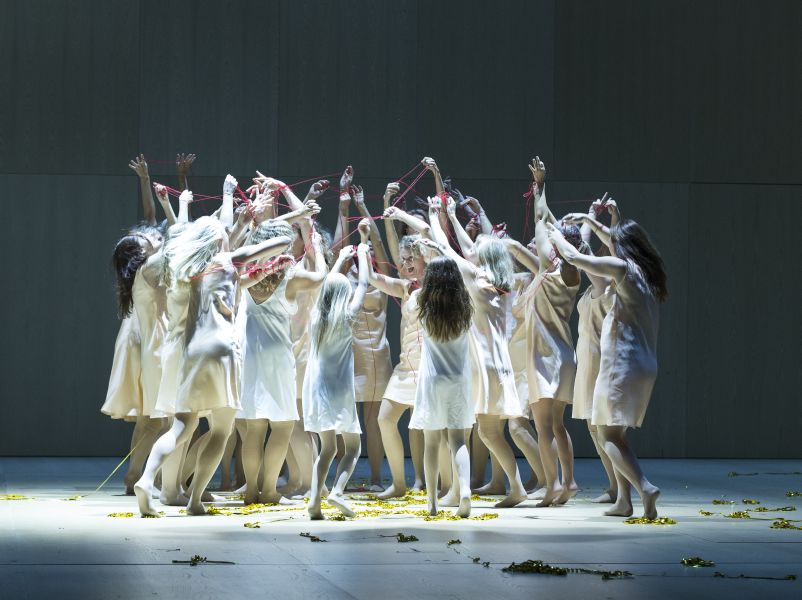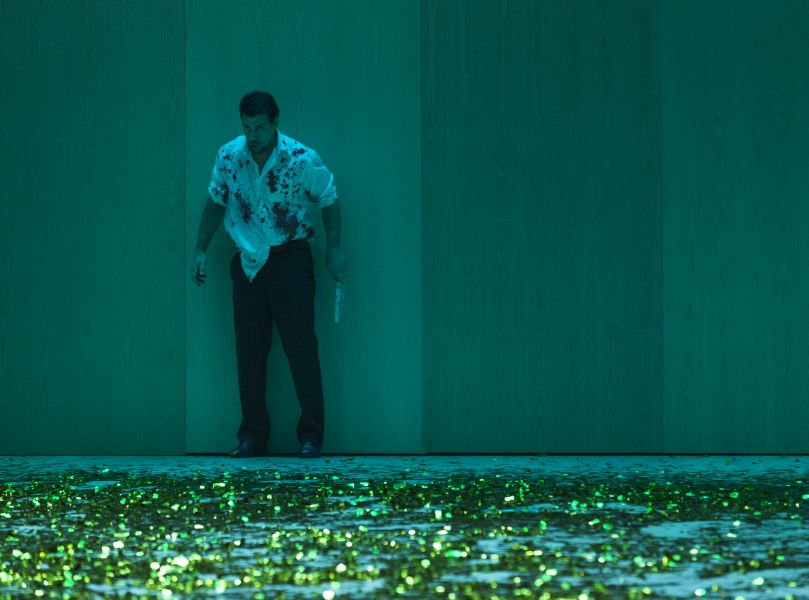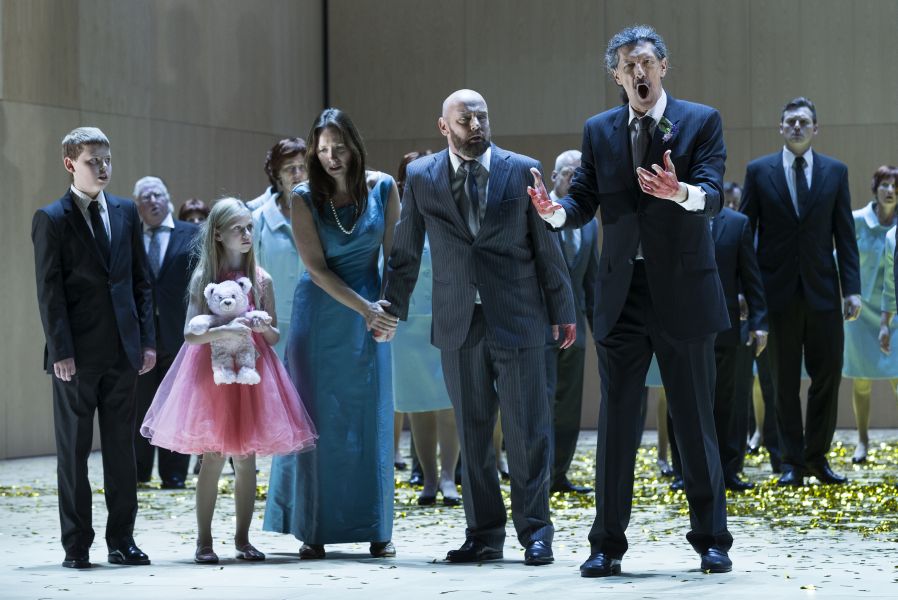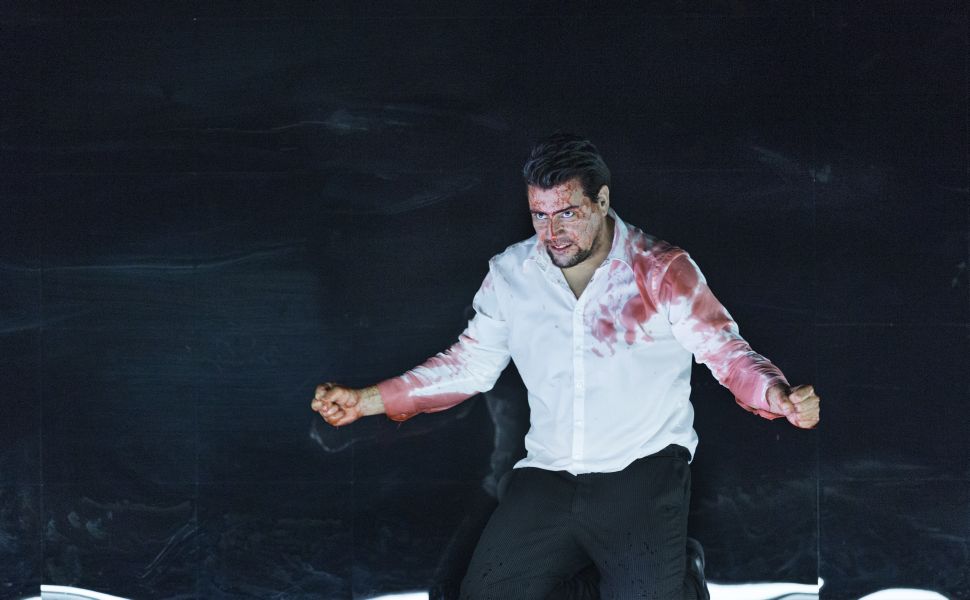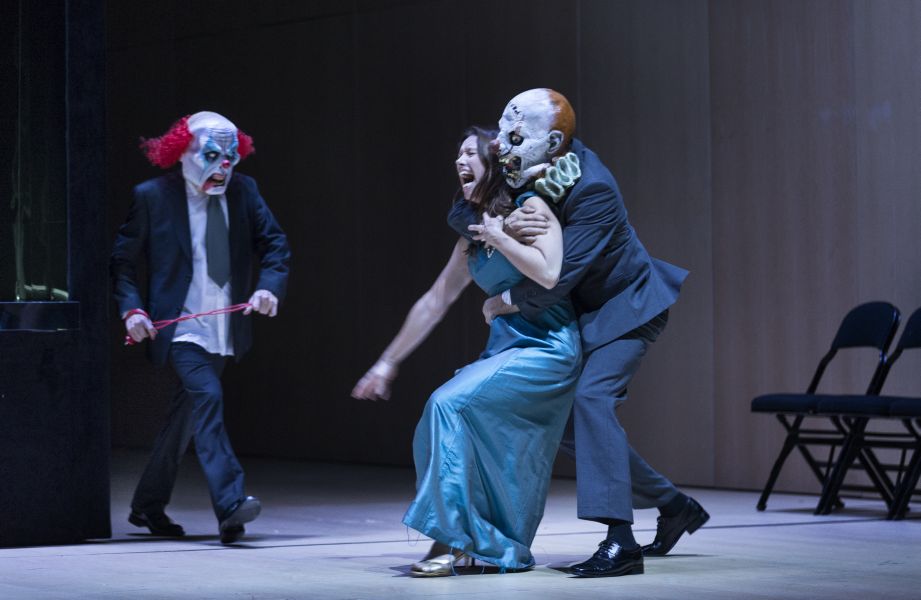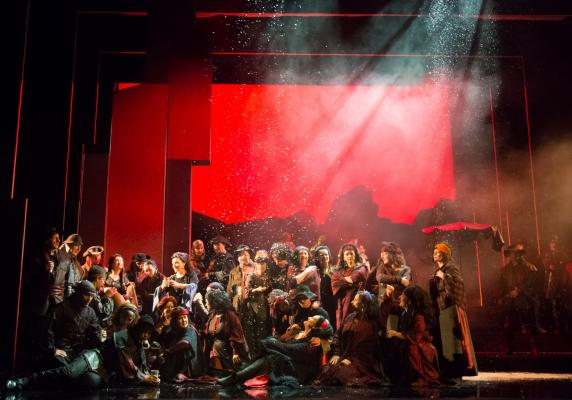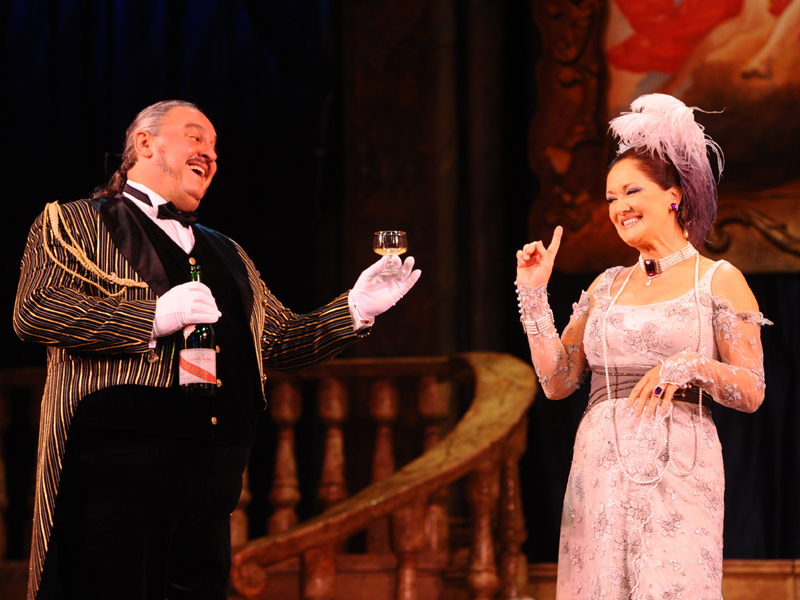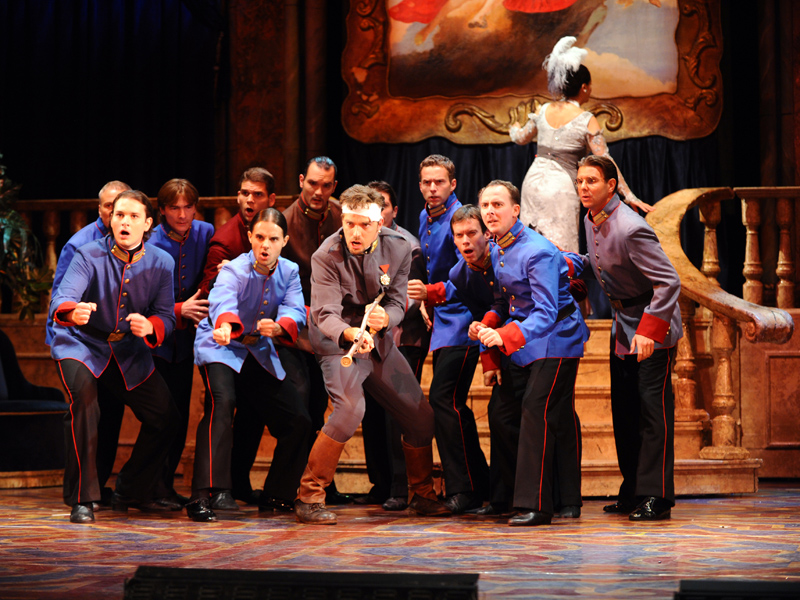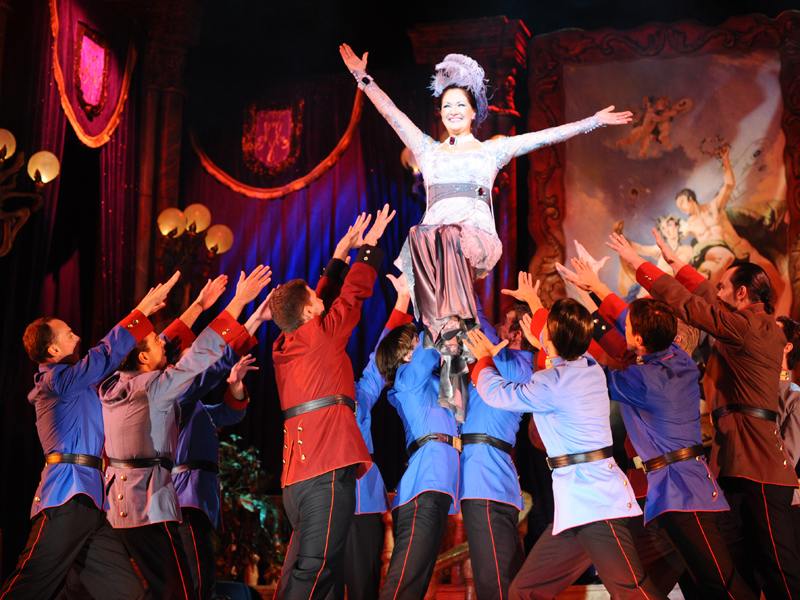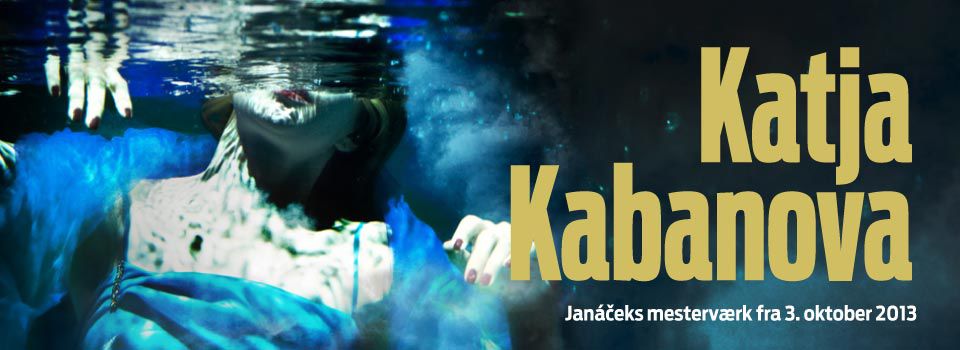
“KATJA KABANOVA” IN DENMARK

katiatitle

The Danish National Opera presents:

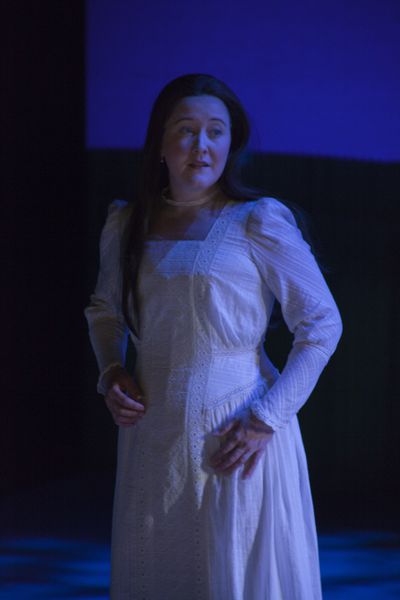
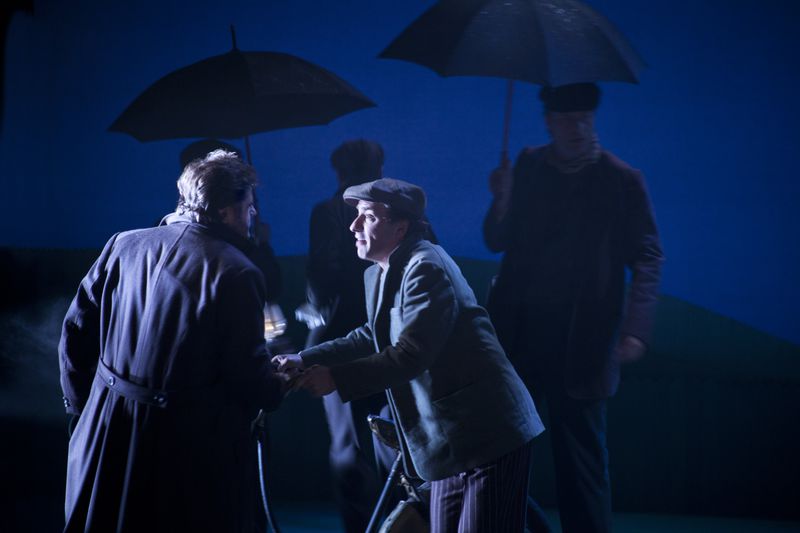
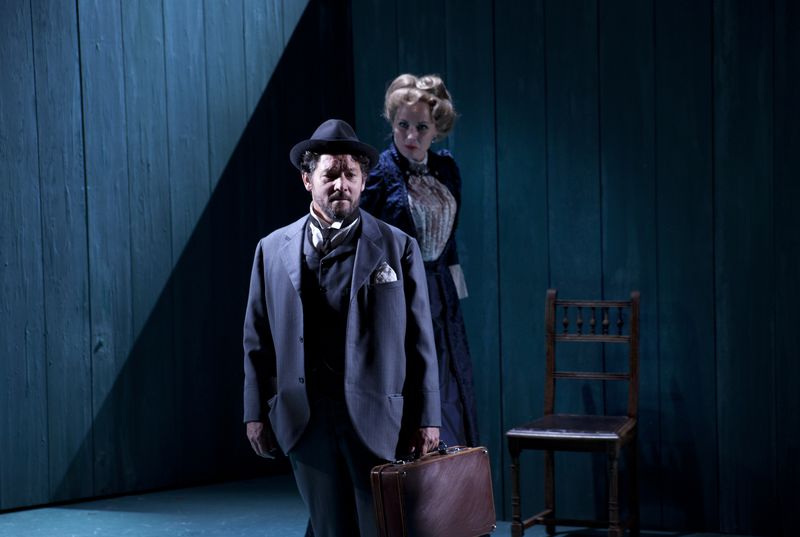
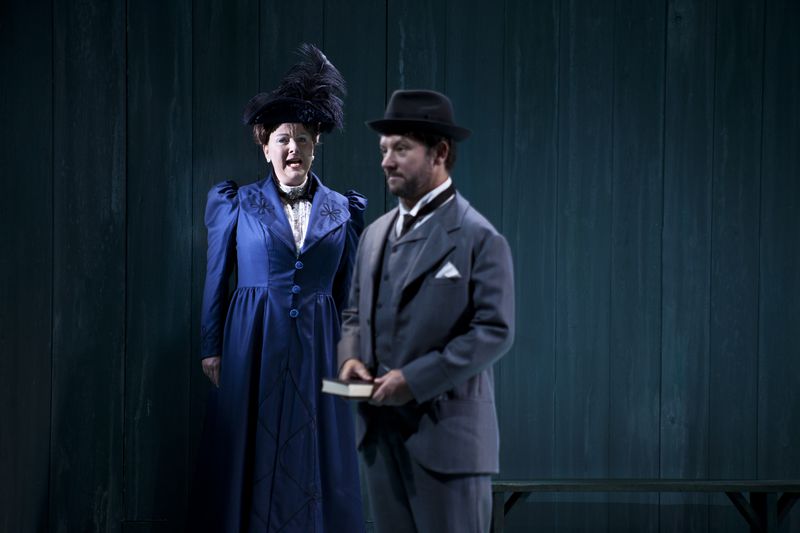
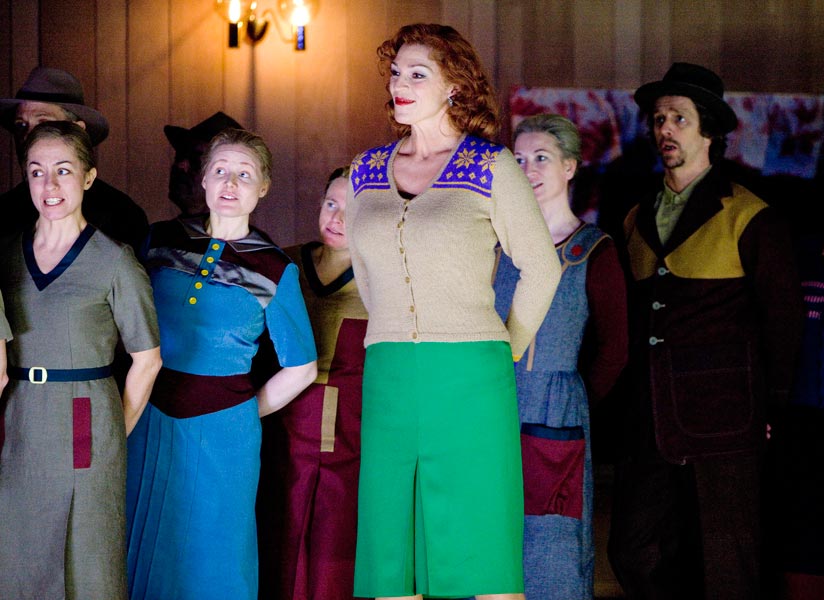
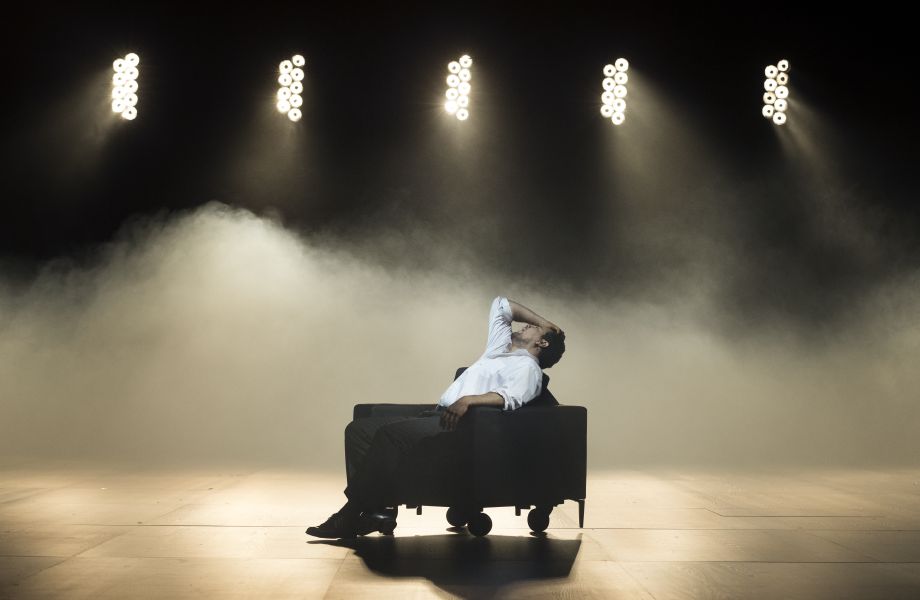
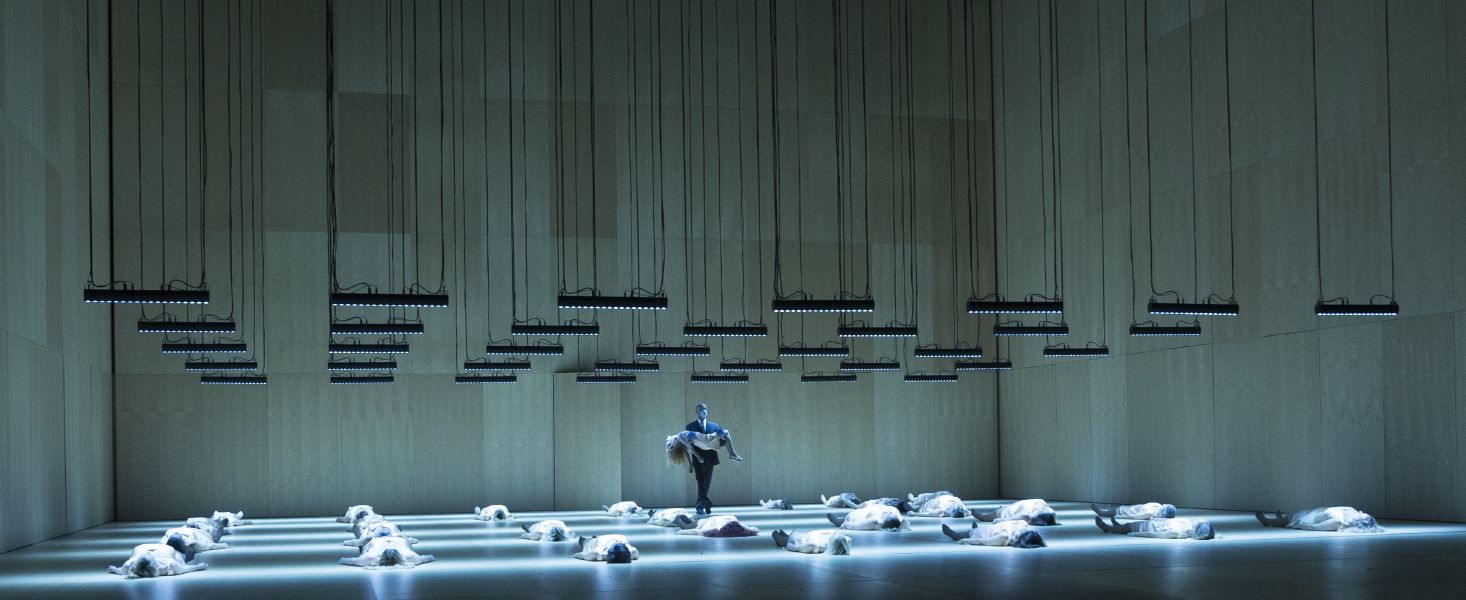
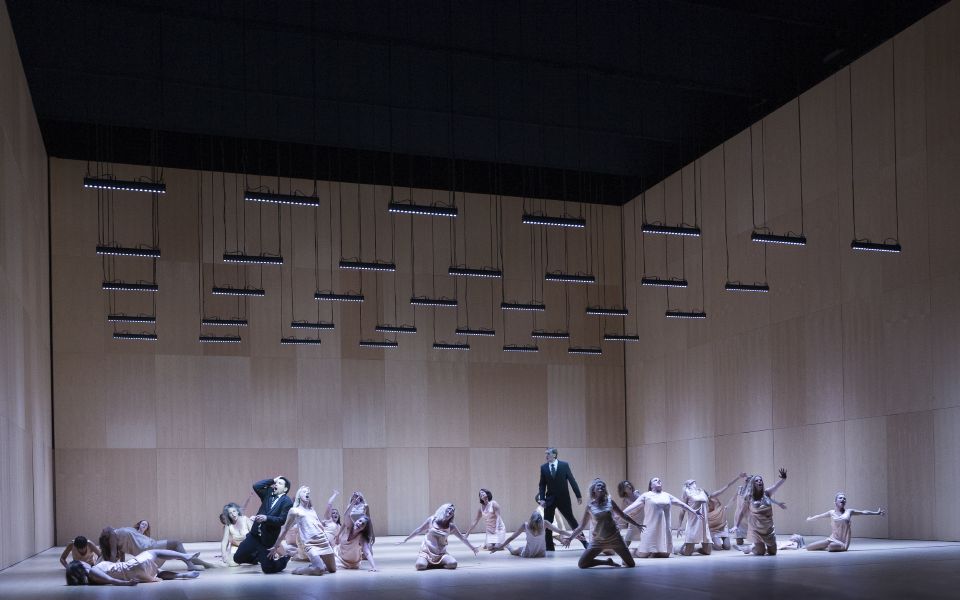
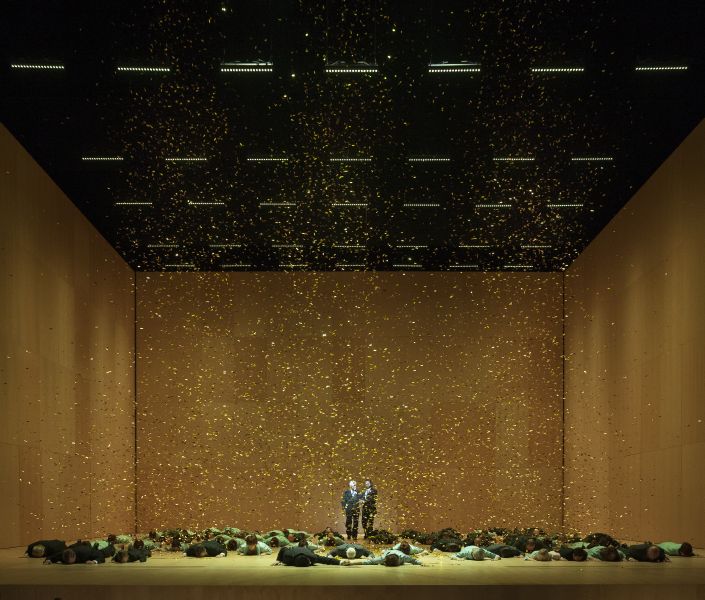
Katja Kabanova

 Can you die of love?

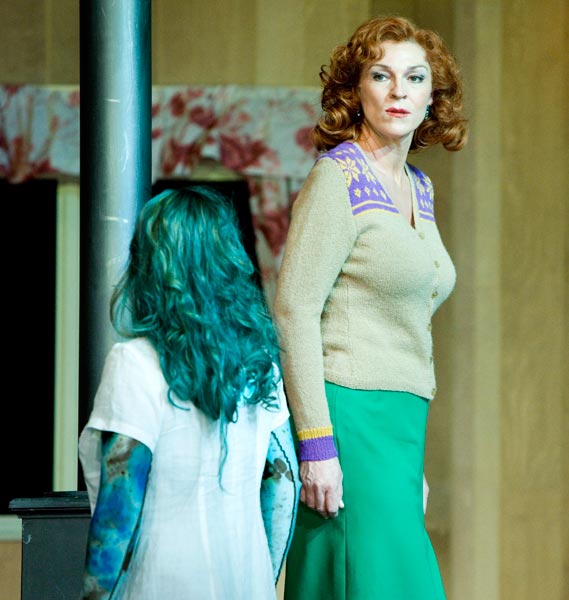
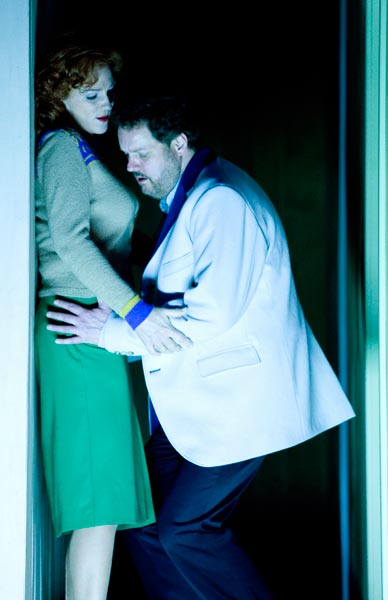
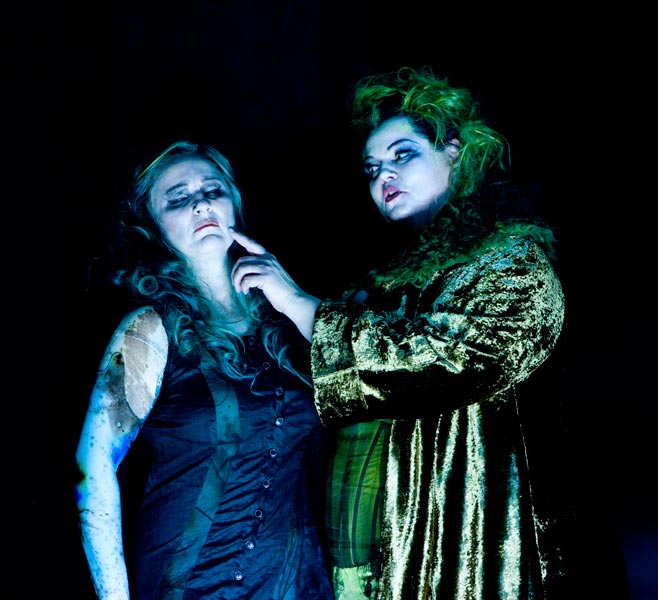
Katja, a passionate unhappily married woman has a love affair that rips apart her world. Known as the ‘Czech Puccini’, Janacek tells her tragic story with music of devastating beauty and psychological power. 

Tour in Denmark 3 October-29 November 2013.

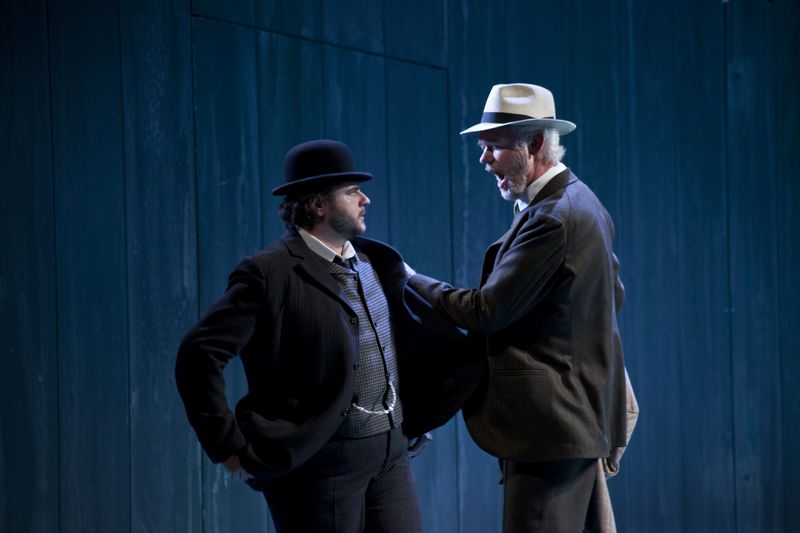
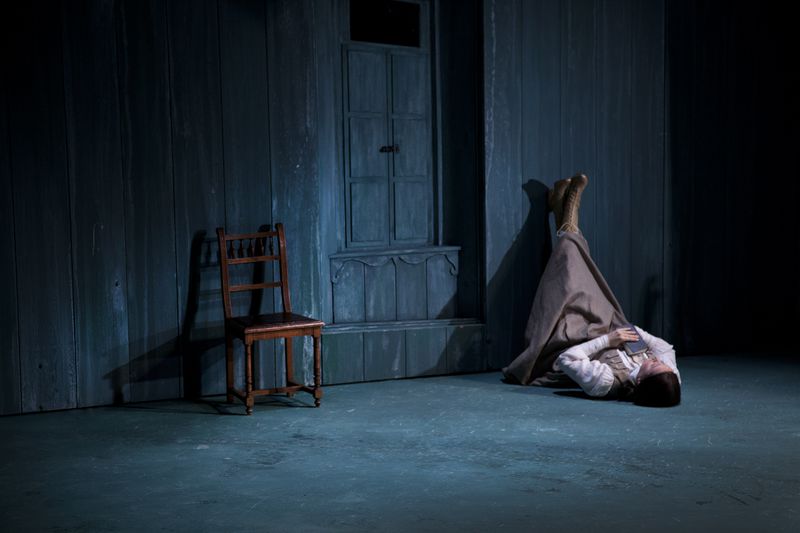
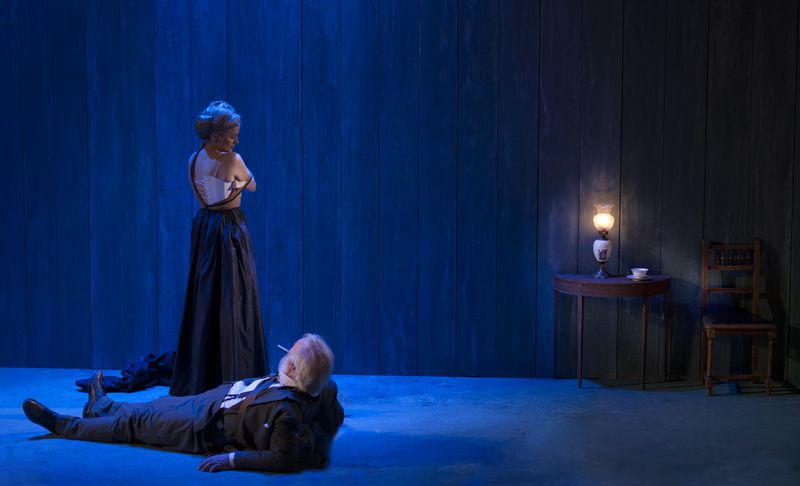
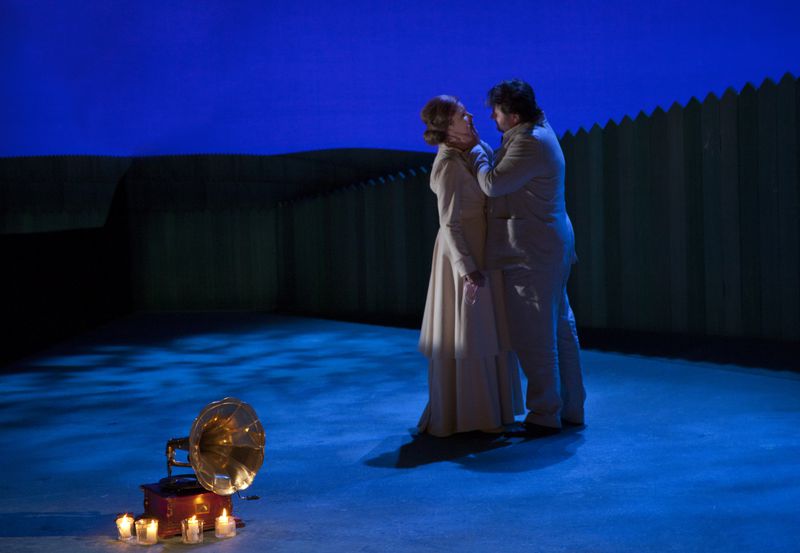
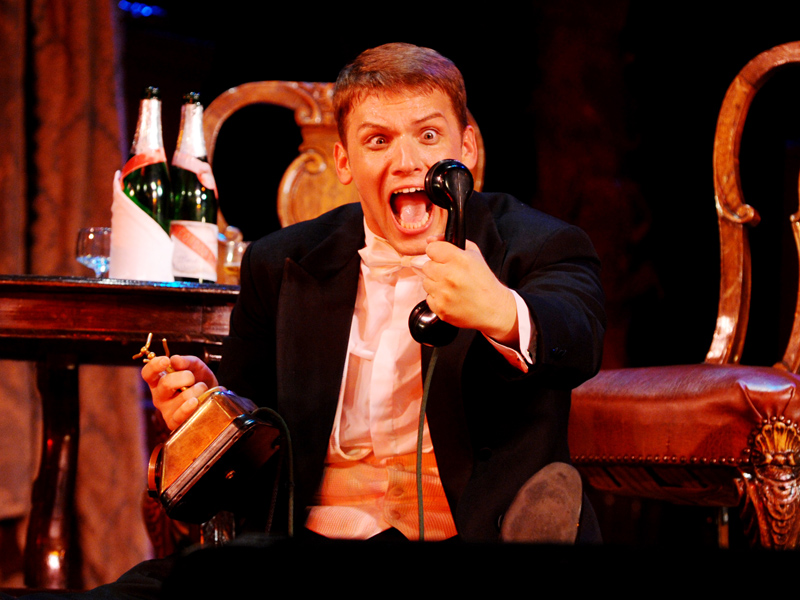
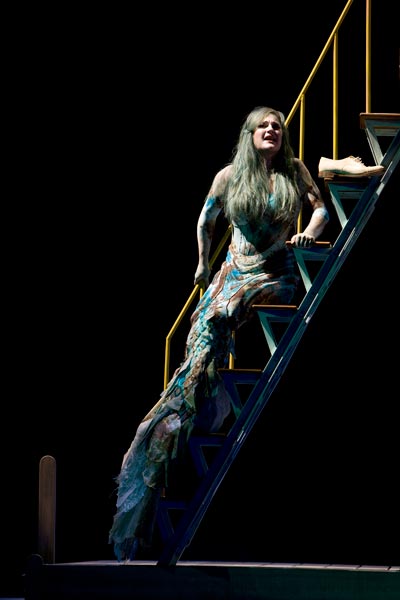
Káťia Kabanová  is an opera in three acts, with music by Leoš Janáček to a libretto by Vincenc Červinka, based on The Storm, a play by Alexander Ostrovsky. katja1

   katja12 katja2 katja3 katja5 katja4 katja6 katja7 katja8 katja9 katja10 katja11

Synopsis

Place: The Russian town of Kalinov on the shores of the Volga River
Time: The 1860s

Act 1

Vána Kudrjás admires the view of the Volga River, which amuses the more literal-minded housekeeper of the adjoining Kabanov estate. Two men approach, Dikoj and his nephew, Boris Grigorjevic, where Dikoj is berating Boris. Dikoj learns that Kabanicha, the Kabanov family matriarch, is not at home. Dikoj leaves, and Boris explains to Vána Kudrjás why he tolerates the abuse: his parents are dead, and to be able collect his inheritance, he must respect his uncle no matter what his uncle says to him. Boris also tells Vána Kudrjás that he is secretly in love with Káťa, the young wife of Tichon. Káťa appears and Kabanicha reproaches her son Tichon – Kata’s husband – for his inattentiveness. Tichon and Káťa try to calm her down, but Kabanicha will have none of it, telling Tichon that he spoils Káťa. Tichon complains to Varvara, the family’s foster daughter, who rebukes him for retreating into drinking more than defending Káťa.

In the house, Káťa tells Varvara of her happy childhood, and dreams of having a man who truly loves her. Tichon enters to say good-bye, as he is journeying to Kazan on business, for Kabanicha. Káťa asks to accompany him or for him not to go, but he insists. Káťa then asks him to make her swear an oath to speak to no strangers during his absence, which puzzles Tichon. Kabanicha announces that Tichon must go, but not before instructing Káťa how to behave in his absence. Tichon dutifully says that Káťa must treat Kabanicha like her own mother and always act properly. He bows to Kabanicha and kisses her and Kát’a before he departs.

Act 2

The women are working on embroidery. Kabanicha criticizes Káťa for not appearing more sorrowful at Tichon’s absence. After Kabanicha leaves, Varvara shows Káťa the key to the far part of the garden. Varvara intends to meet Vána, her lover, there. She hints at the same suggestion for Káťa, and puts the key in her hand. Káťa is hesitant, but then surrenders to fate and will meet Boris. She steps outside as evening comes on. Kabanicha reappears with Dikoj, who is drunk and complaining that people take advantage of his softhearted nature. However, Kabanicha chastises him.

Vána Kudrjás is waiting for Varvara in the garden. Boris then unexpectedly appears, after receiving a message to go there. Varvara arrives, and she and Vána go for a walk by the river. Káťa then appears, and Boris declares his love for her. She is at first worried about social ruin, but finally she reciprocates, confessing her secret feelings for him. They embrace and themselves leave for a walk. Vána and Varvara return, as she explains her precautions in case Kabanicha suddenly appears. Káťa and Boris are heard in wordless, ecstatic duet as Vána and Varvara say that it is time to return home.

Act 3

Ten days later

Vána Kudrjás and Kuligin are strolling near the river when an approaching storm causes them to take shelter in a ruined building. Other people join them, including Dikoj. Vána tries to calm Dikoj with scientific explanations about a new invention, the lightning rod. However, this only angers Dikoj, who insists that lightning is not caused by electricity but is the punishment from God. The rain dies down, and people start to leave the shelter. Vána meets Boris and Varvara. Varvara says that Tichon has returned, and Káťa is very agitated. Kabanicha arrives with Tichon and Káťa. The storm returns, and people assume initially that this is what upsets Káťa. However, she confesses to Tichon in front of everyone her assignation with Boris during her husband’s absence. Then she runs out into the storm.

Evening approaches after the storm has ended. Tichon and a search party are looking for Káťa. At first among the party, Varvara and Vána then decide to leave the village for Moscow and start a new life. They leave, and as the searchers continue, Káťa appears. She knows that her confession has dishonoured her and humiliated Boris. She feels tormented and wants to meet Boris one more time. Boris appears and sees her, and the two embrace. Boris says that his uncle is sending him away to another town, but asks her what will become of her. As her sanity deteriorates, she first begs him to be allowed to accompany him, then insists that she could not and bids him farewell; he leaves in sorrow. After thinking of how nature will continue to flourish over her grave, Káťa throws herself into the river. Kuligin sees this from the far bank and calls for help. Tichon appears, followed by Kabanicha. Tichon tries to help Káťa but is restrained by Kabanicha; he blames her for Káťa’s suicide. Dikoj appears with Káťa’s body and lays her on the ground. Tichon cries over the body as, without any emotion, Kabanicha thanks the bystanders—or, as often done, the audience—for their help.

Danish National Opera • Concert Hall Aarhus • Skovgaardsgade 2C • DK-8000

Posted in Music, OPera | Tagged , , , , , | Leave a comment

“The barber of Seville” in San Francisco

The San Francisco Opera presents:

The barber of Seville

Music by Gioachino Rossini

Libretto by Cesare Sterbini

NEW PRODUCTION

With the help of a wily barber, a strong-willed young woman outwits a lecherous old man in this eternally fresh comic masterpiece featuring Rossini’s wittiest, most charming score and two charismatic casts. One features Isabel Leonard, “a lively stage presence and a radiant lyric voice” (The New York Times); Lucas Meachem, who displayed “vocal brilliance” and “theatrical panache” in the title role of San Francisco Opera’s Don Giovanni (2011) (San Francisco Chronicle); and rising tenor Javier Camarena, praised by Opera News for his “exquisite finesse.” The other equally stunning cast features Daniela Mack, who sings Rossini “with technical command and expressive ease” (Opera News); the “smooth-voiced” Audun Iversen (The New York Times); and Alek Shrader, whose “bright singing” is matched with “matinee-idol good looks” (New York Times). Resident Conductor Giuseppe Finzi, who leads the San Francisco Opera Orchestra with “vigor and clarity” (San Francisco Chronicle), returns to the podium.

Sung in Italian with English supertitles
Approximate running time: 3 hours including one intermission

Pre-Opera Talks are free to ticketholders and take place in the main theater in the Orchestra section, 55 minutes prior to curtain.

Co-production with Lithuanian National Opera

Production photos: Cory Weaver

Audio excerpts from The Barber of Seville with the San Francisco Opera Orchestra and Chorus conducted by Maurizio Barbacini, 2006.  PERFORMANCES:

  • Wed 11/13/13 7:30pm * 
  • Thu 11/14/13 7:30pm 
  • Sat 11/16/13 8:00pm *
  • Sun 11/17/13 2:00pm *
  • Tue 11/19/13 8:00pm
  • Wed 11/20/13 7:30pm
  • Fri 11/22/13 8:00pm
  • Sat 11/23/13 8:00pm
  • Tue 11/26/13 8:00pm
  • Fri 11/29/13 8:00pm
  • Sun 12/1/13 2:00pm

*OperaVision, HD video projection screens featured in the Balcony level for this performance, is made possible by the Koret-Taube Media Suite.

Cast

Figaro Lucas Meachem NOV 13, 16, 19, 22, 26, DEC 1
Figaro Audun Iversen * NOV 14, 17, 20, 23, 29
Rosina Isabel Leonard * NOV 13, 16, 19, 22, 26, DEC 1
Rosina Daniela Mack NOV 14, 17, 20, 23, 29
Count Almaviva Javier Camarena * NOV 13, 16, 19, 22, 26, DEC 1
Count Almaviva Alek Shrader NOV 14, 17, 20, 23, 29
Doctor Bartolo Alessandro Corbelli NOV 13, 16, 19, 22, 26, DEC 1
Doctor Bartolo Maurizio Muraro * NOV 14, 17, 20, 23, 29
Don Basilio Andrea Silvestrelli  
Berta Catherine Cook  
Ambrogio A.J. Glueckert  
Fiorello Ao Li  
An Officer Hadleigh Adams  
Notary Andrew Truett  

Production Credits

Conductor Giuseppe Finzi  
Director Emilio Sagi  
Set Designer Llorenc Corbella  
Costume Designer Pepa Ojanguren  
Lighting Designer Gary Marder *  
Chorus Director Ian Robertson  
Choreographer Nuria Castejón *  

* San Francisco Opera Debut

Synopsis

ACT I
At night, Count Almaviva brings a band of musicians to serenade Rosina, ward of Dr. Bartolo, who keeps the girl confined in his house. When Rosina fails to answer his song, the count pays the players, and they leave. At the sound of Figaro’s voice, Almaviva steps away as the barber bounds in, boasting of his busy life as the neighborhood factotum. Figaro, though currently in Bartolo’s employ, encounters Almaviva and promises to help him win Rosina – for a suitable reward. No sooner has Bartolo left the house to arrange his own marriage with Rosina than Almaviva launches into a second serenade, calling himself “Lindoro,” a poor creature who can offer only love. Figaro suggests Almaviva disguise himself as a drunken soldier billeted to Bartolo’s house.Alone in the house, Rosina muses on the voice that has touched her heart and resolves to outwit Bartolo. Figaro joins her, but they leave on hearing footsteps. Bartolo enters with the music master, Don Basilio, who tells him Almaviva is a rival for Rosina’s hand and advises slandering the nobleman’s reputation. Bartolo agrees, but Figaro overhears them. Warning Rosina that Bartolo plans to marry her himself the very next day, the barber promises to deliver a note she has written to “Lindoro.” Rosina, alone with Bartolo, undergoes an interrogation, then listens to his boast that he is far too clever to be tricked. Berta, the housekeeper, answers violent knocking at the door, returning with Almaviva disguised as a drunken soldier in search of lodging. While arguing with Bartolo, Almaviva manages to slip a love letter to Rosina. But when Bartolo demands to see the letter, the girl substitutes a laundry list. Figaro dashes in to warn that their hubbub has attracted a crowd. Police arrive to silence the disturbance. As an officer is about to arrest him, Almaviva whispers his identity and is released. Rosina, Berta, Bartolo and Basilio are stupefied by everything that is happening.ACT II
Bartolo receives a young music teacher, “Don Alonso” (again Almaviva in disguise), who claims to be a substitute for the ailing Basilio. Rosina enters, recognizes her suitor and begins her singing lesson as Bartolo dozes in his chair. Figaro arrives to shave the doctor and manages to steal the key to the balcony window. Basilio now comes in, looking the picture of health; bribed by Almaviva, he feigns illness and departs. Figaro shaves Bartolo while Almaviva and Rosina plan their elopement that night. They are overheard by the doctor, who drives Figaro and Almaviva from the house and Rosina to her room, then sends again for Basilio. Berta, unnerved by all the confusion, complains she is going mad. Bartolo dispatches Basilio for a notary, then tricks Rosina into believing “Lindoro” is really a flunky of Almaviva. After a thunderstorm, Almaviva arrives with Figaro and climbs through a balcony window to abduct Rosina. At first the girl rebuffs “Lindoro,” but when he explains that he and Almaviva are one and the same, she falls into his arms. Figaro urges haste, but before they can leave, their ladder is taken away. Basilio enters with the notary. Though summoned to wed Rosina and Bartolo, the official marries her instead to Almaviva, who bribes Basilio. Rushing in too late, Bartolo finds the lovers already wed. When Almaviva allows him to keep Rosina’s dowry, the old man accepts the situation.


What the press said:

Lucas Meachem (Figaro)…sang with extremely handsome tone and…infused his voice with the smile, wit, and color that the role demands.”
  –San Francisco Classical Voice

“SFO scored big-time with Resident Conductor Giuseppe Finzi…The orchestra bubbled along as though the body of every instrument had been primed with champagne”
 –San Francisco Classical Voice

“Catherine Cook excelled as Berta and her energy made you want to hug her to bits.”
  –San Francisco Classical Voice

“Andrea Silvestrelli (Don Basilio)…a wonderful performance.”
  –San Francisco Classical Voice

“Elegant, effervescent and deliciously funny, this ‘Barber’ is all new, and everything about it seems charmed.”
  –San Jose Mercury News“It was mezzo-soprano Isabel Leonard who made the most indelible impression. With her rich, buttery sound, the American mezzo-soprano has clearly made the role of Rosina her own.”
  –San Jose Mercury News

“The evening’s biggest discovery was Javier Camarena…His firm, flexible vocalism—and his ardent tone in the role’s serenades—earned him the biggest ovations of the night.”
  –San Jose Mercury News

“A top-notch production…hilarious and heartwarming.”
  –San Jose Mercury News

“Alessandro Corbelli relished Bartolo’s comic opportunities and fast-paced patter.”
  –San Jose Mercury News

“It’s a great party, one that closes the company’s fall season on a definite high.”
  –San Jose Mercury News


ARTICLES ON THE PRODUCTION: 

The Color of Love

By Emilio Sagi

Director Emilio Sagi reveals his thoughts on our current production

 
My principal preoccupation when I began to work on The Barber of Seville was that in seeing the performance one would enjoy the brilliant music of Rossini, from where this theatrical project was born. The scenery raises forth with the music of the overture, emerging from the obscurity, the vacuum, the void. I conceived the opera as a fragile jigsaw puzzle in that each scene is presented like a sketch, forming a series of mosaics united by that frenetic poetic rhythm of the music, which pulses along the entire length of the opera.

Although the period of the drama is not reflected in an explicit manner, all the scenography refers to the eighteenth century, when the antiquated ideas of the ancien régime gave way to the Enlightenment, planting the seed of the revolution of the middle class. This moment of instability led me to conceive of the work as an ingenious “organized madness,” in that everything is moving, nothing is sure, including the scenery, which forms and transforms constantly in front of the audience. In that sense I wanted to differentiate clearly the world of the people anchored in the past and that of those who are trying to find their own liberty, like Rosina, who introduces notes of color into the action with her rebelliousness. The vitality, the bustle, and the spontaneity of the Andalusian “street people,” with their dance-songs and their body language inspired by Flamenco, are evoked throughout the entire opera.

The triumph of love gives way to a progressive emergence of colors in fabrics and flowers right up to the grand finale. The happy lovers go off in a luxurious modern coach in the manner of a fairy-tale carriage, symbolizing the fragility of the liberty that is dreamt of and the actual fragility of love.
***           ***           ***         ***           ***           ***        ***           ***           ***         ***           ***           ***         

A Method to the “Organized Madness”

By Thomas May

If Gioachino Rossini were to revisit today’s opera scene, he’d probably have mixed feelings about the remarkable tenacity of The Barber of Seville in the repertoire. (Rossini loved to joke about the advantage of being born on February 29, which would make him a middle-aged man of 55.25 in leap year terms, not a Methuselah of 221.) Mixed because, though he certainly recognized Barber as a work di qualità—as Figaro asserts of his own profession—its popularity still distorts Rossini’s versatile legacy.

By now we’ve had the better part of a century of the Rossini renaissance to regale us with one rediscovery after another. The result has been to bring before today’s public this composer’s command of an enormous gamut of operatic genres: farce, melodrama, semi-serious drama, comedy, lyric tragedy, sacred tragedy, and grand opera. (By comparison, the cunning Figaro’s skillful multi-tasking almost seems to parody such an encyclopedic range.) Several of his once-neglected works have since reentered the repertoire, yet the mere mention of Rossini continues to immediately evoke, before anything else, the vital comic style of Barberthe opera whose premiere in 1816, when the composer was still just shy of twenty-four, marked one of the legendary disasters of his career.
 
When Giuseppe Verdi was being lured out of retirement by the prospect of composing Otello in 1879, his publisher had to tread carefully and assuage bruised feelings triggered by a remark carelessly reprinted in the company’s music journal. The offending statement recalled what Rossini had declared decades earlier (in 1847): that Verdi could “never write a semi-serious opera…much less a comic opera like The Elixir of Love.” For Italy’s operatic elder statesman to crown his career by giving the world Falstaff served as a kind of vindication. On one level, Falstaff represents Verdi’s response to the anxieties he confronted about how his own legacy would be remembered in the unsettling twilight of the nineteenth century.
 
If Pierre Beaumarchais’s 1778 play The Marriage of Figaro was recognized as prophetic of the French Revolution—“the Revolution already put into action” in Napoleon’s famous phrase—Rossini did a good deal with his treatment of its “prequel,” Barber, to set the tone for a war-weary post-Napoleonic Europe early in that century. (Beaumarchais later published a third play about his Figaro characters—La mère coupable (The Guilty Mother)—but this last part of the trilogy had to wait until the twentieth century before it showed up on the opera stage.) The novelist Stendhal cleverly reversed the French leader’s metaphor of the artist as political prophet: “Napoleon is dead; but a new conqueror has already shown himself to the world,” he writes in the preface to his influential Life of Rossini of 1823.
 
In the composer’s verdict about Verdi’s putative unsuitability for comedy, which was hardly intended as a putdown, it’s tempting to sense an echo of the type-casting Rossini himself had faced—but with the tables turned. Legend holds that Rossini, very much a conquering musical general who had taken Vienna by storm, requested a meeting with Beethoven after arriving in the Habsburg capital in 1822 to supervise a new production. In his account decades later, Rossini recalled Beethoven’s pronouncement that serious opera was not a good fit for the Italian temperament: “You do not possess sufficient musical knowledge to deal with real drama.” On the other hand, the old master congratulated Rossini on The Barber of Seville, advising him to stick to opera buffa. “Any other style would do violence to your nature…Above all, make more Barbers!”

This alleged meeting, though unverifiable, gained a life of its own as one of the symbolic encounters in nineteenth-century European art. It came to stand for the polarity between two aesthetic icons, between serious music with philosophical profundity and heft and music as fun, lightweight entertainment. A collection of essays just published this fall—The Invention of Beethoven and Rossini: Historiography, Analysis, Criticism—in fact makes this opposition the point of departure to examine the myths surrounding both composers and their reception.

Among the many ironic results of this stark dualism is the way it has shaped and limited perceptions of Beethoven’s own music. If indeed he did advise Rossini to stick to “Barber mode,” couldn’t this have been meant as a sign of admiration? Beethoven must have recognized the affinities between Rossini’s comic subversion of the building blocks of Classical style—think especially of the use of manic repetitions in Barber—and his own brand of humor in works like the Second and Eighth Symphonies, which even today get short shrift when set against the “heroic” idiom of their companions.

Given the sheer brilliance with which Rossini crystallizes the comedic perspective—from moment to moment and over the grand arc of the opera—it’s not surprising that, along with remaining a popular favorite, Barber has earned the praise of fellow professionals from Beethoven up to the present. Verdi called it “the best comic opera ever written” by virtue of its “wealth of real musical ideas, comic verve, and truth of declamation.”

We have no difficulty glorifying music’s power to express deep pathos, so why do we hesitate when it comes to its capacity to evoke comedy? Opera, after all, is a realm that allows for complex, layered mixtures of emotions along with straightforward statements of primal passions. And the range of comic responses Rossini generates in his score for Barber is extensive—from the archetypal patterns of commedia dell’arte (the creepy old bachelor-guardian-suitor Bartolo) to witty double entendres and ironically self-referential gestures (the elaborate ruse of the “music lesson”).

But how can music be funny? In his fascinating investigation into laughter and the meaning of the comic (published in 1900), French philosopher Henri Bergson observed: “Not infrequently do we notice in dreams a particular CRESCENDO, a weird effect that grows more pronounced as we proceed. The first concession extorted from reason introduces a second; and this one, another of a more serious nature; and so on till the crowning absurdity is reached.”
 
The tidal pull of the unstoppable crescendo is of course a hallmark of Rossini’s comic style: a crescendo not merely in volume but in texture and density as well. His detractors—who, incidentally, accused him of being too “German” (read “eccentric”) in his special effects—liked to refer to him as “Signor Crescendo.” The layout of Barber’s entire first act might be parsed as a massive crescendo, beginning with the command by Count Almaviva’s (soon forgotten) servant Fiorello to proceed “piano, pianissimo.” The act culminates in one of Rossini’s most dazzling extended finales, a freeze-frame of “organized madness”—to borrow the inspired phrase Stendhal applies to another of the composer’s comic operas (L’italiana in Algieri). The contrast between the character’s awareness of what’s happening and their mechanical, puppet-like repetitions has another correlative in Bergson’s study, which explores the incongruity between intelligence and the inflexible reflexes of habit as a generator of humor.

Another way to approach Rossini’s musical humor is by way of the opera’s source. Musicologist Janet Johnson describes the first play in Beaumarchais’s Figaro trilogy as “a comedy of intrigue and words” as opposed to a “comedy of character.” In other words, what makes the French writer’s comedy so effective is the result of the play’s “rapid pace, its accumulation of imbroglios, and its sustained and virtuosic combination of literary wit and linguistic invention.” If we replace that last pair with playful gestures involving operatic convention and the basic elements of musical discourse, the Rossinian equivalents for these qualities are everywhere evident in his sparkling score. 

A significant challenge Rossini faced by tackling Beaumarchais’s play—itself originally conceived for the comic opera stage—was the competition from an earlier operatic setting: Il Barbiere di Siviglia by Giovanni Paisiello (1740–1816). Paisiello, who died shortly after Rossini’s opera was introduced, unequivocally represented an old-fashioned vision of Italian opera. Paisiello was a workhorse who put even the industrious Rossini to shame, producing more than ninety operas over the course of his career and earning a reputation for his melodic gift. (Beethoven, for one, wrote a set of variations on one of his arias.) Paisiello’s version of The Barber of Seville—it premiered in 1782 in St. Petersburg, where he had relocated to work for Catherine the Great—even predates Mozart’s Figaro by several years. Though it was by no means the only operatic take on the Frenchman’s play, Paisiello’s Barber became especially popular and well-traveled; by the time Rossini burst on the scene, it had long since enjoyed status as a repertoire staple.

Yet it was also a tamer Barber. “The whole art of operatic music,” Stendhal archly writes, “has made immense progress since Paisiello’s day…and it has learned the essential secret of mastering the ensemble.” Along with Rossini’s unsurpassable finales, Stendhal singles out the trio near the end of Barber (“Zitti, ziti, piano, piano!” with Almaviva, Rosina, and Figaro—or is it a love duet with Figaro as the impatient stage director?) as containing “the finest music in the whole opera.”

Already in the middle of his meteoric ascent to become Europe’s most celebrated composer, Rossini must have been champing at the bit to prove what he could do with such excellent material. An opportunity presented itself during one of his freelancing ventures in Rome, away from his ongoing position as head of the Teatro di San Carlo, the leading opera house in Naples. Rossini’s impresario, an aristocrat struggling to keep one of Rome’s opera houses afloat in a city that officially frowned on the art—the Teatro Argentina—commissioned the composer to write a fresh comedy for the coming Carnival season. The contract required an even tighter schedule than Rossini was accustomed to.

Since the original contract has survived (December 15, 1815), we know its precise terms: Rossini was obligated to be present at rehearsals “as often as may be necessary” and to conduct the premiere from the harpsichord. Moreover, since the libretto still needed to be prepared, he most likely had less than three weeks to write the score by the stipulated date—even if he did recycle a previously used overture and, as some scholars believe (given his devotion to Mozart), may even have been contemplating the operatic potential of this material beforehand.

All too aware of the perceived hubris of trying to dislodge a popular favorite, Rossini adopted a humble (and politically astute) posture: he made a point of sending the elderly Paisiello a white flag in the form of a letter expressing admiration for what his predecessor had achieved. Rossini also initially used an alternate title—Almaviva, or The Futile Precaution—as an appeasing gesture. Ironically, after his death, Rossini himself endured a similar process of dislodgement by a later rival. Until Verdi’s Otello, Rossini’s setting of a very different libretto based on the Shakespeare play was considered one of his most sublime masterpieces, and out of deference Verdi considered using a different title (Iago). But as with Otello, only one Barbiere di Siviglia has come to dominate the operatic pantheon.

Still, the ploy didn’t work at first: a clique of Paisiello loyalists helped ensure that opening night would be a mess, despite the benefit of a very fine cast of singers. Just what happened is one of the most famous tales in operatic performance lore—though recounted in so many different forms, the details continually change. Some of the constants are the ridiculously garish, ill-fitting jacket supplied by management to the corpulent Rossini, who conducted from the keyboard; the accident that beset one of the singers walking over a loosened stage floorboards; and the cat that “mysteriously” appeared onstage in the middle of a busy scene, refusing to be shooed away.

Rossini had already experienced his share of failures, and the Roman audience was nothing new to him by this stage. Just two months before Barber, he had endured another flop with Torvaldo e Dorliska, a semi-serious rescue opera set in the Middle Ages. It marked the composer’s first collaboration with Cesare Sterbini, a learned figure but a newbie to libretto writing who was immediately reengaged to furnish a new text based on Beaumarchais’s play.

Still, the humiliation of Barber’s opening night rankled, as the letter Rossini wrote to his mother the next day makes clear: “Last night my opera was performed and was solemnly booed; oh, what mad things, what extraordinary things are to be seen in this country…From the beginning to the end there was a constant noise that accompanied the whole performance.” The composer decided to seclude himself in his hotel during the second performance, but he learned that Barber was now considered a spectacular triumph when the street outside his windows went wild with a cheering crowd following the performance. Rossini updated his letter, proudly noting that later in the run he was greeted with “applause of a totally new kind… that made me cry with pleasure.”

Of course Rossini and Sterbini needed to differentiate their Barber from Paisiello by including different aspects of the play. Paisiello’s Barber included a celebrated trio for Bartolo and two servants; Rossini and Sterbini replaced these with a newly invented character, the maidservant Berta, who in the second act is given an aria di sorbetto (a “sherbet aria,” referring to the convention of relaxing the build-up of tension late in the show with a brief solo for a secondary character, thus allowing a kind of “commercial break” for the audience). A more significant example is the emphasis—dramatic and musical—on Count Almaviva showing up in a decidedly drunken state when disguised as a soldier to be billeted. This hews more closely to the French original and is especially appropriate for the mock reversals of order and the revelry that characterized the Carnival season for which the opera was originally conceived.

Janet Johnson contrasts Paisiello’s “decorous celebration” of the Carnival spirit implicit in the story itself with Rossini’s depiction of “the world of early Romantic grotesque realism, where the picaresque meets the parade. His Count lives up to his name, meaning ‘lively soul’…” (She additionally points out a possible origin for Figaro’s name from the Spanish pícaro for “a witty and peripatetic rogue”—or perhaps from “fils Caron,” Caron being the family name with which Beaumarchais was born.) Rossini’s opera teems with mirthful role-playing and feigned identities.

The conning and cunning ultimately turn out to constitute the intrigue that keeps the story going and aren’t even necessary for the desired result; but everything also transpires without negative moral consequences. All the accumulated confusion is swept away as smoothly as the storm Rossini depicts briefly passing across the narrative landscape. Almaviva tricks both Bartolo and Rosina on different levels yet is given the most “heartfelt” music in his two first-act serenades. Rosina’s first solo presents her as a determined character who displays a notably contradictory nature. The role has of course long been a crown jewel for sopranos, but Rossini’s choice to write Rosina as a contralto underlines the character’s ambiguity: Johnson reminds us that this vocal type was traditionally associated “with the travesty roles of opera seria,” adding that, in the context of Rossini’s musical depiction of her aggressive, “masculine” side, Rosina “puts on modesty like a social mask.”

When the Harold Lloyd Comedy DVD Collection was released some years ago, the critic Philip Kennicott—winner of this year’s Pulitzer Prize for criticism—wrote a perceptive review reflecting on the meaning of comedy that has stood the test of time. “When a real laugh breaks through the fantasy world of Lloyd’s films,” writes Kennicott, “it connects us, via a comedic thread that stretches back through the comic operas of Rossini to the rustics of Shakespeare, to a manic and redemptive creativity—often most pronounced in artists working with a new form, or a form that they are completely remaking.” He goes on to draw a parallel with Rossini, “the composer who injected speed and acceleration into operatic comedy as surely as Lloyd injected it into the movie comedy. Rossini’s great comedies are always built to a magnificent stretto, a quickening of the pace, a building of tension, that takes place over ridiculously long arches. He pulls back from the madcap only to gather strength for a new assault on absurdity.” And in the face of that assault, there’s no better course for the audience than to follow the advice Almaviva proffers to the hapless Bartolo (in his wonderful final aria, so often cut in Barber’s performance history but restored in the present production): “Cessa di più resistere”—“stop resisting it.”
 
Thomas May, a regular contributor to San Francisco Opera’s programs, is an internationally published arts writer. He blogs at memeteria.com.

Posted in OPera | Tagged , , , , | Leave a comment

“RUSALKA” in Copenhagen

logoDenmark

The Royal Danish Theater presents:

The lyric fairytale opera Rusalka, with its tales of mermaids and wood nymphs, is based on Hans Christian Andersen’s magical story of the Little Mermaid who wished to change her body and her identity to be human, just like the man she loves.

The opera is replete with hypnotic, atmospheric music; including the famed opera hit Song to the Moon.

Rusalka is directed by the award-winning English director Richard Jones, whose visionary leadership is renowned on the international opera scene. Ylva Kihlberg makes her Rusalka debut in the title role as the Little Mermaid, and the in-demand Czech conductor Tomáš Hanus leads the Royal Danish Orchestra.

Rusalka is performed in Czech with Danish supertitles.

The Danish Research Foundation is the principal sponsor of the Royal Danish Opera. 

Stage: Operaen Store Scene
Title: Rusalka
Artform: Opera
Performance period: 25. Nov. – 29. Jan. 2014
Duration: 3 hours 10 minutes incl. 2 intervals.
Dates: 25/11, 28/11, 30/11, 03/12, 21/01, 23/01, 25/01, 29/01

Conductor: Tomáš Hanus | Stage direction: Richard Jones | Set design: Giles Cadle | Costume design: Nicky Gillibrand | Lighting design: Mimi Jordan Sherin | Choreography: Linda Dobell | The Royal Danish Opera Chorus | The Royal Danish Orchestra

Cast
  • Read more … Performances:
    Rusalka
    Don Giovanni | On Tour
    Don Giovanni
    Ylva Kihlberg
    Rusalka
  • Read more … Performances:
    Rusalka
    Der Fliegende Holländer
    Johnny van Hal
    The prince
  • Read more … Performances:
    Rusalka
    Tina Kiberg
    The foreign princess
  • Read more … Performances:
    Rusalka
    Der Fliegende Holländer
    Gregory Frank
    The Water Goblin
  • Read more … Performances:
    Rusalka
    Falstaff
    Susanne Resmark
    The witch
  • Read more … Performances:
    Rusalka
    Le Grand Macabre
    Falstaff
    Bengt-Ola Morgny
    The gamekeeper
  • Read more … Performances:
    Rusalka
    Don Giovanni | On Tour
    Don Giovanni
    Falstaff
    Inger Dam-Jensen
    First nymph
  • Read more … Performances:
    Rusalka
    Le Grand Macabre
    Falstaff
    Elisabeth Jansson
    Second nymph
  • Read more … Performances:
    Macbeth
    Rusalka
    Madama Butterfly – A Chamber Opera | On Tour
    The Old Maid and the Thief
    Elisabeth Halling
    Second nymph
  • Read more … Performances:
    Rusalka
    Cavalleria Rusticana & Bajadser
    Le Grand Macabre
    Hanne Fischer
    Third nymph
  • Read more … Performances:
    Rusalka
    Don Giovanni | On Tour
    Cavalleria Rusticana & Bajadser
    Don Giovanni
    Palle Knudsen


Ylva Kihlberg Rusalka
Johnny van Hal The prince
Tina Kiberg The foreign princess
Gregory Frank The Water Goblin
Susanne Resmark The witch
Bengt-Ola Morgny The gamekeeper
Inger Dam-Jensen First nymph
Elisabeth Jansson Second nymph
Elisabeth Halling Second nymph
Hanne Fischer Third nymph
Ulla Kudsk Jensen Third nymph
Palle Knudsen
Rudi Sisseck Kitchen boy
Cast dates
 

<!–


–>

Rusalka:
Ylva Kihlberg
25/11, 28/11, 30/11, 3/12, 21/1, 23/1, 25/1, 29/1

The Prince:
Johnny van Hal
25/11, 28/11, 30/11, 3/12, 21/1, 23/1, 25/1, 29/1 

The Foreign Princess:
Tina Kiberg
25/11, 28/11, 30/11, 3/12, 21/1, 23/1, 25/1, 29/1

Vodník:
Gregory Frank
25/11, 28/11, 30/11, 3/12, 21/1, 23/1, 25/1, 29/1

Ježibaba:
Susanne Resmark:
25/11, 28/11, 30/11, 3/12, 21/1, 23/1, 25/1, 29/1

The Gamekeeper:
Bengt-Ola Morgny
25/11, 28/11, 30/11, 3/12, 21/1, 23/1, 25/1, 29/1

The First Wood Nymph:
Inger Dam-Jensen
25/11, 28/11, 30/11, 3/12, 21/1, 23/1, 25/1, 29/1

The Second Wood Nymph:
Elisabeth Jansson
25/11, 28/11, 30/11, 3/12, 21/1

Elisabeth Halling
23/1, 25/1, 29/1

The Third Wood Nymph:
Hanne Fischer
25/11, 28/11, 30/11, 3/12

Ulla Kudsk Jensen
21/1, 23/1, 25/1, 29/1

The Hunter:
Palle Knudsen
28/11, 3/12, 23/1, 29/1

Rudi Sisseck
25/11, 30/11, 21/1, 25/1

The Royal Danish Theatre
EAN: 5798000791282
Postbox 2185
DK-1017 Copenhagen K

_66E1206 01-ROSALKA- 02-ROSALKA- 03-ROSALKA- 06-ROSALKA- 07-ROSALKA- 08-ROSALKA- 09-ROSALKA- 12-ROSALKA- 13-ROSALKA- 17-ROSALKA- 18-ROSALKA- 19-ROSALKA- 20-ROSALKA- 21-ROSALKA- 22-ROSALKA- 24-ROSALKA- 26-ROSALKA- _66E0903 _66E1016 _66E1042 _66E1137

Posted in Music, OPera | Tagged , , , , , , | Leave a comment

“The Flying Dutchman” in San Francisco

The Flying Dutchman

Music by Richard Wagner

Libretto by the composer

PRODUCTION

In Wagner’s first masterpiece, a ship’s captain is condemned to endlessly travel the seas in search of true love. The “masterful” Patrick Summers (Houston Chronicle) conducts a cast of outstanding Wagnerians led by Greer Grimsley, who thrilled San Francisco Opera audiences as “a thunderous and dramatically compelling Jokanaan” in 2009’s Salome (San Francisco Chronicle). Making her San Francisco Opera debut as Senta is Lise Lindstrom, called “a fast-rising star of the dramatic soprano repertory and absolutely one to watch” (The Independent), when she appeared as Turandot at the Royal Opera House. Presented in celebration of the Wagner bicentennial year.

Sung in German with English supertitles
Approximate running time: 2 hours, 50 minutes including one intermission

Pre-Opera Talks are free to ticketholders and take place in the main theater in the Orchestra section, 55 minutes prior to curtain.

Co-production with Opéra Royal de Wallonie (Liège, Belgium)

Production photos: Cory Weaver.

Audio excerpts are from the November 17, 2004 performance of The Flying Dutchman with the San Francisco Opera Orchestra and Chorus conducted by Donald Runnicles.

Performances:

  • Tue 10/22/13 8:00pm
  • Sat 10/26/13 8:00pm
  • Thu 10/31/13 7:30pm
  • Sun 11/3/13 2:00pm *
  • Thu 11/7/13 7:30pm *
  • Tue 11/12/13 7:30pm *
  • Fri 11/15/13 8:00pm

*OperaVision, HD video projection screens featured in the Balcony level for this performance, is made possible by the Koret-Taube Media Suite.

Cast

Production Credits

Conductor Patrick Summers
Director, Set Designer Petrika Ionesco
Costume Designer Lili Kendaka
Lighting Designer Gary Marder *
Projection Designer S. Katy Tucker
Chorus Director Ian Robertson
Choreographer Lawrence Pech

* San Francisco Opera Debut

Greer GrimsleySynopsis

An icy storm drives the sea captain Daland’s ship miles beyond his home on the coast. As the sky suddenly darkens and the waters again grow rough, another ship, a ghostly schooner, arrives and drops anchor next to Daland’s. Its captain, the Flying Dutchman, steps ashore, despairing of his fate. He once swore he would sail around the Cape of Good Hope if it took him forever, and the devil took him at his word. Once every seven years he may leave his ship in search of a woman who will redeem him from his deathless wandering if she gives him faithful, absolute love; failing this, he is condemned to roam the seas until the Day of Judgment. He tells Daland of his plight and offers a reward of gold and jewels for a night’s lodging. Then, discovering that Daland has a young daughter, the Dutchman asks for her hand in marriage. Daland, seeing the extent of the stranger’s wealth, immediately agrees. Instructing the Dutchman to follow, Daland sets sail for his home port.At Daland’s house, his daughter, Senta, dreamily watches village women as they spin and make sails. They tease the girl about her suitor, the huntsman Erik, but she remains in a trance. Staring at a portrait of the Flying Dutchman, she sings a ballad about the phantom captain. With burning intensity she prays that she may be the one to save him. Erik enters and, after the others have left, asks Senta to plead his cause with Daland. Noticing her preoccupation with the Dutchman’s picture, he relates a frightening dream in which he saw her embrace the Dutchman and sail away in his ship. Senta exclaims that this is her own dream as well, and the despairing Erik rushes away. A moment later, the Dutchman himself stands before the girl. He tells her of his sad lot, and she vows to be faithful to him unto death. Daland blesses the union.

At the harbor, the villagers celebrate the sailors’ return. They invite the Dutchman’s crew to join them but are frightened away by the ghostly crew’s weird chanting. Senta soon rushes in, pursued by Erik, who insists she has pledged her love to him. Overhearing this, the Dutchman believes himself betrayed and jumps aboard his ship. As horrified villagers crowd the shore, he reveals his name and nature and sets sail. Senta runs to the top of a cliff, triumphantly proclaiming herself faithful unto death, and leaps into the sea.

The Flying Dutchman… “theatrical vitality and emotional power.”
  –San Francisco Chronicle
“Lindstrom…gave a performance of vocal ferocity and strength.”
  –San Francisco Chronicle
“And perhaps most dazzlingly of all, there was Ian Robertson’s Opera Chorus, showing in a few perfectly balanced scenes why this group is so integral to the company’s success.”
  –San Francisco Chronicle
“There were strong showings by Adler Fellows A.J. Glueckert—superb and bright toned as the Steersman—and Erin Johnson as the officious Mary.”
“In the pit, Patrick Summers unleashed big bolts of sound from the Opera Orchestra.”
  –San Francisco Chronicle
“Grimsley’s voice is rich in colors, his projection is exemplary, and he enacts the cursed, woebegone Dutchman with believable authority.”
  –San Francisco Classical Voice
“Sigmundsson, as usual, is powerful and reliable.”
“The Act 1 duet between the two men is one of the highlights of the production.”
  –San Francisco Classical Voice
“Patrick Summers led the SFO Orchestra in an intense account that vividly captured the full spectrum of expression that Wagner realized through his score.”
  –San Francisco Examiner
“The Flying Dutchman is a work of ‘wild and somber beauty,’ as Gustav Kobbé put it. There is wildness in this production, some of it musically and dramatically thrilling.”
  –The Classical Review
“Grimsley makes a magnificent first impression…he exudes a kinetic energy even when standing perfectly still.”
“With the backing of conductor Patrick Summers’ spacious tempos and the orchestra’s dynamically plush sound, Grimsley unleashes a warmly thunderous expression of the Dutchman’s anguished search for the end to eternal wanderings. His suffering in this extended aria feels truly oceanic.”
  –The Classical Review
Lise Lindstrom has “a voice that can sound decisively piercing one moment, float innocently the next…the singer offers a Senta of multiple dimensions.”
  –The Classical Review
“Tenor Ian Storey finds the opera’s haunting, fateful heart here, as he spins out the narrative of his own undoing as Senta’s patient suitor.”
  –The Classical Review

ARTICLES ON THE OPERA…

Better Angels: The World of Wagner’s The Flying Dutchman

Patrick Summers

Storm at Sea, 1865 (oil on canvas), by Gustave Courbet (1819–77)
Sieh, die Maschine:
wie sie sich wälzt and rächt
und uns entstellt und schwächt.

Hat sie aus uns auch Kraft,
sie, ohne Leidenschaft,
treibe und diene.
Behold the Machine:
how it rolls and wreaks vengeance
and drains and deforms us.
Yet since it receives strength from us,
let it without vehemence
drive and serve. The eighteenth of The Sonnets to Orpheus, Rainer Maria Rilke (1875–1926)

Composer Richard Wagner (1813–1883) was twenty-nine at the premiere of his Der Fliegende Holländer, (The Flying Dutchman) an opera generally regarded as the first flowering of a genius who would follow it with works of more profundity. But as usual with Wagner, an alternate view is equally valid: The Flying Dutchman can also be seen as a reactive culmination of the great cultural flowering of Romanticism. Though his later creations are indeed among the most profound written for any medium, if Wagner had written nothing after The Flying Dutchman he would be still be remembered as a great composer. Enrichment from Wagner’s most mature and abstract work, his 1882 Parsifal, is significantly aided by some prior study and knowledge, as its diaphanous textual symbolism and ethereal aural beauty combine into an experience without parallel in the opera house. The Flying Dutchman, however, is the most accessible of his music dramas (Wagner rarely used the word, “opera” to describe his works), and one in which the depth of his future creations can be most easily approached.

There was a time before him and a time after: Richard Wagner remains, in this 200th anniversary of his birth, the most controversial and visionary figure in Western art. He is emblematic of the “artist,” imbuing the word with ambiguous meanings it never before had. And small wonder: from nearly any perspective: political, philosophic, cultural, musical, theatrical, societal, racial, or religious, one can umpire any principle with some example in the life and/or works of the man, as testified by the estimated 30,000 books about him, a number that grows precipitously each year. This accounts for the wide array of visual styles associated with Wagnerian productions, because his ambiguous creations can support (nearly) any eccentricity foisted upon them.

Wagner is distinctly uncooperative to write about. It is obvious that he left the world a set creations unparalleled in their intellectual and emotional depth, but he also left us the idea that artists exist at the periphery of a society only they can accurately view, a position that still exacts a cultural toll whenever and wherever public funding for the arts is discussed and/or whenever art attempts a political statement. Every opera composer since Wagner has either emulated or reacted passionately against him; none could ignore him. Few artists in history were as vilified in their lifetime as Wagner, who fundamentally reordered the foundations of tonal harmony and permanently altered the expectations of what opera could communicate.

His status as this contradictory and pervasive cultural icon was largely posthumous, preceded by a time when he was simply an aspiring composer dreaming of breaking into the dominant poetic expression of his era. Romanticism rejected the emotional symmetry of the Enlightenment, preferring to traffic in the extremes of human emotion. Nothing in a Romantic-era story was more desirable than solitude with nature, either in a forest or in that grandest of human metaphors, adrift on the sea. Romanticism had little to do with current notions of “romance”; rather, the movement was an attempt to release the imagination, not through reality, but through the portrayal of deep melancholy and heightened emotions that bordered on violence. Apocalyptic storms mirrored hearts in turmoil; craggy coastlines were the settings of jagged relationships. Ancient natural beauty only threw into relief the pain of living and the brevity of it all. The musical apogee of Romanticism was Beethoven’s Symphony No. 9 of 1824, music unlike any heard up to that time. The open fifths that begin the work haunted Wagner “as a greeting from the spirit world,” and they can be found in The Flying Dutchman’s opening measure, conjuring the spirit of the title character’s torment.

Wagner’s theatrical ideal was Aeschylus, his musical idols Beethoven and—it is easy to forget— Vincenzo Bellini. Following The Flying Dutchman, Wagner eventually rejected the established tenets of Romanticism, further steeping himself in what he considered the only eternal art: German and Norse epic literature. From the 1840s onward he set out to revolutionize the opera house from what he considered decorative display and frilly sentimentality. His voracious literary appetite yielded the characters of Lohengrin, Tannhäuser, Hans Sachs, Tristan, Isolde, Parsifal, and Siegfried; characters that would consume the remainder of his complex creative life.

Wagner worked hard to sculpt his personal narrative. In 1839, fleeing creditors in Riga, Russia, where he had been general music director for two seasons, Wagner sailed on the Thetis towards London. Rough seas forced them shelter in the port of Sandvike, Norway, which became the setting of The Flying Dutchman, the name of which we hear in the work’s opening moments. He tried, retroactively, to claim that this harrowing sea voyage inspired him to write The Flying Dutchman, which remains part of the lore of the work to this day. In actuality, he had sketched most of the text and some of the music already, though the voyage did contribute two artistic inspirations: the antiphonal “Ghost” chorus was inspired by Wagner hearing the echoes of the ship’s crew at port in Sandvike. Wagner’s original libretto set the work in Scotland, a common setting of Romantic-era art, as it was the farthest-flung outpost of Europe and held great mystery and adventure in its highlands and foggy moors. Did Wagner change the opera’s setting to Norway simply to distance his creation from his main source, Heinrich Heine’s 1833 retelling of the ancient Dutchman legend, or was he inspired simply by his unsettling nautical escape from Riga? Wagner acknowledged Heine’s influence, strongly at first, much more grudgingly as his career took flight. There is some logic in simply thinking that Wagner liked the alliteration of the Norwegian names more than the Scottish. As usual, with Wagner, the truth is murky.

The legend of The Flying Dutchman is as old as seafaring, and multiple permutations reemerged during the Industrial Revolution, as the tale of the mariner doomed to wander the seas aligned perfectly with the metaphor of mankind adrift in a soulless world of evermore sophisticated machinery. The basic story, while not specifically religious, is a parable of belief, for the wheels of the plot turn on rules and consequences: the Dutchman is able to come ashore only once every seven years, and if he can find a woman who will be faithful to him for life, his sin will be cleansed, his soul redeemed, and his watery curse ended. In most versions of the story, including Wagner’s, the title refers not to the man himself, but to his ship. Over time, several themes were superimposed on the tale, each reflecting a cultural shift of its time: in the late eighteenth century the story took on elements of crime and punishment, that the crew of the Dutchman was comprised of criminals doomed to never make landfall—shades of the British colonies in America, the loss of which in the 1770s left Britain with no place to send its prisoners, hence the brutal voyages of the “first fleet” from Britain to Australia. The most famous English-language version of the tale is Samuel Taylor Coleridge’s The Rime of the Ancient Mariner, from 1798, pocked with allusions that entered the ninteenth-century lexicon: “Water, water everywhere, and all the boards did shrink; water, water, everywhere, nor any drop to drink.”

Beyond the legend itself, several works played important roles that culminated in Wagner’s opera. Goethe’s vast novel, Faust, written and revised over decades, can be felt hovering over nearly every Romantic era story that followed it, and allusions to Faustian bargains are subtly found in The Flying Dutchman. The youthful Wagner was fascinated with ghost stories and by what might now be termed, “the occult,” and in this he was of his time, for supernatural stories enjoyed wide popularity in the early years of Romanticism. Novels by Mary Shelley (Frankenstein, 1818) and her husband Percy Bysshe Shelley (Prometheus Unbound, 1820) set off decades of books about the dangers of modern science, and shades of both are cast upon The Flying Dutchman.

Elements of two operas Wagner conducted as a young man can also be found in his Dutchman. Now known only to connoisseurs, Heinrich Marschner’s 1828 opera, Der Vampyr (The Vampire), was thought one of the great works of its day, and Marschner was one of the few of Wagner’s fellow composers he didn’t publicly trounce.  More well-documented is the influence on Wagner of Weber’s Der Freischütz (1821), an opera aligned with Wagner’s infatuation with the supernatural and that remains in the active repertoire of many German-speaking opera houses.

Paris was the most active operatic center for new works during Wagner’s formative years, and one forgotten opera he heard there played a unique role in The Flying Dutchman. La Dame Blanche (The White Lady), provided the opening musical phrase of Dutchman’s famous “Spinning” chorus, which Wagner stole with precision but made better, and also an aria of La Dame Blanche’s leading lady bears close resemblance to what Wagner would make more memorable in his ballade aria for Senta.

For all of the influence of French opera-comique and the German Romantic movement, The Flying Dutchman owes its first performances, as do so many works we now know and love, to the advocacy of an important singer, one of the most renowned of her era, Wilhelmine Schröder-Devrient (1804–1860) who premiered the role of Senta. Wagner wrote in his autobiography that witnessing her early performances as Leonore in Fidelio inspired him to pursue a life in composition. Scholars closely examining the peregrinations of both have determined he could not have seen her as Leonore when he was sixteen, as he claimed throughout his life. But he certainly saw her later as Romeo in Bellini’s I Capuletti e i Montecchi, and he conducted her in many roles in the early 1830s. Her greatness as a singer was eclipsed for a time following the posthumous publication of her prurient memoirs. They were, Wagnerian-style, almost entirely fabricated, but their sexual frankness ensured their popularity. For a brief time it was the book no one admitted buying but that everyone privately read.

Conceived as a character of the utmost nobility, Senta can seem simply a pawn for the men in the drama: her father, Daland, feels a bit too eager to sell her, and the Dutchman wants her for his own redemption before he knows her. But The Flying Dutchman transcends the plot norms of its era with the only operatic quality that is ever transcendent: its dazzling score. Wagner wrote extraordinarily pictorial music several generations before the cinematic era, prompting various commentators to opine that Wagner, had he lived in the twentieth century, would have been a renowned film composer—a profession difficult to align with a man who dominated everything and everyone in his orbit. Rarely has a composer summoned more musical energy in a shorter time than Wagner did in this opera: listen to the inexorable drive to the end of the work with the arrival of the “Ghost” chorus. Or the rousing “Sailors” chorus that opens the final scene, or the huge choral conversation between the men and women, something never before seen to such an extent on the opera stage. The opera alternates between rousing nautical tunes and Bellini-inspired arching melodies that limn the work with fragility. Angels permeate the libretto of The Flying Dutchman, and they find metaphysical musical expression throughout it, most poignantly in the in the opera’s final sung text, by Senta, “Preis’ deinen Engel und sein Gebot! Hier steh’ ich treu dir bis zum Tod!” (Praise your angel and his vows. Here I am, true to you until death.)

Though it is counterintuitive to a man about whom there is so much opinion and documentation, there is ultimately no way to “know” Wagner nor is there a definitive way to perform him, because his art provokes inquisition and a continuation of life’s artistic search; it has nothing in it that approaches the static. For as long as we value in our culture the qualities of introspection, curiosity, and our unique ability to think about thinking, Wagner’s works will find their way, as they always have, into our definition of ourselves. That a person of such questionable integrity could invent works of such depth and value is perhaps a sign of cautious hope, and should give us pause. Many artists would be surprised at the longevity of their creations. Wagner, though, would likely feel about himself much as we do here in 2013: that it is difficult to recover from the unsettling wonder he set forth.

Patrick Summers is artistic and music director for Houston Grand Opera and principal guest conductor for San Francisco Opera.

                                         ***                             ***                                    ***                             ***                            ***

Hell, Paradise, and Parody

Thomas May

“…[T]he faithful woman hurls herself into the sea and the curse on the Flying Dutchman is lifted, he is redeemed, and we see the ghostly ship sinking to the bottom of the sea. The moral of this piece, for women, is that they should beware of marrying a Flying Dutchman; and we men should draw from it the lesson that women, at best, will be our undoing.”


The Flying Dutchman, published in Collier’s Weekly, December 8, 1900 (oil on canvas),
by Howard Pyle (1853–1911)

It might not be unreasonable to assume this quotation comes from a critic hostile to Wagner. Or perhaps it represents a merry ribbing of the unintended absurdities that never seem far from the surface in his operas, a la Anna Russell? (“The scene opens in the River Rhine. IN it.”) Yet this sardonic wink at the climactic scene of The Flying Dutchman is actually taken from the chief source Wagner used for the opera in which, as consensus has it, he began to realize his authentic voice for the first time.

That source is “The Fable of the Flying Dutchman,” an episode contained within the longer unfinished novel Aus den Memoiren des Herren von Schabelewopski (From the Memoirs of Herr von Schnabelewopski), which was published in late 1833— eight years before Wagner composed the bulk of his opera. Its author is the great German–Jewish writer Heinrich Heine (1797–1856), and his narrator recounts this story as the plot of a play he has witnessed; his retelling of what he sees onstage moreover embeds an erotically titillating episode involving a seductive fellow audience member (her sexually loose behavior making her a kind of anti-Senta).

Heine here applies his celebrated genius for irony to the tale of the wretched mariner whose defiant pride has doomed him to sail forever on a phantom ship. (In both Heine and Wagner, “the Flying Dutchman” refers not to the protagonist, who is unnamed, but to his doomed ship.) Heine’s bathetic parody of Romantic pathos was so effective precisely on account of the popularity of this relatively modern variant of an ageless legend (a principle that can still be seen operating in the success of films like the Pirates of the Caribbean franchise). The meme of the Cursed Sailor and his crew likely took shape as European empires expanded their maritime trade activities. While it had made the leap from oral folk tale to literature only recently, the culture was already saturated with this meme when Heine added his cynical depiction of “Mrs. Flying Dutchman”—already by 1826 the London playwright Edward Fitzball could score a hit with a partially farcical, over-the-top melodramatic treatment of this material.

Everyone loves a good ghost story, of course, and Shakespeare and Stephen King alike know how to captivate their audiences with a chilling yarn that can simultaneously provide entrée into something more profound. But the Dutchman motif proved especially alluring in the emerging era of Romanticism. From poets such as Samuel Taylor Coleridge (The Rime of the Ancient Mariner) and Thomas Moore to popular German storytellers of the early nineteenth century, it quickly made a trans-Atlantic crossing and became a theme frequently encountered in American letters. Examples include the writings of Washington Irving, James Fenimore Cooper, and Edgar Allan Poe (both “MS Found in a Bottle” and The Narrative of Arthur Gordon Pym introduce Poe’s own fascinating twists on this material).

The Dutchman’s eerie fate gratified a craving for tales of supernatural crime and punishment that also found expression in the work of several of Wagner’s predecessors: most notably, the German Romantic operas of Carl Maria von Weber and Heinrich Marschner (who composed one on a faddish vampire story) and Giacomo Meyerbeer’s early French grand opera Robert le Diable.

Nor was Wagner without precedent in recognizing in his cursed protagonist a resonant metaphor for deeper existential questions. The Gothic sense of alienation from ordinary society that is key to Wagner’s portrayal of the Dutchman taps into related currents of darker Romantic angst about modernity—as seen, for example, in Lord Byron’s world-weary anti-hero Manfred and Mary Wollstonecraft Shelley’s precocious novel Frankenstein, or, The Modern Prometheus. In addition, as Dieter Borchmeyer remarks in Drama and the World of Richard Wagner, the Dutchman of lore can be viewed as “a symbol of the hubristic spirit of discovery that transgressed the boundaries of knowledge and experience” dictated by religion” and “is thus the maritime equivalent of Faust.”

It’s not by coincidence that during his exile in Paris, Wagner abandoned work on a Goethe-inspired Faust Symphony not long before embarking on The Flying Dutchman. (He later published what he had completed as an independent concert overture.) The composer himself analyzed this move toward “the specificity of the drama” as a liberation “from the mists of instrumental music.”

Wagner’s intense attraction to the Dutchman legend can hardly be explained as an attempt to exploit a topic made fashionable by popular culture. In fact, hot on the heels of his first commercial success with Rienzi, the more artistically adventurous Flying Dutchman initially earned a lukewarm reception (there were only four performances of the original Dresden production).

Another angle from which to consider the tale’s grip on the composer’s imagination, according to Joachim Köhler’s controversial biography Richard Wagner: The Last of the Titans, is arguably an inner need to exorcize “the traumatic experiences of horror and the fear of ghosts that kept him awake at night”—terrors that in Köhler’s portrayal had been imprinted on him as a sensitive child. And in a fascinating essay on The Flying Dutchman in the context of the operatic genres of its time, Wagner expert Thomas Grey writes that the composer turned the “melodramatic” claptrap associated with the story—“with its mysterious portraits, invisible voices, ersatz folk ballads, and sentimental ‘romances’”—into “an allegory of Romantic alienation, love, and redemption.” In doing so, “Wagner was aiming to rehabilitee this ailing branch [the “homely genre” of German Romantic opera] of his artistic patrimony.”

Yet what drew Wagner so compulsively to the satirical version of the legend set forth by the notoriously anti-Romantic Heine, whose ironic posture he simply stripped away? Heine, in fact, exercised a far-ranging influence on Wagner’s future career. The aspiring young artist had been befriended by the poet, a fellow exile in Paris who welcomed him into his circle (and quite possibly even helped Wagner polish his French prose in the scenario he prepared for submission to the Paris Opera). Köhler points out that “virtually all the mythological themes that were to be associated with Wagner’s name were already touched on” in Heine’s writings (such as the Grail legends, the tale of Tristan and Isolde, the riding Valkyries, and Tannhäuser’s excursion into the forbidden Venusberg). And in his earlier autobiographical accounts, Wagner credited Heine for giving him “all I needed to adapt the [Dutchman] legend and use it as an operatic subject”—though Wagner’s metastasizing anti-Semitism likely underlay his later suppression of any reference to his debt to Heine.

“One must be able to joke about the most sublime of things,” declared Wagner (as reported by his wife Cosima in her diaries). Borchmeyer adds that “as early as 1840 [before he had even completed his Dutchman libretto] he had written French parodies of Senta’s Ballad and the Sailors’  Chorus, showing how tragic themes immediately evoked parodic associations in his imagination.”  (When you get down to it, “The Ride of the Valkyries” is not such a great distance from vaudeville.) By way of making sense of Wagner’s transformation of the satirical source he discovered in Heine into a primal existential drama, Borchmeyer suggests that “the subject has reacquired its former tragic seriousness, having lived through the experience of its own comic negation…which explains why, in turn, Wagner’s music dramas have repeatedly invited writers to parody them.”
Thomas May, a regular contributor to San Francisco Opera’s programs, is an internationally published arts writer. He blogs at memeteria.com.

***         ***         ***         ***         ***         ***            ***           ***         ***          ***

Poets of Sound

William Berger

In case you hadn’t heard, 2013 marks the bicentenary of the births of the two giants of opera, Richard Wagner and Giuseppe Verdi. It is inevitable that we should compare the two and continue to discuss their relative merits, but much of what is repeated about Wagner and Verdi has grown stale and dogmatic. What was understood about them a hundred years ago was either never true to begin with, or is no longer true in the same way.

Perhaps the best way to celebrate this anniversary is to elevate and expand the discussion surrounding their colossal art.

Download a PDF of this article here

The pairing together of Verdi and Wagner stems from their supreme position in the opera world as well as their common birth year, but there’s still more. People tend to think of them as a sort of “bad cop/good cop” couple, with the faults and glories of one defining those of the other. Wagner, of course, is the “bad cop”: an evil man who stole other men’s wives, never paid his bills, and was an anti-Semitic maniac whose prose spoutings (and perhaps his coded messages in his works) created the blueprint for the Third Reich.

Let’s unpack this. He had two notable affairs with married women—Mathilde Wesendonck and Cosima von Bülow. They weren’t anyone’s property to steal, and in both cases the husbands in question participated to various degrees in facilitating the affairs. We don’t even know the exact clinical definition of Wagner’s relationship with Frau Wesendonck, and once he and Cosima committed to each other, they remained loyal. One searches hard (as have many) for evidence of further affairs. Herr von Bülow’s daughters gained a standing in Wagner’s household equal to that of Wagner’s own children with Cosima—there was very little fuss about “his” vs. “my” children. Wagner did run up bills, and run away from them, but so have many other artists (the great librettist Lorenzo Da Ponte ran as far as Hoboken, New Jersey to escape his creditors), and Wagner was generous when he had money. He was undeniably anti-Semitic, and his obsessive rants on the subject cannot be dismissed in any sort of “let’s just enjoy the music” conspiracy of denial. However, they and their effect on his works must be considered judiciously and with perspective. As it is unacceptable to dismiss his anti-Semitism as irrelevant to his art, so is it unacceptable to dismiss his art as being unacceptable anti-Semitic propaganda.

Here’s the thing: whatever he was, listening to his operas will not make you anti-Semitic. This appears to be the deep-rooted fear, and we must put it to rest. Responding to Wagner’s art will not make you a raging Nazi any more than enjoying a Fanta soda or wearing a Chanel suit will. Similarly, gripping performances of Der Fliegende Holländer have never, to my knowledge, made anyone jump off a cliff in imitation of the frenzied heroine of that great work. Opera doesn’t work that way.

We need to have a better conversation about the relationship between art and politics. There is a relationship, but that fact should not function as a justification of one’s personal dislike of Wagner operas. The simplistic formula of “Wagner = Nazi = Bad” is worse than spurious: it’s precisely the sort of all-or-nothing thinking that is the preexisting condition necessary for the success of totalitarian politics. In a recent issue of The New Yorker, Alex Ross recently made a chilling point on this subject, saying “Hitler has won a posthumous victory in seeing his idea of Wagner become the defining one.”

For our present purposes, this reductive conception of Wagner provides an additional disservice: it makes Verdi, perforce, a saint. Verdi and Wagner were both more complex, nuanced, and ultimately interesting than this. For example, Verdi’s dealings with his (eventual) wife Giuseppina Strepponi belie his irreproachable image. It appears he caused her to give up a young son from a previous liaison for adoption, as well as a baby girl who may well have been his own daughter, and it seems there were financial as well as social considerations behind these decisions. Whatever the reasons, it stands in contrast to Wagner, who spent money (borrowed, admittedly) to raise Bülow’s children once he took responsibility for them. Giuseppina’s later letters to Verdi begging to spend more time in Milan—near his mistress—so she could occasionally see a selected few other human beings are truly wrenching. There must have been times when this woman envied Cosima’s relative freedom and status in society. Verdi once dismissed a tenant laborer from his estate for “stealing” an orange off a tree. He was not a bad man. He was human. He never denied his operatic characters their humanity; we should not deny him his.

Some of the assumptions about who Wagner and Verdi were as people might be informed by our deeply seated ideas about the nations they represent: Germany is seen as formidable, brainy, scary; Italy is vivacious and melodic but unthreatening, romantic (literally), and tasty but not very substantial. Italian culture charms us; German culture commands our respect. It’s time to dispense with these clichés and the operatic prejudices they engender. It used to be thought that Wagner was difficult for people to grasp while Verdi was easy. This may have been true 100 years ago (I doubt it), but it is absolutely not true today. Movie soundtracks, for example, are structured much like Wagner scores, and the general public is quite comfortable with systems of leitmotifs. Conversely, some of Verdi’s most powerful moments are so economically expressed (e.g. Rigoletto’s shifting moods in his narrative “Pari siamo” and Desdemona’s “Ah! Emilia, addio!” in Act IV of Otello) that the easily distracted modern listener may miss them. Also, while Wagner’s operas are indisputably profound, Verdi’s are equally so. His genius for melody merely confused scholars for many years. But repeated hearings have made it apparent that the score of his Requiem, for example, or the first five minutes (the “Storm Scene”) of Otello present profound cosmological studies. Our attempts to pigeonhole these two giants into respective roles are illogical, unconstructive, and partly informed by tired cultural assumptions. Perhaps the best response we can offer to Wagner’s racism is a fearless and unceasing reassessment of our own.

We need new thinking not only when we contrast Verdi and Wagner: we need to engage in a little old fashioned myth-busting when we try to assess their similar achievements. It is often repeated that their greatest accomplishment lay in superseding earlier conventions of operatic form (set arias, choruses, ensembles, and so forth) for a more fluid, through-composed style that liberated the entire art. Indeed, Wagner himself told everyone (in volumes of contentious prose) that this was his intent. He wouldn’t even call his later works “operas,” emphasizing their uniqueness with the term “music dramas.” It’s a case of Wagner the Theorist confusing rather than elucidating Wagner the Composer. It’s time to say bluntly that the Theorist was wrong. He was wrong about Jews being the problem with music and he was wrong about arias being the problem with opera. Other commentators dutifully echoed the master’s dicta, and have ever since. They’ve applied the same ideas to Verdi, who also sought to transcend what he considered limiting conventions of earlier opera with his final masterpieces.
The problem is that this has just enough truth to be truly misleading. We’ve learned that operas before Wagner (from composers like Donizetti, whom Wagner disdained) have dramatic validity if they are performed well. Many of Mozart’s operas appear at least as modern as Wagner’s, and who in Wagner’s day could have predicted the modern enthusiasm for Handel’s stylized baroque operas? And while scholars have always conceded the genius of Verdi’s final operas Otello and Falstaff (really, how could they not?), his earlier masterpieces (Rigoletto, La Traviata, et al.) have not diminished in stature. Indeed, his initial successes (Nabucco, Ernani, et al.) have grown in public and scholarly estimation. Similarly, some thought only Wagner’s mature “music dramas” should be presented at the Wagner Festival at Bayreuth, but Wagner himself disagreed. He decreed that all his operas from Der Fliegende Holländer on should be performed there.

It’s true, however, that both Verdi and Wagner continued to grow throughout their careers, and their final works were truly revolutionary even for them. But the power of these works lies not in being free of operatic conventions (they’re actually not); their power derives from the fact that their composers soared to unprecedented heights of artistic expression when they felt themselves free to write what they wanted.

Here’s what Verdi and Wagner really had in common, and why they rule the opera house: They knew the human voice better than anyone who ever lived—not just the voice that sings on the stage (although that too), but the multiplicity of voices within each human representing internal processes.

Literalists don’t really get opera. A father once told me he had a unique experience of Wotan’s farewell in Die Walküre’s Act III because he had to say goodbye to his favorite daughter when she went to college. I asked him if siblings who commit incest experience that opera’s Act I more deeply than the rest of us. The artistic genius lies not in making an abstract experience personal to you, but in making your personal experience universal to all. Thus Wotan’s farewell is about every time we have to mortify the best part of ourselves. Whenever we have to sacrifice an ideal to the demands of real life (i.e. Fricka), we are putting our “favorite daughter” to sleep and keeping her moribund. The music makes the “word” (story, idea, logos) global, beyond language, ego, dogma.

Verdi does this as well as Wagner, especially with the symbolic pairing of fathers and daughters (e.g. Simon Boccanegra and Rigoletto). Verdi and Wagner wed dramatic context and voice types as departure points to create dramas—not the other way around (as many lesser composers do, using the voice to illustrate and [they hope] heighten dramatic situations). Verdi and Wagner are not painters of words. They are the opposite. They use words to help us get to the meaning of the music. It’s better to think of them as poets of sound.

They knew voices well enough to explore complex human dynamics and interactions even beyond the one-on-one examples cited above: They could depict four individuals with conflicting agendas in a single moment (Rigoletto Act III quartet); or formerly conflicting individuals arriving at a place of harmony (Die Meistersinger Act III quintet); or an individual against a group (Aida Act II); or the individual against God (“Libera me” of Verdi’s Requiem); or the community against God (Otello storm scene); or the community with God against an individual (Parsifal, Act III); or individuals against each other against nations against other nations against God (Don Carlo, Act III), and so forth. They are masters of change and transformation—Tristan and Isolde as individuals becoming ideas; Der Ring des Nibelungen of one cosmic order becoming another; Parsifal of death becoming rebirth; and the transformation of entire communities (the finales of Falstaff and Die Meistersinger).

They didn’t manipulate the human voice for its own sake—a worthy exercise in itself—but they accomplished so much more. Their voices evoke our own, ones we didn’t even know we had and didn’t know needed to be expressed, the way a stricken note on a string instrument will cause other strings to quiver. And they did it so effectively that, if there is a world 200 years from now, people will be talking about why these two artists continue to hold such a unique position in the performing arts.

William Berger is a writer and radio producer for the Metropolitan Opera. His books include Wagner Without Fear, Puccini Without Excuses, and Verdi With a Vengeance.

Posted in Music, OPera | Tagged , , , | Leave a comment

LA TRAVIATA in Detroit

DETROIT OPERA HOUSE Presents

traviataPage551c.jpg

La Traviata

(The Fallen Woman)

Opera in three acts


Music: Giuseppe Verdi

Libretto:  Francesco Maria Piave

Based on the play: La dame aux Camélias by Alexander Dumas

Premiere: Venice, 1853
Running time: About 2.5 hrs

Sung in Italian with English translations projected above the stage

Performance Schedule

Sat Nov 16, 2013 730p

Wed Nov 20, 2013 730p

Fri Nov 22, 2013 730p

Sat Nov 23, 2013 730p

Sun Nov 24, 2013 230p

Eighteenth century Paris. Frail Violetta, afflicted with consumption but consumed by love, abandons her life as a courtesan and begins a new one with young Alfredo. Her racy reputation follows her, however, and threatens to ruin the reputation of the nobleman’s family.  Will their new love blossom or wilt? La Traviata is the most-performed opera in the world.


Starring

nicoleCabell200.jpg   NICOLE CABELL, Violetta
It’s a voice that wraps itself around you. … long, sinuous phrasing, warm tone and a sophistication that touches everything she sings.

-The Times

     
 corinneWinters200.jpg    

CORINNE WINTERS, Violetta
Corinne Winters delivered a performance of white-hot intensity and consummate control.

-BBC Music Magazine


 leonardoCaimi200.jpg    LEONARDO CAIMI, Alfredo
As for Caimi, you can hardly ask for more … power, accents both lyrical and intense, and strong technique allow him to make the most beautiful sounds from one extreme to the other.

-forumopera.com

     
zachBorichevsky200.jpg    ZACH BORICHEVSKY, Alfredo
“Borichevsky is the complete package – possessing a magnificent voice, strong acting ability, enormous stage presence, remarkable versatility, youth, and star caliber good looks that come in about a 6 foot 5 frame.”

-Historic Annapolis Patch


nicoleCabell200.jpg

NICOLE CABELL
Soprano
Role: Violetta
Dates: November 16, 20, 23

corinneWinters200.jpg

CORINNE WINTERS
Soprano
Role: Violetta
Dates: November 22, 24

leonardoCaimi200.jpg

LEONARDO CAIMI
Tenor
Role: Alfredo
Dates: November 16, 20, 23

zachBorichevsky200.jpg
ZACH BORICHEVSKY
Tenor
Role: Alfredo
Dates: November 22, 24
stephenPowell200.jpg
STEPHEN POWELL
Baritone
Role: Germont
Dates: All
ashleyMariaBahriKashat200.jpgASHLEY MARIA BAHRI KASHAT
Soprano
Barbara Gibson Young Artist Apprentice
Role: Flora
jonathanChristopher200.jpg
JONATHAN CHRISTOPHER
Baritone
Barbara Gibson Young Artist 
Role: Baron Douphol
markEwatson200.jpg
MARK E. WATSON
Bass-Baritone
Role: Doctor Grenvil
Dates: All
danielleWright200.jpg
DANIELLE WRIGHT
Mezzo
Barbara Gibson Young Artist Apprentice
Role: Annina
evanRoss200.jpg

EVAN ROSS
Bass-Baritone
Role: Marchese D’Obigny
Dates: All

johnathanRiesen200.jpg 
JONATHAN RIESEBN

Bass-Baritone
Role: Gaston
Dates: All 
 
leonardoVordoni200.jpgLEONARDO VORDONI
Conductor
marioCorradi200b.jpg MARIO CORRADI
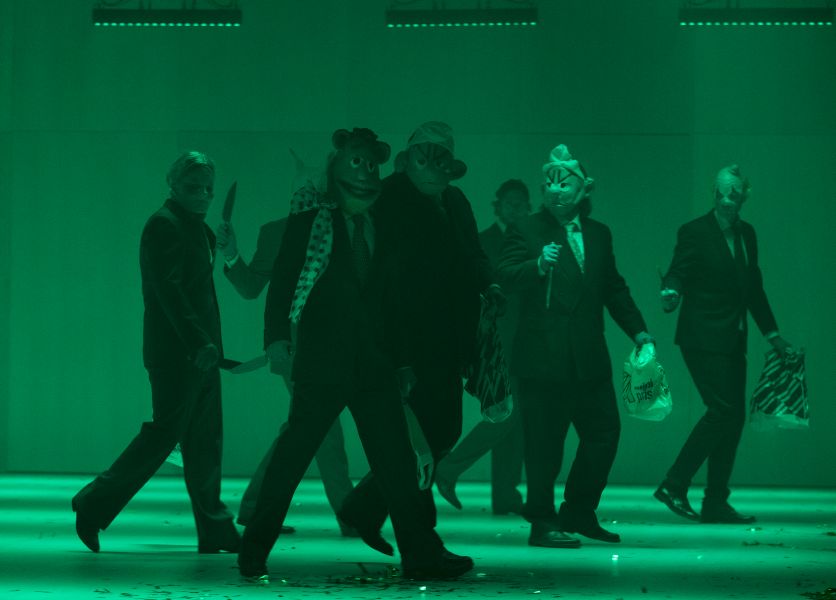
Director


Act I

Violetta Valéry knows that she will die soon, exhausted by her restless life as a courtesan. At a party she is introduced to Alfredo Germont, who has been fascinated by her for a long time. Rumor has it that he has been enquiring after her health every day. The guests are amused by this seemingly naïve and emotional attitude, and they ask Alfredo to propose a toast. He celebrates true love, and Violetta responds in praise of free love (Ensemble: “Libiamo ne’ lieti calici”). She is touched by his candid manner and honesty. Suddenly she feels faint, and the guests withdraw. Only Alfredo remains behind and declares his love (Duet: “Un dì felice”). There is no place for such feelings in her life, Violetta replies. But she gives him a camellia, asking him to return when the flower has faded. He realizes this means he will see her again the following day. Alone, Violetta is torn by conflicting emotions—she doesn’t want to give up her way of life, but at the same time she feels that Alfredo has awakened her desire to be truly loved (“Ah, fors’è lui… Sempre libera”).

Act II

Violetta has chosen a life with Alfredo, and they enjoy their love in the country, far from society (“De’ miei bollenti spiriti”). When Alfredo discovers that this is only possible because Violetta has been selling her property, he immediately leaves for Paris to procure money. Violetta has received an invitation to a masked ball, but she no longer cares for such distractions. In Alfredo’s absence, his father, Giorgio Germont, pays her a visit. He demands that she separate from his son, as their relationship threatens his daughter’s impending marriage (Duet: “Pura siccome un angelo”). But over the course of their conversation, Germont comes to realize that Violetta is not after his son’s money—she is a woman who loves unselfishly. He appeals to Violetta’s generosity of spirit and explains that, from a bourgeois point of view, her liaison with Alfredo has no future. Violetta’s resistance dwindles and she finally agrees to leave Alfredo forever. Only after her death shall he learn the truth about why she returned to her old life. She accepts the invitation to the ball and writes a goodbye letter to her lover. Alfredo returns, and while he is reading the letter, his father appears to console him (“Di Provenza”). But all the memories of home and a happy family can’t prevent the furious and jealous Alfredo from seeking revenge for Violetta’s apparent betrayal.

At the masked ball, news has spread of Violetta and Alfredo’s separation. There are grotesque dance entertainments, ridiculing the duped lover. Meanwhile, Violetta and her new lover, Baron Douphol, have arrived. Alfredo and the baron battle at the gaming table and Alfredo wins a fortune: lucky at cards, unlucky in love. When everybody has withdrawn, Alfredo confronts Violetta, who claims to be truly in love with the Baron. In his rage Alfredo calls the guests as witnesses and declares that he doesn’t owe Violetta anything. He throws his winnings at her. Giorgio Germont, who has witnessed the scene, rebukes his son for his behavior. The baron challenges his rival to a duel.

Act III

Violetta is dying. Her last remaining friend, Doctor Grenvil, knows that she has only a few more hours to live. Alfredo’s father has written to Violetta, informing her that his son was not injured in the duel. Full of remorse, he has told him about Violetta’s sacrifice. Alfredo wants to rejoin her as soon as possible. Violetta is afraid that he might be too late (“Addio, del passato”). The sound of rampant celebrations are heard from outside while Violetta is in mortal agony. But Alfredo does arrive and the reunion fills Violetta with a final euphoria (Duet: “Parigi, o cara”). Her energy and exuberant joy of life return. All sorrow and suffering seems to have left her—a final illusion, before death claims her.

— Courtesy of Opera News


Posted in Music, OPera | Tagged , , , , , , , , | Leave a comment

Verdi’s Bicentennial Celebration: Macbeth in Copenhagen

logoDenmark

THE ROYAL DANISH THEATER PRESENTS:

Thrills, chills, murder and power struggles permeate Macbeth, the story of two alpha types who destroy everything around them in order to realise their ambitions. Verdi was deeply absorbed by Shakespeare throughout his life, and Macbeth was his very first Shakespeare-based opera.

Three witches predict that Macbeth will become king of Scotland. Propelled by Lady Macbeth, he seizes the throne by eliminating his rivals. But blood proves difficult to wash from the hands and justice triumphs at last: Lady Macbeth goes insane and dies, and Macbeth himself is killed in battle.

In the title role is baritone Dario Solari from Uruguay, who has made a brilliant career in Europe and the USA, and the Royal Danish Opera’s own John Lundgren – a master at creating mordantly evil portraits of the most dubious characters from the world of opera.

Macbeth receives stage direction from Australian theatre director Benedict Andrews, whose prize-winning marathon staging of Shakespeare’s historical drama, The War of the Roses, constitutes a first-class springboard for Verdi’s interpretation of the blood-soaked tragedy, Macbeth.

The Royal Danish Theatre celebrates the Giuseppe Verdi bicentennial and the 450th anniversary of William Shakespeare.

Macbeth is performed in Italian with Danish supertitles.

The Royal Danish Theatre wishes to thank the A.P. Møller and Chastine McKinney Møller Foundation whose generous grant has enabled the staging of Macbeth. The Danish Research Foundation is the principal sponsor of the Royal Danish Opera.


FALSTAFF   OTELLO

Cast

  • Read more … Performances:
    Macbeth
    Otello
    Der Fliegende Holländer
    John Lundgren
    Macbeth
  • Read more … Performances:
    Macbeth
    Dario Solari
    Macbeth
  • Read more … Performances:
    Macbeth
    Cavalleria Rusticana & Bajadser
    Madama Butterfly – A Chamber Opera | On Tour
    Anne Margrethe Dahl
    Lady Macbeth
  • Read more … Performances:
    Macbeth
    Arutjun Kotchinian
    Banquo
  • Read more … Performances:
    Macbeth
    Otello
    Don Giovanni | On Tour
    Don Giovanni
    Henning von Schulman
    Banquo
  • Read more … Performances:
    Macbeth
    Otello
    Cavalleria Rusticana & Bajadser
    Der Fliegende Holländer
    Michael Kristensen
    Macduff
  • Read more … Performances:
    Macbeth
    Rusalka
    Madama Butterfly – A Chamber Opera | On Tour
    The Old Maid and the Thief
    Elisabeth Halling
    Lady Macbeths companion
 
Cast dates
 

<!–


–>

Macbeth:
Dario Solari
14/11, 17/11, 20/11, 24/11, 27/11, 11/12

John Lundgren
29/11, 2/12, 4/12, 9/12

Lady Macbeth:
Anne Margrethe Dahl
14/11, 17/11, 20/11, 24/11, 27/11, 29/11, 2/12, 4/12, 9/12, 11/12

Banquo:
Autjun Kotchinian
14/11, 17/11, 20/11, 27/11, 2/12, 4/12

Henning von Schulman
24/11, 29/11, 9/12, 11/12

Lady-in-waiting to Lady Macbeth:
Elisabeth Halling
14/11, 17/11, 20/11, 24/11, 27/11, 29/11, 2/12, 4/12, 9/12, 11/12

Macduff:
Michael Kristensen 
14/11, 17/11, 20/11, 24/11, 27/11, 29/11, 2/12, 4/12, 9/12, 11/12

Malcolm
:
Peter Steen Andersen
14/11, 17/11, 20/11, 24/11, 27/11, 29/11, 2/12, 4/12, 9/12, 11/12

Duncan:
Sten Tulinius:
14/11, 17/11, 20/11, 24/11, 27/11, 29/11, 2/12, 4/12, 9/12, 11/12

Fleance:
Mathias Benjamin Markvardsen
14/11, 20/11, 27/11, 2/12, 9/12

Oscar la Cour Bødtcher-Jensen
17/11, 24/11, 29/11, 4/12, 11/12

A Doctor:
Florian Plock
14/11, 17/11, 20/11, 24/11, 27/11, 29/11, 2/12, 4/12, 9/12, 11/12

A Murderer:
Lasse Bach
14/11, 24/11, 29/11, 4/12, 11/12

Hans Lawaetz
17/11, 20/11, 27/11, 2/12, 9/12

A Herald:
Rudi Sisseck
14/11, 20/11, 27/11, 2/12, 9/12

Torben Demstrup
17/11, 24/11, 29/11, 4/12, 11/12

A Servant of Macbeth:
Simon Schelling
17/11, 24/11, 29/11, 4/12, 11/12

Morten Lassenius Kramp
14/11, 20/11, 27/11, 2/12, 9/12

First Apparition:
Jens Bruno Hansen
14/11, 20/11, 27/11, 2/12, 9/12

Uffe Henriksen
17/11, 24/11, 29/11, 4/12, 11/12

Second Apparition:
Al-Fadl Salem
17/11, 24/11, 29/11, 4/12 og 11/12

William Rasmussen
14/11, 20/11, 27/11, 2/12 og 9/12

Third Apparition:
Mathias Benjamin Markvardsen
14/11, 20/11, 27/11, 2/12, 9/12

Oscar la Cour Bødtcher-Jensen
17/11, 24/11, 29/11, 4/12, 11/12

Synopsis
 

macbethDenmark1  Macbeth_denmark2

Act I
In the dark of night, near a bloodied battlefield, a coven of witches are gathering. They have come with important news for the generals of the Scottish army – Macbeth and Banquo: In a vision they have seen a magnificent future for Macbeth, who will one day be Thane of Cawdor and King of Scotland. For Banquo they bring the news that he will be the father of kings, who will rule over the Scottish realm. As the witches disappear, Macbeth and Banquo are left alone with their astonishment; an astonishment, which becomes greater still, as a messenger arrives with news from the Scottish king: Macbeth has been made Thane of Cawdor and the first of the witches’ prophecies has come true.

macbethDenmark3   Macbeth_denmark4

A few days later at Macbeth’s castle, Lady Macbeth receives a letter from her husband containing the news of his ennoblement and the witches’ prophecies. When a messenger shortly thereafter brings news that Macbeth and the king are on their way to the castle, Lady Macbeth decides to take fate into her own hands. When Macbeth arrives, she tells him of her plan: King Duncan of Scotland must die by Macbeths own hand that very night. Macbeth does not approve of the plan, but he is persuaded and that same night, he kills the king as he sleeps. Afterwards he refused to smear the blood of the dead king onto the clothes of his sleeping guardsmen, so that they will be accused of the murder. This dark deed is consequently done by Lady Macbeth herself. A short while later, Banquo and the nobleman Macduff arrive and uncover the murder. Macbeth and Lady Macbeth join in the dismay at the death of their king, while the desperate guardsmen are arrested for their supposed deed.

Macbeth_denmark5  Macbeth_denmark6

Act II
Macbeth has been proclaimed King of Scotland. The second of the witches’ prophesies have come true, while the rightful heir – the murdered king’s son, Malcolm – has fled Scotland and accusations of having murdered his own father. But for Lady Macbeth all is still not well: The prophecy of Banquo becoming the father of kings worries her, and in her mind there is only one solution: Banquo and his son Fleance must die. Only then can she rest assured that the crown is secure. Macbeth again is not happy about her plan, but again he is persuaded and together they plan the murder.

Banquo and his son arrive for a celebration at Macbeth’s castle. Fleance is uneasy, but Banquo trusts Macbeth and thus walks straight into the arms of the assassins waiting for him outside the castle gates. As his father is murdered, Fleance manages to flee the scene.

Macbeth_denmark7  Macbeth_denmark8

In the castle Lady Macbeth, unaffected by her murderous plans are welcoming her guests. Macbeth receives the message that Banquo has been murdered, but just as he is about to feel a little more at ease, he is paralyzed with fear: His seat on the throne is suddenly taken by Banquo’s bloodied ghost! Terrified, Macbeth begs the ghost to go away while Lady Macbeth and the guest look on in amazement at the new king’s strange behaviour. Lady Macbeth manages to distract the guests, while Macbeth himself flees the hall in terror.

Macbeth_denmark9  Macbeth_denmark10

Act III
Beside himself with misgivings after the death of Banquo and unsure of what the future will bring, Macbeth seeks out the witches for more news. They bring forth three apparitions bringing new prophecies: The first bids him beware of Macduff. The second assures him that “no man of woman born” can harm him. The third assures him that he will be safe until the mighty Birnam Wood marches on his castle, Dunsinan.
Calmed by the apparations, Macbeth asks about the descendants of Banquo and is immediately confronted by another apparition: A procession of future kings, followed by the ghost of Banquo himself. Horrified by what he has seen, Macbeth collapses to the ground. As the witches disappear again, Lady Macbeth finds her husband lying lifeless on the ground. She revives him, and together they plan the murder of Macduff and his entire family.

Macbeth_denmark11  Macbeth_denmark12  Act IV
On the Scottish border, Macduff is gathering an army of fugitives from Macbeth’s tyranny. He is himself full of anger and sorrow for his wife and children, whom Macbeth has had murdered. Malcolm, the son of the late King Duncan, joins Macduff with an army of English soldiers. He intends to fight Macbeth and win back his rightful crown. The army seek shelter under the trees of Birnam Wood while they plan their attack. 

Macbeth_denmark13  Macbeth_denmark14  

In the castle Dunsinan, the Lady Macbeth is being haunted by remorse. In her dreams, she revisits the terrible murders she has ordered and unable to rest peacefully, she sleepwalks through the castle at night, trying to wash invisible blood from her hands.
In another room, Macbeth too is awake in the night. For him there is no rest either: Any minute he awaits the arrival of his enemies and he bitterly he realizes that when he is dead, he will only be remembered for his vile deeds. A servant brings him the news, that Lady Macbeth has taken her own life and that the castle guards are reporting strange tidings that the trees of Birnam Wood are moving towards the castle.

Macbeth_denmark15  Macbeth_denmark16

As Malcolm and Macduff arrive at the castle with their armies, Macbeth flings himself recklessly into the fight. Macbeth and Macduff meet in a vicious duel, where Macbeth taunts Macduff with the witches’ prophecy, that no man born of woman can hurt him. Macduff, however, retorts that he was cut out of his mother’s womb and therefore was not born naturally, upon which he kills Macbeth and proclaims Malcolm the rightful King of Scotland.

Macbeth_denmark17  Macbeth_denmark18

Macbeth_denmark19  Macbeth_denmark20

Macbeth_denmark21  Macbeth_denmark22

Macbeth_denmark23 Macbeth_denmark24 Macbeth_denmark25  Macbeth_denmark26  Macbeth_denmark27  Macbeth_denmark28Macbeth_denmark29  Macbeth_denmark30

Posted in Music, OPera | Tagged , , , , , , | 1 Comment

“NEIGE” by Catherine Kontz in Luxembourg

logoLuxembourg

NEIGE

Catherine Kontz (*1976)

From the novel “Neige” by  Maxence Fermine
Libretto by Catherine Kontz
Création mondiale
In French and Japanese, with subtitles in French and English

After Der Turm in 2011, the Théâtres de la Ville once again support the work of a Luxembourg composer in 2013. Catherine Kontz was inspired by certain aspects of Japanese Kabuki theatre to create her first opera Neige. Based on the novel by Maxence Fermine of the same title, the story recounts the adventures of a 19th century haiku poet who comes across a blind painter, a tragic samurai warrior and a French tight-rope walker.

The multidisciplinary production features five soloists, a small female choir, a dancer and an acrobat. The music is provided by Luxembourgbased ensemble Lucilin, who impressed audiences last year in the production of The Raven and with whom the Théâtres de la Ville are thus continuing their collaboration.

As with her previous theatre work, Catherine Kontz will direct the piece herself but has assembled an impressive creative team around her from her London connections. Avant-garde studio Knifedge will create the projections and Conductor in Residence for the British National Youth Orchestra Gerry Cornelius will be in charge of the music while award-winning theatre designer Ellan Parry will be responsible for set and costumes. Together they will try to create a magical and beautiful landscape with mountains made out of fabric and cutting-edge projections inspired by Japanese painting and calligraphy.

Direction musicale Gerry Cornelius
Mise en scène Catherine Kontz
Collaboration à la mise en scène Keiko Sumida
Scénographie & costumes Ellan Parry
Créateur Vidéo Timothy Bird
Lumières Kristina Hjelm 

Yuko Akita Rodrigo Ferreira
Père Akita Edward Grint
Dignitaire de la Cour & Horoshi Vincent Pavesi
Maître Soseki Omar Ebrahim
Neige Juliet Fraser
Neige jeune / Flocon du printemps Katharina Dröscher
Soseki jeune Reveriano Camil

Orchestre United Instruments of Lucilin

Chœur de femmes Lilith Verhelst (Soprano I), Coline Dutilleul (Soprano II), Dana Luccock ( Mezzo-soprano I), Anaïs Brullez (Mezzo-soprano II)

Instrumentalistes Philipp Marguerre (Glasharmonica), Akinori Fujimoto (Taiko drums) 

Répétiteur piano Klauspeter Bungert

Régie générale Sabine Konz

Production créée le 19 décembre 2013 au Grand Théâtre de Luxembourg

Production Les Théâtres de la Ville de Luxembourg
Coproduction United Instruments of Lucilin
Collaboration Catherine Kontz Productions asbl
Avec le soutien de l’Œuvre Nationale de Secours Grande-Duchesse Charlotte, Ministère de la Culture, de la Fondation Indépendance, FOCUNA (Fond Culturel National) & SACEM

Thursday 19 DÉCEMBER 2013 à 20h00

Friday 20 DÉCEMBER 2013 à 20h00 
 
Estimated time 1h10 plus interval

Introduction à l’opéra par Catherine Kontz (compositrice et metteure en scène) & Guy Frisch (de l’Orchestre United Instruments of Lucilin) une demi-heure avant chaque représentation (en langue française)

Posted in OPera | Tagged , , , | Leave a comment

“Il trovatore” in Krakow

trovatoreKrakowThe Troubadour

(Il trovatore)

Composer: Giuseppe Verdi

opera in four acts
libretto: Salvatore Cammarano and Leone Emanuele Bardare after the play Antonio Garcia Gutiérrez
in the original Italian
world premiere: Roma 1853
Polish premiere: Warsaw 1854
premiere in the Krakow Opera: 8 june 2013

Production team:
Director: Laco Adamik
Music director: Tomasz Tokarczyk
Set and costume designer: Barbara Kędzierska
Chorus master: Zygmunt Magiera
Lighting designer: Bogumił Palewicz

director’s assistant: Dagmar Bilińska
ausic director’s assistant: Grzegorz Brajner
set designer’s assistant: Izabela Firek
chorus master’s assistant: Joanna Wójtowicz
stage managers: Agnieszka Sztencel, Magdalena Wąsowska
prompters: Dorota Sawka, Krystyna Behounek
soloists’ coaches: Irena Celińska-Głodek, Kristina Kutnik, Olha Tsymbalyuk, Natalia Wasidlow
chorus accompanist: Magdalena Kurek
displayed libretto translated by Dorota Sawka

trovatoreKrakow1  trovatoreKrakow2

Cast:
IL CONTE DI LUNA | Leszek Skrla, Dainius Stumbras
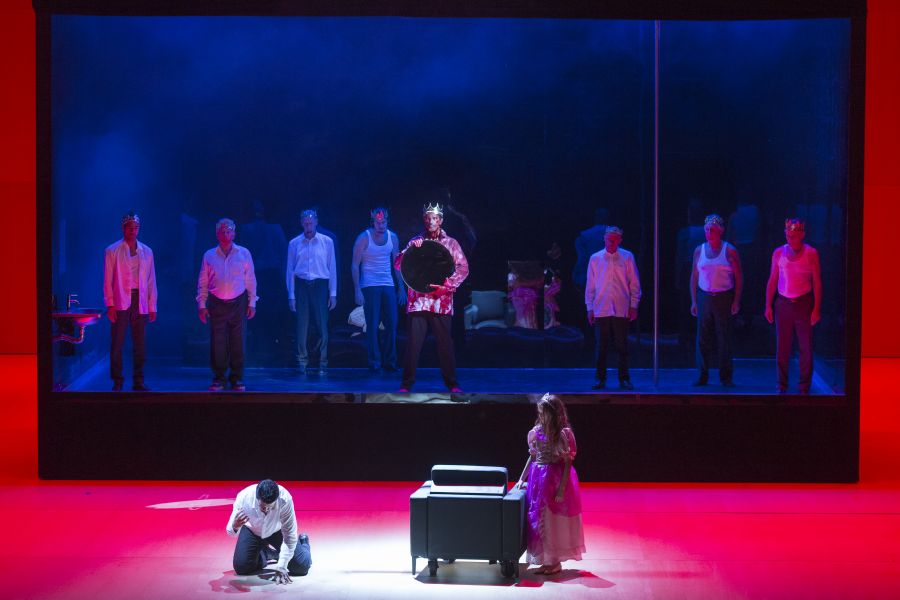
LEONORA | Magdalena Barylak, Katarzyna Oleś-Blacha, Ewa Vesin

AZUCENA | Małgorzata Ratajczak, Agnieszka Rehlis, Małgorzata Walewska

MANRICO | Vasyl Grokholskyi, Tomasz Kuk, Arnold Rutkowski

FERRANDO | Jozef Benci, Krzysztof Dekański, Volodymyr Pankiv

INES | Agnieszka Cząstka, Monika Korybalska

RUIZ | Krzysztof Kozarek, Marek Gerwatowski, Rafał Pawłowski

OLD GYPSY | Marcin Herman, Jan Migała

MESSENGER | Marek Gerwatowski, Rafał Pawłowski

THE KRAKOW OPERA ORCHESTRA AND CHOIR
24.11.2013
time: 6:30 pm
scene: Main Stage
duration: 3 hrs.
intervals: 1

22.11.2013
time: 6:30 pm
scene: Main Stage
duration: 3 hrs.
intervals: 1

trovatoreKrakow3  trovatoreKrakow4

A story of two brothers, separated by fate and then pitted against each other by their love for the same woman and by political turbulences – both unaware of their brotherhood… “Troubadour’s” libretto, despite based on authentic events from Middle Age Spain torn with civil wars, is regarded to be complicated and unclear, mainly because the key events for the plot take place out of stage – they exist only in relations of other characters. The opera’s success was attributed primarily to music – it is “a music and vocal pleasure”, they wrote. Laco Adamik – in defiance of these opinions – tries, relying on his many year’s narrative experience of a director, to make the performance shine also from the plot’s side. His staging offers fleshy characters, well-shaped events and a crime which once committed entails next ones, like in the ancient tragedy. You will be anxious and moved. It is the first staging of the title in the entire history of the Krakow stage.

trovatoreKrakow5

Posted in Music, OPera | Tagged , , , , , , , | Leave a comment

The “Csardas Princess” in Tel Aviv

csardasIsrael8  csardasIsrael7


csardasIsrael6  csardasIsrael5


csardasIsrael4  csardasIsrael3


csardasIsrael2  csardasIsrael1


Csardas Princess

Emmerich Kalman

The Budapest Operetta Theatre comes to Israel with their splashy production of The Csardas Princess. This is a story in which eventually love conquers all, a celebration of sweeping operetta melodies, colorful costumes and music that sparkles like champagne.

Libretto: Béla Jenbach and Leo Stein

Conductor  Laszlo Maklary
Director  Miklos Gabor Kerenyi KERO®
Costumes Designer                      Fanni Kemenes
Set Designer  Agnes Gyarmathy
Lighting Designer  Laszlo Nagy
Choreographer  Gyorgy Gesler


Sylva Varescu Monika Fischl
  Barbara Bordas
Edwin Ronald Zsolt Vadasz
  Gergely Boncser
Countess Stasi Szilvi Szendy
  Annamari Dancs
Graf Boni Karoly Peller
  David Szabo
Feri von Kerekes Tamas Foldes
Leopold Maria Peter Mrik
Anhilte Bori Kallay
Arnold Sandor Gyorgy-Rozsa
Eugen von Rohnsdorff                  Gabor Dezsy-Szabo
Kiss, Notary  

 
Soloists, dancers and chorus of the Budapest Operetta and Musical Theatre

Raanana Symphonette Orchestra with players from the Budapest Operetta Theatre

Surtitles in Hebrew and English

New Production
Sung in Hungarian
Duration: Three hours

Day         Date  Hour        back stage tours       Opera Talkback
*THU 12.12.13           20:00    
FRI 13.12.13 13:00    
    21:30    
SAT 14.12.13 16:30    
    20:30    
MON 16.12.13 20:00 18:30 After the show
TUE 17.12.13 20:00 18:30 After the show
WED 18.12.13 20:00 18:30 After the show
THU  19.12.13 20:00   After the show
FRI 20.12.13 13:00    
SAT 21.12.13 20:30    

* PREMIÈRE
** TOWARDS OPENING – 14.12.13 SAT 11:00 

The Gipsy Princess

Act I The Orpheum Cabaret, Budapest 
The guests at the Orpheum Cabaret are celebrating the final appearance of their singing star, Sylva Varescu, before her departure on a tour of America. After the performance Sylva celebrates with two older admirers, Count Boni and his friend Feri as she eagerly awaits the arrival of the man she loves, Prince Edwin Ronald von und zu Lippert-Weylersheim. Edwin, who is under pressure from his family to abandon this unsuitable liaison with a cabaret singer and return to Vienna, arrives and is not willing to lose Sylva, yet he receives a letter demanding him to report to his regiment in Vienna. Edwin makes up his mind and before returning to Vienna he and Sylva sign a document binding them to marry each other within two months. Sylva decides to cancel her American tour. Unknown to Edwin his parents have already announced the betrothal of Edwin to Countess Anastasia (Stasi). When Sylva finds this outs, she assumes that Edwin has cheated her and decides to fulfill her American contract accompanied by Boni as her manager.

Act II Prince Leopold’s residence near Vienna.
Prince Leopold and Princess Anhilte (Edwin’s parents) are holding a ball announcing the official betrothal of Edwin and Stasi, yet the two are far from happy with the idea. Edwin, who has never understood why Sylva deserted him, is still desperately hoping for news from America. Suddenly two unexpected guests arrive – Sylva and Boni. She has cut short her tour and persuaded Boni to bring her to the ball, pretending that they are now married to each other. Edwin is livid with Boni for his apparent treachery and also accuses Sylva of betraying him, however Edwin and Sylva are still in love and soon enough it is obvious that Stasi and Boni fall for each other and are happy with each other’s company. Edwin persuades Sylva that she should divorce Boni but Sylva needs to be accepted as Sylva Varescu, cabaret singer, not the ex-wife of a Count whom she hasn’t actually married. When the Prince makes an official declaration about Edwin and Stasi’s engagement, Edwin announces that he loves Sylva. But she is not willing to be announced as anyone else than who she really is, the cabaret singer from Budapest, and leaves the ball with anger.

Act III The foyer of the Holzberg Hotel, Vienna, later the same night.
Sylva and Boni return to their hotel, where they find their older friend Feri and the dancing girls from the Orpheum. Edwin follows, looking for Sylva, followed in turn by his angry father. Boni declares that he wants to marry Stasi and she of course accepts. Yet Prince Leopold still rejects his son’s liaison with a cabaret singer. But when by mere coincidence he realizes that long ago his own wife has also been a cabaret singer, he no longer can refuse. And so the two pairs of lovers are reconciled. All’s well that ends well.

The Israeli Opera, Sderot Sha’ul, HaMelech 19, Tel Aviv-Yafo, Israel

Csardas Princess

Posted in Music, OPera | Tagged , , , , , | Leave a comment

CD REVIEW: Gaetano Donizetti – BELISARIO

Reposted from: http://www.voix-des-arts.com/2013/11/cd-review-gaetano-donizetti-belisario-n.html

Author: Joseph Newsome

CD REVIEW: Gaetano Donizetti – BELISARIO (N. Alaimo, J. El-Khoury, R. Thomas, C. Roberts, A. Miles; Opera Rara ORC49)

 Gaetano Donizetti: BELISARIO (Opera Rara ORC49)

GAETANO DONIZETTI (1797 – 1848): Belisario – N. Alaimo (Belisario), J. El-Khoury (Antonina), R. Thomas (Alamiro), C. Roberts (Irene), A. Miles (Giustiniano), J. Sporsén (Eudora), P. Hoare (Eutropio), E. Price (Eusebio), M. Bundy (Ottario), D. Jeffery (Centurion); BBC Singers; BBC Symphony Orchestra; Sir Mark Elder [Recorded at BBC Maida Vale Studios, London, in October 2012; Opera Rara ORC49; 2CD, 124:53; Available from Opera RaraPresto Classical, and all major music retailers]

Thoroughly, memorably satisfactory performances of bel canto operas are as rare today as honest politicians—and as welcome when they unexpectedly appear.  Not so many seasons have passed since the Lucias of Beverly Sills or Dame Joan Sutherland could be partnered on any given night with the Edgardos of Carlo Bergonzi, Nicolai Gedda, Sándor Kónya, or Richard Tucker.  Perhaps they were not Pastas or Rubinis, but these singers knew and loved bel canto and possessed both the requisite techniques and sufficient respect for the music to dedicate themselves to delivering stylish performances.  There are excellent bel cantosingers active today, of course, but instances in which groups of them are assembled in casts for Bellini or Donizetti operas are strangely few.  Are an Adalgisa with no coloratura and a strangulated Roberto Devereux really considerably less expensive for an opera company than good ones?  Bel canto suffers more in the 21st Century than ever before, it seems, from the supposition that this repertory requires star singers in order to be viable: worry first about filling seats and then about meeting the demands of the music, and if one of these aims must be sacrificed it is better to sing poorly to a full house.  The history of Opera Rara proves, however, that, when sung not just competently but enthusiastically and devotedly,bel canto repertory both is a star in its own right and creates stars of its own accord.  Any number of sopranos can get through a rôle like Donizetti’s Maria de Rudenz, but only a mistress of the idiom like Nelly Miricioiu can truly make the part her own, and Opera Rara’s studio recording gave her the ideal setting in which to offer a masterclass in dramatic bel canto singing.  The talented team at Opera Rara have now given this same gift to Donizetti’sBelisario, bringing together a cast of today’s most talented bel canto singers and crafting a performance that sweeps the boards, artistically and technically.

The technical strengths of this recording arise from the work of Opera Rara’s engineers, Neil Pemberton, Drew Leckie, and Susan Thomas.  They faced a daunting assignment: sonic excellence is the expectation rather than the exception with Opera Rara recordings, but the best of their skills were engaged in producing a dynamically wide-ranging recording that benefits from near-ideal balance and a natural, slightly dry acoustic that credibly replicates the sound of a small theatre.  As has also become customary for Opera Rara releases,Belisario is accompanied by an article by Jeremy Commons by which the attentive reader will be both educated and entertained.  Even among Donizetti’s lesser-known operas, Belisario is something of an enigma, its musically uneven but dramatically innovative score largely overlooked during the Donizetti revival of the 1950s and ‘60s.  The opera’s resurgence in the 20th Century was due to interest in the lead soprano rôle by Mara Zampieri and, most significantly, Leyla Gencer.  Compared with Anna Bolena and Lucia di LammermoorBelisariois not a masterpiece, but the efforts of Opera Rara have often revealed that Donizetti’s ‘forgotten’ operas are finer scores than those of his less-remembered contemporaries—and, indeed, than those of subsequent generations that enjoy greater popularity.  Thus it is also with Belisario.  There are passages, even pages, of the opera that lack inspiration, but of how many composers’ scores except the mature operas of Mozart can that not be said?  There are many pages in Belisario that rival the best of Donizetti’s work, however, and there is an obvious effort by all of the personnel involved with this recording to ensure that the score receives uniform distribution of the deep trove of resources.  A listener would not expect a Violetta to sing haphazardly until reaching ‘Amami, Alfredo, amami quant’io t’amo’ and ‘Alfredo, Alfredo, di questo core,’ her two great outpourings of melody, but many performances of bel canto operas do just that, taking flight only in the moments of greatest fame or distinction.  There are moments in Belisario when Donizetti’s genius is more apparent, but the levels of musical and dramatic execution in this recording are consistently high from beginning to end.

One of the finest if least-heralded theatrical conductors working today, Sir Mark Elder presides over this performance of Belisario with passion and precision.  His keen ear for rhythm provides a firm foundation for the performance, and the depth of his understanding of both the similarities and differences of the styles of the mature Donizetti and the young Verdi is evident.  In many ways, Belisario is a close relative of Nabucco, both in terms of the basic structure of the narrative and in the sharply-contrasted musical profiles of the characters.  Donizetti’s opera mostly lacks the contemporary political and religious subtexts of Nabucco but shares many of the complicated, ultimately unanswerable questions of Verdi’s work.  Maestro Elder shows a firm hand in guiding the development of Donizetti’s carefully-conceived thematic arcs, but he is also a confident, cordial friend to the singers.  Melodic lines are granted the flexibility that they need in order to expand organically without distorting the dramatic progression of scenes.  Perhaps the greatest accomplishment of Maestro Elder’s conducting in this performance is the way in which be balances clean articulations of rhythmic figurations with seemingly effortless commands of dynamics, balance between orchestra and singers, and idiomatic phrasing of Italianate melodic lines.  Such accomplishments are far from effortless, of course, and Maestro Elder’s expert leadership contributes significantly to the success of this recording.  Led respectively by Renato Balsadonna and Tomo Keller, the BBC Singers and BBC Symphony Orchestra also perform excellently, not least by responding so readily to Maestro Elder’s baton.  The BBC Singers evoke the grandeur of Imperial Byzantium with singing of compelling vigor.  The choristers are given nothing of the melodic fecundity of Nabucco’s ‘Va, pensiero sull’ari dorate,’ but the Senators’ Chorus in Part One, ‘Che mai sarà,’ is a stirring number, faintly resembling in its basic structure the Council Chamber Scene in Verdi’s Simon Boccanegra.  Whether plotting rebellion or decrying betrayal, the choristers maintain a sturdy, unstintingly musical presence throughout the performance.  The demands of Donizetti’s score find not one of the players of the BBC Symphony Orchestra unprepared, and the reliable quality of the orchestral playing further enhances the cumulative impact of the recording.

Another quality typical of Opera Rara releases (and sadly atypical of other labels’ recordings) is the uniformly high level of talent among the singers cast in supporting rôles.  Belisario is an opera in which there truly are no insignificant rôles, and even the unnamed Centurion comes forward in the penultimate scene with the critical news that Belisario has been mortally wounded in battle.  Thankfully, a singer as capable as Darren Jeffery is on hand to fill the Centurion’s lines with forceful tone befitting the gravitas of his statements.  Eutropio, duplicitous head of the Imperial guards and combatant for Antonina’s favor, and Eusebio, the warden of the Imperial prison, are sung with ringing tones by Peter Hoare and Edward Price.  Michael Bundy is a suitably martial Ottario, leader of the rebels, and Irene’s confidante Eudora is beautifully sung by Julia Sporsén.

The rôle of the Byzantine Emperor Giustiniano is sung by bass Alastair Miles, a frequent participant in Opera Rara projects and one of the most important exponents of bel cantosinging in Britain.  In recent seasons, there were occasional signs of the effects of time and a rigorous career in Mr. Miles’s singing, but in this performance these traits are little in evidence.  Donizetti did not give Giustiniano a concerted aria, but Mr. Miles takes advantage of every opportunity offered him, infusing his pronouncements with focused, suitably regal tone.  Passages at neither the very top nor the bottom of the voice come as easily as in the past, but it is heartening to hear Mr. Miles again singing so well.

Irene is an usual seconda donna in that she, rather than Antonina, is the opera’s sympathetic female protagonist.  Subjected to the cruel workings of fate and her mother’s covert political manipulations, she suffers greatly and, in one of the defining characteristics of bel canto, in music of considerable beauty.  Irene’s scene with her blinded father in Act Two, culminating in the duet ‘Ah! se potessi piangere,’ is the emotional climax of the opera, the situation of the faithful daughter reunited with her humiliated father—so familiar from mythology and in opera—inspiring Donizetti to extraordinary heights of pathos and musical inspiration.  Camilla Roberts scales these heights imaginatively, phrasing with an audible understanding of the art of bel canto and shaping her performance with an effecting sense of womanly dignity.  Ms. Roberts’s Irene is a mercilessly put-upon woman but not one who lashes out in vengeful anger or who demurely accepts the hands she is dealt.  Indeed, Ms. Roberts proves as spirited in up-tempo passages as she is moving in more lyrical moments.  Neither her artistry nor her voice is more eloquently deployed than in the scene with Belisario, when Irene takes her wounded father under her protection.  Warmly feminine and secure throughout the performance, Ms. Roberts’s voice here takes on the slow-burning intensity of a heroine of Greek tragedy.  Ms. Roberts occasionally sounds cautious in approaching the top of her range, but the voice is full and lovely, and her singing is a credit to the performance.

Tenor Russell Thomas takes a rôle that could all too easily be a standard-issue operatic caricature—that of the child long lost but miraculously found at the most opportune time—and transforms it into a vocal and dramatic tour de force.  Even the scene in which, his Greek ancestry having been revealed, he is taken into his father’s household as a replacement for the missing son is managed without the slightest hint of parody.  Donizetti set the scene with absolute sincerity, of course, and Mr. Thomas performs his part in it accordingly.  It is obvious in every line that Mr. Thomas sings in this performance that his is a voice that should be heard in all of the world’s important opera houses.  In Alamiro’s aria and cabaletta that open Part Two, Mr. Thomas sings with virile security and brilliant tone that would be welcome in any of Donizetti’s operas; or, indeed, in any of Verdi’s.  Alamiro is not called upon for any great philosophical discourses, but he is a hero with an insightful nature, and Mr. Thomas’s performance glows with honesty and open-hearted emotion.  Keeping with the nature of the music, interpolated top notes are few, but Mr. Thomas’s excursions into his freely-produced upper register are thrilling.  Even very young singers without idiosyncrasies and mannerisms are rare today: Mr. Thomas impresses most by the unaffected simplicity of his singing.  This is not to suggest that Alamiro’s music is an easy sing, but the facility with which Mr. Thomas sings it is testimony to the well-schooled completeness of his technique.  In every scene in which he appears in Belisario, Mr. Thomas sings with an ideal combination of power and grace—an auspicious launch to what will hopefully prove a long and fruitful career before the microphones.

Also at the dawn of an especially promising recording career is soprano Joyce El-Khoury, who sings Antonina with a dramatic abandon that might seem old-fashioned to listeners accustomed to the anemic singing heard in so many recent performances of bel cantorepertory.  Indeed, Ms. El-Khoury’s performance is refreshingly ‘old-fashioned’ in the sense of bringing to the rôle the kind of take-no-prisoners intensity that was a hallmark of Leyla Gencer’s singing of Antonina.  Bel canto leading lady she is, but a delicate songbird Antonina is not, and Ms. El-Khoury discloses at her first entrance that hers will be a performance that neglects none of the character’s less glamorous elements.  She also neglects none of Donizetti’s musical demands, filling her performance with stretches of wonderfully stylish singing.  Antonina makes her entrance with ‘Sin la tomba è a me negata,’ the first music of real distinction in the score, and Ms. El-Khoury makes it clear that Antonina’s emotions run hot.  First sung by Caroline Ungher, who also created Donizetti’s Parisina and Maria de Rudenz, Antonina is an intriguing figure whose influence, like that of Fricka in Die Walküre, is more felt than heard, her appearances being confined to Parts One and Three.  That she is so omnipresent in this performance is indicative of the strong impression made by Ms. El-Khoury’s singing.  Antonina’s final aria and cabaletta are blazingly sung, Ms. El-Khoury putting even Donizetti’s most demanding vocal writing at the service of her wide-eyed dramatic instincts.  Musically, Ms. El-Khoury encounters no challenge to which her technique is not equal.  The dark-amber timbre of her voice is very attractive, especially as the sunlit ascents of Donizetti’s melodic lines access her glowing upper register.  Like Klytämnestra, Antonina’s political ambitions are upset by the reappearance of a presumed-dead son, though Antonina presumably had no hand in her child’s fate (her hatred of her husband is inspired at least in part by her belief that their son was slain on his order), and destiny delivers one last blow by Belisario’s untimely death thwarting her quest for absolution.  It is perhaps misleading to suggest that Antonina is a ‘broken’ woman, but Donizetti gave her poised, beautiful music that complicates interpretations of the part as either a straightforward bel canto heroine or an evil villainess.  Ms. El-Khoury shares Leyla Gencer’s talent for emotionally-charged dramatic bel canto singing, and she manages to make Antonina an even more sympathetic figure than Gencer achieved in Venice and Bergamo, all while singing with formidably sure technique and controlled fire.

The title rôle receives from baritone Nicola Alaimo a performance of musical and dramatic potency.  Making his entrance into the opera in the manner of Rossini’s—or, even more spectacularly, Verdi’s—Otello, as the triumphant warrior returning to his native land, Belisario receives both from Donizetti and from Mr. Alaimo suitable pomp and circumstance.  Mr. Alaimo joins Mr. Thomas in a monumental account of the duet ‘Sul campo della gloria.’  Belisario’s disbelief and offended exasperation upon being accused and condemned echo Anna Bolena’s ‘Giudici…ad Anna,’ and Mr. Alaimo’s performance brims with barely-concealed rage.  In the scene in which the blinded Belisario is reunited with Irene, recalling the devotion of Antigone to Oedipus, Mr. Alaimo sings with tremendous feeling.  Dramatically, this scene foreshadows many similar scenes of life-altering interaction between parents and their children—or, in one instance, a would-be daughter-in-law—in the operas of Verdi: Rigoletto and Gilda, Germont and Violetta, Boccanegra and Amelia.  Musically, it is a testament to Donizetti’s genius that his music for Belisario and Irene inhabits the same exalted environment as that of Verdi for his celebrated familial confrontations.  Mr. Alaimo responds to Ms. Roberts’s example with long-breathed phrasing and an alert presentation of text.  Mr. Alaimo’s excellent diction is of great importance throughout the opera, and the naturalistic but unaffected manner in which he delivers both Belisario’s surprise at learning that Alamiro is his son and the character’s death scene is richly rewarding.  Mr. Alaimo’s voice is not extraordinarily beautiful like that of Giuseppe Taddei, who was one of the most notable exponents of the part in the 20th Century, but he proves a subtle, moving Belisario whose gifts for bel canto provide countless moments of gratifying singing.

During the past few seasons, a listener might be forgiven for having forgotten that bel cantoboth literally and figuratively means ‘beautiful singing.’  With the increasing focus on crowding the world’s stages with pretty faces regardless of the quality of the voices that pass through them, it is inevitable that the traditions of bel canto, which rely upon handsomeness of tone rather than attractiveness of figure, should suffer.  From that perspective, the operas espoused by Opera Rara’s initiatives are not as rare as the performance traditions they uphold.  More so than many of the works that hover in the peripheries of the repertories of the world’s opera houses today, Belisario is an opera that deserves to be heard on the most important stages and that deserved a recording of the highest possible quality.  Fulfillment of the former goal may remain unlikely, but Opera Rara’s efforts have produced a Belisario to be treasured by lovers of genuine bel canto.  Stylish bel canto singing may be fighting for its life in many theatres, but in Opera Rara’s projects and in the throats of Nicola Alaimo, Joyce El-Khoury, Russell Thomas, Camilla Roberts, and Alastair Miles it is alive and well.

Posted in Article | Tagged , , , , , , , | Leave a comment