
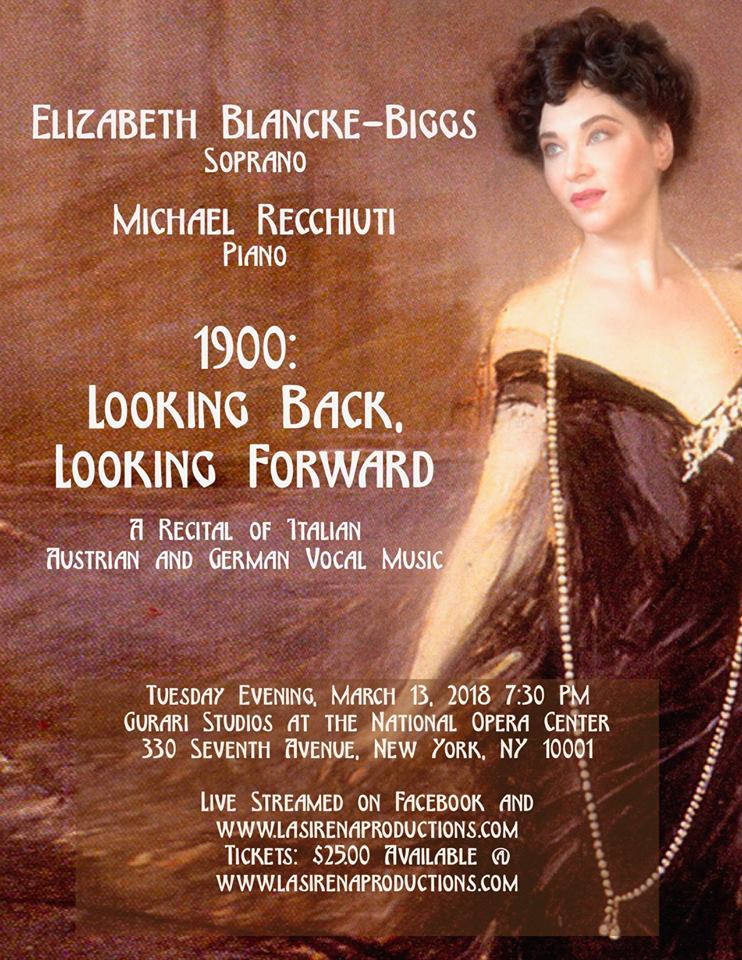


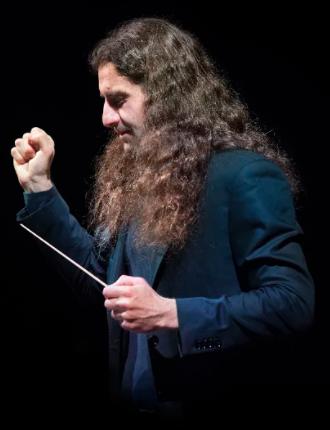
 AN INTERVIEW BY TIZIANO THOMAS DOSSENA
A golden period for the Roman composer Gabriele Ciampi, appreciated by the great men of the Earth: he played for the Obamas in the White House, at the invitation of the former First Lady, he met Pope Francis and was the only one to represent Italy as a judge of the prestigious 2018 Grammy Awards. One of the most important awards of the USA, a recognition that every year crowns the protagonists of the music sector, is generally considered as the “Oscar of Music”. The ceremony took place on January 28, 2018 at Madison Square Garden in New York. Maestro Gabriele Ciampi met us in New York in the hall of his hotel the day after the Grammy Award. We report (late, for technical reasons) part of the long conversation between our editorial director and the congenial Roman composer.
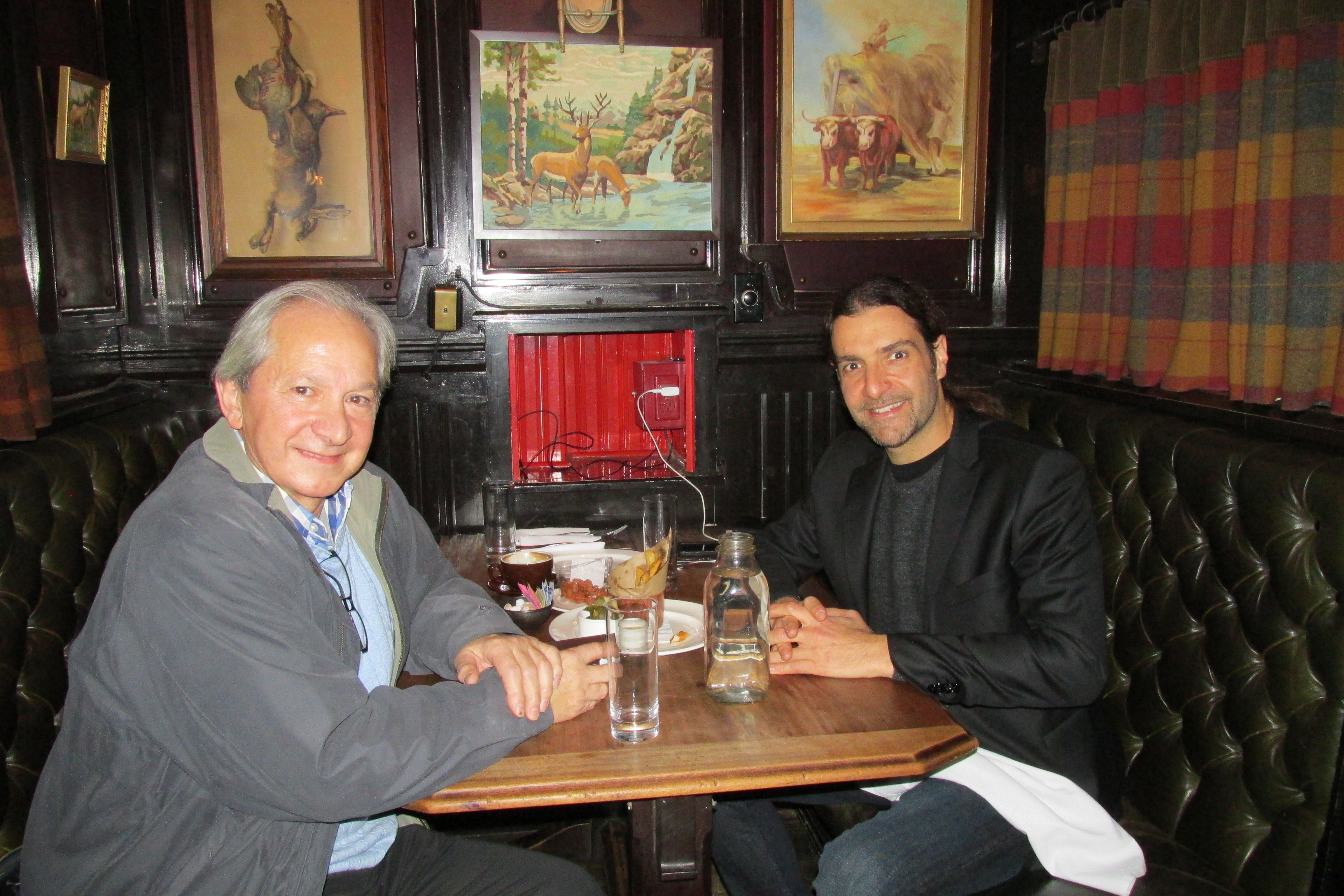
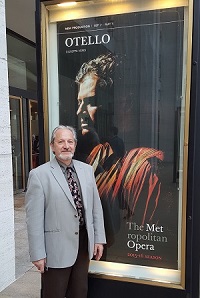
Tiziano Thomas Dossena and Gabriele Ciampi
OperaMyLove: Good evening, Maestro. (I smile) Excuse me but I was not prepared to meet a composer. I thought you were an orchestra conductor, but by researching your name I discovered so much more. So, you conduct orchestras, but you are a composer…?
Ciampi: I am a contemporary composer (Smiling in turn). I have an orchestra of 40 elements plus guitars and percussion that give a little more modern touch; to be clear, something cinematic, obviously with a classical basis, because I come from the conservatory, so the classical basis is there. I have also collaborated with symphony orchestras … And lately I have also been invited by the Recording Academy to be one of the judges; besides that, I’m also a member of the Recording Academy, so as a member I can submit my music in the future when I have some other album, and I can vote.
OperaMyLove: Since you were one of the Grammy Award judges, could you tell us how the award assignment works?
Ciampi: First of all, I consider the Grammy a competition for emerging artists because it is not tied to the sales, discography or popularity of the artist, but it is linked to the quality of the music; so you can have an unknown artist who is competing with Bruno Mars, who won almost everything. This is because the Recording Academy receives twenty thousand titles every year. There are 350 experts at the Recording Academy who make a first screening. They identify ten songs for each category, and then send them to the voting members of the Recording Academy, who are musicians, composers, authors, who choose among these songs the nominations. The first vote is cast, the one called the first round ballot. Having done this, the Recording Academy chooses a sort of artistic commission of about a hundred people from various parts of the world, all belonging to music; there are no journalists or record labels executives, but pianists, authors, composers, etc., and we are asked to do a selection and vote for the songs that have received the nominations. After that, the result of these votes is known only on the evening of the Awards; a three-step process, then. When you see the results on television, you should not think that the judges decided only a few hours before, because the votes had already been delivered a week before.
OperaMyLove: Is it difficult for a classicist, that is, someone who works, composes and lives in the world of classical music, judging pop music or RAP?
Ciampi: Well, let’s start from the fact that classical music is the popular music of a hundred years ago, so when we assigned this concept of musicality, it was not like we think it today; I do not see big differences between pop music and classical music. That said, my opinion is technical on the score, so I get the sheet with the score, I look at what is written … in the case of Bruno Mars, for example, I have examined the song 24K: it’s a song that was written on the piano, so it has interesting harmonies; what I judge is actually the harmonic part of the song, I do not care about the arrangement. Here we return to the pop concept in contrast to the classic: there can be innovation in a pop piece while there may be boredom in a classic piece, it always depends on what one writes. So, the music is all on the same level…
OperaMyLove: How come there are no Italian names in the list of nominees at the Grammy?
Ciampi: That is an old quandary. First, the language. The Italian language is not considered a musical language, so, unfortunately, Italian is being considered a language only suitable for the classics, the opera… It’s a mistake… but, surely English is a much more musical language. If you have to write a song, English flows more easily and makes the composition work easier. Of course, when I had to write a work for the composition exams, in the conservatory, the Italian text was perfect, but if I have to write an opera, using an English text would make my work easier, because English has words that are short and the sound follows a lot; Italian, a bit for the accents, for the length of words, the syllables, is very technical, so I agree with them that Italian music is difficult to understand.While a beautiful English melody appeals to everyone, a melody in Italian, even if written with passion, is difficult; it will never have the same impact. This is the first problem. The second is that, as long as Italian music does not return to being original, it will not be able to compete with the Grammys because it has lost its identity, because there is a tendency a little to trace American success, so if, for example, a pop tune, based on the American experience, comes out in the market, Italians sing it and think it’s Italian music, but it’s not, actually. This is how the last Italian albums all seem to be…So, when you follow a trend, but you are not trendy, why should the Recording Academy choose an Italian song? Paradoxically, if there was a Modugno song, it would be there, because the Italian tradition comes from there. After the 60s and 70s, it all ended. Today, on the Italian recording market there are almost only artists that follow the American one, so it’s not original music.
OperaMyLove: Do you think that returning to professional and not popular judges would improve the quality of the choices at the Sanremo Festival?
Ciampi: I think we will have an important revolution with Baglioni, because it took away the elimination, gave more importance to the authors, so big news … If you could change the jury system slightly, certainly there would be an increase in quality … the popular vote is a bit of a feature of Sanremo, it is important, but at the same time the popular vote is influenced by the presence of an artist on television, so it would take a change in the quality judges, that they should weigh a little more in the Sanremo Festival. So the popular vote is welcome, but the quality vote should be worth 40% instead of 20% to have a balance between the quality vote and the popular vote. The moment you have this, everything improves. So, in the quality judges it would be nice to see only musicians, because the journalist, the movie director, do not have the technical competence to judge. Then the popular vote and the quality vote together would give other fruits. We are already, however, in a phase of change
OperaMyLove: Now you will have to continue your international tour with the Santa Monica Symphony Orchestra. Will they only play songs composed by you or is it a more complex repertoire?
Ciampi: I am a composer who directs his own music, so all my concerts are my original music. As much as I did classical studies, orchestra direction, that it’s not my job. Who does that, makes classical music. My activity is not that of a conductor, but of a composer.
 OperaMyLove: What was the difference in emotions that you felt in the meetings with Pope Francis and the Obamas?
Ciampi: The meeting with Obama is also important for the manner it arrived… So, I wrote to the First Lady, who wrote back me after three months, inviting me to the White House. She wanted an Italian composer … to see them in person … when I could get in … (gives a long sigh) The White House, as a building, is not so big, we have the Quirinale that is a vast palace… The White House gives the idea, however, everything is clean, extremely accurate in details, in short, exciting already from the outside. For the Pope it was different, from the human point of view; (stops a moment, emits a slow and controlled sigh, almost relives those moments, and then resumes talking) the hug with the Pope, the fact that he told me to go on, I was struck, because you have it in front of you, you feel the strength of this man, and then, regardless of the Catholic faith or not, you feel the personality of the man, you cannot but feel it … Two different emotions, in short; e.g. regarding the experience of the pope, I am happy also because it came from Italy.

Rachmaninov
OperaMyLove: If you could hypothetically meet one of the great music of the past, who would he be? Why?
Ciampi: I have a passion for Rachmaninov because I analyzed his scores, which are to date, in the harmonic passages, which can be good for an opera, a ballet, rather than for a piece … well, in short, harmony by Rachmaninov is very modern, yet it was written almost a hundred years ago. I consider him the best contemporary author. And then he was a great pianist; nobody talks about it, but there are records that speak for him. He was a great pianist but wanted to be recognized as a composer, because that was what he wanted to do most of all and he did it beautifully. I would really like to meet him.
Today, in Italy, and we do not talk about who comes to America, there are those who are pianists, then become composers, direct the orchestra, and write books. One thing you can do and do well, then one chooses; I also did various things, I played piano and directed the orchestra, but then as a message I am a composer, I respect who is a conductor … Today there is it’s a bit of a quest to do everything and then you do not do nothing … Of the composers of the past, Chopin himself was an exceptional pianist but no one mentions that, because he was first and foremost a composer. You must not lose your identity. And that is one of the reasons why Italian music was not present at Madison Square Garden.
OperaMyLove: How much has your career choice been influenced by having worked in the family business of selling pianos?
Ciampi: Let’s say that the weight was remarkable, because it is a company started by my grandfather, in 1945; over 70 years of history… But when you live music from a commercial point of view it’s different. It’s a business, there’s no room for creativity. In any case it was an exceptional 10, beautiful years, I approached the piano, the composition, but I lacked the creative aspect, because when you work it is a trade, but I must say that without the experience of the family work, maybe I would have never done what I am doing, because I breathed the air of the piano every day, since I was six, then the passion for the composition has become almost a natural growth because I was fascinated by the instrument. I have also worked in the factory, I know all the aspects of how a piano is born…
OperaMyLove: So, Ciampi also produces pianos?
Ciampi: We distribute them and also produce them, in the Czech Republic. Consequently, I also followed from the single screw that was used, and I realized that the piano is a set of details and it’s like my style, very minimal; in my compositions I try to minimize the harmonic and melodic fabric, because it is easy to write music with many notes, the difficulty lies in removing them as much as possible until the essential backbone remains. The piano is the same, you start with many ornaments, but then you have to remove them, you have to open it to clean it. So, there is a nice analogy between a well written composition, which one may not even like, but that is well written, and the opened piano. As you can put one note too much in a composition, it is like putting too much ornament in the piano, which loses that elegance. So I was fascinated by the production; here, my music, I produce it because the creative process fascinates me, ever since you write a melody, since you develop it, and it can take weeks, because I still use paper and pencil.
OperaMyLove: When you complete a composition, are you then tempted to come back to it and correct it several times, as some writers do with their books?
Ciampi: Let’s say that the moment you put the period, the piece, the work is finished. Then if you come back on it… Of course, I sometimes tell myself, “I could”… but that reasoning is wrong, because when the composition is written, I try to transfer the emotions of the moment, the way I speak is through music, so I have a particular state of mind at the moment. What can I say? An anger, an anguish, an uneasiness, I express it. If I see the piece again with a different mood, it will no longer be a speech of creativity, but only a commercial discourse. In short, when you put the period, you decide.
OperaMyLove: As a matter of fact, I, as a poet, try never to rewrite my poems after some time has passed to avoid losing that feeling that I felt and that was unique, unrepeatable, and that I described in the poem itself. Changing the words would mean changing the feeling that one has felt…
Ciampi: Indeed, in the work, when one hears it, technically it could say: “You know, here, I do not understand why the flute does not play…” But if it was written like this… if you go to analyze Verdi, why it was written, then you also understand the context in which he lived, because it is also important to understand what is behind the opera, not just the opera itself. That’s why in the end, when we go to hear the opera we say “good director”, but that is his personal interpretation. It would be interesting to ask the composer: “But did you want it that way?” Because in the end we always forget who wrote it. Chopin, Verdi, both said that in their musical works there were errors, and I confirm it too, because listening to my songs, I say to myself, “But in that passage I could have done that.” But I leave it as it is, because the piece is part of me, for the good and the bad; if you continue to retouch it, will never end. And then, every instrument has its voice and its emotion, so if I insert a clarinet I do it because I need to express a feeling of sadness, of melancholy. Returning back after a year and listening to the piece I wonder if I could have not used the flute for the same song. Of course, I could have done it, but I did not want it that way at the time, so by changing the instrument you would lose the true emotion that I had tried to transfer.
OperaMyLove: And speaking of the operatic representations made at different times than those prescribed by the libretto, what do you think? I personally hate them.
Ciampi: I am deeply opposed to certain things that they do in America, regarding opera. These modernizations of scenes that bring the opera to other historical periods show a lack of respect for the composer, for our Italian tradition, and someone should write about it. This kind of interpretative extremism in Italy is not much appreciated, not even in Europe, in the end only America is left, because they are a little alternative in their productions.
OperaMyLove: What suggestions do you have for young people who are trying to break into the world of music? This question is asked me many times by readers of the magazine OperaMyLove and I, as a journalist, do not know what to answer…
Ciampi: Mah! There is only one word in my opinion; I do not believe in luck, because even if they say “You were lucky with the White House” I answer: “It also takes the courage to follow it for six months; it’s not just luck…” That said, the study is needed. If there is talent, it comes out. It’s not true as people say: “You know, in Italy there are no possibilities…” It’s more difficult, I took years myself to do something in Italy, but if you have something to say, the space is given to you, eventually. The problem is that many want success just like that; they go on TV, there’s talent show, I’m an artist… It takes years.
OperaMyLove: Well, there is also the problem that “reality shows” make people who have no talent whatsoever, but who have only the nerve to appear in public, famous…
Ciampi: Very true. The reality show should be a consequence of fame. One should already have a certain reputation and therefore become more popular. They create popularity before the character. Let’s create the artist first. If you want to run, first you have to walk and not vice versa. They build sand castles. Yes, sacrifice is necessary, but it can be facilitated by study.
OperaMyLove: For those who study opera, in Italy, it seems that there are not many hopes…
Ciampi: Certainly the Italian opera, our school, is the best in the world, but it is not the only one. One should compare… The luck that I had, if we want to talk about luck, is that I could study at the conservatory in Rome and compare with the American school. When I arrived here they told me: “What you did in Italy does not interest us. Show us what you can do.” One who studies opera in Italy already thinks he has arrived. So, it takes a little more humility. That is, everything you do in Italy, in America matters little. You have to prove it. Thus, show that you are a good singer, a good pianist, and sooner or later you get there.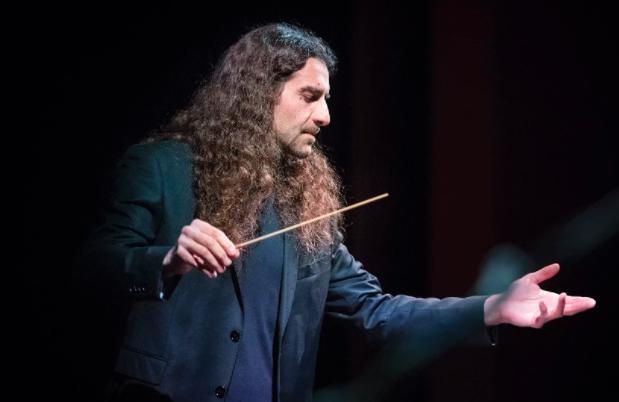
OperaMyLove: Yes, but how can a young soprano, for example, get noticed?
Ciampi: Today, thank God, there is a very important medium that was not there ten years ago, or at least it did not have the same influence: the Internet. So, even if I have no money to come to New York, to come to America, I put a video on YouTube and see it all over the world. We are always there. It is the most democratic instrument that exists today. I am generally opposed to technology and I still write music with paper and pencil, and not with the computer, but I say that it is the most democratic instrument. If you are good, a song on Spotify goes to the top of the chart alone. You do not need the record company that pays; you do not need money to break through. But if nothing happens, well, perhaps that voice is not so captivating; here, I would put some doubt. If I go online to get visibility, I have no followers, maybe there is something in my music that does not work; it is not the others who do not understand, maybe I am the problem.
Therefore, to answer the question, the young Italian who wants to break through must use the Social Network when he has no economic possibilities to finance his experience abroad; the Social is the fastest way to reach the goal. In short, if one has the talent you can see it and eventually they call you.
I recommend this: if you are a singer, make a nice piano and voice piece; there is no need to be opera, far from it. At the Grammy, Lady Gaga sang a piano and voice piece and gave everyone goosebumps. A person who has fifteen million listeners at the Grammy by playing with piano and voice has tenacity… that’s talent.
So, my dear young singer, make a three-minute video, piano and voice. It’s free. Put it on You Tube and see what happens. This is the answer I would give.
Let’s leave the orchestra out of it; I want to hear the voice. If they go to look and ask “Don’t you have a website?” You have to be ready…. How many artists do not have the web site and then wonder why no one knows them. These are things that cost zero, so they are to be done.

By Tiziano Thomas Dossena
From my perspective, having neither reputable vocal capability and experience nor any sizable knowledge of music other than a deep appreciation of opera, attending an Opera Master Class would have been an unthinkable and irrational action until recently. Thanks to Maestro Michael Recchiuti, this experience turned out to be fulfilling, rewarding, interesting and definitely educational. Can I sing any better? Can pelicans sound like songbirds? No to both, I guess, but since that was not the goal of my attendance, it’s irrelevant. What can be said is that I understand a lot more the process of singing on stage and what it takes to make a good voice a great one. That alone would be sufficient, but I learned a lot more just by observing and listening to the various students’ performances and their revised ones after Maestro Recchiuti and renowned soprano Elizabeth Blancke-Biggs had pointed out the possible corrections, be it change of posture, movements, vocal extension or suitable loudness required for that particular aria.
It was a gentle process most of the time, although Recchiuti could at time lecture so as to get the most out of the experience for these already well-trained singers. He wanted them to get the essence of the criticism, so that it would be constructive and bring to a proper change. Sometimes these changes were subtle and probably undetected by most listeners but for the veterans of the stage; however, most of the time these changes were dramatic and easily captured by everyone present, a classic ‘magic wand’ situation. That an apparently simple suggestion could bring such modifications was an utter surprise to me until I realized that these were not simple suggestions but instead ‘tricks of the trade’ that could only have been learned through extensive studies and performing experiences. The magic wand was therefore a real magic one because the teachers certainly had plenty of both and their coaching methods demonstrated it.
The Master Class I attended was at the National Opera Center of America in New York City, on January 12, 2018.
 The attendants were all women and came from various American cities: New York, Chicago and Los Angeles. The cordiality that was displayed among the participants was also possible because of the openness that Maestro Recchiuti demonstrated throughout the Class; his tendency to place a bit of humor at the times when the criticism could have been the harshest certainly made the process easier (“In opera, we like to breathe…”) and the singers seemed extremely pleased with the outcome of the evening.

Maestro Michael Recchiuti and soprano Elizabeth Blancke-Biggs listening to a performance
At the piano, Eric Malson was a prodigy that allowed for a smooth process to everyone, teachers included.
The students learned how to improve their stance and pronunciation as well as to balance their vocal usage so as to obtain the most with their voice for a particular aria but also for their approach in general. Uses of sensuality in their body posture as well as in the articulation of the recitative were taught in order to allow the singers the creation of the proper environment on stage. Timing, tempos, intensity of movements, and why not? breathing patterns, were taught in an impressive manner, more so considering the time constrains of the evening class.
A wonderful educational experience, attending a Master Class of this type, with a compressed albeit detailed approach, is something that I suggest to live through ─ although, maybe, the correct term should be savor─ to anyone who loves opera.
The Opera Master Class by Maestro Michael Recchiuti and soprano Elizabeth Blancke-Biggs may be viewed in its totality by clicking the image that follows: 
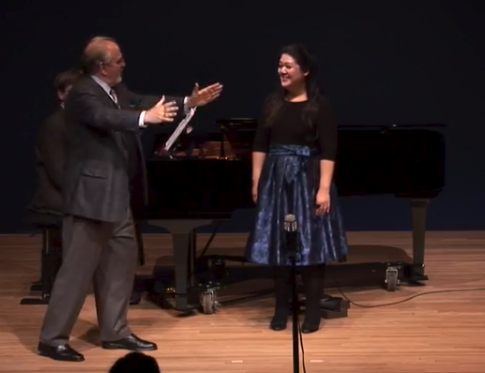
Grace Kim

Elisabeth Papageogiu
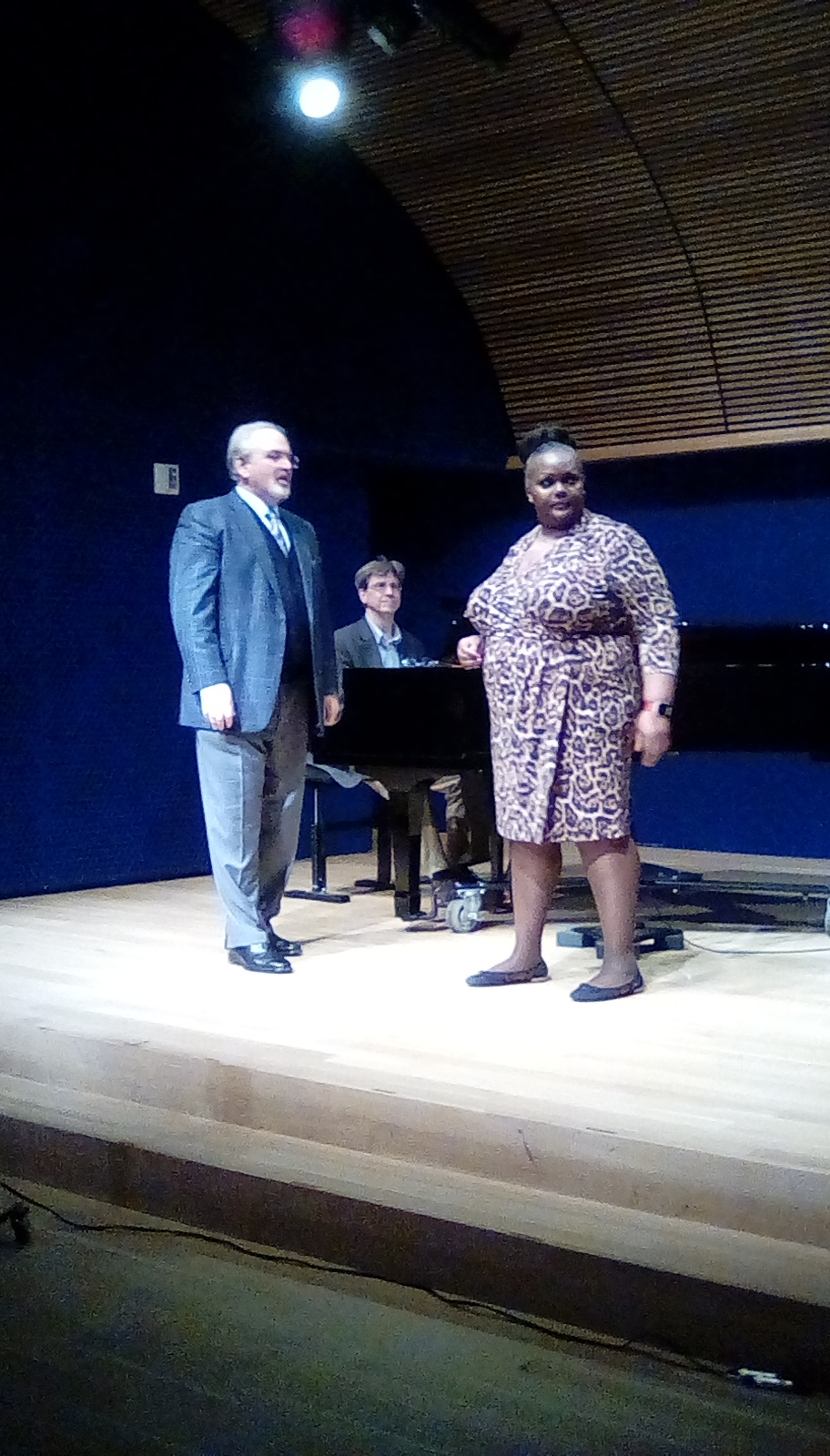
Patrice Easton

Melanie Davis

Kirsten Norwark
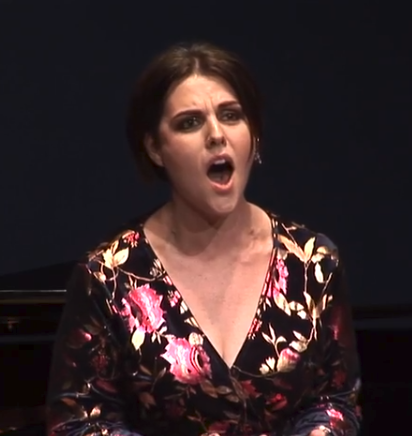
Rachel Pike

Margaret O’Connell


Written By: Tiziano Thomas Dossena
30 December 2017
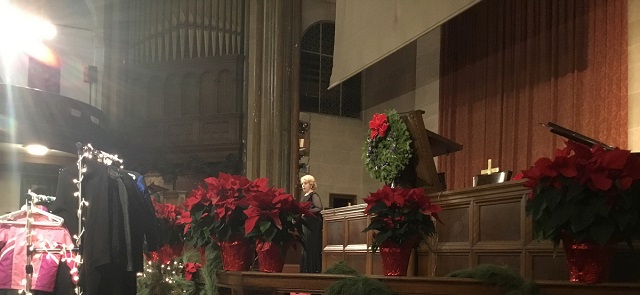
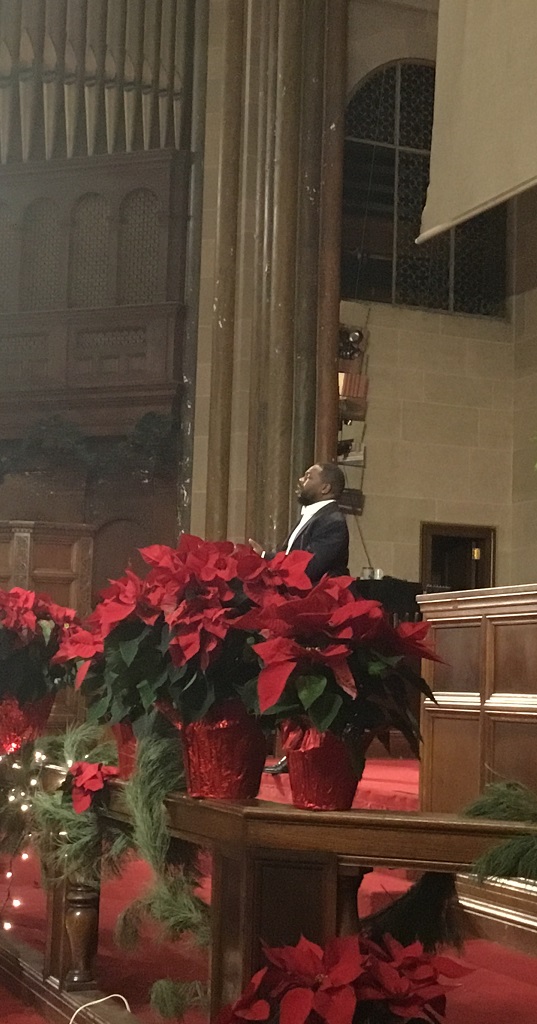
Comfort Ye…, the 23rd Annual Concert to Benefit the Homeless, performed on December 23rd at the Church of St. Paul and St. Andrew, On West End Avenue and 84th Street in Manhattan, was a great success once more, as a proof that great performers and generosity go hand to hand.


Lauren Flanigan opens the evening (photo by Nicoletta Mita-Dossena)
The public, which donated jackets, coats, non-perishable food and money, was offered a great variety of songs from various opera, musicals and from the classic Christmas repertoire. The evening started with a warm welcome by the organizer of the concert, the celebrated soprano Lauren Flanigan, followed by a rendition of Handel’s Comfort Ye and Ev’ry Valley from Messiah by the tenor Aaron Blake.

Olga Makarina (Photo courtesy by Lauren Flanigan)
Lauren Flanigan herself followed with Vieni, s’affretta from Verdi’s Macbeth and a song from a musical.


Nadine Benjamin (photo by Nicoletta Mita-Dossena)

Daniel Sumegi (photo by Nicoletta Mita-Dossena)


Sophie Delphis (photo by Nicoletta Mita-Dossena)
The ensuing arias were from Offenbach’s Les Contes d’Hoffmann, Meyerbeer’s Les Huguenots, Puccini’s La Boheme and Verdi’s Il Trovatore. In the middle there was a marvelous version of Berlin’s White Christmas and a medley of his songs, but also an attention-grabbing If Mary Had But One Child and Old Man River by the baritone Kenneth Overton and a Russian song by the soprano Olga Makarina. The performers were Daniel Sumegi (bass), Raul Melo (tenor), Sophie Delphis (mezzo-soprano), Nadine Benjamin (soprano), and Amy Burton with John Musto at the piano.
These performances were followed by the powerful and warm voices of the Ebony Ecumenical Ensemble, directed by the Rev. Eugene Palmour, which offered a classic and religious set of Christmas songs.
Greg Silverman, from The West Side Campaign Against Hunger, spoke about giving and how his organization works during the intermission.


Amy Burton (photo by Nicoletta Mita-Dossena)
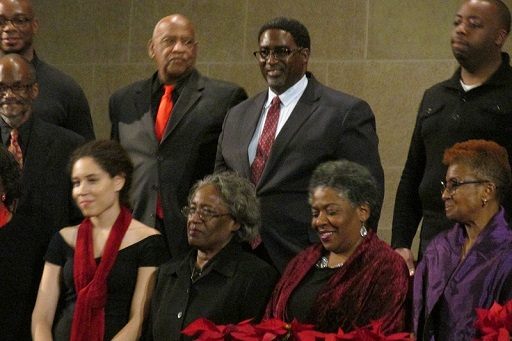

A section of the Ebony Ecumenical Ensemble (photo by Nicoletta Mita-Dossena)


The Ebony Ecumenical Ensemble with the Rev. Eugene Palmour, director (photo by Nicoletta Mita-Dossena)
In the second segment of the concert, the rhythm changed, opening with an exciting interpretation of the Elektra’s Monologue from Richard Strauss’ Elektra. The performer, the renowned soprano Elizabeth Blancke-Biggs, left everyone breathless with the strength of her characterization. Ms. Blancke-Biggs was accompanied by the illustrious maestro Michael Recchiuti.
Elizabeth Blancke-Biggs (photo by Nicoletta Mita-Dossena)The mezzo-soprano Rachelle Pike followed with the aria Acerba voluttà from Cilea’s Adriana Lecouvreur.


Rachelle Pike (Photo courtesy by Lauren Flanigan)
After this initially powerful set of songs, four arias from Wagner’s operas were performed by the soprano Amy Shoremont-Obra, the mezzo-soprano Mary Ann Stewart, the baritone Mark Delavan and the soprano Kirsten Chambers. The last was accompanied by Keith Chambers at the piano.


Amy Shoremont-Obra (photo by Nicoletta Mita-Dossena)
To lighten up a bit the atmosphere, Mary Ann Stewart and Raul Melo sang an aria from The Merry Widow, which raised the spirits, a bit low-key after such an impressive but musically difficult Wagnerian combination, and brought back the smiles.


Mark Delavan (Photo courtesy by Lauren Flanigan)
Lauren Flanigan, with a selection of songs from the Gordon/Bernstein’s collections, raised those spirits even more, putting a special effort in her physical portrayal. Most of the arias were accompanied at the piano by the musical director of the night, Kamal Khan, who confirmed to the public who knows him his superior qualities.
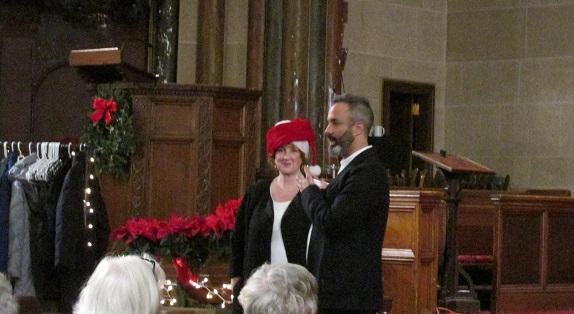

Lauren Flanigan and Greg Silverman (photo by Nicoletta Mita-Dossena)
The night ended on the rise with a heartfelt choral rendition of Holy Night by all the performers of the night.
Yet again Ms. Flanigan and her friends have assembled a marvelous show while collecting funds and other necessities for the homeless in NYC, demonstrating at the same time that opera’s performers are always ready to give.

Kenneth Overton (Photo courtesy by Lauren Flanigan)
Please follow their lead and donate at: https://www.wscah.org/


The Ebony Ecumenical Ensemble

The performers get together at the end of the evening for a choral performance.

Friday Evening December 22nd 2017 at 7pm
Acclaimed American soprano Lauren Flanigan joined by world-class opera singers, sings and hosts this annual event to raise goods and awareness for New York’s Homeless
St. Paul and St. Andrew Methodist Church
At the corner of 86th Street and Amsterdam Avenue 7pm
Admission:
1 bag non-perishable groceries OR
1 brand new toy suitable for a child under ten OR
1 clean used overcoat or blanket OR
3 packages of baby diapers OR
$40
The proceeds of this concert immediately benefit
The West Side Campaign Against Hunger
Lauren Flanigan, Director/Founder
Music and Mentoring House
www.musicandmentoringhouse.com
https://www.nyfa.org/ArtistDirectory/ShowProject/4e495bcf-885e-43f3-8f26-868352799401


La Sirena Productions presents a
with Elizabeth Blancke-Biggs & Mo. Michael Recchiuti
Gurari Studios @ The National Opera Center
Friday, January 12, 2018 7:00 to 9:00pm
330 7th Ave. NY, NY 10001
And streaming LIVE ONLINE
Six singers will be selected to participate in this exciting, and unique performance and learning opportunity with one of today’s leading Dramatic Sopranos and an award winning International Conductor and Pianist. The class will be live-streamed in real time on Facebook and YouTube. Places available for six participants, 2 alternates, and 60 auditors. Application deadline is December 28, 2017.
Application fee is $25.00. Chosen participants will pay an additional $50.00 tuition. Auditors are chosen in order of applications received. Please click on link below to send application, video or audio submission, and application fee.

Elizabeth Blancke-Biggs is recognized as one of the most exciting spinto- drammatico sopranos on the international scene today. Critics have praised her virtuosic bel canto technique, the beauty of her voice, her pyrotechnic coloratura, and her unerring theatricality. A brilliant interpreter of the most demanding roles in the spinto-drammatico soprano repertory, this past season she had triumphant appearances as Bellini’s Norma, opening the season at Rio de Janiero’s Teatro Municipal, and Puccini’s Turandot at the Gala Grand Opening of the Opera House in Xian, China. 2015/16 was her “Year of the Princesses” beginning with Salome with the Orchesta Sinfonica Nacional at the Palacio de Bellas Artes in Mexico, continuing with her debut as Strauss’ Elektra in the “Premio Abbiati” award winning production of the Teatro Comunale di Bologna, and ending with Andreas Homoki’s production of Turandot at Den Norske Opera. Recent seasons have included Verdi’s Lady Macbeth in Montevideo, in Nabucco at the Grand Théâtre de Gèneve, and Nancy, France, and the Teatro Nacional de Costa Rica. She was the featured artist opening the Verdi Bicentennial Concerts at Mexico City’s Palacio de Bellas Artes in a solo aria concert and the Messa da Requiem, followed by her critically acclaimed role and house debut in Strauss’ Salome at den Norske Opern in Stefan Herheim’s reprise of his Salzburg production. She then appeared under the baton of Lorin Maazel as Puccini’s La Fanciulla del West at his Castleton International Festival. She was heard internationally at the Metropolitan Opera as Tosca on a live Sirius Satellite broadcast with the tenor Marcello Giordani. Hailed as one of the best young Verdi singers by Placido Domingo, she appeared with him at the Washington National Opera as Giordani’s Fedora in a gala performance. She made her Metropolitan Opera debut as Violetta in the Zeffirelli production of Verdi’s La Traviata under the baton of Marcello Viotti with Lado Ataneli as Germont, and her Italian debut was the title role in Jonathan Miller’s production of Donizetti’s Maria Stuarda at Torino’s Teatro Regio, conducted by Evelino Pidó.

Michael Recchiuti is active internationally as conductor, pianist, and accompanist. He has collaborated with artists of the international opera stage, and Grammy and Tony award winners such as Carlo Bergonzi, Giuseppe Giacomini, Placido Domingo, Justino Diaz, Roberta Peters, Adrianna Maliponte, Renee Fleming, Ceclia Gasdia, Ghena Dimitrova, Fiorenza Cossotto, Dolora Zajick, Chris Merritt, Paolo Gavanelli, Roberto Scandiuzzi, Stuart Neill, and Vanessa Williams.
He was head of the musical staff at Venice’s Gran Teatro La Fenice, and Consulente Musicale for the Ente Lirico in Cagliari Sardegna, where he presented the first French language performance in Italy, of Rossini’s Guillaume Tell, starring Chris Merritt. He was a Guest Conductor at the Budapest State Opera in the Spring Festival, and for the Summer Festival production of Verdi’s La Forza del Destino starring Giuseppe Giacomini in Santiago de Compostela, Spain.
After winning the International Competition for Opera Conducting at Siena’s prestigious Accademia Chigiana, where he studied with Franco Ferrara, Carlo Maria Giulini, and Bruno Bartoletti, he was awarded the Diploma di Merito, and chosen to conduct performances of Bellini’s Beatrice di Tenda with soprano Cecilia Gasdia. He has assisted many conductors, including Nicola Rescigno, Giuseppe Patanè, Placido Domingo, Bruno Bartoletti, and Alfredo Silipigni, who engaged him as Associate Conductor of the New Jersey State Opera, and invited him to conduct Puccini’s Le Villi, and Mascagni’s Zanetto. He also prepared productions of verismo rarities such as Mascagni’s Iris, and Lodoletta.
In North America, Mo. Recchiuti is the Artistic and General Director of the American Opera Theater, founding Principal Conductor of the New Jersey Opera Theater, and founding Music Director of Opera de las Americas, the national opera of the Dominican Republic. He has been a frequent guest conductor for many organizations including: Orchestra of St. Lukes, the Long Beach Opera where he collaborated with director Hugo DeAna, the Orlando Opera, the Korean Symphony of New York, the Manhattan Chamber Orchestra, the National Lyric Opera.
His discography includes the newly released “Vaghissima sembianza”, a collection of the Arie di Stile Antico di Stefano Donaudy with soprano Elizabeth Blancke-Biggs; “Chris Merritt dal Vivo”, where he conducted the orchestra da Camera di Padova e del Veneto, and was awarded the Palme d’Or, and chosen as “Best CD of the Year” by Opera News, and CD Classica; “English Art Songs” featuring Britten’s the Holy Sonnets of John Donne and Roger Quilter songs, with tenor Paul Austen Kelly; and Alberto Mizrahi’s “Voice of a People” a collection of Cantorial Showpieces, Ashkenazic and Sephardic art songs.

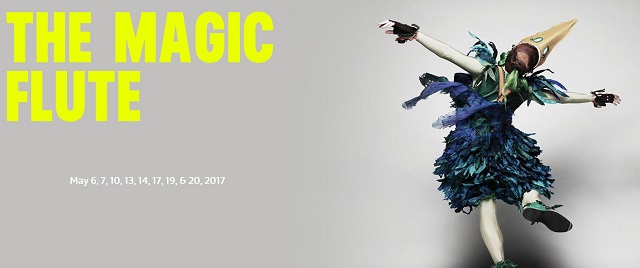
By Wolfgang Amadeus Mozart
 COLORFUL FANTASY. Mozart’s utterly unique extravaganza blends myth, magic, and a remarkable variety of wonderful music to deliver its life-affirming message: love conquers all. A handsome prince and his comical sidekick are given enchanted musical instruments and tasked with rescuing the Queen of the Night’s daughter from a mysterious group of priests. Undergoing trials of virtue, discretion, and charity, they realize that all may not be as it seems in this magical land. Award-winning costumes from the fabulous Zandra Rhodes (The Pearl Fishers) add to the many delights of one of the most fantastic entertainments ever created.
In German with English subtitles | at McCaw Hall
Approximate Running Time: 3 hours, with 1 intermission
Evenings at 7:30 PM. Sunday matinees at 2:00 PM.
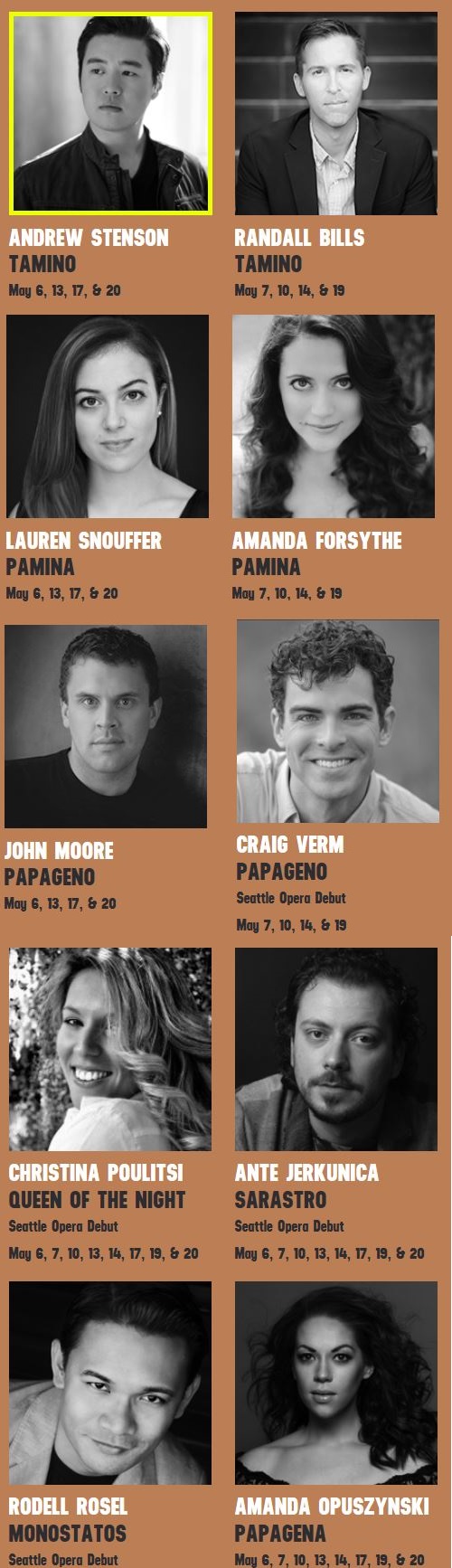
CAST
SYNOPSIS
Distressed queen sends prince (and feathered friend) off to rescue kidnapped princess. But instead, they undertake initiation into the kidnappers’ brotherhood of light and truth.
 Who’s Who?
Tamino is a handsome young prince.
Papageno is a good-natured birdcatcher who travels with Tamino.
Papagena is a pretty girl who likes Papageno.
Sarastro is a wise wizard and the benevolent ruler of a holy brotherhood.
The Queen of the Night is Pamina’s mother and Sarastro’s enemy.
Pamina is a beautiful princess and the Queen of the Night’s daughter. When the opera begins, she is a prisoner in Sarastro’s temple.
Monostatos is a Moorish temple guard in Sarastro’s community. He has the hots for Pamina.
The Three Ladies are servants of the Queen of the Night.
The Three Boys are spirits who guide Tamino and Papageno.
In the land where fairy-tales take place, a dragon is chasing young Prince Tamino. Three ladies kill the monster, then show the prince a picture of Pamina, the Queen of the Night’s daughter. He falls madly in love, and the Queen asks him to rescue Pamina, who has been kidnapped by the wicked Sarastro. The birdcatcher Papageno is enlisted as Tamino’s sidekick; Tamino is entrusted with a magic flute and Papageno with a set of magic bells.
Our heroes make it to Sarastro’s citadel, where Papageno protects Pamina from Monostatos, an amorous guard, while a wise priest explains to Tamino that the Queen is really the evil one: Sarastro kidnapped Pamina to rescue her from her mother’s evil influence. Tamino and Pamina undertake the series of tests and trials which will grant them entrance to Sarastro’s community. Monostatos, too, switches sides when the Queen of the Night offers him Pamina in exchange for betraying Sarastro. And Papageno fails all Sarastro’s tests, but runs off with the girl of his dreams.

GALLERY 


The Orchestra Sinfonica Nazionale of the RAI will be the new main orchestra of the Rossini Opera Festival. The ensemble, formed in 1994, is based in Turin where it holds regular seasons of symphonic music, chamber music and contemporary music in the “Arturo Toscanini” auditorium of the RAI. Besides touring the leading international theaters and festivals, it performs regularly in Italy, and also appears on the RAI radio and television channels, such as Rai5 and Radio3, as well as on the Euroradio and Eurovision circuits and in streaming.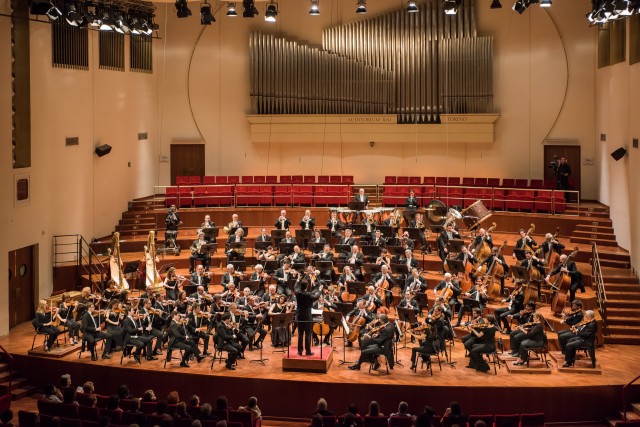
The OSN Rai will be bound to the ROF by a triennial partnership that will extend from 2017 into 2019. The Sovrintendente of the Rai Orchestra, Paola Carruba, introduces the agreement with these words: “We are particularly happy in this new collaboration with one of the most prestigious Italian and international festivals. Our involvement originally began with a few concerts to take place in 2018 and 2019. More recently the opportunity came up for our participating in the ROF itself beginning with this year, and as its main orchestra. And so a new agreement was reached for a project that will be developed over the course of several years. The Orchestra Sinfonica Nazionale della Rai is noted for its versatility, allowing it to pass easily from the main symphonic repertory to contemporary music, lending itself also to chamber music and, naturally, to opera, which we regularly present in our seasons, or on special occasions such as La traviata in Paris, Rigoletto in Mantua and La Cenerentola in Turin, all broadcast live in mondovisione. Therefore, the Rossini Opera Festival represents a new and important opportunity for us to test ourselves in the operatic repertory and in the works of a composer who, together with the singing voices, brings the role of the orchestra into high relief. Besides the operas, each year the OSN Rai will be required to interpret Rossini’s great choral works, beginning with the Stabat Mater that will bring this year’s festival to an end.
The General Administrator of the Festival, Gianfranco Mariotti, declares: “We are highly satisfied with the new agreement with one of the most important Italian orchestras on an international level, and we are particularly so because of the strategic implication that both we and the Rai give to the fact that the agreement covers three years. In this way we start off from a solid base of clearly defined shared objectives. In the 2017 ROF the Orchestra Sinfonica Nazionale della Rai will take part in three productions: the first performance ever of the critical edition of Le siège de Corinthe, conducted by Roberto Abbado and produced by La Fura dels Baus, which will open the Festival on August 10th; La pietra del paragon, a revival of the ROF 2002 production conducted by Daniele Rustioni and directed by Pier Luigi Pizzi, opening on August 11th ; and the Stabat Mater concluding the Festival on the 22nd of August, this too conducted by Daniele Rustioni.”


February 22, 25, 28
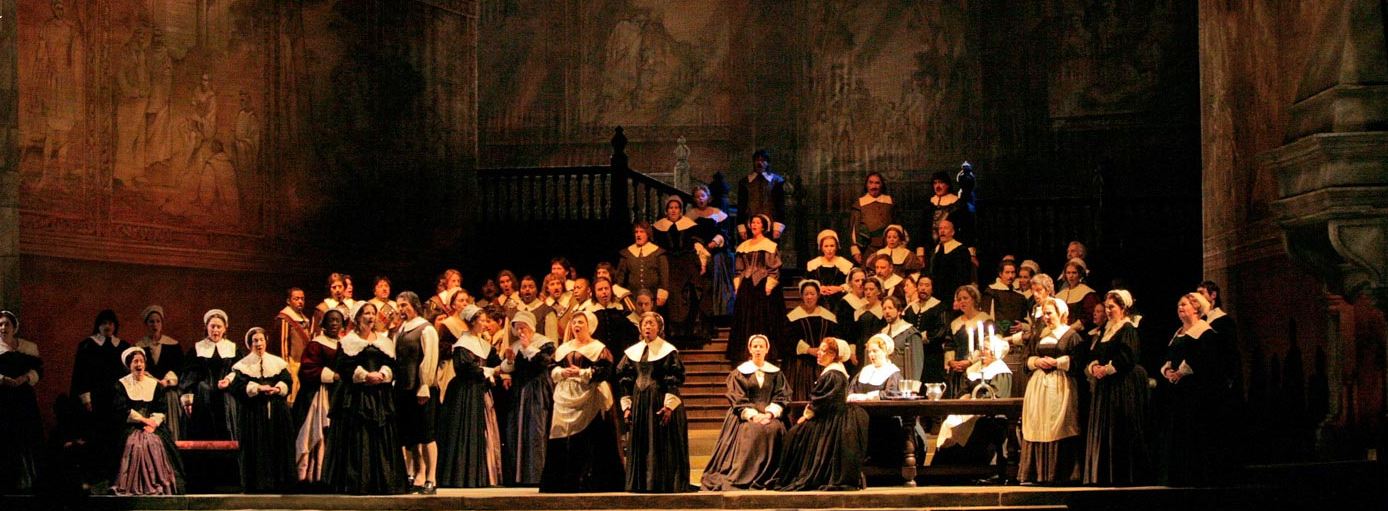
The art of bel canto will take center stage in Bellini’s lyrical jewel. The electrifying Diana Damrau is Elvira, gripped by madness and love; Javier Camarena, a sensation in his recent appearances in other bel canto works, takes on the role of her beloved and heroic Arturo; and Alexey Markov and Luca Pisaroni are the soldiers caught up in the English Civil War. Maurizio Benini conducts.
World premiere: Théâtre Italien, Paris, 1835. I Puritani was the final work from Vincenzo Bellini, the great Sicilian exponent of the bel canto style of opera. It was written specifically for the talents of four of the best singers of its day, and the opera’s success depends almost entirely on the vocal abilities (and artistic sensibilities) of the performers. In our time, Maria Callas was catapulted to international stardom by a series of performances in I Puritani in 1949 at Venice’s La Fenice.
SETTING
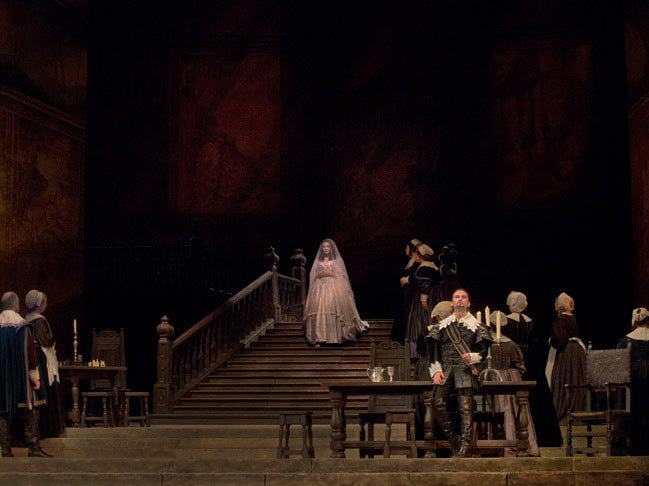
The opera is set in the English Civil War of Puritans (“Roundheads”) versus Royalists (“Cavaliers”). While taking many liberties with history, it is set against a background that was a universal idea and very familiar to Italians in Bellini’s time. The bel canto composers explored with powerful results the relationship of civil strife and individual madness: Donizetti’s Lucia di Lammermoor works with a similar, if slightly less explicit, format.
CAST and ARTISTIC TEAM


PRODUCTION Sandro Sequi
SET DESIGNER Ming Cho Lee
COSTUME DESIGNER Peter J. Hall
LIGHTING DESIGNER Gil Wechsler
REVIVAL STAGE DIRECTOR Sarah Ina Meyers


Vincenzo Bellini (1801–1835) possessed an extraordinary gift for melody and a thorough understanding of the human voice. His premature death—just as he was achieving international success and expanding in new musical directions—is one of the most unfortunate in the history of music. The librettist, Count Carlo Pepoli (1796–1881), was an Italian political exile living among the seething expatriate circles of Paris.
SYNOPSIS (Courtesy of Metropolitan Opera)
World premiere: Théâtre Italien, Paris, 1835.
The art of bel canto will take center stage in Bellini’s lyrical jewel. The electrifying Diana Damrau is Elvira, gripped by madness and love; Javier Camarena, asensation in his recent appearances in other bel canto works, takes on the role of her beloved and heroic Arturo; and Alexey Markov and Luca Pisaroni are the soldiers caught up in the English Civil War. Maurizio Benini conducts.
England, around 1650. Plymouth, a Puritan stronghold, is threatened by siege from the Royalist troops. Distant voices herald the wedding day of Elvira, daughter of Gualtiero, the fortress’s commander. Riccardo enters lamenting that his promised bride, Elvira, loves another man—a Stuart partisan. Her father will not force her to marry against her will, it seems, so Riccardo’s friend Sir Bruno urges him to devote his life to leading the parliamentary forces.
Elvira tells her uncle, Giorgio, that she would rather die than marry Riccardo. Her uncle reassures her that he has persuaded her father to let her marry her lover, Arturo. Although Arturo is a Royalist, he is heralded as he approaches the castle.
Everyone gathers for the wedding celebration and Arturo greets his bride. He learns that King Charles’s widow, Queen Enrichetta, is a prisoner in the castle and soon to be taken to trial in London. Alone with the queen, Arturo offers to save her even if it means his death. Elvira returns with the bridal veil and capriciously places it over Enrichetta’s head. When he is alone again with the queen, Arturo explains that the veil will provide the perfect disguise for escape from the castle. As they are about to leave, Riccardo stops them, determined to kill his rival. Enrichetta separates them and reveals her identity. Riccardo lets them get away, knowing this will ruin Arturo. The others return for the wedding, and Riccardo tells of Arturo’s escape with Enrichetta. Soldiers rush off in pursuit. Elvira, believing herself betrayed, is overcome by madness.
The townsfolk mourn Elvira’s mental breakdown. Giorgio explains that she continues to long for Arturo. Riccardo arrives to announce that Arturo has been condemned to death by Parliament. The Puritans depart.
Elvira wanders in, reliving her happy past. In her madness, she mistakes Riccardo for Arturo and dreams of her wedding. When she leaves, Giorgio tries to convince Riccardo to save Arturo. At first indignant, Riccardo is finally moved to help Elvira, and the two men unite in patriotism: if Arturo returns as a friend, he shall live—if as an armed enemy, he shall die.
In Elvira’s garden, Arturo reveals that love for her has brought him back to Plymouth. He overhears her sing their old love song and is torn between his affection and his loyalty to the Stuarts. Elvira herself appears and Arturo reassures her that she is his only love. Soldiers rush in to arrest Arturo. Just then, a diplomat arrives with the news of the Royalists’ final defeat and a general amnesty for all the offenders. The shock of this news restores Elvira’s senses, and all rejoice in the peace as Elvira and Arturo embrace their new happiness.


The full vocal score of this magnificent composition is AVAILABLE FROM AMAZON.COM or BARNES & NOBLE
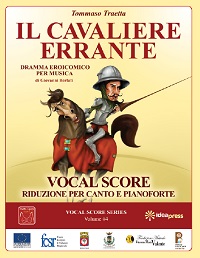
The full vocal score of this magnificent opera is AVAILABLE FOR THE FIRST TIME IN HISTORY FROM AMAZON.COM or BARNES & NOBLE
 The full vocal score is AVAILABLE FOR THE FIRST TIME IN HISTORY FROM AMAZON.COM or BARNES & NOBLE
The full vocal score of this magnificent opera is AVAILABLE NOW FROM AMAZON.COM


Sold out e grande emozione nella Cattedrale di San Lorenzo, a Trapani, per il capolavoro incompiuto di Mozart, con la direzione di Nicola Kitharatzis e un cast di solisti di rilievo internazionale Trapani, 31 marzo 2026 – Si è aperta la 78ª Stagione del Luglio Musicale Trapanese con il Requiem in Re minore K. 626 […]

Al via il IV° “Sabbioneta chamber Opera festival – Residenze 2026” Un grande progetto internazionale dedicato ai giovani talenti della lirica e della musica antica Con grande entusiasmo, l’Associazione “Concetto Armonico APS”, in collaborazione con il Comune di Sabbioneta e la Fondazione Sabbioneta Heritage, annuncia il lancio della quarta edizione del “Sabbioneta chamber Opera festival – Residenze”, dove […]

Presentata la 78a Stagione del Luglio Musicale Trapanese Ventuno appuntamenti da marzo a dicembre. Si apre domenica 29 marzo con il Requiem di Mozart in Cattedrale: ingresso libero per la città. È stata presentata nella Sala Grande del Complesso San Domenico, a Trapani, la 78ª Stagione dell’Ente Luglio Musicale Trapanese, Teatro di Tradizione riconosciuto dal […]

La Società Dante Alighieri e il Teatro dell’Opera di Roma presenteranno mercoledì prossimo, 4 febbraio, alle ore 17.30 a Palazzo Firenze (Roma), “Inferno”, l’opera, in chiave contemporanea composta da Lucia Ronchetti, è ispirata alla prima cantica della Commedia di Dante Alighieri.Durante la conferenza interverranno Alessandro Masi, Segretario generale della Società Dante Alighieri, Giuliano Danieli, Fondazione Teatro dell’Opera di Roma, Lucia Ronchetti, Compositrice, […]

Il cuore del melodramma italiano e il romanticismo europeo approdano al Cairo per una grande serata di cultura. Un quintetto di artisti d’eccezione guiderà il pubblico in un viaggio emozionante tra le arie, i duetti e i capolavori pianistici più amati di sempre con “Opera Concert – Recital for 4 voices and piano”, in programma il 5 febbraio alle […]

Recensione di Salvatore Margarone La ripresa al Teatro Filarmonico di Verona del Don Giovanni di Mozart, nell’allestimento firmato da Enrico Stinchelli e già presentato nella stagione 2019, conferma le perplessità emerse fin dal suo debutto. La regia, improntata a un sostanziale rispetto letterale del libretto, si colloca su un piano prevalentemente illustrativo, rinunciando a un’elaborazione […]

L’imponente Aida di Giuseppe Verdi, nel leggendario allestimento firmato da Franco Zeffirelli, sarà in Australia a febbraio 2027. Dopo il rinvio annunciato alcuni mesi fa, sono ora state definite le nuove date dell’evento: venerdì 26 e sabato 27 febbraio 2027. La Fondazione Arena di Verona porterà in scena all’Adelaide Oval l’opera regina, nell’ambito dell’Adelaide Festival 2027.A 25 anni esatti dal suo debutto in Arena, […]

Articolo di Gianluca Macovez Il Maestro di canto pronto ad inaugurare l’Accademia del Belcanto nel New Jersey Su questo sito qualche tempo fa avevamo pubblicato un’intervista a Massimo Iannone, Maestro di canto di valore internazionale. Ci piace parlare di nuovo di questo artista, perché da allora la sua attività ha avuto un deciso incremento: lasciata […]

Sala gremita e grande partecipazione di pubblico per “Un viaggio a Venezia”, il concerto di Natale dedicato ad Antonio Vivaldi che ha concluso la prima serie di quattro appuntamenti musicali di “L’anima italiana – I Maestri della Musica Classica”, progetto ideato e promosso dalla Società delle Associazioni Italiane di Ginevra (SAIG) che rende omaggio a otto tra i più celebri compositori italiani, […]

Venerdì 24 ottobre 2025, presso il Conservatorio di Musica “Giovan Battista Martini” di Bologna, è stato proclamato il vincitore del Premio Zucchelli per pianoforte 2025 – seconda edizione, realizzato con il contributo di Banca di Bologna. Il premio è finalizzato a sostenere la formazione artistica degli allievi e delle allieve delle classi di pianoforte del Conservatorio di Bologna, che si sono […]
Tiziano Thomas Dossena, Author & Editor
Di Raffaele Pisani
A memoir by Cav. Gilda Battaglia Rorro Baldassari


 Opera, My Love Magazine