by Richard Strauss
In German with projected English titles
It’s exactly what you want a Strauss opera to be — deliciously extravagant!
Can the elegantly alluring Marschallin find lasting happiness with her lover Octavian, who’s half her age? Does the hot-blooded Baron really think his exalted position guarantees that young Sophie will be his wife? All bets are off when Sophie receives an engagement rose from the Baron — delivered by the devastatingly handsome Octavian. Love, sex, fidelity, and aging are delicately explored in a masterwork that artfully blends laugh-out-loud humor with insightful poignancy.
Der Rosenkavalier is a grand event with more than 100 musicians, famous waltzes, and ravishing performances in store from Alice Coote, Sophie Koch, and Amanda Majeski — glorious singing actresses who have each triumphed at Lyric and internationally. And treat yourself to two eagerly awaited Lyric debuts: celebrated British bass Matthew Rose and silver-voiced German soprano Christina Landshamer.
Performance running time: 4 hours 5 minutes with 2 intermissions
Lyric Opera production generously made possible by an Anonymous Donor and Mr. & Mrs. Dietrich M. Gross.


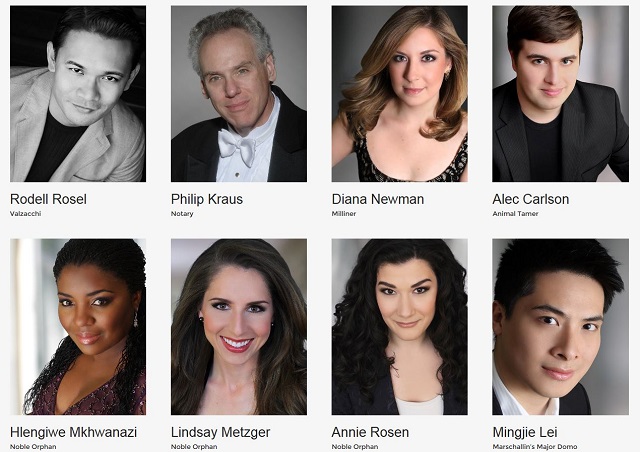
CAST


Der Rosenkavalier Opera Synopsis
TIME: 1740s
PLACE: Vienna
ACT ONE
The Marschallin’s boudoir
Intermission
ACT TWO
The reception hall of Faninal’s town house
Intermission
ACT THREE
An inn
ACT ONE
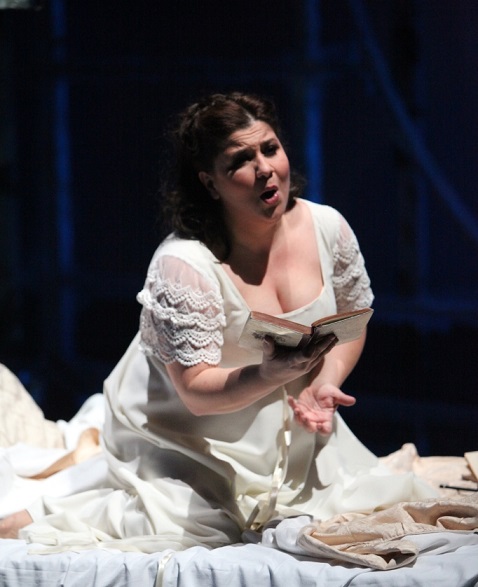
Unwelcome sunlight streams into the Marschallin’s bedroom, where she has just spent the night with the young Count Octavian Rofrano, during the absence of her own husband, the Field Marshal. Octavian’s ardor spills into praises of his “Bichette,” who delights in the extravagances of her “Quinquin.” When Mohammed, her page, brings breakfast, Octavian scurries into hiding.
Once they are alone again, the Marschallin distresses Octavian by confessing that the night before she dreamed of her husband. Suddenly voices are heard in the anteroom, and she fears that the Field Marshal himself has unexpectedly returned. To avoid being discovered, Octavian disguises himself as a housemaid. The Marschallin discerns with relief that it is actually her cousin, Baron Ochs of Lerchenau, who is causing the uproar outside her door. The baron forces his way past the servants and takes immediate notice of the pretty “maid.”
Ochs is visiting specifically to remind the Marschallin of his engagement to Sophie von Faninal, the daughter of a wealthy, newly-ennobled merchant whose health is conveniently not the best. As it is customary to have a silver rose presented to one’s fiancée, Ochs asks the Marschallin to recommend a young nobleman to be his rose cavalier. The Marschallin suggests her cousin Octavian, showing the baron the young man’s portrait. Ochs notices a striking resemblance to the maid, “Mariandel,” which the Marschallin attempts to ignore. Once the doors open to admit the crowd assembled for the morning levée, “Mariandel” finally escapes.
While having her hair dressed, the Marschallin listens to pleas for alms from three noble orphans, as well as presentations from a milliner, an animal-vendor, and two Italian “intriguers,” Valzacchi and Annina. A tenor sings for her (Aria: Di rigori armato) while Ochs browbeats the Marschallin’s notary, whose services he usurps to draw up an unconventional marriage contract. He then engages the Italians to help him arrange a rendezvous with “Mariandel.” Suddenly distressed, the Marschallin sends everyone away, but Ochs departs only after leaving her with the silver rose. Once alone, she reflects on the passage of time (Monologue: Da geht er hin).
Now dressed as himself, Octavian returns to continue the interrupted tête-à-tête, but the Marschallin is preoccupied and finally asks him to leave. He goes abruptly and without a farewell kiss. The Marschallin sends her footmen after him, but he has ridden away. Summoning Mohammed, the Marschallin gives him the rose to deliver to Octavian.
ACT TWO
With her father and Marianne, her duenna, Sophie awaits the cavalier whose appearance will precede her first meeting with her fiancé. When Octavian presents the silver rose, he and Sophie feel strongly attracted to each other (Duet: Mir ist die Ehre). The two make polite conversation, interrupted by the arrival of Ochs. His manner repulses Sophie, although her oblivious father presses onward with the wedding arrangements.
Drunk on Faninal’s wine, Ochs’s servants chase their host’s serving maids through the house as chaos ensues. When alone at last with Sophie, Octavian swears to protect her (Duet: Mit Ihren Augen voll Tränen). They two are embracing when they are suddenly pulled apart by Valzacchi and Annina, who have been eavesdropping. They call for the baron, who condescends to Octavian when the young man informs him that Sophie will not marry him. Octavian finally draws his sword and slightly wounds Ochs, who responds with exaggerated outcries. He is bandaged and then left to rest (Monologue: Da lieg’ ich). Annina returns with a note that Octavian has paid her to deliver: an invitation from “Mariandel” to a rendezvous the following night. His mood now completely altered, Ochs waltzes in delighted anticipation.
ACT THREE
Valzacchi and Annina have joined Octavian in a plot to discredit Ochs and rid Sophie of him permanently. They are using the private room of an inn as a scene for an assignation. They conceal their cohorts strategically around the room and, with his henchmen, Valzacchi then rehearses everyone for the upcoming shenanigans.
Ochs enters escorting “Mariandel” and dismisses the inn’s fawning staff. He attempts to ply his companion with wine, which she coyly refuses. As he tries to kiss her, he is startled by her resemblance to Octavian and by the abrupt appearance of one of the henchmen’s heads, which “Mariandel” ignores. More wine and more apparitions succeed in confusing and frightening Ochs. Annina rushes in claiming to be his deserted wife, followed by numerous children claiming that Ochs is their “papa.” A bona fide police commissioner arrives, intent on investigating the disturbance. He is followed by Sophie and her father, who have arrived on schedule to witness the baron’s misbehavior.
At the height of the tumult, the Marschallin appears. Unimpressed by Ochs’s attempts to extricate himself from the situation, she suggests he leave immediately. He does so, followed by his “wife and children,” a throng of annoyed waiters, and Valzacchi’s accomplices.
Alone with Octavian and Sophie, the Marschallin graciously offers to take Faninal home in her carriage. Sophie is embarrassed at the ridiculous situation her father’s social aspirations have created, while the Marschallin is saddened by the realization that losing her lover is a presage of approaching age. Octavian is torn between his new love for Sophie and the complex mixture of love, gratitude, and loyalty he still feels for the Marschallin (Trio: Hab mir’s gelobt). Left to escort Sophie home himself, Octavian lingers with her to savor the moment (Duet: Ist ein Traum/Spür nur dich). The room is empty until Mohammed runs in, catches sight of the handkerchief Sophie has left behind, and rushes out with it. – See more at: https://www.lyricopera.org/concertstickets/calendar/2015-2016/productions/lyricopera/der-rosenkavalier#./Synopsis?&_suid=1455161019615008671028649799228