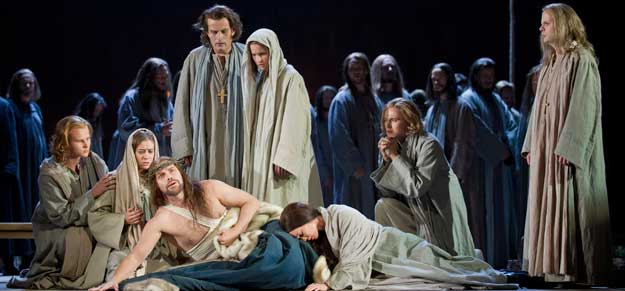

Nikolai Rimsky-Korsakov’s “Boris Godunov” at The Bolshoi in Moskow

bolshoiNikolai Rimsky-Korsakov and Modest Mussorgsky’s
“Boris Godunov”

preview_Brodyagi(D)BigOpera in four acts

Premiered on October 16, 1948.

Sung in Russian.
Presented with three intervals.
Running time: 4 hours 7 minutes.


Libretto by Modest Mussorgsky, based on Alexander Pushkin’s play of the same name
Version and orchestration by Nikolai Rimsky-Korsakov
Orchestration of “At St. Basil Cathedral” scene by Mikhail Ippolitov-Ivanov

1948 production
Music Director: Nikolai Golovanov
Stage Director: Leonid Baratov
Designer: Fyodor Fedorovsky
Choreographer: Leonid Lavrovsky

2011 revival
Conductors: Vassily Sinaisky, Pavel Sorokin
Director: Igor Ushakov
Designer of scenery revival: Alyona Pikalova
Designer of costumes revival: Elena Zaytseva
Choreography revival: Ekaterina Mironova
Lighting Designer: Sergei Shevchenko
Chorus Master: Valery Borisov

Performance dates:

October 1, 2013  19:00
October 2, 2013  19:00
October 5, 2013  19:00

CAST
Conductor: Pavel Sorokin
Boris Godunov: Mikhail Kazakov
Xenia, his daughter: Anna Aglatova
Fyodor, his son: Elena Novak
Xenia’s Nurse: Evgenia Segenyuk
Prince Vasily Ivanovich Shuisky:Maxim Paster
Andrei Shchelkalov, secretary to the Duma: Andrei Grigoriev
Pimen, hermit chronicler: Pyotr Migunov
Pretender, the false Dimitri, Grigory Otrepiev: Oleg Kulko
Marina Mnishek, daughter of the Sandomierz commander: Svetlana Shilova
Varlaam: Valery Gilmanov
Missail, a vagabond: Yuri Markelov
Innkeeper: Alexandra Durseneva
Simpleton: Marat Gali
Nikitich, police officer: Vladimir Krasov
Mityusha, a peasant: Alexander Korotky
Court Boyar: Leonid Bomshteyn (Vilensky)
Boyar from Kromy: Leonid Bomshteyn (Vilensky)
Two Women: Elena Okolysheva, Irina Udalova

Synopsis

Prologue
Scene 1
A crowd throngs by the high walls of the Novodevichy Monastery in Moscow. The boyar, Boris Godunov, has withdrawn to the monastery after the death of Tsar Fyodor, who did not leave an heir. That Boris will be elected to the throne is a foregone conclu­sion, but he makes a show of refusing the crown so that he is not suspected of wishing to seize power. At the order of a police offi­cer, the people beg Godunov to accept election to the throne:
“Do not abandon us, Father,
Do not leave us helpness!”

But Shchelkalov, secretary of the Duma, announces that Boris is implacable.

Scene 2
Square in front of the Cathedral of the As­sumption in the Kremlin. A majestic pealing of bells — Boris has given his consent and is being crowned. But Tsar Boris is not happy, he is weighed down by anxiety:
“My soul is heavy,
Some instinctive fear
With ominous foreboding
Rivets my heart…”

In the Kremlin the bells are pealing and the people break out again into acclamation.

preview_Dolzhenko+(D)BigAct I
Scene 1
Late at night. A cell in the Chudov Monaste­ry. By the light of an icon-lamp, the wise monk Pimen is writing a truthful chronicle of the history of the Russian state. In his chronicle, Pimen reveals the secret of the murder, by Boris Godunov, of Tsarevitch Dimitri who had stood between him and the throne. Grigory, a young novice, sharing Pimen’s cell, wakes up. He listens to the holy man’s tale and a storm of anxieties, passions and vainglorious ambitions breaks into the peace of the night. The idea comes to Grigo­ry of calling himself the Tsarevitch and of doing battle with Boris for the throne.
preview_GubskyUrodivy(D)Big“Boris! Boris! All tremble before you,
No one dares to remind you
Of the fate of the hapless infant…
But meanwhile a hermit in a dark cell
Is writing a terrible denunciation against you.
And you shall not escape human judgment,
As you shall not escape the judgment of heaven!”

Scene 2
An inn near the Lithuanian frontier. Three va­gabond monks, Varlaam, Missail and Grigory, have dropped in on the sprightly, merry mistress of the establishment. Varlaam, a drunkard and glutton, sings a song about the capture of Kazan. Grigory, questions the mi­stress of the inn on the best route to Lithuania. A police officer comes into the inn: on the Tsar’s orders he is searching for the run­away monk, Grigory Otrepiev. After an un­successful attempt to deflect the suspicion from himself, Grigory leaps through the win­dow and makes good his escape.

preview_KazakovBor(D)BigAct II
Scene 3
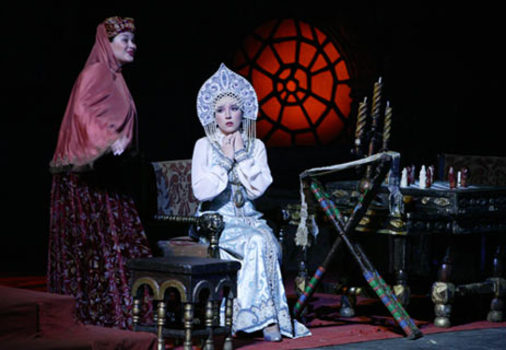
The Tsar’s private apartment in the Kremlin. Tsarevitch Fyodor is looking at the “Book of the Big Drawing”, the first map of Russia. Ksenia, Boris’ daughter, is grieving before a portrait of her dead fiancй, the heir to the Danish throne. In an attempt to cheer her up, her old nurse tells her a funny story. Boris comes in and talks tenderly to his children, he is pleased to see his son gleaning wis­dom from a book. But even here, with his children, Boris is tormented by anguish. Russia has been visited by a terrible famine. “Peop­le affected with the plague wander about like wild animals”, and the common people bla­me the Tsar for all their troubles: “in the squ­ares they curse the name of Boris”. Some­thing approaching a groan breaks out from deep down inside the Tsar:
“All around is darkness and impenetrable gloom,
O, for a fleeting glimpse of a ray of joy!..
Some secret anxiety,
One inconstantly expecting disaster!..”

preview_Mamsirova(D)BigThe boyar, Shuisky, comes in, a cunning courtier and leader of a group of boyars with seditious intentions. He brings bad news: a pretender has raised his head in Lithuania, having taken the name of the Tsarevitch Dimi­tri. He has the support of the King of Poland, the Polish nobles and the Pope. Boris requires Shuisky to tell him the truth: is he certain that the babe who was killed in the town of Uglich was the Tsarevitch Dimitri? Shuisky, enjoying the Tsar’s torment, descri­bes the deep wound on the Tsarevitch’s neck, and the angelic smile on his lips…
“It seemed, that in his cradle
He was peacefully sleeping…”

Shuisky departs, having aroused with new force the fears and agitation which grip Bo­ris: the latter now thinks he sees an appari­tion of the murdered Dimitri.

preview_MatorinOkolysheva(P)BigAct III
Scene 4
A ball in the garden of Mnishek, the Governor of Sandomir. The Polish nobles are preparing to march on Moscow. They mean to place their protйgй on the Russian throne: Grigory, the runaway monk from the Chudov monaste­ry, who has taken the name of the murdered Tsarevitch Dimitri. In this they will be helped by the ambitious plans of the Governor’s daugh­ter, the beautiful Marina, who dreams of beco­ming the wife of the future king of Russia. The long-awaited (by the Pretender) rendez­vous between Marina and Dimitri who is in love with her takes place. However, Marina’s abrupt and calculating speech, and her de­termination, which she makes no attempt to conceal, to sit on the Russian throne discon­cert the Pretender for a brief moment. Reali­zing this, Marina wins him over by false pro­testations of her love for him. The Jesuit, Rangoni, celebrates his victory.

preview_NechaevMatorinKudryash(D)BiScene 5
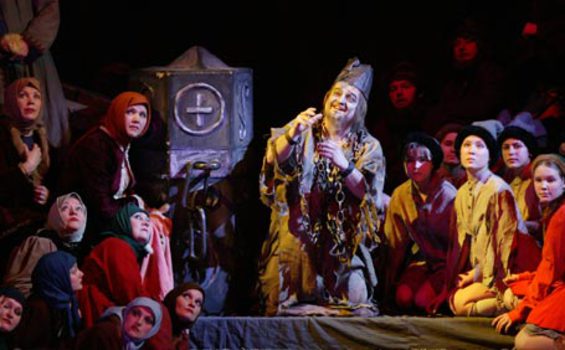
An early winter’s morning. A square in front of the Cathedral of St. Basil the Blessed in Moscow. A crowd of starving people are discussing the Pretender’s victories over the forces of Boris. A Simpleton comes running into the Square. Urchins surround him and take a kopek from him . The Tsar comes out of the Cathedral. “Bread, bread! Give the starving bread! Give us bread, father, for the sake of Christ!” cries the crowd. Goaded by the urchins, the Simple­ton addresses the Tsar: “Order them to be killed, as you killed the little Tsarevitch”. Boris tells the boyars not to seize the Simpleton:
“Let him be! Pray for me, simple person…”
But the Simpleton replies:
No, Boris! It can not be done!
How can one pray for a Tsar Herod?
Our Lady does not allow it…”

preview_SceneKelya(D)BigAct IV
Scene 6
A clearing in the forest near Kromy. Night-­time. The peasants, who are in revolt, lead in a Kromy boyar whom they have taken pris­oner. They make fun of the boyar, reminding him of all their grudges:
“You trained us the right way,
In storms and bad weather, and when roads were impassable,
You exploited us,
And whipped us with a slender lash…”

The arrival of the monks, Varlaam and Missail, who denounce the sins of Boris, the regicide, stirs up the crowd’s anger even more. They break out into a threatening song:
“A dashing young force is on the rampage,
The Cossack blood is all aflame!
A great subversive power has risen from the depths…”

Jesuit priests, the Pretender’s emissaries, appear. But the arrival of these foreigners arouses the crowd’s indignation. The peas­ants drag the Jesuits into the forest to be hanged.
preview_ShilovaLomova(D)BigThe Pretender, rides into the clearing, sur­rounded by troops, Polish gentry and Jesu­its. He frees the Kromy boyar. By promising his favor and protection, the Pretender per­suades the peasants to march on Moscow. The sky lights up with the glow of a fire. The alarm bell is rung. The Simpleton appears, looking round him in fear. His prophetic words of the new troubles that await the Russian people are spoken in anguish and pain:
“Flow, flow, bitter tears,
Cry, cry, Russian Orthodox soul!
Soon the enemy will come and darkness will fall,
Black, impenetrable darkness…”
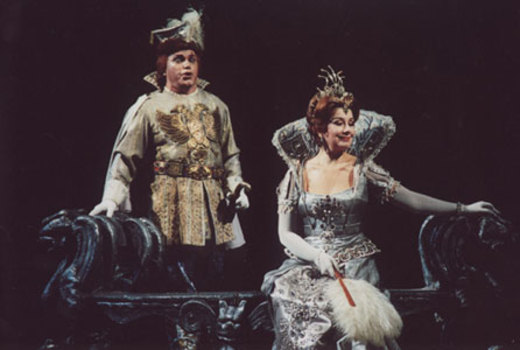
preview_TarascenkoTerentieva(P)BigScene 7
The Granovitaya Chamber, in the Kremlin. A session of the Duma is in progress. The boyars are discussing what punishment sho­uld be meted out to the Pretender should he be caught. Shuisky appears. He describes the scene in the Tsar’s private apartment, when Boris drove off the apparition of the murdered Tsarevitch Dimitri. At this point, Boris comes running in, shouting: “Away, away, child!” Catching sight of the boyars, he regains his self-control and asks them for advice and help. At this, Shuisky suggests to the Tsar that he listen to a holy man who has come to tell them of a great secret. Boris ag­rees. Pimen is brought in. Pimen’s tale of the miraculous cure of a sick man at the gra­ve of the murdered Tsarevitch Dimitri, in Uglich, is more than Boris can take and he falls senseless to the floor. Regaining conscious­ness, the dying Tsar gives his son advice on how to protect his kingdom:
“Don not trust the slander of the seditious boyars,
Keep a vigilant watch over their secret dealings with Lithuania,
Punish treason without mercy, without charity punish it,
Listen carefully to what the people say –
for their judgement is not hypocritical…”

preview_Scene1(D)BigTo the pealing of the funeral bell and the chanting of a choir of monks, the Tsar dies. The shocked Tsarevitch Fyodor, having paid his last respects to his father, rises to his feet…And immediately, Shuisky who, unse­en, had crept ahead of him, blocks his way to the throne.

Posted in Music, OPera | Tagged , , , , , | Leave a comment

The Icelandic Opera stages Georges Bizet’s Carmen


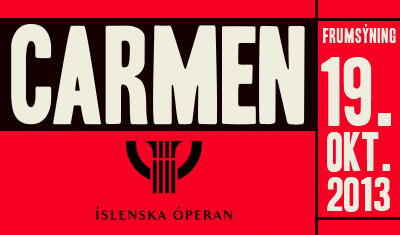
Carmen_midi_is_auglysing_icelandCARMEN

Premiere on October 19th 2013


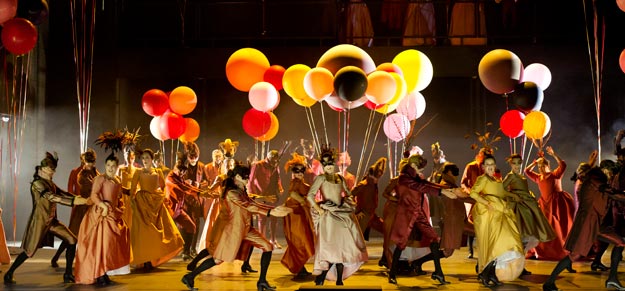
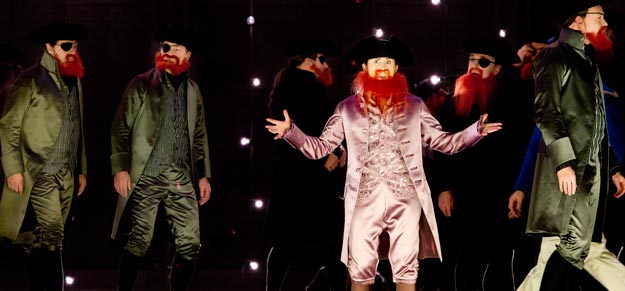
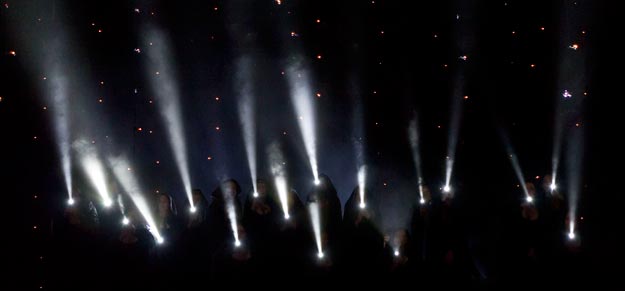
The Icelandic Opera stages Georges Bizet’s Carmen this year, with a premiere at Harpa Concert Hall on October 19th. 

In leading roles are Hanna Dóra Sturludóttir/ Sesselja Kristjánsdóttir as Carmen, Kolbeinn Jón Ketilsson/Garðar Thór Cortes as Don José, Hrólfur Sæmundsson/Kristján Jóhannesson as Escamillo.

The conductor is Guðmundur Óli Gunnarsson, the director is Jamie Hayes, the set designer is Will Bowen, costumes are designed by Helga I. Stefánsdóttir and the choreographer is Lára Stefánsdóttir. The Icelandic Opera Choir, an Icelandic children Choir and Orchestra will furthermore participate in the production.

A totalogoicelandl of six performances of Carmen will take place at Harpa Concert Hall; on Saturday October 19th (premiere),  Saturday October 25th, Saturday November 2nd, Sunday November 10th, Saturday November 16th and Saturday November 23th. All performances start at 8 pm. Tickets go on sale at www.harpa.is

 
The Icelandic Opera – P.O. Box 1416 – 121 Reykjavik – ICELAND
Posted in OPera | Tagged , , , , , , | 4 Comments

“Un ballo in maschera” at the Swedish Royal Opera

fst_Maskeradbalen_625x291_2“Un ballo in maschera” at the Swedish Royal Opera

Passion on the edge of disaster

At the castle an attack on Gustav, the king, is planned. But he ignores the warnings about a conspiracy. The king is possessed by a desperate and destructive passion to Amelia, the wife of his adviser and friend Anckarström. With the threat of death hanging over his head he goes to meet his beloved. In a cold and dark wintery Sweden a masquerade filled with betrayal, political intrigue and a yearning for something completely different takes place.

Verdi’s opera Un ballo in maschera was inspired by a historical event, the murder of Sweden’s king Gustav III. The opera was written in the mid-1800s and because of the political atmosphere in Europe and the Italian theater censorship Verdi and his lyricist Somma was forced to rewrite the libretto and place the opera in Boston. Here the director Tobias Theorell has opted for the Italian version after Scribes’ Gustave III ou Le bal Masqué “.

Music Giuseppe Verdi
Libretto Antonio Somma after a text by Eugène Scribe
Direction Tobias Theorell
Scenography Magdalena Åberg
Lights Ellen Ruge
Coreography Roine Söderlundh
Playwright Katarina Aronsson

Schedule

Tuesday, October 15, 2013, 19:00
Thursday, October 17, 2013, 19:00
Thursday, 24 October 24, 2013, 19:00
Monday, 28 October 28, 2013,  19:00
Wednesday, 30 October 30, 2013, 19:00
Monday, November 4, 2013, 19:00
Friday, November 8, 2013, 19:00

CAST

Gustav Klas Hedlund

Anckarström* Vladislav Sulimsky

Amelia Lena Nordin

Ulrica Katarina Leoson

Oscar Marianne Hellgren Staykov

Christian Carl Ackerfeldt

Count Ribbing Johan Edholm

Count Horn Lennart Forsén

A Bishop Magnus Kyhle

Director Keri-Lynn Wilson

fst_Maskeradbalen_625x291_4  fst_Maskeradbalen_625x291_5

fst_Maskeradbalen_625x291_7  fst_Maskeradbalen_625x291_8


Posted in Music, OPera | Tagged , , , , , | Leave a comment

“Cosi` fan tutte” at the Opera de Paris

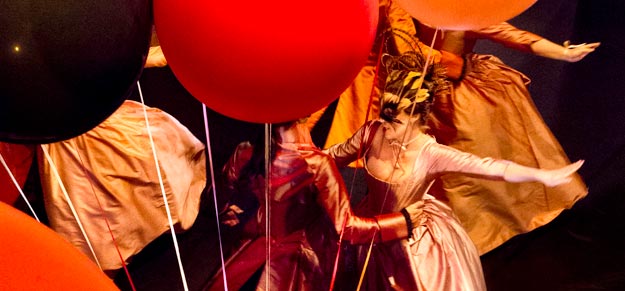
cosifantutte1COSI` FAN TUTTE

OPERA BUFFA in two acts (1790)

Music by WOLFGANG AMADEUS MOZART (1756-1791)
Libretto by LORENZO DA PONTE

Performed in Italian

From October 22 to November 13, 2013

Thus Do They All , or The School for Lovers . When Da Ponte and Mozart teach us, the lesson, however graceful, is harsh and cruel. In this game of masks and deception, the rules are entangled and everybody loses.

Thus do they all or The School for Lovers. When Lorenzo da Ponte is the teacher, the lesson is harsh and cruel, even if Mozart cannot resist tempering the implacable demonstration with musical grace. Before the cynical gaze of a pair of meddling manipulators, two brothers and two sisters become caught up in the alchemy of desire. Here we have pretend soldiers, false Albanians, a fake doctor, a counterfeit lawyer and above all, false friends! Can one really expect the heart to remain steadfast and love to be eternal? In this game of masks and deception with its labyrinthine rules, there can be no winners! Amid the vertiginous polyphony of this concerto for six voices, reminiscent of Marivaux at his most abstract and Musset at his least indulgent, Michael SchØnwandt leads his disciples along the path towards enlightenment.

The composer

Wolfgang Amadeus Mozart was born in Salzburg on 27 January 1756, and died in Vienna on 5 December 1791.
A child prodigy (he took his first harpsichord lessons at the age of four and started composing when he was six), Mozart soon became famous thanks to the many tours organised by his father, Leopold, who was also his teacher and mentor. Despite his short life, he is one of the most prolific composers in the history of music. In the field of opera, after his early works (La Finta semplice, Mitridate re di Ponto, Lucio Silla and La Finta giardiniera, among others), it was with Idomeneo (1781) that he truly asserted his personality. Die Entführung aus dem Serail, the following year, was his first mature work and heralded his later masterpieces : Le Nozze di Figaro in 1786, Don Giovanni in 1787, Così fan tutte in 1789. His last opera, La Clemenza di Tito, was a return to opera seria.

The work

Così fan tutte was commissioned from Mozart at the beginning of September 1789 by the emperor Joseph II who, according to legend, chose the subject himself: a news story which was then the talk of the town.
The commission could not have come at a better time for the composer who was experiencing both psychological and financial difficulties. Lorenzo da Ponte, with whom Mozart had written his two previous operas, thereby creating modern opera (opera where the orchestra no longer simply accompanies the singers but brings out the deeper psychology of the characters), was once more entrusted with the libretto. Così fan tutte is an opera which, like La Clemenza di Tito, was greatly misunderstood. For many years it was considered merely as a romantic comedy, frivolous banter for which the composer had written charming but superficial music. While it is true that da Ponte’s libretto, after the audacity of Le Nozze de Figaro and Don Giovanni, might seem conventional, it is clever, well constructed and theatrical. With his sensual, spirited and passionate music, Mozart poses fundamental questions about love and brings to the libretto surprising psychological depth and an underlying seriousness not present in the original farce.

The first performance

Così fan tutte was first performed at the Burgtheater in Vienna on 26 January 1790. The first production in France was given at the Théâtre des Italiens in Paris on 28 January 1809.

Logo_OnPThe work at the Paris Opera

The work entered the repertoire at the Opéra-Comique in 1920, in a French version, with André Messager as conductor. It was not until 1963 that the Opéra-Comique put on the work in its original version, in a production for the Aix-en-Provence festival. Mozart’s opera was first given at the Palais Garnier on 17 May 1974, in a production by Jean-Pierre Ponnelle (who was also responsible for scenery and costumes), with Josef Krips conducting (alternating with Serge Baudo), and Margaret Price (Fiordiligi), Jane Berbié (Dorabella), Tom Krause (Guglielmo), Ryland Davies (Ferrando), Teresa Stratas/Danièle Perriers (Despina), Gabriel Bacquier (Don Alfonso). Several different casts alternated in this production up until 1980. Così fan tutte returned to the Opéra Comique on 17 April 1982 in a Jean-Claude Auvray production, with scenery and costumes by Bernard Arnould, Gustav Kuhn at the rostrum, and sung by Felicity Lott, Alicia Nafé, Dale Duesing, Eberhard Büchner, Hildegard Heichele and Richard Van Allan. The opera was back at the Palais Garnier in March 1996 in a production staged by Ezio Toffolutti and conducted by Jeffrey Tate with Susan Chilcott/Emily Magee, Susan Graham, Simon Keenlyside, Rainer Trost, Eirian James and William Shimell in the main roles. In 2005, a new production staged by Patrice Chéreau was presented, with Erin Wall, Elina Garanca, Stéphane Degout, Shawn Mathey, Barbara Bonney and Ruggero Raimondi. It is Ezio Toffolutti’s production, revived in 1998 (with Melanie Diener, Angelika Kirschlager, Russel Braun, Bruce Ford, Anna Maria Panzarella, William Shimell), 2000 (with Barbara Frittoli, Katarina Karnéus, Russell Braun, Michael Shade, Nuccia Focile, Rolando Panerai), 2003 (with Anja Harteros, Enkelejda Shkosa, Russell Braun, Roberto Sacca, Maria Bayo and Alessandro Corbelli) and 2011 (with Elza van den Heever, Karine Deshayes, Paulo Szot and Matthew Polenzani) which is being performed this season.

Michael Schonwandt Conductor
Ezio Toffolutti Stage director, sets and costumes
André Diot Lighting
Alessandro Di Stefano Chorus master

Myrto Papatanasiu Fiordiligi
Stéphanie d’Oustrac Dorabella
Dmitry Korchak Ferrando
David Bizic Guglielmo
Lorenzo Regazzo Don Alfonso
Bernarda Bobro Despina

Paris Opera Orchestra and Chorus

Posted in Music, OPera | Tagged , , , | Leave a comment

Wagner’s final masterpiece, “PARSIFAL”, at the Swedish Royal Theatre in Stockholm

ROYAL THEATRE, STOCKHOLM

parsifal_fst3Wagner’s final masterpiece: PARSIFAL

Young Parsifal wanders the earth. He meets Grail knight Amfortas whose bleeding wound no one can heal. He meets Kundry whose kiss opens his eyes to man’s desire and misfortune. Guardian angels descend to the Earth with a sacred sword. Can humankind be set free from misery?
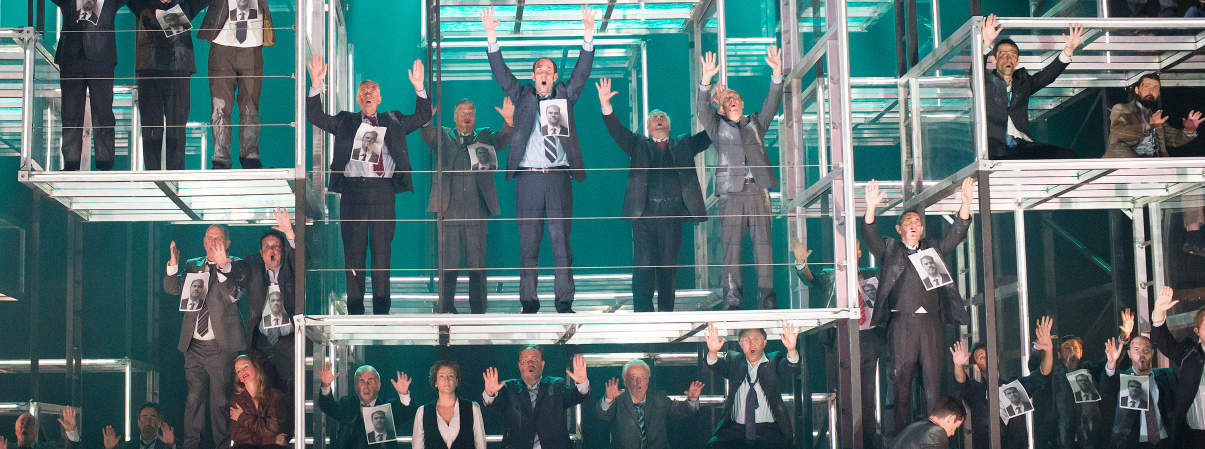
For director Christof Loy, a celebrated name in the world of opera, the complexity of corpreal love is central in his staging of Richard Wagner’s five-hour opus. Abstaining or indulging – that is the question! Royal Opera celebrates the bicentennial commemoration of Wagner with the story of Parsifal, which will be the new king of the weakened Grail Society. Parsifal was first performed in 1882, and the libretto is based in part on Wolfram von Eschenbach Bach’s medieval heroic poem Parzival from the middle ages. The religious motifs in Parsifal encompass Catholic mysticism, the philosophy of Schopenhauer and the compassion of Buddhism. As Parsifal we hear Michael Weinius, one of Europe’s most sought-after tenors, and the role of Kundry is sung by World renowned soprano Katarina Dalayman who, during the spring of 2013, sang the same role at the Metropolitan Opera in New York.

Music and lyrics Richard Wagner Director Christof Loy Sets Dirk Becker Costume and mask Barbara Drosihn Light Olaf Winter Dramaturg Thomas Jonigk Choreography Thomas Wilhelm performance lasts approximately 5 hours 15 minutes. task is still preliminary.

Performed in German with Swedish text on surtitles

Select performance

Saturday, October 5, 17:00   Premiere!
Tuesday, October 8 17:30
Saturday, October 12 15:00
Wednesday, October 16 17:30
Sunday, October 20 15:00
Sunday, October 27 15:00
Thursday, November 7th 17:30

Cast

Amfortas
Ola Eliasson
Titurel
Michael Schmidberger
Gurnemanz
Christof Fischesser
Parsifal
Michael Weinius
Klingsor
Martin Winkler
Kundry
Katarina Dalayman
Integral Knight
Jonas Degerfeldt Kristian Flor
Squire
Magdalena Risberg Frida Josefin Österberg Niklas Björling Rygert Jon Nilsson
FLOWER-GIRL
Magdalena Risberg Roma Loukes Frida Josefin Österberg Vivianne Holmberg Sara Olsson Johanna Rudström
Altrösten
Katarina Leoson
Conductor
Patrik Ringborg

*) The University College of Opera

Royal Opera chorus and extracorporeal
choir leader Folke Alin and Christina Hornell
Royal Opera Orchestra

Royal Opera AB
Box 160 94
103 22 Stockholm, Sweden

parsifal_fst1  parsifal_fst3

parsifal_fst4  parsifal_fst5


Posted in Music, OPera | Tagged , , , , , , | Leave a comment

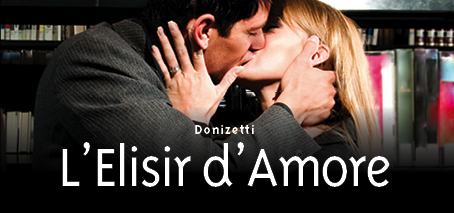
DONIZETTI’S “L’ELISIR D’AMORE” TOURS NORTHERN IRELAND!

elixir-posterL’ELISIR D’AMORE TOURS NORTHERN IRELAND!

ni-opera-logo 

Newtownabbey, Belfast, Omagh, Enniskillen and Armagh in the tour.

Anna Patalong and John Molloy in rehearsal

Anthony Flaum and members of the female chorus in rehearsal

NI Opera’s tour of Donizetti’s L’Elisir d’Amore opened on September 27th in Newtownabbey, and from there it will move to Belfast, Omagh, Enniskillen and Armagh.

 Donizetti’s ever-popular romantic comedy is a tale of passion, deception, and the triumph of love. It is famous for its spellbinding music and arias, which include the much-loved “Una furtiva lagrima”.

The opera tells the story of the besotted Nemorino, hopelessly in love with the beautiful but haughty Adina. When the sly Dr Dulcamara arrives peddling his quack remedies, Nemorino is fooled into believing that a love potion can help him win the girl of his dreams…

This brand new production features a wonderful cast of British and Irish singers led by Anna Patalong (making her first NI Opera appearance in the same season as her Royal Opera Covent Garden debut) and John Molloy (who last sang with NI Opera in The Bear), as well as the Ulster Orchestra conducted by David Brophy (RTÉ Concert Orchestra Principal Conductor).

Co-production with Opera Theatre Company. Sung in English.
Conductor: David Brophy, with the Ulster Orchestra
Director: Oliver Mears
Set Designer: Annemarie Woods
Costume Designer: Ilona Karas
Lighting Designer: Kevin Treacy

 NI Tour, 27 September – 11 October
Cast:
Adina: Anna Patalong
Dulcamara: John Molloy
Nemorino: Anthony Flaum
Belcore: James McOran-Campbell
Gianetta: Sarah Reddin

PERFORMANCES

September 27 at 7.45pm – The Theatre at The Mill, Newtownabbey
Tickets £14 – £18 (student tickets £5 / other concessions available).
Box office 028 9034 0202 / http://www.theatreatthemill.com

September 30 & October 1 at 7.45pm – the MAC, Belfast
Tickets £12 – £22 (concessions available).
Box office 028 9023 5053 / http://www.themaclive.com

October 3 at 8.00pm – Strule Arts Centre, Omagh
Tickets £18 (£14 concessions / student tickets £5).
Box office 028 8224 7831 / http://www.struleartscentre.co.uk

October 10 at 8.00pm – Ardhowen Theatre, Enniskillen
Tickets £18 (£14 concessions / student tickets £5).
Box office 028 6632 5440 / http://www.ardhowentheatre.com

October 11 at 8.00pm – Market Place Theatre, Armagh
Tickets £18 (£14 concessions / student tickets £5).
Box office 028 3752 1821 / http://www.marketplacearmagh.com

elixir-wo

Posted in Music, OPera | Tagged , , , , , , , , , | Leave a comment

Bizet’s Carmen on tour in Ireland

logo-irelandtheatreBizet’s Carmen

The initial success of Bizet’s Carmen depended more on people’s curiosity to see a piece that had been described as “immoral”, than on a public appreciation for the music and libretto. The first opera to have a working class anti-hero, this story of a regular Joe and his obsession with a woman who wouldn’t be accepted by polite society, was seen as shocking, with music that was too passionate, too novel, too…. Germanic! for the conservative French audiences of the time. Sadly, Bizet passed away before Carmen achieved the popular success it maintains to this day.

This production will be conducted by Andrew Synnott, directed by Gavin Quinn and designed by Aedín Cosgrove. With Imelda Drumm in the title role and Michael Wade-Lee as her smitten soldier, Don José, who has abandoned sweet Micaela, sung by Mairéad Buicke, and Owen Gilhooly taking the role of Escamillo, it is guaranteed that sparks will fly!

This production will also see new Young Associate Artist Maria Hughes taking on the role of Mercedes.

October 2013 tour continues….

Glór Ennis, Causeway Link, Ennis, Co. Clare – Tue Oct 15                                           Mermaid Arts Centre, Main Street, Bray, County Wicklow – Thu 17 Oct.17                 Siamsa Tíre, Town Park, Tralee, Co Kerry – Sat 19 Oct                                                     Samuel Beckett Theatre, Trinity College Dublin, College Green, Dublin 2 – Tue Oct. 22 Pavilion Theatre DUN LAOGHAIRE – Thu Oct. 24                                                          Theatre at the Mill, Mossley Mill, Carnmoney Road North, Newtownabbey– Sat 26 Oct – A

New Micaëla for CARMEN October Tour

Mairéad Buicke will not be rejoining the cast of CARMEN for our October tour, for the happy reason of maternity leave – we know that fans of OTC will join us in wishing her well with her new production!

Mairéad Buicke as Micaëla

And there is more good news: Sinéad Campbell-Wallace, a long-time friend to OTC, most recently singing the Countess in OTC’s immensely popular Irish and UK tour of The Marriage of Figaro (2010/11), will join the company for our performances in Ennis, Bray, Tralee, Dublin, Dun Laoghaire and Newtownabbey.

Sinéad Campbell-Wallace in the title role of OTC’s 2009/10 Irish & UK tour of ALCINA

Posted in Music, OPera | Tagged , , , , , , , | Leave a comment

“Die Fledermaus” at English National Opera in London

eno_diefledermausDie Fledermaus

September 30, 2013 – November 6, 2013

ENGLISH NATIONAL OPERA

Running time: 2hrs 35mins

Johann Strauss’s classic operetta, Die Fledermaus is a comic story of revenge, seduction and mistaken identity, centred on a high-society party thrown by Prince Orlofsky. Man-about-town Eisenstein is to be jailed, his wife is being seduced by an old flame, his friend Dr Falke has a plan to exact revenge for a past prank, and everybody wants to go to the party!

Light-hearted and colourful, yet sophisticated, this new production from Olivier Award-winning director Christopher Alden is re-imagined in an Art Deco-inspired fantasy world influenced by Freud and dream analysis. The staging offers the perfect complement to Viennese waltz-king Strauss’s sparkling melodies, including the joyous ‘Laughing Song’ and the memorable chorus in praise of champagne.

The cast of Die Fledermaus includes ENO favourite Tom Randle as Eisenstein, ENO Harewood Artists Julia Sporsén (who returns to the company following her much-lauded performance in the title role of Julietta in 2012) and Rhian Lois, and Olivier Award-nominated baritone Andrew Shore. Award-winning Korean conductor Eun Sun Kim makes her ENO debut.

New production supported by Lord and Lady Laidlaw.

Co-produced by ENO and the Canadian Opera Company.

Sung and surtitled in English.

All performances at 19:30

Signed performance October 24, 2013 Pre-performance talk October 9, 2013

Monday, September 30, 2013
Wednesday,  October 2, 2013
Saturday, October 5, 2013
Wednesday, October 9, 2013
Friday, October 11, 2013
Tuesday, October 15, 2013
Friday, October 18, 2013
Tuesday, October 22, 2013
Thursday, October 24, 2013
Thursday, October 31, 2013
Wednesday,  November 6, 2013

Cast

Gabriel von Eisenstein   Tom Randle 
Rosalinde   Julia Sporsén 
Frank   Andrew Shore 
Prince Orlofsky   Jennifer Holloway 
Alfred   Edgaras Montvidas 
Dr Falke   Richard Burkhard 
Adele   Rhian Lois 
Dr Blind   Simon Butteriss 
Ida   Lydia Marchione  
Frosch  Jan Pohl  

eno

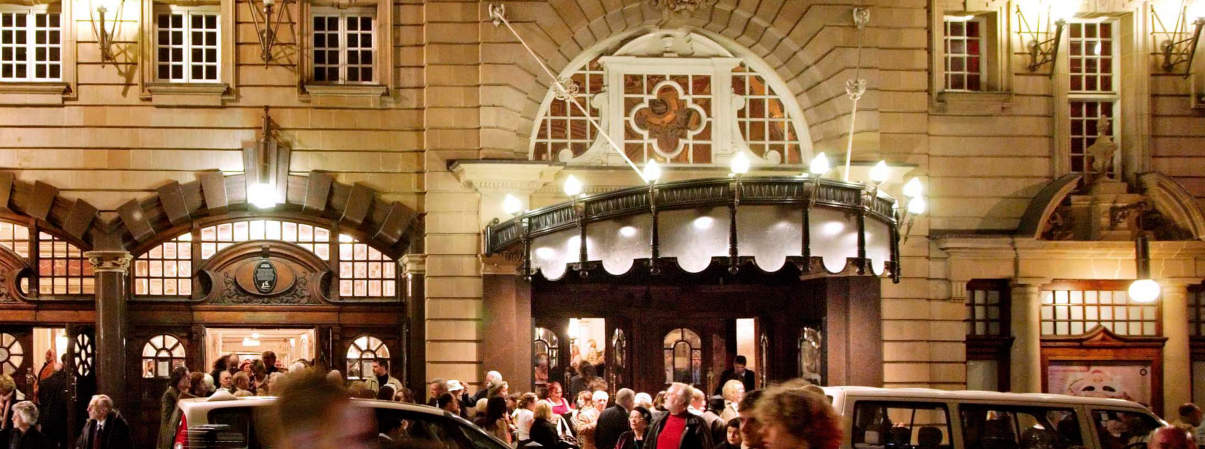
London Coliseum
St Martin’s Lane
London
WC2N 4ES

Posted in Music, OPera | Tagged , , , | Leave a comment

“Madam Butterfly” at English National Opera in London

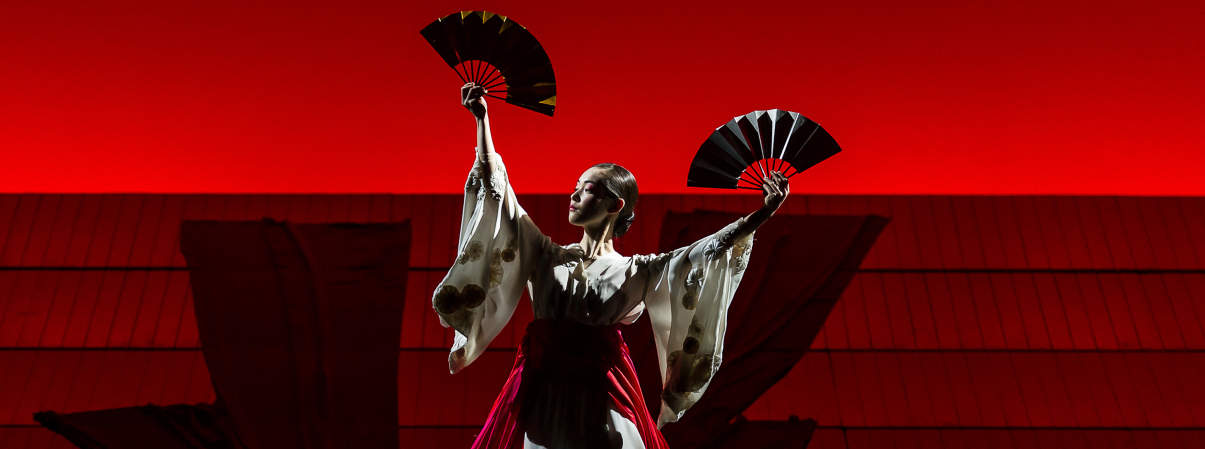
eno_sprite2Anthony Minghella’s Olivier Award–winning production returns to English National Opera in London…

enobutterflyMadam Butterfly

Oct. 14, 2013 – Dec. 1, 20 13

 
Running time: 2hrs 50mins

Puccini’s tragic love story tells of Butterfly, a young Japanese girl who falls in love with American naval officer Pinkerton. Shortly after their wedding, Pinkerton returns to America: Butterfly gives birth to a son and patiently awaits her husband’s return, never giving up hope.

Hailed by The Sunday Telegraph as ‘the most beautiful show of the year in operatic London’, Anthony Minghella’s award-winning Madam Butterfly returns to ENO. With its breathtaking mix of cinematic images and traditional Japanese theatre, riot of colourful costumes, stunning sets and unforgettable use of puppetry, Anthony Minghella’s sole opera production has developed into one of the most iconic stagings of the 21st century.

Madam Butterfly sees internationally renowned sopranos Dina Kuznetsova and Mary Plazas (Minghella’s original Butterfly) sharing the title role, alongside Welsh tenors Timothy Richards and Gwyn Hughes Jones as Pinkerton, Pamela Helen Stephen as Suzuki, and ENO Harewood Artist George von Bergen as Sharpless.

Co-produced by ENO with the Metropolitan Opera, New York and Lithuanian National Opera.

Original production supported by Lord and Lady Laidlaw.

Sung and surtitled in English.

Signed performance 13 Nov. Pre-performance talk October 16, 2013

Butterfly Dina Kuznetsova / Mary Plazas (21, 26 Oct, 2, 8 , 13 Nov)
F.B. Pinkerton Timothy Richards / Gwyn Hughes Jones (21 Nov, 29 Nov)
Sharpless George von Bergen
Suzuki Pamela Helen Stephen
Goro Alun Rhys-Jenkins
The Bonze Mark Richardson
Prince Yamadori Alexander Robin Baker
Kate Pinkerton Catherine Young
Conductors Gianluca Marciano / Martin Fitzpatrick
Original Director Anthony Minghella
Original Associate Director & Choreographer Carolyn Choa
Revival Director Sarah Tipple
Set Designer Michael Levine
Costume Designer Han Feng
Original Lighting Designer Peter Mumford
Revival Choreographer Anita Griffin
Puppetry Blind Summit
Translator David Parry 
eno

London Coliseum
St Martin’s Lane
London
WC2N 4ES

Posted in Music, OPera | Tagged , , , , | Leave a comment

Fidelio at English National Opera in London

eno_FidelioFidelio

25 Sep 13 – 17 Oct 13

Running time: 2hrs 40mins

In Fidelio, Political prisoner Florestan is unjustly held captive by Don Pizarro, the corrupt governor of a state prison. Florestan’s wife, Leonore, searches for him by assuming the disguise of a young man called Fidelio and joining the prison staff as a guard. Her rescue of Florestan offers a universal story of the power of marital love and fidelity triumphing over injustice and tyranny.

Two hundred years after its premiere, Beethoven’s Fidelio continues to thrill audiences with its many echoes of the composer’s symphonic works, powerful orchestral imagination and exquisite melodies. Calixto Bieito’s unique vision of Beethoven’s only opera explores the psychological prison of each character, in a production which is contemporary and yet abstract, and which always seeks to challenge our expectations and certainties about this much-admired opera.

Fidelio is conducted by ENO Music Director Edward Gardner. The cast of this ground-breaking new production is led by acclaimed soprano Emma Bell as Leonore and Stuart Skelton as Florestan.

Co-produced by ENO and the Bavarian State Opera, Munich.

Sung and surtitled in English. Strong flashing lights are used in parts of this production.

Signed performance October 3, 2013 Pre-performance talk September 27, 2013
Leonore   Emma Bell 
Florestan   Stuart Skelton* 
Don Pizarro   Philip Horst 
Rocco   James Creswell 
Marzelline   Sarah Tynan 
Jaquino   Adrian Dwyer 
Don Fernando   Roland Wood 

* excluding 1 & 3 October when Bryan Register will sing the role of Florestan
Conductor   Edward Gardner 
Director   Calixto Bieito 
Set Designer   Rebecca Ringst 
Costume Designer   Ingo Krügler 
Lighting Designer   Tim Mitchell 
Translator   David Pountney

Heath Quartet
Violin   Oliver Heath 
Violin   Cerys Jones 
Viola   Gary Pomeroy 
Cello   Christopher Murray

eno

London Coliseum
St Martin’s Lane
London
WC2N 4ES

Posted in Music, OPera | Tagged , , , , , , , | 1 Comment