Thomas Adès’ THE TEMPEST at the Hungarian State Opera

Hungarian_logoOpera in two parts, three acts in English, with Hungarian and English surtitles
Hungarian premiere

Heralded by the New York Times as “one of the most inspired, audacious and personal operas to have come along in years”, Thomas Adès’s 2004 opera uses the tales of Prospero, Caliban and Ariel – as well as the young Ferdinand and Miranda – to raise issues about the thirst for vengeance, the power of good and evil, the nature of magic, the possibility of love, and paths to reconciliation.tempest23

The libretto by Australian dramatist Meredith Oakes preserves Shakespeare’s poetry, while at the same time providing space for the soaring and thrilling music of Adès, whose vocal works frequently test the limits of the human voice and present a quite formidable challenge to the singers.

Performed by arrangement with Faber Music Ltd, London.tem22

PERFORMANCES

2016. May 19., Thu, 19:00
2016. May 21., Sat, 19:00
2016. May 25., Wed, 19:00
2016. May 28., Sat, 19:00
2016. June 01., Wed, 19:00

PHOTO GALLERY

SYNOPSIS

Background
After being deposed from the throne by his brother, Antonio, with the support of the king of Naples, Prospero, the rightful duke of Milan, sets out to sea in a small ship with his young daughter, Miranda, to be carried off wherever the currents take them. The former duke and the child owe their life to a nobleman named Gonzalo, who had previously been Prospero’s counsellor. Sympathising with the exiles, the gentleman loads the ship full of food and Prospero’s books. Although everyone believes them to be dead, Prospero and Miranda find a new home on an unknown island. Prospero uses sorcery to bring the island under his dominion.

Approximately 12 years later

Act I
In the open sea near Prospero’s island, a ship encounters a sudden raging tempest and founders. The crew and passengers, who include Antonio, as well as the king of Naples and Gonzalo, miraculously manage to reach the shore in safety. Suspecting that her father had used his magical powers to summon the tempest, Miranda feels sympathy and worry for the travellers on the ship. Prospero reassures her that no ill has befallen anybody. Since the girl has no memories of her early childhood, Prospero now tells her for the first time about Milan, about her girlhood and the treachery of his enemies. Deeply saddened by what she has heard, Miranda falls asleep. Prospero summons Ariel, the spirit who serves him, and commands him to watch over the survivors of the shipwreck. Caliban, the son of the witch Sycorax, who had previously ruled over the island, comes to Prospero. The loathsome creature accuses Prospero of ungratefulness, and also makes it clear that he would be pleased to marry Miranda and make her the mother of his children. The thought of this fills Prospero with disgust, and he threatens Caliban. Meanwhile, Ferdinand, the heir to the throne of Naples, despite being separated from his companions, makes it safe and sound to shore, where he encounters Miranda. Against Prospero’s will, the two fall in love with each other immediately. This is the first time that Miranda has acted against her father’s wishes. Prospero, blinded by his own thirst for revenge, sees Ferdinand only as the son of his enemy.

Act II
The castaways marvel at the island and the circumstances of their deliverance. Only the king is worried, as his son, Ferdinand, is nowhere to be found. Each attempt to cheer him up fails, especially after the clever Ariel instigates a quarrel between Antonio and Sebastian, and then between Sebastian and the courtiers. When Caliban joins them in order to incite them against Prospero, the group laughs at him and ply him with brandy, making Caliban drunk. The survivors set off to find Ferdinand, leaving Stefano and Trinculo alone with Caliban. Prospero slowly realises that he cannot stand in the way of Miranda and Ferdinand’s love. He has lost his total power over his daughter.

Act III
Caliban, Stefano, Trinculo – all three of them intoxicated – set out against Prospero, intending to kill him. Stefano and Caliban both dream of becoming the master of the island, with Miranda as his wife. Meanwhile the despairing king, believing Ferdinand to be dead, designates Gonzalo as heir to the throne in the event of his death instead of his own younger brother, Sebastian. When the king and his retinue fall into a deep sleep shortly thereafter, Antonio and Sebastian decide to kill the king and Gonzalo, but Ariel thwarts their plans by waking up the sleepers in time. The spirit then sternly calls the king and Antonio to account for seemingly having sent Prospero and Miranda to their certain death twelve years earlier. Meanwhile, Prospero, accepting the love between Ferdinand and Miranda, asks his daughter’s forgiveness. Miranda again states how much she abhors Caliban and his murderous instincts. When Ariel movingly relates to Prospero how much pain the king of Naples and Gonzalo feel over Ferdinand’s death, the master of the island decides to forgive his enemies and forget the past. When the group of people wandering the island appear before him, Prospero returns Ferdinand to his father, renounces his study of magic, and sets free the spirits held in his service. Preparing for Ferdinand and Miranda’s wedding, they leave together on the ship that had already been repaired by magic. Only Caliban remains on the island, all alone.


General cast

Conductor
Péter Halász
Ariel
Laure Meloy
Prospero
Franco Pomponi
Caliban
István Horváth
Miranda
Andrea Szántó
Ferdinand
Péter Balczó
Antonio
Tamás Tarjányi
Stéfano
Géza Gábor
Trinculo
Armin Gramer
Sebastian
Zsolt Haja
Gonzalo
András Palerdi
Nápoly királya
Attila Fekete

Credits

Libretto after Shakespeare by
Meredith Oakes
Director
Ludger Engels
Set designer
Ric Schachtebeck
Costume designer
Sabine Blickenstorfer
Dramaturg
Eszter Orbán
Hungarian surtitles
Ádám Nádasdy
Chorus director
Kálmán Strausz
Posted in OPera | Tagged , , | Leave a comment

Macbeth in Marseille

operamarseillelogo

Macbeth

GIUSEPPE VERDI

Tuesday June 7th, 2016 > 8:00PM
Friday June 10th, 2016 > 8:00PM
Sunday June 12th, 2016 > 2:30PM
Wednesday June 15th, 2016 > 8:00PM

Opulent orchestral work with sometimes murderous arias take this opera to a paroxysm of violence and madness, leaving both performers and audience holding their breath

Visu-MacBeth


MACBETH

Opera in 4 acts
Libretto by Francesco Maria PIAVE and Andrea MAFFEI
from the play by William SHAKESPEARE
First performed in Florence, Teatro della Pergola, on March14th, 1847
Last performed in Marseille opera, on January 12th, 1992
New production

Conductor Pinchas STEINBERG
Director Frédéric BÉLIER-GARCIA
Scenic Designer Jacques GABEL
Costume Designer Catherine and Sarah LETERRIER
Lighting Designer Roberto VENTURI

CAST

Lady Macbeth Csilla BOROSS
Lady-in-waiting of Lady Macbeth Vanessa LE CHARLÈS

Macbeth Seng-Hyoun KO
Banquo Wojtek SMILEK
Macduff Stanislas DE BARBEYRAC
Malcolm Xin WANG
The Doctor Alain HERRIAU
A murderer / Servant of Macbeth / An apparition Jean-Marie DELPAS

Marseille Opera Orchestra and Chorus

About the show

Conférences opéras
Macbeth – Giuseppe Verdi
Samedi à 15h au Foyer de l’Opéra
(3€, dans la limite des places disponibles. Réservation prioritaire pour les abonnés : 04 91 55 11 10 ou 04 91 55 20 43)

Posted in OPera | Tagged , , | Leave a comment

OTELLO saved by the performers at the MET

REVIEW BY TIZIANO THOMAS DOSSENA

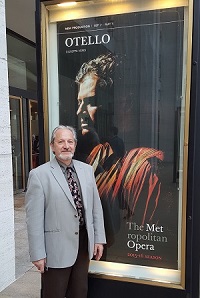
This ostensibly new production (it started in September of last year) of Verdi’s Otello at the Metropolitan Opera could have been the greatest pleasant surprise if only… Well, that is not how I would want to start my review, since the singers have all proved themselves to be professional in all senses, but truthfully there are some ifs, regardless of the famous critics’ pat in the back to the Met for an auspicious Met debut (the New York Times), and because of these ifs, the opera loses its great impact with the audience, especially for the neophytes who wanted to chew on a more ear-challenging Verdi, without the aria and recitative structure to which they may be used to, as in the classics Rigoletto or La Traviata. Otello has an audacious and complex orchestration and its characters are well developed, so having great singers and a great opera, what could go wrong? The comments of the audience on the way out of the theater (yes, it’s true, I did not take a poll, all I did was eavesdrop, but even that can give you an idea of at least how the audience reacted)  were mostly  matching my impressions, so I could not have been wrong in feeling that something had gone amiss.

What was it? I am already not a promoter of updating or modernizing the story, but there are times when it works; most of the times it does not, sadly. The efforts of the scenic designer (Es Devlin), a respected professional who created a marvelous series of sliding and rotating transparent arches, illuminated in a way to give a feeling of fable, could have worked for another type of show, maybe some fantasy similar to Alice in Wonderland, but it had no pertinence to this story. I cannot blame Mr. Devlin or Donald Holder (the lighting designer) for the failure to deliver, though. Mr. Bartlett Sher, who produced this opera version, is fully responsible for the choices taken and for their effect on the story development. The amazing projected images by Luke Halls did bring some sanity at times, but their use got old fast enough, having to deal with those inadequate structures that someone wrongly imagined to create a proper environment for an Otello. And what is with the choir always dressed in black, with reminiscence to a witch tribunal among the Puritans? This opera already has enough drama within itself without attempting to create an unrelated atmosphere of doom. The fact that the choir stands on stage dressed as for a funeral, singing about the possibility of a shipwreck could be acceptable, maybe even building on the roots of the tragedy that will soon loom behind the scenes, and that the same choir (in black) just goes on a happy frenzy as soon as Otello’s ship comes to port is annoying to people of good taste and clashing with the expectations of an opera lover. How believable is seeing Venetians in Crete dressed as English Puritans (or whatever those outfits were meant to represent)? And choosing those garments to create an even deeper sense of doom does not feel incorrect to the director, when the celebration occurs? Just an opinion….

Phot Copyrigth Epoch Times

Photo Copyright Epoch Times

The sliding arches, with their majestic beauty and there lack of usefulness to the story and its setting, have another characteristics that attempted even more to destroy the proper flow of the drama: their inadequacy for the movements of the actors. To see the poor Otello (an otherwise flawless and magnificent Aleksandrs Antonenko, who proved his voice skills and his power over and over throughout the performance) attempting to go around the arches, passing through them clumsily as if that would have been a naturally expected action was disheartening to say the least. Didn’t the director notice the lack of flow in the actions? Did the glitter and special effects convince him that it was an ideal choice? It would have been nice to hear an explanation by Mr. Sher regarding the meaning of these flowing arches (Symbolism? Cubism? Belated expressionism? Minimalism?).OTELLONYTimes

Thankfully, besides the magnificent voice of Mr. Antonenko, a marvelous, silky-textured voiced commanding soprano (Hibla Gerzmava) performed in an impeccable manner, although there were two instances when I could not hear her, and I am not certain whether it was the volume of the orchestra, which otherwise seemed to have a clear grasp of the music interpretation and played in a remarkable fashion (also thanks to the excellent conduction by Adam Fischer) or a slight loss of volume by the soprano. Nevertheless, it was forgivable, especially keeping mind of the difficulty of the part and the strange selections of movements across the stage set by Mr. Sher, which would have confounded and stressed out any normal performer ( maybe not a rocker on acid, but I am not sure about that).iagoagainstglass

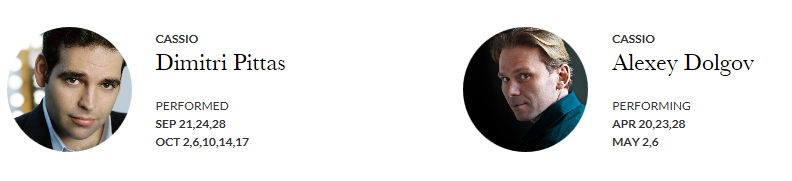
A ‘bravo’ also to Alexey Dolgov, an effective and substantial Cassio., and  to Iago (Željco Lučić, a baritone with a luxurious voice and a great stage presence,) who proved to be a prodigious ‘evil character’ and at times he made me forget the inadequacy of the staging. Actually, there was a time in this magnificently sung Otello when I did forget that there were no sliding psychedelic arches in Cyprus, also because they finally were in the background and the main part of the stage was occupied by a real bed (a touch of sanity that surprised me; I expected a sleeping bag or maybe a transparent platform that would have stood in for the bed). The brilliance of the late Verdi’s musical choices was here in primo piano, and proved their validity in bringing the depth of the tragedy and the real essence of the drama to the audience. You could feel the drama in your chest; people’s eyes were moist and their necks were tense. Yes, it was a tragedy and the marvelous work by the composer was grabbed successfully by the singers as well by the orchestra, bringing a divine product on stage. One has to recognize that the singers were all so convincing and skilled that they were able to annihilate the negative effects of the stage production, or at least most of the time.

Posted in Article | Tagged , | Leave a comment

Boismortier : “Don Quixote visits the Duchess” at the Chateau de Versailles

versailles_logodon

In 1743, two years before Rameau imagined Platée, Boismortier had an extraordinarily modern and preposterous « comic ballet » performed at the Académie royale de musique : Don Quixote visits the Duchess.

donquichotte_ot_metz_metropole_2015-4331web

In the course of a totally hysterical plot, the hero encounters monsters, magicians, princesses, inhabitants of Japan… a pretest for daring and quirky ballets and choruses. The beauty of music mingles with irreverent parody. Boismortier is little known nowadays, but he was a prolific composer under Louis XI’s reign, in all the fashionable styles in vogue at the time. His first major success was this Don Quixote visits the Duchess, a Ballet Comique he invented with Favart, the libretto genius, who transformed the subject of Don Quixote into a farce of “theatre within the theatre”, full of brilliance and colour. Boismortier’s music sparkles in each phrase of this light comedy where the Duchess makes Don Quixote believe that he meets Dulcinea again and a gallery of characters, among whom the Magician Merlin or the Infante of Congo, when he is unknowingly on the stage of the castle’s private theatre…

donquichotte_ot_metz_metropole_2015-4484web

Hervé Niquet discovered this gem in 1988 and finally stages it with Corinne and Gilles Benizio (Shirley and Dino), the infernal trio from King Arthur. You are warned, baroque frenzy in view!

Extrait de Don Quichotte chez la Duchesse, Boismortier, 2015.
Performed at the Royal Opera of Versailles, located in the grounds of the Castle, one of the major opera houses.

CAST

Mathias Vidal, Don Quichotte

Marc Labonnette, Sancho Pança

Chantal Santon-Jeffery, Altisidore, Japan Queen

João Fernandes, Montesinos / Merlin / the Translator

Gilles Benizio, the Duke, the Japanese man

Camille Poul, a farmer / a lover / a companion

Charles Barbier, a lover

donquichotte_ot_metz_metropole_2015-4711web

CREATIVE TEAM

Philippe Lafeuille, Choreography

Daniel Bevan, Stage sets

Anaïs Heureaux et Charlotte Winter, Costumes

Jacques Rouveyrollis, Lights

Elisabeth Geiger, Chef de chant

Pauline Jolly Assistant director

Jessica Duclos Lighting assistant

Corinne et Gilles Benizio (Shirley et Dino), Director

Le Concert Spirituel

Hervé Niquet, Conductor

Posted in OPera | Tagged | Leave a comment

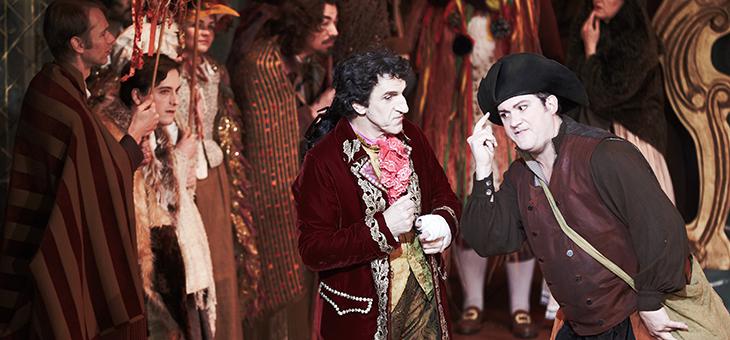
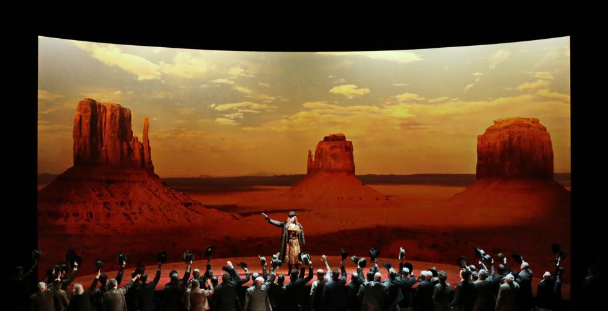
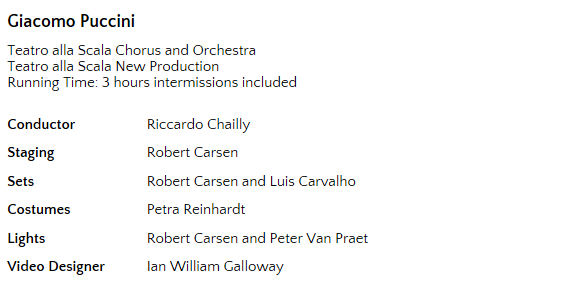
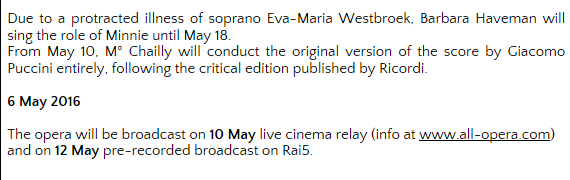
La Fanciulla Del West at La Scala di Milano

scala_Logo_fanciullafanciulla1fanciulla_staff
libretto_westLIBRETTO OF THE OPERA

Riccardo Chailly

Riccardo Chailly

cast
cast1
cast2

La fanciulla del west

La fanciulla del west

fanciulla_notes
act1

act2

act3

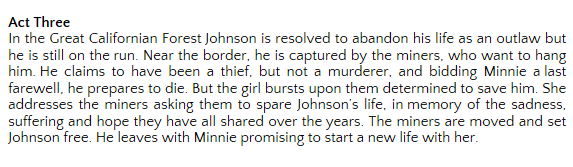
Posted in OPera | Leave a comment

Don Carlo at the San Francisco Opera

sanfranciscologo

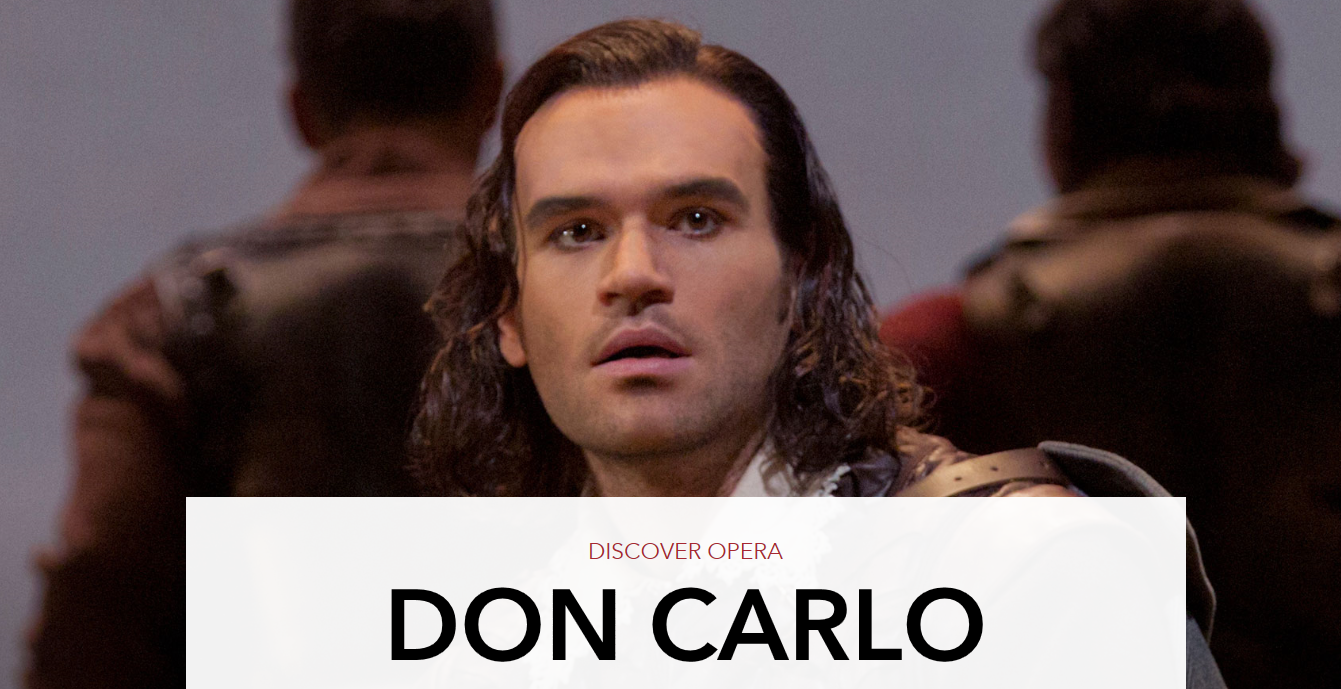
doncarlo+titleAt the time of Spain’s brutal Inquisition, the king of Spain marries the woman his son loves and sets into motion a tension-filled chain of events. Music Director Nicola Luisotti conducts this magnificent tale of romantic triangles, political idealism and life-and-death devotion.

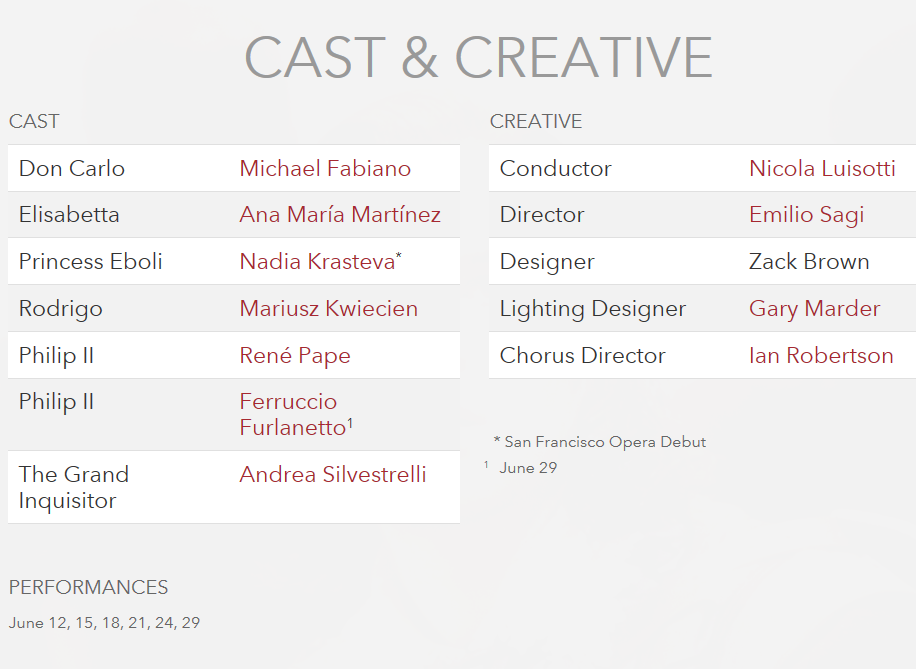
Starring soprano Ana María Martínez, renowned bass René Pape and the powerful tenor Michael Fabiano in his role debut as Don Carlo, this grand Italian opera will grip your heart with its complexity, passion and conscience long after the curtain falls.

Music by Giuseppe Verdi | Libretto by Joseph Méry and Camille du Locle

Sung in Italian with English supertitles

Running Time: 4 hours, 20 minutes including two intermissions

Who Should See It: Fans of historical drama and Masterpiece Theater.

Pre-Opera Talks are free to ticketholders and take place in the Orchestra section, 55 minutes prior to curtain.

doncarloscheduleDonCarloCast

GALLERY

SYNOPSIS

ACT I 1559-1568; France and Spain.

Against the wishes of the Spanish King Philip II, his son and heir, Don Carlo, has traveled incognito to Fontainebleau, where negotiations are under way for a peace treaty between Spain and France. He has seen his intended bride Elisabetta, daughter of the French king, and fallen in love with her on sight. When he meets Elisabetta and her page, who have been hunting and become lost in the forest, Carlo offers his protection without revealing his identity. Elisabetta questions him about her future husband, apprehensive over her marriage to a stranger. Carlo gives her a miniature portrait of himself, and she realizes that he is the prince. It is clear to them both that their feelings of love are mutual. Their happiness ends with news that the treaty arrangements have been altered and Elisabetta is to marry King Philip, Carlo’s father. Elisabetta reluctantly accepts. While all around them celebrate the end of the war, Elisabetta and Carlo are devastated.

ACT II

Carlo seeks peace at the monastery of St.-Just in Spain, where he prays at the tomb of his grandfather, Emperor Charles V. He is confronted by a monk who seems to be the emperor’s ghost. His friend Rodrigo, the Marquis of Posa, arrives to remind Carlo of his commitment to the cause of the Flemish people who are oppressed by Spanish rule. Both pledge themselves to the cause of liberty and swear eternal friendship. In a garden outside the monastery, Princess Eboli entertains the other ladies of the court with a song. Elisabetta—now queen—enters, followed by Posa, who hands her a secret letter from Carlo asking for a meeting. When he is admitted, Carlo asks the queen to obtain Philip’s permission for him to go to Flanders, then suddenly declares his continuing love. Elisabetta rejects him and Carlo rushes off. The king enters and, finding the queen unattended, banishes the Countess of Aremberg, who should have been present. Left alone with the king, Posa challenges Philip to end his oppression of the Flemish people. Philip refuses but is impressed by Posa’s courage. He warns him to beware of the Inquisition and tells Posa about his suspicions of his wife and Carlo, asking Posa to watch them. Posa accepts the assignment, knowing that being in the king’s confidence will help him in the future.

ACT III

Carlo has received a letter asking him to a secret meeting at midnight in the queen’s gardens in Madrid. He thinks the meeting is with Elisabetta, but it is Princess Eboli who appears. She is in love with him. When Carlo discovers her identity and rejects her advances, Eboli realizes where the prince’s true feelings lie and swears to expose him. Posa arrives in time to overhear Eboli and threatens to kill her but is stopped by Carlo. Eboli leaves. Posa persuades Carlo he is now in danger and Carlo hands over some secret papers to him for safekeeping. At a public burning of heretics in front of Madrid’s Basilica of Our Lady of Atocha, Carlo leads a group of Flemish deputies to Philip. The king rejects their pleas for freedom. When he also dismisses Carlo’s own request to rule Flanders, the prince draws his sword on his father. He is disarmed by Posa and arrested. In thanks, Philip makes Posa a duke. As a group of heretics is led to the stake, a celestial voice welcomes their souls into heaven. ACT IV In his study at night, the king reflects on his life with a wife who doesn’t love him. He consults with the old and blind Grand Inquisitor, who consents to the death sentence for Carlo: as God sacrificed his son to save mankind so Philip must stifle his love for his son for the sake of the faith. The Inquisitor also demands that Posa be handed over to him. As he leaves, Philip wonders if the throne must always yield to the altar. Elisabetta enters, having discovered that her jewel case has been stolen. Eboli, who knows that Elisabetta keeps a portrait of Carlo in it, had taken the box and given it to the king. Philip now shows the box to Elisabetta, takes out the portrait, and accuses her of adultery. Elisabetta collapses and the king calls for help. Eboli and Posa rush in, he to express amazement that a king who rules half the world cannot govern his own emotions, she to feel remorse at what her jealousy has brought about. Alone with Elisabetta, Eboli confesses that she not only falsely accused her but that she has been the king’s mistress. Elisabetta orders her from the court. Eboli laments her fatal beauty and swears to spend her final day in Spain trying to save Carlo. Posa visits Carlo in prison to tell him that he has used the secret papers to take upon himself the blame for the Flemish rebellion. He is now a marked man, so Carlo must take up the cause of liberty for Flanders. Posa is shot by agents of the Inquisition. As he dies, he tells Carlo that Elisabetta will meet him at the monastery of St.-Just and declares he is happy to have sacrificed his life for a man who will become Spain’s savior.

ACT V

Elisabetta has come to the monastery, wanting only her own death. When Carlo appears, she encourages him to continue Posa’s quest for freedom in Flanders and they hope for happiness in the next world. As they say goodbye, Philip and the Grand Inquisitor arrive. As the agents of the Inquisition move in on Carlo, the Emperor Charles V materializes out of the darkness to insist that suffering is unavoidable and ceases only in heaven.

Posted in OPera | Tagged , , , , , , , , | Leave a comment

Turandot in Norway with the phenomenal Elizabeth Blancke-Biggs ( updated with more images and a video)

turandotTitledateslogonorway

In Puccini’s opera, Princess Turandot  has sworn never to marry any man unless he can correctly answer her three riddles. Captivated by her beauty, the unknown Prince Calàf takes up the challenge, well aware that the untouchable ice princess has issued an ultimatum: anyone who tries and fails must die.

Giacomo Puccini created a rich, beautiful soundtrack for this darkly erotic tale, setting it in classical Beijing and weaving simple Chinese folk tunes into the orchestra’s huge sound.turandot3

The opera includes famous arias such as “Signore, ascolta”, sung by the servant Liù as she tries to stop Prince Calàf from throwing himself away in Turandot’s perilous challenge, and the Prince’s beautiful “Nessun dorma”, as he looks forward to winning the princess’s hand.

In director Andreas Homoki’s production, we do not encounter a classical, folkloric China, but instead a modern fairy tale where screens are functioning as storytellers and camera lenses represent the gaze of power. However, the potential brutal encounters between the individual and the demands of the masses are still the same. An open question

The penultimate scene in Turandot was the last Puccini wrote before travelling to a clinic in Brussels, where he died after a cancer operation in 1924. The opera was completed two years later by Franco Alfano. During the premiere at La Scala Milan in 1926, conductor Arturo Toscanini laid down his baton in the middle of the third act, turning to the public to say: “At this point, the maestro died.” This is after Liù has sung “Tu che di gel sei cinta” (“You who are begirdled by ice”) to Turandot. Immediately afterward, Liù kills herself.

We are performing the incomplete version of Turandot, which ends with the death of Liù – and of Puccini. When we do not know whether the prince and princess end up together, the story ends as an unanswered question.

Co-production with Semperoper Dresden

  • Premiere discussion one week before the premiere
  • Free introduction one hour before the performance

GALLERY (Photos Copyright Den Norsk opera)

CAST

cast1 Cast2 Cast3 cast4 cast5 cast6 cast7

FOCUS ON

liz

Read an interview with this magnificent soprano, recently published by our magazine!

‘Elizabeth Blancke-Biggs … certainly was [Salome’s] highlight. Her vocal splendor and strength were Salome worthy and she often formed the merciless role with beautiful bel canto singing.’
– Kulturkompasset

liz2 liz1
A brilliant interpreter of the most demanding roles on the operatic and concert stage, this past season has seen Elizabeth Blancke ­ Biggs as Salome in Mexico City’s Palacio de Bellas Artes, as soloist in the Verdi Requiem, also in Mexico City with Mo. Carlos Miguel Prieto, At New York’s Lincoln Center for the Rossini Stabat Mater and the Dvorak Te Deum, Verdi’s Nabucco at the Teatro Nacional di Costa Rica, and La Traviata in Argentina. Last season she was the featured artist opening the Verdi Bicentennial Concerts at Mexico City’s Palacio de Bellas Artes, followed by her critically acclaimed role and house debut in Strauss’ Salome at den Norske Opern in Stefan Herheim’s reprise of his Salzburg production. She then appeared under the baton of Lorin Maazel as Puccini’s La Fanciulla del West at his Castleton International Festival, and as Verdi’s Lady Macbeth at Montevideo’s Teatro Solis.

She was heard worldwide in the Sirius Satellite Radio Metropolitan Opera Broadcast of Puccini’s Tosca with tenor Marcello Giordani, as Puccini’s La Fanciulla del West under the direction of Bruno Bartoletti at Palermo’s Teatro Massimo, and as Verdi’s Lady Macbeth at Santiago, Chile’s Teatro Municipal.

Elizabeth is becoming recognized as one of the most exciting lirico-spinto sopranos on the international scene today. Critics have praised her virtuosic bel canto technique, the beauty of her voice, her pyrotechnic coloratura, and her unerring theatricality. Hailed as one of the best young Verdi singers by Placido Domingo, she appeared with him at the Washington National Opera as Giordani’s Fedora in a gala performance. She made her Metropolitan Opera debut as Violetta in the Zeffirelli production of Verdi’s La Traviata under the baton of Marcello Viotti with Lado Ataneli as Germont, and her Italian debut was the title role in Jonathan Miller’s production of Donizetti’s Maria Stuarda at Torino’s Teatro Regio, conducted by Evelino Pidó. In South America she was Abigaille in Verdi’s Nabucco for Chile’s Teatro Municipal, with Maurizio Benini. In London she appeared as Bellini’s Norma and Puccini’s Fanciulla del West for Opera Holland Park. She was seen as Minnie in La Fanciulla del West, for Florida Grand Opera with Anthony Michaels-Moore as Rance, and where one reviewer said “… [her] rapturous sound literally enveloped the stage. A flamboyant, charismatic stage presence.” She returned to FGO to sing a critically acclaimed Tosca. She reprised Abigaille in Nabucco for the Aspendos Festival at the 15,000 seat Roman amphitheater in Antalya, Turkey, and was featured in a new production of Aida at Opera Omaha and Norma for Palm Beach Opera with Ruth Ann Swenson as Adalgisa. For the New York City Opera she was seen as both Tosca and Mimì in La Bohème. Her most recent appearances in Palermo’s Teatro Massimo (La Fanciulla del West,) Bologna’s Teatro Comunale, Chile’s Teatro Municipal (Lady Macbeth) and the Welsh National Opera Gala (Fedora) were all critically acclaimed.

Posted in OPera | Leave a comment

Das Rheingold in Frankfurt

Operfrankfurt2016logo

DAS RHEINGOLD
Richard Wagner
1813 – 1883

Libretto by the composer
First performed September 22nd 1869, Royal Court and National Theatre Munich
First performance as part of the Ring des Nibelungen 13th August 1876, Bayreuth

Sung in German with German surtitles
Duration: c. 2 1/2 hrs. without interval

Live recording and DVD available – OehmsClassics

About the piece

It starts with the beginning of everything. A triad gradually grows from a deep E flat, and rhythmic structures emerge, almost unn
It starts with the beginning of everything. A triad gradually grows from a deep E flat, and rhythmic structures emerge, almost unnoticed: the organic development of nature swells into an enormous crescendo, striding forth – until it suddenly plunges into the depths of the Rhine. But it is really the beginning? Lots has happened in this world before the first singers appear. In Rheingold, in the whole Ring, layers of time overlap one another, opening up contradictory viewpoints depending on who is speaking. The ambiguity of events, the ambivalence of all deals made constantly reinvent themselves. Nobody knows the whole truth. Wotan, who formed the world, wants to control everything that happens in it. He has replace chaos with order. But in striving to keep this new order in place Wotan makes a mistake: he – who sacrificed an eye to drink from the fountain of wisdom – overlooked the fact that he too must be subject to his own laws. This mistake took place when Wotan agreed a contract with the giants for them to build his castle, when he never had any intention of keeping his side of the bargain. Even before the events in the Ring have begun, Loge knows where it will lead: »They, who thing themselves strong and enduring, are hurrying to their end.
Performances

Thursday 05.05.2016

Further performances: 08.07.2016

Cast

Conductor
Sebastian Weigle
Director
Vera Nemirova
Revival rehearsed by
Orest Tichonov
Stage Designer
Jens Kilian
Costume Designer
Ingeborg Bernerth
Lighting Designer
Olaf Winter
Video
Bibi Abel
Dramaturge
Malte Krasting

Wotan James Rutherford
Donner Vuyani Mlinde
Froh Beau Gibson
Loge Kurt Streit
Alberich Jochen Schmeckenbecher
Mime Hans-Jürgen Lazar
Fasolt Alfred Reiter
Fafner Per Bach Nissen
Fricka Claudia Mahnke
Tanja Ariane Baumgartner
Freia Lise Davidsen
Erda Bernadett Fodor
Woglinde Jessica Strong*
Wellgunde Jenny Carlstedt
Flosshilde Katharina Magiera

Oper Frankfurt’s Orchestra

Oper Frankfurt’s Extras

*Member of the Opera Studio

GALLERY

This slideshow requires JavaScript.

Synopsis
The Rhinemaidens play. Alberich tries to get closer. They make fun of him, flirt with him, rebuff him. He is furious. The sun shines on the gold in the river. The maidens expain it’s magical powers: he who is willing to renounce love can forge a ring from it which will bestow limitless power. Alberich curses love and steals the gold. Wotan sees that the gods’ castle has been finished. Fricka is is anxious because Wotan has sold her sister Freia to the giants Fasolt and Fafner in return for building it. Wotan says that Loge is supposed to be finding a way out of the contract he advised him to enter into. The giants demand payment. Wotan denies that he was serious about the contract. Fasolt reminds him that his power is only founded upon contracts. If Wotan does not honour them then peace is in jeopardy. Fasolt wants to marry Freia. Fafner knows that if the gods lose her they will be robbed of eternal youth. Loge reappears. In searching for a replacement for Freia he has realiZed that there is nothing of greater worth than »a woman’s beauty and love«. Only one man has renounced it: Alberich. Loge passes on to Wotan the Rhinemaiden’s plea for help in returning the gold to the Rhine. Everybody wants to possess it when Loge explains its magical powers. The giants agree to accept it in return for Freia, keeping her as forfeit until they have received it. The gods begin to age. Wotan and Loge go to Niebelheim to steal the gold. Having forged the ring Alberich now rules over the Nigelungs. He forced his brother Mime to make a magic helmet. Alberich can now make himself invisible. Loge taunts Alberich into proving the helmet’s magical powers. Wotan grabs Alberich when he turns himself into a toad. They removes the helmet, tie him up and drag him away. Wotan takes the ring and releases him. Alberich curses them: possession of the Ring will result in death. Wotan does not take this seriously. The giants insist that the gold be piled up until it covers Freia’s shape. When Fasolt sees one of her eyes he demands the ring to cover it up. Wotan intends to keep it. Fasolt prepares to leave with Freia. Erda warns Wotan about the dangers the ring brings with it and prophesies the gods’ downfall. Wotan gives up the ring. Freia is saved. The giants argue. Loge tells Fasolt to just take the ring. Fafner kills his brother: the curse has found its first victim. Donner summons up a thunder storm. Froh sees a rainbow which will lead them to the castle, which Wotan names Walhall. The Rinemaidens can be heard, mourning the lost gold.

Posted in OPera | Tagged , , | Leave a comment

Otello at the MET

otellotitle

otello1inNew Production Sep 21 2015- May 6 2016

Director Bartlett Sher’s new production of Verdi’s masterful Otello, which opened the Met season last September, returns for a second run, with Aleksandrs Antonenko in the title role and Željko Lučić as Iago reprising their performances. Hibla Gerzmava joins the cast as Desdemona, and Adam Fischer conducts.

“Magnificence worthy of the Met… Aleksandrs Antonenko sang brilliantly.” —Financial Times

Željko Lučić “is superb as Iago, a chilling and malevolent portrait of evil personified… A stark and simple yet often powerful new production of Verdi’s passionate and masterful rendering of one of Shakespeare’s greatest plays.” —Huffington Post

Production a gift of Jacqueline Desmarais, in memory of Paul G. Desmarais Sr.

Composer Giuseppe Verdi

Librettist Arrigo Boito

Sung In Italian

Met Titles In English German Italian Spanish

World premiere: Teatro alla Scala, Milan, 1887.

Met company premiere: Chicago (on tour), November 23, 1891.

Often cited as Italian opera’s greatest tragedy, Otello is a miraculous union of music and drama, a masterpiece as profound philosophically as it is thrilling theatrically. Shakespeare’s tale of an outsider, a great hero who can’t control his jealousy, was carefully molded by the librettist Arrigo Boito into a taut and powerful opera text. Otello almost wasn’t written: following the success of Aida and his setting of the Requiem mass in the early 1870s, Verdi considered himself retired, and it took Boito and publisher Giulio Ricordi several years to persuade him to take on a major new work.

otello3in

SETTING

The opera is set on the island of Cyprus in the late 15th century. The island itself represents an outpost of a European power (Venice) under constant attack from an encroaching, hostile adversary (the Turkish Empire). In a sense, the setting echoes Otello’s outsider status: he is a foreigner (a “Moor,” an uncertain term applied indiscriminately at that time to North African Arabs, black Africans, and others) surrounded by suspicious Europeans. The Met’s new production updates the setting to the late 19th century, where the action unfolds in a shape-shifting glass palace.

otello1ain

Music

The score of Otello is remarkable for its overall intensity and dramatic insight rather than the memorable solo numbers that made Verdi’s earlier works so popular. The latter are present most notably in Desdemona’s Willow Song and haunting “Ave Maria” in the last act and the baritone’s “Credo” at the start of Act II. Throughout the score, the orchestra plays a diverse role unprecedented in Italian opera, beginning with the impressive opening storm scene, in which the power of nature is depicted with full forces, including an organ, playing at the maximum possible volume.

CAST

cast1cast2cast3cast4cast5cast6


GALLERY

SYNOPSIS

Act I Cyprus, late 19th century.

During a violent storm, the people of Cyprus await the return of their governor and general of the Venetian fleet, the Moor Otello. He has been fighting the Muslim Turks and guides his victorious navy to safe harbor. In his absence, the young Venetian Roderigo has arrived in Cyprus and fallen in love with Otello’s new wife, Desdemona. Otello’s ensign Iago, who secretly hates the governor for promoting the officer Cassio over him, promises Roderigo to help win her. While the citizens celebrate their governor’s return, Iago launches his plan to ruin Otello. Knowing that Cassio gets drunk easily, Iago proposes a toast. Cassio declines to drink, but abandons his scruples when Iago salutes Desdemona, who is a favorite of the people. Iago then goads Roderigo into provoking a fight with Cassio, who is now fully drunk. Montano, the former governor, tries to separate the two, and Cassio attacks him as well. Otello appears to restore order, furious about his soldiers’ behavior. When he realizes that Desdemona has also been disturbed by the commotion, he takes away Cassio’s recent promotion and dismisses everyone. Otello and Desdemona reaffirm their love.

Act II

Iago advises Cassio to present his case to Desdemona, arguing that her influence on Otello will secure his rehabilitation. Alone, Iago reveals his bleak, nihilistic view of humankind. He makes dismissive remarks about Desdemona’s fidelity to Otello, whose jealousy is easily aroused. Otello’s suspicions are raised when Desdemona appears and appeals to him on Cassio’s behalf. Otello evasively complains of a headache, and Desdemona offers him a handkerchief, which he tosses to the ground. Emilia, Iago’s wife and Desdemona’s maidservant, retrieves it, and Iago seizes the handkerchief from her. Left alone with Otello, Iago fans the flames of the governor’s suspicions by inventing a story of how Cassio had spoken of Desdemona in his sleep, and how he saw her handkerchief in Cassio’s hand. Seething with jealousy, Otello is now convinced that his wife is unfaithful. The two men join in an oath to punish Cassio and Desdemona.

Act III

Iago’s plot continues to unfold as he tells Otello that he will have further proof of his wife and Cassio’s betrayal. When, moments later, Desdemona approaches Otello and once again pleads for Cassio, Otello again feigns a headache and insists on seeing the missing handkerchief, which he had once given her as a gift. When she cannot produce it, he insults her as a whore. Alone, he gives in to his desperation and self-pity. Iago returns with Cassio, and Otello hides to eavesdrop on their conversation, which Iago cleverly leads in such a way that Otello is convinced they are discussing Cassio’s affair with Desdemona. Cassio mentions an unknown admirer’s gift and produces the telltale handkerchief—in fact planted by Iago in his room. Otello is shattered and vows that he will kill his wife. Iago promises to have Roderigo deal with Cassio.A delegation from Venice arrives to recall Otello home and to appoint Cassio as the new governor of Cyprus. At this news, Otello loses control and explodes in a rage, hurling insults at Desdemona in front of the assembled crowd. He orders everyone away and finally collapses in a seizure. As the Cypriots are heard from outside praising Otello as the “Lion of Venice,” Iago gloats over him, “Behold the Lion!”

Act IV

Emilia helps the distraught Desdemona prepare for bed. She has just finished saying her evening prayers when Otello enters and wakes her with a kiss to tell her he is about to kill her. Paralyzed with fear, Desdemona again protests her innocence. Otello coldly strangles her. Emilia runs in with news that Cassio has killed Roderigo. Iago’s plot is finally revealed and Otello realizes what he has done. Reflecting on his past glory he pulls out a dagger and stabs himself, dying with a final kiss for his wife.

Text and pictures copyright by Metropolitan Opera

Posted in OPera | Tagged , , , | Leave a comment

Carmen at the San Francisco Opera

sanfranciscologoCarmen_title

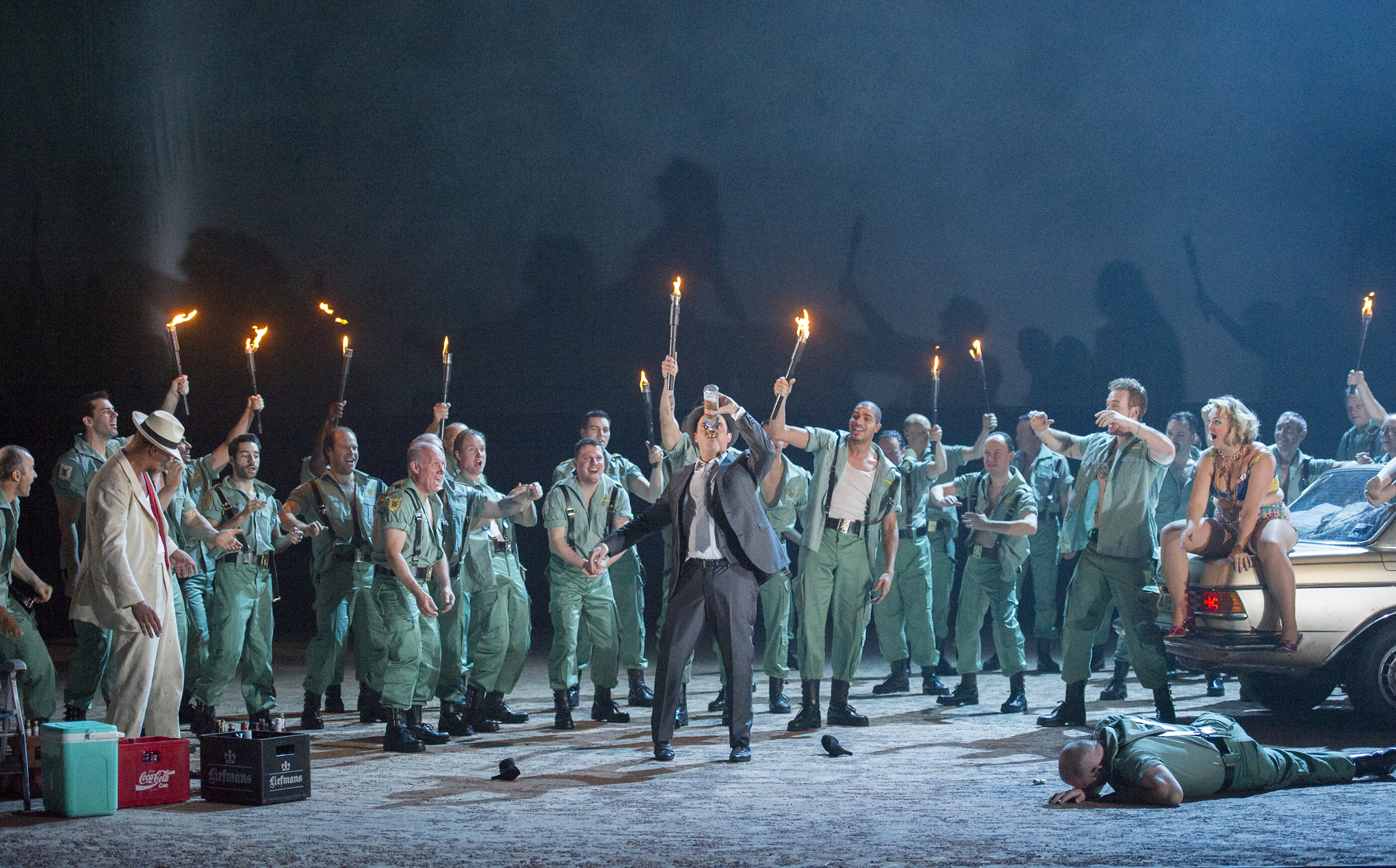
The ultimate femme fatale returns in a provocative staging by director Calixto Bieito in his long-awaited U.S. opera debut. Set in the arid earthiness of post-Franco Spain, Bieito’s raw and cinematic vision of Carmen unabashedly provokes the intense emotions pulsing through this tale of love, lust and murder. The result is a powerful, uncompromising account of a defiantly free-spirited woman and her obsessive lover.

Two outstanding casts take the reins in Bizet’s blazingly tuneful score. One stars Irene Roberts as the impassioned Gypsy, Brian Jagde as the lovesick soldier and Zachary Nelson as the dashing bullfighter. The other is headed by Ginger Costa-Jackson, Maxim Aksenov and Michael Sumuel. Be swept into her deadly seduction as never before.

Music by Georges Bizet | Libretto by Henri Meilhac and Ludovic Halevy

carmen_slideshow5

Sung in French with English supertitles

Carmen_schedule

Running Time

2 hours, 45 minutes including one intermission

Who Should See It

Fans of great femme fatale roles and bold modern productions.

Pre-Opera Talks

Pre-Opera Talks are free to ticketholders and take place in the Orchestra section, 55 minutes prior to curtain.
CarmenCastCarmen_Watch

SYNOPSIS
ACT I 20th-century, Spain.

Corporal Moralès and his men are resting outside the guardhouse as Micaëla comes looking for Don José. The change of guard arrives, among them Corporal José and Lieutenant Zuniga. Zuniga questions José about the nearby cigarette factory and the girls who work there. The cigarette girls leave the factory for a break, and the men await a glimpse of Carmen. When she appears, Carmen flirts with them and gives a flower to José. Micaëla returns and gives José a letter from his mother. She leaves when he begins to read the letter that advises him to marry Micaëla and settle down. Screams are heard from the cigarette factory, and Zuniga sends José to find out the cause of the disturbance. José returns with Carmen and another girl, Manuelita, whose face has a knife wound allegedly inflicted by Carmen. When Carmen refuses to speak, Zuniga orders José to tie her hands and take her to prison and leaves to make out the warrant for Carmen’s arrest. Carmen hints to José about a rendezvous at her friend Lillas Pastia’s tavern, and José agrees to let her escape. When Zuniga returns with the warrant, Carmen breaks free as she is being led off to prison. José is demoted and arrested for his participation in Carmen’s escape.

carmen_slideshow2

ACT II

Carmen and her Gypsy friends Frasquita and Mercédès sing and dance at Lillas Pastia’s tavern. Zuniga tells Carmen that José has been released from prison. A procession announces the arrival of the toreador, Escamillo. Attracted to Carmen, he invites her to attend his upcoming bullfight but she declines. As the soldiers leave, Zuniga promises to return to see Carmen. Dancaïre and Remendado come to ask the three Gypsy girls to join them in a smuggling expedition. José arrives and gives Carmen the gold piece she sent him along with a file while he was in prison. He explains that his soldier’s honor prevented him from trying to escape. Carmen dances for José, but when retreat sounds, he starts to leave for the barracks. She taunts him and challenges him to follow her to the mountains. Zuniga returns and José attacks him in a jealous rage, but the smugglers break up the fight and disarm José. José has no choice but to join the band of smugglers.

ACT III

The smugglers are at work in the mountains. After a brief period of happiness, Carmen has become fed up with José’s jealousy. Frasquita and Mercédès read their own good fortune in the cards. When Carmen takes her turn, she only finds death. Dancaïre asks the girls to distract the customs men on duty, leaving José on guard. Looking for José, Micaëla is led to the smuggler’s cove by a mountain guide who warns her of the perils she faces. She hides as Escamillo arrives unexpectedly. A jealous José challenges him to a knife fight, but Carmen and the smugglers separate them. Escamillo invites the band of smugglers to his next bullfight. Micaëla is discovered hiding, and she tells José that his mother is dying. He leaves with her, but warns Carmen that they will meet again.

ACT IV

The crowd gathers outside the arena for the bullfight. When Carmen and Escamillo appear, Frasquita and Mercédès warn her that José is in the crowd. Carmen declares she is not afraid of José and waits alone outside the arena. José confronts her and begs that she return to him. She coldly tells him all is over between them and returns the ring he had given her. José stabs Carmen and confesses to the murder.

GALLERY

Posted in OPera | Tagged , , , , , , , | Leave a comment