Papageno wants Papagena – Tamino his Pamina. But the pathway to love is not a simple one! Everyone has to undergo difficult trials. They even have to decide against murder and suicide, and do without food and drink and sometimes even without speech and song. The things that help them survive danger are a flute and a set of magic bells. The most world-renowned opera in a classically beautiful production, the legacy of stage director August Everding. The snake still breathes “real” fire, the Queen of the Night is still really a “star-flaming” monarch. The stage portrait (by Jürgen Rose) is wondrous fair. The magic of this opera really works here.
When Pamina’s father died his wife, the Queen of the Night, lost her power, because he had handed the seal of the seven circles of the sun to the initiates. Sarastro is now administering the Sun King’s legacy.
The Queen of the Night is not willing to submit to being directed by the wise men around Sarastro. She endeavours to regain her former power.
In order to foil her plans, Sarastro has kidnapped Pamina, who is actually her father’s heir.
Act One
The Queen of the Night has chosen Prince Tamino to free her daughter. Pursued by a huge snake from which he is endeavouring to escape, the prince stumbles into the realm of the Queen of the Night and falls unconscious from exhaustion. Three ladies, attendants of the Queen of the Night, save his life.
When Tamino awakes, he discovers the snake lying dead at his feet. He meets Papageno and assumes that the bird-catcher has rescued him from the snake. Papageno does not contradict him and is punished for his boasting by the three ladies. They show Tamino a picture of Pamina and he immediately falls in love with her.
When the Queen of the Night herself appears on the scene, Tamino swears to deliver her daughter from the hands of the “demon” Sarastro. Tamino and Papageno, who is to accompany the prince, are given magical instruments to protect them from danger: a flute and a set of chimes. Three youths or genii are to accompany them on their journey to Sarastro’s palace.
Tamino has sent Papageno on ahead, and the latter meets Monostatos, who is keeping guard over Pamina and pursuing her with unwelcome attentions. Papageno’s appearance puts Monostatos to flight. Pamina now learns from Papageno that a prince, who is in love with her, is coming to set her free. Papageno persuades Pamina to flee.
In the meantime, Tamino has been led to Sarastro’s temple by the three youths. A priest, a spokesman of the initiates, emerges and informs him about Sarastro’s real character, assuring him that he is a kind, wise man and also telling him of Sarastro’s plan. Tamino also learns that Pamina is still alive. In his gratitude he plays the flute, the magic of which tames wild animals. Monostatos and his slaves catch up with Papageno and Pamina but they are able to free themselves again with the help of the set of chimes. Their plan to escape is then foiled again by the arrival of Sarastro.
Pamina and Tamino meet for the first time and fall into each other’s arms. Monostatos drags them apart, but, instead of the reward he expects for his services, he is punished by Sarastro.
Tamina and Papageno are led into the Temple of Ordeal.

Die Zauberflöte (The magic flute)

Die Zauberflöte (The magic flute)

Die Zauberflöte (The magic flute)

Die Zauberflöte (The magic flute)

Die Zauberflöte (The magic flute)

Die Zauberflöte (The magic flute)
Act Two
Sarastro informs the initiates of his plan to lead Tamino to a greater destiny and the priests approve his decision. Tamino, however, must first prove himself worthy of the greater happiness by submitting to the ordeals. Pamina and Tamino must take their leave of each other. Papageno is also to be put to the test. First of all, both he and the prince are enjoined to silence.
Tamino does not allow himself to be tempted by the three ladies of the Queen of the Night who have sneaked into the temple. In the meantime, the Queen of the Night has managed to reach her daughter and orders Pamina to kill Sarastro. Pamina cannot do this. Monostatos, who has overheard the Queen talking to her daughter and is
blackmailing Pamina by threatening to reveal all, is chased away by Sarastro. Sarastro is aware of Pamina’s predicament and is able to reassure her.
While Tamino and Papageno are awaiting further ordeals, an old crone appears and introduces herself as Papageno’s sweetheart. Before she can tell them her name, there is a clap of thunder and a flash of lightning and she disappears. Tamino plays his flute, the sound of which guides Pamina to him. She speaks to him but, not knowing that he has been enjoined to silence, she believes he does not love her any longer when she gets no answer. Life no longer seems worth living to her.
Sarastro considers Tamino to be capable of ruling as a wise prince, once he has surmounted the two last ordeals. Papageno, on the other hand, has failed and is afraid that he will be thrown into a dungeon for the rest of his life if he does not take the old crone as his wife. When he reluctantly agrees to do so, Papagena reveals herself as a young and attractive woman. The two of them are, however, still destined not to be united yet.
In her despair, Pamina is contemplating suicide. The three youths restrain her and lead her to Tamino, who is awaiting the final ordeals at the “Gate of Fear”. Accompanied by the music of the magic flute, the two of them undergo the ordeals by fire and water together and overcome despair and the fear of death.
In the meantime the three youths have brought Papageno and his Papagena together. The Queen of the Night and her ladies make a last bid for revenge by trying, in vain, to storm Sarstro’s palace and are cast into endless night.
Tamino and Pamina are welcomed into the temple by Sarastro and the priests.
© Bavarian State Opera
The Joy of Drawing Has Remained
A Conversation with Jürgen Rose about the Revised Production of Die Zauberflöte
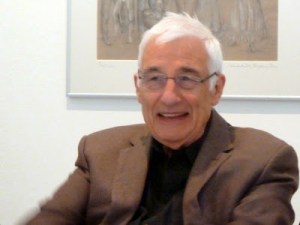
Jürgen Rose
They look like works of art all by themselves: the sketches, stage settings and costume designs Jürgen Rose created in elaborately loving detail for August Everding’s production of Die Zauberflöte back in 1978. In their abundance and elaborateness, they document the development of a production concept and bring back many a memory.
For this revised production of Die Zauberflöte you worked together with the theatre craftspeople to overhaul and freshen up the sets and costumes. What do you feel about an artistic work that meanwhile lies 26 years in the past? Is this also an encounter with yourself?
That’s exactly the point: we recognize ourselves in these works, and yet they are somewhat unfamiliar at the same time, because, of course, we’ve developed further. I was amazed at the nonchalance with which I approached this piece, and the ideas that emerged. I would do many things totally differently today. But we have to be very careful to keep from destroying our original ideas. Ultimately our task today is to give the production a new sheen, and restore some things that have perforce worn out over the years: whether these are damaged stage backdrops or hangers which have fallen away for pragmatic reasons, costumes that are missing or are no longer in their original condition because they had to be altered every time a role was re-cast, and so on. I’ve gotten used to this in the course of all the work I’ve done, especially for the ballet. John Cranko or John Neumeier ballets I designed 20, 30, 40 years ago are still being performed all over the world, and all the ballet companies place great value on keeping them as original as possible.
The sketches, designs and drawings that came about for this Zauberflöte production document different phases of the conceptual work. However, they also reveal that there were originally some ideas that were later not implemented. Does that indicate that the artistic conception had gone through a long maturation process?
Fundamentally, I need a lot of time to develop my ideas. It begins with collecting a great deal of material – photos, pictures, fabric samples, etc., which I can use to give form to my initial thoughts on the piece. In the case of Zauberflöte I had an abundance of images and ideas in my head, and I would have liked to put them all on the stage. Things were similar with August Everding, who was not staging the work in Munich for the first time. I remember, for example, that initially we had thought of a lavish salon for the Queen of the Night, a very feminine world in contrast to Sarastro’s domain, which we saw as architecturally more severe, built into a cliff or something like that. We considered how the Three Ladies might look, if they are perhaps birds, in other words fictional creatures like the serpent, or warrior maidens, and many other things. Then we began sorting out and discussing the various details. During these meetings I kept drawing sketches, so to speak as memoranda to myself. I work the same way with other stage directors. The complicated thing with Everding, however, was the he was so full of zeal for action, and there was never enough time for all the things he planned. Something always intervened: phone calls, appointments, visitors. When we started on the Zauberflöte, which was a very difficult piece for me, I really had to lock him up at my home, without the telephone or any other contact possibilities to the outside world so we could work concentratedly for a few hours on the piece. Those hours were terrific. Everding was absolutely brimming over with ideas, and his thoughts about the context of the drama and the music were absolutely thrilling. He really provoked me to turn those ideas into images. For all of this, when we went into rehearsal a half year later, many things had changed, and he showed up with new ideas he had just come up with. I actually like that sort of thing. But at a specific point in time a stage concept has to be nailed down in its basic structure. With Die Zauberflöte with its frequent scene changes, that is especially urgent. On top of that there was the difficulty of bringing this piece onto the huge stage of the Nationaltheater. I would have preferred doing it in the Prinzegententheater or even in the Cuvilliès-Theater, where the visual factors are more intimate and the technical sequences not quite so elaborate.
Everding stressed that the piece had to be performed seamlessly, in other words without long interruptions and scene changes. How did you manage that?
Naturally we used the stage machinery, but on such a big stage it always takes a few seconds for the side wagons to travel in or out, or for yard-long walls to open and close. There was always the hazard of things getting stalled. That’s why from time to time there were highly pragmatic reasons for changing the concept, in which the stage director would have to invent additional actions to make it possible for a given change in the scenic sequence to become integrated. Fortunately Everding was a real past master at that.
Everding was also determined to stress the human qualities in the characters and thus bring the basic idea of humanity to the fore. This was particularly clear in the characterization of the priests as 18th century human beings.
That was something totally new back then. Until that time the priests were generally decked out in Egyptian accessories, helmets from the time of the pharaohs, ritualistic garments, that sort of thing, For us, as you said, it was important to show them as human beings. Human beings who could have been Mozart’s contemporaries. We wanted our singers – Mr. Adam, Mr. Vogel, Mr. Auer and the others – to look quite natural, without artificially bouffant wigs, with their own hair, with only a pigtail pinned on to indicate the historical period. That was unusual back then, and I can remember that Jean Pierre Ponnelle in the Salzburg Zauberflöte production he did shortly after ours also had the priests come out in 18th century costumes. On the large stage of the Nationaltheater this attempt at individualization however didn’t quite come off. Today we would create different stage areas that focus more on the characters. That principle had not yet established itself back then.
One special “trade mark” of this production is also the wonderful bed-tree at the end and the entrance of the many little Papagenos and Papagenas.
Everding retained that idea with the children in all of his Zauberflöte productions. I’m sure there were also highly personal reasons for this. Everding had married rather late in life and then became the father of four sons. This conclusion attests to this highly personal happiness he felt, and it always goes over very well with the audience. Of course, a theatre man like Everding had calculated that precisely.
For the difficult question of who the Three Boys are and where they come from, you decided on a “floating” solution.
Here it was quite clear to us right from the start that these would definitely have to be three real children. Back then those roles were generally sung by three girl choristers. But we wanted children, three boys, who, in keeping with their enigmatic origin, become transformed in the course of the play, sometimes appearing as little Mozarts, sometimes as children from well-heeled homes, sometimes as little scamps. In any cased we wanted them to look totally terrestrial, even though they come floating in on a cloud.
We can also see this urge for naturalness in the delineation of the costume designs, when we look at your designs for the chorus, or more precisely, the “people”.
The people have only a tangential function in this drama. They come on to welcome Sarastro with jubilation, and they come back at the end, when Tamino and Pamina are taken into the community of the initiated. For this they often put the ladies in priestly robes, which makes absolutely no sense, because the unprecedented event here is that Pamina is the first woman to be taken into the order. I myself made those priestess costumes back in the sixties for a Zauberflöte production in Berlin, but it must always have been a disturbance. That’s why I considered how the people might look. I found the inspiration during a trip to Italy, where I saw Neapolitan crêches with their large spectrum of common people statuettes, whose liveliness fascinated me. The Munich National Museum owns a very large collection of such statuettes, and I myself began collecting them so I could study them down to the last detail. The same thing applies to Monostatos and the slaves. That way we were able to get away from the cliché of the evil Monostatos and give him a more human face.
Many of the costumes had to be reworked for the new revision. Were there problems there?
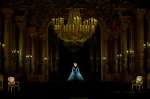
It was very complicated. The greatest difficulty was finding similar fabrics. You have to realize that most of the companies we originally acquired our materials from no longer exist today. Back then we had the good fortune that the Fuchs Company in Augsburg arranged to have the original fabrics for the costumes of the Queen and the Three Ladies woven for us in India. That may sound terribly upscale, but in those days it was totally affordable. Today we have to look around the textile market, that is to say select our materials from catalogues. Those fabric catalogues, however, are geared in color and material to current fashion trends. The few special firms that still exist today generally want to sell in large quantities. It also happens that a fabric, despite the same production number, looks quite different today. We saw that in the Queen of the Night costume. It’s still the same gown Edita Gruberova wore back in 1978, and all the Queens after her have also worn. Now it is already totally worn out. But the newly supplied cloth isn’t anywhere near as beautiful. So we had to decide in each individual situation whether we could retain the old costume or whether we would have to make a new one, in certain cases by sacrificing some æsthetic qualities. The same applies to the settings. This often has to do with certain skills, such as flat painting, which today’s craftspeople have not mastered on the same level today because there isn’t that much of a demand for it because of the change in stage æsthetics. And so we just had to refer back to what we already had.
You also staged Zauberflöte yourself for the first time in 1999 in Bonn. Were you influenced there by your experience in Munich?
No, because twenty years had passed from one production to the other. I saw it more as an opportunity to implement ideas I hadn’t yet realized. Of course I wanted the sequence to continue seamlessly here as well, but it was important to me to create more intimate spaces and delineate the characters more precisely. For instance, I wanted to make Monostatos into a really loving person and stage his tragedy as something like Othello’s and generally focus more on the relationships of the individual characters.
Are your set and costume designs today just as “picturesque” as your Zauberföte designs?
I work somewhat differently today and prefer to develop costumes on the body. I imagine a fabric or a color and want to try both of them out first on a dummy to see how the cloth falls or what effect the color has. In earlier times I would first paint the design, so to speak as a kind of ideal situation. Of course I still have to draw a lot of sketches, especially for ballet productions. They are the work material for the costume workshops. I like doing that, too, exactly as I still like to build my stage design models. Especially in the case of Zauberflöte, I designed the various spaces in minute detail on my models all the way to putting little figurines in them. That gave me a better spatial orientation than the drawing. To this day, I always begin a new job by initially designing the spaces for myself alone. Not until later, when the set is technically fixed, do I work with assistants on a stage model. I also need this first phase of concentration and the solitude that goes with it to develop costumes. I need to be alone when I face the challenge of sitting in front of an empty sheet of paper, designing, rejecting and starting over. But then I suddenly begin having fun again as I work everything through precisely. Over the past years I have drawn costume designs in the form of little scenes, in groups of figures. This of course has to do with my work as a stage director, which I am doing more and more these days. But the joy of drawing has remained.
Interview conducted by Hella Bartnig
English translation by Donald Arthur


 Presented in partnership with the French Institute Alliance Française

















































 Opera, My Love Magazine