“Babylon” in Munich

Bayerische Staatsoper 

PRESENTS:

Babylon

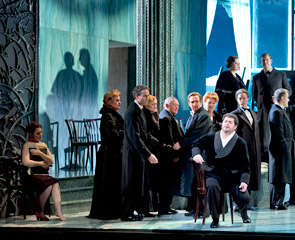
Babylon: Willard White (Priesterkönig), Statisterie Babylon: Ensemble, Chor und Statisterie der Bayerischen Staatsoper Babylon: Gabriele Schnaut (Euphrat), Chor der Bayerischen Staatsoper
Music by Jörg Widmann
Libretto by Peter Sloterdijk

Opera in seven pictures
The mighty city of Babylon becomes the setting for a transformation of civilisation at the moment when two cultures collide: Whilst the Babylonians are still practicing human sacrifice, the Jews, who have settled here in exile, have already abolished it. The opera follows this conflict through the love of the exile Tammu for the Babylonian Inanna, a priestess in the Temple of Free Love. When the gods unleash chaos in the universe, life on earth also becomes confused, meteorite storms threaten humankind, the Euphrates leaves its bed, and the Flood comes. The priest-king promises that peace and order will be achieved between heaven and earth through a human sacrifice, and the Babylonians carry this out in a frenzied celebration. But Inanna descends into the underworld to bring the sacrificed Tammu back to life and to be reunited with him. In the end, love wins the day and reconciliation between heaven and humankind replaces the old sacrifice. A contractual agreement forms the basis for a new world order, in which we will live today: the 7-day week, based on an orderly cycle of life.

The composer Jörg Widmann carried the idea of an opera about Babylon in him for a long time. His original fascination was aroused by the completely different concept of love, almost unimaginable for us, in Ancient Mesopotamia. The love between Tammu and Inanna has its origins in one of the most legendary mythological couples of Babylonian Antiquity, who had already inspired Mozart’s Magic Flute librettist Schikaneder: that between the hero Tammuzi and Inanna, goddess of love and war. 

In German with German surtitles

Commissioned work by the Bavarian State Opera

Partner of the world premières of the Bavarian State Opera

Playing time: 3 hours, 25 minutes (1 intermission)
6.00 p.m. : Introductory event
Saturday, 25 January 2014
Nationaltheater
7.00 p.m. – app. 10.25 p.m.

Cast

Musikalische Leitung Kent Nagano
Musik Jörg Widmann
Text Peter Sloterdijk
Inszenierung Carlus Padrissa – La Fura dels Baus
Bühne Roland Olbeter
Kostüme Chu Uroz
Video welovecode
Tigrelab
Licht Urs Schönebaum
Szenische Mitarbeit Tine Buyse
Dramaturgie Miron Hakenbeck
Moritz Gagern
Chor Sören Eckhoff

Seele Claron McFadden
Inanna Anna Prohaska
Tammu Jussi Myllys
Priesterkönig / Tod Willard White
Euphrat Gabriele Schnaut
Skorpionmensch Kai Wessel
Ezechiel August Zirner
Septette Kenneth Roberson
Dean Power
Silvia Hauer
Elsa Benoit
Iulia Maria Dan
Septette / Pförtner 1 Tim Kuypers
Septette / Der Schreiber / Pförtner 2 Tareq Nazmi
Ein Bote / Das Kind Tölzer Knabenchor
Priester Joshua Stewart

Bayerisches Staatsorchester
The Chorus of Bayerische Staatsoper


Posted in Music, OPera | Tagged , , , , , , , , | Leave a comment

“DARK SISTERS” in Pittsburgh

PITTSBUGH OPERA PRESENTS:Dark Sisters

DARK SISTERS

January 25, 28, 31; February 2, 2014
CAPA Theater

Music by Nico Muhly • Libretto by Stephen Karam

DARK SISTERS is part of Pittsburgh Opera’s 2014 American Opera Series

RIPPED FROM THE HEADLINES: MEDIA FRENZY PROMPTS SISTER-WIFE’S SELF-DISCOVERY
NEW PRODUCTION! After a raid on her family’s compound, sister-wife Eliza embarks on a quest for self-discovery. Her journey is burdened by tragedy and strife, in a work that “evokes the jittery buzz of reality television” (New York Times).

The Cast

Resident Artist Jasmine Muhammad Resident Artist Meredith Lustig
 
Resident Artist Nicole Rodin Resident Artist Samantha Korbey
Jasmine Muhammad *
Eliza
Meredith Lustig *
Zina
Nicole Rodin *
Ruth
Samantha Korbey *
Presendia
Resident Artist Joseph Barron  Alexandra Loutsion Rebecca Belczyk  
Joseph Barron *
The Prophet/King
Alexandra Loutsion **
Almera
 Rebecca Belczyk
Lucinda


Creative Team 

Conductor
Glenn Lewis
Stage Director George Cederquist *
Set Designer(s) Dan Daly
Costume Designer Antonia West
Lighting Designer Robert Figueira
   
Assistant Conductor James Lesniak
Chorus Master Mark Trawka
 Associate Coach/Pianist James Lesniak
 Hair & Makeup Designer James D. Geier

 + Pittsburgh Opera debut
* Pittsburgh Opera Resident Artist
** Pittsburgh Opera Resident Artist alumni

SYNOPSIS

ACT I
A lunar eclipse. Against the severe landscape – red earth, sharp cliffs and endless sky – that surrounds a polygamist compound in the American Southwest, five mothers cry out in despair. State officials have just raided their homes and removed all of their children, under the suspicion that minors are being abused and forced to marry by members of the sect.
The husband of the five women, a professed Prophet of God, discloses that he has received a Revelation. He must journey into the desert, where he will receive guidance: holy words that will ensure the return of their children. The Prophet instructs his wives to “keep sweet” while he is away, explaining that total obedience is necessary to ensure their salvation and the safe return of their children.

Eliza (the fourth wife) has visions of her only daughter, Lucinda. A room decorated with scripture and looming portraits of past Prophets triggers a memory: the day of her wedding. She was 16, afraid, an unwilling bride. Eliza does not want her daughter to suffer the same fate, but cannot imagine how they could ever leave this life. She has no friends or knowledge of the outside world. She has no way of making money or affording a place to live.
As night slowly turns to day, Eliza passes the time with her other sister-wives. Almera is haunted by dreams of her mother and grandmother, while Presendia and Zina work diligently to pass the time, longing for their husband’s return. Ruth is tormented by mental illness and the memory of her two sons, both of whom died tragically.

Ruth discovers a letter in the Prophet’s study and gives it to Eliza. The letter voices Lucinda’s concerns about being promised to a man so much older, almost 60. Eliza is shocked to learn that her daughter would be promised so soon. She resolves to leave the compound and hatches a plan to escape. The Prophet returns, and Eliza convinces him to spend the night with her. She needs his full trust so that she can travel with him the next day and enact a plan to share her own message with the world. Alone and forgotten in their bedrooms, the other women seethe with jealousy, sadness and longing.

ACT II
Split scene: the women sit in front of a TV camera in their large meeting room, while in Los Angeles a TV personality, King, interviews the women via satellite. The women are careful to stay on message. Afraid and distraught, Ruth suffers a breakdown during the interview and leaves the room. The women, paralyzed with fear and the intrusion of the media, continue with the show.

Eliza, nervous that she may not have the courage to speak out, suddenly explodes with the announcement that she was, indeed, married underage. She also seizes the opportunity to speak to her daughter – she looks directly into the camera and begs Lucinda to have faith, and to know that she, Eliza, has received her own divine message: “Say goodbye to men who encourage silent suffering – only a false Prophet would ask such things of you. Don’t be afraid of what lies beyond the sharp cliffs, the red earth – blaze a trail beyond the canyons, past the forests and gorges. This is my hope for you, Sisters of Zion! Hope and pray! I promise you, kind hearts beat for all of us in the outside world!”

Chaos erupts. Eliza’s sister-wives cannot believe she would betray them.
Later that night Ruth sits atop the mesa near the compound, under a starlit sky. She has been hiking all day. Praying for relief from her pain, and longing to be with her two children in heaven, she jumps off the cliff to her death.

Back at the compound, a few days later: Ruth’s funeral. The children have been returned to the ranch. Eliza arrives at the gate of the compound and is shunned by the other women. Lucinda approaches her mother, furious – she is sickened that Eliza lost her faith and will not gain eternal salvation. She would have preferred Eliza’s death to the course she is taking. Lucinda has no desire to leave the compound.

Eliza, watching Lucinda join the other women, realizes she cannot force her daughter to leave. She hopes that she will see her daughter again, and pledges that she will always be waiting for her, and will always love her. Heartbroken, she walks away from the compound and into the unknown.

Posted in Music, OPera | Tagged , , , , , , , | Leave a comment

“La traviata” in Munich

Bayerische Staatsoper

PRESENTS:

La traviata

La traviata: Piotr Beczala, Ermonela Jaho La traviata: Fabio Maria Capitanucci, Ermonela Jaho

Giuseppe Verdi

Libretto by Francesco Maria Piave

Men don’t fall in love with courtesans! That’s the opinion of Alfredo’s father after his son moves in with the mortally ill Violetta Valéry. In her love for Alfredo Violetta even agrees. She leaves him, dies poor, ill – still dreaming of the happiness of true love. One of Verdi’s most beloved operas continues to hold the mirror up to society and its hypocritical morality. An exemplary production! See it!

In Italian with German surtitles

Nationaltheater

Performances:
Tuesday, 31 December 2013, 6.00 p.m.
Friday, 3 January 2014, 7.00 p.m.
Monday, 6 January 2014, 6.00 p.m.
Tuesday, 15 April 2014, 7.00 p.m.
Saturday, 19 April 2014, 7.00 p.m.
Friday, 25 April 2014, 7.00 p.m.
Friday, 4 July 2014, 7.00 p.m.
Monday, 7 July 2014, 7.00 p.m.
Thursday, 10 July 2014, 7.00 p.m.

 SYNOPSIS

Scene One

Alfredo Germont, a young man from Provence, is introduced by Gaston, Vicomte de Letorieres, to Violetta Valery, a famous courtesan. She is giving a soiree in her house in Paris. Gaston knows how much Alfredo admires Valery, but initially she pays hardly any attention to Germont.

When Baron Douphol, with whom Violetta is having an affair, refuses to propose a toast in celebration of the evening, Alfredo, urged on by Violetta, declares his willingness to do so. He sings a passionate song in praise of love with Violetta and the party guests joining in.

As the guests go off to dance, Violetta suddenly feels faint and has to remain behind. Alfredo makes a declaration of love. Violetta turns him down with gentle scorn. Touched however by Alfredo’s candid overtures, she presents him with a camellia: he may return when the flower has withered, that is, within a day. At dawn the guests depart.

Alone, Violetta reflects on the senselessness of her past life. But still she refues to accept that she is falling in love with Alfredo.

Scene Two

Violetta has retreated to a country-house with Alfredo. Far away from Paris, she wants to enjoy some happiness with her beloved.

Alfredo learns from the servant Annina that Violetta intends to sell her valuables in order to support them.

After Alfredo has left the house in order to procure the necessary money himself, his father pays Violetta an unexpected visit. He asks that she break off the relationship with his son. Giorgio Germont demands this sacrifice because a liaison between his son and a courtesan would compromise his family and endanger his daughter’s proposed marriage.

Violetta is prepared to make the sacrifice and leave Alfredo on condition that Giorgio Germont reveal to his son after her death the true reasons behind her actions.

Violetta sends Annina with a message to her friend Flora Bervoix in Paris that she will attend her soiree that evening. Then she writes Alfredo a farewell letter. On the pretext of wanting to prepare for his father’s visit, Violetta leaves the unsuspecting Alfredo and returns secretly to Paris.

A few moments later a messenger brings Alfredo Violetta’s letter. She informs him that she has decided to return to her former life.

Alfredo’s father tries in vain to persuade his son to return to the family. Alfredo rushes off to Paris to Flora’s salon.

Scene Three

There is dancing, singing and gambling at the courtesan Flora Bervoix’s soiree. Alfredo is looking for Violetta. He appears to be desinterested when asked about his mistress. The guests invite him to take a seat at the gambling table.

Soon after Violetta enters the room on the arm of her former lover, Baron Douphol. At the gambling table Alfredo provokes not only the Baron but also Violetta with his remarks.

After the guests have sat down to dinner, Alfredo is able to speak with Violetta alone. She pretends to be in love with the Baron and implores Alfredo to leave at once, as she is afraid he might lose his life in a duel with Douphol.

In a state of extreme agitation Alfredo summons the guests. In front of the assembled people he throws the money he has won at Violetta’s feet. Alfredo’s father enters at this moment and rebukes his son for his lack of self-control. The emotional upheaval has drained Violetta. Rejected by the others, she slowly leaves the room.

Scene Four

Some time later. Besides her deteriorating health Violetta is now financially ruined. Doctor Grenvil consoles the dying woman.

In a letterfrom Giorgio Germont,Violetta learns that there has been a duel between Alfredo and Douphol. Germont announces furthermore that his son will be arriving.

Violetta feels that death is imminent. Outside a carnival procession passes by. Annina prepares Violetta to meet Alfredo who has returned.

The lovers embrace passionately. Alfredo pleads with Violetta for forgiveness. Violetta experiences one last surge of life, then succumbs. Doctor Grenvil and Giorgio Germont find a dying woman.

Translation: Christopher Balme
© Bayerische Staatsoper

CAST AND CREATIVE TEAM

Conductor

Paolo Carignani (c) Barbara Aumüller

<!–

–>


Production

Günter Krämer

<!–

–>


Set

Andreas Reinhardt
Geboren in Meißen; Ausbildung an der Hochschule für Bildende Künste in Dresden und an der Deutschen Akademie der Künste Berlin. 1965 Bühnenbildner am Berliner Ensemble; 1977 Bühnenbildner an den Staatlichen Schauspielbühnen Berlin; seit 1978 freier Bühnenbildner in München. Ausstattungen an allen großen europäischen Opernhäusern – u.a. Der Ring des Nibelungen in Hamburg – sowie bei den Festspielen von Bayreuth, Salzburg und Spoleto. An der Bayerischen Staatsoper schuf er das Bühnenbild zu La traviata, die Gesamtausstattung zu Il barbiere di Siviglia (Inszenierung: Ruth Berghaus), zu Henzes Der junge Lord und zu Lohengrin.

<!–

–>


Costumes

Carlo Diappi

<!–

–>


Lighting

Wolfgang Goebbel
Wolfgang Göbbel
Geboren in Ulm. Zahlreiche Arbeiten an verschiedenen renommierten europäischen Bühnen wie z.B. an der English National Opera (Tristan und Isolde, Un ballo in maschera, Béatrice et Bénédict), am Châtelet Paris (King Arthur) oder bei den Salzburger Festspielen (Der Kirschgarten). An der Bayerischen Staatsoper entwarf er das Licht-Design zu Lucia di Lammermoor, Un ballo in maschera und La traviata.

<!–

–>


<!–

–>


Violetta Valéry

Ailyn Pérez © Paul Mitchell

<!–

–>


Flora Bervoix

Tara Erraught (© Christian Kaufmann)

<!–

–>


<!–

–>


Alfredo Germont

Ivan Magrì

<!–

–>


<!–

–>


<!–

–>


Baron Douphol

Christian Rieger

<!–

–>


Marquis d’Obigny

Tareq Nazmi

<!–

–>


<!–

–>


Giuseppe

Matthew Grills

<!–

–>


Ein Diener Floras

Leonard Bernad

<!–

–>


Ein Gärtner

Rafał Pawnuk
Posted in Music, OPera | Tagged , , , , , , , , | Leave a comment

“Hänsel und Gretel” in Munich

Bayerische Staatsoper 

PRESENTS:

Hänsel und Gretel

Hänsel und Gretel: Tara Erraught (Hänsel), Hanna-Elisabeth Müller (Gretel) Hänsel und Gretel: Tara Erraught (Hänsel), Hanna-Elisabeth Müller (Gretel)

Engelbert Humperdinck

Libretto by Adelheid Wette

Fairy Tale Opera in three pictures

Since its first performance in 1893, Humperdinck’s most famous opera Hansel and Gretel has remained constantly popular, becoming over the generations almost synonymous with the first family visit to the opera. “Brother come and dance with me!“ – “Susie, dear Susie” – a dancing brother and sister, the Dew Fairy and the Sandman, the Witch and the parents: a collection of all the fairy tale elements of the 19th century. And yet this is also a tale of hardship, hunger and the desire for abundance with a clear moral: “When the need is greatest, God the Lord puts out His hand!“
And, in Richard Jones’ opulent, brilliant setting, it’s a real must!

In German

In cooperation with the Welsh National Opera, Cardiff

Ausstattungspartner der Bayerischen Staatsoper
Performances:
Sunday, 29 December 2013, 2.00 p.m.
Sunday, 29 December 2013, 7.00 p.m.
 

SYNOPSIS

Act One

Hansel and Gretel are alone at home and do not want to do any work. They are hungry and sad about the fact that there is scarcely anything to eat in their home most of the time. Gretel shows her brother the freshly-filled jug of milk with which their mother plans to make a rice pudding in the evening. Both children take several sips of the milk, the level drops increasingly. They are dashing around and dancing when their mother comes home. She is angry and wants to punish the children and while doing so she accidentally knocks the milk jug over and sends the two of them off to collect berries. In despair she bemoans the fact that the family is so poor.

Their father comes home in a good mood. He has had a successful day for once, he is slighty drunk and brings home a bag full of food. He is worried about his children and tells his wife about the witch who bakes children in her oven, turning them into gingerbread children which she then eats. The parents set out to search for their children.

Act Two

Hansel has picked berries and Gretel has woven a wreath of flowers. Hungry still, and acting more wildly, they eat all the berries. They cannot find their way home again. They wander around, lost and frightened. A strange being appears: the sandman, who strews sand in their eyes. Drunk with sleep they say their evening prayer and lie down. They dream.

Act Three

Next morning the children are awoken by another unknown being, who introduces herself as the little dew fairy. They realize that they have both had the same dream. They suddenly come across huge sweets and stuff them in their mouths greedily. With every bite a mysterious voice is heard, Hansel and Gretel think they have just imagined it and continue to eat. They are taken prisoner by the witch, who overpowers them with ever more to eat, Hansel is tied up. The witch plans to bake the children in a huge oven. The children craftily trick the witch and push her into the hot oven. Suddenly numerous children, who have been turned into gingerbread children by the witch, come alive again. The worried parents rush in and everyone is pleased to see each other again and glad about the fact that the witch is dead.

CAST AND CREATIVE TEAM

Conductor

Tomáš Hanus (© Jakub Świetlik)
<!–


–>


Production

Richard Jones
<!–


–>


Set and Costumes

<!–


–>


Revival director

 
<!–


–>


Lichtkonzept

<!–


–>


Lighting

Michael Bauer
<!–


–>


Choreography

 
<!–


–>


Einstudierung Choreographie

 
<!–


–>


Einstudierung Kinderchor

Stellario Fagone
<!–


–>


<!–


–>


<!–


–>


<!–


–>


<!–


–>


Die Knusperhexe

Kammersänger Kevin Conners
<!–


–>


Sandmännchen / Echo IV

Yulia Sokolik
<!–


–>


Taumännchen / Echo I

Elsa Benoit
<!–


–>


<!–


–>


Echo III

 
<!–


–>


Posted in Music, OPera | Tagged , , , , , , , , , | Leave a comment

“La forza del destino” in Munich

Bayerische Staatsoper 

PRESENTS:

La forza del destino

La forza del destino: Jonas Kaufmann, Anja Harteros La forza del destino: Jonas Kaufmann, Ludovic Tézier La forza del destino: Anja Harteros
Giuseppe Verdi
Libretto after Duque de Rivas’ drama Don Álvaro o La fuerza del sino by Francesco Maria Piave (1862),adapted by Antonio Ghislanzoni (1869)Opers in four acts
Second version adapted 1869
La forza del destino – what is the meaning of the destiny that Verdi uses so forcefully for the title of this family tale of various outlaws in his opera of 1862, revised in 1869? Who forces Leonora, and Alvaro as the murderer of her father, to enter the hermitage of a monastery – and confronts them there, in a mighty showdown, with the brother who is full of hatred and cannot forgive? Is it a declaration of war against God’s promise of redemption? The heavenly cantilena of a solo violin rises at the end of the opera – in the face of the death of the hero’s lover and brother. Those who withdraw into the consoling twilight of a divine peace here are only trying to deny one thing: the force of destiny.In Italian with German surtitles

New production

This performance will be broadcast live on STAATSOPER.TV.
 

Performance Dates:

Wednesday, 25 December 2013, 6.00 p.m.
Saturday, 28 December 2013, 6.00 p.m.
Thursday, 2 January 2014, 7.00 p.m.
Sunday, 5 January 2014, 6.00 p.m.
Wednesday, 8 January 2014, 7.00 p.m.
Saturday, 11 January 2014, 7.00 p.m.
Friday, 25 July 2014, 6.00 p.m.
Monday, 28 July 2014, 6.00 p.m.
Thursday, 31 July 2014, 6.00 p.m.

SYNOPSIS

Act One

Leonora di Vargas is in love with Alvaro. Her father, the Marchese di Calatrava, refuses to accept the relationship on the grounds of Alvaro’s  background. Together with her confidante, Curra, Leonora is waiting for her beloved, with whom she plans to elope. The Marchese enters the room and discovers them. Alvaro is armed and throws down his pistol as a token of  his surrender. At that moment the pistol goes off and the shot fatally wounds the Marchese. As he dies, the father curses his daughter.  

Act Two

Assuming that Alvaro has deliberately killed his father, Leonora’s brother Carlo is seeking revenge. Disguised as a student he scours the land in search of the murderer of his father. Leonora has lost sight of Alvaro and believes him to be dead. Dressed in men’s clothing, she overhears her brother in an inn saying that Alvaro is on the way to America. Preziosilla stirs up enthusiasm for war and prophesies a dreadful end for the student, the appearance of whom she does not trust.

Leonora wishes to devote herself to God in a solitary environment. Seeking sanctuary in a monastery, she begs Fra Melitone to be allowed to speak to Padre Guardiano. At the suggestion of her father confessor she hopes he will allow her to live the life of a  hermit in a cell. She is prepared for a secluded life by the monks.

Act Three

Alvaro has joined the army under a new name. He saves an officer’s life during a violent altercation. This officer is none other than Carlo, who is also serving under an assumed name. The two men swear eternal friendship – without recognizing each other. When Alvaro is wounded he gets Carlo to promise to destroy his personal papers if he dies. This awakens Carlo’s suspicions and he opens the papers, finds a picture of his sister and recognizes in Alvaro the presumed murderer of his father. He decides to kill his „friend“.

In the soldiers‘ camp, Preziosilla extols the liberal way of life in wartime. Fra Melitone reproaches the celebrating soldiers for their godlessness and is driven out.

Carlo makes sure that Alvaro has recovered and challenges him to a duel. The fighting men are separated. Alvaro decides to enter a monastery.

Act Four

Fra Melitone is distributing meals to the needy. Alvaro now lives in a monastery under the name of Padre Raffael. Carlo nevertheless recognizes him as his father’s murderer. They fight a duel. In her loneliness Leonora calls on God and begs for salvation in death. Carlo is wounded in the duel. Alvaro seeks help – in Leonora’s cell of all places. The two of them recognize each other. Leonora wants to stand by Carlo as he dies but he kills her. Alvaro is left alone in his despair.

Conductor

Asher Fisch
<!–


–>


Production

Martin Kusej (c) Karin Rocholl
<!–


–>


<!–


–>


Costumes

 
<!–


–>


Lighting

Reinhard Traub
<!–


–>


Dramaturgy

 
<!–


–>


Dramaturgy

 
<!–


–>


<!–


–>


Il Marchese di Calatrava / Padre Guardiano

Vitalij Kowaljow
<!–


–>


Donna Leonora

Anja Harteros (c) Marco Borggreve
<!–


–>


Don Carlo di Vargas

Ludovic Tézier
<!–


–>


<!–


–>


Preziosilla

Nadia Krasteva
<!–


–>


<!–


–>


<!–


–>


<!–


–>


Mastro Trabuco

Francesco Petrozzi
<!–


–>


Un chirurgo

Rafał PawnukRafal Pawnuck

Bayerisches Staatsorchester
The Chorus of Bayerische Staatsoper

Posted in OPera | Leave a comment

La sonnambula in Barcelona

logoliceu 

Presents:

La sonnambula

Vincenzo Bellini

27, 28 and 30 January and 1, 2, 4, 5, 8, 9, 11, 14 and 17 February 2014


Bel canto in the spirit of ballet blanc

If there is one title that occupies a unique place in Barcelona’s nearly two centuries of operatic history, it is unquestionably Bellini’s La sonnambula. Its Barcelona premiere, at the Teatre de la Santa Creu, went down in history as veritable apotheosis, an unqualified success, which was repeated when it came to the Gran Teatre del Liceu. An opera season without this masterpiece of bel canto was virtually unthinkable. Its unwittingly Freudian fascination with the loss of consciousness and its implicit fondness for the dreamlike create a truly Romantic ecstasy comparable to the ballets blancs then fashionable in imperial courts: Amina’s emotional fragility is on a par with Giselle’s. Marco Arturo Marelli’s production is perfectly in tune with the notion of semi-serious opera, striking a delicate balance between humour and Romantic pathos.  


Opera semiseria in two acts. Libretto by Felice Romani based on La Somnambule by Eugène Scribe and Germain Delavigne and  La Somnambule ou L’arrivée d’un nouveau seigneur by Eugène Scribe and Pierre Aumer. Music by Vincenzo Bellini. Premiered on 6 March 1831 at the Teatro Carcano in Milan. First Barcelona performance at the Teatre de la Santa Creu on 21 April 1836. First staged at the Gran Teatre del Liceu on 5 August 1848. Most recent performance at the Gran Teatre del Liceu: 29 January 1987.

Conductor
Daniel Oren

Stage direction
Marco Arturo Marelli

Scenography and Lighting
Marco Arturo Marelli

Costume
Dagmar Niefind

Co-production
Wiener Staatsoper (Viena) / Royal Opera House Covent Garden (London)

Symphony Orchestra and Chorus of the Gran Teatre del Liceu

CAST

<:section>

 
Amina Diana Damrau 27 and 30 Jan, 2, 5, 8, 11, 14 and 17 Feb
Patrizia Ciofi 28 Jan, 1, 4 and 9 Feb
Elvino Juan Diego Flórez 27 and 30 Jan, 2, 5, 8, 11 and 14 Feb
Celso Albelo 28 Jan, 1, 4, 9 and 17 Feb
Comte Rodolfo Nicola Ulivieri 27 and 30 Jan, 2, 5, 8, 11, 14 and 17 Feb
Michele Pertusi 28 Jan, 1, 4 and 9 Feb
Lisa Eleonora Buratto 27 and 30 Jan, 2, 5, 8, 11, 14 and 17 Feb
Sabina Puertolas 28 Jan, 1, 4 and 9 Feb
Teresa Gemma Coma-Alabert  
Alessio Alex Sanmartí  
Un notari Jordi Casanova


sonambula_cg_8_02 sonambula_cg_1_02 sonambula_cg_2_02 sonambula_cg_3_02 sonambula_cg_4_02 sonambula_cg_5_02 sonambula_cg_6_02 sonambula_cg_7_02

Photos: RHO / Bill Cooper

Posted in Music, OPera | Tagged , , , , | Leave a comment

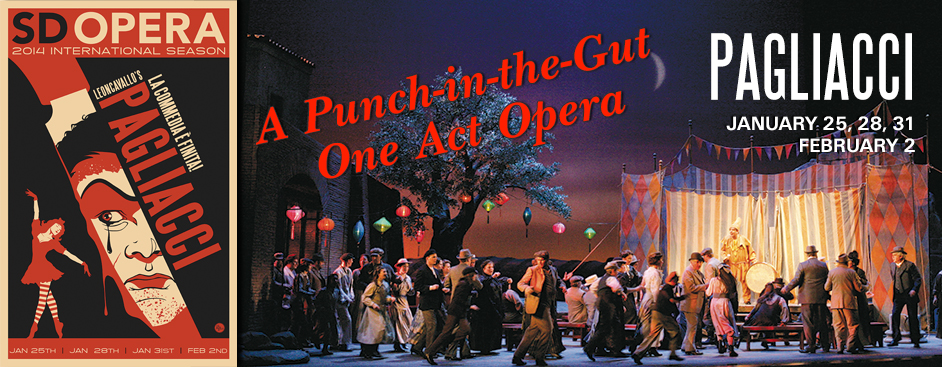
“Pagliacci” in San Diego

San Diego Opera presents:


PAGLIACCI

by Ruggero Leoncavallo

PERFORMANCES:

JANUARY 25, 28, 31; FEBRUARY 2, 2014

“Crazed clown murders wife in front of live audience” is what the headlines would have screamed after the jealous Canio stabs his wife Nedda and her lover to death in a jealousy-driven rage while performing a comedy before an audience of shocked Italian villagers.

One of the most powerful operas in the repertoire, Pagliacci is gut-wrenching as Tonio, a member of the traveling troupe of players rejected by Nedda, sees her with another man and tells Canio how to get vengeance. In the famous aria “Vesti la giubba”, Canio applies his clown make-up saying that the show must go on, but creates his own tragic ending.

Debuting artist Romanian soprano Adina Nitescu, a consummate actress at the Paris Opera, Metropolitan Opera and Florence, and dynamic baritone Stephen Powell, with recent performances for Virginia Opera and Cincinnati Opera, are joined by American tenor Frank Porretta, fresh from successes at Washington National Opera and Deutsche Oper Berlin. Yves Abel, following his great success leading The Daughter of the Regiment last season, returns to conduct with Andrew Sinclair directing this extraordinary production.

The running time is approximately 1 hour and 18 minutes with no intermission. There will be no late seating.
Sung in Italian with English translations displayed above the stage.

Pagliacci

SYNOPSIS OF PAGLIACCI

In the Prologue, Tonio the clown steps before the curtain to announce that the author has written about actors, who know the same joys and sorrows as other people.

PART I

Villagers mill around as a small theatrical road company arrives at the outskirts of a Calabrian town. Canio, head of the troupe, describes that night’s offering, and when someone jests that the hunchbacked Tonio is secretly courting his wife, Nedda, Canio warns that her fidelity is no joking matter. Vesper bells call the women to church and the men to the tavern, leaving Nedda alone. Disturbed by her husband’s vehemence and suspicious glances, she envies the freedom of the birds soaring overhead. Tonio appears and tries to make love to her, but she laughs at him. Enraged, he reaches for her, and she lashes out with a whip. Nedda in fact does have a lover — Silvio, who now appears and persuades her to run away with him after the evening’s performance. But Tonio, who has seen them, hurries off to tell Canio. Soon the jealous husband bursts in. Silvio escapes, and Nedda refuses to identify him, even when threatened with a knife. Beppe, another player, restrains Canio, and Tonio advises him to wait until evening to catch Nedda’s lover. Alone, Canio cries out that he must play the clown though his heart is breaking.

PART II

The villagers, Silvio among them, assemble to see the play Pagliaccio e Colombina. In the absence of her husband, Pagliaccio (played by Canio), Colombina (Nedda) is serenaded by her lover Arlecchino (Beppe), who dismisses her buffoonish servant Taddeo (Tonio). The two sweethearts dine together and plot to poison Pagliaccio, who soon arrives; Arlecchino slips out the window. With pointed malice, Taddeo assures Pagliaccio of his wife’s innocence, firing Canio’s real-life jealousy. Forgetting the play, he demands that Nedda tell him her lover’s name. She tries to continue with the script, the audience applauding the realism of the “acting.” Maddened by her defiance, Canio stabs Nedda and then Silvio, who has rushed forward to help her. The comedy is ended.

© Copyright OPERA NEWS 2007.

THE CAST

Please click an artist’s name to read more.

San Diego Opera’s performances take place at the Civic Theatre, at the intersection of Third Avenue and B Street in downtown San Diego.

Posted in Music, OPera | Tagged , , , , , , , , | Leave a comment

“Il Trittico” performed by Opera Carolina

OPERA CAROLINA PRESENTS:

Performance

  • Belk Theater (130 North Tryon St., Charlotte, NC 28202) Saturday, January 18th, 2014 @ 8:00pm
  • Belk Theater (130 North Tryon St., Charlotte, NC 28202) Thursday, January 23rd, 2014 @ 7:30pm
  • Belk Theater (130 North Tryon St., Charlotte, NC 28202) Sunday, January 26th, 2014 @ 2:00pm

Il Trittico is a triptych of one-act operas by Giacomo Puccini commissioned by the Metropolitan Opera. Il Trittico premiered on December 14, 1918 at the Metropolitan Opera.

Performed in Italian with English titles.

The libretto for Il Tabarro is by Giuseppe Adami, based on the play La houppelande by Didier Gold.

The libretto for Suor Angelica is by Giovacchino Forzano.

The libretto for Gianni Schicchi is by Giovacchino Forzano, based on an episode in Dante’s Inferno.

SYNOPSIS

Il Tabarro (The Cloak)

Paris. A barge docked along the Seine, c. 1910. Michele and his young wife Giorgetta have hired Tinca, Talpa and Luigi to unload the barge. The sun is setting; the day’s work is nearly complete. Giorgetta, who has been cool to her husband lately, brings wine for the men as reward for their labors. When she refuses his kiss, Michele leaves the men and Giorgetta to drink, and dance the hurdy-gurdy. He returns to tell his wife that work is scarce, and that he will have to let one of the men go. He is surprised when she suggests releasing Talpa or Tinca, but keeping Luigi. After a visit from Talpa’s wife Frugola, who rummages the streets of Paris, Tinca and Talpa leave for home. Luigi stays behind to ask Michele if he will take him to Rouen, where he hopes to start afresh. Michele says he’s better off in Paris and offers to keep him on. Left alone, Giorgetta and Luigi profess their passionate love for each other. Luigi vows to kill Michele so they can be together and they agree to meet that night. Michele asks his wife why she no longer loves him. Has she turned away from him because of his age and the death of their child? Michele concludes she has been unfaithful with one of the workmen and waits in the darkness. In the silence, Luigi enters to rendezvous with Giorgetta. He is caught by the jealous husband who strangles him, and hides his body in his cloak; revealing to Giorgetta the body of her lover.

Suor Angelica (Sister Angelica)

17th century Italy. A convent near Siena. As the nuns are leaving the chapel, Sister Genevieve admires the May sunshine streaming across the fountain. We learn that Sister Angelica comes from a wealthy and noble family and that she has not received a single visitor or letter in the seven years she has been cloistered. The Abbess announces a visitor is waiting for Sister Angelica. It is Angelica’s aunt, the Princess. Coldly, the old woman approaches her niece. She reminds her that when her parents died, she was entrusted with the care of their children and the family fortune. As Executor, she has decided that Angelica must renounce all claims to the family wealth, as her sister is engaged to be married. She brusquely presents Angelica with a legal document to sign. “After seven years this is all you have to say? Tell me about my son, the child who was taken from me, who I only saw once,” Angelica cries. Stiffly, the Princess tells her that her son died two years ago. As coldly as she entered, she leaves. In her anguish, Angelica takes poison, hoping to join her son in Heaven. At the last moment of her life, she realizes she has committed the mortal sin of suicide, and begs the Madonna for salvation. A miracle of forgiveness unites Sister Angelica with her lost son as the curtain falls.

Gianni Schicchi

15th century Florence, Italy. Surrounded by his relatives in his bedchamber, Buoso Donati, the richest man in Tuscany, dies. A rumor spreads: Buoso has left everything to the Church. Chaos ensues as the relatives tear apart the room to find the will, which only confirms the rumor. Buoso’s nephew, Rinuccio claims that only one person can save them – Gianni Schicchi. He has called for Schicchi and his daughter, Lauretta, who he wants to marry. Over the protestations of Rinuccio’s ancient aunt, Schicchi arrives. At first he refuses to help the hated Donati family, but his daughter, in the famous aria, “O mio babbino caro,” convinces him. Schicchi’s plan is set in motion: “You will call for a lawyer and witnesses. When the lawyer enters, I will imitate Buoso’s voice and dictate a new will.” The relatives are delighted and each lobbies Schicchi to leave them a piece of property. He warns them that the sentence for falsifying a will is exile. The lawyer and witnesses enter, and Schicchi, nearly good to his word, dictates a new will, leaving each relative the property they asked for, but leaving the best of the best to Buoso’s dear friend, Gianni Schicchi.

Giacomo Puccini (1856-1924)

Giacomo Antonio Domenico Michele Secondo Maria Puccini was born in Lucca in Tuscany, Italy on December 22, 1858 into a family of five generations of church organists, choirmasters and composers. His father died when Giacomo was five years old, and he was sent to study with his uncle Fortunato Magi, who considered him to be a poor student. As a teenager, Puccini served as an organist to the area churches and played the piano as entertainment at social events. In March 1876, the twenty-year old walked thirty kilometers to attend a performance of Verdi�s latest opera success, Aida. This event changed his life and he decided that he would make opera his life�s work.

The greatest influence in Puccini’s life was his mother, who petitioned and received a grant to send her son to the Milan Conservatory, where he worked diligently at his music and received his diploma in 1883. While studying at the Conservatory, Puccini obtained a libretto from Ferdinando Fontana, and entered a competition for a one-act opera in 1882. Although he did not win, Le Villi was later staged in 1884 at the Teatro Dal Verme and it caught the attention of Giulio Ricordi, head of G. Ricordi & Co. music publishers, who commissioned a second opera, Edgar, in 1889.

Edgar failed: it was a bad story and Fontana’s libretto was poor. This may have had an effect on Puccini’s thinking because when he began his next opera, Manon Lescaut, he announced that he would write his own libretto so that “no fool of a librettist” could spoil it. Ricordi persuaded him to accept Leoncavallo as his librettist, but Puccini soon asked Ricordi to remove him from the project. Four other librettists were then involved with the opera, due mainly to Puccini constantly changing his mind about the structure of the piece. It was almost by accident that the final two, Illica and Giacosa, came together to complete the opera. They remained with Puccini for his next three operas and probably his greatest successes: La Boheme, Tosca and Madama Butterfly.

Puccini’s next project took up a different dramatic challenge. Il Trittico is a group of three sharply contrasting one-act operas that together make up a complete evening: a sinister melodrama Il Tabarro; a sentimental religious tragedy, written entirely for women’s voices (Suor Angelica); and a comic Opera (Gianni Schicchi).

ARTISTS:

Jill Gardner, Sister Angelica in Suor Angelica
Soprano

Noted for her “effortlessly produced, rich voice” (Opera News), American soprano Jill Gardner is swiftly establishing herself among today’s leading operatic heroines. This “powerhouse soprano” (Syracuse New Times) continues to garner national praise for her “sparkling personality” (Coral Gables Gazette), her “lustrous, golden soprano and riveting stage presence” (Rochester Democrat and Chronicle) and for “her commitment, passion and ability to convey vocally the slightest nuance of emotion, making for gripping theater” (Opera News). Equally praised for her acting as well as her singing, Opera News observed of her Boston Lyric Opera performances of Tosca, “Soprano Jill Gardner, whose voice was fresh and focused, undertook the title role as if it were newly written. There was little of the conventional grand diva in her approach, and her character was all the more human for it. In Gardner’s hands, her Act II aria, “Vissi d’arte”, was not merely a famous showstopper but an opportunity to reveal layers of Tosca’s character.”

For the 2012-2013 season, Ms. Gardner sings the title role of Tosca in her debut with Opera Carolina as well as Arizona Opera and Hawaii Opera Theater. She will also join the roster of the Washington National Opera, covering the title role of Manon Lescaut in the spring.

During the 2011-2012 season the soprano returned to Arizona Opera and Tri-Cities Opera in the title role of Puccini’s Madama Butterfly and reprised the role of Nedda in I Pagliacci in her debut with Michigan Opera Theater as well as for the inaugural season of Mill City Summer Opera in Minneapolis, MN. On the concert stage, she marked her debut with the Wichita Symphony in Beethoven’s Mass in C Major.

In the 2010-2011 season, Ms. Gardner made her celebrated return to Boston Lyric Opera in the title role of Tosca as well as making her company debuts with Arizona Opera in the role of Liu in Turandot, Opera Grand Rapids in her role debut of Manon in Manon Lescaut and Eugene Opera as Musetta in La Boheme. This season also marked Ms. Gardner’s role debut of Leonora in Verdi’s Il Trovatore with Piedmont Opera.

Over the past few seasons, the young soprano marked her Lyric Opera of Chicago debut performing Nedda in I Pagliacci and covering Mimi in La Boheme, her Florida Grand Opera debut as Musetta in La Boheme, her Boston Lyric Opera debut as Mimi in La Boheme, her Madison Opera debut as Marguerite in Faust, as well as performing Countess Charlotte Malcolm in Sondheim’s A Little Night Music in her debut with Hawaii Opera Theater where she returned in the following season as Helmwige in Die Walkure. In concert, she made her Kennedy Center Debut with the Washington Chorus, under the baton of Julian Wachner, in a concert called The Essential Puccini, performed Beethoven’s 9th Symphony and Vaughan William’s Serenade to Music with the Syracuse Symphony, Brahms’ Requiem with the Binghamton Philharmonic and Verdi’s Requiem with the Tower Arts Series of Dallas’ Highland Park United Methodist Church under the baton of Craig Jessop.

Additional engagements from recent seasons include a return to the Glimmerglass Opera as Eurydice in a new production of Orpheus in the Underworld, Margaret Johnson in the first opera house performances in The Light in the Piazza with Piedmont Opera, Hanna Glawari in The Merry Widow with the Syracuse Opera, the title role in Susannah with New York Opera Projects, Donna Anna in Don Giovanni, Mimi in La Boheme as well as the title role in Puccini’s Tosca with the Mercury Opera Rochester, and multiple performances with the Tri-Cities Opera including Violetta in La Traviata and Countess in Le Nozze di Figaro. Ms. Gardner also performed the role of Madama Erlecca in Cimarosa’s Li Sposi per Accidenti at Studio Lirico in Cortona, Italy.

In the summers of 2005 and 2006, Ms. Gardner was a member of the prestigious Young American Artist Program at the Glimmerglass Opera. During this tenure, she created the role of Madame Loiseau in the world premiere of Stephen Hartke’s The Greater Good, which was recorded on the Naxos Label. Also at the Glimmerglass Opera, Ms. Gardner added two new roles to her repertoire in cover assignments: Elle in Poulenc’s La Voix Humaine and the title role of Jenufa.

She has been the recipient of the Richard F. Gold Career Grant of the Shoshana Foundation-NYC, a Special Opportunity Award from the New York Foundation of the Arts, an Emerging Artist Grant from the Winston-Salem/Forsyth County Division of the North Carolina Arts Council and participated in a Public Masterclass on Puccini Style for the George London Foundation with Catherine Malfitano. She received a Master of Music degree in vocal performance from the University of North Carolina at Greensboro and a Bachelor of Music degree in piano performance from Centenary College of Louisiana.

Opera Carolina Performances:

Art to Poetry to Music (2013–2014)
Il Trittico (2013–2014)
Tosca (2012–2013)

Dongwon Shin, Luigi in Il Tabarro
Tenor

2012 began with Korean born tenor Dongwon Shin’s appearances in Montreal as Manrico which was now followed by his return to Dresden for this role. Last spring, he made his debut as Radames at Covent Garden and just prior at the Vienna Staatsoper and later in the spring performed Manrico in his return to Ft. Worth Opera. Earlier in 2011 he had performed the Verdi Requiem as well as Samson at the Teatro Verdi, Trieste. He also recently debuted with San Francisco Opera as Radames and performed Manrico in Dresden again to begin 2010-11 after scoring a great success as Manrico in his debut with the Semperoper, Dresden last season. He also covered Dick Johnson in San Francisco’s Fanciulla. Last year he performed Radames in his return to Opera Australia in their revival of Aida as well as completing his first engagement at the Metropolitan Opera covering Turridu. Just prior he debuted at the Deutsche Oper Berlin as Radames after performing his signature role Calaf again with Dayton Opera. In summer 2008 he sang a “thrilling” Radames in the Savonlinna Festival’s Aida. Earlier in 2008 he sang Calaf to glowing reviews with Ft. Worth Opera: “Tenor Dongwon Shin met the challenge on Saturday. His Nessun dorma was the highlight of an incredible evening for him and for the Fort Worth Opera.” That spring he also sang Manrico in Il Trovatore with Nashville Opera after making his Italian debut as Samson in Lecce. Just prior he was Calaf in Turandot with Palm Beach Opera having just performed this role with Opera New Zealand as “a superb Calaf with a wonderfully strong, fully italianate voice, and brought the house down in Nessun Dorma”. He made his professional operatic debut in 2005 as Radames in Aida with Opera Company of Philadelphia. In 2007 he made a dramatic debut with Opera Australia as Calaf in Turandot, arriving the day before the opening and receiving both public and critical acclaim-and has been reengaged to return in 2009.

Mr. Shin has also sung with the Philadelphia Orchestra under Christoph Eschenbach in the Gala Concert celebrating the 150th Anniversary of the Academy of Music. He first sang Calaf in Turandot with Santa Fe Opera in 2005 and subsequently sang it at the Thessaloniki Concert Hall Association.

Other recent engagements have included Radames in Aida with Houston Grand Opera under Carlo Rizzi, the title role in Samson et Dalila with Dayton Opera, Canio in Pagliacci with Opera Delaware, Pollione in Norma with Michigan Opera Theatre, and the Verdi Requiem with the Delaware Symphony. Mr. Shin distinguished himself early in a number of competitions including the Metropolitan Opera National Council Auditions (National Finalist), Loren Zachary Competition, Licia Albanese Puccini Foundation Competition, Caruso-Altamura International Competition, Maria Anderson Competition, Giargiari Competition (1st & Audience Favorite). He was a 2005 graduate of the Academy of Vocal Arts in Philadelphia, where he sang the title role in Puccini’s Edgar and Gennaro in Lucrezia Borgia. Before attending AVA, he received a BM in Music from Seoul National University and also attended Indiana University.

In 2012-13 he is with Arizona Opera as Manrico and performs Calaf and Cavaradossi in Korea and performs concerts in Seoul and throughout Korea. New roles coming up include Don Jose in Carmen and Luigi in Il Tabarro.

Opera Carolina Performances:

Il Trittico (2013–2014)

Susan Nicely, Zita in Gianni Schicchi
Mezzo Soprano

Mezzo-Soprano Susan Nicely is known for her rich voice and vivid characterizations. Her highly acclaimed “lively comic presence” in roles such as Dame Marthe in Faust, Old Lady in Candide, Katasha in The Mikado, and Marcellina in Le Nozze di Figaro, as well as dramatic portrayals in Cavalleria Rusticana as Mamma Lucia and The Ballad of Baby Doe as Mama McCourt make the character mezzo an “audience darling,” says the Austin American-Statesman. Up next, she performs both Auntie in Peter Grimes and Gertrude in Romeo et Juliette with Des Moines Metro Opera Little Buttercup in HMS Pinafore with Arizona Opera; and the roles of Frugola, Principessa, and Zita in Il Trittico with Opera Carolina. A house favorite with the Dallas Opera, she has appeared there as Suzuki in Madama Butterfly, Alisa in Lucia di Lammermoor, Annina in La Traviata, Hannah in Maria Stuarda, Tisbe in La Cenerentola, the Nurse in Boris Godunov, and most recently in a highly acclaimed performance of Julia Child in Lee Hoiby’s one-woman opera, Bon Appetit! Proclaimed D Magazine: “Mezzo-soprano Susan Nicely… delivered the goods with a gorgeously textured, rich vocal timbre and a perfect touch of slapstick, expanding on and somewhat exaggerating Child’s endearing, always-laughed-off clumsiness.” Also a house favorite at the Atlanta Opera, she has seen performances there as Alisa in Lucia di Lammermoor, Mary in The Flying Dutchman, Thelma Predmore in Cold Sassy Tree, Berta in Il Barbiere di Siviglia, and Annina in La Traviata.

Engagements from the past few seasons include Marcellina in Le Nozze di Figaro with Arizona Opera and the Orlando Philharmonic, Mamma Lucia in Cavalleria Rusticana with New York City Opera, Arizona Opera, and Opera Tampa; Gertrude in Romeo et Juliette with the New Orleans Opera and Opera Grand Rapids; Katasha in The Mikado with the Indianapolis Opera and Portland Opera; Emma Jones in Street Scene, Dame Quickly in Falstaff, and Marcellina in Le Nozze di Figaro with Chautauqua Opera; Berta in Il Barbiere di Siviglia with Opera Omaha; The Old Lady in Candide with Austin Lyric Opera; Marquise de Berkenfeld in La Fille du Regiment with Florentine Opera; Annina in La Traviata with Opera Pacific; the Witch in Hansel und Gretel with Chicago Opera Theatre; Little Buttercup in H.M.S. Pinafore with Opera Cleveland; and Dame Marthe in Faust with Palm Beach Opera.

Ms. Nicely made her European debut in Strasbourg, France in the role of Mary with Opera du Rhine’s production of Der Fliegende Hollander and her debut in South America as Mrs. Lovett in Sweeney Todd with Opera Breve in Caracas, Venezuela. Other acclaimed previous engagements include Mother Goose in The Rake’s Progress with San Francisco Opera; Mamma Lucia in Cavelleria Rusticana, Governess in Pique Dame and Mrs. Ott in Susannah with Lyric Opera of Chicago; Marthe in Faust with Houston Grand Opera; and Marcellina in Le Nozze di Figaro with Cincinnati Opera.

Orchestral appearances include concerts with the Milwaukee Symphony, Charleston Symphony, Grant Park Symphony of Chicago, Wheeling Symphony, Des Moines Symphony, and the Chautauqua Symphony Orchestra.

Opera Carolina Performances:

Il Trittico (2013–2014)
Love Notes (2008–2009)

Posted in Music, OPera | Tagged , , , , , , , , | Leave a comment

“Don Giovanni” in Greece

ΕΘΝΙΚΗ ΛΥΡΙΚΗ ΣΚΗΝΗ

Don GiovanniSuitcase opera

Wolfgang Amadé Mozart’s

Don Giovanni

Director: Alexandros Efklidis

PREMIERE 29 DECEMBER 2013
29 December 2013

TECHNOPOLIS, AMPHITHEATRE 984
Starts at 20.00
Free admission

Sets: Vassiliki Papadopoulou
Costumes: Natassa Dimitriou
Lighting: Spyros Tzoras
Musicological coordination: Dimitris Yakas
Piano: Frixos Mortzos

Cast:

Don Giovanni:  Dionysos Tsantinis 
Commendatore/Masetto:   Theodore Moraitis
Donna Anna: Anna Stylianaki
Don Ottavio: Nikos Stefanou
Donna Elvira: Julia Souglakou
Leporello, Don Giovanni’s servant:   Vangelis Maniatis
Zerlina: Despina Scarlatou
   

Technopolis – Amphitheatre 984, Athens (100 Pireos & Persefonis, tel.: 210 8810884)

The Greek National Opera presents Mozart’s legendary Don Giovanni in the form of a Suitcase Opera, an initiative that has been embraced by audiences all over Greece for the past two years. Suitcase Opera is a flexible and mobile production form, which allows operas to be presented at unusual venues and beyond traditional theatres, where the GNO’s star performers sing to a piano accompaniment. The performances are possible thanks to a donation from the Stavros S. Niarchos Foundation within the context of the “Journey to the Stavros S. Niarchos Foundation Cultural Centre” initiative.

The GNO’s new Suitcase Opera production tells the tale of the Spanish nobleman Don Giovanni, a blasphemous libertine admired by men for his courage and by women for his scandalous reputation. Don Giovanni appears as a man without feelings, without compassion and without a sense of what is just and what is not. At the same time, however, he embodies the principles of the Enlightenment and rationalism; he has control over his destiny and desires, and defines his own fate without fear of God.

The director of the production, Alexandros Efklidis, notes:
“Don Giovanni belongs to that small core of masterpieces in the fantastic museum of contemporary Western culture, somewhere between the Sistine Chapel, the Divine Comedy, Crime and Punishment, Beethoven’s Ninth Symphony and Beckett’s Waiting for Godot. However, despite the grandeur that has been assigned to it, Don Giovanni was written as a comedy for a very small stage. Scaling the opera down and reviving its comic elements were, for the Pocket Opera production, the two main goals through which to emphasise those aspects of the opera that are usually overlooked by its presentation on a grand scale. Even though achieving a reasonable duration for the circumstances meant scrapping a large part of the musical material, Mozart’s musical message comes across in pristine form. Our performance is not an interpretation of the piece. Instead, it aims to highlight the motives of the characters that flank the undisputed protagonist, Don Giovanni. Mozart, with his monumental sense of theatre and humour, endowed his characters with an incredible amount of psychological detail, which we have attempted to convey in a playful manner, adding our own brushstrokes to 18th century sensibilities and making the characters more affable to a modern-day audience. Our production, moreover, has done away the metaphysical features that are so often prevalent in the opera. It presents the characters in the context of the here and now, which is why we decided to strip them of their rococo frills and, instead, show them as they would be today. The aim was not just to make them more familiar, but, rather to make them easier to understand.”Don Giovanni

Don Giovanni at a glance

The composer / Most people have a great sense of familiarity for Mozart, probably because his music is so pleasant at a first hearing. However, prevalent misconceptions about his life and work have formed an image that is much different to reality. These misconceptions, that have even altered his name, date as far back as the 19th century, when Mozart was first cast as a figure that inspired awe. That was when the rather bombastic Amadeus was introduced, a name that he used rarely and then only in jest, instead of the more prosaic Αmadé or Amadeo, which was how he usually signed his name. To this day, the misconceptions regarding Mozart continue to be propagated through popular presentations of his life and work, for example in film. There is certainly no doubt that Mozart was an intellectual and one of the most significant and introspective figures of his time. He was charismatic and sensitive, and embraced lofty ideals. However, recent research into his life and work continues to endow him with additional attributes, completing the portrait of a man who is constantly revealing new and exciting aspects of himself.

The opera / Don Giovanni is an opera in two acts. The libretto by Lorenzo Da Ponte was based on an earlier piece by Giovanni Bertati for Giuseppe Gazzaniga’s opera Don Giovanni Tenorio, or The Stone Guest, which premiered in Venice in 1787. The story revolves around the salacious adventures of the Spanish nobleman and libertine Don Giovanni. In one of these incidents, Don Giovanni tries to rape Donna Anna and kills her father in his effort to escape justice. But the elderly man returns from the dead to exact his revenge and Don Giovanni, unrepentant for his sins, is sent straight to hell. The opera ends with a moral, as was the usual practice at the time.

Premieres / Don Giovanni was first performed in Prague on 29 October 1787. For its premiere in Vienna on 7 May 1788, Mozart adapted the score to accommodate the new singers, while also adding a editing a number of the musical parts. The opera that is most often presented today is a combination of the original and adapted versions. The Greek National Opera first introduced Don Giovanni to its repertory on 20 March 1962 in a production directed by Antiochos Evangelatos. The Pocket Opera presents an abridged version of the original.

Posted in Music, OPera | Tagged , , , , , , , | 2 Comments

“Nabucco” in Florida

FLORIDA GRAND OPERA Presents: 

Nabucco

Giuseppe Verdi

NabuccoIn the opera that put Giuseppe Verdi on the map, follow the plight of the Hebrews of Babylonia as they are assaulted, conquered, and ultimately exiled from their homeland. Within this backdrop of exiles yearning for their homeland is a love story, but can love flourish in such a place and time?

Dario Solari Nabucco (Jan 25, 28, 31, Feb 6, 8 )
Nelson Martinez Nabucco (Jan 26, 29, Feb 1)
Maria Guleghina Abigaille (Jan 25, 28, 31)
Susan Neves Abigaille (Jan 26, 29, Feb 1, 6, 8)
Kevin Short Zaccaria
Ramón Tebar Conductor
Thaddeus Strassberger Production Designer
Leigh Holman Stage Director
Washington National Opera/Minnesota Opera/Opera Philadelphia Production

MIAMI
Adrienne Arsht Center for the Performing Arts
of Miami-Dade County
Sanford and Dolores Ziff Ballet Opera House
Jan 25, 2014, at 7 p.m. – Opening Night
Jan 26, 2014, matinee at 2 p.m.
Jan 28, 29 & 31, 2014, at 8:00 p.m.
Feb 1, 2014, at 8:00 p.m.

FORT LAUDERDALE
Broward Center for the Performing Arts / Au-Rene Theater

Feb 6 & 8, 2014, at 7:30p.m.

Posted in OPera | Tagged , , , , , , , | Leave a comment