“Pagliacci” in San Diego

San Diego Opera presents:


PAGLIACCI

by Ruggero Leoncavallo

PERFORMANCES:

JANUARY 25, 28, 31; FEBRUARY 2, 2014

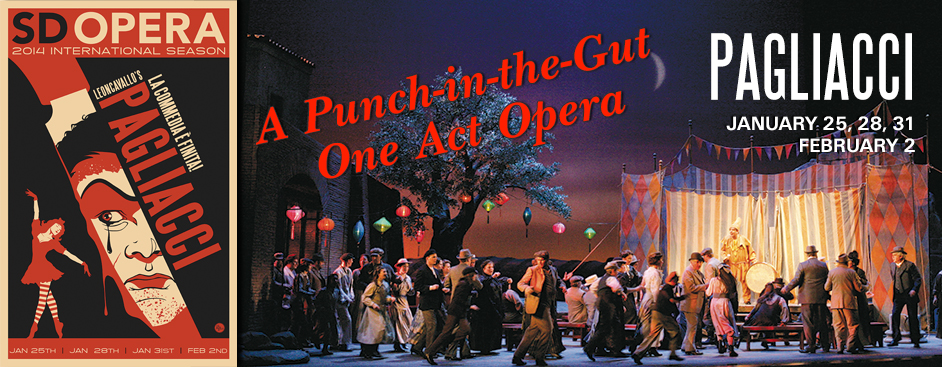
“Crazed clown murders wife in front of live audience” is what the headlines would have screamed after the jealous Canio stabs his wife Nedda and her lover to death in a jealousy-driven rage while performing a comedy before an audience of shocked Italian villagers.

One of the most powerful operas in the repertoire, Pagliacci is gut-wrenching as Tonio, a member of the traveling troupe of players rejected by Nedda, sees her with another man and tells Canio how to get vengeance. In the famous aria “Vesti la giubba”, Canio applies his clown make-up saying that the show must go on, but creates his own tragic ending.

Debuting artist Romanian soprano Adina Nitescu, a consummate actress at the Paris Opera, Metropolitan Opera and Florence, and dynamic baritone Stephen Powell, with recent performances for Virginia Opera and Cincinnati Opera, are joined by American tenor Frank Porretta, fresh from successes at Washington National Opera and Deutsche Oper Berlin. Yves Abel, following his great success leading The Daughter of the Regiment last season, returns to conduct with Andrew Sinclair directing this extraordinary production.

The running time is approximately 1 hour and 18 minutes with no intermission. There will be no late seating.
Sung in Italian with English translations displayed above the stage.

Pagliacci

SYNOPSIS OF PAGLIACCI

In the Prologue, Tonio the clown steps before the curtain to announce that the author has written about actors, who know the same joys and sorrows as other people.

PART I

Villagers mill around as a small theatrical road company arrives at the outskirts of a Calabrian town. Canio, head of the troupe, describes that night’s offering, and when someone jests that the hunchbacked Tonio is secretly courting his wife, Nedda, Canio warns that her fidelity is no joking matter. Vesper bells call the women to church and the men to the tavern, leaving Nedda alone. Disturbed by her husband’s vehemence and suspicious glances, she envies the freedom of the birds soaring overhead. Tonio appears and tries to make love to her, but she laughs at him. Enraged, he reaches for her, and she lashes out with a whip. Nedda in fact does have a lover — Silvio, who now appears and persuades her to run away with him after the evening’s performance. But Tonio, who has seen them, hurries off to tell Canio. Soon the jealous husband bursts in. Silvio escapes, and Nedda refuses to identify him, even when threatened with a knife. Beppe, another player, restrains Canio, and Tonio advises him to wait until evening to catch Nedda’s lover. Alone, Canio cries out that he must play the clown though his heart is breaking.

PART II

The villagers, Silvio among them, assemble to see the play Pagliaccio e Colombina. In the absence of her husband, Pagliaccio (played by Canio), Colombina (Nedda) is serenaded by her lover Arlecchino (Beppe), who dismisses her buffoonish servant Taddeo (Tonio). The two sweethearts dine together and plot to poison Pagliaccio, who soon arrives; Arlecchino slips out the window. With pointed malice, Taddeo assures Pagliaccio of his wife’s innocence, firing Canio’s real-life jealousy. Forgetting the play, he demands that Nedda tell him her lover’s name. She tries to continue with the script, the audience applauding the realism of the “acting.” Maddened by her defiance, Canio stabs Nedda and then Silvio, who has rushed forward to help her. The comedy is ended.

© Copyright OPERA NEWS 2007.

THE CAST

Please click an artist’s name to read more.

San Diego Opera’s performances take place at the Civic Theatre, at the intersection of Third Avenue and B Street in downtown San Diego.

Posted in Music, OPera | Tagged , , , , , , , , | Leave a comment

“Il Trittico” performed by Opera Carolina

OPERA CAROLINA PRESENTS:

Performance

  • Belk Theater (130 North Tryon St., Charlotte, NC 28202) Saturday, January 18th, 2014 @ 8:00pm
  • Belk Theater (130 North Tryon St., Charlotte, NC 28202) Thursday, January 23rd, 2014 @ 7:30pm
  • Belk Theater (130 North Tryon St., Charlotte, NC 28202) Sunday, January 26th, 2014 @ 2:00pm

Il Trittico is a triptych of one-act operas by Giacomo Puccini commissioned by the Metropolitan Opera. Il Trittico premiered on December 14, 1918 at the Metropolitan Opera.

Performed in Italian with English titles.

The libretto for Il Tabarro is by Giuseppe Adami, based on the play La houppelande by Didier Gold.

The libretto for Suor Angelica is by Giovacchino Forzano.

The libretto for Gianni Schicchi is by Giovacchino Forzano, based on an episode in Dante’s Inferno.

SYNOPSIS

Il Tabarro (The Cloak)

Paris. A barge docked along the Seine, c. 1910. Michele and his young wife Giorgetta have hired Tinca, Talpa and Luigi to unload the barge. The sun is setting; the day’s work is nearly complete. Giorgetta, who has been cool to her husband lately, brings wine for the men as reward for their labors. When she refuses his kiss, Michele leaves the men and Giorgetta to drink, and dance the hurdy-gurdy. He returns to tell his wife that work is scarce, and that he will have to let one of the men go. He is surprised when she suggests releasing Talpa or Tinca, but keeping Luigi. After a visit from Talpa’s wife Frugola, who rummages the streets of Paris, Tinca and Talpa leave for home. Luigi stays behind to ask Michele if he will take him to Rouen, where he hopes to start afresh. Michele says he’s better off in Paris and offers to keep him on. Left alone, Giorgetta and Luigi profess their passionate love for each other. Luigi vows to kill Michele so they can be together and they agree to meet that night. Michele asks his wife why she no longer loves him. Has she turned away from him because of his age and the death of their child? Michele concludes she has been unfaithful with one of the workmen and waits in the darkness. In the silence, Luigi enters to rendezvous with Giorgetta. He is caught by the jealous husband who strangles him, and hides his body in his cloak; revealing to Giorgetta the body of her lover.

Suor Angelica (Sister Angelica)

17th century Italy. A convent near Siena. As the nuns are leaving the chapel, Sister Genevieve admires the May sunshine streaming across the fountain. We learn that Sister Angelica comes from a wealthy and noble family and that she has not received a single visitor or letter in the seven years she has been cloistered. The Abbess announces a visitor is waiting for Sister Angelica. It is Angelica’s aunt, the Princess. Coldly, the old woman approaches her niece. She reminds her that when her parents died, she was entrusted with the care of their children and the family fortune. As Executor, she has decided that Angelica must renounce all claims to the family wealth, as her sister is engaged to be married. She brusquely presents Angelica with a legal document to sign. “After seven years this is all you have to say? Tell me about my son, the child who was taken from me, who I only saw once,” Angelica cries. Stiffly, the Princess tells her that her son died two years ago. As coldly as she entered, she leaves. In her anguish, Angelica takes poison, hoping to join her son in Heaven. At the last moment of her life, she realizes she has committed the mortal sin of suicide, and begs the Madonna for salvation. A miracle of forgiveness unites Sister Angelica with her lost son as the curtain falls.

Gianni Schicchi

15th century Florence, Italy. Surrounded by his relatives in his bedchamber, Buoso Donati, the richest man in Tuscany, dies. A rumor spreads: Buoso has left everything to the Church. Chaos ensues as the relatives tear apart the room to find the will, which only confirms the rumor. Buoso’s nephew, Rinuccio claims that only one person can save them – Gianni Schicchi. He has called for Schicchi and his daughter, Lauretta, who he wants to marry. Over the protestations of Rinuccio’s ancient aunt, Schicchi arrives. At first he refuses to help the hated Donati family, but his daughter, in the famous aria, “O mio babbino caro,” convinces him. Schicchi’s plan is set in motion: “You will call for a lawyer and witnesses. When the lawyer enters, I will imitate Buoso’s voice and dictate a new will.” The relatives are delighted and each lobbies Schicchi to leave them a piece of property. He warns them that the sentence for falsifying a will is exile. The lawyer and witnesses enter, and Schicchi, nearly good to his word, dictates a new will, leaving each relative the property they asked for, but leaving the best of the best to Buoso’s dear friend, Gianni Schicchi.

Giacomo Puccini (1856-1924)

Giacomo Antonio Domenico Michele Secondo Maria Puccini was born in Lucca in Tuscany, Italy on December 22, 1858 into a family of five generations of church organists, choirmasters and composers. His father died when Giacomo was five years old, and he was sent to study with his uncle Fortunato Magi, who considered him to be a poor student. As a teenager, Puccini served as an organist to the area churches and played the piano as entertainment at social events. In March 1876, the twenty-year old walked thirty kilometers to attend a performance of Verdi�s latest opera success, Aida. This event changed his life and he decided that he would make opera his life�s work.

The greatest influence in Puccini’s life was his mother, who petitioned and received a grant to send her son to the Milan Conservatory, where he worked diligently at his music and received his diploma in 1883. While studying at the Conservatory, Puccini obtained a libretto from Ferdinando Fontana, and entered a competition for a one-act opera in 1882. Although he did not win, Le Villi was later staged in 1884 at the Teatro Dal Verme and it caught the attention of Giulio Ricordi, head of G. Ricordi & Co. music publishers, who commissioned a second opera, Edgar, in 1889.

Edgar failed: it was a bad story and Fontana’s libretto was poor. This may have had an effect on Puccini’s thinking because when he began his next opera, Manon Lescaut, he announced that he would write his own libretto so that “no fool of a librettist” could spoil it. Ricordi persuaded him to accept Leoncavallo as his librettist, but Puccini soon asked Ricordi to remove him from the project. Four other librettists were then involved with the opera, due mainly to Puccini constantly changing his mind about the structure of the piece. It was almost by accident that the final two, Illica and Giacosa, came together to complete the opera. They remained with Puccini for his next three operas and probably his greatest successes: La Boheme, Tosca and Madama Butterfly.

Puccini’s next project took up a different dramatic challenge. Il Trittico is a group of three sharply contrasting one-act operas that together make up a complete evening: a sinister melodrama Il Tabarro; a sentimental religious tragedy, written entirely for women’s voices (Suor Angelica); and a comic Opera (Gianni Schicchi).

ARTISTS:

Jill Gardner, Sister Angelica in Suor Angelica
Soprano

Noted for her “effortlessly produced, rich voice” (Opera News), American soprano Jill Gardner is swiftly establishing herself among today’s leading operatic heroines. This “powerhouse soprano” (Syracuse New Times) continues to garner national praise for her “sparkling personality” (Coral Gables Gazette), her “lustrous, golden soprano and riveting stage presence” (Rochester Democrat and Chronicle) and for “her commitment, passion and ability to convey vocally the slightest nuance of emotion, making for gripping theater” (Opera News). Equally praised for her acting as well as her singing, Opera News observed of her Boston Lyric Opera performances of Tosca, “Soprano Jill Gardner, whose voice was fresh and focused, undertook the title role as if it were newly written. There was little of the conventional grand diva in her approach, and her character was all the more human for it. In Gardner’s hands, her Act II aria, “Vissi d’arte”, was not merely a famous showstopper but an opportunity to reveal layers of Tosca’s character.”

For the 2012-2013 season, Ms. Gardner sings the title role of Tosca in her debut with Opera Carolina as well as Arizona Opera and Hawaii Opera Theater. She will also join the roster of the Washington National Opera, covering the title role of Manon Lescaut in the spring.

During the 2011-2012 season the soprano returned to Arizona Opera and Tri-Cities Opera in the title role of Puccini’s Madama Butterfly and reprised the role of Nedda in I Pagliacci in her debut with Michigan Opera Theater as well as for the inaugural season of Mill City Summer Opera in Minneapolis, MN. On the concert stage, she marked her debut with the Wichita Symphony in Beethoven’s Mass in C Major.

In the 2010-2011 season, Ms. Gardner made her celebrated return to Boston Lyric Opera in the title role of Tosca as well as making her company debuts with Arizona Opera in the role of Liu in Turandot, Opera Grand Rapids in her role debut of Manon in Manon Lescaut and Eugene Opera as Musetta in La Boheme. This season also marked Ms. Gardner’s role debut of Leonora in Verdi’s Il Trovatore with Piedmont Opera.

Over the past few seasons, the young soprano marked her Lyric Opera of Chicago debut performing Nedda in I Pagliacci and covering Mimi in La Boheme, her Florida Grand Opera debut as Musetta in La Boheme, her Boston Lyric Opera debut as Mimi in La Boheme, her Madison Opera debut as Marguerite in Faust, as well as performing Countess Charlotte Malcolm in Sondheim’s A Little Night Music in her debut with Hawaii Opera Theater where she returned in the following season as Helmwige in Die Walkure. In concert, she made her Kennedy Center Debut with the Washington Chorus, under the baton of Julian Wachner, in a concert called The Essential Puccini, performed Beethoven’s 9th Symphony and Vaughan William’s Serenade to Music with the Syracuse Symphony, Brahms’ Requiem with the Binghamton Philharmonic and Verdi’s Requiem with the Tower Arts Series of Dallas’ Highland Park United Methodist Church under the baton of Craig Jessop.

Additional engagements from recent seasons include a return to the Glimmerglass Opera as Eurydice in a new production of Orpheus in the Underworld, Margaret Johnson in the first opera house performances in The Light in the Piazza with Piedmont Opera, Hanna Glawari in The Merry Widow with the Syracuse Opera, the title role in Susannah with New York Opera Projects, Donna Anna in Don Giovanni, Mimi in La Boheme as well as the title role in Puccini’s Tosca with the Mercury Opera Rochester, and multiple performances with the Tri-Cities Opera including Violetta in La Traviata and Countess in Le Nozze di Figaro. Ms. Gardner also performed the role of Madama Erlecca in Cimarosa’s Li Sposi per Accidenti at Studio Lirico in Cortona, Italy.

In the summers of 2005 and 2006, Ms. Gardner was a member of the prestigious Young American Artist Program at the Glimmerglass Opera. During this tenure, she created the role of Madame Loiseau in the world premiere of Stephen Hartke’s The Greater Good, which was recorded on the Naxos Label. Also at the Glimmerglass Opera, Ms. Gardner added two new roles to her repertoire in cover assignments: Elle in Poulenc’s La Voix Humaine and the title role of Jenufa.

She has been the recipient of the Richard F. Gold Career Grant of the Shoshana Foundation-NYC, a Special Opportunity Award from the New York Foundation of the Arts, an Emerging Artist Grant from the Winston-Salem/Forsyth County Division of the North Carolina Arts Council and participated in a Public Masterclass on Puccini Style for the George London Foundation with Catherine Malfitano. She received a Master of Music degree in vocal performance from the University of North Carolina at Greensboro and a Bachelor of Music degree in piano performance from Centenary College of Louisiana.

Opera Carolina Performances:

Art to Poetry to Music (2013–2014)
Il Trittico (2013–2014)
Tosca (2012–2013)

Dongwon Shin, Luigi in Il Tabarro
Tenor

2012 began with Korean born tenor Dongwon Shin’s appearances in Montreal as Manrico which was now followed by his return to Dresden for this role. Last spring, he made his debut as Radames at Covent Garden and just prior at the Vienna Staatsoper and later in the spring performed Manrico in his return to Ft. Worth Opera. Earlier in 2011 he had performed the Verdi Requiem as well as Samson at the Teatro Verdi, Trieste. He also recently debuted with San Francisco Opera as Radames and performed Manrico in Dresden again to begin 2010-11 after scoring a great success as Manrico in his debut with the Semperoper, Dresden last season. He also covered Dick Johnson in San Francisco’s Fanciulla. Last year he performed Radames in his return to Opera Australia in their revival of Aida as well as completing his first engagement at the Metropolitan Opera covering Turridu. Just prior he debuted at the Deutsche Oper Berlin as Radames after performing his signature role Calaf again with Dayton Opera. In summer 2008 he sang a “thrilling” Radames in the Savonlinna Festival’s Aida. Earlier in 2008 he sang Calaf to glowing reviews with Ft. Worth Opera: “Tenor Dongwon Shin met the challenge on Saturday. His Nessun dorma was the highlight of an incredible evening for him and for the Fort Worth Opera.” That spring he also sang Manrico in Il Trovatore with Nashville Opera after making his Italian debut as Samson in Lecce. Just prior he was Calaf in Turandot with Palm Beach Opera having just performed this role with Opera New Zealand as “a superb Calaf with a wonderfully strong, fully italianate voice, and brought the house down in Nessun Dorma”. He made his professional operatic debut in 2005 as Radames in Aida with Opera Company of Philadelphia. In 2007 he made a dramatic debut with Opera Australia as Calaf in Turandot, arriving the day before the opening and receiving both public and critical acclaim-and has been reengaged to return in 2009.

Mr. Shin has also sung with the Philadelphia Orchestra under Christoph Eschenbach in the Gala Concert celebrating the 150th Anniversary of the Academy of Music. He first sang Calaf in Turandot with Santa Fe Opera in 2005 and subsequently sang it at the Thessaloniki Concert Hall Association.

Other recent engagements have included Radames in Aida with Houston Grand Opera under Carlo Rizzi, the title role in Samson et Dalila with Dayton Opera, Canio in Pagliacci with Opera Delaware, Pollione in Norma with Michigan Opera Theatre, and the Verdi Requiem with the Delaware Symphony. Mr. Shin distinguished himself early in a number of competitions including the Metropolitan Opera National Council Auditions (National Finalist), Loren Zachary Competition, Licia Albanese Puccini Foundation Competition, Caruso-Altamura International Competition, Maria Anderson Competition, Giargiari Competition (1st & Audience Favorite). He was a 2005 graduate of the Academy of Vocal Arts in Philadelphia, where he sang the title role in Puccini’s Edgar and Gennaro in Lucrezia Borgia. Before attending AVA, he received a BM in Music from Seoul National University and also attended Indiana University.

In 2012-13 he is with Arizona Opera as Manrico and performs Calaf and Cavaradossi in Korea and performs concerts in Seoul and throughout Korea. New roles coming up include Don Jose in Carmen and Luigi in Il Tabarro.

Opera Carolina Performances:

Il Trittico (2013–2014)

Susan Nicely, Zita in Gianni Schicchi
Mezzo Soprano

Mezzo-Soprano Susan Nicely is known for her rich voice and vivid characterizations. Her highly acclaimed “lively comic presence” in roles such as Dame Marthe in Faust, Old Lady in Candide, Katasha in The Mikado, and Marcellina in Le Nozze di Figaro, as well as dramatic portrayals in Cavalleria Rusticana as Mamma Lucia and The Ballad of Baby Doe as Mama McCourt make the character mezzo an “audience darling,” says the Austin American-Statesman. Up next, she performs both Auntie in Peter Grimes and Gertrude in Romeo et Juliette with Des Moines Metro Opera Little Buttercup in HMS Pinafore with Arizona Opera; and the roles of Frugola, Principessa, and Zita in Il Trittico with Opera Carolina. A house favorite with the Dallas Opera, she has appeared there as Suzuki in Madama Butterfly, Alisa in Lucia di Lammermoor, Annina in La Traviata, Hannah in Maria Stuarda, Tisbe in La Cenerentola, the Nurse in Boris Godunov, and most recently in a highly acclaimed performance of Julia Child in Lee Hoiby’s one-woman opera, Bon Appetit! Proclaimed D Magazine: “Mezzo-soprano Susan Nicely… delivered the goods with a gorgeously textured, rich vocal timbre and a perfect touch of slapstick, expanding on and somewhat exaggerating Child’s endearing, always-laughed-off clumsiness.” Also a house favorite at the Atlanta Opera, she has seen performances there as Alisa in Lucia di Lammermoor, Mary in The Flying Dutchman, Thelma Predmore in Cold Sassy Tree, Berta in Il Barbiere di Siviglia, and Annina in La Traviata.

Engagements from the past few seasons include Marcellina in Le Nozze di Figaro with Arizona Opera and the Orlando Philharmonic, Mamma Lucia in Cavalleria Rusticana with New York City Opera, Arizona Opera, and Opera Tampa; Gertrude in Romeo et Juliette with the New Orleans Opera and Opera Grand Rapids; Katasha in The Mikado with the Indianapolis Opera and Portland Opera; Emma Jones in Street Scene, Dame Quickly in Falstaff, and Marcellina in Le Nozze di Figaro with Chautauqua Opera; Berta in Il Barbiere di Siviglia with Opera Omaha; The Old Lady in Candide with Austin Lyric Opera; Marquise de Berkenfeld in La Fille du Regiment with Florentine Opera; Annina in La Traviata with Opera Pacific; the Witch in Hansel und Gretel with Chicago Opera Theatre; Little Buttercup in H.M.S. Pinafore with Opera Cleveland; and Dame Marthe in Faust with Palm Beach Opera.

Ms. Nicely made her European debut in Strasbourg, France in the role of Mary with Opera du Rhine’s production of Der Fliegende Hollander and her debut in South America as Mrs. Lovett in Sweeney Todd with Opera Breve in Caracas, Venezuela. Other acclaimed previous engagements include Mother Goose in The Rake’s Progress with San Francisco Opera; Mamma Lucia in Cavelleria Rusticana, Governess in Pique Dame and Mrs. Ott in Susannah with Lyric Opera of Chicago; Marthe in Faust with Houston Grand Opera; and Marcellina in Le Nozze di Figaro with Cincinnati Opera.

Orchestral appearances include concerts with the Milwaukee Symphony, Charleston Symphony, Grant Park Symphony of Chicago, Wheeling Symphony, Des Moines Symphony, and the Chautauqua Symphony Orchestra.

Opera Carolina Performances:

Il Trittico (2013–2014)
Love Notes (2008–2009)

Posted in Music, OPera | Tagged , , , , , , , , | Leave a comment

“Don Giovanni” in Greece

ΕΘΝΙΚΗ ΛΥΡΙΚΗ ΣΚΗΝΗ

Don GiovanniSuitcase opera

Wolfgang Amadé Mozart’s

Don Giovanni

Director: Alexandros Efklidis

PREMIERE 29 DECEMBER 2013
29 December 2013

TECHNOPOLIS, AMPHITHEATRE 984
Starts at 20.00
Free admission

Sets: Vassiliki Papadopoulou
Costumes: Natassa Dimitriou
Lighting: Spyros Tzoras
Musicological coordination: Dimitris Yakas
Piano: Frixos Mortzos

Cast:

Don Giovanni:  Dionysos Tsantinis 
Commendatore/Masetto:   Theodore Moraitis
Donna Anna: Anna Stylianaki
Don Ottavio: Nikos Stefanou
Donna Elvira: Julia Souglakou
Leporello, Don Giovanni’s servant:   Vangelis Maniatis
Zerlina: Despina Scarlatou
   

Technopolis – Amphitheatre 984, Athens (100 Pireos & Persefonis, tel.: 210 8810884)

The Greek National Opera presents Mozart’s legendary Don Giovanni in the form of a Suitcase Opera, an initiative that has been embraced by audiences all over Greece for the past two years. Suitcase Opera is a flexible and mobile production form, which allows operas to be presented at unusual venues and beyond traditional theatres, where the GNO’s star performers sing to a piano accompaniment. The performances are possible thanks to a donation from the Stavros S. Niarchos Foundation within the context of the “Journey to the Stavros S. Niarchos Foundation Cultural Centre” initiative.

The GNO’s new Suitcase Opera production tells the tale of the Spanish nobleman Don Giovanni, a blasphemous libertine admired by men for his courage and by women for his scandalous reputation. Don Giovanni appears as a man without feelings, without compassion and without a sense of what is just and what is not. At the same time, however, he embodies the principles of the Enlightenment and rationalism; he has control over his destiny and desires, and defines his own fate without fear of God.

The director of the production, Alexandros Efklidis, notes:
“Don Giovanni belongs to that small core of masterpieces in the fantastic museum of contemporary Western culture, somewhere between the Sistine Chapel, the Divine Comedy, Crime and Punishment, Beethoven’s Ninth Symphony and Beckett’s Waiting for Godot. However, despite the grandeur that has been assigned to it, Don Giovanni was written as a comedy for a very small stage. Scaling the opera down and reviving its comic elements were, for the Pocket Opera production, the two main goals through which to emphasise those aspects of the opera that are usually overlooked by its presentation on a grand scale. Even though achieving a reasonable duration for the circumstances meant scrapping a large part of the musical material, Mozart’s musical message comes across in pristine form. Our performance is not an interpretation of the piece. Instead, it aims to highlight the motives of the characters that flank the undisputed protagonist, Don Giovanni. Mozart, with his monumental sense of theatre and humour, endowed his characters with an incredible amount of psychological detail, which we have attempted to convey in a playful manner, adding our own brushstrokes to 18th century sensibilities and making the characters more affable to a modern-day audience. Our production, moreover, has done away the metaphysical features that are so often prevalent in the opera. It presents the characters in the context of the here and now, which is why we decided to strip them of their rococo frills and, instead, show them as they would be today. The aim was not just to make them more familiar, but, rather to make them easier to understand.”Don Giovanni

Don Giovanni at a glance

The composer / Most people have a great sense of familiarity for Mozart, probably because his music is so pleasant at a first hearing. However, prevalent misconceptions about his life and work have formed an image that is much different to reality. These misconceptions, that have even altered his name, date as far back as the 19th century, when Mozart was first cast as a figure that inspired awe. That was when the rather bombastic Amadeus was introduced, a name that he used rarely and then only in jest, instead of the more prosaic Αmadé or Amadeo, which was how he usually signed his name. To this day, the misconceptions regarding Mozart continue to be propagated through popular presentations of his life and work, for example in film. There is certainly no doubt that Mozart was an intellectual and one of the most significant and introspective figures of his time. He was charismatic and sensitive, and embraced lofty ideals. However, recent research into his life and work continues to endow him with additional attributes, completing the portrait of a man who is constantly revealing new and exciting aspects of himself.

The opera / Don Giovanni is an opera in two acts. The libretto by Lorenzo Da Ponte was based on an earlier piece by Giovanni Bertati for Giuseppe Gazzaniga’s opera Don Giovanni Tenorio, or The Stone Guest, which premiered in Venice in 1787. The story revolves around the salacious adventures of the Spanish nobleman and libertine Don Giovanni. In one of these incidents, Don Giovanni tries to rape Donna Anna and kills her father in his effort to escape justice. But the elderly man returns from the dead to exact his revenge and Don Giovanni, unrepentant for his sins, is sent straight to hell. The opera ends with a moral, as was the usual practice at the time.

Premieres / Don Giovanni was first performed in Prague on 29 October 1787. For its premiere in Vienna on 7 May 1788, Mozart adapted the score to accommodate the new singers, while also adding a editing a number of the musical parts. The opera that is most often presented today is a combination of the original and adapted versions. The Greek National Opera first introduced Don Giovanni to its repertory on 20 March 1962 in a production directed by Antiochos Evangelatos. The Pocket Opera presents an abridged version of the original.

Posted in Music, OPera | Tagged , , , , , , , | 2 Comments

“Nabucco” in Florida

FLORIDA GRAND OPERA Presents: 

Nabucco

Giuseppe Verdi

NabuccoIn the opera that put Giuseppe Verdi on the map, follow the plight of the Hebrews of Babylonia as they are assaulted, conquered, and ultimately exiled from their homeland. Within this backdrop of exiles yearning for their homeland is a love story, but can love flourish in such a place and time?

Dario Solari Nabucco (Jan 25, 28, 31, Feb 6, 8 )
Nelson Martinez Nabucco (Jan 26, 29, Feb 1)
Maria Guleghina Abigaille (Jan 25, 28, 31)
Susan Neves Abigaille (Jan 26, 29, Feb 1, 6, 8)
Kevin Short Zaccaria
Ramón Tebar Conductor
Thaddeus Strassberger Production Designer
Leigh Holman Stage Director
Washington National Opera/Minnesota Opera/Opera Philadelphia Production

MIAMI
Adrienne Arsht Center for the Performing Arts
of Miami-Dade County
Sanford and Dolores Ziff Ballet Opera House
Jan 25, 2014, at 7 p.m. – Opening Night
Jan 26, 2014, matinee at 2 p.m.
Jan 28, 29 & 31, 2014, at 8:00 p.m.
Feb 1, 2014, at 8:00 p.m.

FORT LAUDERDALE
Broward Center for the Performing Arts / Au-Rene Theater

Feb 6 & 8, 2014, at 7:30p.m.

Posted in OPera | Tagged , , , , , , , | Leave a comment

“Ririka” at the Greek National Opera

ΕΘΝΙΚΗ ΛΥΡΙΚΗ ΣΚΗΝΗ

Ririka (1934)

Stathis Mastoras

Ririka (1934)

PREMIERE 

29 DECEMBER 2013

Greek Operetta Cycle
Olympia Theatre’s Foyer
Starts at 18.00
Free admission


Just one song has survived in the public mind from Ririka, an operetta by the Corfu-born composer Stathis Mastoras (1893-1943) that was a smash-hit in its time. Yet the operetta (whose libretto was penned by Yiannis Prineas) is among the most charming on the repertory, featuring powerful drama and music, poignant social criticism and hilarious characters. The composer, who was executed by the Nazis on Crete in the 1943 massacre of Viannos, is one of the sadly forgotten protagonists of the second generation of Greek operetta composers.

Posted in Music, OPera | Tagged , , , , , , , , , | Leave a comment

International Brazilian Opera Company will present scenes from four new operas in New York.

International Brazilian Opera Company will present scenes from four new operas by composers João MacDowell, Thiago Tiberio and Luigi Porto.

There is no limit to what can be done in new opera, but how far can they go? Maybe you can help…

LUIGI PORTO AT THE PIANO
luigiportoAt iBoc they aim to mix ideas from both Brazilian and international artists to create new approaches for the genre. iBoc’s core team has members from Brazil, Russia, Ukraine, Italy, Portugal and the United States  and they hope to have even more diversity as their team grows. Through collaboration and shared perspectives, they believe opera can be relevant to large audiences.

They also believe that opera is the multimedia event of the future. Not only does opera unite all art forms, the genre has a lot of potential for creative development. Most opera companies now have access to contemporary performance techniques, yet they keep repeating a repertoire that was written in the 19th century. The iBoc creative team consists of professional composers, singers, musicians, film-makers, mixed media artists, choreographers and performance artists. They are dedicated to producing unique and refreshing performances.


New York City – Baruch’s Egelman Recital Hall, March 7th & 8th Program:

•”O Sonho de Ianadi”, an aria from “Watunna—A criação do mundo segundo os índios do Orinoco”, opera in Portuguese by Thiago Tiberio

•”Provvisorietá (Provisoriedade)” an aria from “Anita” opera in Italian and Portuguese by Luigi Porto, libretto by Andrea Amoroso

• “I Don’t Want to Die” a trio from “Cries and Whispers”, opera in Portuguese and English by Joao MacDowell

– Intermission-

• 12 scenes from from “Tamanduá – A Brazilian Opera” in Portuguese and English by João MacDowell

The International Brazilian Opera Company has underway a Kickstarter to provide funds for its March performance in NYC.

Information regarding the Kickstarter may be found on:

http://www.kickstarter.com/projects/joaomacdowell/iboc-debut-concerts

iboc tee_shirt

Posted in OPera | Tagged , , , , , , , , | 2 Comments

World Premiere of “The King’s Man” in Kentucky

Kentucky Opera

PRESENTS:

World Premiere of The King’s Man

  • Revolution and revolutionary!

October 11, 2013 at 8pm – Comstock Hall – UofL Campus
October 12, 2013 at 2pm – Comstock Hall – UofL Campus

KingsManDanse166x225The American Revolution is the backdrop of The King’s Man as the relationship between Benjamin Franklin and his son William Franklin is challenged as the men take different sides in defining the direction of the country. “Revolutionary” describes The Rite of Spring and its aftermath as the creators deal with the fallout from its opening night riots in Danse Russe. These two new one-acts are the works of Pulitzer Prize winning composer Paul Moravec and librettist Terry Teachout, who is the drama critic for The Wall Street Journal.


Production Sponsored by Reverend Alfred R. Shands III

The King’s Man – The Cast


Marco Cammarota

Marco Cammarota+ as William Franklin


Cesar Mendez-Silvagnoli

César Méndez-Silvagnoli+ as Benjamin Franklin


Danielle Messina

Danielle Messina+ as Mary

Danse Russe – The Cast


Raymond

Brad Raymond+ as Igor Stravinsky


Arnold

John Arnold+ as Pierre Monteux


Gonzalez

Sergio Gonzalez+ as Vaslav Nijinsky


Smith-Kotlarek

Christiaan Smith-Kotlarek+ as Sergei Diaghilev


Creative Team


Moravec

Paul Moravec, composer


Teachout

Terry Teachout, librettist

The King’s Man

Music by Paul Moravec
Libretto by Terry Teachout

World Premiere

Setting:  1785 in the London library of William Franklin

At dawn, Mary and William’s manservant are preparing their London library for a visit from Ben.

William enters, visibly anxious and distressed. Mary, who only knows Ben from his reputation and is young and naïve, doesn’t understand. She asks the manservant to bring in a bust of Franklin as a surprise. William explodes, singing an arietta in which he pours out his resentment of his father (It was my kite) and reads from Ben’s chilly letter suggesting a meeting in London.  Apologetically, William tries to explain to Mary that there is more to Ben than his public “statuarial” side and his proverbs, that Ben Franklin is in fact a worldly, self-interested careerist.  Ben arrives and the resemblance between the two men is striking. Here we see the public Ben, genial and ceremonial. Mary excuses herself.

The conversation between the two men starts out stiff but cordial, then Ben brings up the subject of William’s debts. Ben says, “I paid for everything.” William: “You loaned me everything. You were never a generous father. Always the Puritan prig—and hypocrite.” Ben’s arietta: “What could you have expected of me? I was born on a Sunday, born in the long shadow of God.”

Anger mounts and we discover the real reason for it—the two men tried to kill one another. A flashback to see Ben signing William’s death warrant as William waits in prison, mourning the death of his wife and expecting to be taken out and shot at any moment.

Present day: Ben reminds William that what has come between them is more than merely personal, that William was a traitor to the land of his birth and that Ben’s first loyalty is to America—even beyond loyalty to his son.

The situation is clearly hopeless and Ben storms out of the library and the house, slamming the two doors behind him. An angry, then despondent William sweeps the bust of his father off his desk and falls into his chair with his head in his hands as Mary tries to comfort him.

Ben has returned to Philadelphia. His manservant brings in the letter from Washington. Ben reads it, then reads the disinheritance portion of the will. Manservant, a faithful retainer, says, “You owe it to him to tell him what you’re doing.” Exits, and Ben writes three false starts on a letter—the first cold, the second angry, the third an attempt at reconciliation. He can finish none of them and tears up the three letters.

The Forgotten Franklin 

Terry Teachout

EVERYBODY IN AMERICA knows who Benjamin Franklin was, more or less, and most people even have a pretty good idea of what he looked like. But William Franklin, Ben’s illegitimate son, is known only to those who are well read in American history, even though the story of his stormy relationship with his famous father is a fascinating and disturbing tale. Unlike Ben, William was a Tory who chose to remain loyal to King George III throughout the Revolutionary War, a decision that got him tossed into prison and nearly cost him his life. It also led to a permanent break between father and son, who saw each other only once more after William fled to England in 1782. Their final meeting, and the complicated events that led up to it, are what The King’s Man is about.

Paul Moravec, my operatic collaborator, has long been fascinated by Ben Franklin, so much so that he composed a piece called Useful Knowledge that is based on his writings. When we decided to write a companion piece to Danse Russe, our second opera, a backstage comedy about the making of The Rite of Spring, Paul suggested that we might look to Franklin as a possible subject. It soon became clear to both of us that Ben’s break with William was not just dramatic but positively operatic. While my libretto is a fictionalized account of their quarrel that takes liberties with the facts, it is firmly rooted in historical truth. To be sure, we don’t know all that much about the particulars of the two men’s relationship—neither one of them left behind anything like a frank account of how they felt about one another—I think the way that we portray them in The King’s Man is entirely plausible. Few things, after all, are as fraught with tension and resentment as the relationship between a father of genius and a son who is merely talented, and that is what Paul and I have sought to explore.

The King’s Man was specifically written to be performed in tandem with Danse Russe. Yes, Danse Russe is a giddy farce with touches of tenderness and The King’s Man is a dark domestic drama, but both works are one-act historical operas of similar length that are performed by the same vocal and instrumental forces. We hope they add up to a satisfying night at the theater—one that is both entertaining and thought-provoking.

Terry Teachout is the drama critic of The Wall Street Journal and the author of Duke: A Life of Duke Ellington, Pops: A Life of Louis Armstrong, and Satchmo at the Waldorf, a one-man play about Armstrong. He has also written the libretti for three operas by Paul Moravec, The Letter, Danse Russe, and The King’s Man.


Danse Russe

Music by Paul Moravec
Libretto by Terry Teachout

First performed April 28, 2011 at the Kimmel Center, Philadelphia, PA with Center City Opera and members of Orchestra 2001

Setting:  Before, during and after the May 1913 premiere of Stravinsky’s The Rite of Spring and the subsequent riot

Told in a one-act vaudeville style as Igor Stravinsky thinks back to the opening night of The Rite of Spring; the other players arrive including producer Sergei Diaghilev, ballet dancer Vaslav Nijinsky and conductor Pierre Monteux.  Each discusses his role in the creation of the ballet and it is clear that none of them like Diaghilev.

Diaghilev suggests that this new work should create a scandal and he wants to be astonished.  Stravinsky and Nijinsky agree.  Stravinsky and Diaghilev rhapsodize about the Russian spring and Nijinsky recalls when he first met Diaghilev.  Diaghilev continues to push Stravinsky and Nijinsky to make their new ballet brutal, crude, modern and scary.  Stravinsky is still a little concerned over this approach but he and Monteux admit that they will do whatever Diaghilev asks.  As Stravinsky composes, the others start to see the possibilities and they realize the audience will likely respond with “boos” and “hisses”.

Opening night and as the audience responds negatively to the ballet, the men tell them all to go to hell.

Stravinsky returns to his reminiscence of that partnership and realizes that all of the others are either dead (Monteux and Diaghilev) or in a mad house (Nijinsky).  He is alone.  He remembers the time before the war, a world of kings and queens and czars – destroyed by blood and iron.  Although he has never returned to Russia, he tries to remember the Russian spring and how very beautiful it was.


Posted in Music, OPera | Tagged , , , , , , , | Leave a comment

“Cosi` Fan Tutte” in Toronto

Cosi` Fan Tutte

Wolfgang Amedeus Mozart

Atom Egoyan explores love, fidelity and the frailties of the human condition.

Celebrated director Atom Egoyan returns to the COC, bringing his signature style to this wry comedy about two couples gambling with faith and desire. Featuring a cast of exciting young opera stars and distinguished, seasoned veterans, this work is full of both farce and folly. Yet Mozart’s sublime musical depiction of the honest and intimate struggles of love and temptation is truly one of the greatest pieces about relationships ever written.

Canadian Opera Company

JANUARY 18 to FEBRUARY 21, 2014


On stage at the Four Seasons Centre, 145 Queen St. W., Toronto.
Performance time is approximately three hours, 5 minutes including one intermission.
Sung in Italian with English SURTITLES™.

Conductor: Johannes Debus
Director: Atom Egoyan
Set & Costume Designer: Debra Hanson

Fiordiligi: Layla Claire
Dorabella: Wallis Giunta
Ferrando: Paul Appleby
Guglielmo: Robert Gleadow
Despina: Tracy Dahl
Don Alfonso: Thomas Allen


New Canadian Opera Company Production

SYNOPSIS

Act I

Don Alfonso, a gentleman, goads two young soldiers into a wager regarding their fiancées’ fidelity. Ferrando and Guglielmo are convinced their lovers – Dorabella and Fiordiligi, respectively – are true to them, and agree to test the women’s faithfulness through trickery. The men agree to do everything Don Alfonso asks.

Sisters Dorabella and Fiordiligi are met in their garden by Don Alfonso. He tells them that their fiancés have been recalled to military duty. The two soldiers arrive to bid their unhappy fiancées farewell. The sisters are inconsolable. Once the men have departed, their maid Despina suggests that Dorabella and Fiordiligi amuse themselves in the meantime by meeting other men. The women refuse to be unfaithful to their lovers.

Don Alfonso speaks privately with Despina, enlisting her aid in introducing two prospective lotharios to the sisters. He then presents to Despina two “Albanians,” who are none other than Guglielmo and Ferrando in disguise. When Fiordiligi and Dorabella arrive, the men proclaim their affection. The women demand that the strangers leave their house.

Later that day, the Albanians burst into the garden where the two sisters still sit, lamenting the absence of their sweethearts. The men drink what they claim is poison, expressing their wish to die for love. A doctor arrives (Despina in disguise) and “revives” the two men.


Act II

Despina attempts to persuade Dorabella and Fiordiligi to be more receptive to the Albanians’ advances. The sisters reluctantly agree that a flirtation might prove a welcome distraction in the absence of their fiancés. The men return once more to serenade the sisters, and this time Dorabella exchanges words of love with Guglielmo – to his astonishment. Ferrando has less luck with Fiordiligi.

Ferrando is told of his lover’s betrayal and vows revenge. Don Alfonso reminds the soldiers that the test is not yet over.

Dorabella confesses her new fondness for her Albanian to Despina. Fiordiligi admits that she also has feelings for the Albanian (the disguised Ferrando), but scolds her sister’s lack of control and vows to remain true to her fiancé. But when Ferrando returns, secretly accompanied by Guglielmo and Don Alfonso, Fiordiligi yields to his advances.

Ferrando and Guglielmo lament their lovers’ betrayal and express a desire for revenge. Don Alfonso urges the now-bitterly-disillusioned soldiers to marry the women.

Wedding preparations are quickly made. Don Alfonso produces a notary – Despina in disguise – who in turn produces a marriage contract. A drum is heard, signaling the return of the soldiers. Having hastily removed their disguises, Ferrando and Guglielmo appear and feign outrage at the incriminating scene. But when they put on their Albanian disguises, the truth comes out.

In the final chorus all four lovers, in the spirit of reconciliation, sing hopefully of accepting life as it presents itself and maintaining a sense of humour. But will they be able to when faced with an uncertain future?

Artist Basics: Layla Claire

What she’s doing with us: Hailing from Penticton, B.C., soprano Layla Claire makes her COC debut at the Four Seasons Centre for the Performing Arts as Fiordiligi in Atom Egoyan’s brand new production of Mozart’s romantic comedy, Così fan tutte.

Where you might have seen her: Well-known for her skills with Mozart’s repertoire, Layla has performed a variety of roles onstage at Palm Beach Opera, Tanglewood Festival, Curtis Opera Theatre, Glyndebourne, Aix-en-Provence and at the Metropolitan Opera. While at the Met, she also performed the role of Helena in the world premiere of The Enchanted Island.

Her background: Layla earned an undergraduate and a master’s degree from the University of Montreal, continued her studies at the Curtis Institute in Philadelphia and took her talents to the Metropolitan Opera’s Lindemann Young Artist Development Program. (Two of her Così co-stars, Paul Appleby and Wallis Giunta, also graduated from the Lindemann program.)

Interviews and profiles: Layla was featured in Opera News last year about her time spent at the Lindemann program, a Toronto Star article profiled her performance as Sandrina in La finta giardiniera at the 2012 Aix Festival, and she is featured in a coaching session with conductor James Levine in the PBS documentary, America’s Maestro. Most recently, she participated in a Q&A in a CBC Music blog post about being awarded the illustrious Virginia Parker Prize by the Canada Council for the Arts.

What’s next for Layla: Before she heads to Toronto for Così in the winter, Layla stars as Pamina in The Magic Flute at the Pittsburgh Opera, and next spring she performs the same role at the Minnesota Opera.

You can follow Layla on Twitter @laylaclairesop or on Facebook.

Watch Layla perform with Elizabeth DeShong (our Cenerentola from 2010) in this clip from The Enchanted Island.

Performance Dates & Times

  • Sat. Jan. 18, 2014 at 7:30 p.m.
  • Fri. Jan. 24, 2014 at 7:30 p.m.
  • Wed. Jan. 29, 2014 at 7:30 p.m.
  • Sat. Feb. 1, 2014 at 4:30 p.m.
  • Thurs. Feb. 6, 2014 at 7:30 p.m.
  • *Fri. Feb. 7, 2014 at 7:30 p.m.*
  • Sun. Feb. 9, 2014 at 2 p.m.
  • Sat. Feb. 15, 2014 at 7:30 p.m.
  • Tues. Feb. 18, 2014 at 7:30 p.m.
  • Fri. Feb. 21, 2014 at 7:30 p.m.

* Special Ensemble Studio Performance


“Las Dos Fridas” painting by Frida Kahlo © 2011 Banco de México Diego Rivera & Frida Kahlo Museums Trust. Av. Cinco de Mayo No. 2, Col. Centro, Del. Cuauhtémoc 06059, México, D. F.


Posted in Music, OPera | Tagged , , , , , , , , | Leave a comment

Macbeth in Greece

logogreekopera 

Presents:

Giuseppe Verdi

macbeth2Macbeth

Conductor: Myron Michailidis
Director: Lorenzo Mariani

PREMIERE 17 JANUARY 2014
17, 18, 19, 21, 22, 24, 25, 26 January 2014

Athens Concert Hall – Alexandra Trianti Hall
Performances begin at 20.00

Sets: Maurizio Balo
Costumes: Silvia Aymonino
Choreography: Renato Zanella
Lighting: Linus Fellbom
Chorus Master: Agathangelos Georgakatos

Macbeth:   Dimitris Tiliakos (17, 19, 21/1)
   Dimitri Platanias (18, 24, 26/1)
   Tassis Christoyannis (22, 25/1)
Banco:  Tassos Apostolou (17, 19, 21, 25/1)
   Petros Magoulas (18, 22, 24, 26/1)
Lady Macbeth:  Dimitra Theodossiou (6, 11, 14/12)
   Tatiana Melnychenko (18, 22, 24, 26/1)
Woman in attendance on Lady Macbeth:  Antonia Kalogirou (17, 19, 21, 25/1)
   Sophia Kyanidou (18, 22, 24, 26/1)
Macduff:  Dimitris Paksoglou (17, 19, 21/1)
   Angelo Simo (18, 22, 26/1)
   Filippos Modinos (22, 25/1)
Malcolm:  Charalambos Alexandropoulos (17, 19, 21, 25/1)
   George Zografos (18, 22, 24, 26/1)
A Doctor / A Servant of Macbeth:  Dionyssis Tsantinis (17, 19, 21, 25/1)
   Pavlos Sampsakis (18, 22, 24, 26/1)
A Murderer / A Herald:  Christos Amvrazis (17, 19, 21, 25/1)
   Nikos Syropoulos (18, 22, 24, 26/1)
First Apparition:  Pavlos Maropoulos (17, 19, 21, 25/1)
   Theodore Moraitis (18, 22, 24, 26/1)
Second Apparition:  Maria Zoi (17, 19, 21, 25/1)
   Vassiliki Petrogianni (18, 22, 24, 26/1)
Third Apparition:  Marilena Striftompola (17, 19, 21, 25/1)
   Diamanti Kritsotaki (18, 22, 24, 26/1)

 
scala_macbethOne of Verdi’s most thrilling operas, Macbeth is the GNO’s first production for 2014 and will be staged at the Athens Concert Hall’s Alexandra Trianti Hall at the beginning of the New Year. Based on the play of the same title by William Shakespeare, the opera offers a rare insight into the psychology of the leading roles, General Macbeth and his wife, two ruthless characters prepared to go to extremes in order to take the throne of Scotland. The powerful and dramatic music evokes the intensity of the characters and the action. The opera will be presented together with the ballet that Verdi composed for the Paris staging of the piece. The direction is by the acclaimed opera director Lorenzo Mariani, who has worked on numerous major productions with leading opera companies in Europe and the United States.
The main roles are performed by: Dimitris Tiliakos, Dimitris Platanias, Tasis Christoyiannopoulos, Dimitra Theodosiou and Tatiana Melnychenko
With the participation of the GNO Orchestra and Choir

Posted in Music, OPera | Tagged , , , , , , , , , | Leave a comment

LAFAYETTE OPERA Presents “Les Femmes Vengées”

LFV banner

LAFAYETTE OPERA Presents:
Les Femmes Vengées

opéra-comique by Philidor and Sedaine

Friday, January 17, 2014, 7:30 p.m., The Kennedy Center Terrace Theater  

Thursday, January 23, 2014, following Così fan tutte,

Rose Theater, Frederick P. Rose Hall, Home of Jazz at Lincoln Center

Saturday, February 1, 2014, 9:00 p.m., Versailles

Sunday, February 2, 2014, 8:00 p.m., Versailles

Cosi-4800Among the precedents for Mozart and Da Ponte’s final masterpiece, Così fan tutte, was Les Femmes Vengées (The Avenging Wives), a 1775 opéra-comique by Philidor and Sedaine. A mirror image of Così’s plot, Les Femmes Vengées continues the story of the four fickle lovers, but this time it’s the women who humorously uncover their husband’s infidelities.   

On January 16th and 17th, Opera LafayetteCosi-5094 presents the American premiere of Les Femmes Vengées as a one-act opera at the Kennedy Center’s Terrace  

For performances in New York and Versailles, Opera Lafayette will reproduce the innovative set created for Les Femmes Vengées , and concieve and perform Cosi and Les Femmes with the same cast and set as a three-act opera with one continuous story line.  

Philidor and Sedaine’s Les Femmes Vengées appeared in Vienna in 1776, a year after its debut in Paris. Mozart’s Così fan tutte was performed in Paris and in French as an opéra-comique thoughout the latter half of the 19th century. Opera Lafayette presents Cosi in this French version to shed new light on a familiar work and to integrate it with one of its most successful forerunners. Les Femmes Vengées will be an American premiere.

Posted in Music, OPera | Tagged , , , , , , , | Leave a comment