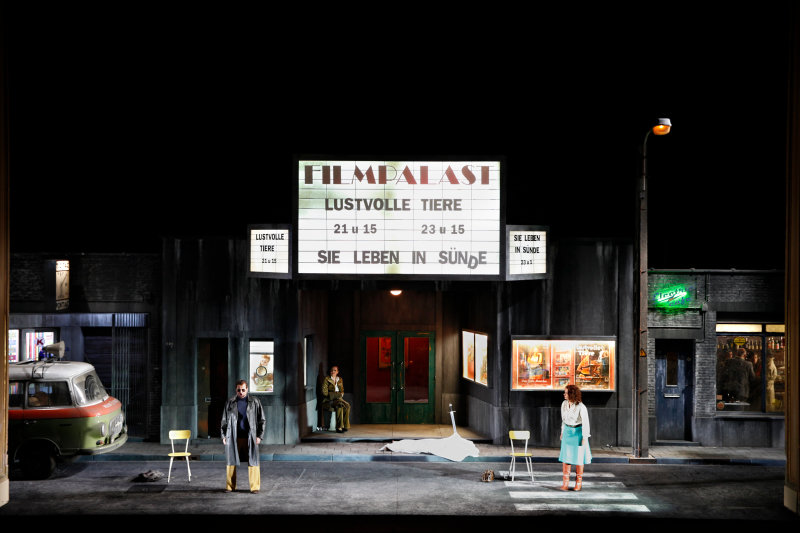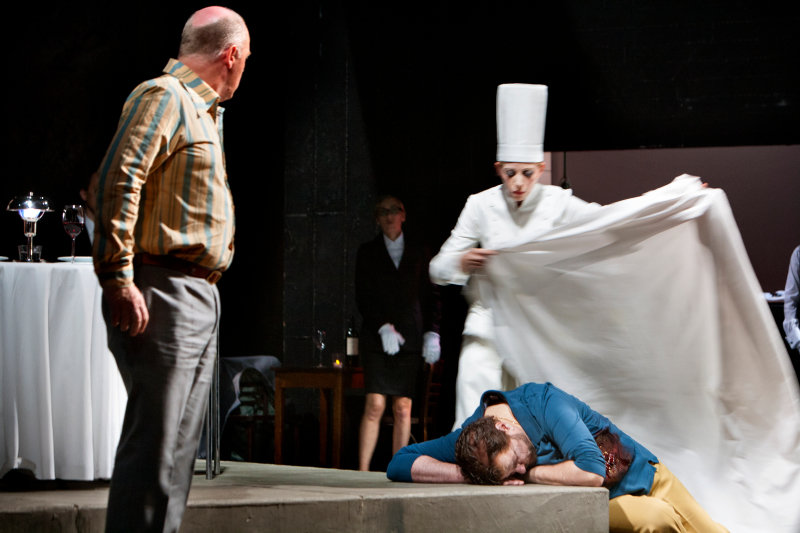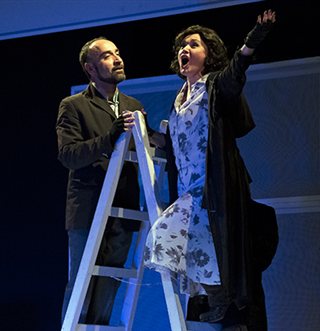
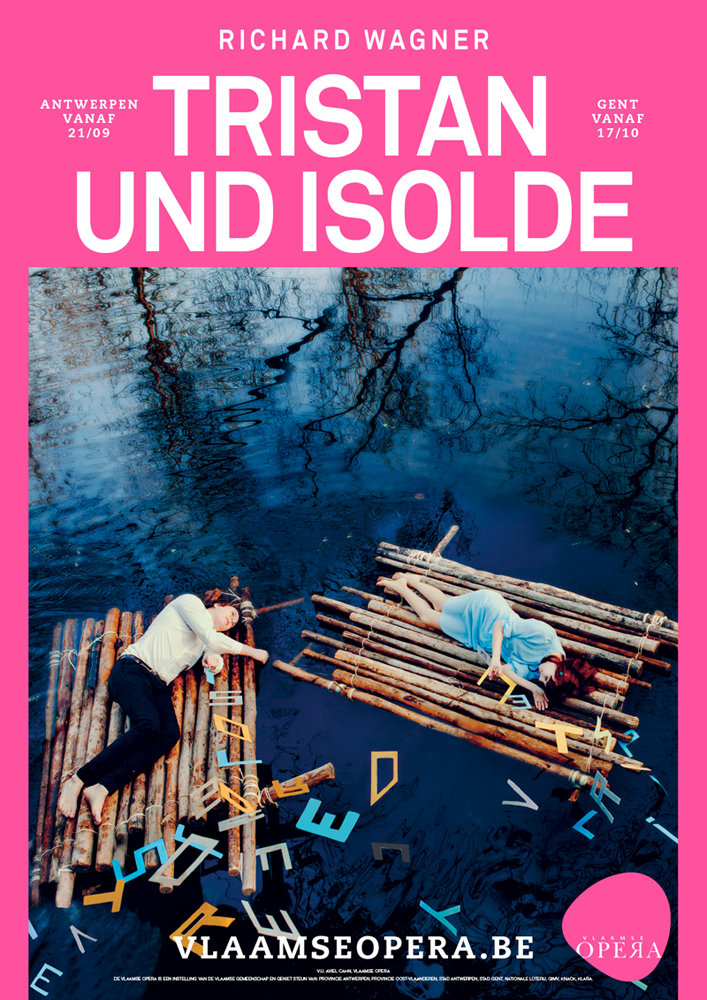
Wagner’s “Tristan und Isolde” performed in Belgium

00_opera_tristan_isolde_affiche_weblogobelgium

Tristan und Isolde

Richard Wagner (1813 – 1883)

Language: German. Surtitles: Dutch.

From 27/09/2013 in Antwerp

  • Fri 27 Sep 2013 – 18:00
  • Sun 29 Sep 2013 – 15:00
  • Wed 02 Oct 2013 – 18:00
  • Sat 05 Oct 2013 – 18:00

from 17/10/2013 in Ghent

  • Thu 17 Oct 2013 – 18:00
  • Sun 20 Oct 2013 – 15:00
  • Wed 23 Oct 2013 – 18:00
  • Sat 26 Oct 2013 – 18:00
 
  • Dmitri Jurowski Dmitri Jurowski
  • Stef Lernous Stef Leurnos
  • Franco Farina Franco Farina
  • Andreas Schager Andreas Schager
  • Lioba Braun Lioba Braun
  • Marion Ammann Marion Ammann
  • Musical direction: Dmitri Jurowski
  • Director: Stef Lernous
  • Tristan: Franco Farina / Andreas Schager
  • Isolde: Lioba Braun / Marion Ammann
  • König Marke: Ante Jerkunica
  • Brangäne: Martina Diketristan-isolde_belgium1

Tristan accompanies Isolde to her marriage to King Marke. But on the journey, a coincidence transforms the love that’s been simmering between them into a fiery passion. Once they reach land, it is clear that their relationship does not have a chance in this world. That is why they both seek refuge in the night and beyond life.

To evoke this otherworldly passion, Richard Wagner created a unique musical language that far exceeded the musical boundaries of his time. His composition balances on the limits of tonality and opened the door to a modern world of sound. The music allows Tristan and Isolde the space and intensity to be themselves. This is perfect material for ‘king of darkness’ Stef Lernous. Here, the artistic director of theatre collective Abbatoir Fermé will be applying his dark, grimy aesthetics to the great opera repertoire for the first time, daring to take on Wagner.

Coproduction with Abattoir Fermé.

Team

Stefan Lernous is infamous for his fascination with the dark side of humanity and for playing with reality and imagination. He’s an unusual, but appropriate match for the tale of Tristan, in which the night plays a central part. Dmitri Jurowski will be conducting his first full length Wagner at the Flanders Opera. Franco Farina is to play Tristan: he has mesmerised audiences in the world’s greatest opera houses and, recently, with the great German repertoire. Lioba Braun is his Isolde. She excels at the Wagner repertoire, at the prestigious Bayreuth and elsewhere. Ante Jerkunica, who has been described by NRC as “the mighty bass”, and who recently sang the role of Sarastro in Die Zauberflöte, will play King Marke.

  • Musical direction
    Dmitri Jurowski
  • Director
    Stef Lernous
  • Set design
    Stef Lernous & Sven Van Kuijk
  • Costumes
    Margerita Sanders
  • Lightning
    Stef Lernous & Sven Van Kuijk
  • Dramaturgy
    Luc Joosten
  • Choir
    Herenkoor van de Vlaamse Opera
  • Orchestra
    Symfonisch Orkest van de Vlaamse Opera
  •  
  • Tristan
    Franco Farina – 21, 24, 29 Sep en 2, 5, 17, 20, 23 Oct 2013
  • Andreas Schager – 27 Sep en 26 Oct 2013
  • Isolde
    Lioba Braun – 21, 24, 29 Sep en 2, 5, 17, 20, 23, 26 Oct 2013
  • Marion Ammann – 27 Sep 2013
  • König Marke
    Ante Jerkunica
  • Brangäne
    Martina Dike
  • Kurwenal
    Martin Gantner
  • Melot
    Christopher Lemmings
  • Ein junger Seemann / Ein Hirte
    Stephan Adriaens
  • Ein Steuermann
    Simon Schmidttristan-isolde_belgium2
Posted in Music, OPera | Tagged , , , , , , | Leave a comment

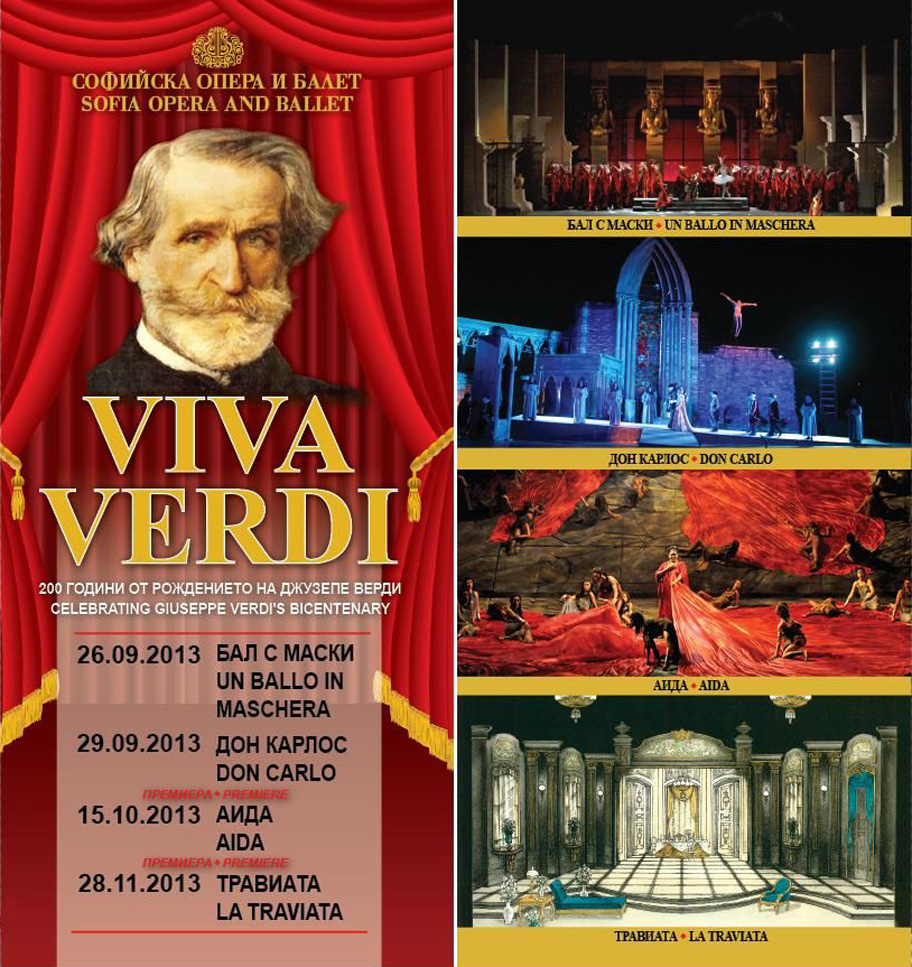
“Viva Verdi” in Bulgaria….

en_logosofia

VIVAVERDI912

Posted in Music, OPera | Tagged , , , , , , | Leave a comment

Giacomo Puccini’s La bohème in Greece…

logogreekopera 

Suitcase Opera Presents:

bohemegreeceGiacomo Puccini’s

La bohème

Director: Isidoros Sideris

PREMIERE SEPTEMBER 22, 2013      THE PETROS M. NOMIKOS CONFERENCE CENTRE – FIRA, SANTORINI, GREECE
At 21.00

Sets – Costumes: Giannis Katranitsas
Choreographer: Dionyssis Tsaftaridis
Lights: Nikos Ergazakis
Libretto translation: Maria Mourkoussi
Piano: Frixos Mortzos

Rodolfo:         Yannis Christopoulos
Mimi:   Elena Kelesidi
Marcello: Haris Andrianos
Musetta:   Maria Kokka
Schaunard  Christos Lazos
Colline:   Theodoros Moraitis 
Alcindoro: Pavlos Maropoulos
Love–Death:   Dionyssis Tsaftaridis 

Petros M. Nomikos Conference Centre
Fira, 847 00 Santorini, Greece
tel: +30 22860 23016-7 

The Suitcase Opera continues its journey around Greece with Giacomo Puccini’s legendary opera, La bohème within the framework of the 35th International Music Festival of Santorini.
Versatile but without discounting on quality, the Suitcase Opera travels to unexpected venues with the GNO’s cast of excellent singers, a piano instead of an orchestra and all of its sets packed into a suitcase with the purpose of meeting and charming new audiences.
The production’s director, Isidoros Sideris, notes: The Suitcase Opera presents La bohème in an alternative form, as a versatile and compact performance. Its aim is not to compete with the central stage of the GNO, but, rather, using simple media and the power of the music and our cast, to approach a new audience. In La bohème the intensity of the music is in constant dialogue with the fervent intensity and density of the performance. Humor and suspense are juxtaposed with the wonderful melodrama of the libretto and the music, creating a contemporary and direct show that is within the reach of all audiences.

Posted in OPera | Tagged , , , , , , , , , , , , | Leave a comment

“Rigoletto” in Krakov, Poland

 logooperaKrakov

Rigoletto

Composer: Giuseppe Verdi


22.09.2013 Sunday, time: 6:00 pm

Cast:

Il Duca di Mantova Krzysztof Bednarek, Vasyl Grokholskyi, Tomasz Kuk, Krzysztof Marciniak, Leszek Świdziński, Adam Zdunikowski
Rigoletto Andrzej Biegun, Andrzej Dobber, Jerzy Mechliński, Leszek Skrla, Dainius Stumbras, Mikołaj Zalasiński
Gilda Katarzyna Oleś-Blacha, Edyta Piasecka-Durlak, Joanna Woś, Dorota Wójcik
Sparafucile Janusz Borowicz, Volodymyr Pankiv, Rafał Siwek, Wiesław Nowak
Maddalena-Giovanna Agnieszka Cząstka, Małgorzata Ratajczak, Bożena Zawiślak-Dolny
Il Monte di Monterone Przemysław Firek, Krzysztof Witkowski Il Monte di Ceprano Krzysztof Dekański, Wiesław Nowak, Jacek Ozimkowski, Volodymyr Pankiv
La Contessa di Ceprano Joanna Tylkowska, Karin Wiktor-Kałucka
Marullo Michał Kutnik, Konrad Szota
Borsa Janusz Dębowski, Franciszek Makuch
Piaggio della Duchessa  Kamila Mędrek-Żurek, Marta Poliszot-Holzmann
Usciere di Corte Jan Migała, Andrzej Wartalski
Marionetta Maciej Zabielski, Tadeusz Żak

Krakow Opera Orchestra, Choir and Ballet 

Production team:

  • Music Director Aurelio Canonici
  • Director Henryk Baranowski
  • Set Designer Henryk Baranowski, Sławomir Lewczuk
  • Costumes Zofia de Ines 
  • Chorus Leader Ewa Bator, Marek KLuza 
  • Lighting Robert Baliński
  • Choreography Janina Niesobska
  • Premiere 28th March 2004

About the title:

Opera in 3 acts
The Italian libretto was written by Francesco Maria Piave based on the play Le roi s’amuse by Victor Hugo.

World premiere: Venice, 11th March 1851
Polish premiere: Warsaw, 8 November 1853


Giuseppe Verdi’s Rigoletto is one of the greatest operas in the history of 19th century music. The composer is believed to have said after the premiere that he would never write anything better. The director Henryk Baranowski was awarded the 2000 Golden Mask (Złota Maska) for his production, which he prepared to celebrate the Krakow Opera’s 50th anniversary. Rigoletto never ceases to delight the Krakow audience: the show is always played to a full house and the artists are rewarded with thunderous applause. The critics praise Gilda (in Edyta Piasecka’s excellent interpretation), who “is not a conventional, sweet, innocent thing, but a mysterious, fascinating figure in white, who meekly submits to her father’s and the Duke’s will. This character (…) is interestingly and consistently developed (…) Traditionally interpreted as the epitomic victim of intrigue and male lust, Baranowski’s Gilda is affected by “toxic love,” by “her father’s bad touch,” and creates situations built of her desires and fears in relation to men.”

 
  Address: ul. Lubicz 48, 31-512 Krakow, tel: (+48) 12 296 61 00
Posted in OPera | Tagged , , , , | Leave a comment

“Il Barbiere di Siviglia” opens at the Teatro Real in Madrid

IL_BARBIERE

Il Barbiere di Siviglia opens at the Teatro Real in Madrid

Teatro Real,  Madrid 28013, Spain
Monday 23-Sep-13 08:00pm
Il Barbiere di Siviglia (The Barber of Seville) (Rossini, Gioacchino (1792-1868))


Teatro Real
Tomas Hanus, Conductor
Emilio Sagi, Director
Llorenç Corbella, Set Designer
Serena Malfi, Mezzo-soprano: Rosina
Dmitry Korchak, Tenor: Count Almaviva
Mario Cassi, Baritone: Figaro
Bruno de Simone, Bass: Dr. Bartolo
Susana Cordón, Soprano: Berta (Marcellina)
Eduardo Carranza, Bass: Ambrogio
Dmitri Ulianov, Bass: Don Basilio
Isaac Galán, Bass: Fiorello
Chorus of the Teatro Real
Orchestra of the Teatro Real
Orquesta Sinfónica de Madrid
 
 The opening of the Teatro Real’s season in Madrid has been anything but uneventful. However, Rossini’s Il Barbiere di Siviglia, the ever-pleasing opera chosen to welcome back an expectant audience, had very little to do with it. Just days before the curtain rose, the classical music world woke up to the news of the dismissal of Gérard Mortier, hitherto the Artistic Director of Madrid’s opera house: a tense if not entirely surprising end to a rocky relationship between the Belgian manager and the theatre which began in 2010. Joan Matabosch, who is to succeed him, has demanded artistic independence as a precondition to accept the job. A somewhat telling request.

Dmitry Ulyanov (Don Basilio), Bruno De Simone (Bartolo), Serena Malfi (Rosina), Susana Cordón (Berta), Mario Cassi (Figaro) © Javier del Real / Teatro Real

Dmitry Ulyanov (Don Basilio), Bruno De Simone (Bartolo), Serena Malfi (Rosina), Susana Cordón (Berta), Mario Cassi (Figaro) © Javier del Real / Teatro Real

Rossini’s quintessential opera buffa comes at the perfect time to pour some oil on troubled waters and focus the attention back on the stage. This Barbiere is a joint venture of the Teatro Real and the San Carlos Opera in Lisbon, staged by the Spaniard Emilio Sagi. It premièred in this same house in 2005 and has since travelled to the Théâtre du Châtelet in Paris and Los Angeles Opera, where it will return in 2015. This is a production that is, indeed, still very much alive.

Sagi’s starting point is a stereotype with a twist: he presents Seville as a city where people dance instead of move, stomp instead of walk, lure instead of look. Yet black and white dominate both scene and characters, very aptly mirroring the torment of the two lovers who desire to be together in vain. Edgardo Rocha plays Almaviva, the count disguised as a student, then a soldier, then a music teacher. Love was evidently not an easier affair back then, and Rocha should know: he is rapidly becoming a highly sought-after Almaviva. He displays a clear Rossinian voice, hitting every single note in his truly wicked coloraturas. High notes have clearly never been a problem for him, given the ease with which they flow. This is also true of Anna Durlovski, who plays Rosina with wit and vitality. At times, and particularly in her otherwise crystal-clear “Una voce poco fa”, she does take her vocal rollercoasters a step too far – something that might not have entirely pleased a Rossini that made the point of writing out his vocal embellishments to restrain whimsical singers.

Then there is Figaro, the larger-than-life barber in whose shoes Levente Molnár feels at home theatrically and vocally. Energy also abounds in Susana Cordón’s Berta, a minor role that was however one of the most applauded of the evening, and in my opinion, a solid vocal performance with slightly overdone acting, even for a comedy character. This contrasted with a more restrained yet effective rendition of José Fardilha (Bartolo)’s epic patter “A un dottor della mia sorte” or Carlo Lepore (Basilio)’s acutely observed aria “La calunnia è un venticello”, underlined by a white silk cloth that, just like slander, grows silently until it is too late to mitigate the damage. Two arias that are gems within an inspired score packed with freshness and hilarious absurdity. It is almost inconceivable to think that just two years before its première, in northern Europe a seventeen-year old Schubert was writing the incarnation of distress that is Gretchen am Spinnrade.

Distress in Il Barbiere is a very different matter. And sure enough, it does not last. Soon, and as the troubled lovers find hope, a colourful rain washes away dullness and unsolicited suitors, and dyes buildings and clothes. With joy come pink suits, purple dresses and even a red balloon to bid farewell to the now married couple. How much is too much is at every individual’s discretion. This is certainly an unapologetic proposal.

In charge of this feast is Tomáš Hanus, a conductor who has seen his career grow from strength to strength in recent years, with recent debuts with the Opéra National de Paris and Deutsche Oper Berlin. He must be commended for his deep commitment to his craft. It is not hard to imagine him working hours on end to bring the score to life. Hanus is accurate and expressive in his gestures, and with some exceptions he keeps the stage and the pit together. His performance is honest, yet the result somehow falls short of being mindblowing, with an orchestra that performs professionally but does not go as far as sparkling, as this opera so badly requires – the orchestra is, after all, arguably the funniest of all characters in Il Barbiere. The chorus features short but convincing performances.

While it is easy to think that this score is a low-hanging fruit – it is vibrant, genius and full of personality – it is because of this same seeming simplicity that it is so hard to make it shine. Rossini himself was perfectly aware that this work would make him immortal, and history has proved him right: Il Barbiere has never left the stage since it was composed, and ironically, its most famous failure was that of its world première, with the composer himself conducting and a staged boycott undermining his best efforts. Perhaps expecting a life-changing experience from an opera that on the surface does not take itself too seriously is too much to ask. But it does happen.

Laura Furones, Bachtrack.com
Posted in Music, OPera | Tagged , , , , , , , , , , , , , , , , , , | Leave a comment

“IL FALEGNAME DI LIVONIA, OSSIA PIETRO IL GRANDE” at the Hermitage Theater in St. Petersbugh, Russia

Hermitage Theatre of Classical Russian Ballet
St. Petersburg State Governor’s Symphony orchestra presents

Gaetano Donizetti’s

PIETRO IL GRANDE

PIETRO IL GRANDE

IL FALEGNAME DI LIVONIA, OSSIA PIETRO IL GRANDE

Comic melodrama in two acts

10 October 2013 (Thu), 19:00

Libretto by Gherardo Bevilacqua Aldobrandini
Libretti for the Italian & Russian versions by Yuri Dimitrin

(11 characters, 34 musicians & 8 chorus singers)
Project and staging by Yuri Alexandrov
Premiere: 27 May 2003

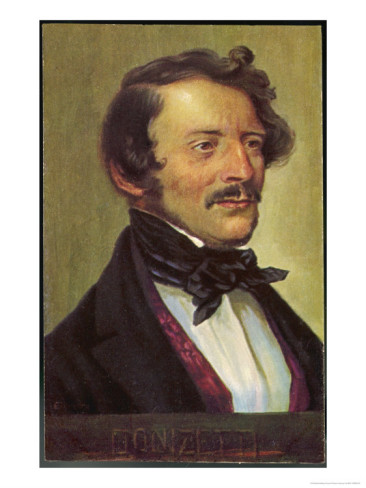
donizettiIn 1819 the young, as-yet unknown Donizetti, delighted with Alexandre Duval’s fashionable play Le Menuisier de Livonie, created a brilliant opera-buffa. It remains a mystery why, after the triumphant 1823 premiere at the Teatro Comunale, Gaetano Donizetti’s opera was never performed again.
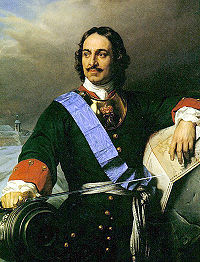
Artistic Director of the St. Petersburg Chamber Opera Yuri Alexandrov spent three years in search of the score for Pietro, which, so it appeared, had been lost forever. The painstaking work yielded results – the score was restored fragment by fragment. The audience will discover much that is unexpected in the interpretation of the image of Peter the Great and of Russian history. The St. Petersburg Chamber Opera has restored Donizetti’s tour de force to its rightful place.

Posted in OPera | Leave a comment

VERDI’S 200th ANNIVERSARY CELEBRATION: Aida at the Opera de Paris

Logo_OnPAIDA

OPERA IN FOUR ACTS (1871)

MUSIC BY GIUSEPPE VERDI (1813-1901)


LIBRETTO BY ANTONIO GHISLANZONI AFTER AUGUSTE MARIETTE

Performed in Italian

From October 10 to November 16, 2013

Commissioned to celebrate concord between the nations, Aida is essentially about conflict. Hieratic and flamboyant, spectacular and introspective, Verdi’s masterpiece returns to the Paris Opera after an absence of more than half a century.

With its fascination for Egypt, 19th century Europe seems to have embarked on an intoxicating voyage down the Nile, marvelling at the colours of that great river and of the Egyptian sky, rediscovering monuments that are not so much palaces and towns but enigmatic sanctuaries of both the genius and the folly of humanity. Aida is one of the most celebrated examples of this “Egyptomania” albeit one of the most contradictory: commissioned by Ismail Pasha, the project of a work to be performed in honour of the inauguration of the Suez Canal was initially rejected by Verdi. However, a second commission for an operatic work to be performed in the new theatre in Cairo was later, somewhat condescendingly, accepted. Verdi had no inclination for exoticism and any concessions were, for him, out of the question. This opera, intended as a celebration of universal concord and harmony between nations with all the pomp and ceremony appropriate to such solemn occasions, is in fact entirely about conflict: the war between Egypt and Ethiopia is  nothing compared to that which opposes the characters to each other. Their bloody confrontations give way, in turn, to the conflict within each individual. A work both flamboyant and hieratic, spectacular and intimate, and one of Verdi’s most beautiful masterpieces, Aida returns to the Paris Opera after more than half a century’s absence.

aida paris

Philippe Jordan Conductor
Olivier Py Stage director
Pierre-André Weitz Sets and costumes
Bertrand Killy Lighting
Patrick Marie Aubert Chorus master

Carlo Cigni Il Re
Luciana D’intino (A) ⁄Elena Bocharova (B) Amneris
Oksana Dyka (A) ⁄ Lucrezia Garcia (B) Aida
Marcelo Alvarez (A) ⁄ Robert Dean Smith (B) Radamès
Roberto Scandiuzzi  (10, 12, 15, 20, 29 oct., 2, 6, 9, 12, 14 et 16 nov.) / Alexei Botnarciuc (25 oct.) Ramfis
Sergey Murzaev Amonasro
Elodie Hache Sacerdotessa
Oleksiy Palchykov
Un Messaggero

Paris Opera Orchestra and Chorus

(A) 10, 15, 25 OCTOBER, 2, 9, 14 NOVEMBER
(B) 12, 20, 29 OCTOBER, 6, 12, 16 NOVEMBER

En direct au cinéma
EN DIRECT AU CINÉMA LE JEUDI 14 NOVEMBRE 2013

Opéra de Paris Production    Partenaires techniques Viva l'Opéra

 
Fondation Orange Ciné Mécène des retransmissions audiovisuelles de l’Opéra national de Paris
Posted in Music, OPera | Tagged , , | 1 Comment

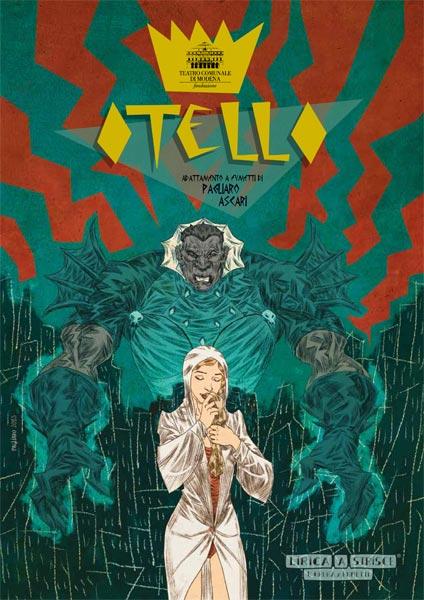
Opera as a Graphic Novel: Otello.

otellocomicOtello as a graphic novel, Fondazione Teatro Comunale di Modena

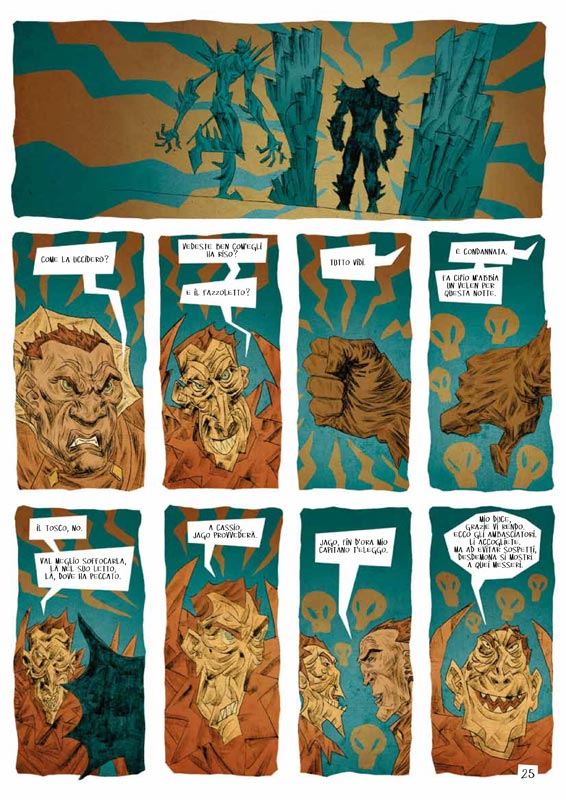
Giuseppe Verdi’s Otello is about to become a graphic novel. “We are not talking about a simplified version of the opera” explains Aldo Sisillo, the director of the Fondazione Teatro Comunale, foundation which is responsible for producing the volume, “neither is it an explanation for young people, rather, it is a way of observing opera through one of the languages of contemporary society. Above all, Modena has a long tradition of excellence regarding the world of comics and we thought it would be a wonderful idea to use this occasion to create synergy between two worlds which on the surface seem so distant”. Stefano Ascari is the author of the text and the man with the difficult job of synthesising this story of love, envy and jealousy between Othello, Iago and Desdamona. He was also responsible for three similar gaphic novels published between 2011 and 2012: Macbeth, Romeo e Giulietta and la Traviata. Ascari comes from the new generation of Modenese comic book writers. He trained in the studio of Massimo Bonfatti, the author of Cattivik, and recently was also responsible for the text of Mytico!, produced by RCS-Corriere della Sera. The artwork is by the Florentine artist Alberto Pagliaro, who is extremely well known in France, where he does most of his work. “In the characterisation of this version of Otello, Pagliaro has interpreted different strands of influence” explains Ascari. “ He uses a science-fiction/ technological imagery which undoubtedly can be traced to Japan. The choice of characterisation in the expressivity of the faces is borrowed from manga, because Japanese comics pay such great attention to the portrayal of expression -especially where it comes to strongest expressions of the type found in a tragedy like that of Otello -, while Italian graphic novels traditionally tend to render more through dialogue, and employ a more moderate tone with the action”. In the production of this graphic novel and the whole Lirica a strisce collection which can betranslated as “Comic strip Opera”), the Fondazione Teatro Communale has worked with the Modenese company Labirinto Comunicazione.


Click on the images to see a larger version….

otello_seconda-copertina  pag1otello

pag18otello  pag25otello

Posted in Books, OPera | Tagged , , , , , , | Leave a comment

VERDI’S 200th ANNIVERSARY CELEBRATION: Rigoletto with the London Symphony Orchestra (Review)

Rigoletto – review

Barbican, London
High-voltage intensity and fierce insight powered this superb concert performance of Verdi’s masterpiece

By Tim Ashley, The Guardian, Tuesday 17 September 2013

conductor Gianandrea Noseda

In his element in Verdi … conductor Gianandrea Noseda


The London Symphony Orchestra’s new season opened with a concert performance of Rigoletto conducted by Gianandrea Noseda, effectively a transfer, albeit with a few cast changes, from the Aix-en-Provence festival where both orchestra and maestro have spent part of the summer performing Verdi’s masterpiece in an apparently provocative staging by Robert Carsen. Despite occasional vocal flaws, the London performance was often remarkable.

In his element in Verdi, Noseda powered his way through the score with a combination of high-voltage intensity and fierce insight. The pervasive mood was one of nerve-wracking tension, a reminder that the work itself is first and foremost a study of the moral corruption attendant on the abuse of power, and that it should never be treated or accepted as safe. Tempi were on the fast side, with emotions in constant danger of eruption. The pressure persisted even in the duets between Rigoletto and his daughter, where many interpreters, overlooking the malaise that undermines the tenderness, offer temporary respite and calm. Informed, one suspects, by the experience of a whole run of the work, the playing was superb in its energy and detail.

Noseda’s approach was very much matched by that of his Rigoletto, dark-voiced Greek baritone Dimitri Platanias, who persuasively captured the seething rage and potential violence beneath the jester’s obsequious servility. Desirée Rancatore was an exquisite Gilda, despite a rather grand platform manner that didn’t always suggest mangled innocence. More problematic was Saimir Pirgu’s aggressive Duke, occasionally effortful, short on poetry, a sexual bully rather than a seducer. There was sharply focused singing from the men of the London Symphony Chorus, and the smaller roles were consistently well taken: Gábor Bretz’s dangerous Sparafucile and Wojtek Smilek’s ferocious Monterone were particularly outstanding.

Posted in Article, Music, OPera | Tagged , , , , , , , , | Leave a comment

MOZART and More; Free Concert in Arizona

La Forza Chamber Orchestra offers free concert

Friday, September 27, 2013
7:30 p.m.

Valley Presbyterian Church
6947 E. McDonald Dr.
Paradise Valley, Arizona


“Mozart and More”

PROGRAM:

The Magic Flute (Die Zauberflöte) Overture – Mozart

Piano Concerto No. 20 in D Minor, K. 466 – Mozart
Noel Engebretson-piano soloist

Serenade in D Minor, Op. 44, for Winds, Cello and Contrabass – Dvořák
           
Academic Festival Overture – Brahms
           

Admission: FREE
Parking: FREE


       Noel Engebretson


Critics have raved about Noel Engebretson’s powerful performances.  The critic for the Austin, Texas Statesman said he was left “gasping in amazement.”  The Tuscaloosa news cited Engebretson’s “astounding keyboard skills”, while the Rochester NY newspaper stated that compared with the average pianist who reproduces notes without emotion, “Engebretson is a breed apart.”  In a different review from Tuscaloosa, the critic admired the power of projection from Dr. Engebretson, noting that at times the “piano overpowered the orchestra…”

Dr. Engebretson has had a wide and varied career.  As a pianist who has played widely throughout the United States, he has garnered a reputation as not just a technician at the keyboard, but as an artist who studies and deeply penetrates the meaning of the musical score, with a subtlety in his address that has also attracted critical notice.  He has toured China three times, and performed with four of the most prestigious orchestras there.  Recent performances have also included Serbia and Sicily.  He has also established a reputation as a teacher, clinician, and masterclass teacher.  His students have garnered prizes and awards in the Joanna Hodges International Piano Competition, the MTNA regional competitions, the California CAPMT competition, as well as many local and state competitions throughout the southeast and southwest United States.  He has presented clinics on pedaling for the International Piano Pedagogy Conference, and given masterclasses throughout China.  One of the major conservatories in China, the Shenzhen Conservatory, named Dr. Engebretson as a permanent guest faculty.  Dr. Engebretson has performed more than 25 piano concertos, and can offer repertoire as a soloist that would encompass more than 20 different recitals.

Posted in Music | Tagged , , | Leave a comment