VERDI’S 200th ANNIVERSARY CELEBRATION: Aida at the Opera de Paris

Logo_OnPAIDA

OPERA IN FOUR ACTS (1871)

MUSIC BY GIUSEPPE VERDI (1813-1901)


LIBRETTO BY ANTONIO GHISLANZONI AFTER AUGUSTE MARIETTE

Performed in Italian

From October 10 to November 16, 2013

Commissioned to celebrate concord between the nations, Aida is essentially about conflict. Hieratic and flamboyant, spectacular and introspective, Verdi’s masterpiece returns to the Paris Opera after an absence of more than half a century.

With its fascination for Egypt, 19th century Europe seems to have embarked on an intoxicating voyage down the Nile, marvelling at the colours of that great river and of the Egyptian sky, rediscovering monuments that are not so much palaces and towns but enigmatic sanctuaries of both the genius and the folly of humanity. Aida is one of the most celebrated examples of this “Egyptomania” albeit one of the most contradictory: commissioned by Ismail Pasha, the project of a work to be performed in honour of the inauguration of the Suez Canal was initially rejected by Verdi. However, a second commission for an operatic work to be performed in the new theatre in Cairo was later, somewhat condescendingly, accepted. Verdi had no inclination for exoticism and any concessions were, for him, out of the question. This opera, intended as a celebration of universal concord and harmony between nations with all the pomp and ceremony appropriate to such solemn occasions, is in fact entirely about conflict: the war between Egypt and Ethiopia is  nothing compared to that which opposes the characters to each other. Their bloody confrontations give way, in turn, to the conflict within each individual. A work both flamboyant and hieratic, spectacular and intimate, and one of Verdi’s most beautiful masterpieces, Aida returns to the Paris Opera after more than half a century’s absence.

aida paris

Philippe Jordan Conductor
Olivier Py Stage director
Pierre-André Weitz Sets and costumes
Bertrand Killy Lighting
Patrick Marie Aubert Chorus master

Carlo Cigni Il Re
Luciana D’intino (A) ⁄Elena Bocharova (B) Amneris
Oksana Dyka (A) ⁄ Lucrezia Garcia (B) Aida
Marcelo Alvarez (A) ⁄ Robert Dean Smith (B) Radamès
Roberto Scandiuzzi  (10, 12, 15, 20, 29 oct., 2, 6, 9, 12, 14 et 16 nov.) / Alexei Botnarciuc (25 oct.) Ramfis
Sergey Murzaev Amonasro
Elodie Hache Sacerdotessa
Oleksiy Palchykov
Un Messaggero

Paris Opera Orchestra and Chorus

(A) 10, 15, 25 OCTOBER, 2, 9, 14 NOVEMBER
(B) 12, 20, 29 OCTOBER, 6, 12, 16 NOVEMBER

En direct au cinéma
EN DIRECT AU CINÉMA LE JEUDI 14 NOVEMBRE 2013

Opéra de Paris Production    Partenaires techniques Viva l'Opéra

 
Fondation Orange Ciné Mécène des retransmissions audiovisuelles de l’Opéra national de Paris
Posted in Music, OPera | Tagged , , | 1 Comment

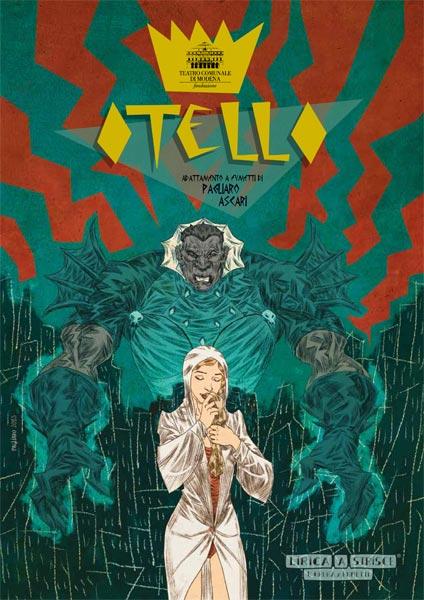
Opera as a Graphic Novel: Otello.

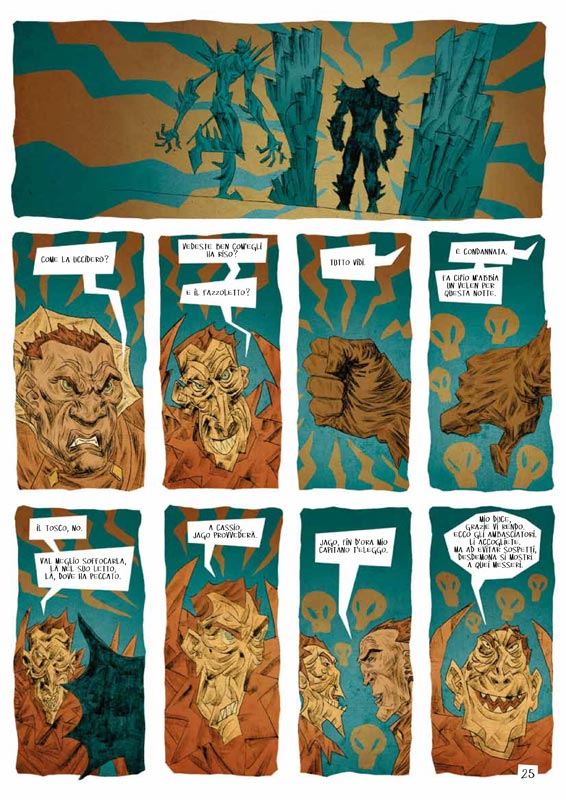
otellocomicOtello as a graphic novel, Fondazione Teatro Comunale di Modena

Giuseppe Verdi’s Otello is about to become a graphic novel. “We are not talking about a simplified version of the opera” explains Aldo Sisillo, the director of the Fondazione Teatro Comunale, foundation which is responsible for producing the volume, “neither is it an explanation for young people, rather, it is a way of observing opera through one of the languages of contemporary society. Above all, Modena has a long tradition of excellence regarding the world of comics and we thought it would be a wonderful idea to use this occasion to create synergy between two worlds which on the surface seem so distant”. Stefano Ascari is the author of the text and the man with the difficult job of synthesising this story of love, envy and jealousy between Othello, Iago and Desdamona. He was also responsible for three similar gaphic novels published between 2011 and 2012: Macbeth, Romeo e Giulietta and la Traviata. Ascari comes from the new generation of Modenese comic book writers. He trained in the studio of Massimo Bonfatti, the author of Cattivik, and recently was also responsible for the text of Mytico!, produced by RCS-Corriere della Sera. The artwork is by the Florentine artist Alberto Pagliaro, who is extremely well known in France, where he does most of his work. “In the characterisation of this version of Otello, Pagliaro has interpreted different strands of influence” explains Ascari. “ He uses a science-fiction/ technological imagery which undoubtedly can be traced to Japan. The choice of characterisation in the expressivity of the faces is borrowed from manga, because Japanese comics pay such great attention to the portrayal of expression -especially where it comes to strongest expressions of the type found in a tragedy like that of Otello -, while Italian graphic novels traditionally tend to render more through dialogue, and employ a more moderate tone with the action”. In the production of this graphic novel and the whole Lirica a strisce collection which can betranslated as “Comic strip Opera”), the Fondazione Teatro Communale has worked with the Modenese company Labirinto Comunicazione.


Click on the images to see a larger version….

otello_seconda-copertina  pag1otello

pag18otello  pag25otello

Posted in Books, OPera | Tagged , , , , , , | Leave a comment

VERDI’S 200th ANNIVERSARY CELEBRATION: Rigoletto with the London Symphony Orchestra (Review)

Rigoletto – review

Barbican, London
High-voltage intensity and fierce insight powered this superb concert performance of Verdi’s masterpiece

By Tim Ashley, The Guardian, Tuesday 17 September 2013

conductor Gianandrea Noseda

In his element in Verdi … conductor Gianandrea Noseda


The London Symphony Orchestra’s new season opened with a concert performance of Rigoletto conducted by Gianandrea Noseda, effectively a transfer, albeit with a few cast changes, from the Aix-en-Provence festival where both orchestra and maestro have spent part of the summer performing Verdi’s masterpiece in an apparently provocative staging by Robert Carsen. Despite occasional vocal flaws, the London performance was often remarkable.

In his element in Verdi, Noseda powered his way through the score with a combination of high-voltage intensity and fierce insight. The pervasive mood was one of nerve-wracking tension, a reminder that the work itself is first and foremost a study of the moral corruption attendant on the abuse of power, and that it should never be treated or accepted as safe. Tempi were on the fast side, with emotions in constant danger of eruption. The pressure persisted even in the duets between Rigoletto and his daughter, where many interpreters, overlooking the malaise that undermines the tenderness, offer temporary respite and calm. Informed, one suspects, by the experience of a whole run of the work, the playing was superb in its energy and detail.

Noseda’s approach was very much matched by that of his Rigoletto, dark-voiced Greek baritone Dimitri Platanias, who persuasively captured the seething rage and potential violence beneath the jester’s obsequious servility. Desirée Rancatore was an exquisite Gilda, despite a rather grand platform manner that didn’t always suggest mangled innocence. More problematic was Saimir Pirgu’s aggressive Duke, occasionally effortful, short on poetry, a sexual bully rather than a seducer. There was sharply focused singing from the men of the London Symphony Chorus, and the smaller roles were consistently well taken: Gábor Bretz’s dangerous Sparafucile and Wojtek Smilek’s ferocious Monterone were particularly outstanding.

Posted in Article, Music, OPera | Tagged , , , , , , , , | Leave a comment

MOZART and More; Free Concert in Arizona

La Forza Chamber Orchestra offers free concert

Friday, September 27, 2013
7:30 p.m.

Valley Presbyterian Church
6947 E. McDonald Dr.
Paradise Valley, Arizona


“Mozart and More”

PROGRAM:

The Magic Flute (Die Zauberflöte) Overture – Mozart

Piano Concerto No. 20 in D Minor, K. 466 – Mozart
Noel Engebretson-piano soloist

Serenade in D Minor, Op. 44, for Winds, Cello and Contrabass – Dvořák
           
Academic Festival Overture – Brahms
           

Admission: FREE
Parking: FREE


       Noel Engebretson


Critics have raved about Noel Engebretson’s powerful performances.  The critic for the Austin, Texas Statesman said he was left “gasping in amazement.”  The Tuscaloosa news cited Engebretson’s “astounding keyboard skills”, while the Rochester NY newspaper stated that compared with the average pianist who reproduces notes without emotion, “Engebretson is a breed apart.”  In a different review from Tuscaloosa, the critic admired the power of projection from Dr. Engebretson, noting that at times the “piano overpowered the orchestra…”

Dr. Engebretson has had a wide and varied career.  As a pianist who has played widely throughout the United States, he has garnered a reputation as not just a technician at the keyboard, but as an artist who studies and deeply penetrates the meaning of the musical score, with a subtlety in his address that has also attracted critical notice.  He has toured China three times, and performed with four of the most prestigious orchestras there.  Recent performances have also included Serbia and Sicily.  He has also established a reputation as a teacher, clinician, and masterclass teacher.  His students have garnered prizes and awards in the Joanna Hodges International Piano Competition, the MTNA regional competitions, the California CAPMT competition, as well as many local and state competitions throughout the southeast and southwest United States.  He has presented clinics on pedaling for the International Piano Pedagogy Conference, and given masterclasses throughout China.  One of the major conservatories in China, the Shenzhen Conservatory, named Dr. Engebretson as a permanent guest faculty.  Dr. Engebretson has performed more than 25 piano concertos, and can offer repertoire as a soloist that would encompass more than 20 different recitals.

Posted in Music | Tagged , , | Leave a comment

Lucia di Lammermoor at the Opera de Paris

luciadilammermoorLUCIA DI LAMMERMOOR

DRAMMA TRAGICO IN TWO PARTS (AND THREE ACTS) (1835)


MUSIC BY GAETANO DONIZETTI (1797-1848)

LIBRETTO BY SALVATORE CAMMARANO AFTER WALTER SCOTT’S NOVEL “THE BRIDE OF LAMMERMOOR”

Performed in Italian

From September 7 to October 9, 2013

Inspired by Sir Walter Scott’s novel, madness is the dominant theme in this opera, set in a ruined castle on the misty moors. With sublime mastery, Donizetti combines drama with consummate vocal writing, giving the role of Lucia a heartbreakingly delicate quality.

In Paris in 1835, Donizetti could not hope to compete against the wave of enthusiasm for I Puritani by his rival Bellini. His Marino Faliero, inspired by Byron’s drama of the same name, and with the same singers as I Puritani, namely Giovanni Battista Rubini and Giula Grisi, enjoyed only a very short run. He had his revenge a few months later however, albeit a sad one: three days before the first performance of Lucia di Lammermoor, Bellini died at the age of thirty-four. Lucia was a huge success thanks, notably, to Grisi and Rubini’s principal rivals, Fanny Persiani and Gilbert-Louis Duprez. With Rossini in retirement since 1829 and Bellini in his grave, Donizetti was now master of the European operatic stage. He did not remain so for long however. Even before Verdi came to fame, he succumbed to madness, that terrible affliction whose accents he so brilliantly captured and which dominates this Scottish opera. Inspired by Sir Walter Scott’s novel, the story unfolds in an old ruined castle amid the wild and misty moorland. As Balzac later pointed out in Massimilla Doni, virtuosity is the very soul of a prima donna and Donizetti succeeds with sublime mastery in combining drama  consummate vocal writing, bringing to the role of Lucia a quality both heart-rending and exquisitely delicate. In Lucia di Lammermoor, madness is neither an abyss nor a descent into hell, but deliverance and sublimation.

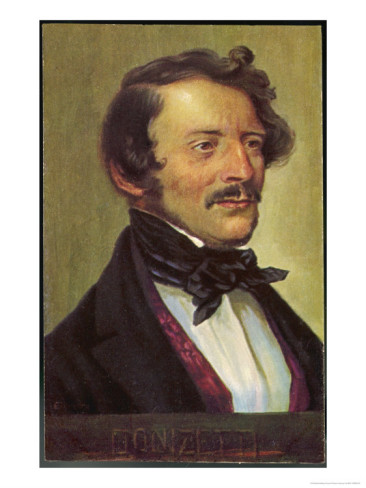
donizettiThe composer

Born in Bergamo in 1797, Gaetano Donizetti occupied a transitional place between Rossini and Verdi. Less affected by romanticism than Bellini, Donizetti was the link between two trends to which Italy owes its most authentic masterpieces. We owe him an abun­dance of lyrical works: some sixty operas composed between 1816 and 1843, most of which have fallen into oblivion. As a student of Simon Mayr at the Bergamo School of Music, his first opera, Enrico di Borgogna, was performed in 1818, thanks to the help of his teacher who had recognised his young talent. In 1822, Zoraide di Granata met with remarkable success. Then, a series of commissions turned Donizetti into a full-time com­poser of operas. From 1822 to 1830, he wrote no fewer than 26 operas. His first real triumph came with Anna Bolena (1830). The death of Bellini and Rossini’s premature retirement would contribute to Donizetti’s growing success in Europe. He composed Les Martyrs, La Favorite and Dom Sébastien for the Paris Opera. La Fille du régiment was first performed at the Opéra Comique. Vienna commissioned Linda di Chamounix and Maria di Rohan from him. His final masterpiece, Don Pasquale, was first performed at the Théâtre des Italiens in 1843. Although at the height of his glory, his health deteriorated rapidly. Hospitalised in Ivry in 1846, he died in 1848 in his native town of Bergamo from complications due to cerebrospinal degeneration. He left many other operas to posterity, including Lucrezia Borgia (1833), Lucia di Lammermoor (1835), Maria Stuarda (1835), Roberto Devereux (1837), Maria di Rudenz (1838) and Caterina Cornaro (1844).

The work

Salvatore Cammarano’s libretto drew its inspiration from Walter Scott’s The Bride of Lammermoor and Victor Ducange’s tragedy based on the novel and written 1828. The archetypal Italian opera in which the tragic destiny of the heroine goes hand in hand with vocal virtuosity, Lucia de Lammermoor is generally considered along with Don Pasquale to be Donizetti’s masterpiece. The numerous ornate melodies always reflect the dramatic content of the work, particularly in the famous sextet at the end of the second act which in many ways heralds the music of Verdi with each of the six characters expressing different feelings which gradually blend together. The work is most famous for the long “mad scene” in Act III, one of the jewels of romantic bel canto. This bravura piece requires an artist possessing not only an exceptional technique but also a true feeling for theatre. Somewhere between sleep and wakefulness, Lucia relives the great love duet of Act II. For a few minutes she imagines that she has married Edgardo, before reality catches up with her. The voice passes from virtuosity to rapture whilst expressing the depths of suffering and despair in its exchanges with the flute. This highly elaborate scene transcends simple vocal dexterity to become an essential element of the work.

The first performance

The Italian version was created at the Teatro San Carlo in Naples on 26 September 1835. A French version using a translation by Alphonse Royer and Gustave Vaëz, revised by the composer himself and including numerous cuts, was first performed at the Théâtre de la Renaissance in Paris on 6 August 1839.

Logo_OnPThe work at the Paris Opera: Lucia di Lammermoor was performed at Le Peletier on 20 February 1846 in the French version. The work was first performed at the Palais Garnier on 9 December 1889 with Nelly Melba in the title role. There were numerous revivals until 1970 with, among others, Lily Pons (1935), Joan Sutherland (1960-1961), Mady Mesplé (1962-1963-1968-1969-1970), Christiane Eda-Pierre (1968-1970). The original version entered the repertoire of the Opéra Bastille in 1995 in a production by Andrei Serban, conducted by Maurizio Benini, with June Anderson, Roberto Alagna and Gino Quilico in the main roles. It is this production, already revived with Mariella Devia, Sumi Jo, Andrea Rost and Natalie Dessay in the title-role, that is being performed today

Maurizio Benini Conductor
Andrei Serban Stage director
William Dudley Sets and costumes
Guido Levi Lighting
Alessandro Di Stefano Chorus master

Ludovic Tézier (7, 13, 20, 26 sept., 1er oct.) / George Petean (10, 17, 23, 29 sept., 4, 6, 9 oct.) Enrico Ashton
Patrizia Ciofi (7, 13, 20, 26 sept., 1er, 6 oct.) / Sonya Yoncheva (10, 17, 23, 29 sept., 4, 9 oct.) Lucia
Vittorio Grigolo (7, 13, 20, 26 sept., 1er, 6 oct.) / Michael Fabiano (10, 17, 23, 29 sept., 4, 9 oct.) Edgardo di Ravenswood
Alfredo Nigro Arturo Bucklaw
Orlin Anastassov Raimondo Bidebent
Cornelia Oncioiu Alisa
Eric Huchet Normanno

Paris Opera Orchestra and Chorus

logo radio classique en direct sur Radio Classique le 26 septembre, après une journée complète depuis l’Opéra Bastille sur leur antenne.

Posted in OPera | Leave a comment

Bellini opera fragment found in Spain

Bellini opera fragment found in Spain

Rare fragment of an opera score handwritten by 19th century Italian composer Vincenzo Bellini found in Spain.

This handout photo provided on September 19, 2013 by the National Library of Spain (Biblioteca Nacional de Espana) shows a fragment of an opera score by Italian composer Vincenzo Bellini found in between the pages of an album of 19th century photographs and drawings.

This handout photo provided on September 19, 2013 by the National Library of Spain (Biblioteca Nacional de Espana) shows a fragment of an opera score by Italian composer Vincenzo Bellini found in between the pages of an album of 19th century photographs and drawings.

Spain’s national library said today that it had discovered a rare fragment of an opera score handwritten by 19th-century Italian composer Vincenzo Bellini lying within its archives.

The single page of manuscript shows an outline of seven bars of notes from a duet in the opera “Il Pirata” (The Pirate) which had its debut in Milan’s La Scala on October 27, 1827, the National Library of Spain said.

The manuscript by Bellini (1801-1835) has annotations at the bottom of the page and a phrase written in the right-hand margin: “Manuscript of Vincenzo Bellini and his brothers Mario and Carmelo”.

The phrase was a form of authentication commonly found on manuscripts sought after by 19th century collectors of “relics” of the most memorable composers, the library said in a statement.

The newly discovered Bellini manuscript was unusual because the notes did not correspond exactly to the final score, although there were barely any changes, it said.

“This rarity makes it of even more interest from a musicological point of view,” the library said.

The fragment was discovered after the library’s catalog service requested the identification of a “sheet of music bound in an album of 19th century photographs and drawings with landscapes of Malta and Sicily”, it said.

Posted in OPera | Leave a comment

Terrible news: Tragic death of young soprano while singing Verdi’s Requiem

Terrible news: Tragic death of young soprano while singing Verdi’s Requiem

 by Norman Lebrecht, Arts Journal Blogs, Slipped Disc

The Teatro Colón in Buenos Aires reports the death of soprano Florencia Fabris, who had suffered a brain aneurysm while singing Verdi’s Requiem at the Auditorio Juan Victoria in the province of San Juan.

Fabris, 38, felt bad during the performance, but refused to leave the stage. She  was rushed to Mendoza and underwent surgery but failed to recover. Our deep sympathies to her family and friends.


Florencia Fabris

Her colleague Carmen Giannattasio has contacted Slipped Disc with the following message:

It is with extreme sadness I am aware of the death of Florencia Fabris who was my cover as Desdemona only a month ago in Buenos Aires. She
was a young, solar, full of life girl. She was so nice to give to me a little teddy bear mascot of her daughter taken from her toy box just to keep me company in my dressing room during performances, since I was alone.
Life hides many surprises sometimes happy, sometimes bitter like this one.  She died while singing Libera Me Domine in Verdi’s Requiem.
May God rest her soul  I am very close to her family in this very sad moment.  Florencia rest in peace
Carmen Giannattasio

Posted in Article, Music, OPera | Tagged , , , , , | Leave a comment

Euphoria and Unease. Jewish Vienna and Richard Wagner

wagner_gedenktafelEuphoria and Unease. Jewish Vienna and Richard Wagner

25 September 2013 – February 2014 (the exact end date will be announced later)

The year 2013 marks the two hundredth anniversary of the birth of Richard Wagner, one of the most controversial personalities of the nineteenth, twentieth, and twenty-first centuries. His essay ‘Judaism in Music’ (1850 and 1869), his operas, and many other statements established Wagner as one of the most out-and-out anti-Semitic figures within the German bourgeoisie. At the same time his musical creativity, the idea of the ‘Gesamtkunstwerk’ (total work of art), and the cult of genius meant that he had an enormous influence on his time and on subsequent generations. The Jewish Museum Vienna focuses in its exhibition on this wide-ranging and contradictory phenomenon, with special reference to Vienna, which became a center of the Wagner cult very early on. There were a lot of Jewish Wagnerians, but his most sarcastic critic, the renowned feature writer Daniel Spitzer, also lived and published in Vienna. Wagner’s work inspired non-Jewish artists and intellectuals as well as declared anti-Semites and – naively ignoring or reinterpreting the anti-Semitic messages – influential Jewish intellectuals like Theodor Herzl or Otto Weininger. Taking this adoration of the composer, which was soon to prove to be a trap, as the starting point, the exhibition looks at anti-Semitism of the nineteenth and twentieth centuries and at Wagner’s impact on the art and culture of fin-de-siècle Vienna and – beyond that – on Adolf Hitler and the Nazi regime. It also considers attitudes to Wagner today in Europe, the USA, and Israel.

Jewish Museum Vienna (Jüdisches Museum Wien) Palais Eskeles

Dorotheergasse 11
1010 Wien (Austria)

Posted in Exhibits, Music, OPera | Tagged , , , , , | Leave a comment

Wagner and the Jews, Symposium in London

Sunday 6 October 2013

Wagner and the Jews

  • Event type: Symposium
  • Venue: London Jewish Cultural Centre
  • Time: 2pm

No aspect of Wagner generates more heat than his anti-Semitism. This discussion will attempt to throw light  too, debating Wagner’s anti-Semitism in relation to his works and his place in history. Speakers: Mark Berry, Cori Ellison, Erik Levi and Barry Millington. Chair: Trudy Gold.

LJCC, Ivy House, 94–96 North End Rd, London, NW11 7SX

Posted in OPera | Leave a comment

“Wagner’s Jews” Screening in Chicago

Wednesday, September 18, 2013

Hilan Warshaw


Filmmaker, Author, Lecturer
Lecture and Screening
of his documentary film
WarshawFilm


Wagner’s Jews
Documentary, 55 minutes, 2013
Produced, directed, and written by Hilan Warshaw
Includes a Q+A with the filmmaker

Richard Wagner was notoriously anti-Semitic, and his writings on the Jews were later embraced by Hitler and the Nazis. But there is another, lesser-known side to this story. For years, many of Wagner’s closest associates were Jews—young musicians who became personally devoted to him, and provided crucial help to his work and career. Who were they? What brought them to Wagner, and what brought him to them? These questions are at the heart of Hilan Warshaw’s new documentary Wagner’s Jews, co-produced with WDR and ARTE and broadcast in Europe in 2013 to mark Wagner’s bicentenary. Filmed on location in Germany, Switzerland, and Italy, Wagner’s Jews tells these remarkable stories through archival sources, visual re-enactments, interviews, and musical performances. Parallel to this historical narrative, the film explores the ongoing controversy over performing Wagner’s music in Israel.

Hilan Warshaw

HILAN WARSHAW is a filmmaker and writer based in New York City. Through his production company, Overtone Films (www.overtonefilms.com), he produces and directs independent projects as well as videos for organizations including Carnegie Hall and the League of American Orchestras. His writings on Wagner have been published by McFarland Press, The Wagner Journal, Wagner Spectrum, and in the new Cambridge Wagner Encyclopedia. He recently taught a course on Romanticism and Film at Barnard College, Columbia University, and he has lectured at venues including New York University, Hofstra University, Wagner Society of America, Wagner Society of New York, and Boston Wagner Society.  He has a B.F.A. with honors (Film & TV) and M.F.A. (Musical Theatre Writing) from NYU’s Tisch School of the Arts, and he studied orchestral conducting at Mannes College of Music and the Aspen Music School. www.hilanwarshaw.com

Hotel Allegro
171 W. Randolph Street
Chicago

7:00 p.m. – Reception
7:30 p.m. – Program
Cost: $5.00 Refreshment Fee
(Guests $ 10.00) – Payable at the event only
Questions: 847-256-1292 Reservations are not required.
Guests are always welcome!

SAVE THESE DATES

Tuesday, October 29 – Sir Andrew Davis

Saturday afternoon, November 23 – Professors Katherine Syer and William Kinderman

Posted in Film, Music, OPera | Tagged , , , , , | Leave a comment