MOZART and More; Free Concert in Arizona

La Forza Chamber Orchestra offers free concert

Friday, September 27, 2013
7:30 p.m.

Valley Presbyterian Church
6947 E. McDonald Dr.
Paradise Valley, Arizona


“Mozart and More”

PROGRAM:

The Magic Flute (Die Zauberflöte) Overture – Mozart

Piano Concerto No. 20 in D Minor, K. 466 – Mozart
Noel Engebretson-piano soloist

Serenade in D Minor, Op. 44, for Winds, Cello and Contrabass – Dvořák
           
Academic Festival Overture – Brahms
           

Admission: FREE
Parking: FREE


       Noel Engebretson


Critics have raved about Noel Engebretson’s powerful performances.  The critic for the Austin, Texas Statesman said he was left “gasping in amazement.”  The Tuscaloosa news cited Engebretson’s “astounding keyboard skills”, while the Rochester NY newspaper stated that compared with the average pianist who reproduces notes without emotion, “Engebretson is a breed apart.”  In a different review from Tuscaloosa, the critic admired the power of projection from Dr. Engebretson, noting that at times the “piano overpowered the orchestra…”

Dr. Engebretson has had a wide and varied career.  As a pianist who has played widely throughout the United States, he has garnered a reputation as not just a technician at the keyboard, but as an artist who studies and deeply penetrates the meaning of the musical score, with a subtlety in his address that has also attracted critical notice.  He has toured China three times, and performed with four of the most prestigious orchestras there.  Recent performances have also included Serbia and Sicily.  He has also established a reputation as a teacher, clinician, and masterclass teacher.  His students have garnered prizes and awards in the Joanna Hodges International Piano Competition, the MTNA regional competitions, the California CAPMT competition, as well as many local and state competitions throughout the southeast and southwest United States.  He has presented clinics on pedaling for the International Piano Pedagogy Conference, and given masterclasses throughout China.  One of the major conservatories in China, the Shenzhen Conservatory, named Dr. Engebretson as a permanent guest faculty.  Dr. Engebretson has performed more than 25 piano concertos, and can offer repertoire as a soloist that would encompass more than 20 different recitals.

Posted in Music | Tagged , , | Leave a comment

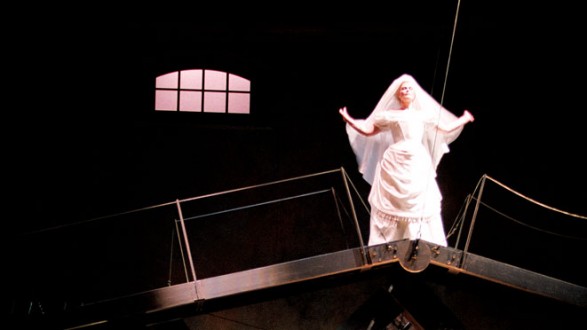
Lucia di Lammermoor at the Opera de Paris

luciadilammermoorLUCIA DI LAMMERMOOR

DRAMMA TRAGICO IN TWO PARTS (AND THREE ACTS) (1835)


MUSIC BY GAETANO DONIZETTI (1797-1848)

LIBRETTO BY SALVATORE CAMMARANO AFTER WALTER SCOTT’S NOVEL “THE BRIDE OF LAMMERMOOR”

Performed in Italian

From September 7 to October 9, 2013

Inspired by Sir Walter Scott’s novel, madness is the dominant theme in this opera, set in a ruined castle on the misty moors. With sublime mastery, Donizetti combines drama with consummate vocal writing, giving the role of Lucia a heartbreakingly delicate quality.

In Paris in 1835, Donizetti could not hope to compete against the wave of enthusiasm for I Puritani by his rival Bellini. His Marino Faliero, inspired by Byron’s drama of the same name, and with the same singers as I Puritani, namely Giovanni Battista Rubini and Giula Grisi, enjoyed only a very short run. He had his revenge a few months later however, albeit a sad one: three days before the first performance of Lucia di Lammermoor, Bellini died at the age of thirty-four. Lucia was a huge success thanks, notably, to Grisi and Rubini’s principal rivals, Fanny Persiani and Gilbert-Louis Duprez. With Rossini in retirement since 1829 and Bellini in his grave, Donizetti was now master of the European operatic stage. He did not remain so for long however. Even before Verdi came to fame, he succumbed to madness, that terrible affliction whose accents he so brilliantly captured and which dominates this Scottish opera. Inspired by Sir Walter Scott’s novel, the story unfolds in an old ruined castle amid the wild and misty moorland. As Balzac later pointed out in Massimilla Doni, virtuosity is the very soul of a prima donna and Donizetti succeeds with sublime mastery in combining drama  consummate vocal writing, bringing to the role of Lucia a quality both heart-rending and exquisitely delicate. In Lucia di Lammermoor, madness is neither an abyss nor a descent into hell, but deliverance and sublimation.

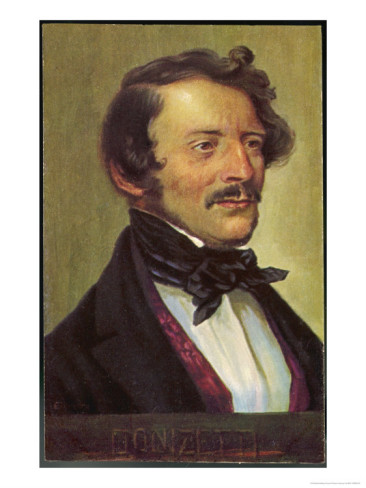
donizettiThe composer

Born in Bergamo in 1797, Gaetano Donizetti occupied a transitional place between Rossini and Verdi. Less affected by romanticism than Bellini, Donizetti was the link between two trends to which Italy owes its most authentic masterpieces. We owe him an abun­dance of lyrical works: some sixty operas composed between 1816 and 1843, most of which have fallen into oblivion. As a student of Simon Mayr at the Bergamo School of Music, his first opera, Enrico di Borgogna, was performed in 1818, thanks to the help of his teacher who had recognised his young talent. In 1822, Zoraide di Granata met with remarkable success. Then, a series of commissions turned Donizetti into a full-time com­poser of operas. From 1822 to 1830, he wrote no fewer than 26 operas. His first real triumph came with Anna Bolena (1830). The death of Bellini and Rossini’s premature retirement would contribute to Donizetti’s growing success in Europe. He composed Les Martyrs, La Favorite and Dom Sébastien for the Paris Opera. La Fille du régiment was first performed at the Opéra Comique. Vienna commissioned Linda di Chamounix and Maria di Rohan from him. His final masterpiece, Don Pasquale, was first performed at the Théâtre des Italiens in 1843. Although at the height of his glory, his health deteriorated rapidly. Hospitalised in Ivry in 1846, he died in 1848 in his native town of Bergamo from complications due to cerebrospinal degeneration. He left many other operas to posterity, including Lucrezia Borgia (1833), Lucia di Lammermoor (1835), Maria Stuarda (1835), Roberto Devereux (1837), Maria di Rudenz (1838) and Caterina Cornaro (1844).

The work

Salvatore Cammarano’s libretto drew its inspiration from Walter Scott’s The Bride of Lammermoor and Victor Ducange’s tragedy based on the novel and written 1828. The archetypal Italian opera in which the tragic destiny of the heroine goes hand in hand with vocal virtuosity, Lucia de Lammermoor is generally considered along with Don Pasquale to be Donizetti’s masterpiece. The numerous ornate melodies always reflect the dramatic content of the work, particularly in the famous sextet at the end of the second act which in many ways heralds the music of Verdi with each of the six characters expressing different feelings which gradually blend together. The work is most famous for the long “mad scene” in Act III, one of the jewels of romantic bel canto. This bravura piece requires an artist possessing not only an exceptional technique but also a true feeling for theatre. Somewhere between sleep and wakefulness, Lucia relives the great love duet of Act II. For a few minutes she imagines that she has married Edgardo, before reality catches up with her. The voice passes from virtuosity to rapture whilst expressing the depths of suffering and despair in its exchanges with the flute. This highly elaborate scene transcends simple vocal dexterity to become an essential element of the work.

The first performance

The Italian version was created at the Teatro San Carlo in Naples on 26 September 1835. A French version using a translation by Alphonse Royer and Gustave Vaëz, revised by the composer himself and including numerous cuts, was first performed at the Théâtre de la Renaissance in Paris on 6 August 1839.

Logo_OnPThe work at the Paris Opera: Lucia di Lammermoor was performed at Le Peletier on 20 February 1846 in the French version. The work was first performed at the Palais Garnier on 9 December 1889 with Nelly Melba in the title role. There were numerous revivals until 1970 with, among others, Lily Pons (1935), Joan Sutherland (1960-1961), Mady Mesplé (1962-1963-1968-1969-1970), Christiane Eda-Pierre (1968-1970). The original version entered the repertoire of the Opéra Bastille in 1995 in a production by Andrei Serban, conducted by Maurizio Benini, with June Anderson, Roberto Alagna and Gino Quilico in the main roles. It is this production, already revived with Mariella Devia, Sumi Jo, Andrea Rost and Natalie Dessay in the title-role, that is being performed today

Maurizio Benini Conductor
Andrei Serban Stage director
William Dudley Sets and costumes
Guido Levi Lighting
Alessandro Di Stefano Chorus master

Ludovic Tézier (7, 13, 20, 26 sept., 1er oct.) / George Petean (10, 17, 23, 29 sept., 4, 6, 9 oct.) Enrico Ashton
Patrizia Ciofi (7, 13, 20, 26 sept., 1er, 6 oct.) / Sonya Yoncheva (10, 17, 23, 29 sept., 4, 9 oct.) Lucia
Vittorio Grigolo (7, 13, 20, 26 sept., 1er, 6 oct.) / Michael Fabiano (10, 17, 23, 29 sept., 4, 9 oct.) Edgardo di Ravenswood
Alfredo Nigro Arturo Bucklaw
Orlin Anastassov Raimondo Bidebent
Cornelia Oncioiu Alisa
Eric Huchet Normanno

Paris Opera Orchestra and Chorus

logo radio classique en direct sur Radio Classique le 26 septembre, après une journée complète depuis l’Opéra Bastille sur leur antenne.

Posted in OPera | Leave a comment

Bellini opera fragment found in Spain

Bellini opera fragment found in Spain

Rare fragment of an opera score handwritten by 19th century Italian composer Vincenzo Bellini found in Spain.

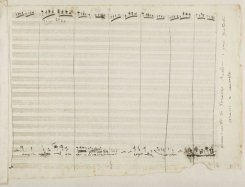
This handout photo provided on September 19, 2013 by the National Library of Spain (Biblioteca Nacional de Espana) shows a fragment of an opera score by Italian composer Vincenzo Bellini found in between the pages of an album of 19th century photographs and drawings.

This handout photo provided on September 19, 2013 by the National Library of Spain (Biblioteca Nacional de Espana) shows a fragment of an opera score by Italian composer Vincenzo Bellini found in between the pages of an album of 19th century photographs and drawings.

Spain’s national library said today that it had discovered a rare fragment of an opera score handwritten by 19th-century Italian composer Vincenzo Bellini lying within its archives.

The single page of manuscript shows an outline of seven bars of notes from a duet in the opera “Il Pirata” (The Pirate) which had its debut in Milan’s La Scala on October 27, 1827, the National Library of Spain said.

The manuscript by Bellini (1801-1835) has annotations at the bottom of the page and a phrase written in the right-hand margin: “Manuscript of Vincenzo Bellini and his brothers Mario and Carmelo”.

The phrase was a form of authentication commonly found on manuscripts sought after by 19th century collectors of “relics” of the most memorable composers, the library said in a statement.

The newly discovered Bellini manuscript was unusual because the notes did not correspond exactly to the final score, although there were barely any changes, it said.

“This rarity makes it of even more interest from a musicological point of view,” the library said.

The fragment was discovered after the library’s catalog service requested the identification of a “sheet of music bound in an album of 19th century photographs and drawings with landscapes of Malta and Sicily”, it said.

Posted in OPera | Leave a comment

Terrible news: Tragic death of young soprano while singing Verdi’s Requiem

Terrible news: Tragic death of young soprano while singing Verdi’s Requiem

 by Norman Lebrecht, Arts Journal Blogs, Slipped Disc

The Teatro Colón in Buenos Aires reports the death of soprano Florencia Fabris, who had suffered a brain aneurysm while singing Verdi’s Requiem at the Auditorio Juan Victoria in the province of San Juan.

Fabris, 38, felt bad during the performance, but refused to leave the stage. She  was rushed to Mendoza and underwent surgery but failed to recover. Our deep sympathies to her family and friends.


Florencia Fabris

Her colleague Carmen Giannattasio has contacted Slipped Disc with the following message:

It is with extreme sadness I am aware of the death of Florencia Fabris who was my cover as Desdemona only a month ago in Buenos Aires. She
was a young, solar, full of life girl. She was so nice to give to me a little teddy bear mascot of her daughter taken from her toy box just to keep me company in my dressing room during performances, since I was alone.
Life hides many surprises sometimes happy, sometimes bitter like this one.  She died while singing Libera Me Domine in Verdi’s Requiem.
May God rest her soul  I am very close to her family in this very sad moment.  Florencia rest in peace
Carmen Giannattasio

Posted in Article, Music, OPera | Tagged , , , , , | Leave a comment

Euphoria and Unease. Jewish Vienna and Richard Wagner

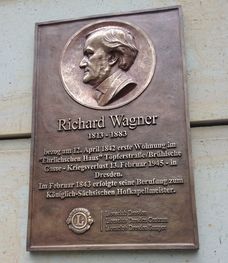
wagner_gedenktafelEuphoria and Unease. Jewish Vienna and Richard Wagner

25 September 2013 – February 2014 (the exact end date will be announced later)

The year 2013 marks the two hundredth anniversary of the birth of Richard Wagner, one of the most controversial personalities of the nineteenth, twentieth, and twenty-first centuries. His essay ‘Judaism in Music’ (1850 and 1869), his operas, and many other statements established Wagner as one of the most out-and-out anti-Semitic figures within the German bourgeoisie. At the same time his musical creativity, the idea of the ‘Gesamtkunstwerk’ (total work of art), and the cult of genius meant that he had an enormous influence on his time and on subsequent generations. The Jewish Museum Vienna focuses in its exhibition on this wide-ranging and contradictory phenomenon, with special reference to Vienna, which became a center of the Wagner cult very early on. There were a lot of Jewish Wagnerians, but his most sarcastic critic, the renowned feature writer Daniel Spitzer, also lived and published in Vienna. Wagner’s work inspired non-Jewish artists and intellectuals as well as declared anti-Semites and – naively ignoring or reinterpreting the anti-Semitic messages – influential Jewish intellectuals like Theodor Herzl or Otto Weininger. Taking this adoration of the composer, which was soon to prove to be a trap, as the starting point, the exhibition looks at anti-Semitism of the nineteenth and twentieth centuries and at Wagner’s impact on the art and culture of fin-de-siècle Vienna and – beyond that – on Adolf Hitler and the Nazi regime. It also considers attitudes to Wagner today in Europe, the USA, and Israel.

Jewish Museum Vienna (Jüdisches Museum Wien) Palais Eskeles

Dorotheergasse 11
1010 Wien (Austria)

Posted in Exhibits, Music, OPera | Tagged , , , , , | Leave a comment

Wagner and the Jews, Symposium in London

Sunday 6 October 2013

Wagner and the Jews

  • Event type: Symposium
  • Venue: London Jewish Cultural Centre
  • Time: 2pm

No aspect of Wagner generates more heat than his anti-Semitism. This discussion will attempt to throw light  too, debating Wagner’s anti-Semitism in relation to his works and his place in history. Speakers: Mark Berry, Cori Ellison, Erik Levi and Barry Millington. Chair: Trudy Gold.

LJCC, Ivy House, 94–96 North End Rd, London, NW11 7SX

Posted in OPera | Leave a comment

“Wagner’s Jews” Screening in Chicago

Wednesday, September 18, 2013

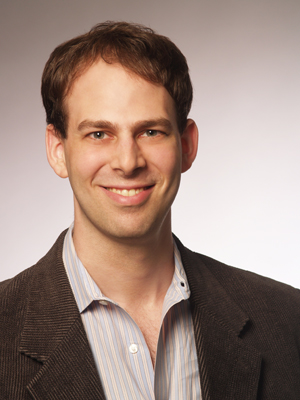
Hilan Warshaw


Filmmaker, Author, Lecturer
Lecture and Screening
of his documentary film
WarshawFilm


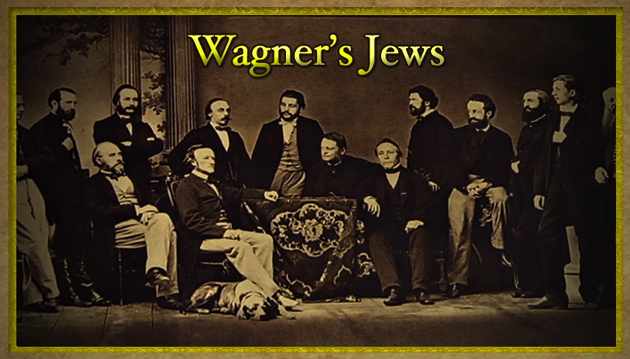
Wagner’s Jews
Documentary, 55 minutes, 2013
Produced, directed, and written by Hilan Warshaw
Includes a Q+A with the filmmaker

Richard Wagner was notoriously anti-Semitic, and his writings on the Jews were later embraced by Hitler and the Nazis. But there is another, lesser-known side to this story. For years, many of Wagner’s closest associates were Jews—young musicians who became personally devoted to him, and provided crucial help to his work and career. Who were they? What brought them to Wagner, and what brought him to them? These questions are at the heart of Hilan Warshaw’s new documentary Wagner’s Jews, co-produced with WDR and ARTE and broadcast in Europe in 2013 to mark Wagner’s bicentenary. Filmed on location in Germany, Switzerland, and Italy, Wagner’s Jews tells these remarkable stories through archival sources, visual re-enactments, interviews, and musical performances. Parallel to this historical narrative, the film explores the ongoing controversy over performing Wagner’s music in Israel.

Hilan Warshaw

HILAN WARSHAW is a filmmaker and writer based in New York City. Through his production company, Overtone Films (www.overtonefilms.com), he produces and directs independent projects as well as videos for organizations including Carnegie Hall and the League of American Orchestras. His writings on Wagner have been published by McFarland Press, The Wagner Journal, Wagner Spectrum, and in the new Cambridge Wagner Encyclopedia. He recently taught a course on Romanticism and Film at Barnard College, Columbia University, and he has lectured at venues including New York University, Hofstra University, Wagner Society of America, Wagner Society of New York, and Boston Wagner Society.  He has a B.F.A. with honors (Film & TV) and M.F.A. (Musical Theatre Writing) from NYU’s Tisch School of the Arts, and he studied orchestral conducting at Mannes College of Music and the Aspen Music School. www.hilanwarshaw.com

Hotel Allegro
171 W. Randolph Street
Chicago

7:00 p.m. – Reception
7:30 p.m. – Program
Cost: $5.00 Refreshment Fee
(Guests $ 10.00) – Payable at the event only
Questions: 847-256-1292 Reservations are not required.
Guests are always welcome!

SAVE THESE DATES

Tuesday, October 29 – Sir Andrew Davis

Saturday afternoon, November 23 – Professors Katherine Syer and William Kinderman

Posted in Film, Music, OPera | Tagged , , , , , | Leave a comment

The hateful side of Wagner’s musical genius

w-richardwagnerbicentennial-012813

From: www.dw.de

Famous German composer Richard Wagner was a vehement anti-Semite. But he also admired Jews like poet Heinrich Heine and had both Jewish patrons and fans. How does it all fit together, and where did his hatred come from?

Zurich in 1850: Richard Wagner writes of “the Jew” that he is “incapable … of artistic expression, neither through his outer appearance, nor through his language and least of all through his singing.” Instead, Wagner believed Jews could only “imitate art.”

In his pamphlet “Das Judenthum in der Musik” (“Jewishness in Music”), he makes no secret of his anti-Semitism. When the composer published those lines in a music magazine under a pseudonym, he was still largely unknown to the world and living on limited funds in Switzerland. It was only later that he would come to be revered as a musical revolutionary and as the mastermind behind operas like “Lohengrin” or “The Ring of the Nibelung.” His genius is still commemorated around the world today, and for his 200th birthday on May 22, 2013, Germany celebrated his artistry.

But there was clearly a hateful side to the composer, as well. His anti-Semitic views became increasingly aggressive as he got older. As such, understanding the dark side of his intellectual legacy is as important as ever in the Richard Wagner year of 2013.

Richard and Cosima Wagner Richard Wagner and his wife, Cosima

From beer halls to middle-class salons

After Wagner’s death in 1883, the calamitous legacy of anti-Semitism would continue. His wife, Cosima, and several of his children turned the famed performances at Bayreuth, which Wagner founded during his lifetime, to a venue of oppression against Jewish artists. Racist ideas had currency there. And later, the Nazis appropriated Wagner as a composer. Adolf Hitler cherished his music and also esteemed him as an early herald of anti-Semitism in Germany. For the racist and nationalist opponents of German modernism, Wagner was – even during the composer’s lifetime – an important figure.

As one of the most famous composers of his time, Wagner’s name carried weight. He helped hoist anti-Semitism out of dirty bars or scarcely read pamphlets and into the comfortable milieu of the middle class, said theater and literary scholar Jens Malte Fischer.

“That was disastrous and has to be attributed to him,” the Wagner expert said.

wagner5Fischer has researched the composer for years and has now published a further book about Richard Wagner. Although it’s clear that Wagner did not invent anti-Semitism, he was a pioneer of such thinking in at least one respect, Fischer said, “He carried over the hatred of Jews of his era into the area of culture and – in particular – that of music.”

In Germany, this is one way in which anti-Semitism found entry into middle-class salons.

What explains Wagner’s hatred?

Historian Hannes Heer is curating an exhibition on the role of Jews in Bayreuth from 1876 to 1945, which can be seen in Bayreuth through the end of this year.

“In the first third of the 19th century, a certain anti-Judaism shaped by Christianity dissolved into anti-Semitism, which fixated more on contemporary society,” Heer said.

Since then, the traditional Christian opposition to Jews was grounded less in religion and more in political and racist expressions. Nationalist authors and writers made Jews into the supposed enemy of the German state, while anti-Semitic organizations sprang up and anti-Jewish demonstrations took place. These political and intellectual movements shaped Wagner’s views.

It was typical for authors of the time to couple anti-Semitism with criticism of modernism. In their caricature, Jews were the protagonists of a new, industrial-capitalist era, which the authors rejected.

But Wagner also had personal experiences that influenced his anti-Semitic beliefs. In the 1840s, he went to Paris, where the young and ambitious composer found no success. Jens Malte Fischer explained, “He had the feeling that the music business in which he couldn’t succeed was in Jewish hands. But that’s, of course, not true.”

Wagner focused his frustration on critics, music journalists and publishers with Jewish roots and came to see them as behind his failure.

 Opportunism

In Paris, Wagner met the famous German poet Heinrich Heine, whom he initially admired. Heine was of Jewish heritage but had converted to Protestantism. And the opera conductor Giacomo Meyerbeer, who was also Jewish, was a supporter of Wagner’s.

“In letters, Wagner expresses much appreciation for that,” said Wagner expert Fischer.

Once back in Germany, Wagner later maintained contact with wealthy Germans who had Jewish roots, like the mathematician and art patron Alfred Pringsheim, with whom Wagner even regularly exchanged letters. Is this ambivalence an expression of mere opportunism?

Anti-Semitism researcher Matthias Küntzel said, “Wagner had an ambivalent relationship with Jews.” Although he rejected them in many ways, he also allowed Jewish supporters to make the trip to Bayreuth. That apparently had pragmatic reasons – after all, they put money into his coffers. But that hardly means he wasn’t an anti-Semite.

When it came to Jewish colleagues, Wagner could be quite cruel, said historian Hannes Heer, who cited the example of “Parsifal” conductor Hermann Levi.

“Levi is unfortunately the most prominent example to show that Wagner tormented the Jews around him,” Heer said.

Wagner repeatedly tried to get the conductor baptized, and Levi was not the only Jewish musician that Wagner put under psychological pressure.

After Wagner’s death, the harassment became systematic under his wife and heir Cosima Wagner. She overwhelmingly cast the singers with non-Jewish performers, and her son and successor Siegfried continued the discriminatory practices from 1908 onward. Although there were occasional Jewish soloists and musicians in Bayreuth until the Nazis took power in 1933, such moves generally had political motivations. Siegfried Wagner wanted to ensure he had the support of the liberal press.

Even during Richard Wagner’s lifetime, his home became a kind of summoning point for anti-Semites. “If you didn’t know in the 1870s and 1880s that Wagner was a pretty staunch anti-Semite, then you must have been pretty much deaf and blind,” said Jens Malte Fischer.

And for today’s listeners?

Wagner’s followers were anything but blind and deaf. They praised the composer for his fiery opera works. For many, it remains a question today whether Wagner’s anti-Semitism can be blocked out when hearing his work. Does his hatred of Jews come through in his works for the stage?

Most Wagner researchers would say no. But those who disagree include Jens Malte Fischer. He said Wagner never wrote any anti-Semitic operas, but that his attitude toward Jews is reflected in some of his characters.

“There are allusions in some of his individual figures that subliminally point to Jewish stereotypes, particularly with Mime in ‘The Ring of the Nibelung’ and with Beckmesser in the ‘Mastersingers of Nuremberg,'” the researcher said.

Both characters represent antagonists to heroic counterparts in Wagner’s works, and Fischer said Wagner’s contemporaries would have known how to interpret this “anti-Semitic code” in the roles.

“When people stage Wagner today, they’re not works with anti-Semitic connotations. Instead, it’s the work of a great composer and theater maker,” Hannes Heer said.

Musical genius and anti-Semite – Richard Wagner is and will remain one of the most controversial titans of Germany’s musical history.

Posted in Article, Music, OPera | Tagged , , , , | Leave a comment

VERDI’S 200TH ANNIVERSARY CELEBRATION: Viva l’Opera ’13/’14- Live in French Cinemas

visuel_nabuccoVerdi’s Nabucco from La Scala in Milan, part of the 200th anniversary celebrations across Europe this year, will open the UGC cinema chain’s Viva l’Opéra 2013-2014 broadcast season around France. 

frenchnews

In an echo of the hugely successful live broadcasts from the New York Met matinees that are screened in cinemas across France and the rest of the world, the Paris Opera and the UCG chain joined forces two years ago to bring audiences here a similar experience. They have based their programme on live performances from French and other major European opera houses in a season that opens September 19, 2013 and runs through to 10th July 2014.

Reporting on the initiative France Musique radio presenter David Christoffel said surveys showed that most cinema-goers attending  the live broadcasts from the Met came precisely because it was live and the cinema performances are attracting new audiences for opera around the world.

Thanks to the Internet, the famous chorus of the Hebrew slaves has made Nabucco one of the most popular operas. But Nabucco cannot be reduced to this chorus, it is also a founding work of Verdi’s style – a work that in addition was for the Italians, a symbolic image of their ‘enslavement’ under Austrian occupation. Thus in this year of Verdi’s 200th anniversary we could not celebrate without an opera that was for Verdi the spark that ignited the lyrical art of the 19th century. First screening: Nabucco, Giuseppe Verdi Directed by: Nicola Luisotti, Directed by Danièle Abbado, Singers – Nabucco: Leo Nucci (Baritone); Ismaele: Aleksandrs Antonenko; Zaccaria: Vitalij Kowaljow; Abigaille: Liudmyla Monastyrski; Fenena: Veronica Simeoni; The high priest of Babylon: Ernesto Panariello; Abdallo: Giuseppe Veneziano; Anna: Tatyana Ryaguzova September 19, 2013 from La Scala Milan.

Read more: http://www.french-news-online.com/wordpress/?p=30262#ixzz2f76wUQjO
Follow us: @frenchnewsonlin on Twitter

Posted in Music, OPera | Tagged , , , , | Leave a comment

VERDI’S 200th ANNIVERSARY CELEBRATION: The Workshop Project “Verdi Web”

verdiweb

Verdi Web

A second workshop project of the Ravenna Festival aimed at young people between the ages of 16 and 28 will be held in 2013

Verdi Web is a workshop project of the Ravenna festival aimed at young people which focuses on the various languages of communication connected to opera. In 2012 17 young people were chosen from a number of candidates coming from all over Italy. They were all aged between 16 and 28. The Alighieri Theatre opened its doors to 10 photographers, five writers, and two videomakers during the period of rehearsals for Verdi’s “Popular Trilogy”, namely  Rigoletto,  Il Trovatore and la Traviata. This gave the participants a wonderful  opportunity to get closer to the theatrical and musical experience. Day after day the participants “invaded” the theatre (the stalls, the balconies, the foyer the stage and the dressing rooms) participating with passion and a growing knowledge of this special opportunity they had been offered.
The experience of the workshop has been documented by the participants with photos videos and texts, which were published on a daily basis on www.verdiweb.it

The 23rd Ravenna Festival ended with performances of the “popular trilogy” between November 9th and 18th 2012 at the Teatro Alighieri. All three works were performed on consecutive evenings in a type of “operatic marathon”.
workshop is an experience that Ravenna Festival wants to repeat again in November 2013 with another Verdi trilogy alongside another Verdi Web

Posted in OPera | Leave a comment